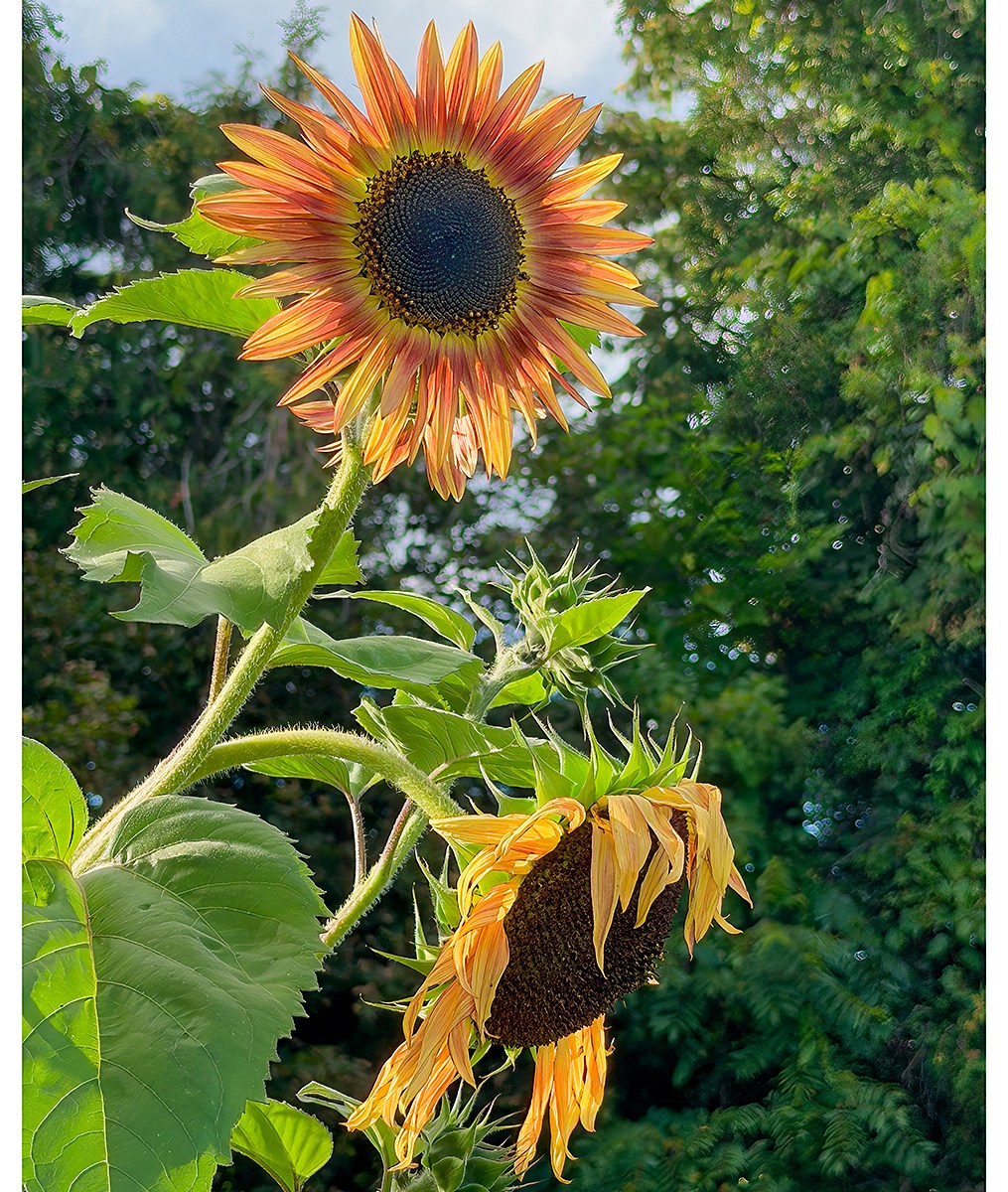
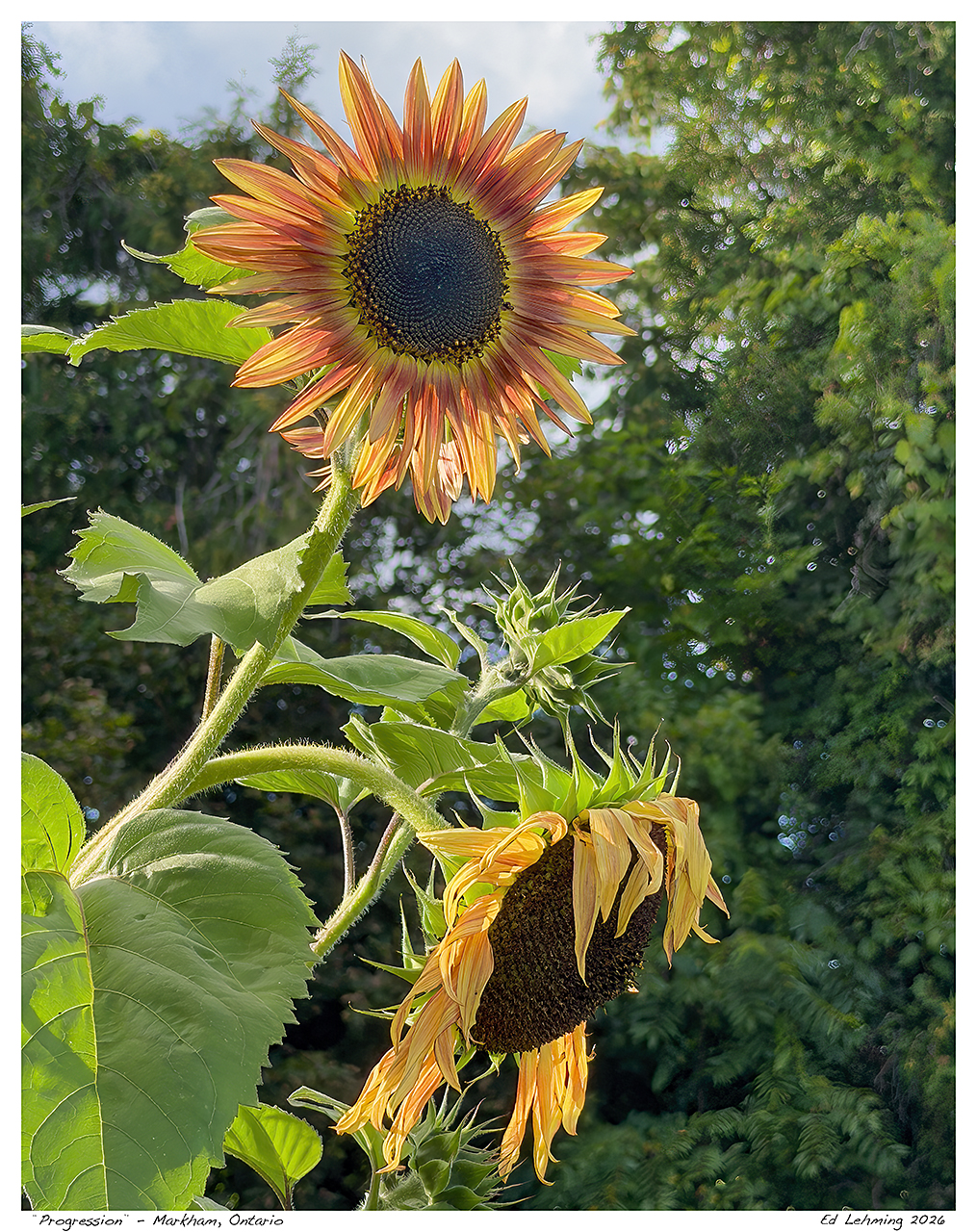
“Time marches forward. Sometime we see it effects and at other times, it’s barely noticable” – Ed Lehming
I spent some time with this photo, as I often do, looking for something. Sometimes subtle details reveal themselves, things I had not noticed when I shot the photo. Other times, there are whispers of wisdom; the image evokes thoughts for me and helps me think deeper about the world around me. It has been a practice for me for some time now. Maybe as I age, I have a larger repository to draw from: fond memories, regrets, and experiences that I revisit. I find myself more contemplative in my experiences.
When I first framed this image, I was focused on the bright, unusually colored sunflower blossom. As I considered different potential compositions, I struggled with how to eliminate the lower, somewhat tired-looking flower. Nothing worked, so I took the shot as you see it, figuring maybe I would do a tighter crop in my post-editing. During this process, while considering a title for the print, some pretty obvious symbolism emerged.
The upper flower is bright and pristine, at the peak of its beauty, while the lower blossom is wilting and fading. Then, I looked at my calendar and realized that August is almost gone, along with the joyful warmth and sunshine that defined this summer for me. The lower flower represents an ending of something that just a few days ago was bright and glorious, like the past few days of this summer. Time’s inevitable change is portrayed through an image where fresh and faded coexist.
It saddenes me a bit to say farewell to another summer, but I also realize that the faded flower’s role is not yet complete. It is heavy with seeds that will further mature, provide food for birds, and sow the next generation.
iPhone 17 Pro Max
Main Camera — 79 mm
1/1377 sec, ƒ/1.78 ISO 100
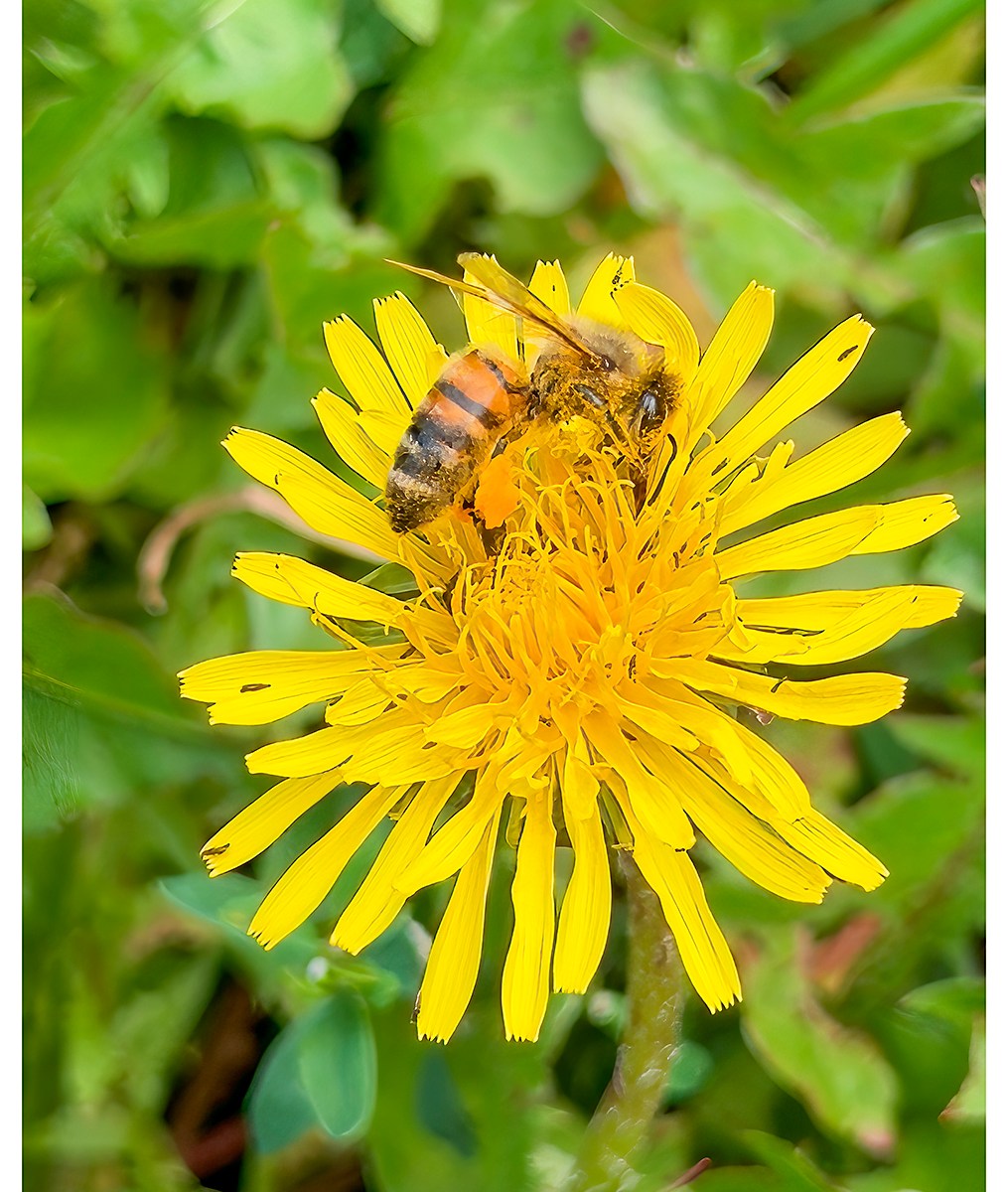
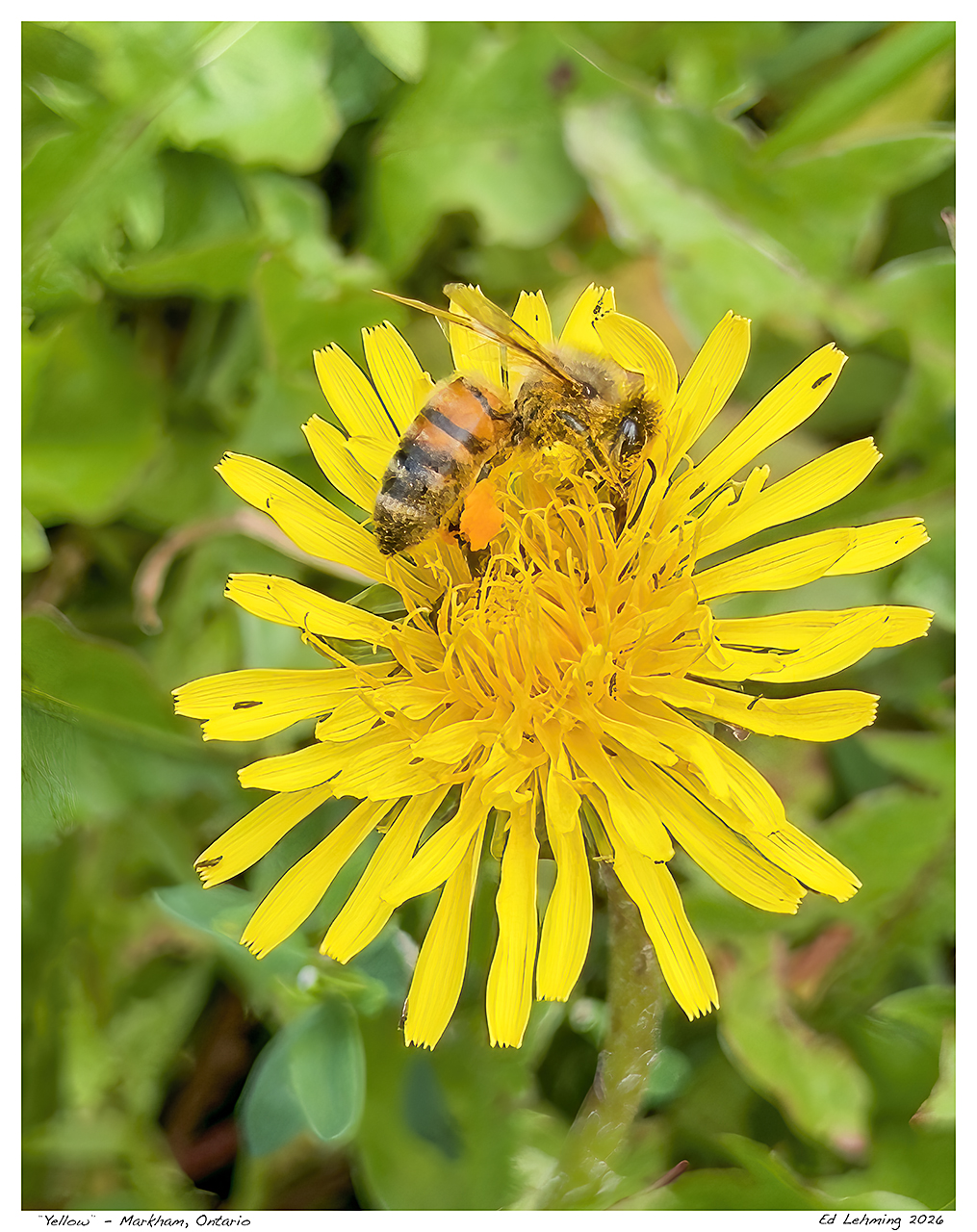
“Sometimes, simple is the best option” – Ed Lehming
This scene presented itself to me this morning. Walking across the grass, I noticed this honey bee collecting sap for a dandelion blossom. The shot was simple to compose, and I was pleased with the first shot. Then, I got to editing and wanted to come up with something clever. Nothing seemed to fit, so I went with my first instinct and titled it “Yellow,” the simplest option and the one that came to me first. Sometimes, simple really is the best option.
iPhone 17 Pro Max
Main Camera — 100 mm
1/1608 sec, ƒ/1.78 ISO 64
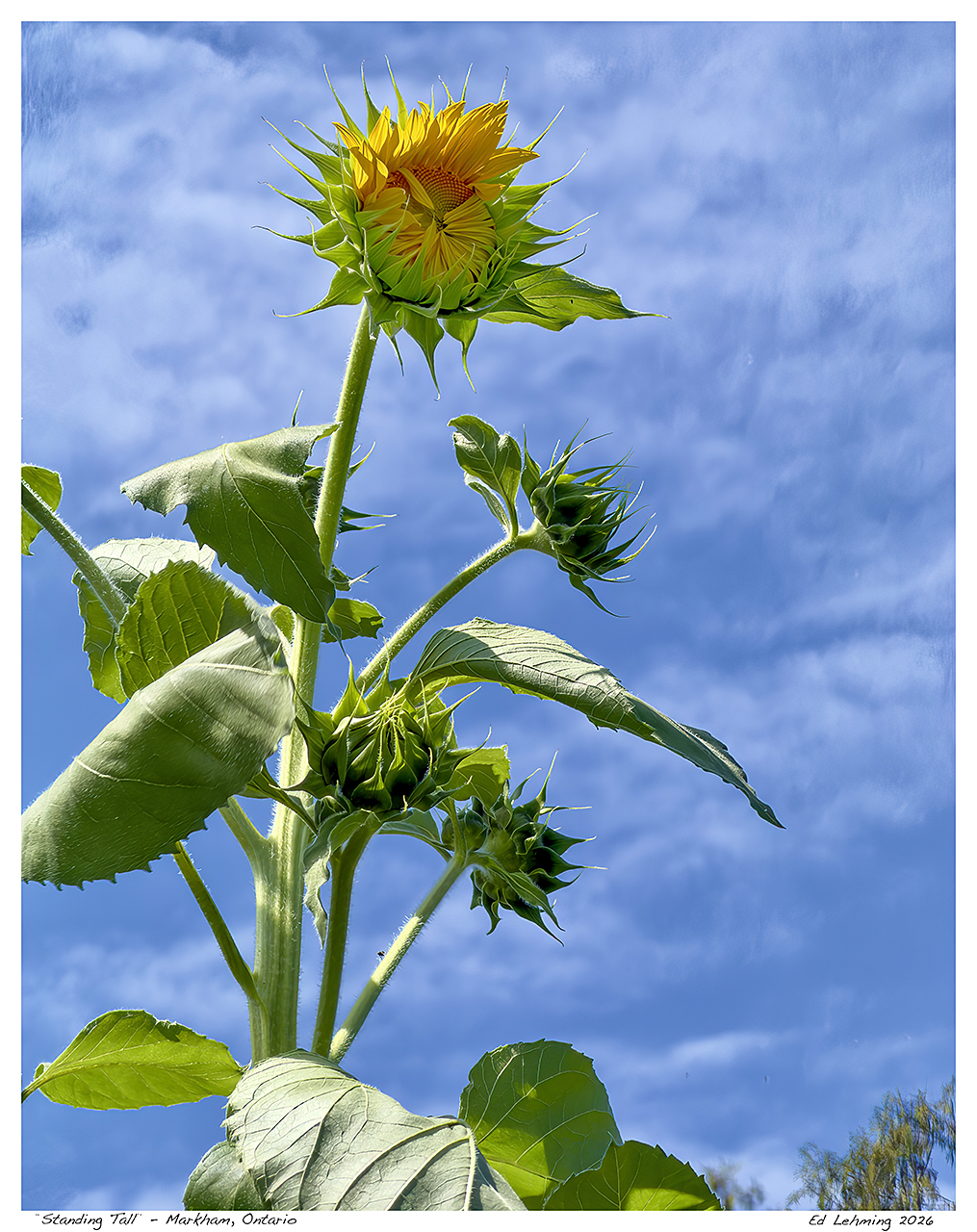
“Given the right conditions, even the commonplace can show surprising potential’ – Ed Lehming
Oddly enough, in contrast to yesterday’s post about the commonplace, the next image up in my library is this one, which is not commonplace at all. This sunflower, a volunteer, likely seeded by a bird dropping in the middle of my daughter’s vegetable patch, is a monster, over 4 meters (14′ for the non-metric) tall. It towers above everything else, with a base stalk more like a tree than a sunflower. High above, the blossoms are just opening. They too are big, but seem diminished by the plant that supports them.
It’s really hard to miss. My challenge in photographing it was to create some sense of scale, so I decided on this low angle shot to give it that look of hovering high above me, framed by a backdrop of wispy clouds. I think it works. I’ll have to revisit it soon to see how it has developed. I’m certain it has not stopped growing; the soil there is incredibly rich, having been a cow paddock for years before being converted into a garden.
iPhone 17 Pro Max
Main Camera — 100 mm
1/638 sec, ƒ/2.8 ISO 20
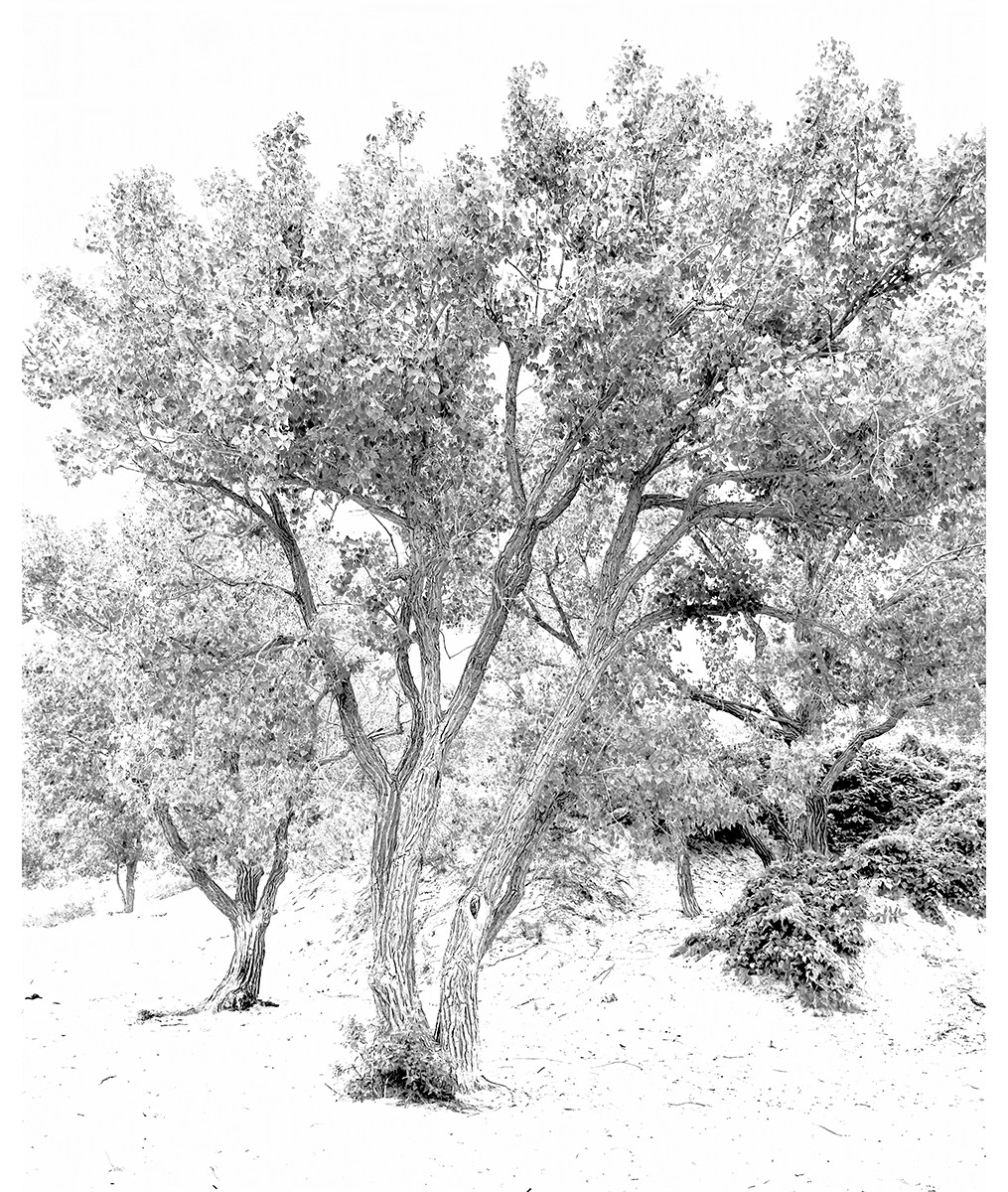
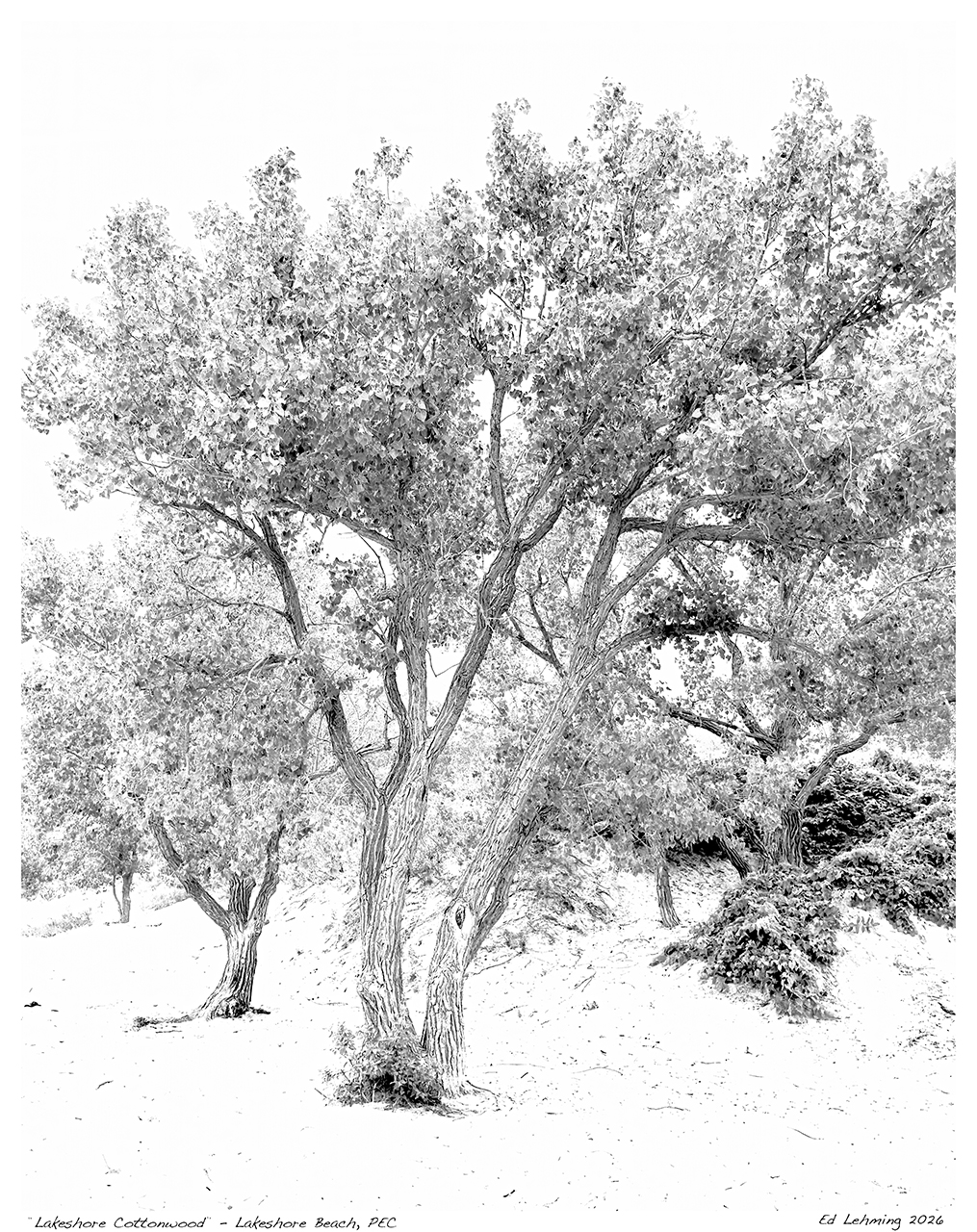
“Even the most common, the familiar, the passed by, can show beauty when we just pause to appreciate it” – Ed Lehming 2026
I’ve made a practice of looking for beauty in ordinary places. We can’t always be in exotic locations, and every day is seldom perfect or jaw-dropping. Most of us live in places that are, or over time, become, commonplace to us. Given that this is often the reality, many years ago I set out to deliberately photograph the ordinary things I would normally pass by or take for granted as just part of the background.
This cottonwood tree, for example, stands by the path that carries me from the parking lot to a local beach. I have some very nice shots of this tree; given the right light and good framing, it is quite lovely. However, from this angle, as seen when leaving the beach, it generally seems a bit boring, and thousands of beachgoers pass it by without a second glance. But on this day, I decided to shoot it as it is, stripping away all the background color and distractions so that just the raw tree showed. I was amazed at what I normally would not see, consciously.
There is beautiful texture to the bark, creating an almost pencil sketch appearance when rendered in monochrome. There is a rough symmetry to the trunks as they rise and separate, and the smaller trees, generally overlooked, start to emerge from the background. Through observation, what was once unexciting begins to reveal so much more than I had imagined when I shot the image.
iPhone 17 Pro Max
Main Camera — 35 mm
1/60 sec, ƒ/1.78 ISO 160
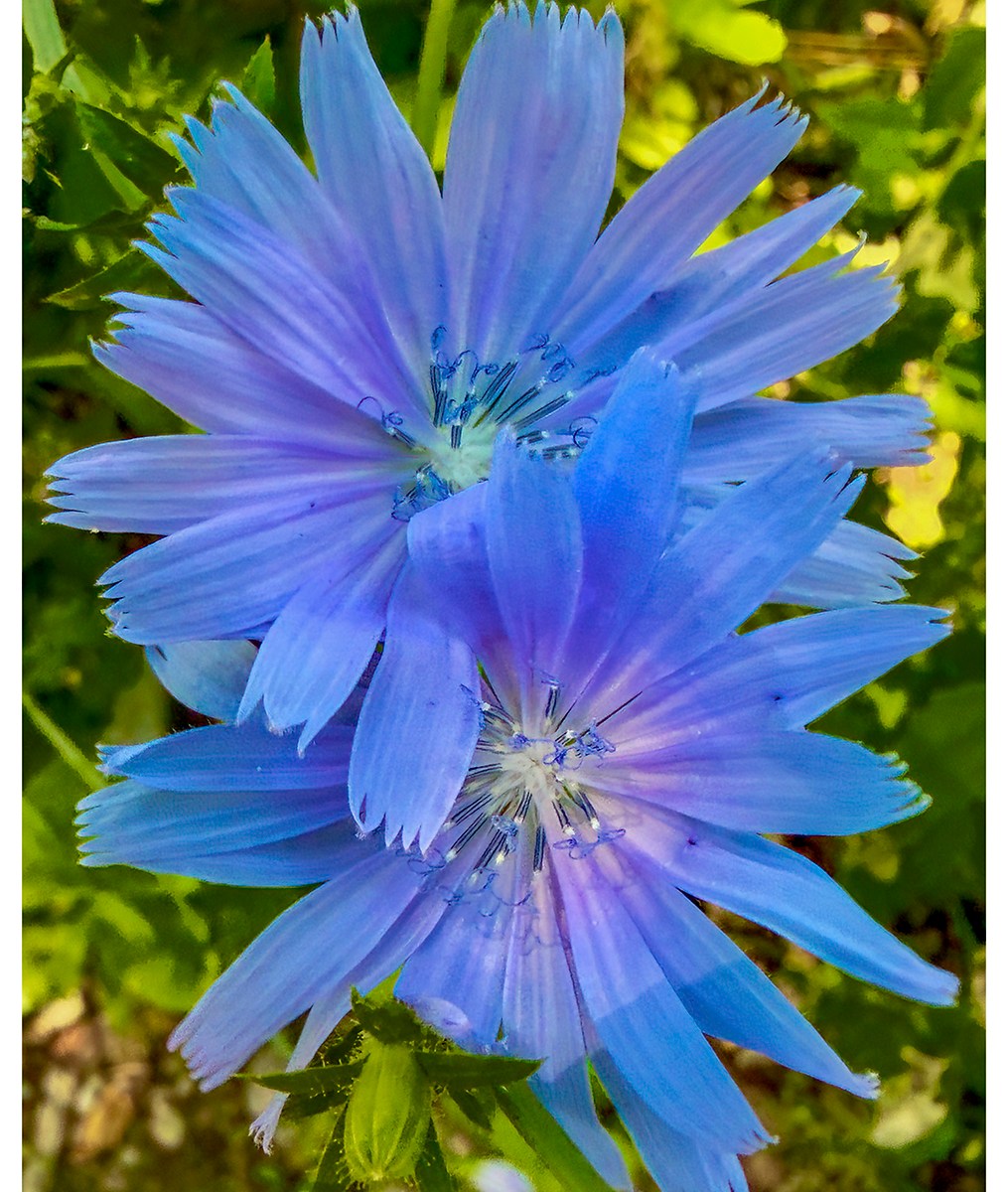
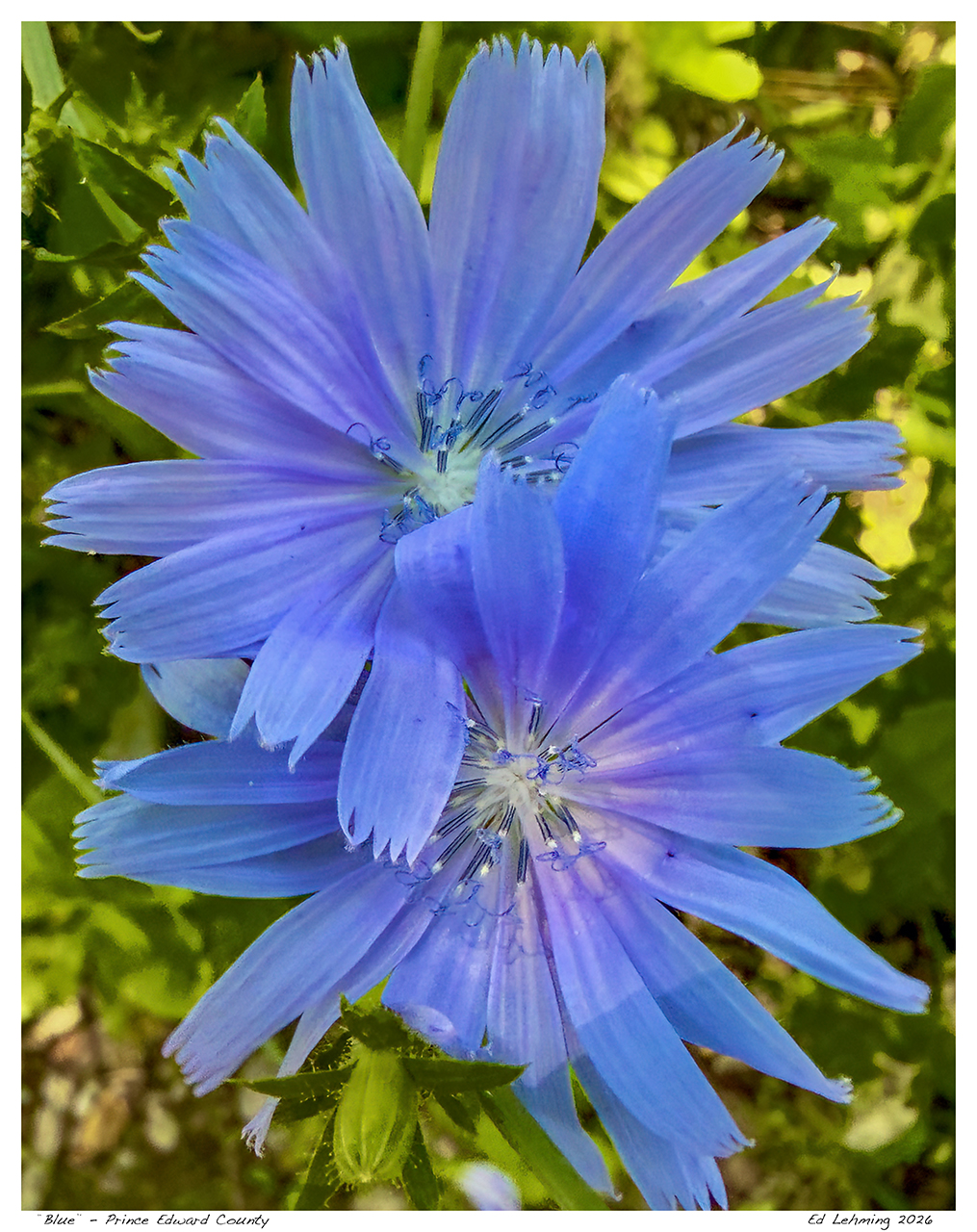
“There are days where it’s all just too much. Entitlement, arrogance, and selfishness have drained me. My only solace on these days is beauty from good days and the hope that tomorrow will be better.” – Ed Lehming
Ya, it’s been one of those days. I’m weary, tired of the nonsense of the world. Yet I’m determined to keep posting, even though I’m drained, knowing there are people out there, just like me, who are in search of some glimmer of hope, of beauty.
So, here’s today’s post: a simple composition from a few days back, along a lakeside trail where I noticed this simple, beautiful chicory blossom, not knowing just how much I might need it for a day like this, a reminder of what can be, if I can just push through the mental and emotional exhaustion.
iPhone 17 Pro Max
Main Camera — 24 mm
1/121 sec, ƒ/2.2 ISO 125
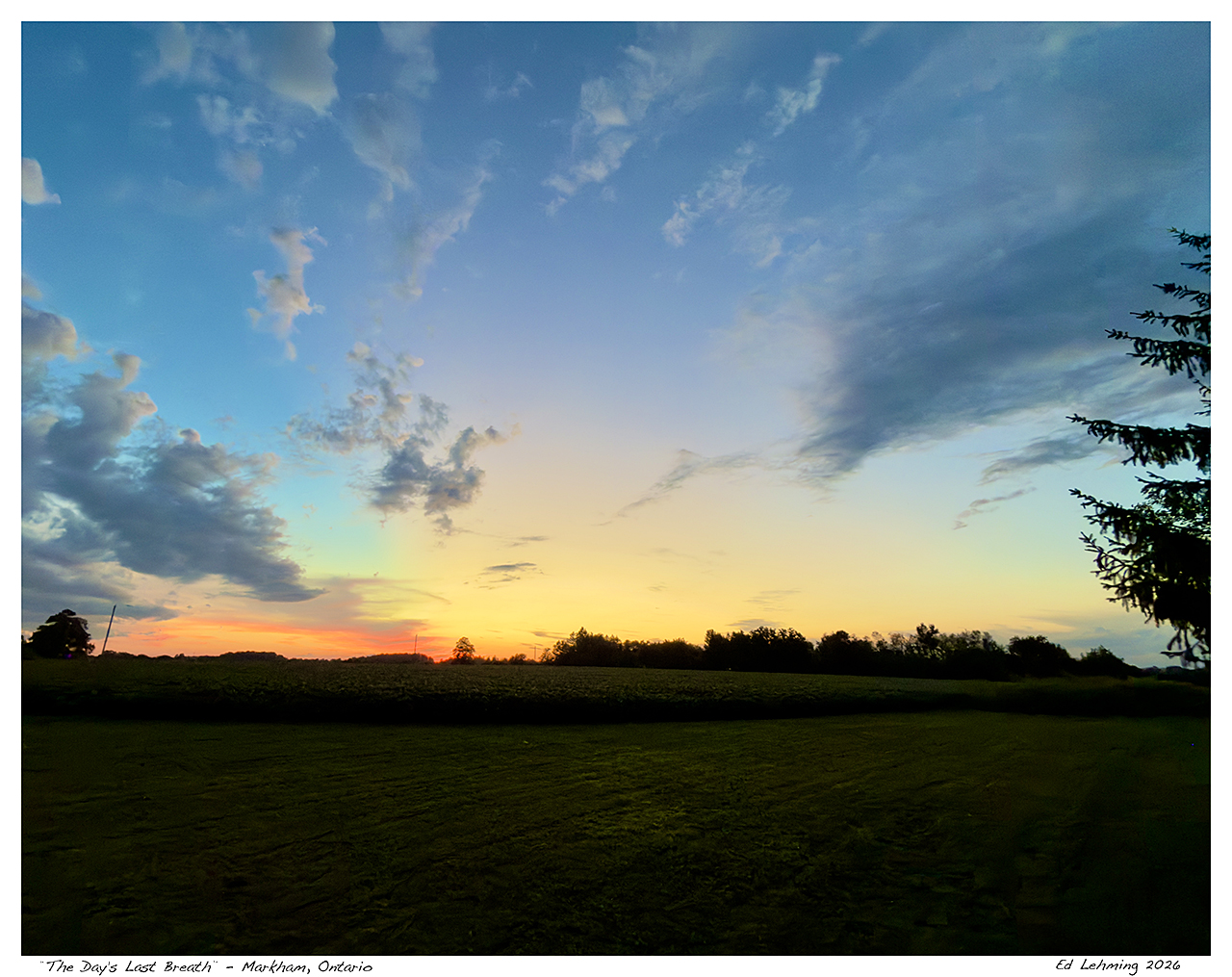

“There is a moment at the end of the day when the landscape seems to pause.” – Ed Lehming
This image from a week ago made me a bit philosophical. At first, I thought, “It’s just another sunset,” but there was something different here that I still can’t put a label on; I even struggled for a bit to find a title for the image. It may have been that pale pink haze that floats at the center of the photo. The last warmth of the sun glowed along the horizon, painting the distant sky in soft shades of gold and amber. Above it, the blue deepened, while scattered clouds caught the fading light, creating a delicate contrast between warmth and coolness. It’s like the whole spectrum is on display, all at once.
The field in the foreground had already surrendered to shadow. Its darkness draws the eye toward the horizon, where a pale patch of light remains—a final reminder that daylight has not quite disappeared.
Framed on one side by the silhouette of an evergreen, the scene feels both vast and intimate. Nothing dramatic is happening, yet there is something quietly powerful about it. Maybe it’s the thought that the wind may be moving through the field, clouds may be drifting overhead, but from this distance, everything feels still, paused.
Perhaps that is what makes twilight so compelling. It asks us to slow down and notice the brief space between what was and what is about to be.
For just a few moments, the day seems to take one last breath before letting go, leaving me with unanswered questions, yet at peace.
iPhone 17 Pro Max
Main Camera — 14 mm
1/30 sec, ƒ/2.2 ISO 200
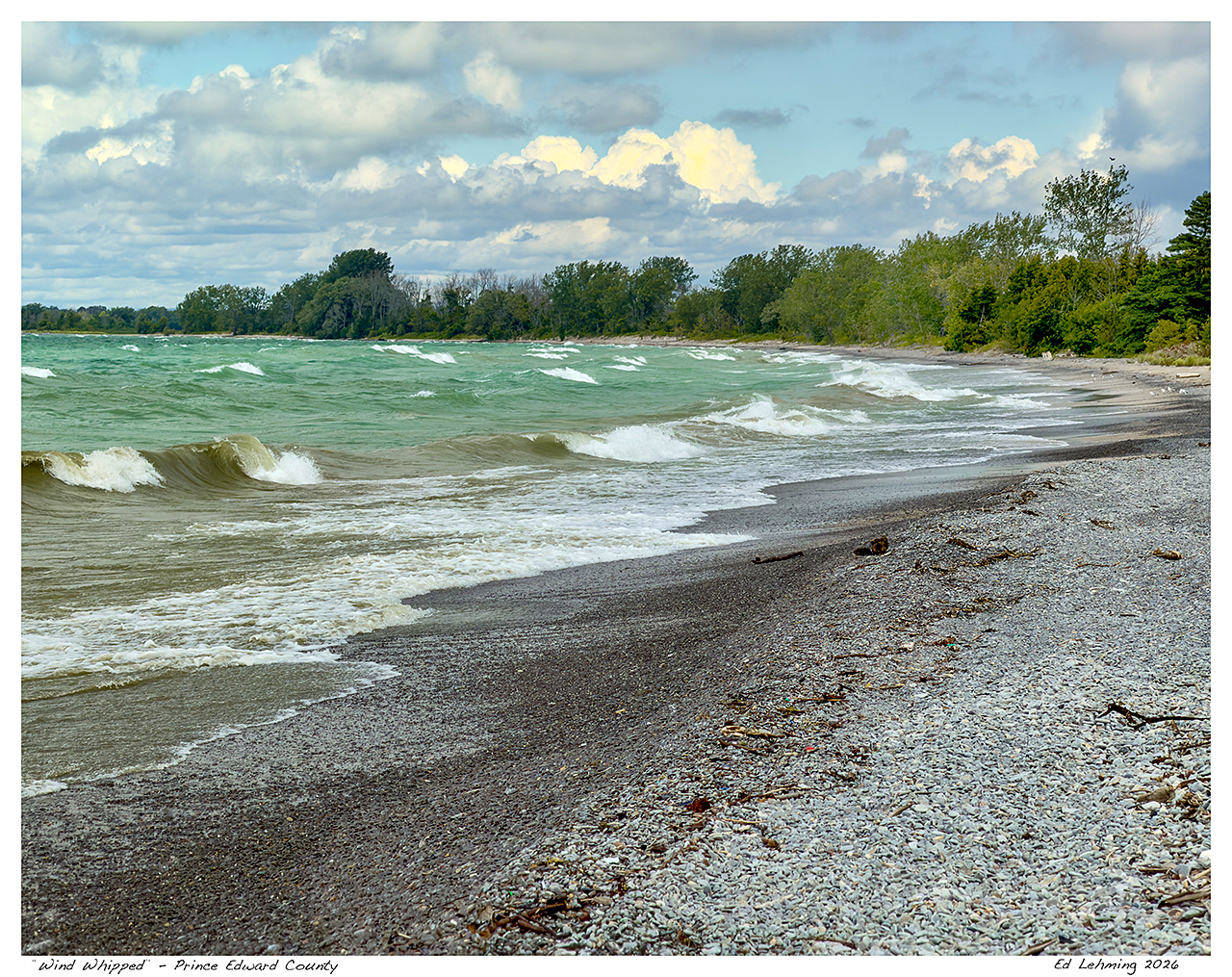
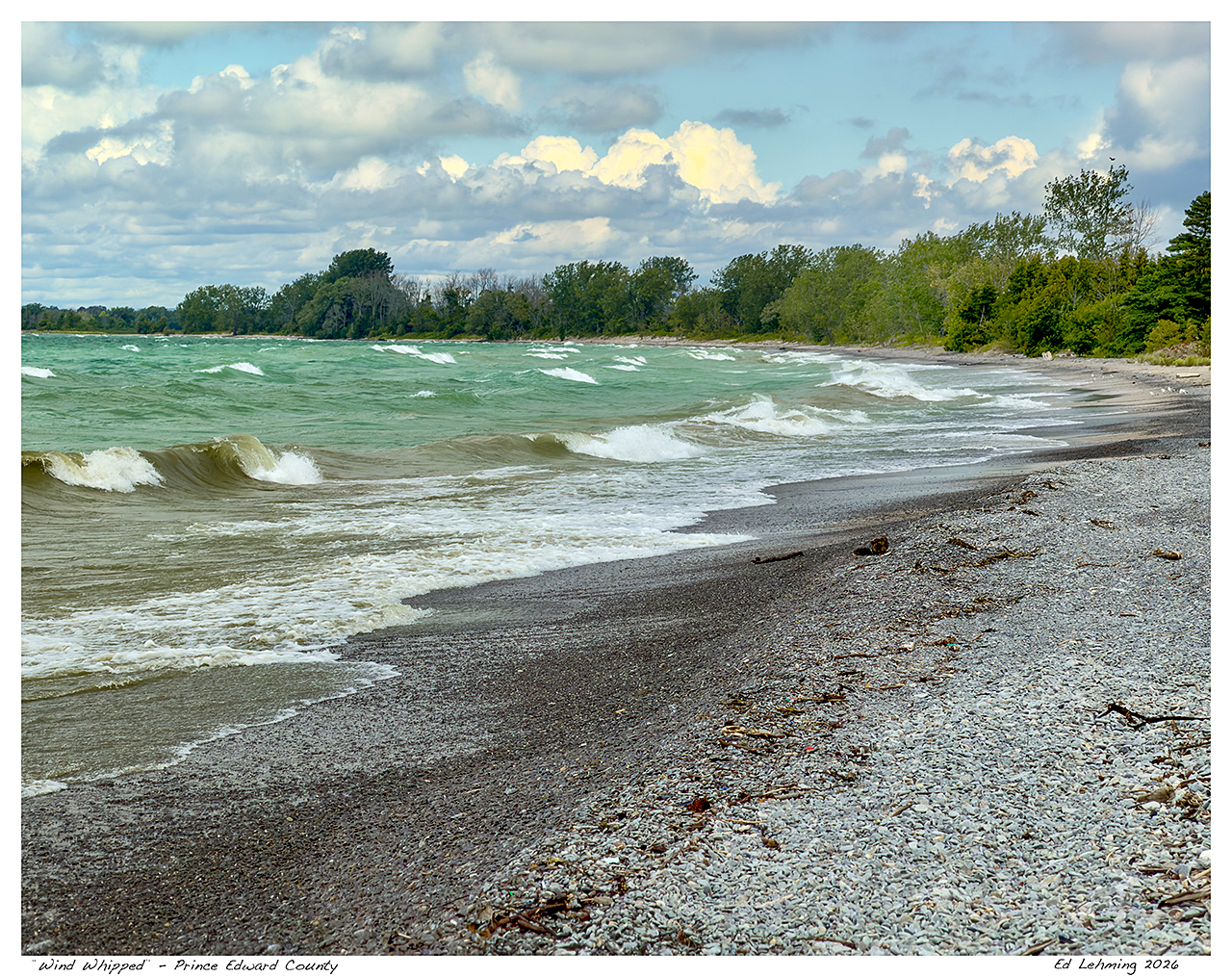
“It’s quite a thing, returning to a place that not long ago gave peace, and now surges with raw energy” – Ed Lehming
Those who have been following along over the past few weeks may recall the image that I titled “Solitude”. It featured a long curving beach, serene blue skies, and a gentle ripple on the water. I returned there yesterday with my daughter, her husband, and three of our grandsons.
I had been telling them about this wonderful place and sharing photos from my visit a few weeks before. It was a bit of an unsettled day, but we wanted to go fishing and get the boys out of the house to blow off some energy. This seemed like a great place, despite the threat of showers and what seemed, at least in town, to be just a “breezy” day. As we drove towards this spot, we noticed that the lake was looking pretty angry but continued along, knowing that this cove was a bit sheltered and we could fish at a pond adjacent to the beach.
When we arrived, the once idyllic beach looked like this. Despite being sheltered, the water was still being churned, and waves crashed violently on the shore. The boys had never seen the lake like this and thought it was “cool.” The raw energy of the lake was hard to ignore. Still, we were a bit sheltered, and as my son-in-law and I fished, the boys spent time collecting rocks higher up on the beach. This lasted for the better part of an hour, and we noticed the wind was picking up and the sky threatened rain. We looked across the bay and could see squalls forming and heading our way, so we decided to pack it in. As we were packing up the last of our gear, the island about half a mile from the shore literally disappeared from sight as the squall line hit it. We knew we were in trouble, and less than a quarter of the way back to the car, the skies opened up, rain and hail soaked us, all driven by gale-force winds that nearly blew us off our feet. This lasted almost all the way to the car, and just as it started, it ended. We were all soaked to the skin, and the kids were scared, having never been out in weather like this before.
As we dried off, sharing the one dry towel remaining, we all had a good laugh at our misfortune and wrote it up as yet another family memory. My one regret is that I did not stop to take a photo across to the “disappeared” island or video our scramble along the shore back to the car. It will only be a memory to us now.
iPhone 17 Pro Max
Main Camera — 100 mm
1/485 sec, ƒ/2.8 ISO 50
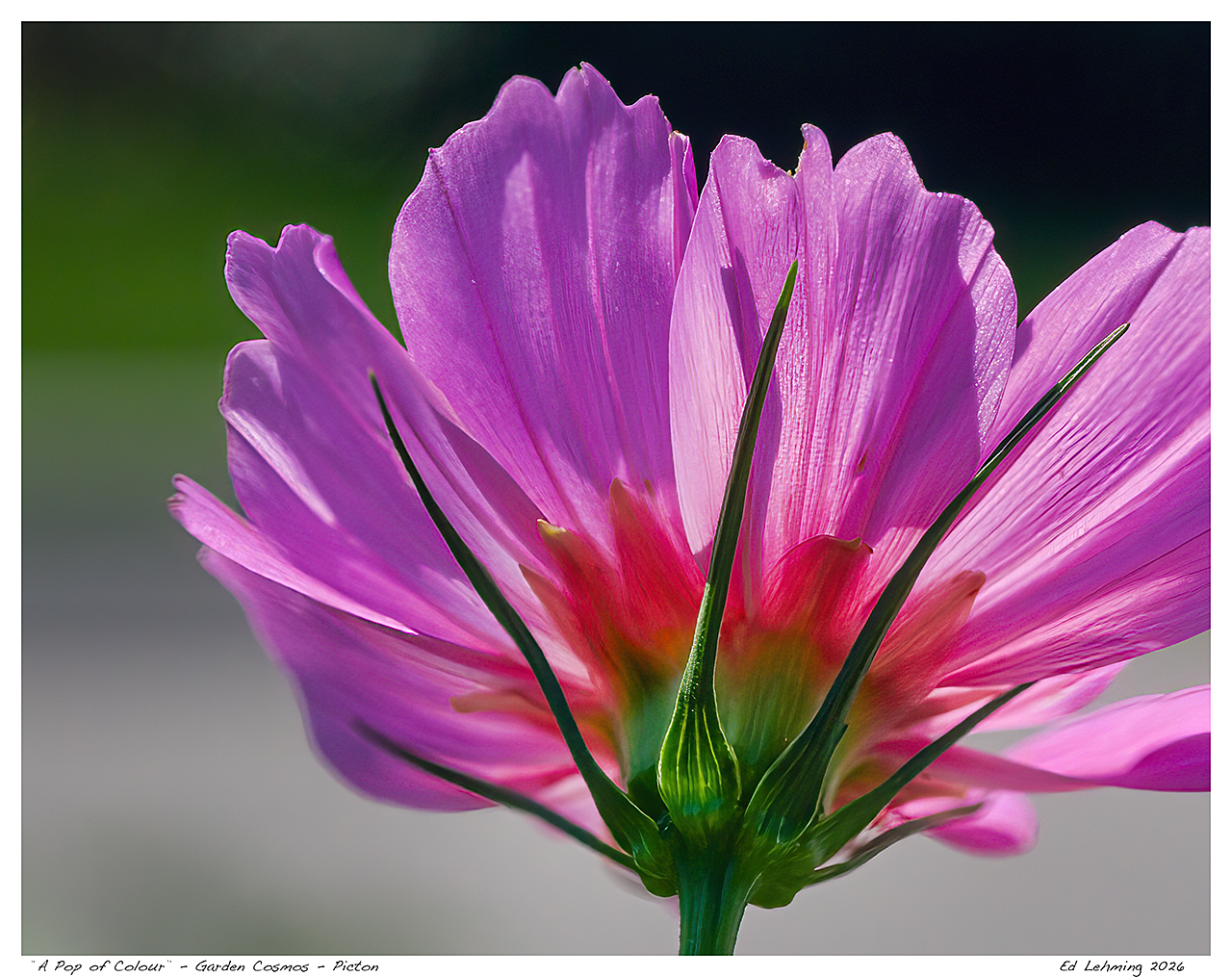

“Closer, closer, see me in all my splendour” – Ed Lehming
Another macro shot today. This time, a garden cosmos from the front yard on a rainy day.
When conditions are not ideal, I’m still looking for things to photograph. A brief time of sunlight between rain clouds lit up my cosmos and led to this shot. I wanted something a bit different, so I got up close with my macro lens, focusing on the light shining on the base of the flower.
It still amazes me that the closer you focus on natural things, the more amazing the detail is. For that, I once more turned to my kit camera and macro lens, since the iPhone simply can’t achieve the depth of field I need for images like this.
Nikon D800
Tamron SP AF 90mm f/2.8 Di Macro 1:1 (272ENII)@90mm
1/3200 sec, f/5, ISO 640


“Every now and then, a composition that cannot be ignored presents itself” – Ed Lehming
I made this image a few days ago while on my evening walk. I’ve been watching this cluster of Echinacea develop over the past few days and then suddenly “pop.” What amazed me was that they remained almost pristine, with the exception of a few insect holes in their leaves; the flowers themselves were almost perfect. So much so that they look almost artificial. Had I not seen them myself, I would have been a bit dubious about the authenticity of the image. But they are real and remained that way for several days after the photo was made.
I’m happy to see this in nature. It reminds me that as a society, we don’t need artificial or AI-created images when often that pristine state actually exists in nature.
I was also blessed with really nice pre-dusk light, and the composition pretty much created itself.
iPhone 17 Pro Max
Main Camera — 100mm
1/121 sec, ƒ/2.8 ISO 200
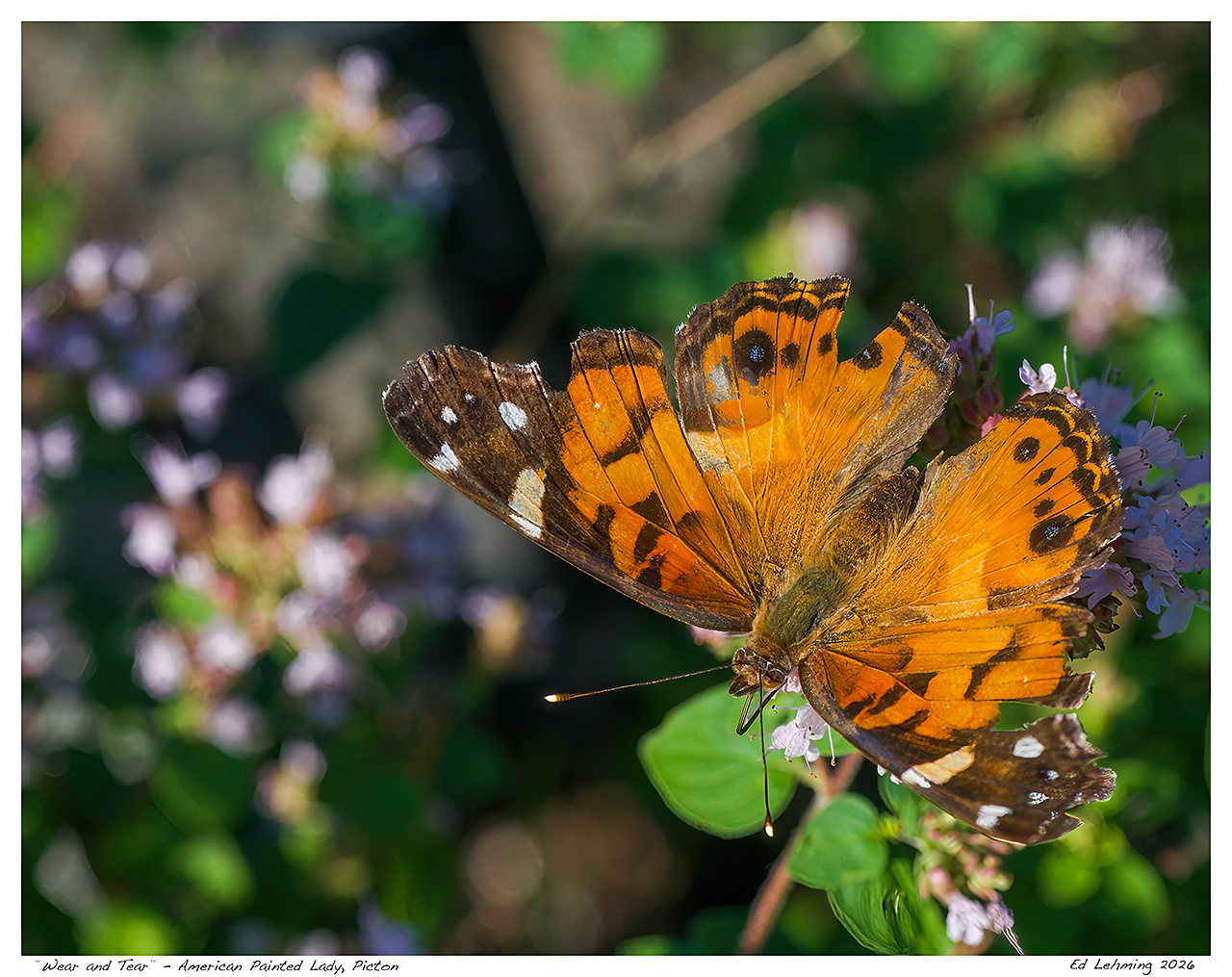

“As summer wears on, it’s effects start to show” – Ed Lehming
I was sitting on my porch a few days ago, and the gardens were filled with hungry butterflies. After a few attempts with my iPhone, I was reminded of some of the limitations that phone cameras, no matter how current, still have. One of those limitations is that I cannot effectively control the aperture; the phone does all the thinking, and I ended up with a bunch of photos where only a small portion of the butterfly was actually in focus—less than ideal for what I wanted.
So, I stepped inside and grabbed my trusty Nikon D800 and fitted it with my Tamron AF90 f/2.8 macro lens. I set my aperture to f/7.1 to ensure that my depth of field was sufficient and snapped this shot before the butterfly darted off to the next garden. This is one of the things I have found is hard to teach: the knowledge of how to shoot when a specific situation presents itself and knowing why, learned by me through trial and error (lots of trials and lots of errors). I also knew that since the butterfly was on the move, I had limited time, so the thought of focus stacking was never a consideration. It had to be a single shot at a moderate depth of field (aperture).
I was happy with the result, and it was not until I got to the editing stage that I noticed how beat up the butterfly was, with tatters and tears in its wings but still flying well. I suppose that a season filled with wind, rain, predators, and thorny branches must have an effect over time. The butterfly is much like many gardens this time of year, getting a bit weather-worn. It’s just another step in the cycle of the seasons. As I write this, there are fewer and fewer butterflies; the evenings are starting to cool, and the days are shortening. So, I’m happy for the moments that present themselves and always look forward to the next opportunity.
Nikon D800
Tamron SP AF 90mm f/2.8 Di Macro 1:1 (272ENII)@90mm
1/800 sec, f/7.1, ISO 650


“Summer winds down and the landscape switches palettes once more” – Ed Lehming
It’s hard to believe that we are now past mid-August, but the signs are everywhere; the days have gotten noticeably shorter, the evenings a bit cooler and damper, and the wildflowers that were blooming just a few weeks ago are gone, replaced by the late summer sunflowers and black-eyed Susans.
There is also a very noticeable change in the colors along my walking route. Pinks, whites, and purples are now replaced with bold orange and yellow. The late summer sun seems to bring out these hues so very nicely. It makes me a bit sad to think only a few more weeks of longer days and warm sunshine remain. I’ll miss it, but am hopeful for a repeat performance.
iPhone 17 Pro Max
Main Camera — 24 mm
1/430 sec, ƒ/1.78 ISO 80
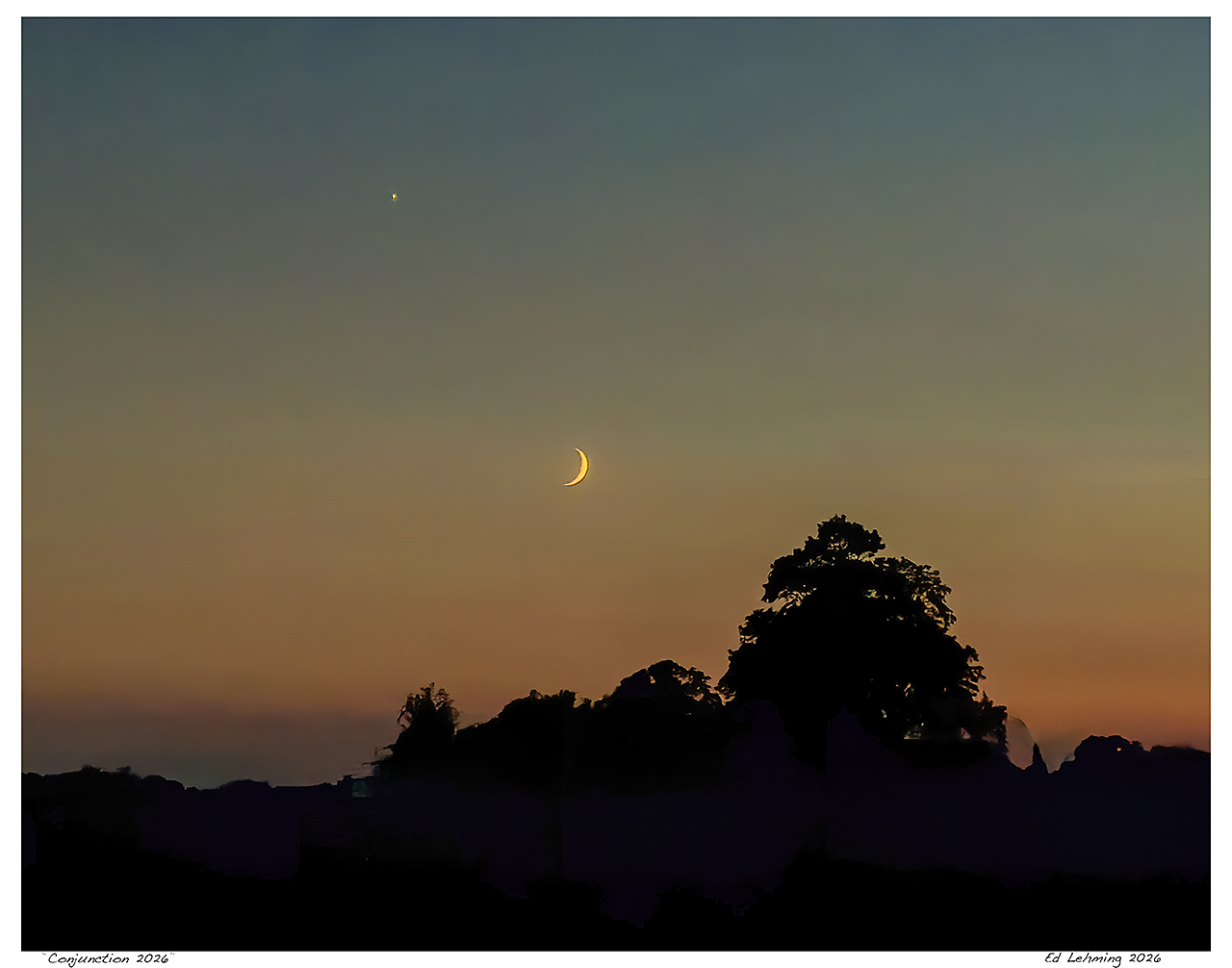
“Moments define our lives. Some of those moments cause me to pause and marvel at the world we live in. Sometimes, it’s simple things like appreciating the sky at dusk in all its wonder” – Ed Lehming
Today’s image is a simple shot, a moment in time where I looked out across the horizon and saw something that stopped me in my tracks for a bit. I’m not sure just how rare these conjunctions of the moon and Venus are, but they sure are beautiful.
We were at my daughter’s farm and getting ready for an anniversary party. In the background, people were gathering and the band was warming up. I stepped away from the group and walked over to an open field to make this image. What surprised me was that nobody else really noticed it, caught up in chatter, food, and music. This felt like a moment just for me to enjoy.
iPhone 17 Pro Max
Main Camera — 100 mm
1/11 sec, ƒ/2.8 ISO 1600
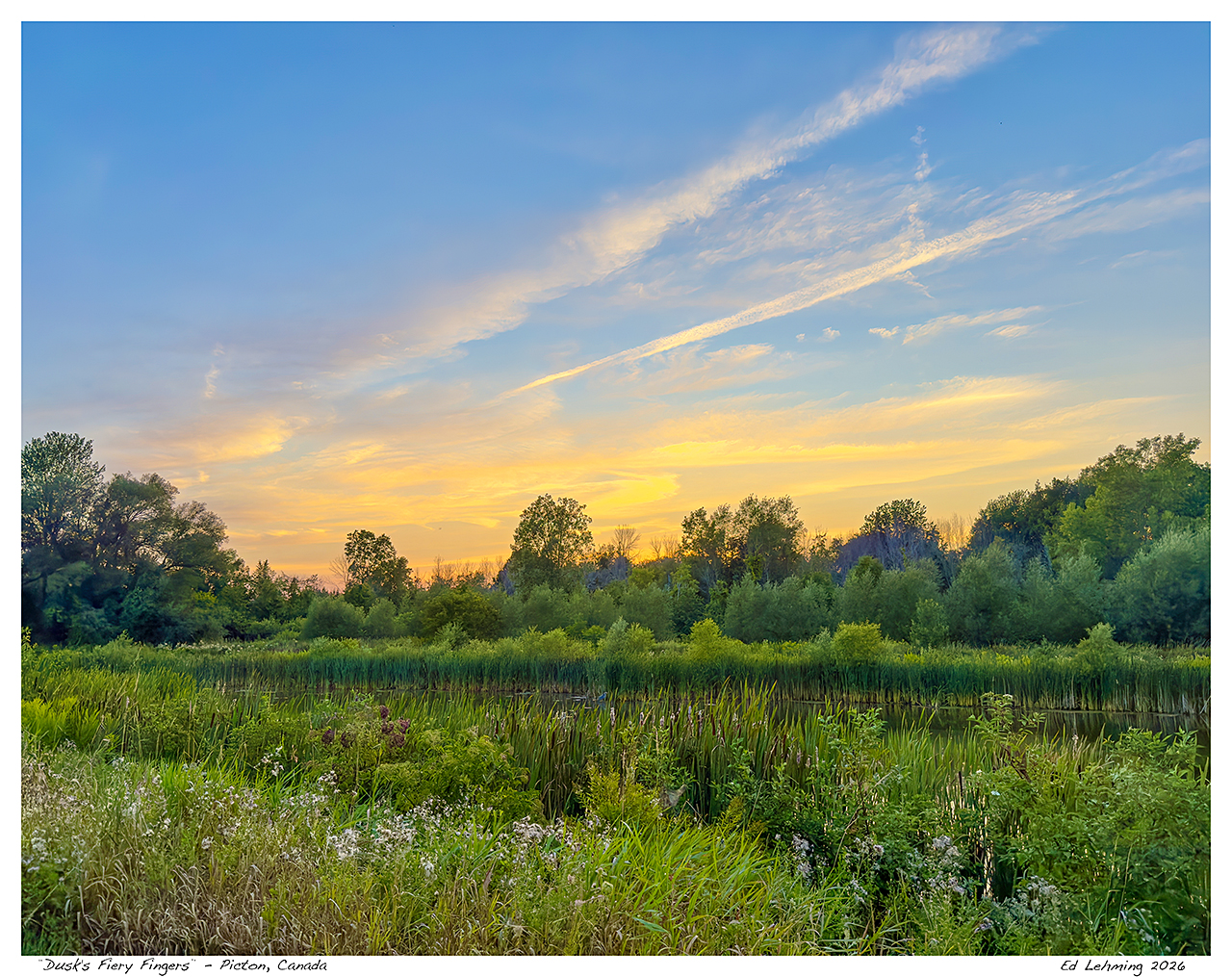
“Wind shapes our world” – Ed Lehming
I’ve become far more aware of wind lately. I first started paying attention a few years ago when I moved to Prince Edward County. The “county,” as it’s referred to locally, is an island on the northeast shore of Lake Ontario. Winds tend to blow in from the west, across the open water, and there really isn’t much in the way to calm them. So, I’ve found that there are some extended times when it’s just “windy” out.
There are other effects of the wind that I had not really needed to pay attention to. For the past two summers, we have been significantly affected by smoke from wildfires. I can’t say that I have any recollection of this in my lifetime. Perhaps it was not newsworthy back in the day, but it’s been pretty dominant here lately. Last summer, you could smell everything from “campfire” to “chemically,” depending on the nature of the fire itself and how long the wind held the smoke aloft.
Last year’s smoke came from northern Quebec, and the winds pushed the smoke westward and then south, which resulted in mainly orange sunsets. When it got really thick, there was a haze in the air and various smells. This year, the smoke came from northern Ontario, turning our skies an eerie orange, like something from a dystopian movie. It was quite unsettling, but we knew that eventually the wind would carry it off. The benefits of air movement became quite obvious.
But something I have really failed to appreciate is just how incredible the wind is at shaping our clouds and creating peaceful sunsets. The image I chose for today was taken a few days ago while on my evening walk. It had been a relatively cloudless day, but as dusk set in, a few clouds rolled in, and the wind worked its magic. It was not until later that I noticed the jet contrail, which surprised me a bit since we don’t get a lot of air traffic in our skies.
iPhone 17 Pro Max
Main Camera — 24 mm
1/590 sec, ƒ/1.78 ISO 64
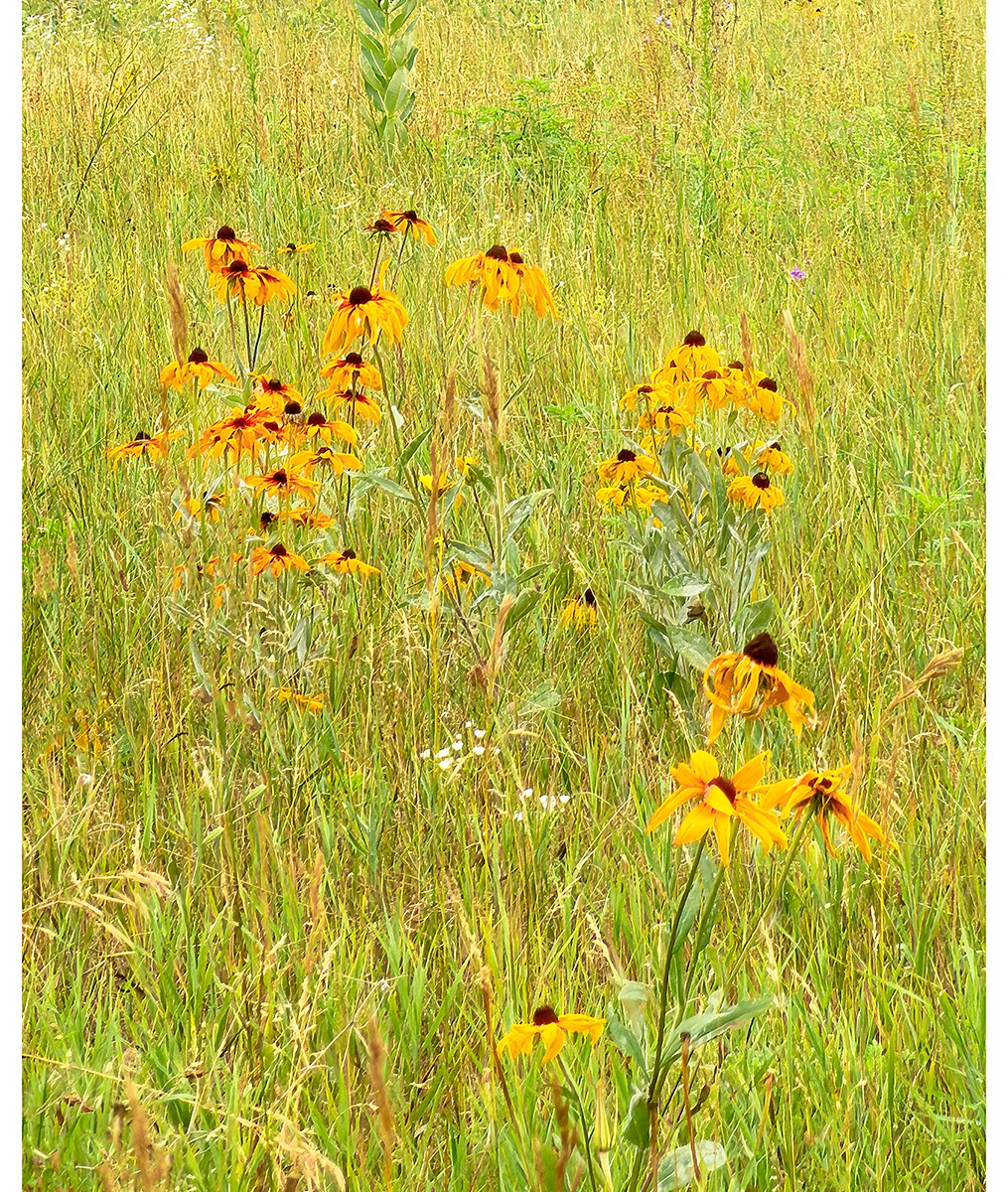
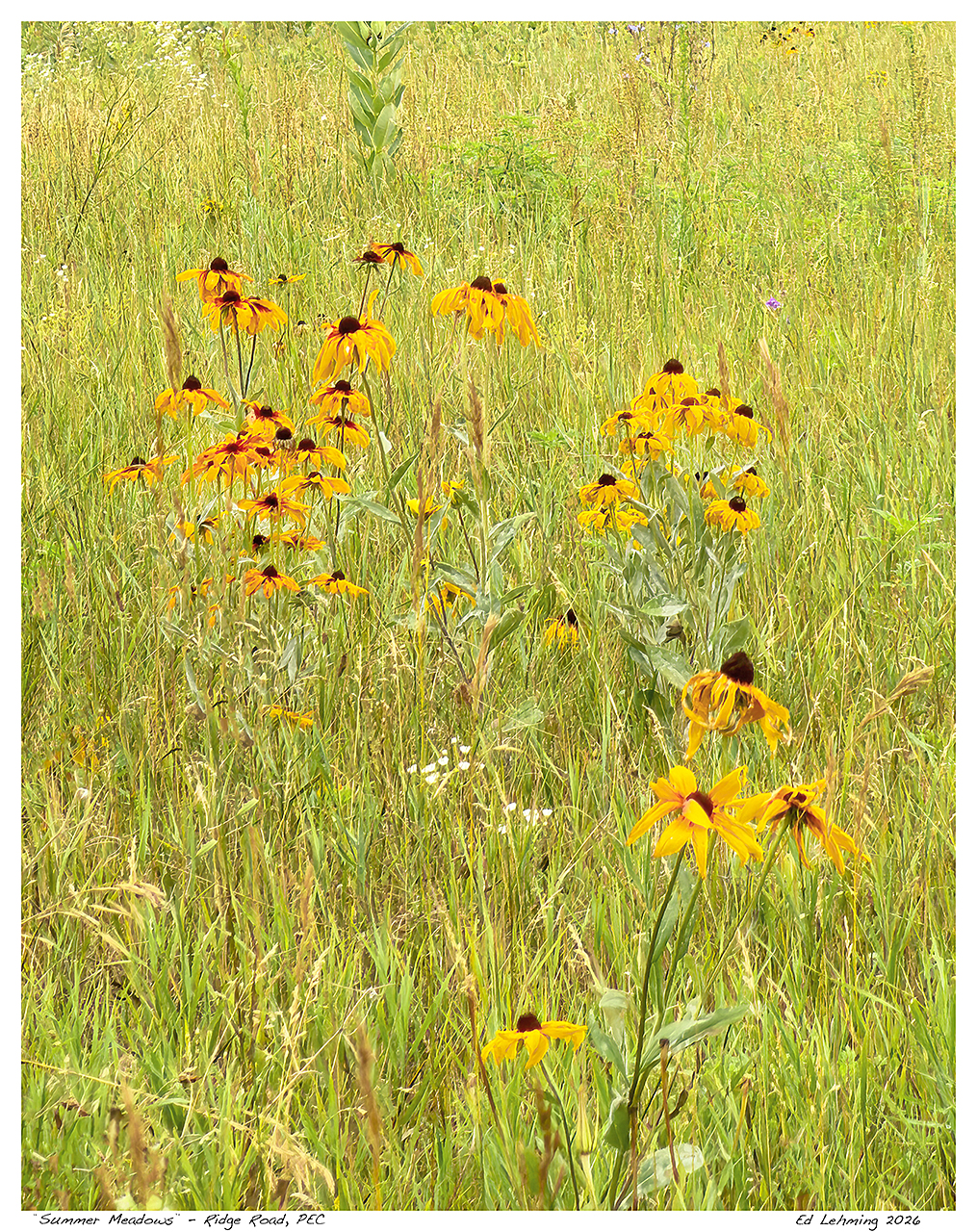
“Our summers abound with beauty, we just need to stop, from time to time, to really appreciate it, and with the right technology, take the memory home with us.” – Ed Lehming
This image astounded me and made me think about how we currently conduct our days, moving from here to there and seldom enjoying the journey itself.
I’ve driven past this meadow dozens of times recently and noticed the clusters of Black-Eyed Susans scattered through the field and thought, “Those might make a nice photo,” but then kept on driving. Well, I finally stopped along the road, quieting those thoughts.
The flowers were in small clusters and a bit of a distance from the road. Fortunately, my new iPhone 17 Pro Max, which produced most of my recent photos, offers a 200mm zoom option, which is why I bought it, and I was easily able to compose a few shots right from the roadside. I only went to 100mm to get the composition that I wanted, but I had the option to shoot tighter. It is yet another reason for my purchase since I don’t usually have my full Nikon kit with me while traveling from point to point locally. As they say, “The best camera is the one you have with you,” and I have had so many opportunities pass me by because I either didn’t have my camera with me or the phone simply lacked the reach and resolution I required. This device shoots 48MB RAW files with stunning color depth and clarity. I won’t be giving up my kit, since there are still a lot of things the phone simply can’t do, but it sure has opened up possibilities.
Which gets me back to my point about this image. The technological capabilities allowed me to make that stop a success. I got several nice images of the flowers and , armed with capable technology, had a reason to stop along the way to make it happen. It may make for a few longer drives, but I will now be more likely to capture moments that otherwise would simply be memories.
iPhone 17 Pro Max
Main Camera — 100 mm
1/220 sec, ƒ/2.8, ISO 40
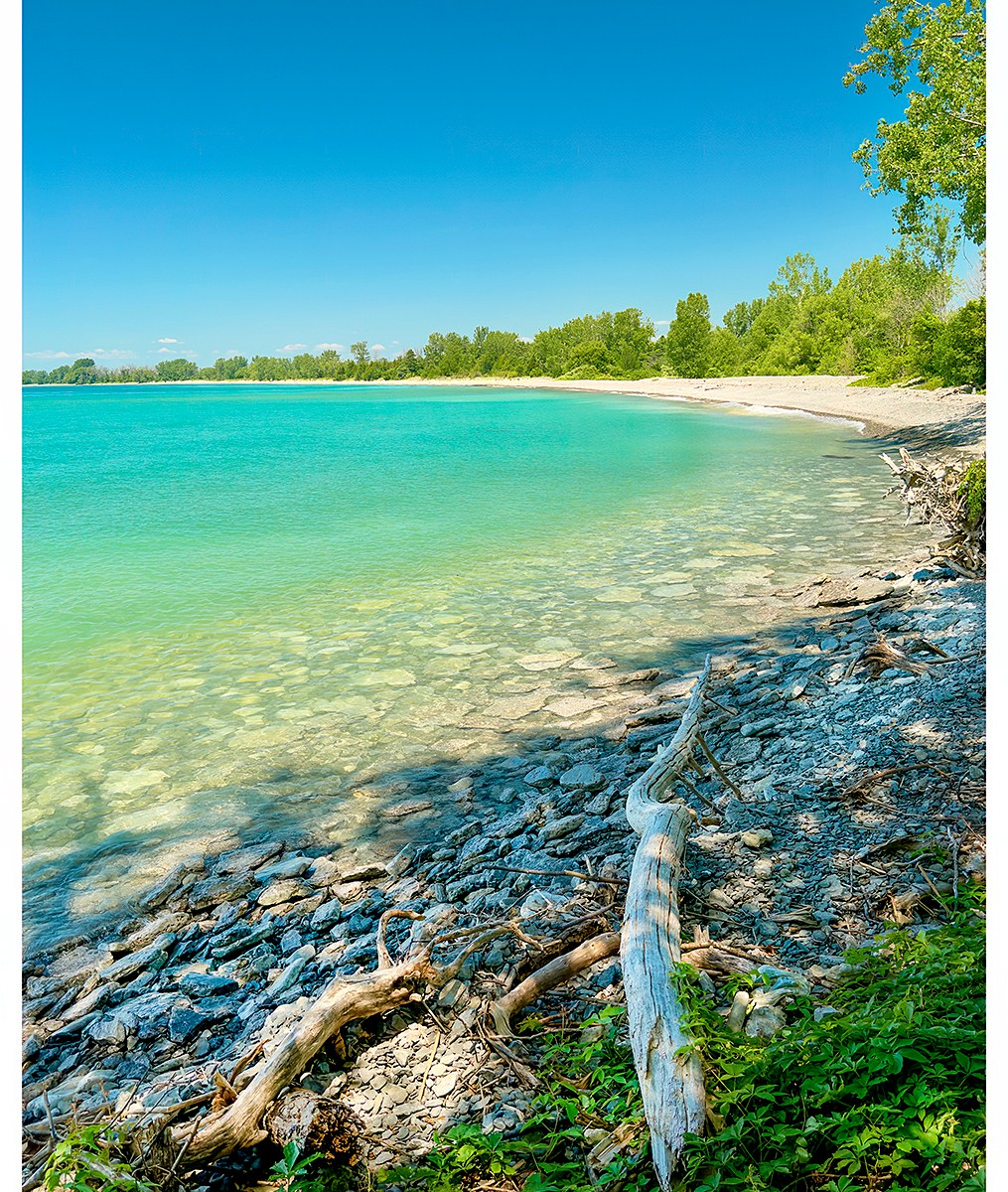

“It surprises me that there are still places, not too far away, that offer quiet solitude” – Ed Lehming
I got a bit introspective on this one. You see, it’s summer here in “The County,” which means that thousands of people pour into the area to enjoy its world-renowned beaches, wineries, breweries, and dining. The summers here are overrun with people looking to enjoy all that the County has to offer. So, it’s pleasantly surprising to find places that are, for lack of a better word, empty. I’ve lived here for close to six years and have not, till this day, driven in search of this spot. It’s in a rather obscure location, and there is no parking without a special permit. I have such a permit, so I parked my car and headed on the short hike toward the shore. When I crested the small ridge that bounds the beach, I saw this: as far as the eye can see, this stretch of beach was “empty,” empty and serene. I simply sat for a while, slowed my breathing, and drank in the view—the shimmering waters of Lake Ontario stretching along the beach in front of me.
The water of Lake Ontario, in some of the bays, has an almost tropical turquoise tone, which those who have not witnessed it often accuse me of doctoring, but that is not the case. There is something about the minerals (limestone) in the bedrock, which you can see as slabs of rock in this image, and the quality of the light, that creates this effect. However, this is Lake Ontario, one of the largest freshwater lakes in the world, and it is deep, with an average depth of 283 ft / 86 m. The deepest part of the lake, the Rochester Basin, at 802 ft / 244 m, is just a few miles away, just around the bend behind me. The summer water temperature ranges from 21°C to 25.5°C (70°F to 78°F). It was at the low end that day, with summer storms churning up deeper, colder water. It’s a brisk and refreshing swim, but it’s not the tropics.
And while it is tranquil, this area is known for its undertows, so swimming is not encouraged.
So, there are all the facts about the water. Getting back to this day of quiet solitude, it was unusual, as locals are often found seeking the same quiet that I was, and there are often people out for a stroll or walking their dogs. Not today; I had it all to myself, and I simply enjoyed it, wandered the shore, and took some photos. It made me think that all the beaches and shorelines around here were once like this. It would have been a sight to behold.
Of note as well, the beach here is quite steep and rocky for a long stretch, and it does not turn to a sandy beach until well past the center of this image, so it’s a bit of a walk if you want a traditional sandy beach.
iPhone 17 Pro Max
Main Camera — 24 mm
1/914 sec, ƒ/1,78 ISO 64
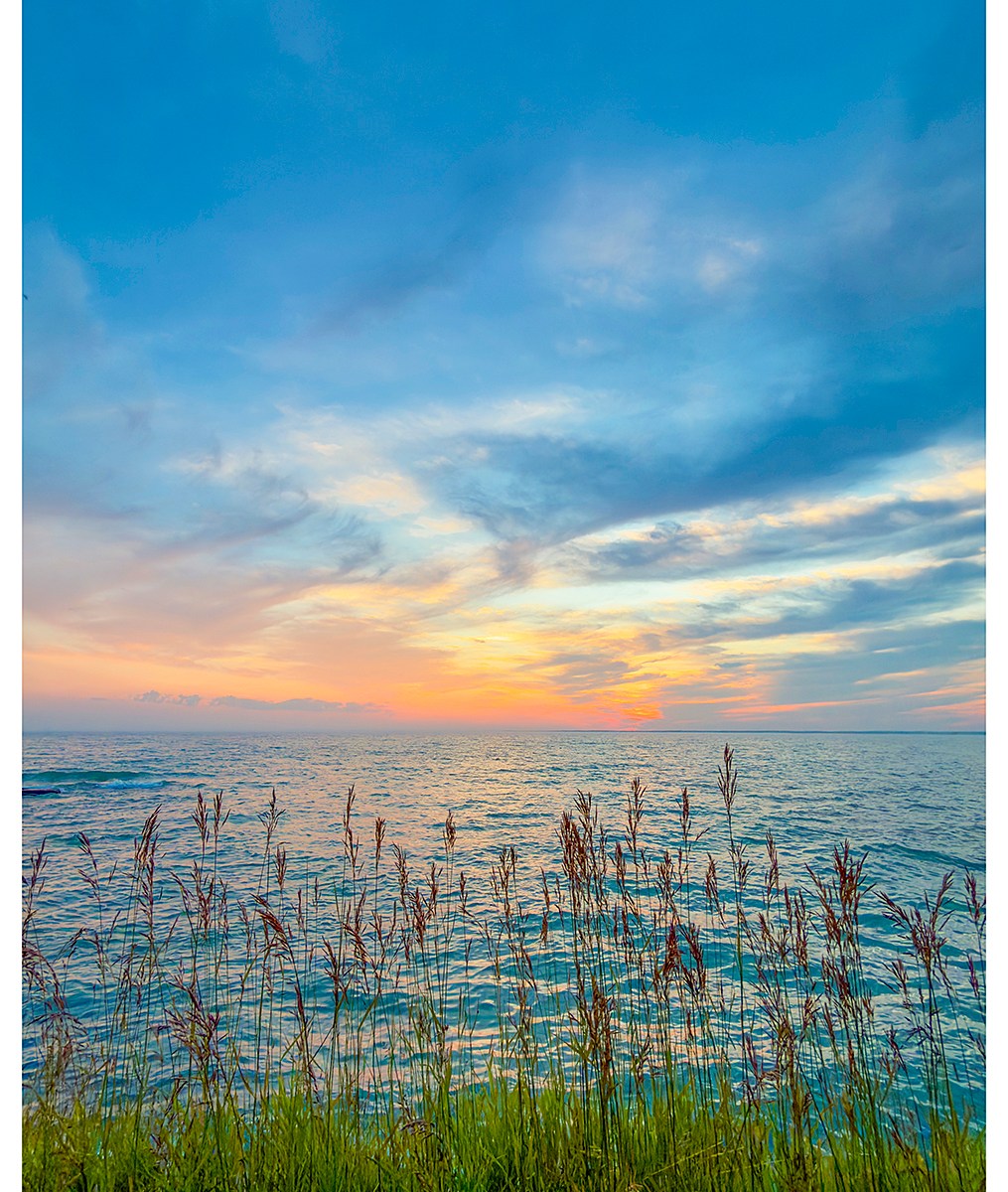
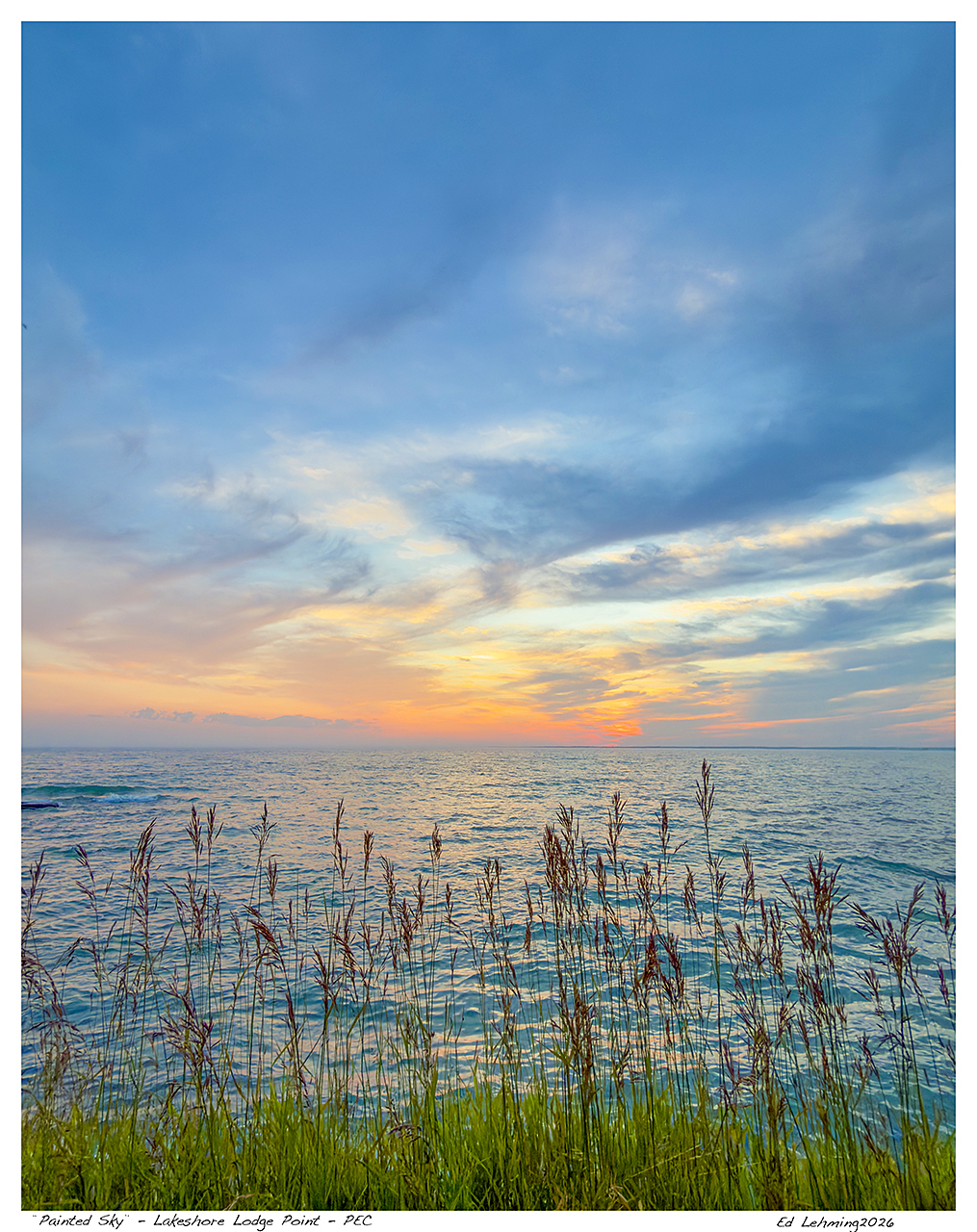
“There are times, when looking at my world, that I see a painting just waiting to be created. Then I realize that nature already has.” – Ed Lehming
This is a return to a previously shared image, though presented here as a portrait composition. I think I prefer the portrait version because it shows more sky and is a bit brighter overall.
I also have to say that this was a memorable day for me. I had not been out making landscape shots for some time and got re-inspired by some stunning sunsets, which led to the series I have recently shared. The sky this evening really looked like it had been painted, and I’ve had some artist friends comment back with words like “That sky!” I would agree. Every sunset is a bit different, and some are jaw-droppers. This one just makes me smile in its simple beauty.
As well, it has reignited the desire to get outside to enjoy the beauty that surrounds me, create engaging photos and share them here.
iPhone 17 Pro Max
Main Camera — 14 mm
1/121sec, ƒ/2.2, ISO 50
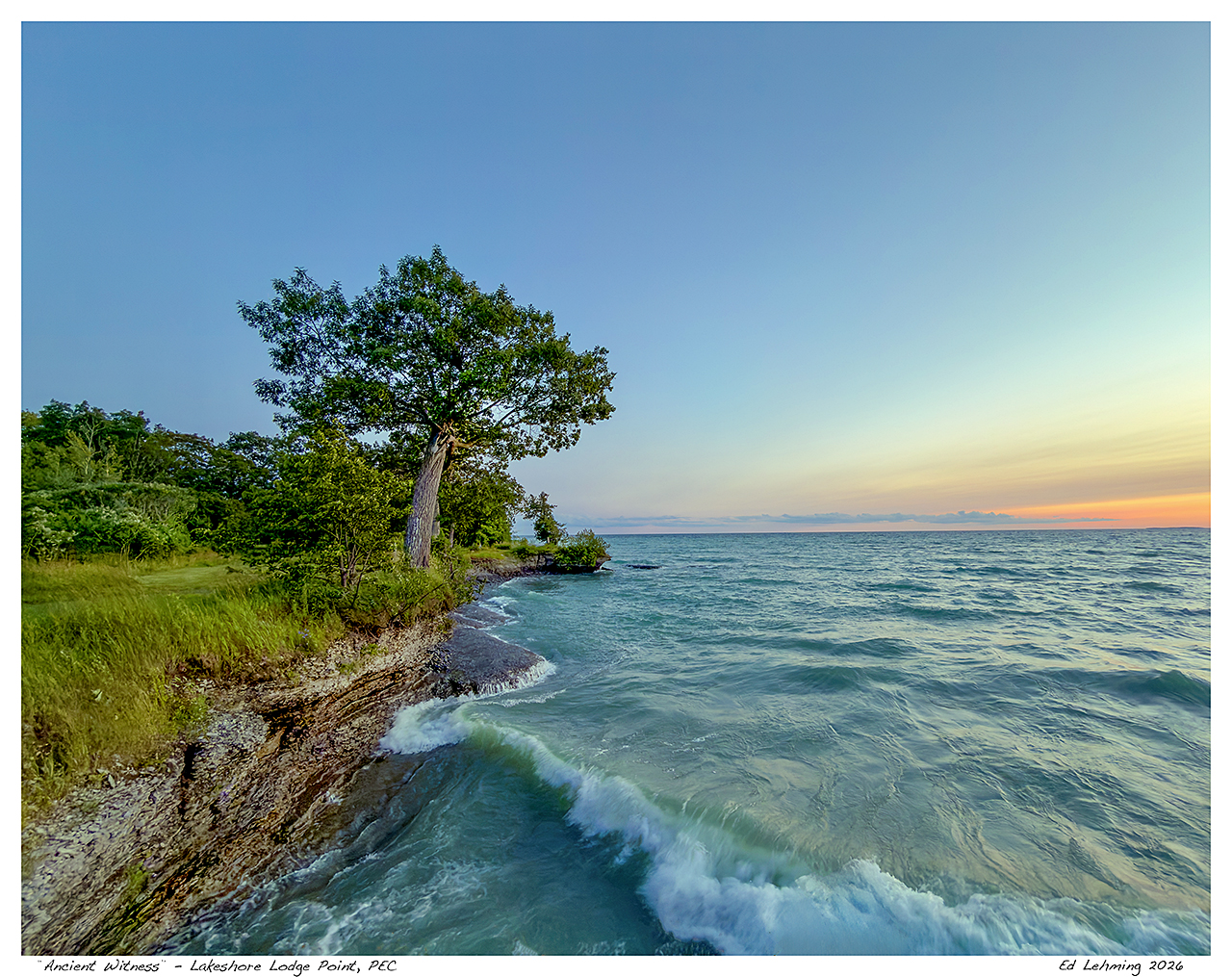
“Year after year, nature bears witness to constant change.” – Ed Lehming
Another, though probably not final, view of this beautiful shoreline, taken at the same time as my previous post, but framed slightly differently. I spend quite a bit of time working on different compositions of the same scene. Some may appeal to me at the time, while others evolve during my editing process. That said, I am very deliberate in framing my compositions in the field and rarely modify in post-processing.
For this shot, I waited until a larger wave crested in the cove in order to give a different dynamic to the image. In order to get it all in, I had to frame the shot differently, including switching to a landscape orientation.
iPhone 17 Pro Max
Main Camera — 14 mm
1/40 sec, ƒ/2.2, ISO 50

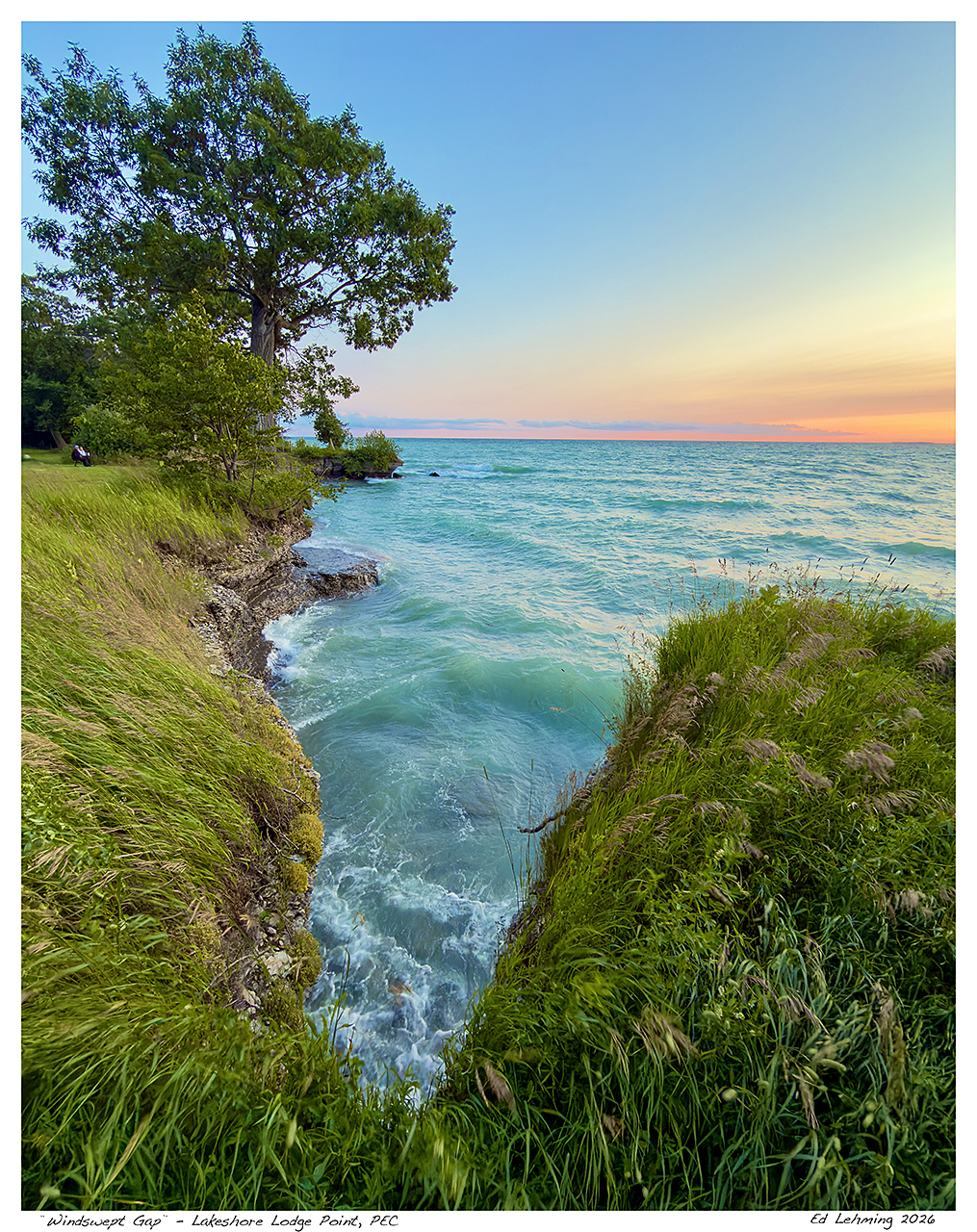
“Hark now, hear the sailors cry; smell the sea and feel the sky.” – Van Morrison (Into the Mystic)
Every now and then, a photo captures the dynamic nature of our world—times when the true moment is documented so well that I can sense the very air and feel of that moment in time when looking back at the photo.
That is the case with this image, taken once more along the shores of Lakeshore Lodge Point in Ontario’s Prince Edward County. It looks back to locations where I made my previous photos and features the large oak that hangs over the bluff. In this image, the movement of the wind against the gap at my feet is quite obvious. I can still hear the sound of the waves and smell the unmistakable scent of the lake water as it crashes on the shore below. It immediately reminded me of one of my favorite Van Morrison songs.
The image was made looking southwest, as I tried to capture all the elements that I was experiencing, including a narrow wedge of the sunset across the lake.
iPhone 17 Pro Max
Main Camera — 14 mm
1/53 sec, ƒ/2.2, ISO 50

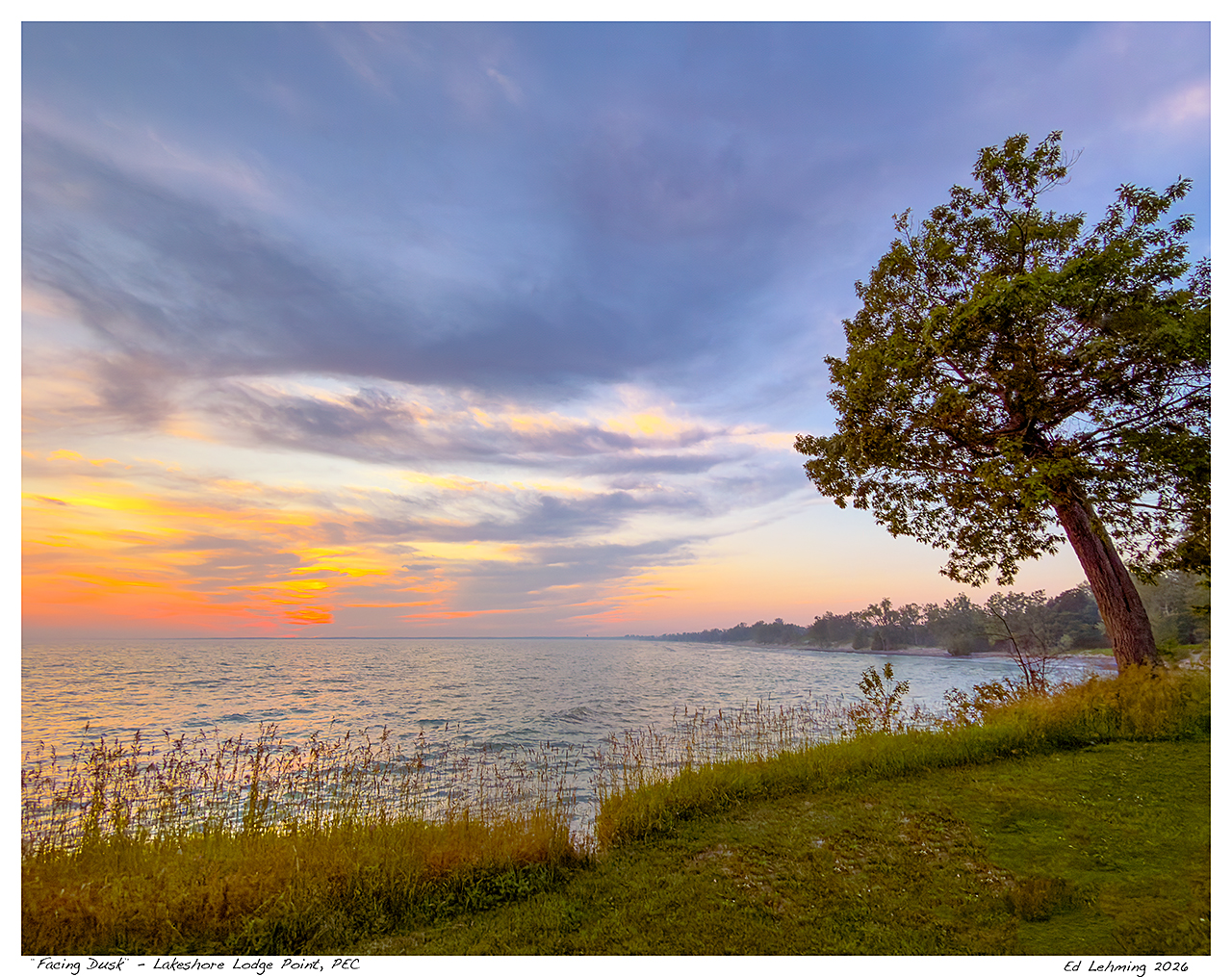
“Winding down the day, at waters edge, the breeze in my face, there is not much better to end the day in peace.” – Ed Lehming
As a continuation from yesterday’s “Standing in Awe” post, here’s the same vantage point but looking to my right. I had nearly forgotten that we were just emerging from a few days of wildfire smoke from northern Ontario, which can be seen lingering on the horizon, subtly altering the colors of the landscape.
The beach, which stretches off to the right, had largely emptied out by this time of day, with only a few stragglers enjoying the last moments of sunlight. There was a slight breeze that kept the grasses in the foreground (also from yesterday’s image) swaying gently, complemented the tranquil atmosphere. The oak tree on the shore evidences years of enduring shore breezes as it leans over the bluff below, its branches reaching out towards the lake as if trying to embrace it. There are days when it seems like the wind is all that prevents it from tumbling into the water below, giving the tree a precarious presence. It was this tree that inspired the title for this image, as it embodies the beauty and struggle of nature.
Once more, the skies offered beautiful wispy textures and a wide range of tones, from soft pastels to deeper hues as the day transitioned to dusk. It was a nice way to end another beautiful summer day in the County, a moment to reflect on the simple yet profound beauty that surrounds us.
iPhone 17 Pro Max
Main Camera — 16 mm
1/100 sec, ƒ/2.2, ISO 50


“There are times when a composition is just automatic. Often the simplest things align to create beauty without effort” – Ed Lehming
I’m jumping ahead just a few days from the “Pink Sunsets” series that I just posted. I was looking for something a bit different than the open farmland I’d recently photographed, and I have a spectacular waterfront/beach view only a 20-minute drive from home. The sky was starting to show some interesting clouds, so I headed to one of my favorite lookouts, Lakeshore Lodge Point in the renowned Sandbanks Provincial Park. It’s a huge draw for thousands of summer tourists and I get to enjoy it whenever I want.
I’ve been to this spot hundreds of times. In fact, it was my first vantage point of Lake Ontario from the County, as this area is refered to, just prior to moving here six years ago. I still find myself returning, in all seasons and all kinds of weather. It’s one of those places that always shows me some new aspect of itself.
As I walked the short distance from my car to the water’s edge, this composition presented itself to me immediately. I simply squatted and took the shot. That simple, not a lot of fuss trying to balance the elements or angles; it simply was.
Beyond the grasses and the lake itself, the sky presented an awesome show of pastel colors and textures, so different from the previous week. I’ve looked at it many times, and every time my eyes see this as a painting. The amazing thing that evening was that the show had just started. There is more to follow.
iPhone 17 Pro Max
Main Camera — 13 mm
1/105 sec, ƒ/2.2, ISO 50
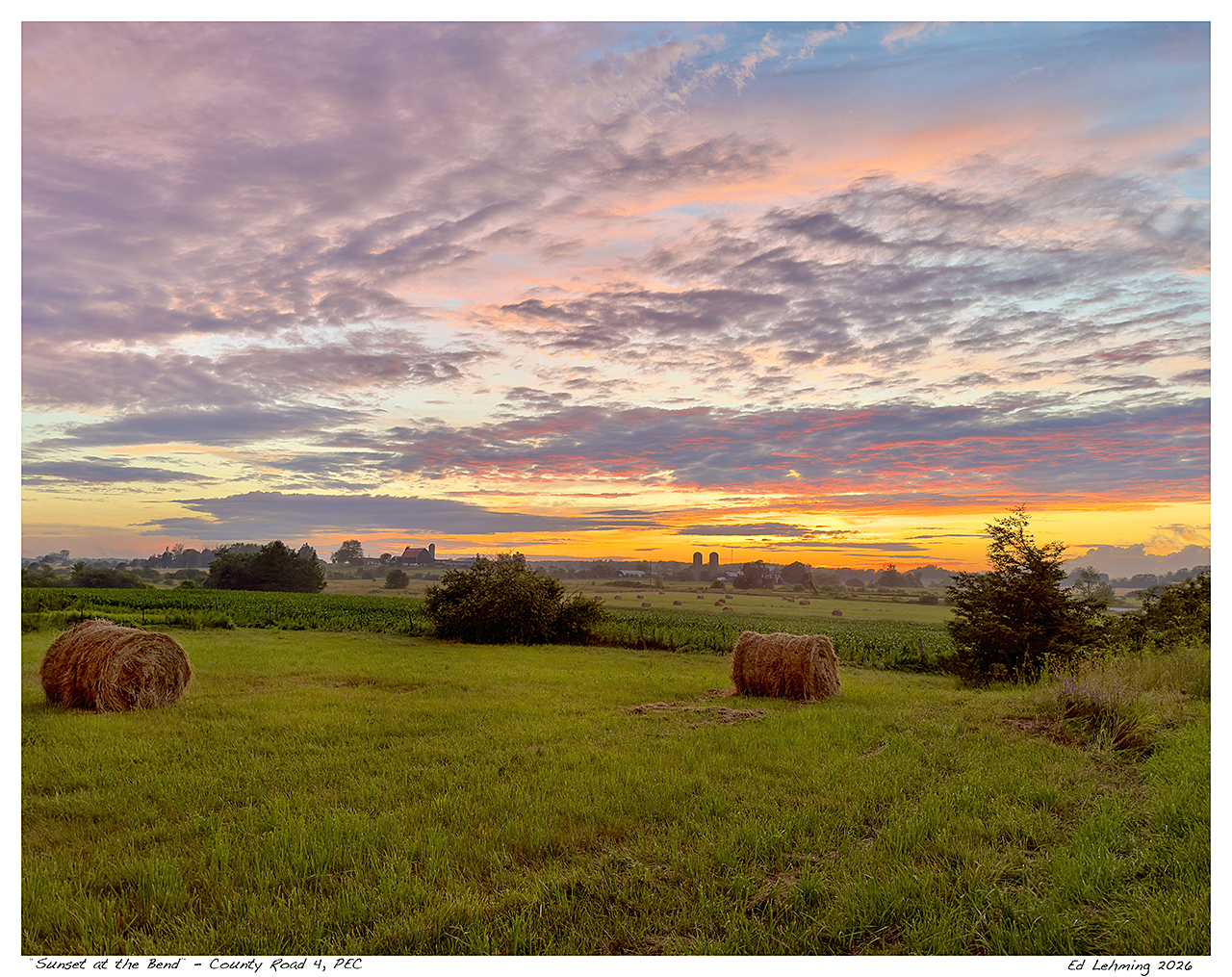
“There is not much more soothing that looking across beautiful vistas and remebering that this is home” – Ed Lehming
This is the final image from my early July sunset series. This image was made on the same day as Pink Wave and Candy-Floss Skies. I simply traveled north a bit further up the road. By then, the bright pink billows had subsided and a more typical sunset took their place.
Once more, I realized that this is scenery that I drive through on a regular basis, catching glimpses of the details of the countryside. It’s not until I stop and compose a photo that I truly realize just how wonderful this area is. Looking beyond the hay bales that first caught my interest, as well as the beautiful sky, the distant details of local farm buildings emerge near the horizon, as well as yet another field filled with hay bales.
The title for the image comes from a bend in the road, not visible in the image, but directly between the cornfield and hay bale field behind it. I’ve driven this road hundreds of times and never fully appreciated just how beautiful the scenery is. In fact, I just drove this stretch of road yesterday and had trouble piecing this scene together. What a difference a few steps off the road can make.
iPhone 17 Pro Max
Main Camera — 24 mm
1/121 sec, ƒ/1.78, ISO 64
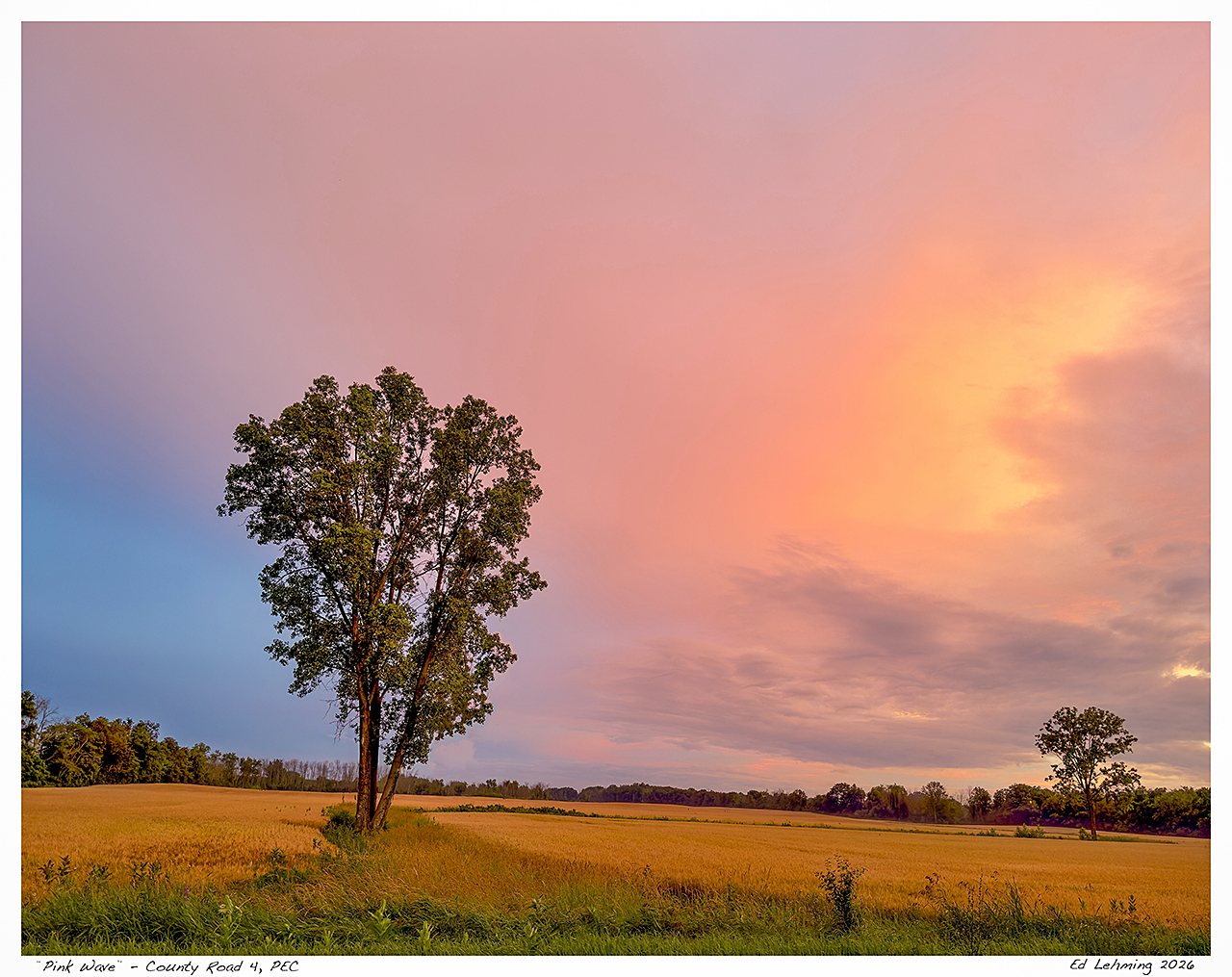
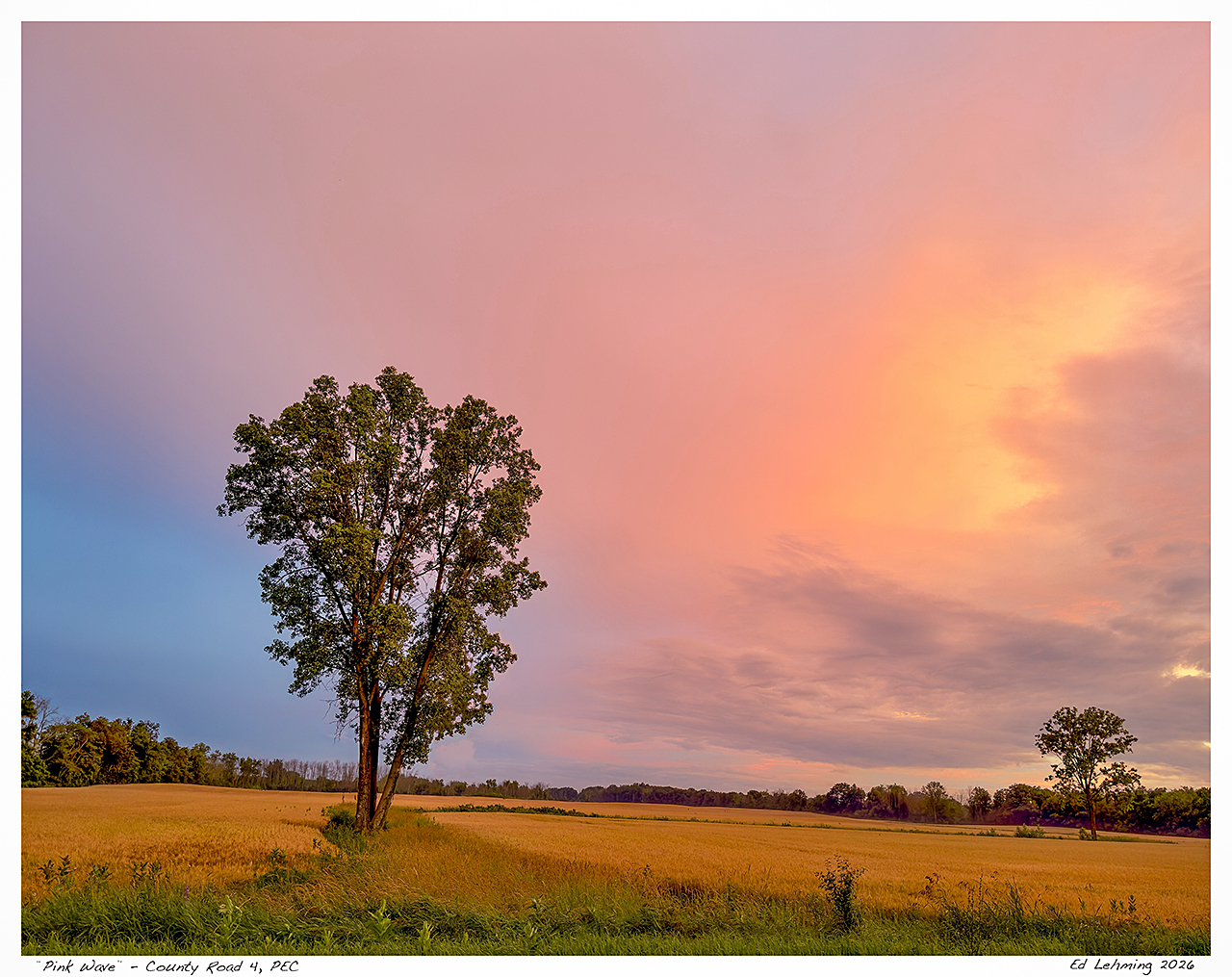
“We look to the sky for wonders” – Ed Lehming
This will be my second to final entry from the early July post-storm series. It’s been fun looking back at these recent memories and reflecting on the wonderful, almost surreal skies.
The image, aptly named “Pink Wave,” shows a local farm field and a stunning pink cloud formation. This image was made only a short distance from my prior images. It’s a field I often drive by and see photographic potential. In this case, the stunning pink sky, with just a hint of blue, was too good to pass up.
It’s a simple composition, looking across the wheat fields with a few trees for interest. I recall parking my car at the side of the road and looking up in awe at the bright sky. I focused on the tree in the foreground as I composed the shot. I clicked the shutter and looked at the result on my screen. One shot captured it exactly as I had seen it and preserved a great memory that is not likely to repeat itself anytime soon.
iPhone 17 Pro Max
Main Camera — 24 mm
1/87 sec, ƒ/1.78, ISO 100
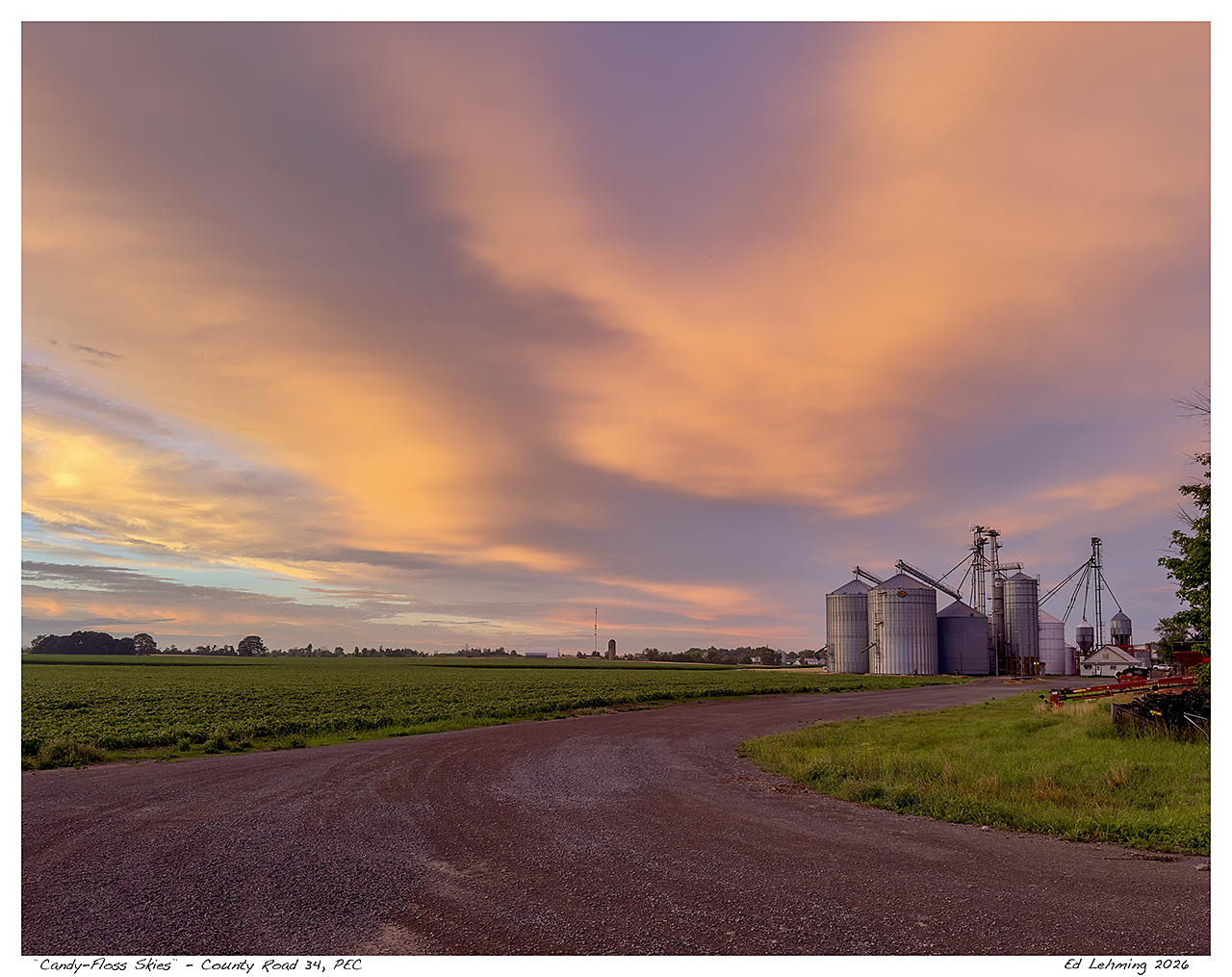
“If joy had a colour, I think it would be pink” – Ed Lehming
Another storm passing, unsettled and angry gray clouds give way to joyful pinks and lavenders. The summer evenings continue in contrasts, and I’m back to what has become a regular spot for me as the day fades to night.
Here’s another shot, another day, from the same location that I have been sharing photos from over the past few days, this time looking northeast, or just to my right. The farm driveway has been a great place to pull off the road so that I don’t have to worry about passing cars.
On this day, storms had once again passed over in the afternoon, but rather than offering wispy multicolored clouds, there was a high pink mist in the sky interspersed with waves of purple. This pink filled the sky, except to the far west, where the clouds had started to break up. This intense pink reminded me of candy floss, thus the image name. Though the overwhelming pink felt a bit sureal, I also felt a joyful calm as it bathed the landscape in its glow.
I do have a few more images from this evening which I will share over the next few days.
iPhone 17 Pro Max
Main Camera — 24 mm
1/121 sec, ƒ/1.78, ISO 50
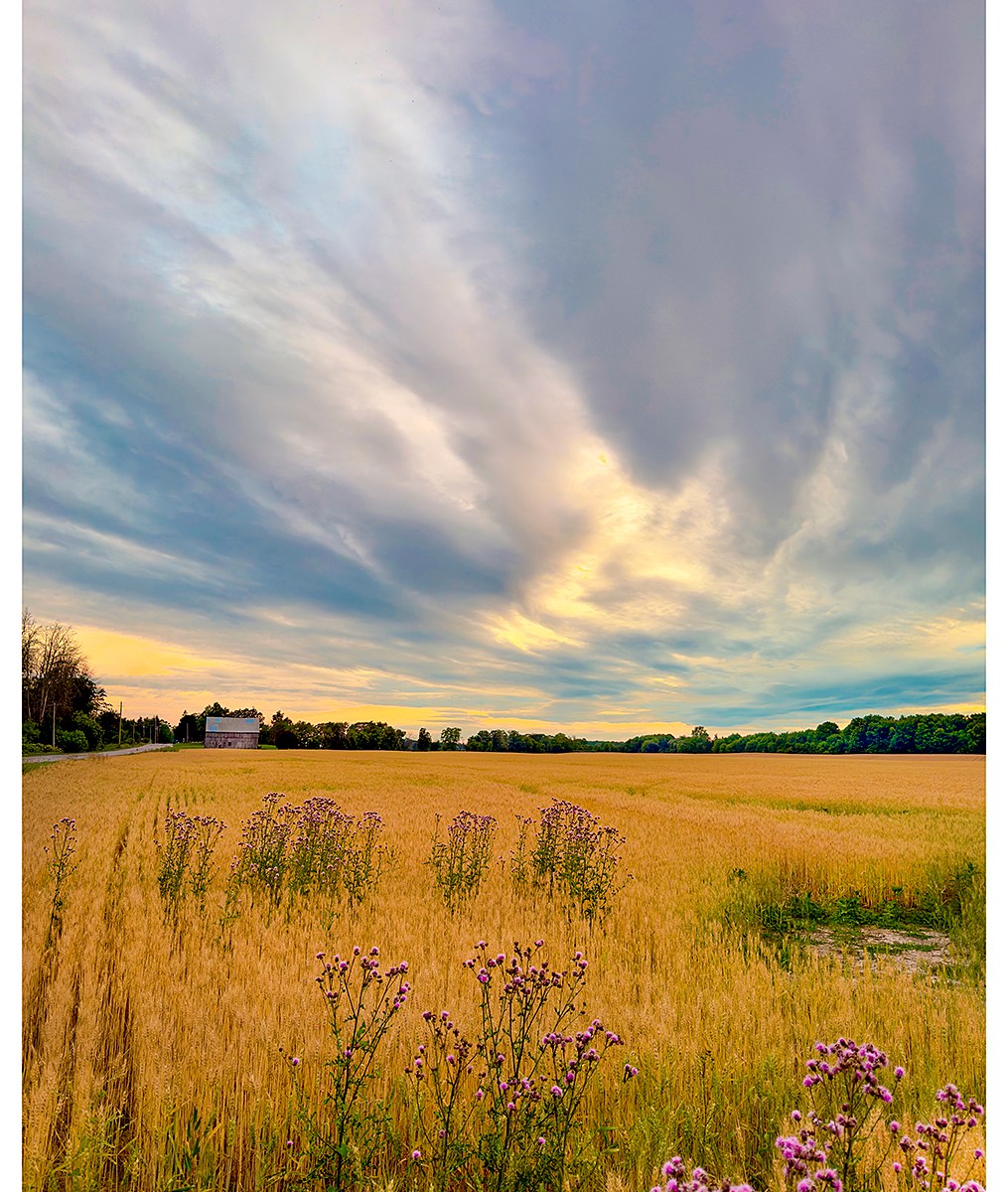
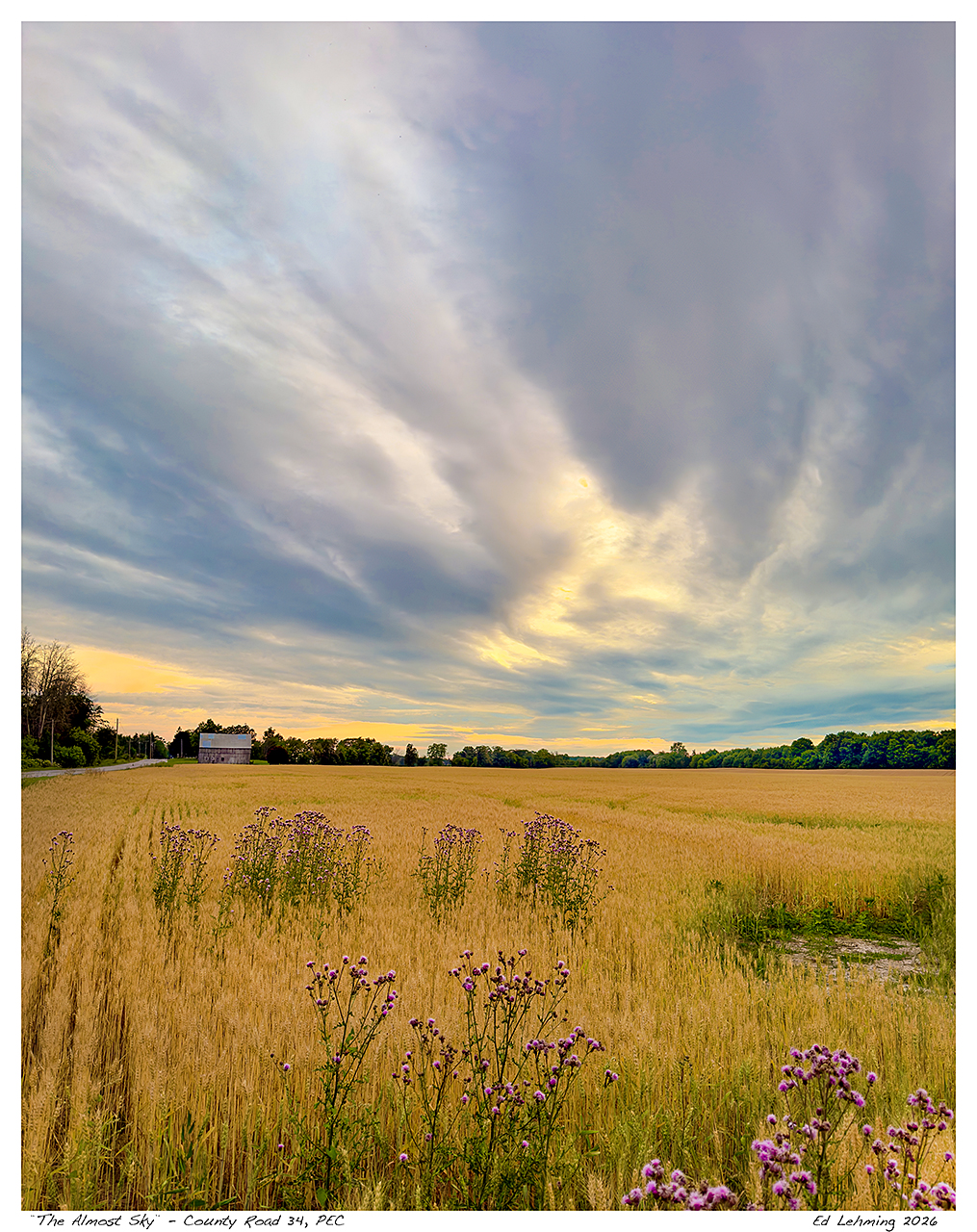
“Sometimes there is promise, a hopeful potential, the ‘almost’ hangs just out of reach” – Ed Lehming
After a few days of stunning sunsets, this day was a bit of a letdown, and my thoughts were that this was “almost” as nice as the prior days. So I titled it the “Almost Sky.” Yet I look at it now, a few weeks later, and wonder how I could have been disappointed in this beautiful mid-summer evening.
The wheat, at the time, was golden and only a few days from harvest; the thistles added a pop of color to the composition, and the sky is still quite interesting. That wheat is now gone, as are the thistles. It’s just a flat field of stubble.
I suppose that is the contrast we often face when we have had all that we want for a time and then are faced with something that feels “lesser.” At any other time, like now, when we have had clear skies and no interesting clouds, I would be happy with an “almost” sky. It’s better than nothing at all.
One of the things I like best about blogging about my photos is that actually sitting down with the photo and reflecting back on that past moment, with the perspective of today, makes me more appreciative of what is in front of me then and today. It’s also the process of writing that slow me down, chosing the words that best reflect my thoughts, both then and now. In the end, even moments that we are less appreciative of at the time become fond memories in our future. I’m just happy that I have the ability to keep so many documented.
iPhone 17 Pro Max
Main Camera — 24 mm
1/121 sec, ƒ/1.78, ISO 100

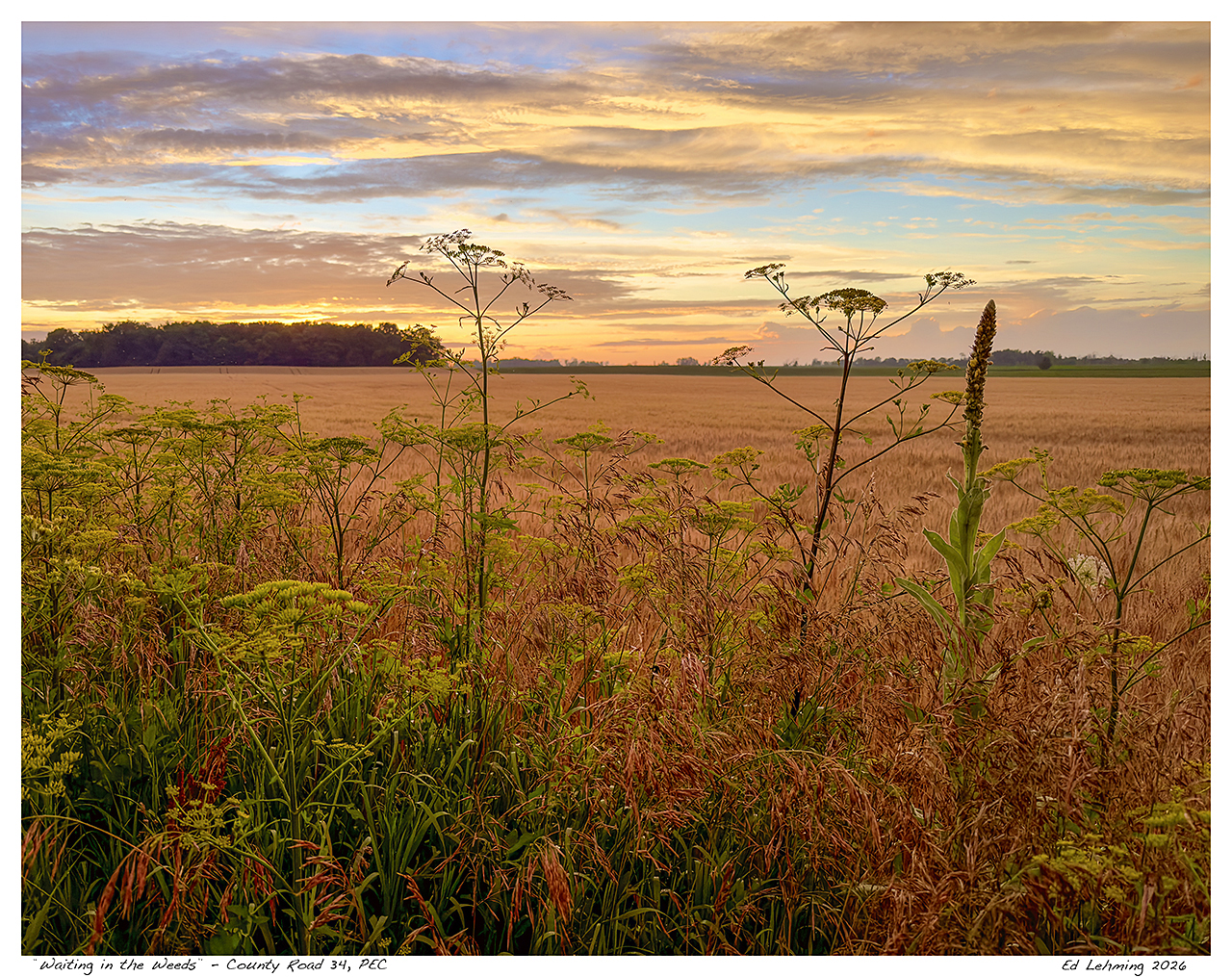
“There are days where we simply need to pause and wait for the noise to clear” – Ed Lehming
The title of this image came from a song by The Eagles. It’s a bit of a theme song for me, not because of the lyrics but because of the title of the song itself. There are times where, as some of the lyrics say, I’m “biding time with the crows and sparrows.” Times when life gets hectic and I know that I need to slow down, often not in a place of comfort, but among the weeds that I am in.
The image was made along the same stretch of county road where I captured the previous two images. The sky is not quite as spectacular, but still captivating for me. I got down low at the roadside to include the grasses, mullion, and wild parsnip, which seems to be everywhere lately.
Something about the composition resonated with me, and it was not until I got to doing my edits that I noticed the outstretched arms of the one wild parsnip plant. It seemed to be worshiping or celebrating the colors offered by the last light of day. I look at it now with a combined sense of joy and calm. If I need to wait in the weeds, I may as well enjoy the view!
iPhone 17 Pro Max
Main Camera — 24 mm
1/498 sec, ƒ/1.78, ISO 64
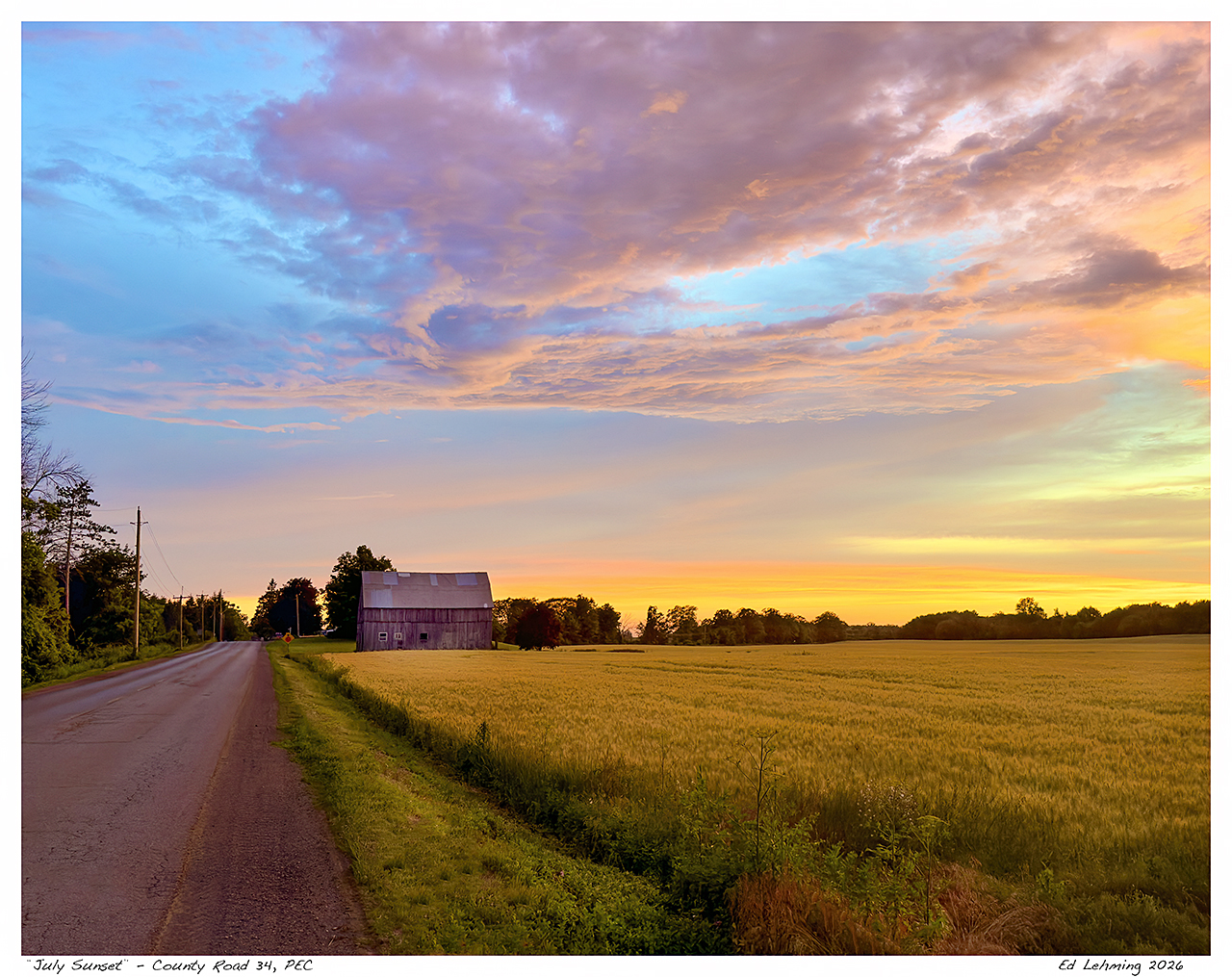
“The storms of life come and go and remind us to enjoy the beauty of good times” – Ed Lehming
I need to remind myself constantly that bad times, the “storms” of our lives, are temporary. Time moves on, and better times often follow. This applies to a lot of things, including my creative work. As I noted in my earlier post “After the Storms”, I had gone through yet another creative lull— not a storm, but more plain old dullness. Then the clouds eased up, and I was presented with wonder once again.
The image above was made from the same spot, about 30 seconds later, just looking to my left, along the road where I was parked. That same golden light from the wheat and the bold purple clouds are a significant part of the composition as well. The scene, and being able to capture it effectively, did wonders to jump-start my creative practice once more. It did take me a full month to start writing again, but here I am.
There are many more photos that I have made since that day, and I plan to write about them on a daily basis. I find it’s a healthy, often neglected practice for me to pause and reflect on the things I have seen, as well as talk about the emotions and reflections of what has made these moments significant to me.
You will see a lot more iPhone images from me since I have my device with me more often than I have my heavy professional kit, and frankly, I’m impressed with how well my iPhone captures what I see, when I see it.
iPhone 17 Pro Max
Main Camera — 24 mm
1/60 sec, ƒ/1.78, ISO 125
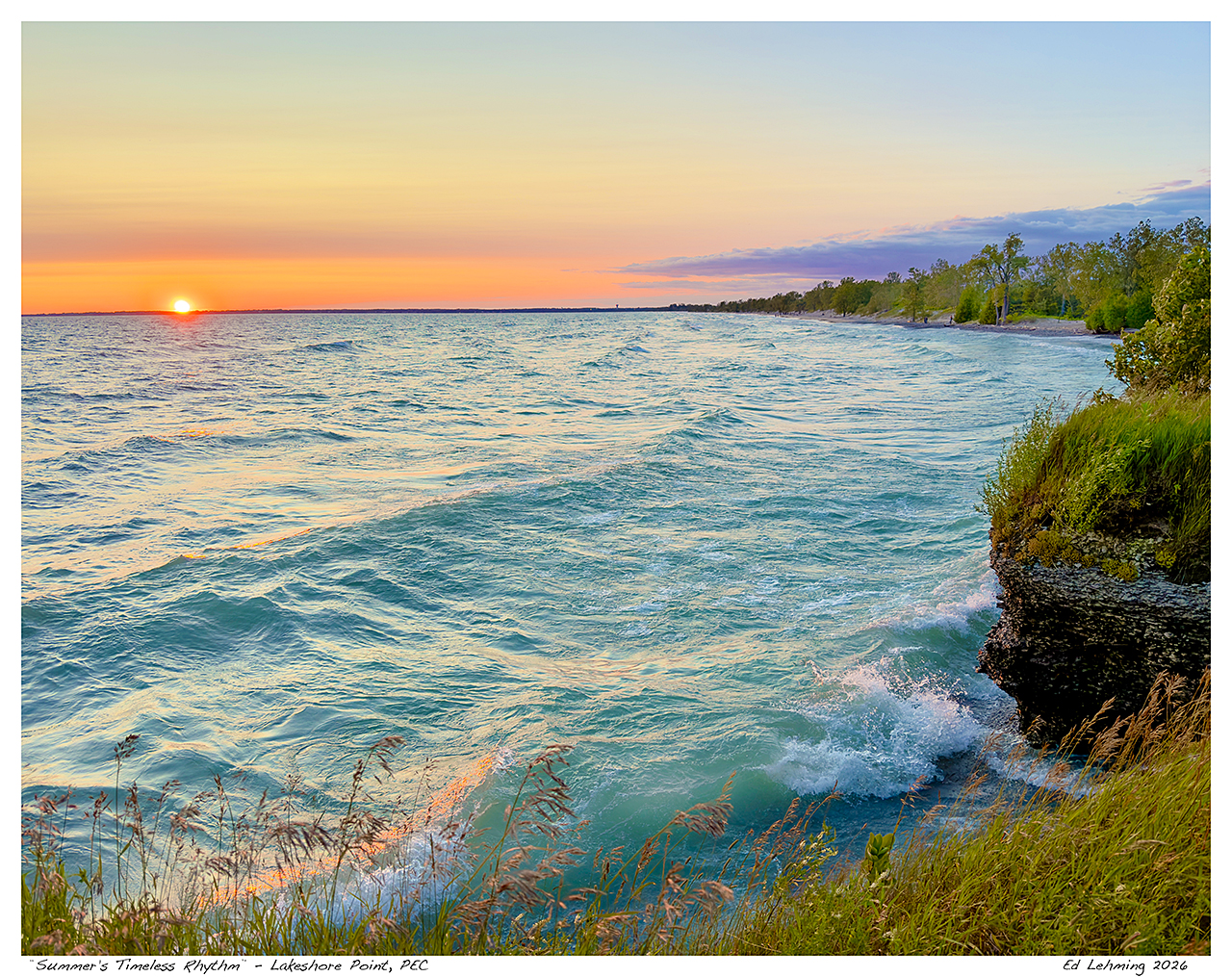
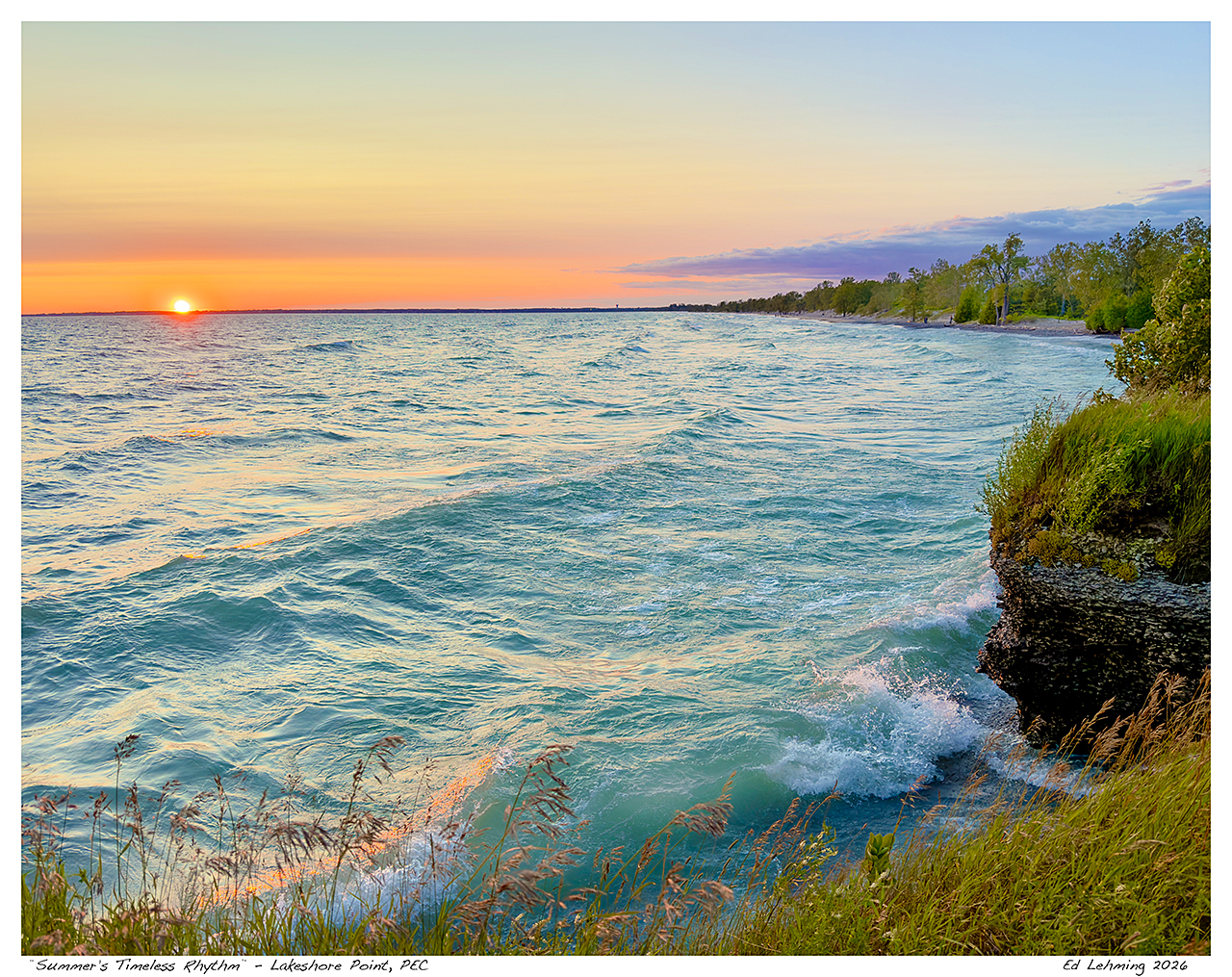
“Summer rolls on, like the constant waves break on the shore, in a rhythm older than time” – Ed Lehming
It was early July; the skies had begun to offer some variety, displaying a blend of soft pastels and deeper hues as the day transitioned into evening. So, I headed to one of my favorite spots to see what the late afternoon had to offer. The image above was made just as the sun was about to dip below the horizon, casting a soft glow across the landscape. Another storm had passed earlier in the day, and there was still a good chop on the water, due to the post-storm winds, creating a dynamic scene that seemed to pulse with life.
I love the way this beach curves, an elegant arc that guides the eye along the shore. The waves conform to that shape as they roll in, like an endless heartbeat, measuring out the moments of the day. Each crest and trough seems to tell a story, whispering secrets to the sand beneath. They also seem to push the last vestiges of cloud off to the east, clearing the sky for the vibrant display that a summer sunset promises. There is something magical in the color of the water here; it reminds me of the turquoise waters of the Caribbean, yet it’s right at my doorstep in Ontario, highlighting the beauty that often goes unnoticed in our own backyards.
As I look at the photo and remember back to that moment when I snapped the shutter, I can still feel the wind blowing off the lake, crisp and refreshing, caressing my skin. The sound of the waves crashing against the shore creates a soothing melody, perfectly complemented by the aroma of the water mingling with the scent of dstill wet grasses. The warmth of the setting sun on my face envelops me in a comforting embrace, making the fleeting moment linger a little longer. Yet another moment of another beautiful summer day coming to a close, reminding me of the simple joys found in nature and the passage of time. Each sunset feels like a gentle farewell, promising that the light will return another day, just as summer always does.
iPhone 17 Pro Max
Main Camera — 24 mm
1/351 sec, ƒ/1.78, ISO 64
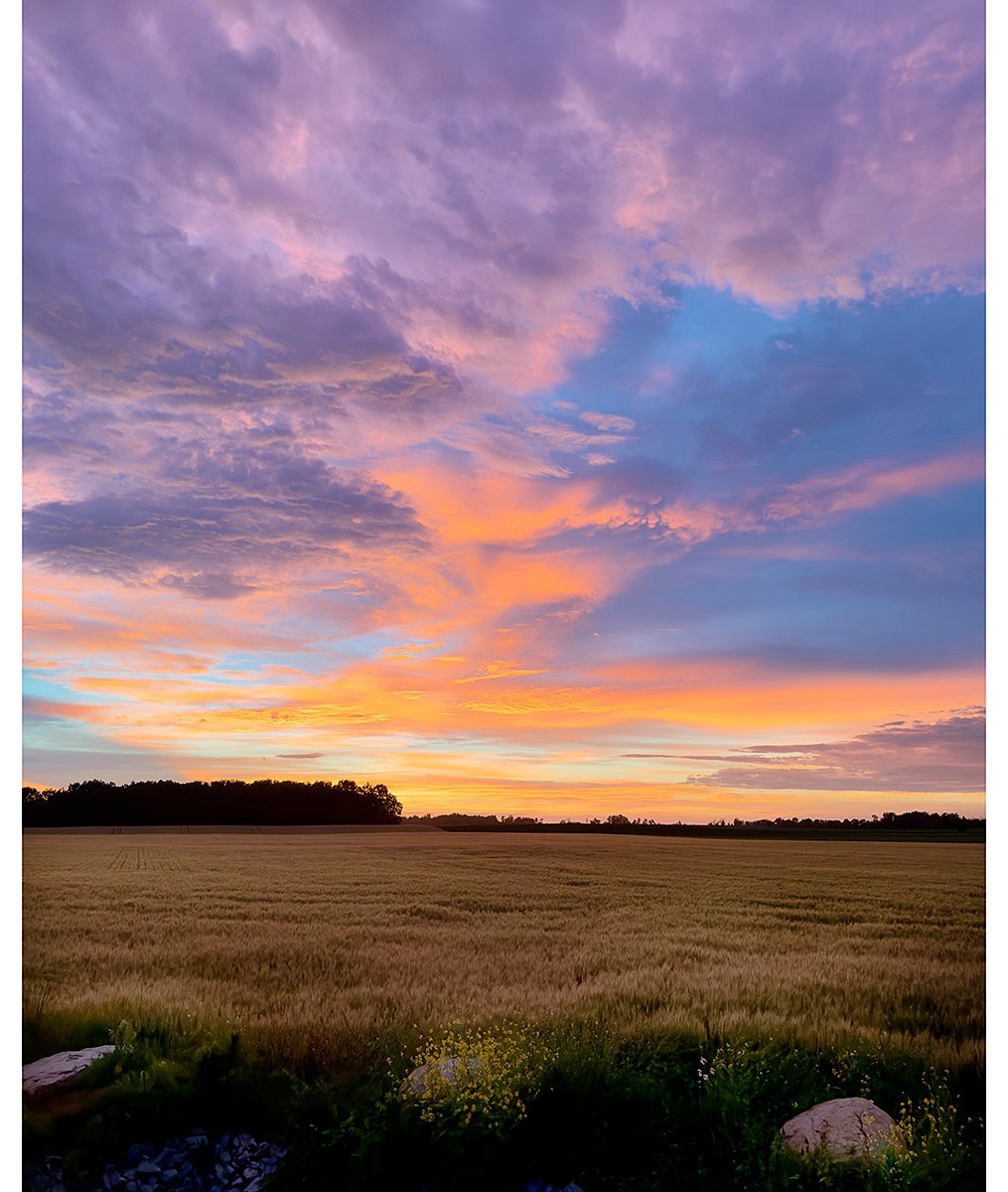

“Everyday offers new beauty, just give it time, keep your eyes open, and be ready.” – Ed Lehming
There are days, as a photographer, where days seem to hold little promise. The skies are dull and dreary, and the forecast is not promising. But then, out of nowhere, a spectacle emerges.
Such was this evening in early July. I’ve been a bit off my game photographically, as many creatives can probably relate to. Too many days, lacking inspiration or motivation, had gone by and I was experiencing a bit of a lull. I live in a beautiful area that people flock to by the thousands every summer, and yet, I did not find inspiration. It was a long weekend here in Canada, but the clouds and rain had rolled in, and nothing inspired.
But, near the end of the day, the clouds unexpectantly shifted and the sun shone through the remaining tatters. And what a show it provided! Not for a long time had I seen such a display of colors and textures. The good thing was, I was ready for it. I know my gear and I know where to be to capture these rare moments. I got in my car at that first sign of color and drove the five minutes north of my house to a field that offered a clear view of the horizon. The field was still filled with unharvested, ripe wheat, providing a golden glow. In the foreground, a few conveniently placed boulders and some wildflowers added interest to the shot. The clouds and the colors were the real stars of the show, but this composition laid itself out nicely for this singular image. I did shoot the same scene as a landscape, but I fell in love with this orientation.
This single, successful, image inspired me again, and I have been out almost every day looking for something new. I’ll share those images over the next few days. I am so happy to be reinspired and now wonder how I got into my previous state in the first place. Maybe that will reveal itself as I undertake writing over the next few days and weeks.
iPhone 17 Pro Max
Main Camera — 200 mm
1/423 sec, ƒ/2.8, ISO 50


“The everyday, mundane paths can lead to new wonders, if we chose to take them” – Ed Lehming
There are many times when I simply look around for things of interest. Sometimes I have no idea what, specifically, I am looking for, but a scene will catch my eye. At the time, nothing particular jumps out, but subconsciously, I know that there is some element worth pursuing.
On this instance, I was at the beach with my grandson at the end of the day. He wanted the beach to play on, and I wanted new material to photograph. The sun was setting by this time, but the sunset itself was unremarkable. I’ve been to this beach many times and have learned to just look around at the scenes I’ve seen over and over, looking for “something” out of the ordinary, something that makes me look twice. That day, the path up into the dunes and past a half-dead cottonwood caught my eye.
The curved path into the dunes, the contrast of the half-dead tree, and the wispy clouds drew my attention. It took a bit of work to frame it without interference from some overhanging branches. I finally composed a pleasing shot and snapped the photo. It looked “OK” as a color image but really popped when I stripped it down into mono and adjusted the tones.
I can still see the original scene in my mind’s eye and am really pleased with how this one turned out. The well-trodden path leads toward what may lie over the dune, the grasses offer nice shadows, and the clouds add just a hint of mystery to the scene. What began as a simple exploration turned into what I think is a really nice image that captures the mood of the day.
iPhone 17 Pro Max
Main Camera — 14 mm
1/121 sec, ƒ/2.2, ISO 40
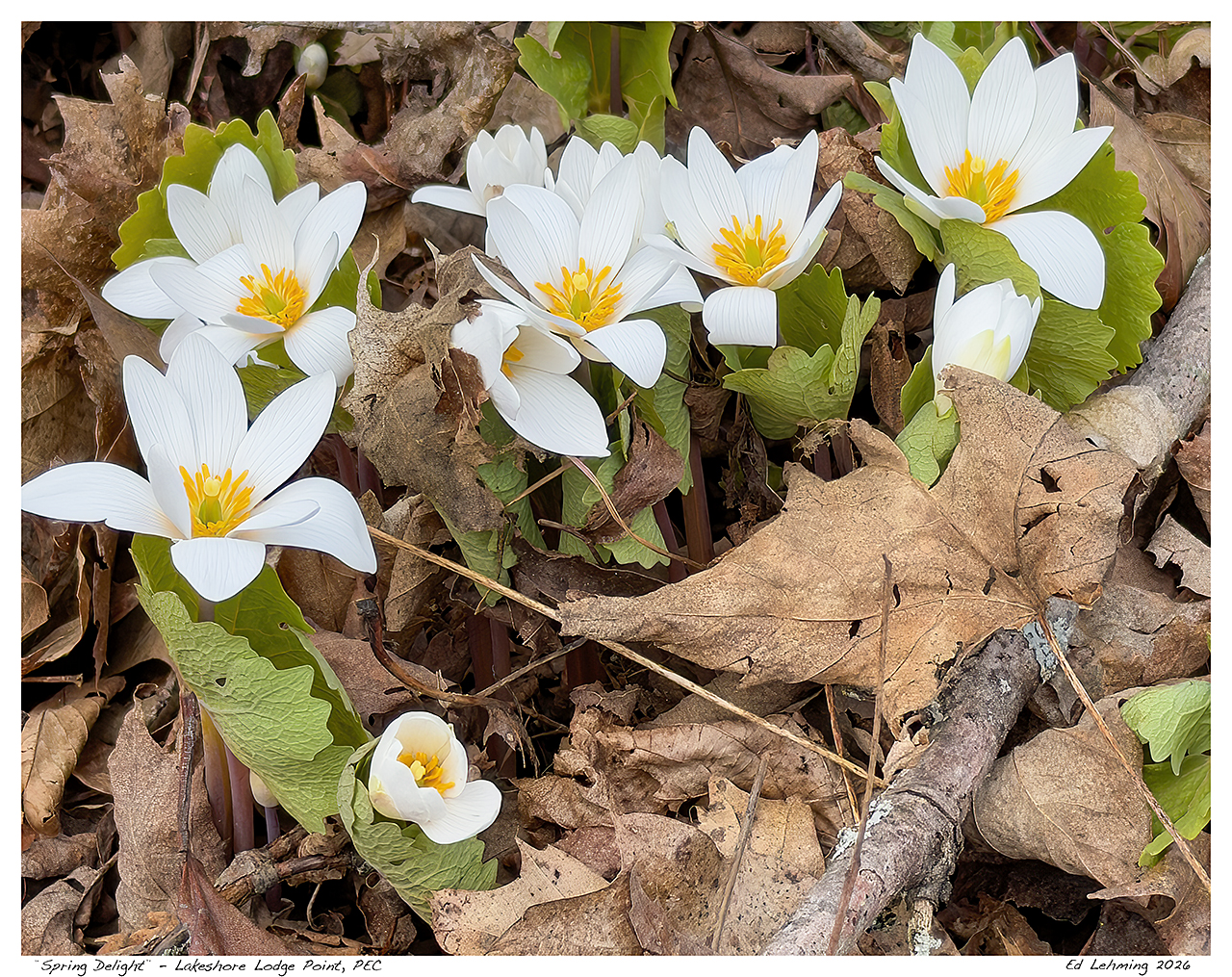
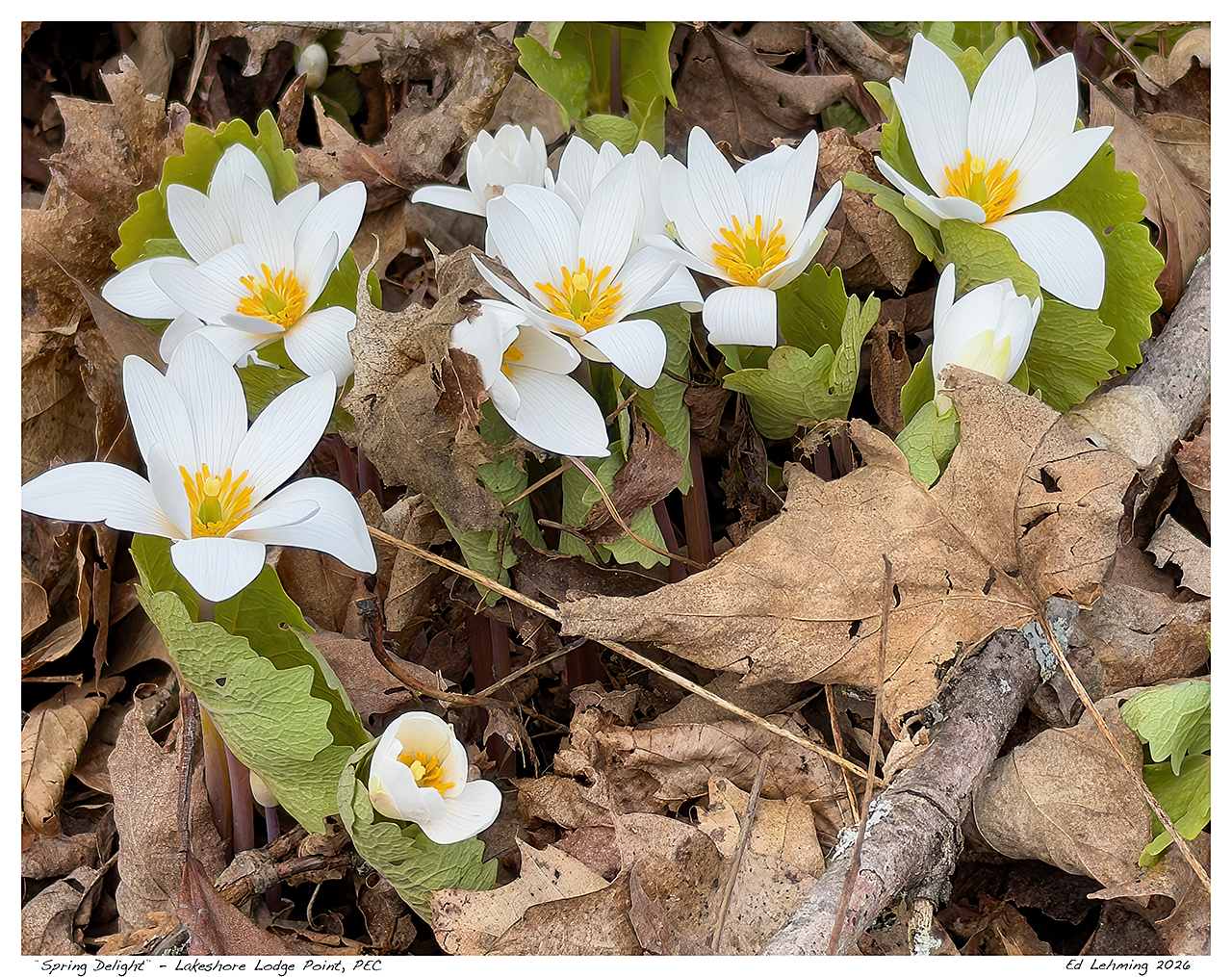
“After a long and gloomy winter, there is an unspeakable joy that comes with seeing the first blooms of spring; the world is waking from its winter slumber, and spring is on its way.” – Ed Lehming
Early last week, I took a look at my calendar and noted that this is usually the time when the first flowers, the spring ephemerals, begin to bloom. Each year is a bit different, but the signs of spring are ever present: the longer days of sunshine, the warming air, and the gradual “greening” of trees and grasses. It’s inevitable, but when?
This year, it felt like winter was holding its grip just a bit longer. The days felt cooler, rainier, and darker than in the past few years. But my calendar told me to ignore those characteristics and head out in search of signs of spring. On the first fairly mild day, I took a drive to Sandbanks Provincial Park, which is a twenty-minute drive from my home. It’s usually the first place around here that offers blossoms. As I drove, I scanned the roadside ditches for signs of life; usually, the bright yellow Coltsfoot is the first to bloom, but I did not see any on my journey.
I parked my car and headed along the trail to where a large patch of Bloodroot usually blooms. Again, no promising signs of flora along the way. And then, between the winter-weary trees, I saw a patch of white flashing. They were in bloom and in profusion! A feeling of joy filled me at the sight; the whole patch was in full bloom! It’s difficult to put into words the delight in seeing this—there is no turning back: spring has arrived in the County, as we refer to our region at the east end of Lake Ontario.
I also had the whole place to myself and took the time to fully enjoy it and capture several nice photos to keep the feeling with me.
iPhone 17 Pro Max
Main Camera — 109 mm
1/2415 sec, ƒ/1.78, ISO 80


Recent Comments