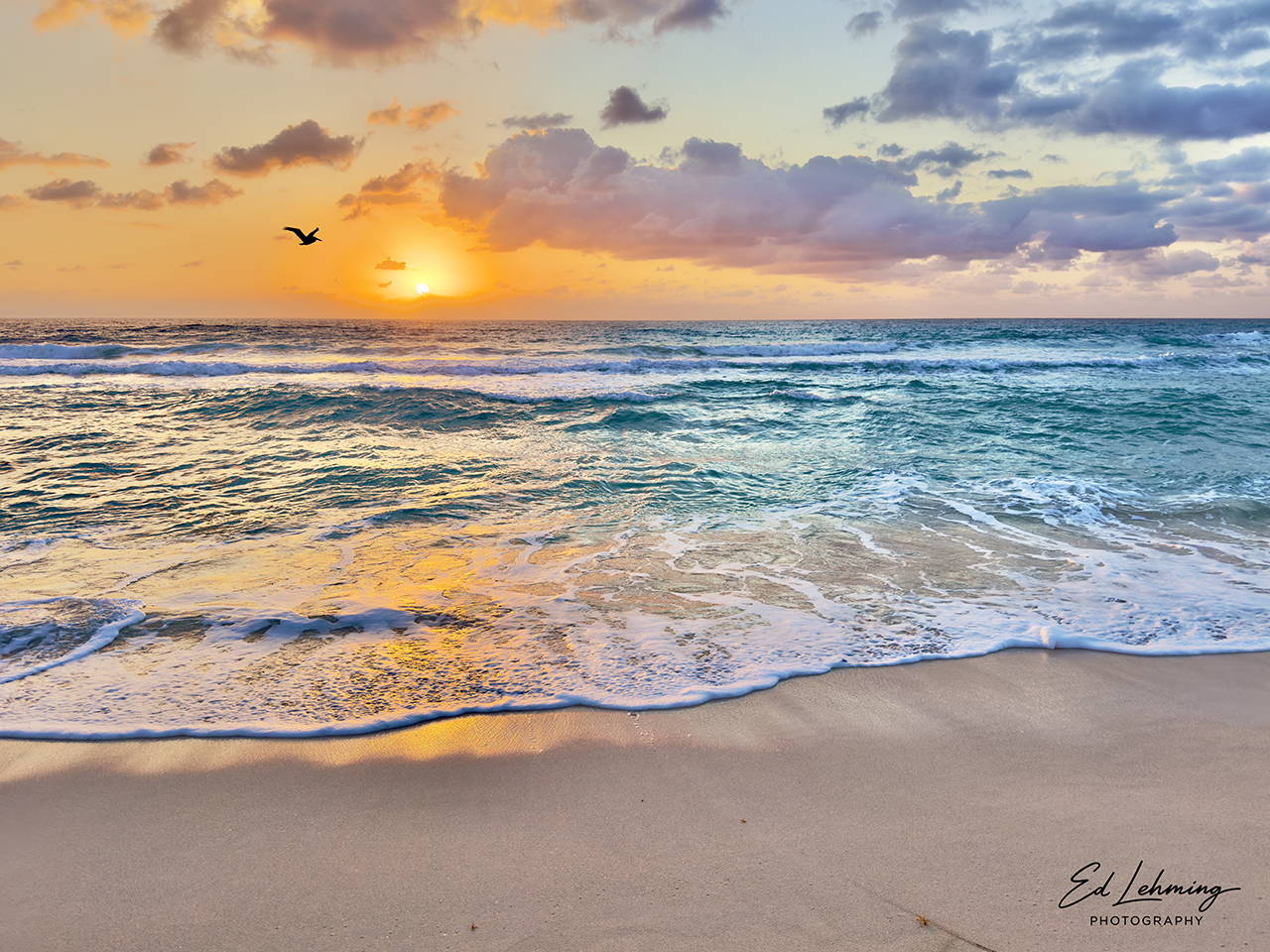
“Sunrises bring me not only their breathtaking beauty but also serve as gentle reminders of new beginnings and fresh starts. In these challenging times, filled with an overwhelming amount of bad news, I find myself seeking comfort in the cherished memories of those beautiful February beach days.” – Ed Lehming
I’ve been away from my blog for far too long. It was my son who reminded me of the personal value of journaling my journey through life through my photos. It’s strange, and this happened during COVID as well, that at times when it is probably more important than ever to spend some time in introspection, that is the same time when I drift away from my practice.
During a recent conversation, he asked me if I was planning on taking up blogging again, and I knew right away that the answer was, “Yes.” After all, over the past several months, I have not been idle and have many new images that have brought me a lot of joy—photos of travel, family, friends, events, and the world I live in—so why not start this endeavor once more? So here we are. Like the photo that I chose, a new start, a blank canvas, informed by the past but looking forward.
The image I chose was made a mere few weeks ago on the beach of our resort in Cancun, Mexico. I made a point of getting up with the sun every day and simply sitting with the day as it revealed itself to me. Every morning was just a bit different, and even when clouds covered the eastern horizon, the sun seemed to send a few welcoming rays into the sky anyway.
There is also a rhythm to these mornings. Just before the sun breaks on the horizon, there is a fairly long period of soft dawn light and a handful of fellow dawn welcomers. All is quiet except for the constant swooshing of waves on the shore. As the sun peeks over the horizon, the sky begins to fill with life; pelicans and gulls start to circle overhead, seeking their morning meal, and the day begins anew for all of us. And I just sat in quiet meditation, taking in the sights, the sounds, and the feel of the sun on my skin; bliss. No thought of anything except what was before my eyes, in the moment.
It’s that very moment that I want to carry with me to help me endure the world in its current state. I have printed this photo, and it sits on my desk as I write this. Through my work week, I look at it and recall a snippet of that moment and remind myself that this serenity is possible even in a chaotic world; I just need to recall it to sustain myself.
So, here we go. I’ll be going over many such moments, experienced in the recent past, considering the photos I have made of these “moments,” and realizing just how blessed I truly am to have experienced them along the way. And, hopefully, the inspiration to keep writing stays with me for more than a few days.
iPhone 17 Pro Max
Main Camera — 24 mm
1/1582 sec, ƒ/1.8, ISO 100
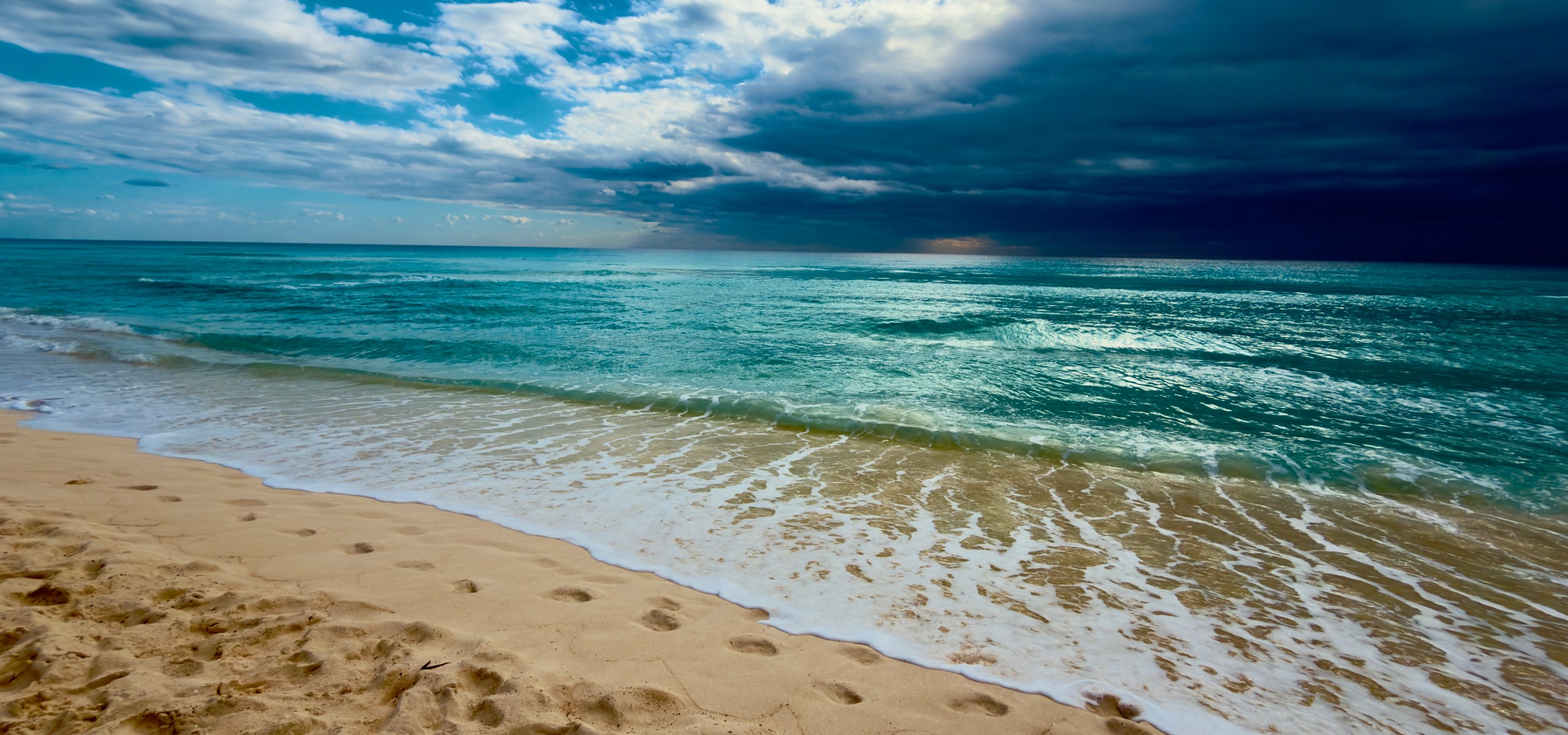
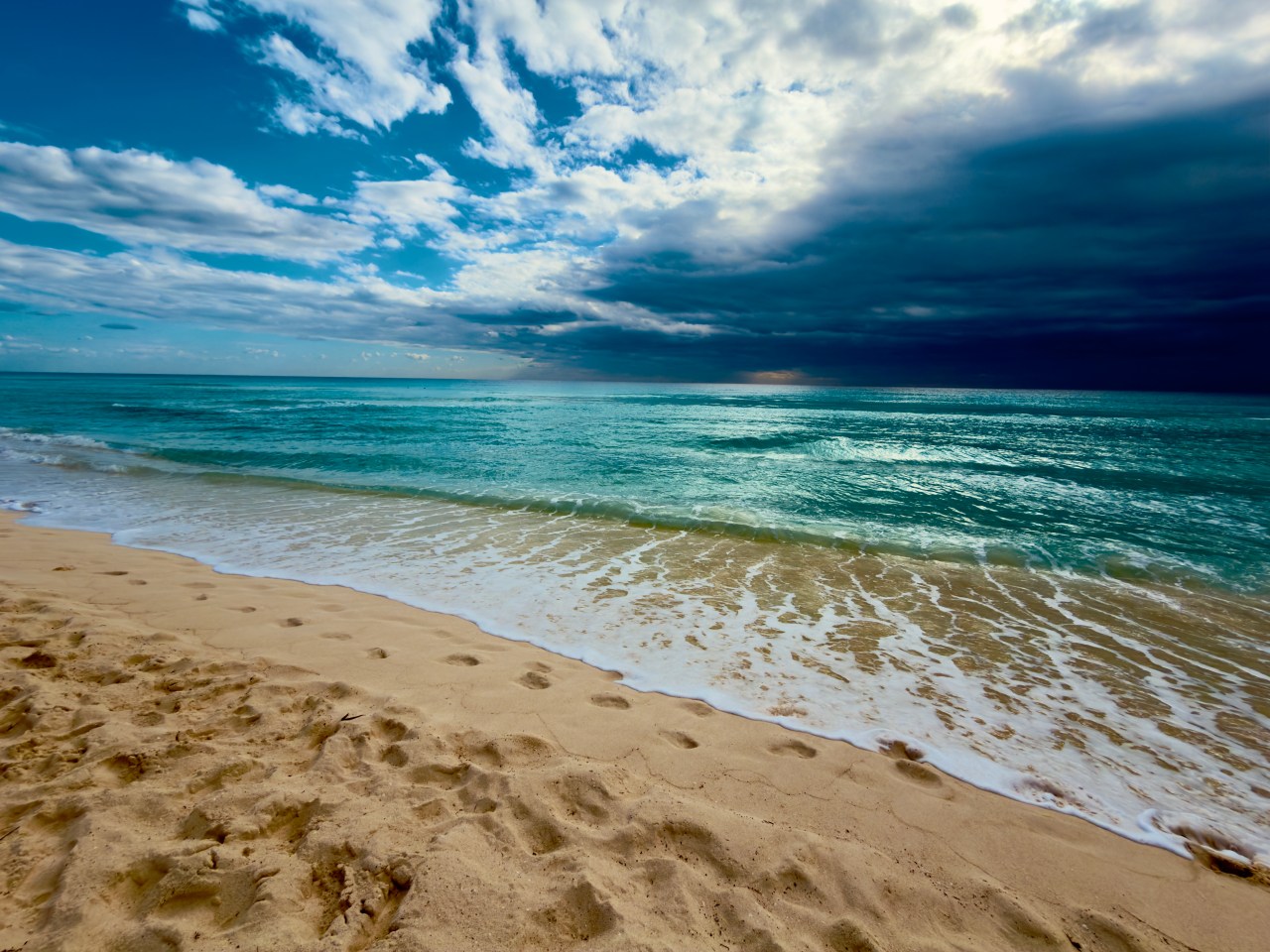
“There are days that, at first seem brooding and filled with dread. Let them unfold as they will. Those storm clouds may pass and the worry was for naught” – Ed Lehming
I made this photo a few weeks ago while vacationing in Cancun. While I made a point of capturing sunrises every day, this shot was taken around 9:45 am on February 8th. We had beautiful weather for the past few days, each day gradually warming after a chilly 17°C on our first day. This particular morning, dark clouds rolled in from the north, and we figured we were in for it.
Not a drop of rain landed on us; the storm remained well offshore, likely heading to Cozumel to spoil someone else’s morning. This experience was a poignant reminder that many of the worries we hold on to are often unfounded, much like the storm that threatened to disrupt our day but ultimately never reached us.
I tend to worry about things on the horizon—things that I can see or imagine. I’m not sure if this is something learned or simply part of me. Every event like this that passes reminds me that nothing is imminent. Forces beyond our control can just as easily change the outcome, often for the better.
As I reflect on this, I find it crucial to remember that worrying can cloud our perspective, much like those dark clouds that seemed so foreboding. Instead of fretting about what might happen, we should embrace the uncertainty of life and trust that not every looming threat will come to pass.
So, as I consider the world events around us right now, I’m hopeful that, like these dark and threatening clouds, the challenges we see are merely passing shadows that may not be as dire as they appear. Choosing not to worry allows us to appreciate the brightness that often follows the storm, finding peace in the knowledge that sometimes, things are not as bad as they seem, or might be.
iPhone 17 Pro Max
Main Camera — 14 mm
1/1522 sec, ƒ/2.2, ISO 20
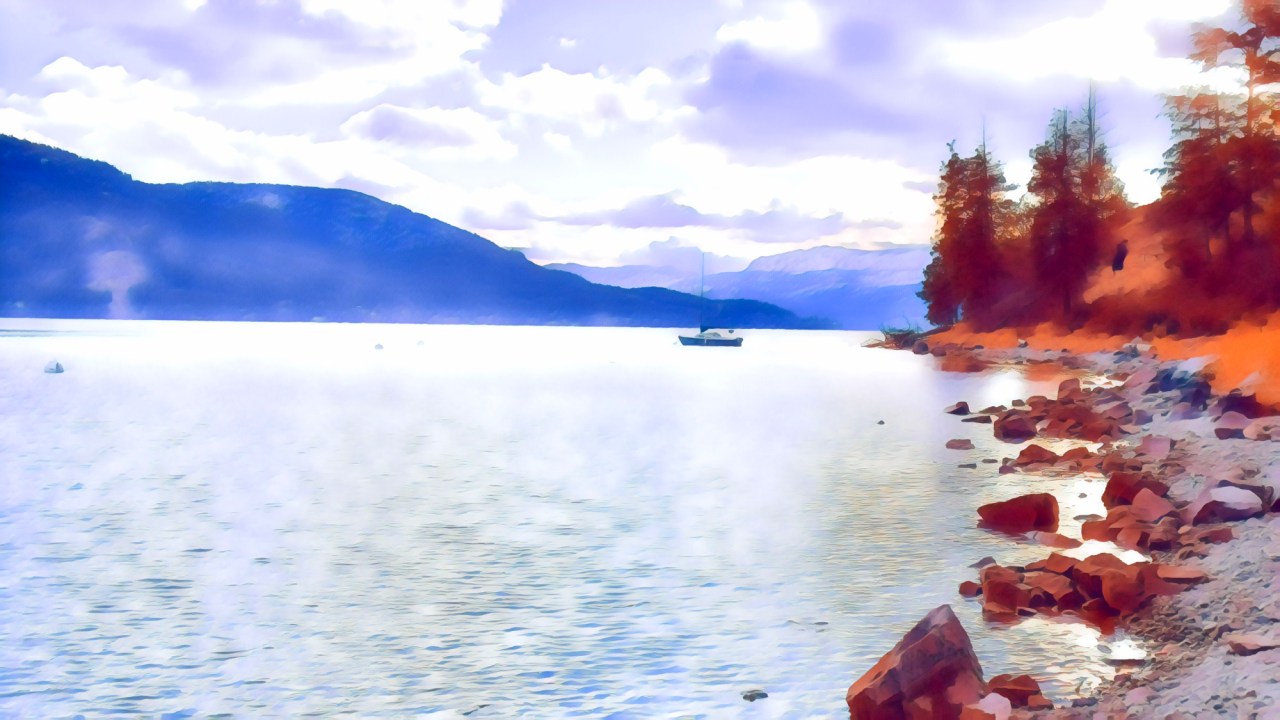
“Our lives are made of moments, all are on a scale from rapturous to devastating. There is a resilience that can come be built by holding up those moments to the light, carefully considering their place and meaning in time, and sorting them accordingly. It’s up to us to chose what to do with those moments.” – Ed Lehming
Memories of January 17, 2025. The day my mother left this life. A time of complex feelings, yet life also provided me such beauty at the time of this loss.
The memory of the moment she passed over will always linger with me. I’m so happy for this particular image because it was made at the same time she passed. I can look back on it and reflect on that singular moment, sometimes with sadness, but more often with joy for all the memories of the times I got to spend with her. The significance of that moment varies with whe I look at it.
I had time to myself on that Lake Okanagan shore, knowing what was about to happen in her hospice room and trying to come to terms with the permanence of it all. During that time, I purposely made photos of the world around me, primarily as points of reflection to recall those moments, as I’m doing today.
I rendered this image in a bit of a different way here. The dominant theme for me, today, represents a crossing over.

“Endings are beginnings and beginnings are endings. The cycle of time and nature continues, bringing both the sorrow of loss and joy of fresh starts.” – Ed Lehming
This is one of the final colourful autumn images I was able to capture this year. I had a “feeling” when I set out this day that it might be finale of sorts. The fall seemed too good to be true and the forcast of an early snowfall compelled me to get outside for some potentially final images.
I’m glad that I did, because the forecast heald true and we got a heavy early November snowfall the next day, effectively ending the colour, and blanketing the County with heavy wet snow. That same wet snow pulled down the last remaining leaves.
It was an important reminder to follow my gut on days like this. The conditions were perfect, with mild temperatures and lovely, soft sunlight. Not so much the following day.
I was just in the midst of preparing for my first solo photo exhibit and going through the images that I was showing inspired me to return once more to my intentional camera movement style, since the lighting was nicely balanced and the colors were still vibrant, with a nice mix of yellows, oranges, and greens in this narrow finger of Carolinian forest. In the background, some notes of turquoise from Lake Ontario peek through.I focussed my attention on a small Maple tree that still had its dry, golden leaves mostly intact. One “final flourish” before a long winter rest.
Nikon D800
Tamron SP 24-70 mm f/2.8 Di VC USD @ 52 mm
1/4 sec, f/22, ISO 100

“The forest is alive, it’s a living thing. See it and feel it. As the cold sets in, it may feel more dormant, but there is still more going on that may not be so obvious.” – Ed Lehming
This may be a final nod to the season of leaves and color for a few months, but it seemed worth the post.
As those who have known me over the years know, I love the forest and am constantly trying to present it in a way that communicates what I am feeling when I’m in the forest. For me, Intentional Camera Movement or ICM brings some of the feeling to the image.
The movement, something that I have learned and developed over time to be my own style, brings forth an energy that is not present in static images. I think that the slight movement adds confusion to the image that makes you look at it again, trying to figure it out. That second look brings forth elements that you may not have noticed at first; at least that is my theory on why this seems to work.
When I consider this image I made just a week ago, there are layers of color and texture that a still image would not present effectively. There are, of course, the bright yellow and orange leaves of the canopy that you notice at first, but look again and subtle layers of greens become visible, just above ground level. Then, as your vision pulls back, all the fine branches and undergrowth in the foreground show themselves. And then there is the bright blue of the early November sky peeking out behind it all.
I had set out this day with the sole purpose of capturing a few ICM shots to round out the season. I was challenged by a thinning canopy and bright skies, making it more difficult to capture images that pleased me. This is one of about five that I kept after culling all the trials. I think it works, given the conditions.
Nikon D800
Tamron SP 24-70 mm f/2.8 Di VC USD @ 62 mm
1/4 sec, f/22, ISO 400
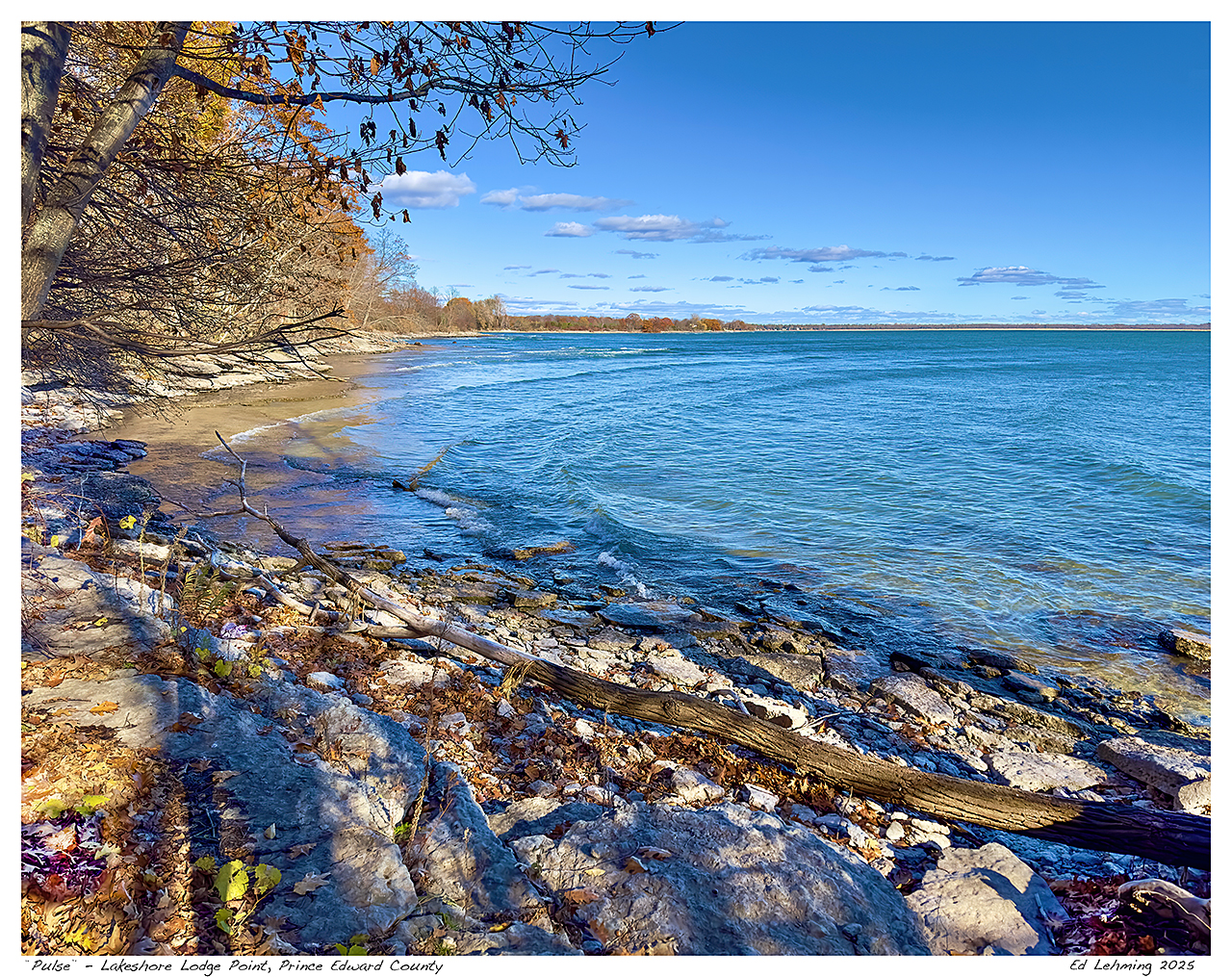
“The final sunny fall day before the snow arrives and the lake pulses in anticipation, as if aware of the coming change, filling the bay with echoes of its life” – Ed Lehming
This image was made yesterday. The forecasts called for snow today and I wanted one final day among the remaining colours of autumn. Many of the leaves had already fallen but pockets of colour remained along this point. Copper-tones oaks and a few sugar maples still held their leaves.
The inevitable outcome of early season snows is that the last leaves finally get pulled down by the weight of wet snow, and the feel of winter finally takes hold.
I’m truly blessed to live in a region with forests and lakeshore and this particular area has become on eof my favourite places to hike, make photos’ and just relax.
I’ve spent many years in the area around my old home hiking the vast tracts of forests and had little exposure to lakeshores, especially one as vast as Lake Ontario. Just as I became aware of the pulse and life of the forests, I’m beginning to understand and appreciate that the same is true of bodies of water. As seasons change and weather systems roll across, the very character of the water changes in response.
As I looked across the bay, the waves formed to the shoreline creating what appeared to me as a “pulse”, thus the tile of this photo. It summed it all up in one word.
For those wondering, yes, the water really is this colour, enhanced by the deep blue autumn sky. There are days where it becomes bright emerald, ar and angry gray. But on this day, deep blue was the tone.
Far in the distance and sweeping to the right is Outlet Beach, as vast freshwater beach which is part of Ontario’s fames Sandbanks Provincial Park. The park also features a lot of flat, rocky limestone ledges, which are also visible in the image and I’m sure will be featured in future posts.
iPhone 14 Pro Max back triple camera 24 mm
1/4900 sec, f/1.8, ISO 100

“Winter’s teeth bite deep into the shoreline and the familiar becomes alien and unknown” – Ed Lehming
I could spend hours with my recent images from the shores of Lake Ontario at Sandbanks Provincial Park. It’s a quick 20 minute drive from home and seems to offer me something new every time I go there.
I’m new to living this close to Lake Ontario (though I grew up in Scarborough but did not venture to the lake in winter) and the features created by this massive body of water. Until recently, I had never used terms like ice shelf, cryovolcano, or break-offs, yet they are all in this image. The photo also allows me more time to look deep into the structures.
For example, the cryovolcano to the center-left can now be seen in detail, and I can observe the structures that form it. Larger chunks of ice have solidified with snow to form a solid mass that makes up the main structure. To the right, you can see a larger mass of shelf ice that has a similar composition. It’s not pure ice, but rather a blend of ice and snow, frozen together to form a thick shelf.
Offshore, in a blend of thinner and newly formed ice and patches of open water, pieces of shelf ice that have broken free from shore are locked in place as the lake continues to freeze in the chilly -12 degree temperatures.
What the photo does not communicate, but is ever-present, is the deep rumble and constant clicking and popping of the ice as it shifts and settles, even with no wind to speak of. It’s ever-changing, ever-adjusting as it floats above the frigid waters below. It’s important to remember that this mass of ice could shift or break away to join its companions further offshore.
As I was making this image, another photographer ventured out on the shelf ice, a big no-no for those who understand the nature of the ice. Eventually, he ended up way out on the large structure to the right. I should also note that this image was made safely from shore, and I was some 50 meters back using my telephoto. Even close to the shore, the ice can shift and heave unexpectedly, so it’s not worth the risk for a photo. I lost track of the other photographer until later in the afternoon.
The last time I checked, Lake Ontario was 18% iced over. For perspective, the far shore in this image is some 80 kilometers distant. The lake is roughly 310 kilometers long and has an average depth of 85 meters. It’s a BIG body of water and rarely freezes over completely due to its depth, volume, and the insulating properties of the ice shelves. The last recorded freeze-over was in 1934. But there is still lots of winter left, so time will tell.
Nikon D800
Nikkor 70-300mm f/4.5-5.6 G I AF-S VR Zoom @ 116 mm
1/800 sec, f14, ISO 400
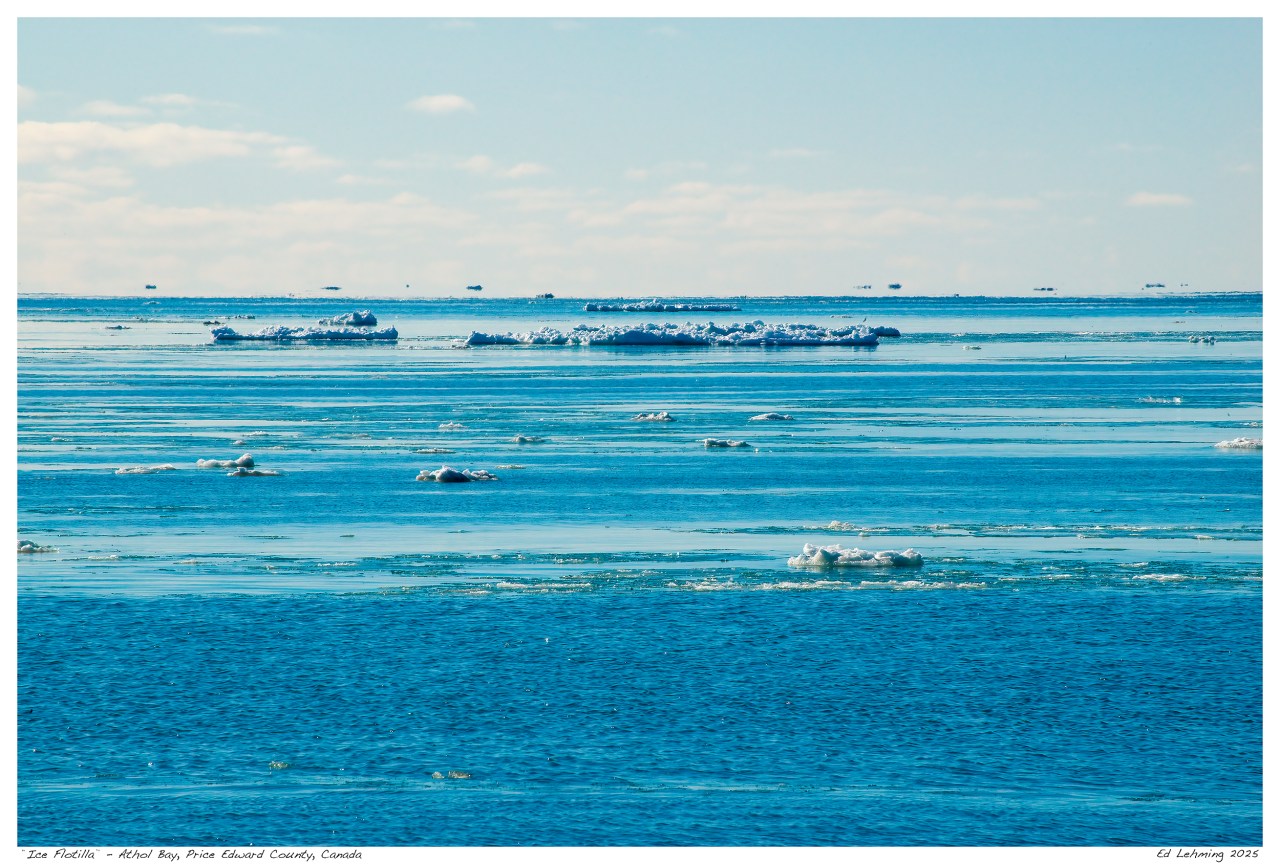
“The freeze is on, winter has us firmly in its grip, and the world is transformed from liquid to solid, seemingly overnight. The horizon is filled with ice and illusions” – Ed Lehming
The title for the scene seemed fairly obvious to me, looking across Lake Ontario, particularly, Athol Bay in Ontario’s Prince Edward County. This bay is bounded by Lakeshore Lodge Point to the north and Salmon Point to the south. It’s a large almost square bay that is responsible for the formation of Outlet Beach to the east, a very popular destination for summer beach goers. The winter, is a different story.
The lake in front of me had been transformed from what had only been a few weeks before open water with ducks swimming and had now became a vast frozen sea of sheer ice, with a few patches of open water; the frozen landscape punctuated by large masses of floating ice and snow that had broken free from shore during a recent storm.
What really stood out for me was the brilliant blues of the fresh ice. Clearly visible because of the lack of significant snow. I suspect that the snow which had fallen last weeks had combined with pieces of fractured lake ice to form a frozen conglomerate that formed these large frozen rafts, now trapped in ice.
I spent about an hour walking along the shore mesmerized by the scene in front of me. It felt like it was somewhere in the Arctic and not in my South-East Ontario neighbourhood. Since moving here, I’ve begun to make the shift from wooded trails to endless shorelines and water, and I’m learning about all the new features that the lake presents. This scene took me by surprise. I was expecting ice, but I wasn’t expecting these large rafts of snow and ice floating as far as the horizon. And then, there is the optical illusion of the pieces seemingly floating high above the water. It just looks well, odd. Given the distance, I suspect they are larger than the pieces in the foreground. The whole thing reminded me of the D-Day flotillas of boats approaching the shores for France.
To get this shot, I stood on shore and zoomed fully to 300 mm to crop past the vast shelf of sheet ice that filled the east end of the bay. This is a long way out!
Nikon D800
Nikkor 70-300mm f/4.5-5.6 G I AF-S VR Zoom @ 300 mm
1/250 sec, f29, ISO 400

“Life changes in a heartbeat, what was once so close and familiar can change and become distant, seemingly out of reach, like a distant horizon. We know it’s out there, but it takes trust and time to get there.” – Ed Lehming
Today was a tough day. This is the day my mother’s life ended. I look out the window of my hotel room, and the mountains of the Okanagan that have been her daily view for most of her life are bright with sunshine. I can’t help but lock this image in my memory. Despite this beauty, a little more of this world’s beauty has left us.
Right now, the feelings are pretty raw. This is not the first family death that I have experienced, but this time there are a lot of unresolved family dynamics that will take me a long time to unpack and process.
For now, I will hold the memories of my mother dear. We had some very beautiful times and memories; individually and with my siblings, aunts, and uncles. We spent summer days on the beach of her Lake Okanagan home, shared family genealogy with family in Ontario, and connected with distant cousins in Cabo San Lucas. All these times are indelibly etched in my memory of her.
We also shared times of sadness and grief at the loss of close family members, particularly the passing of my sister Carrie just over two years ago, in the same hospice. That was a profound loss for all of us, and I wonder if the sky was as bright on that day. I like to think so. There are so many of these overlapping moments in my family, and I suppose that offers me some comfort too.
I also made a point to be somewhere meaningful when she passed. So I drove to the shores of Lake Okanagan, across from where she lived for many years. From the shore, I could see her house. Around the time that she passed, the sun burst through the clouds, yielding the photo above. At the same time, a magpie landed on the tree above me. I knew she was gone, and for me, the magpie was not just a signal of her passing but a symbol of reciprocity. Not something instant, but something that will require patience and learning on my part. It brings me hope for healing.
iPhone 14 Pro Max back triple camera 14 mm
1/1473 sec, f/2.2, ISO 50

“The summer beach has transformed, even though the beach sand is still exposed, the shoreline has now transformed into the ice and snow of winter. Where I stand, the worlds seem to meet.” – Ed Lehming
I made this image over a week ago and had titled it at that time. Since that time life has thrown me a few curve balls. So, I expect my upcoming theme will be about transitions. The transitions in life that parallel my experiences as a photographer. These parallels resonate with me more and more, and I’ve begun to consider what life events will tie back to my images next.
This past week I found out that my mother’s cancer had accelerated and we expect she will part this world tomorrow, another transition. So, tying back to the image, what seems today as a bleak and harsh time does show promise on the horizon. I am hopeful for good outcomes.
Back to the image, the tall ice structure in the foreground is another cryovolcano. These things absolutely fascinate me, because they are so otherworldly, and this one had such nice structure against the shelf ice. The storm clouds over the lake simply enhance the alien appearance of the landscape.
Nikon D800
Nikkor 70-300mm f/4.5-5.6 G I AF-S VR Zoom @ 140 mm
1/640 sec, f13, ISO 400
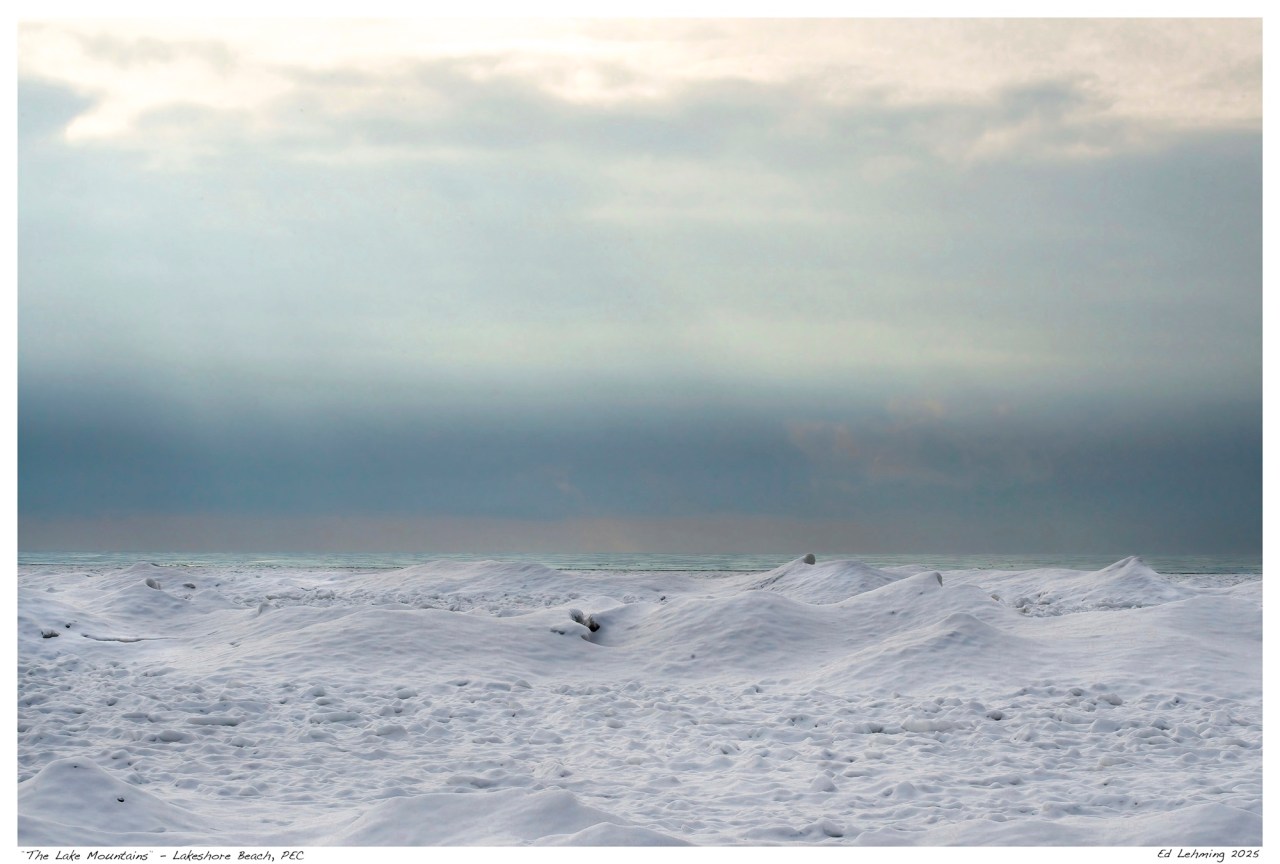
“The view was surreal, there were mountains where the water was, only a few days before. The world had transformed fully to winter” – Ed Lehming
As I mentioned in yesterday’s post, these lake mountains, or cryo-volcanoes, are something that’s unique to the Great Lakes, as far as I know. They probably occur in any cold weather, fresh water lake that is big enough to generate the wave force to create them.
The photo I chose for today was taken minutes after the photo that I shared yesterday. However, this photo really appeals to me because the sky had opened up a little bit above me, and bright rays of sunshine beamed down on top of the open ice and the water on the horizon. I just thought it was a nicer composition.
I do have to say that I struggled a little bit trying to name this image, and calling it the Lake Mountains just seemed a bit obvious. However, I really had nothing else that came to mind, so here it is.
Nikon D800
Nikkor 70-300mm f/4.5-5.6 G I AF-S VR Zoom @ 70 mm
1/500 sec, f11, ISO 400

“Water, in its many forms, continues to amaze me. From warm gentle streams in summer to the surprising frozen cryovolcanoes of the shelf-ice of the Great Lakes, water is ever changing” – Ed Lehming
Today, I went for a walk along the shores of Lake Ontario. My destination, once more, was Lakeshore Beach in Sandbanks Provincial Park, which I have written about quite a bit lately. Just a few weeks ago, the water was wide open, and people were enjoying a leisurely winter stroll along the beach, the waves rolling into the shore.
As I descended the narrow path towards the beach, I noticed a significant change in the landscape. The once open water was now covered in mountains of snow and ice. And a feature that I believe is unique to large bodies of fresh-water; cryovolcanoes.
Cryovolcanoes are formed in the colder days of winter, once ice has formed a thick crust. When storms force water to shore and under the ice shelf, the force of the wind presses the water beneath the shelf ice, forcing it through a crack or a hole. The water sprays through this opening and freezes on contact with the ice and cold air, forming a cone, much like a typical volcano. Except here, it is water cooling, not lava. The water continues to flow and freeze, eventually forming the tall, distinct mountain shapes.
When the shallower water closer to shore freezes, the water is cut off, and the whole process begins again, just further out. This creates even bigger volcanoes since the water below is deeper and takes longer to freeze. It’s a fascinating process.
Today, there were several people walking on the beach, taking in the sights and reminiscing about what the shoreline looked like a week ago.
Most people around here are actually quite water-savvy and avoid the shelf ice, which, while beautiful and interesting, can be extremely fragile and dangerous. The temptation is to venture out to these mountains of ice and cryovolcanoes to get a closer look. However, it’s extremely dangerous, and I was glad I had my long lens with me today to capture a few stunning photographs of these unique features from the safety of shore.
Nikon D800
Nikkor 70-300mm f/4.5-5.6 G I AF-S VR Zoom @ 185 mm
1/800 sec, f14, ISO 400

“Even on the coldest winter days, time spent outdoors and be a joy” – Ed Lehming
This photo resonates with me for some reason. I was wrapping up my photography of the raging waters at Prince Edward County’s Lakeshore Beach, and I took a final look across the beach. The beach stood empty. Then, a few minutes later, two people came across the dunes and proceeded with their stroll along the beach. It really struck me that this place, which is usually filled with sun, bathers, and tourists, can be a place where people can find some comfort and serenity, even in the exposed solitude of the winter dunes, the waves crashing fiercely against the shore. You can see the shores have been eroded by the recent storms, but they will recover over the next few days. It’s not like this is the first storm they have faced. Despite the cold and howling winds, these people will have spent their afternoon enjoying some quiet walking along the beach together. It was just the moment that felt good to capture.
It’s also a bit of a strange picture for me because I usually don’t like to have people in my photos, but they complemented the shot and gave it a sense of scale. It just felt right to have this couple in the photograph on this particular day.
Nikon D800
Nikkor 70-300mm f/4.5-5.6 G I AF-S VR Zoom @ 220 mm
1/320 sec, f9, ISO 400
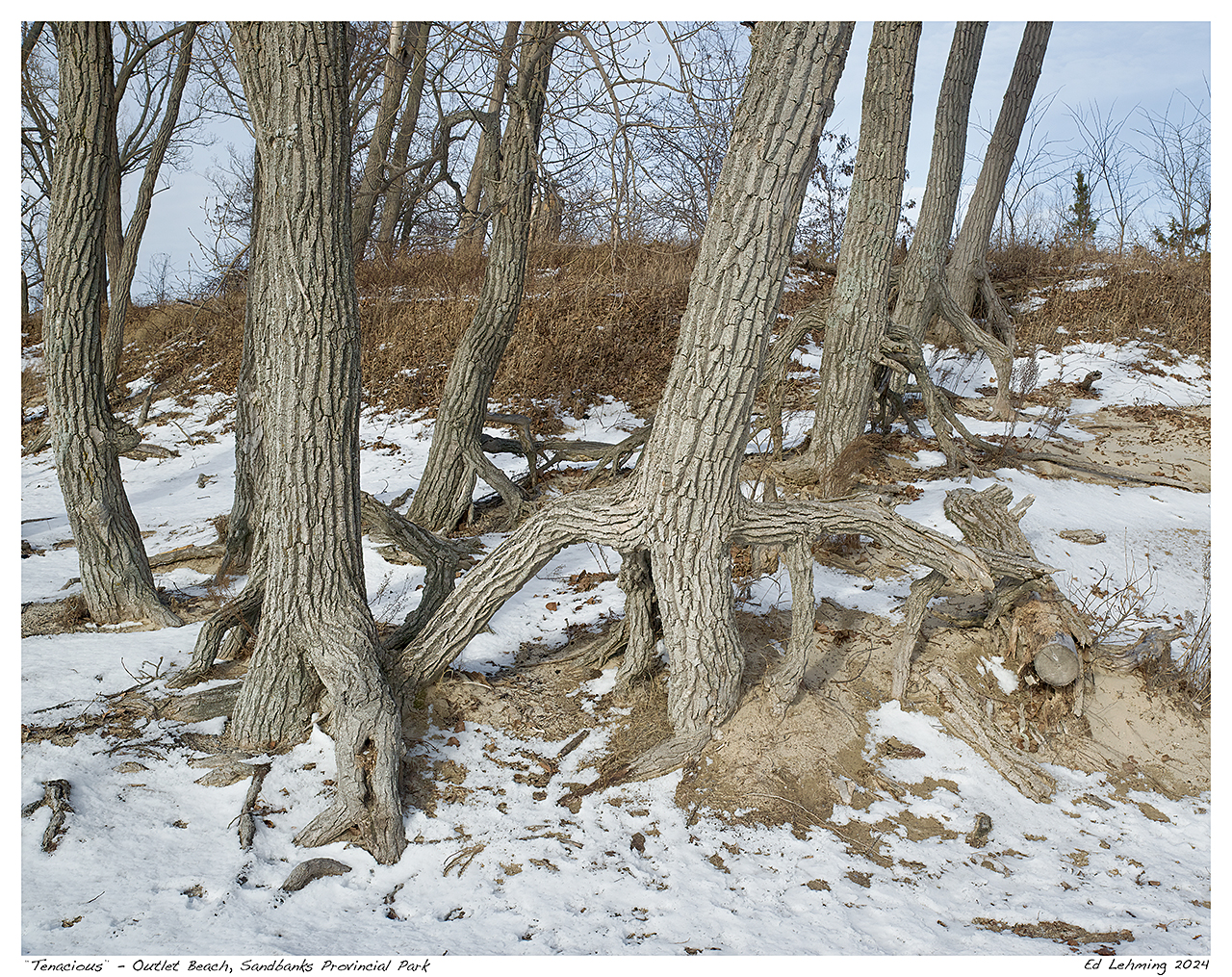
“Floating strangely above the ground, it soon becomes apparent why these tree roots look like they do. In nature, nothing happens by chance.” – Ed Lehming
A few weeks ago, I visited Outlet Beach in Sandbanks Provincial Park. I had been there before on several occasions, but this day I walked along the edge of the sand dunes with the intention of photographing them and trying to see them in more detail. I often do this: visit an area that is fairly familiar but really immerse myself in the environment.
I honestly don’t recall seeing this phenomenon on previous visits. Perhaps the roots were not exposed during previous visits, or I had simply missed them. As far as I know, this is the only place along the beach where this effect is so pronounced. The trees hover above the sand on roots that have grown bark to protect them, making the roots look more like branches. It looks very odd, but I see the purpose behind the adaptation. Since these cottonwood trees grow within the sand dunes, they have adapted to the ever-changing sand levels. As you can see, some of them are nearly two feet above the current sand levels.
On my next visit, I’ll have to check if the sand has once again filled the void below the trees, since the sand is forever on the move.
Nikon D800
Tamron SP 24-70 mm f/2.8 Di VC USD @ 31 mm
1/320 sec, f/9, ISO 400

“The play of light on the water was a sight to behold. In the background, dark storm clouds loomed over the lake, yet bright rays of sunlight on the storm’s edge caught the rolling waves and lit them up as if from within. But only for a moment, then it was gone, and darkness prevailed” – Ed Lehming
It’s moments like this that photographers dream of. The stunning contrast between the dark blue sky and the bright waves was astounding; a rare moment when the elements align. For much of the time that I was visiting this location, the start of the show was the churning lake. I got a few good shots of this, but suddenly the world before me turned to pure magic. It was like two separate worlds in one image.
I had no problem whatsoever naming this image; the wave was the most amazing bright green. Against the black sky, it was stunning. My biggest challenge was exposing the shot correctly. It took only two tries to get this image, and then the sun was gone again.
That is one thing that I’m constantly reminded of: great moments are fleeting, and it’s so critically important that the photographer is prepared to adapt and adjust instinctively. All those settings we need to consider: shutter speed, aperture, ISO, and focus must happen within seconds; there is no time to think about them without hesitation. I honestly attribute this ‘muscle memory’ to the countless failures that I’ve had—all those missed opportunities—that have taught me how to adapt to varying conditions because there are no second chances.
Nikon D800
Nikkor 70-300mm f/4.5-5.6 G I AF-S VR Zoom @ 260 mm
1/500 sec, f/11, ISO 400

On a stormy shore, a lone maple bears witness to the churning waves. This steadfast tree stands resilient, a symbol of endurance and beauty, unfaltered by the storm that rages on the horizon, reminding me, once again, of the power of nature and the tranquility that can be found even in chaos. – Ed Lehming
This image just beckoned to be rendered in black and white. The scene was intensely moody and a bit somber, encapsulating the essence of a winter’s day that felt both desolate and beautiful. Across the lake lies Oswego, New York, which looked like it was experiencing the full brunt of the January snow squall.
When I left home to visit the shore for some pictures, the sky was slightly overcast, and a few delicate flurries drifted through the air, giving me hope that my outing would yield some captivating shots. However, when I arrived at the lakeshore twenty minutes later, I was greeted by howling winds and raging waves crashing against the icy shoreline. It was completely unexpected, yet stunningly beautiful in its chaos. The energy of the storm, many kilometers away, was palpable, and I couldn’t help but feel a rush of exhilaration at being part of such a lively spectacle of light and dark. Which is another reason for presenting this in black and white.
A bonus during my visit was the occasional opening in the clouds, which allowed bursts of bright sunlight to break through the gloom, providing me with spectacular lighting for my photographs. Each moment felt like a new scene was unfolding just for me.
Due to the extreme cold and the relentless wind, I did not spend much time at the lakeshore, but I knew what I wanted as far as photos. I proceeded to shoot about 20 images, each one different from the last, capturing not only the landscape but also the ethereal quality of the winter air. This tree stood sentinel at the end of my walk, its gnarled branches silhouetted against the stark backdrop; it felt like the embodiment of resilience amid the harsh winter.
With my fingers frozen despite a warm jacket and gloves, I reluctantly headed back, already pondering the images I had captured and the stories they would tell. Sunday’s adventure, marked by the visceral encounter with nature’s raw beauty, will linger in my mind long after I returned home, reminding me of the magic to be found even in the most challenging of conditions.
Nikon D800
Tamron SP 24-70 mm f/2.8 Di VC USD @ 50 mm
1/200 sec, f/7.1, ISO 400

“As the storms rage over the lake, even the shoreline vegetation bears testimony to this often harsh environment, leaning over the frigid water, as if to brace for what is to come” – Ed Lehming
I’ve made a few photos from this very spot, but yesterday, as the wind howled over the waters of Lake Ontario, I noticed this maple tree, still bearing some dried leaves, leaning over the edge, taking in the full force of the western winds. What initially caught my attention was the leaves which seem frozen in time, caught in a perpetual breeze.
Beyond the tree is the rock-strewn shore, ice clinging to the slabs of limestone, and the deep turquoise waves pounding the shore. Further beyond lies Lakeshore Beach, bereft of summer sunbathers and also feeling the impact of the wind-whipped waves.
And immediately behind me, to further complement the experience, was the scene I that posted yesterday.
The whole scene opened up from that one glance at the leaves. I immediately saw a composition that captured that moment in time. All the elements work together to tell the story of this blustery day on the western shore of Ontario’s Prince Edward County and Sandbanks Provincial Park. It was not till I got home and started to review the images from the day that I noticed how nicely the orange of the maple leaves complemented the greens of the water and the beautiful structure of the rocks below. Once more, it’s one of those scenes that I witness that I know just works, but am not sure why until I spend more time with the image.
Nikon D800
Tamron SP 24-70 mm f/2.8 Di VC USD @ 24 mm
1/250 sec, f/8, ISO 400
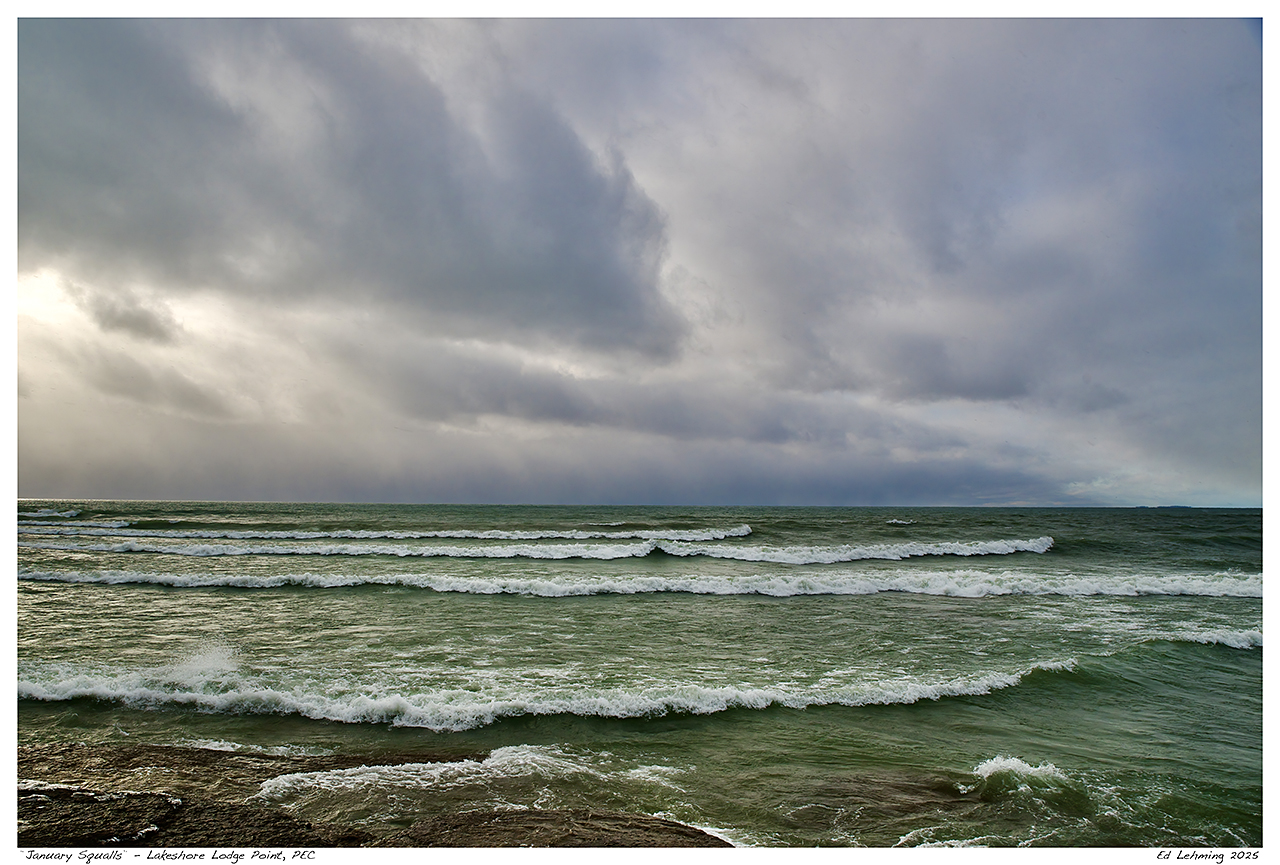
“Water brings me energy. To see waves pounding, to feel the spray, and to taste it in the air is always an amazing thing. Water is a living, breathing thing, continually moving. I feel it in my soul.” – Ed Lehming
Today’s image is a break from the calm, serene beach scenes that I have been posting recently. Today’s image, captured in the same place that last week yielded gently rolling waves, has transformed into a dark and angry blender of rocks and pounding surf.
After all, it is now January, and Lake Ontario is not known to lay dormant for long. Today, as I left my house, I was anticipating dreamy seascapes, with gentle snow wafting down. Because, at my house, a mere 20 minutes from this location, there was no wind and the sky was a mix of sun and cloud.
Imagine my surprise when I pulled into the parking area and saw massive whitecaps breaking on the lake. That changed everything. I was excited to see the churning waves and frozen shoreline. There was nothing serene about it; it was pure, raging energy.
I walked along the shore to my regular vantage points, all transformed by the storms that raged over the lake, but not above me. Where I stood, sunlight broke through and lit up the water, to a point where the images I was previewing looked like paintings; the storm surge was just that intense. And in the background, black storm clouds, the squalls produced over Lake Ontario by cold north-west winds, were seen clearly on the horizon. This is winter on the Great Lakes; the lakes, with their still relatively warm waters, have not frozen over, and wind picks up moisture and turns it to snow in the form of intense squall lines.
Standing on the shore making this image was a glorious but bone-chilling experience. I loved the play of light on the horizon as the sun occasionally broke through. You can see the snow falling near the horizon on the left and the blue sky to the right. That is how fast the wind makes now.
The image is a bit darker and more brooding than my regular style, but I’m trying to stay true to my intent on accurately communicating the mood that I experience as I witness these scenes. I’m pleased with the results of my first excursion of 2025 and hope to share more over the coming days.
Nikon D800
Tamron SP 24-70 mm f/2.8 Di VC USD @ 24 mm
1/320 sec, f/9, ISO 400
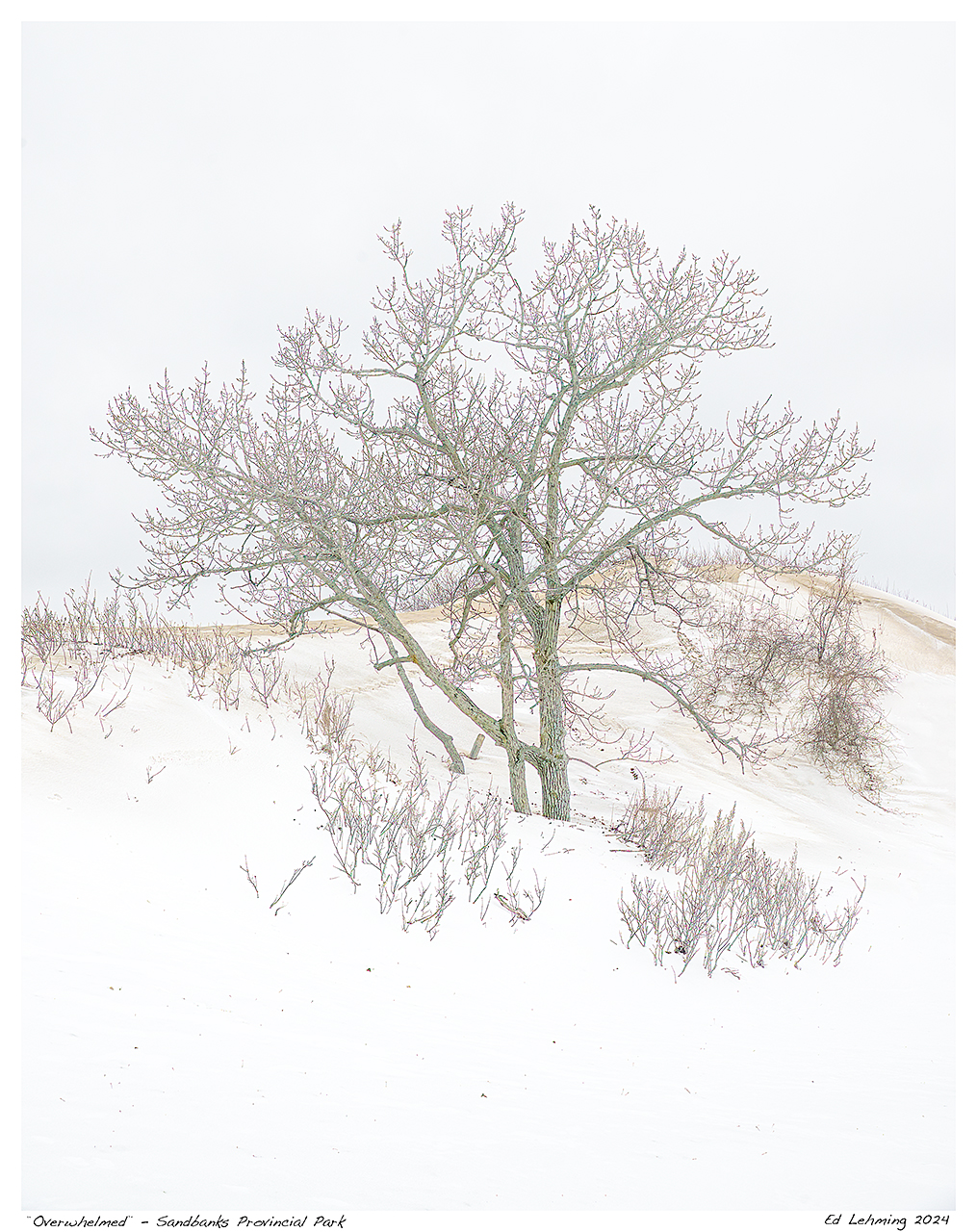
“What appears to us as tenacity is often simply adaptation.” – Ed Lehming
This cottonwood tree, seemingly overwhelmed by the ever-shifting drifting sand, is not alone. These trees have adapted with a root system that allows for fluctuations in sand depth. I’ve seen the tree trunks several feet above the sand, as if the trees are on stilts, and one like this buried to an equal depth. The root wood adapts, becoming tougher and resembling inverted branches. The tree in this image is probably buried in about two to three feet of sand and may be quite exposed by next summer.
It’s interesting to observe this type of phenomenon; it’s all about nature’s amazing ability to adapt. Some species are more successful than others, and those are the flora and fauna of the dunes—the adapters, the survivors.
I had not noticed how deeply buried the tree was initially; I just saw an interesting composition. That is often the way of my photos. I see something subtle, something intangible, which often does not reveal itself until I spend more time with the image, and then it reveals itself and I understand. I believe that is the difference between a good composition and a snapshot: the ability to unconsciously distill details not immediately obvious.
Like the tree in the image, I’ve had to adapt some of my approaches to capture the subtleties of the dunes, which to many, especially at this time of year, would appear barren and lifeless.
Nikon D800
Tamron SP 24-70 mm f/2.8 Di VC USD @ 45 mm
1/250 sec, f/8, ISO 400

“Colour and movement danced before me as the waves wove a pattern of unexpected brightness under a winter sky, not yet locked in ice; they put on a final show for me.” – Ed Lehming
I love water. I love how it moves, the sounds it makes, and the constant sense of being a living thing. I also like to accentuate movement by adding movement of my own. Intentional Camera Movement (ICM) is a technique that I have used many times in forest scenes and a few seascapes. On this day, the light was subdued enough that I could get good results without adding neutral density filters or any other accessory to get pleasing images.
My hike among the dunes had concluded, and I drove the short distance to Lakeshore Lodge Point, still within Prince Edward County’s Sandbanks Provincial Park. One of the nice features of this point, jutting into Lake Ontario, is a shallow shelf of limestone that juts out into the lake. I find that the combination of rock, water, and moss creates some beautiful colour.
On this day, there was a slight breeze, which created shallow waves just tall enough to crest into low whitecaps, adding a touch of white to the palette. The way the waves crossed the rock and the backflow created this lovely weave effect that inspired the title of the image. After a few horizontal pans at low shutter speeds, I found I had the mix I needed to let the colours and movement of the water really show.
The tan that you see in the foreground is the limestone and a bit of sand, which switches to a deeper green as the water crosses a deeper point, then light green/aqua, before the lighter blues of the water further out dominate. There are also touches of lavender mixed in, which I can’t really explain, but they were there, and the longer shutter speed simply enhanced them, really complementing the greens.
What I really like about this technique is that every image is unique and unexpected, yet I can loosely anticipate the final outcome as I make the image, so it’s not just pure chance. Doing these handheld also adds some unpredictability and personalization to the shot. You’ll never get two the same. It’s kind of like a fingerprint.
I made about 20 images of the water movement that day and have only processed three so far, which I will spread out over a few days, but this is my favourite.
Nikon D800
Nikkor 70-300mm f/4.5-5.6 G I AF-S VR Zoom @ 300 mm
1/4 sec, f/40, ISO 640

“The first real snows filled the gaps in the dunes, drifted snow covering the drifted sand. A seasonal change” – Ed Lehming
I’ve been enjoying reviewing the images I made several days ago. That day brought some significant changes to an established photographic method and style. To get the images to communicate the nature of the environment, I had to change how I communicated as well.
As those who follow this blog will know, I previously spent a lot of time on forest trails, in somewhat subdued or diffused light. Photographing sand dunes in wide open spaces is much different in appearance and camera settings.
In this case, I wanted to communicate the bleak and windswept landscape, which I found was better accomplished by slightly overexposing the image. Yet, I still wanted to show the important details of the frozen water in the foreground while muting the dull sky. I’m not a fan of high-key images, so I pushed my exposure slightly as I shot the scene and made some subtle adjustments in post-processing to balance the winter tones. I also wanted to retain the details of the trees, which are a key element of the shot and are what drew me to the composition initially. I also did not want to lose the shadows, which add some sense of structure and depth to the image. It was a bunch of fine-tuning in post that yielded the final image.
I think it works, as when I look at it on my screen, I feel like I am looking at it live all over again.
Where I did struggle a bit was coming up with a title for the image. So, I went for a mental note of the location. As I walked the frozen shore, this was the first gap in a continuous line of sand dunes and what struck me initially about eh scene was the snow drifting between this gap. Nothing else resonated with me. I also realized that this is a closer shot of a previously posted image. Seeing things in new ways has been an interesting experience for me.
iPhone 14 Pro Max back triple camera 48mm
1/1953 sec, f/1.78, ISO 64

“Seasons blend on the now barren beach and grasses dance in the mix of sand and snow” – Ed Lehming
I’m continuing this series of images from December 2024 with this shot of the sand dune fringes. While the trees block the majority of eroding winds, it is the grasses that hold it all together. This variety of beach grass is known as Marram Grass Ammophila, and I never gave it much thought until my iPhone Photos app stated identifying flora for me. So, I spent a bit more time studying the grass and its place in the sand dune ecology.
Marram grass helps to trap sand and to build up sand dunes. Sand dunes provide natural protection for low-lying land and settlements, especially important in the face of water level changes and increased storminess due to climate change. Sand dunes help in maintaining water flows and supporting vital pollinators, such as bees and butterflies.
Marram, also known as Bentgrass or beachgrass, holds sand in place by its unique root structure. It’s not a simple root, like many other plants but a series of roots connecting tiered, horizontally spreading rhizomes that help it hold sand in place so well. Its unique structure also enables it to outpace sand buildup which would choke out other plants. And finally, the leaves are curled in, enabling the plant to retain water and be very drought resistant. It’s quite a fascinating plant and made for a good subject to photograph and learn about.
Nikon D800
Tamron SP 24-70 mm f/2.8 Di VC USD @ 62 mm
1/400 sec, f/10, ISO 400

A slight wisp of lake snow hangs in the air, the light mutes, yet color still shines through” – Ed Lehming
I’m continuing my series of images from Sandbanks Provincial Park. Over Christmas, I spent two days exploring various parts of this beautiful park. The days were cold and often overcast, with brief moments of subdued sunlight. It had snowed quite a bit before Christmas. Still, much of that snow had blown away. A bright dusting remained, letting some vegetation peek through.
This image was made along the western shoreline, in an area known as Lakeshore Lodge Point. There had at one time been a beautiful three-story building on the site. The original building was constructed around 1870. It was a major tourist attraction for visitors to the nearby sand dunes and beaches. The lodge, at the height of its popularity, even had a dance hall and swimming pool. It went through many different ownerships but was heavily vandalized and burned to the ground on Halloween 1983. It’s a shame that this is often the fate of historical buildings. All that remains here are concrete floor slabs and some foundation walls, and of course, memories of Lakeshore Lodge itself.
This has become a favorite place for me to visit because the shoreline has so many interesting features. My visit on December 26th was no exception. I treated the images consistently with my prior beach and dunes images. I left them slightly overexposed and soft to communicate the serenity of the place. What really stood out for me was the bright orange leaves of the small beech trees and the golden tone of the shoreline grasses.
Nikon D800
Tamron SP 24-70 mm f/2.8 Di VC USD @ 26 mm
1/60 sec, f/4, ISO 400
“I’m continually amazed at how subtle changes in light can transform a landscape.” – Ed Lehming
I’m continuing with my recent photo series of images made over two days at the local Sandbanks Provincial Park.
It’s a big change for my photo practice. I have spent the past thirty years surrounded by forest trails and deliberately sought out waterfalls. Sandbanks is completely different. It is a 15-minute drive from my new home. In my opinion, it requires a different photographic approach to capture its essence effectively.
This transformation in my technique began by chance. Those of you who have read my past few posts know this. My entire journey into photography started similarly. I simply discovered a new way of making and editing my photos that is more effective than my previous process.
For the sand dunes and seascapes, a subtle softness and less saturated image seem to communicate the ‘feel’ better. I found that my previous method yielded harder and darker images than what I was experiencing. The snow-covered sand dunes in this image, for example, did not communicate the cold December air. The predominant yellow grasses and bare tree branches were not shown effectively either. By slightly overexposing and adjusting contrast in post-processing, those important elements began to emerge. They brought me back to what I was seeing and experiencing at the time the photo was made.
My philosophy on photography is simple. I want to capture as much of a ‘moment’ as I can. I focus not just on the scene itself, but the entire experience of bearing witness to the beauty around me. Often, those elements are not immediately evident. I’ve made many images without a specific purpose. I sense some magic during those moments, which I perceive rather than see at the time. I try to make my audience aware of these unseen elements as well when I present my images.
Nikon D800
Tamron SP 24-70 mm f/2.8 Di VC USD @ 42 mm
1/250 sec, f/8, ISO 400

“Our views are influenced strongly by the past. Breaking the habit of the familiar is not easy, but opens up new possibilities” – Ed Lehming
The evolution of this photo has been an interesting exercise for me. Over the years, I have developed certain “styles” that I go to because the results are pleasing to me. However, I don’t believe that doing things the same way is necessarily a good thing. There is always room to “evolve” and to improve. Doing this requires us to get out of our comfort zone. I find myself very comfortable shooting certain scenes a certain way and processing my images a certain way.
A few days ago, I went out on a cold and dull December day, with the knowledge that I had a bit of a limited opportunity before bad weather settled in for several days. As I walked along the lakeshore at The Dunes, part of the local Sandbanks Provincial Park, I surveyed my surroundings and proceeded to shoot several images in my standard method.
I paused at one point to change my lens and took my sunglasses off for a moment. What struck me was how different the scenes appeared in the bright, unfiltered light. It was like I was seeing a whole different landscape, and I proceeded to shoot the images slightly overexposed to get the same effect. I have to say, I like the result. The images are somewhat subdued and subtle, not bright and colorful, which I usually prefer. The images capture more accurately the “feel” of the scenes that I photographed, which is more true to my photographic intent.
As I edited my photos, I began philosophizing, as I often do during this process. My photography has taught me many life lessons, as I spend intentional time interpreting my photos and letting the images speak to me. I’ve also been very deliberate in curating my social media feeds, weeding out as much as possible the negative content that is so prominent. I’ve completely exited Twitter/X, and am in the process of winding down Threads, which I had so much hope for. A friend of mine started on BlueSky and piqued my curiosity. On BlueSky, I have full control of what I see and don’t see. After a few weeks of self-curation, sans algorithms, my feed has become mostly very good photography, art, and thoughtful articles. I found that removing the negative also changed my overall outlook, which has flowed into my creative work.
I’m trying to move forward, informed, but not ruled by my past experiences. So far, it’s looking promising. I hope that shows through in future photos as well.
Nikon D800
Tamron SP 24-70 mm f/2.8 Di VC USD @ 46 mm
1/200 sec, f/7.1, ISO 400
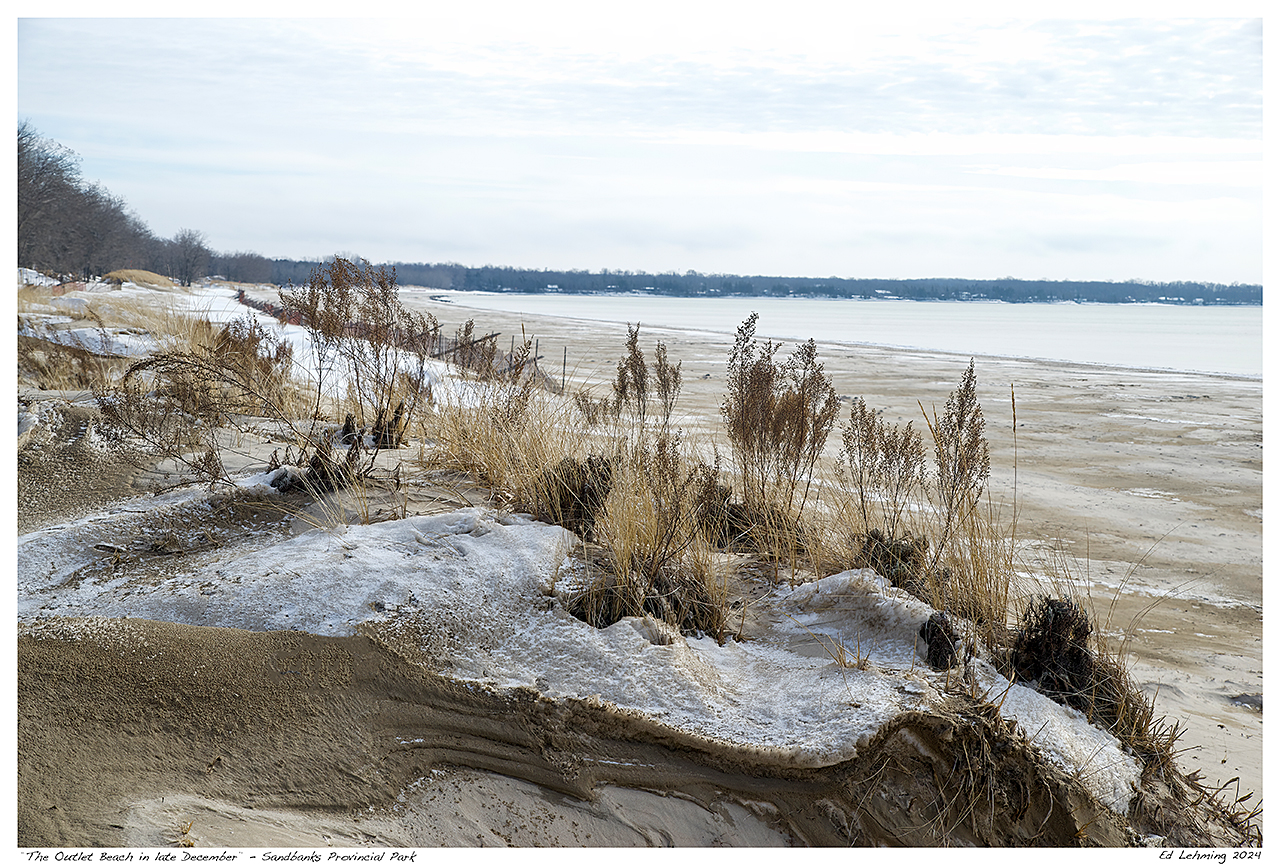
“Snow, grass, and sand blend together in the winter sun. The beach, usually teeming with sun-worshipers, rests for the season. The grasses and weeds stand quiet among the coastal dunes, awaiting another summer. But for now, they rest.” – Ed Lehming
Still at Sandbanks Provincial Park and Outlet Beach, the most popular summer destination in Prince Edward County, is a place transformed in the winter.
There are still plenty of locals who frequent the beach in the off-season, but they were fairly scarce today; the beach ahead of me was wide open as I walked the 2.5 kilometers from the parking lot to Outlet Creek, the namesake of this beach.
The park has taken care, over the past few years, to block off sections of the coastal dunes to allow them to regenerate. There are posts and ropes, as well as signs to educate the public on the ecological value and sensitivity of this dune system. The dunes contain many rare and endangered plant species, which don’t do well with a lot of foot traffic. So, the park has carved out access points to the beach every 20-30 meters and roped off the rest. I do like this system because I can still enjoy the natural beauty without having to look over a fence. It seems to be working well, and many species are making a comeback.
Needless to say, it was a great day to be out for a walk with my camera, enjoying and documenting my surroundings.
This image, unlike my past few, was captured using my Nikon 🙂
Nikon D800
Tamron SP 24-70 mm f/2.8 Di VC USD @ 52 mm
1/250 sec, f/8, ISO 400

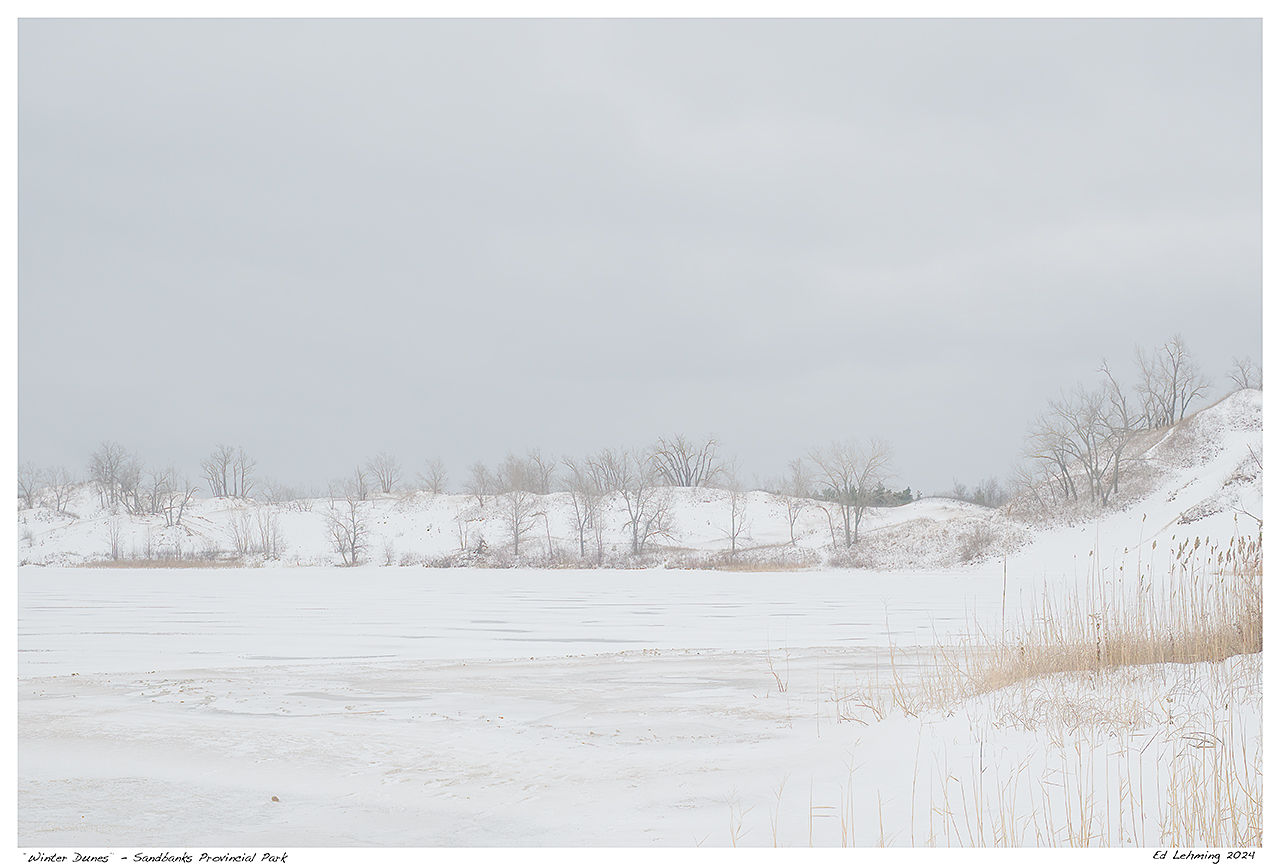
“In the flat gray light of winter, the familiar landscapes change their character. The summer sand becomes an icy vista, serene but raw at the same time.” – Ed Lehming
Above is another image made yesterday, Boxing Day in Canada, the day after Christmas. After a few days indoors feasting and celebrating, it was nice to stretch my legs and get in a few kilometers outdoors, hiking along the shoreline of West Lake, in Canada’s Prince Edward County.
The Dunes are a long series of high sand dunes that separate West Lake from Lake Ontario to the west. It’s a stunningly beautiful place in the summer, but for me, equally fascinating in the winter.
We had our first significant snowfall a few days ago, and the wind has sculpted that snow to match the sand dunes, which are barely discernible from the sand. Both sand and snow are equally bright, even on an overcast day like I had yesterday. It really struck me that the trees clinging to the dunes don’t look much different in the winter, except for the obvious lack of leaves. They still stand in stark contrast to the brightness around them. This became even more evident when I took off my sunglasses to change lenses. I looked up, and everything washed together in brightness, which inspired this photo, which is slightly overexposed to get the effect that I was experiencing. I would have exposed a bit more, but then I would have lost the subtle texture of the clouds behind the dunes.
This is also an iPhone photo, but I adjusted the exposure to get the effect. I do promise to share photos from my D800 over the next few days.
iPhone 14 Pro Max back triple camera 24mm
1/2352 sec, f/1.78, ISO 80

“There is a magic in new snow. There is a cleansing, and a freshness that transforms the landscape and, despite the cold temperatures, it warms our weary souls with its brightness and purity.” – Ed Lehming
It has been a while, many days of business and work, but I finally got out to create some images. Not just a few snapshots to say I’ve been photographing, but a deliberate time set aside to create.
It was not until today, the 26th of December, that I realized that it has been far too long since I set time aside to focus on an activity that I love to do. There have been many opportunities this year to capture some really wonderful images, but I had not spent much time, especially since spring, to spend a few hours outdoors truly observing and appreciating my surroundings.
I live in a beautiful part of Canada known as Prince Edward County (the County). It’s an area highly sought after for its wonderful rural life, wineries, arts, culture, food, and its famous Sandbanks. The Sandbanks are a naturally occurring feature that run along much of the west shores of the County. They are one of those things that leave you awestruck the first time you see them and then seem to be taken for granted after a few visits.
In the summertime, thousands of visitors flock to the County, specifically to visit Sandbanks Provincial Park and spend their time on the endless kilometers of soft sandy beaches and gentle breezes. It’s a very popular and busy place, so I tend to avoid it during peak times and prefer to arrive after the sun begins to send the sunburnt tourists starting to depart.
I have spent some time making photos here in the spring, summer, and fall, but rarely in the winter. There certainly aren’t any crowds here once it cools off, so I had them pretty much to myself.
The image above was made in an area appropriately named “The Dunes.” In this area, the sand dunes reach heights of 20-30 meters and are interspersed with a few hardy trees and shrubs. What makes for good photos is when the snow and sand mix, seeming to blend together. Today, when I made the photo, the day was dull and gloomy, and the flat light made for some really interesting black and white photos.
I used my iPhone for this particular image but had my full kit with me and will be posting those images over the next few days as well. Which also reminded me that I need to spend more time with my blog and sharing images and thoughts. That too has gone by the wayside for some reason. Time to get back to a bit more discipline.
iPhone 14 Pro Max back triple camera 24mm
1/2252 sec, f/1.78, ISO 80

“Endless seas of grasses wave and writhe in the wind, imitating the ocean just below; a dance of land and sea.” – Ed Lehming
Something that deeply resonated with me as I stood amidst the expansive, grass-filled plains above Estero Bluffs was the striking resemblance between the swaying of the grass and the adjacent ocean. It appeared as though the motion of the grass was an extension of the ocean’s own movement.
The grassy terrain is punctuated by apparent bare areas of rock and sand that, upon closer examination, reveal an abundance of low-lying wildflowers, as showcased in my previous post. It is a remarkably well-balanced ecosystem thriving in a challenging environment.
I was captivated by the grasses, which possess a notably distinct texture compared to the native grasses of my homeland. Furthermore, they made for a pleasing composition as the midday sunlight accentuated the green and yellow hues of the panicles.
As suggested by the photo title, this is Annual Beard-Grass or Annual Rabbitsfoot-Grass. Despite not being native, it has successfully established itself and dominates extensive areas along the Pacific coast of California. Its presence was noted by me at every stop we made.
iPhone 14 Pro Max back triple camera 24mm
1/4545 sec, f/1.78, ISO 80

“From the first moment I spotted it from far off along the shoreline, it invited me to approach and admire its beauty; a profusion of exquisite purple flowers spilling over the rugged cliff.” – Ed Lehming
For this image, I posted a high-resolution photo, so I hope it does not cause me problems. There is just so much detail that I wanted to be able to share it fully, without resolution loss or compression.
As my quote says, when I saw this amazing purple cascade, I just had to get closer and soak it all in. So many times, I’ll spot something like this only to realize it’s totally out of reach, like those California beach flowers, always clinging to some rocky cliff or across a water expanse. But here, I could get right up to it and savor all the little details.
The plant itself is Drosanthemum floribundum, also known as Rodondo Creeper or locally, “Magic Carpet”. The names all seem quite fitting for a plant that flows like a purple river over the sandstone bluffs, only in this one location on Moonstone Beach. The plant is native to the Eastern Cape of South Africa, but has been naturalized in several locations including Portugal, Australia, and Pacific Grove (just outside of Monterey) in California, about 2 hours north of this location. One cannot help but wonder if someone intentionally transplanted it here, given the striking similarity of the environment. Regardless, it thrives here, covering about 10 square meters of ground.
I was so impressed by the flowers that I overlooked certain peculiarities in the stone, specifically the unusual green patches, which resemble a type of copper oxide seeping out of the rock. I also failed to observe the numerous spider webs that appear so abundant now that I have the opportunity to examine the image more closely. Nevertheless, it was a delight to spend time admiring this exceptional and beautiful plant, and even more satisfying that I was able to capture a photograph that truly showcases its details.
Nikon D800
Tamron SP 70-200mm f/2.8 Di VC USD @70mm
1/1600 sec, f/2.8, ISO 400


Recent Comments