

“After few days of of showing their bright pink faces to the warming sun, the Spring Beauties take a rest, allowing the cool spring rains to refresh them till the sun returns again.” – Ed Lehming
It’s mid-April and every day can’t be warm and sun-filled. These cool and rainy days are all part of the growing cycle and it has been, till now, quite dry in the local forests, so the gentle rain is most welcomed. I don’t mind being out on these days, particularly if it’s not pouring. Cool and rainy days provide me with other opportunities to observe the living forest and to note the behaviors of wildflowers at a time when most people remain at home and dry. The dull, soft light is also ideal for photographing wildflowers. Bright sunshine often washes out details.
The Spring Beauties have been blooming steadily for the past few days, providing me with lots of photo opportunities. These same cheerful little ephemerals close up in cool or rainy conditions, dropping their heads and protecting their pollen form washing away. It also protects them from cool evening, and now, daytime temperatures.
These conditions also force me to look for alternate compositions that don’t focus on open blossoms. This one seemed quite natural and shows nice details of Spring Beauty plant structures that are easily missed when focusing on pretty blossoms. I enjoy spending time with images like this, appreciating the hidden details that reveal so much about the environment in which the plants grow, like the wet, partially decomposed leaf that the plant has pushed up from the ground, exposing the soil to sunshine and providing opportunity for other seeds to germinate.
At this time of year I can almost hear and see the slow eruption of life from the forest floor, there is such a profusion of growth, even on rainy days like this.
Nikon D800
Tamron SP AF 90mm f/2.8 Di Macro 1:1 (272ENII)@90mm
1/100 sec, f/22, ISO 800

“Cool April hikes bring such joy. There is always something new, not always obvious or evident, but when you look around new surprises and revelations always present themselves.” – Ed Lehming
The spring that began so mild and warm has settled back to a bit more normal pattern of cool nights and misty days. The plants and flowers that seemed so accelerated have slowed down as well. This has been a good thing because it has allowed me to enjoy the early bloomers for a few more days and has spaced out the opening of others.
I’ve wandered the woods nearly every day this week, observing the subtle changes. I’m seeing the leaves of Trout Lilies and Trillium push through the leaves, ready to burst into bloom any day now, once the conditions are right. The cool and damp days have caused the Spring Beauties to close up for the time being, also waiting for some sunshine before they open up once more. Single day bloomers like Bloodroot are hanging in for an extra day, providing me an extra opportunity to photograph them.
Many of these things are not obvious to the casual eye, they are things you need to look for and spend time with. I’m constantly surprised as other hikers pass by me asking what I am photographing and seem amazed that there are flowers blooming once I show them.
Not everything in obvious however, and some plants take a bit of extra effort and fortuitous timing to spot this time of year. As I said, the trilliums are beginning to show through the ground, blossoms still tightly sealed, awaiting a warm day or two. The majority in this forest are White Trilliums or Trillium Grandiflorum. A less populous species, which also favours these rich woods is the Wake-Robin or Trillium Erectum, also known as Stinking Benjamin. The Wake-Robins are actually quite foul smelling and their odor and red colour attract flies as pollinators, smelling of rotten meat. I tested this and they do, in fact, reek.
The Wake-Robins tend to bloom a few days before their white counterparts and since the whites seemed close to blooming I looked more carefully for the reds. Red is a surprisingly difficult color to see in the forest, but once you pick up on it, it’s fairly easy. I began my search by looking deeper in the forest for deep green bunches of trilliums and noticed a small splash of deep red in the distance. Upon closer investigation I came across this single, fully-opened blossom, among many others soon to open. The red trilliums also tend to ‘nod’, not fully revealing their blossom faces, so I had to get down low with my camera to get this image.
Getting images of flowers when they first open is particularly satisfying since they are generally pristine and undamaged by their environment and insects. This one was nearly perfect, with just a dusting of pollen laying on the petal. Finding this single bloom made my entire misty morning hike worth every step and I look forward to what tomorrow has to offer.
Nikon D800
Tamron SP AF 90mm f/2.8 Di Macro 1:1 (272ENII)@90mm
1/100 sec, f/22, ISO 800

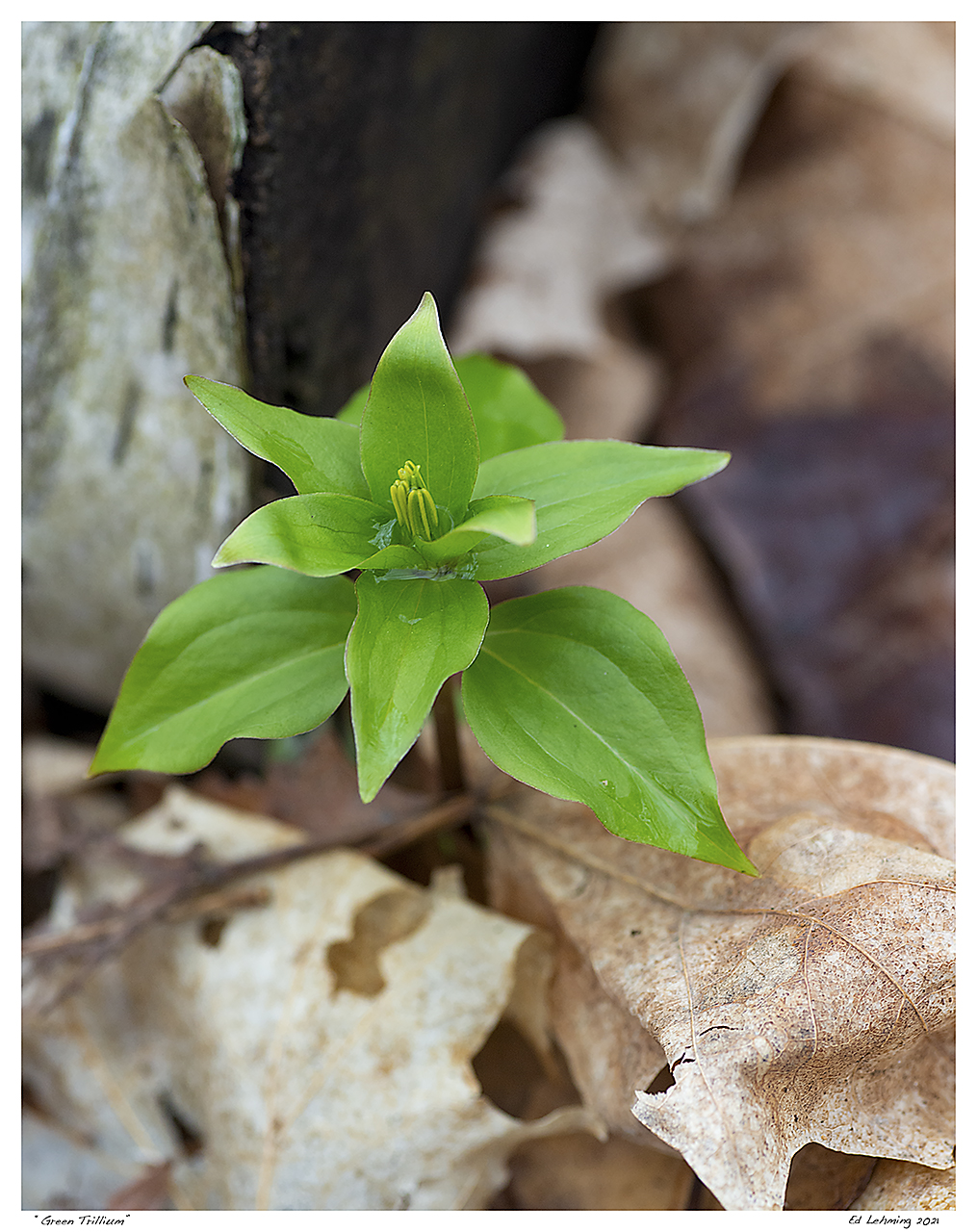
“In it’s incredible diversity, nature produces many variations, some are very interesting and make you wonder what the cause and purpose may be.” – Ed Lehming
I’ve posted about these interesting trillium variations previously, referring to variants of the White Trillium that have touches of green in them, I have not, till this past week, come across one that is completely green. The other remarkable thing about this particular trillium is that is already blooming, perhaps a full week before its ‘normal’ neighbours.
When you are in a forest with literally tens of thousands of trilliums, you are bound to see a few variations among those numbers. In this particular forest, I have seen many different trillium blossoms, including a few yellow ones, which are a different species altogether as well as many of the green variety. I notice them because I am spending a lot of time observing my surroundings, looking for things that would make good and engaging photographs. I also spend time, when back in my office, researching the things I have observed and sharing this information with my readership.
The green/white trilliums that I have seen in the past are fairly plentiful in isolated patches along the trails in this forest. I have found that the variation is caused by an infection of a mycoplasma-like organism and will ultimately kill the plant. This infection causes the flower to bloom in non-typical ways, many exhibiting varying amounts of green along the edges of the petals, sometimes distorting the petals themselves by creating ripples or waves in the petal form, and apparently, though I have not seen this one yet, creating six petals, rather than the standard three.
But back to this early bloomer. It was even non-typical with other wildflowers this day. As you can see from the image, the flower and leaves are very wet, holding water for the rainy morning. Other flowers had closed up almost completely on this cool and gray day, which did not provide my with much to photograph, yet this flower was wide open, despite the less than ideal environment. I expect this is also a result of the infection but have yet to find articles or similar observations explaining it. I also notice that the stamen are tightly clustered and wonder if the plant is actually sterile?
Nikon D800
Tamron SP AF 90mm f/2.8 Di Macro 1:1 (272ENII)@90mm
1/320 sec, f/9.0, ISO 200


“Every spring, the cycle of growth begins in a similar way: flat and dull leaf litter, the first small green shoots, followed by the bright and tiny faces of the Spring Beauties. So hard to spot, but a joy when found. Spring has arrived to the forest floor.” – Ed Lehming
This tiny, often missed, spring ephemeral is what I look for as soon as the temperatures warm. It’s the first flower to bloom after Colt’s Foot. The blooming of Spring Beauties signals the start of the greater spring bloom. They are small, often pail, blossoms that hug the ground, not easy to spot, but once you see one you begin to notice them all over the place. As soon as I see them, I begin to look for other spring bloomers like Blue Cohosh, Hepatica, Wild Ginger, Meadow Rue, and Trilliums.
This year has been a bit different, since I spotted Hepatica blossoms at the end of March and could find no sign of other blossoms till last week. But, the bloom is on and this flower was surrounded by Trillium shoots pushing out from under the tightly packed leaf litter. The litter seems particularly compressed this year, but there is nothing stopping the flush of green now emerging. In the next few days, if temperatures remain mild, I expect to see the first few Trilliums in bloom.
Nikon D800
Tamron SP AF 90mm f/2.8 Di Macro 1:1 (272ENII)@90mm
1/250 sec, f/14, ISO 800
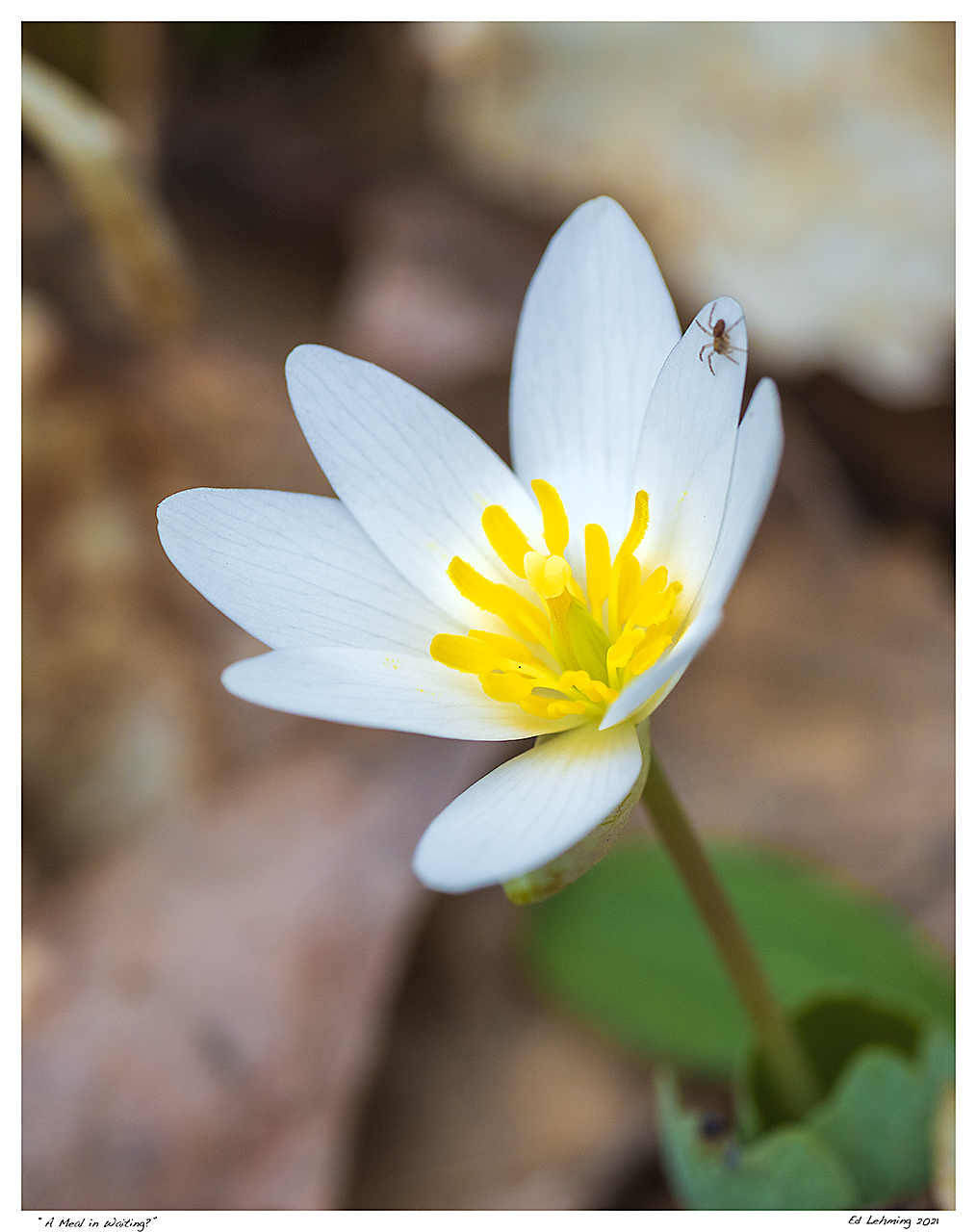
“Often, the primary subject of a photograph becomes secondary. The natural world is not static and scenes shift.” – Ed Lehming
Late last week I was hiking through one of my regular trails, checking out the progress of the spring wildflowers, not sure what to expect. As I’ve noted over the past few weeks, this has been a very unusual spring, with warm temperatures, so the usual ‘schedule’ of things is a bit off. Every day seems to bring some new surprise since the plants have their own timing lately.
I was enjoying some Spring Beauties (yet to be shared) and noted a small splash of white just to my left. It was the first bloom of Bloodroot, which I was expecting to bloom this past week. My timing must have been just right, as it had only recently opened, it’s leafy ‘cloak’ still tightly closed, with just the blossom to mark its presence.
In the time it took me to set up my camera for macro work the blossom had opened even more and several others in the vicinity were also starting to bloom. It’s an amazing thing to be present right at the moment this kind of thing takes place. I returned my focus to the original blossom and began composing the image.
When I make macro images, I’m very deliberate in trying to get the shot extremely sharp, so I set my focus on the part of the flower that I want in very sharp focus. Being this close up, the camera’s focal range, even at f/14 is very narrow and it does not take much for an image to be out of focus. Since I was focussed on just the pistil and stamen, with secondary focus on the petals I was not even looking at the rest of the flower or anything else going on around me. I was quite surprised when I got home to edit the images that I had inadvertently captured the spider crawling from behind the petals, no doubt setting himself up to make a meal some unsuspecting tiny fly drawn to the blossom by the fresh nectar.
I know he came from behind the flower because I shot a series of five images and could see his slow and deliberate progress in that series of shots.
Unfortunately, because I was focussing on the flower parts, the spider is ever so slightly out of focus, but I thought it made for an interesting, though accidental, image and does capture the reality of springtime – everything is out for a meal after a long winter’s hibernation and these early blooms are the perfect breakfast table.
Nikon D800
Tamron SP AF 90mm f/2.8 Di Macro 1:1 (272ENII)@90mm
1/400 sec, f/14, ISO 800
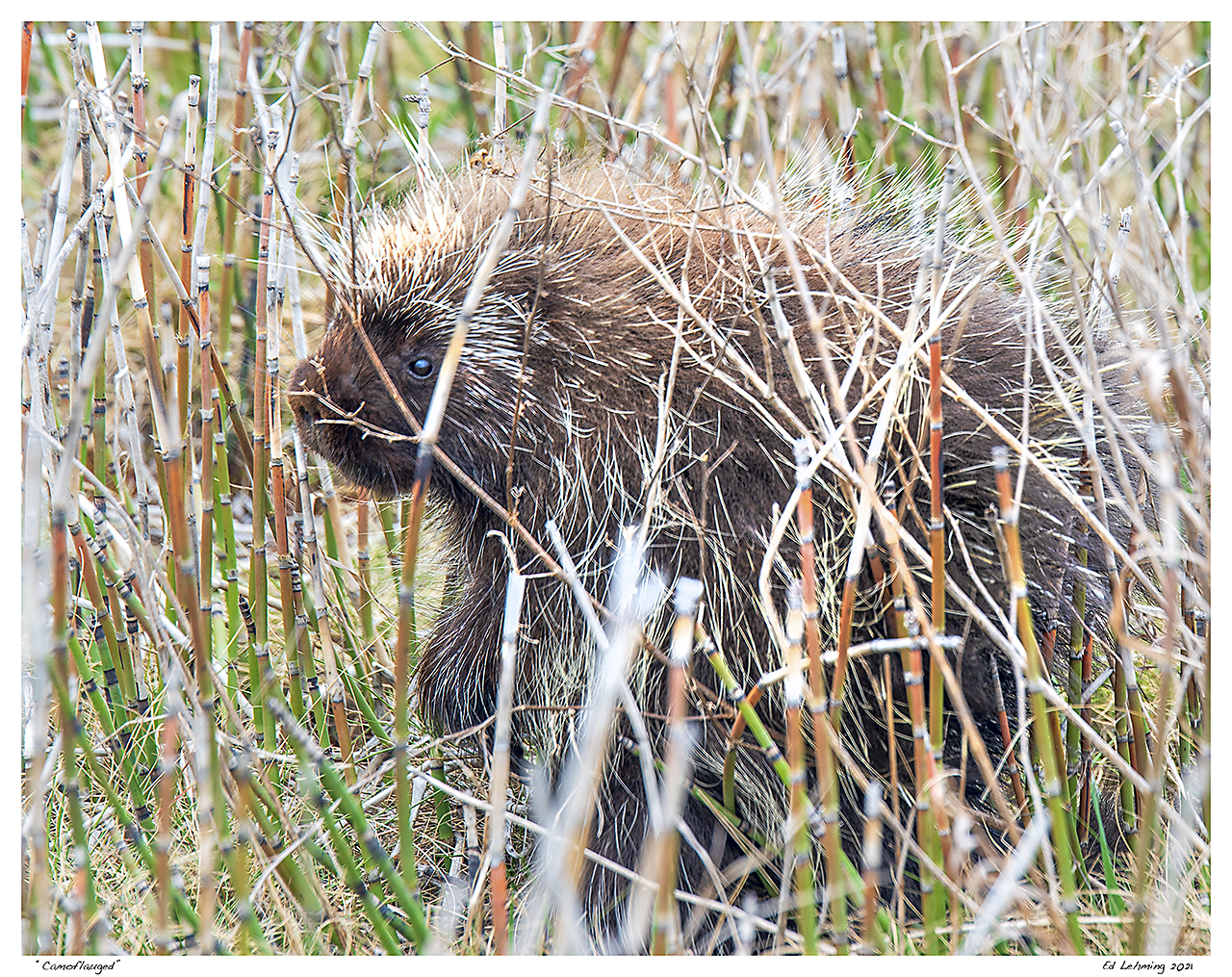
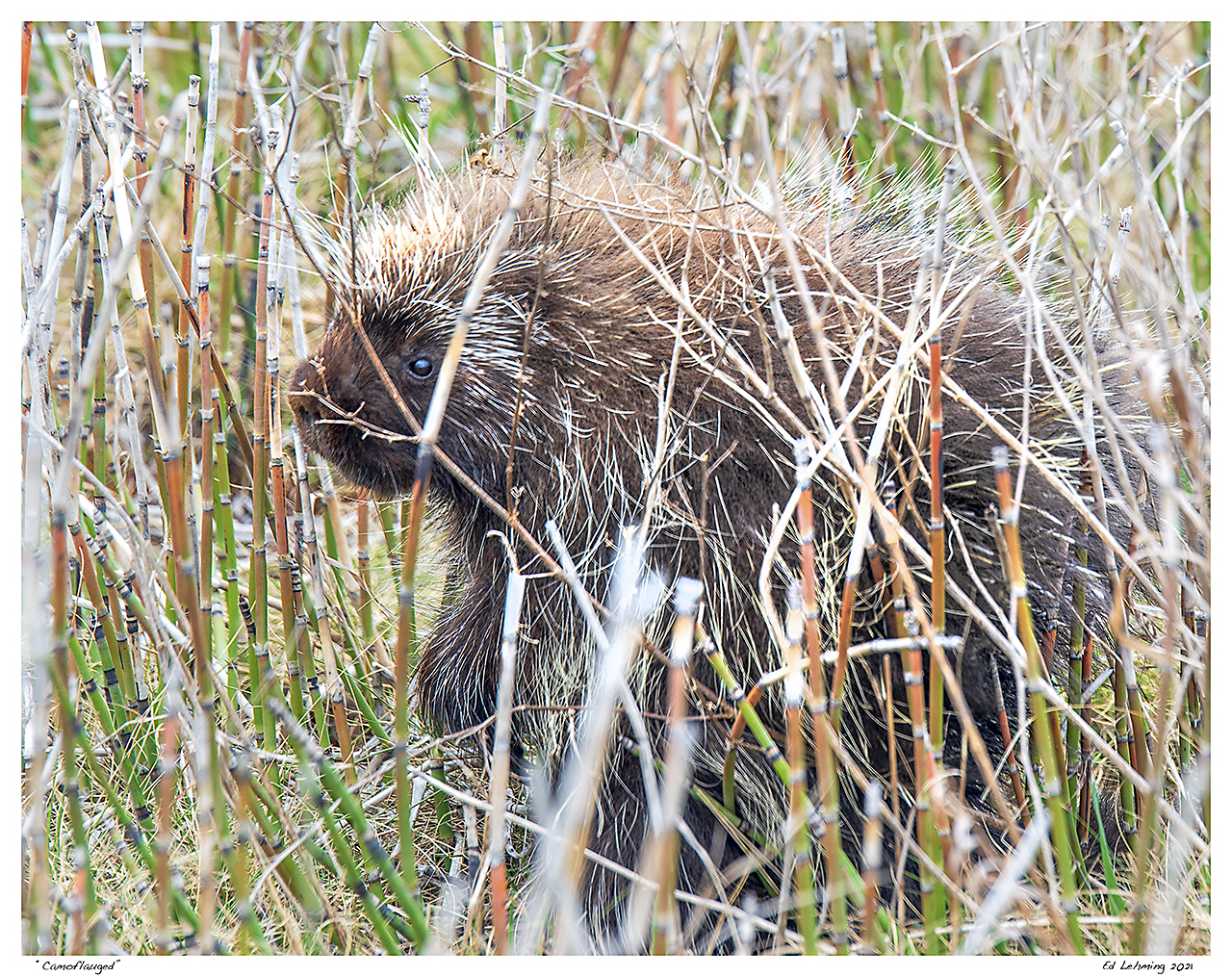
“To add to the oddities of this strange and early spring, wildlife seldom seen is also making an appearance, seeming fairly unaware that it is seen.” – Ed Lehming
It’s been a very interesting and energizing spring. The warm temperatures have opened wildflowers early and wildlife abounds, including this porcupine that I initially spotted at a distance from a hillside I was standing on. I first noticed him as a medium-sized brown mammal of some sort, wandering slowly across an open field. Based on its size, I initially thought it might be a beaver travelling between the two ponds below me, but when it moved between the ponds and not towards them, I thought it odd. I still had no idea what this animal might be, never thinking it might be a porcupine, as they are primarily nocturnal, yet it’s shape and slow movement was not like a racoon either and it was to large to be a muskrat or ground hog.
I took my time approaching it, being careful not to spook it. As I got closer, it did not seem to notice me and I soon realized that my mystery mammal was in fact a large porcupine. As I got closer it had left the low grasses and got into a patch of tall horse-tails, eventually peering over at me and moving more cautiously and deliberately into the scant cover they provided. As I look at this image I realized how the coarse and dried horse-tail looked a bit like the porcupine’s quills and provided the closest thing to camouflage available. Though he seemed very much aware of me, he did not seem to be on the defense, rather, more curious about my presence.
Interestingly, I had just had a conversation with a fellow hiker a few days before that they had seen very little wildlife this past year, largely due to the increased use of the forest trails as COVID weary crowds try to escape the cities. This increased traffic includes a multitude of off-leash dogs which scare off the once plentiful wildlife. For this image, I had actually stepped off the formal trail system and explored an open meadow a short distance outside the actual conservation area. So, this fellow is a bit of a testament to my statement about the busy trails. The wildlife has moved just outside the busy trail area.
That said, for me, this spring has actually presented me with quite a few wildlife photography opportunities, which I’m happy for. While trees and wildflowers are satisfying in there own way, to see the animals which inhabit the forests in this environment and to be able to watch them as they interact with that environment, is very satisfying.
Back to the porcupine, of the many images I made of him, he never did present me with an opportunity to get a clear shot of him, particularly his face. He remained in the cover of the horse-tails the entire time, changing his position as I slowly circled, looking for a better angle and maintaining a distance so as no to frighten him, thus the title that I chose for this image.
Nikon D800
Tamron SP 70-200mm f/2.8 Di VC USD @ 200 mm
1/250 sec, f/8.0, ISO 400

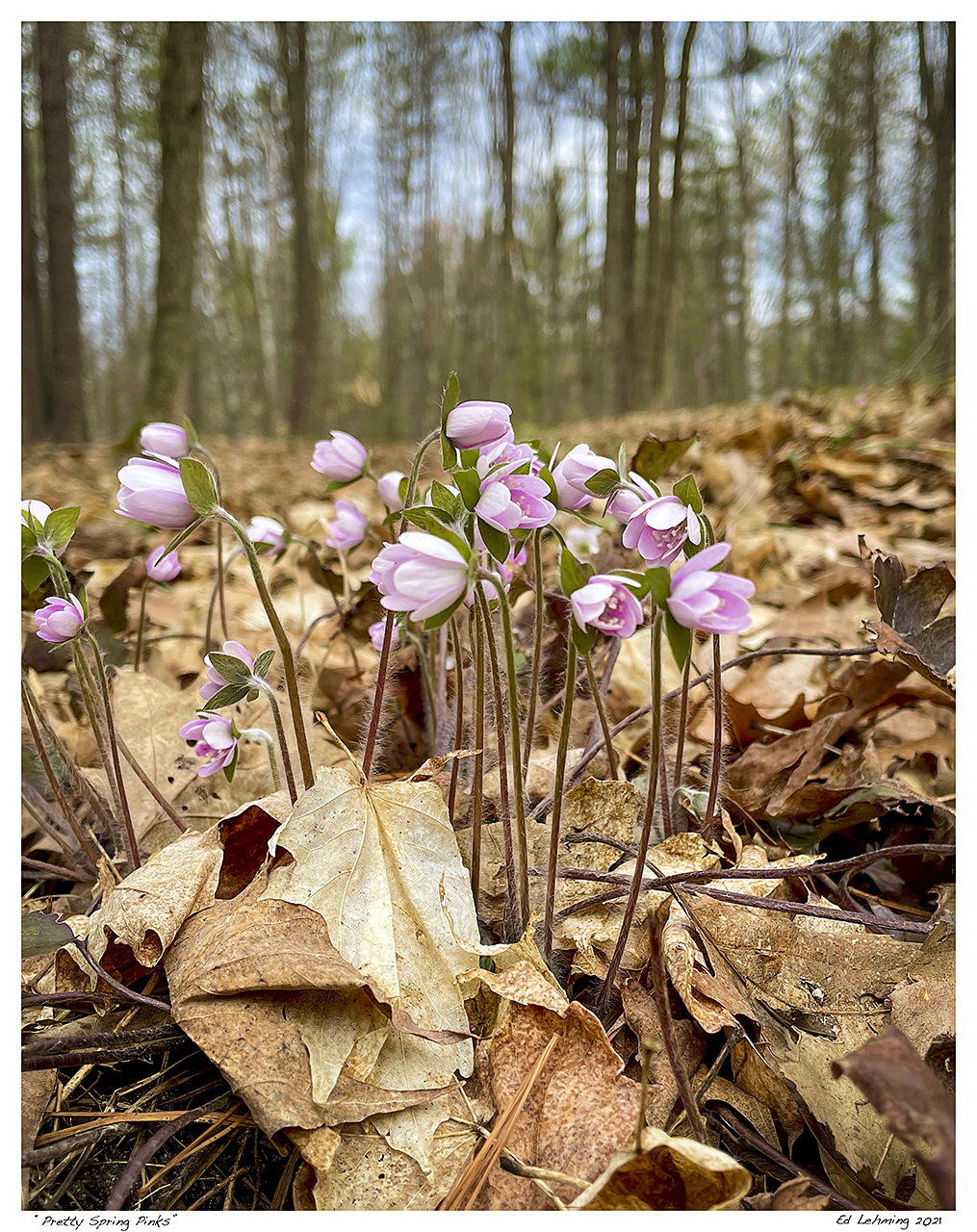
“From the compacted blanket of last year’s leaves, bright and beautiful wildflowers erupt, pushing aside the reminders of what was, and revealing was it to be.” – Ed Lehming
Continuing the theme of this year’s early spring wildflowers, I present a beautiful pink cluster of early Hepatica. For this image, I got down low to the ground. My goal was to show the blossoms rising above the leaf litter and show some of the background forest as well.
One of the unique characteristics of some of these early bloomers is that there are no leaves yet, the plant simply puts out flowers, no doubt drawing on a reserve of energy stored form last autumn. The leaves will begin to form in the next few days. These early blossoms also provide a much needed food source for bees and other pollinators. As I lay on the ground, making this image, I could not help but notice the multitude of small flies buzzing eagerly around the blossoms. It’s something I have observed when doing macro shots with my full camera rig, but it was not till I saw it from this low angle perspective that I realized just how many there actually were.
This year’s Hepaticas have been a big draw for me, firstly because they bloomed so very early, at a time when there really is not much choice in photographic subjects, but also because there seems to be a broad variety of colours this year. Hepatica do have a lot of variations, mainly based on soil composition, ranging between pure white, to pale blue, purples, and shades of pink, like these.
Once more, this is an image made with my iPhone 12 Pro. It was made on a day that I had not expected much in the way of new plant growth, so I travelled light. I did return the next day with my D800 and macro setup and was able to capture some nice, super-sharp images that I will also share in future posts. The iPhone quality has been such a blessing, since I can create images like this with great success where in prior years, this would simply have been a memory that I was unable to capture.
iPhone 12 Pro @ 4.2 mm
1/1082 sec, f/1.6, ISO 32
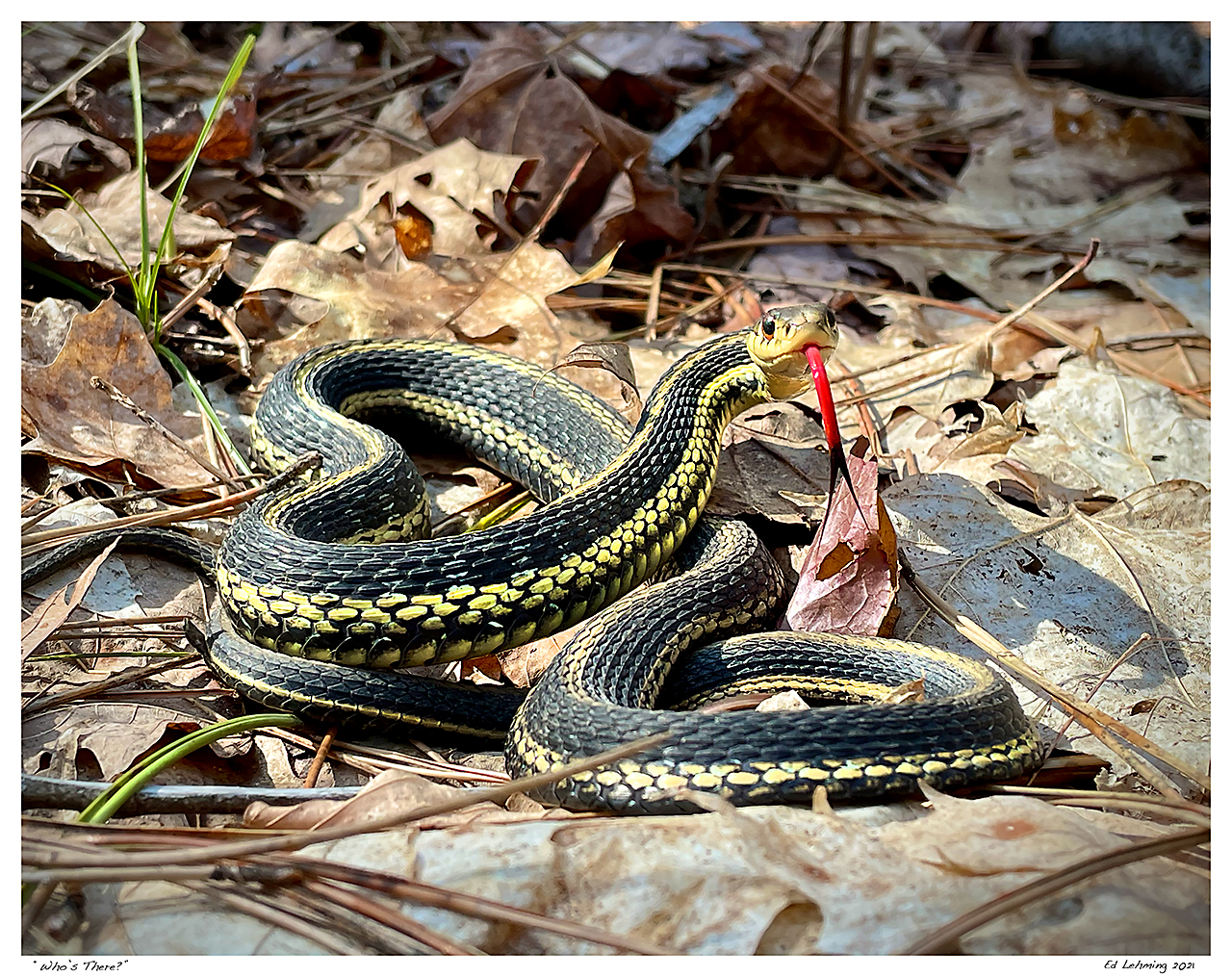
“A sure sign of spring is the time the reptiles emerge from hibernation, each assessing their environment, and seeking a first meal.” – Ed Lehming
I know there are many who are not big fans of snakes, but to me they are all part of the natural world, participants in the local eco-system. As spring ramps up, larger and larger forest dwellers start to show up. It started with small flies and beetles, butterflies, frogs, and mice. Now, the predators are showing up too, working our way up the food chain.
I happened to catch a motion to my side as this fairly large Garter Snake began to move from the place it was basking, warming itself in the warm sunlight. As I stopped to watch it, it stopped to, coiled up in a defensive bundle, it’s tongue flicking the air, trying to figure out what I was. It also swayed it’s head back and forth, assessing me, almost as if asking, “Who’s There?”
This particular day, I had decided to travel light and only had my iPhone with me. I was able to get down low to the ground to get this picture (one of several) and also captured a bit of video to go with it, before he’d had enough of me and headed for the cover of the forest. No need to watch if snakes make you squeamish.
One of the added benefits of the iPhone is that I can make videos easily to document some of my photos, something that is a bit more challenging with my D800. The original video was done in 4K and looks quite good. It does not translate well to WordPress and I don’t want to spend the time figuring out why.
iPhone 12 Pro @ 4.2 mm
1/575 sec, f/1.6, ISO 32


“It seems that most tasks are easier and more enjoyable when we have companions to accompany us.” – Ed Lehming
This photo was caused by a bit of fortunate timing and my desire to recreate an image I made several years ago. Fortunate timing in that this spring has been quite unpredictable and the regular cycles that I follow are off by a few weeks. My trigger for visiting this local creek is the blooming of coltsfoot, a native wildflower that is usually the first to bloom. Once I see them it usually means that the Rainbow Trout are about to start their annual spawning run. I saw my first Coltsfoot only a few days ago but it seemed early for the run. I followed nature and sure enough, some of the trout were making their trek to spawn. I’m not sure if the spawn was just beginning or just ending, a return visit next week will answer that question.
I walked the shores of the creek, looking for an opportunity to get a nice side view of the brightly coloured male trout in the water. My first observation was that there were quite few trout. Agin, I wondered if I was too early or too late. After a few so-so images I ventured back to the place I had made a good image a full five years ago. Sure enough, mere steps away from where the first image was made, I saw a pair of trout in clear water. The next trick was to get close enough for a good image, not obscured by the tall shrubs that crowd the shoreline. After fifteen minutes of slow movement, I got close enough to set up an capture some photos.
Something that I have noticed over the years, that really stands out in this photo is that the trout, usually solitary animals seem to travel up-stream in pairs; not as mates but simply pairs. The two shown here are both males, as indicated by their bright spawning colours. I have to look this up but I expect that the reason for this is it simply makes the journey easier, as one fish blocks the current for the other. They did seem to move back and forth, looking for an opportunity to make the next move forward against the current, separating on occasion and then nudging close to each other once more.
For those who click on the link to my previous photo, you’ll notice quite a difference in the colours of the fish and the water. This is because the previous image was taken earlier in the day, when the sun had not risen so high above that and the few days of mild temperatures have already caused pale green moss to grow on the rocks. In my 2016 image, the ice had just come off the creek and the rocks were still freshly scoured.
Nikon D800
Tamron SP 70-200mm f/2.8 Di VC USD @ 155 mm
1/250 sec, f/8.0, ISO 800

“Drawn by sweet nectar and bright colour, the pollinators themselves add flamboyance to the joyful spring blossoms.” – Ed Lehming
While I was capturing some images of this spring’s Hepaticas movement to my side caught my attention and presented me with this shot. Like the honey-bee post from yesterday, this was also shot hand-held but the beetle was not flying and so, made the image a lot less technical, though I had widened my aperture for a previous shot, which made the focal plane a bit narrower, but it all worked out. Sometimes you just have to give it your best effort and hope for the best. It was not till I looked through my viewfinder that I noticed the bright colour of the beetle’s thorax, since it is only about a centimeter in length. That’s an element of macro photography that I simply love; the ability to spend time enjoying the detail of things that the naked eye can’t see very well.
These kind of images also prompt me to research the specifics of the elements of my photo. This time I discovered that the main subject of my photo is an aptly named Fire-colored Beetle – Dendroides canadensis, part of a larger family of Pyrochroidae (Fire Colored Beetles). So, I have learned about a new species that I don’t recall having seen before this encounter. From what I have read, they are active mostly at night and that would explain why I have not seen them before.
Nikon D800
Tamron SP AF 90mm f/2.8 Di Macro 1:1 (272ENII)@90mm
1/800 sec, f/14, ISO 800
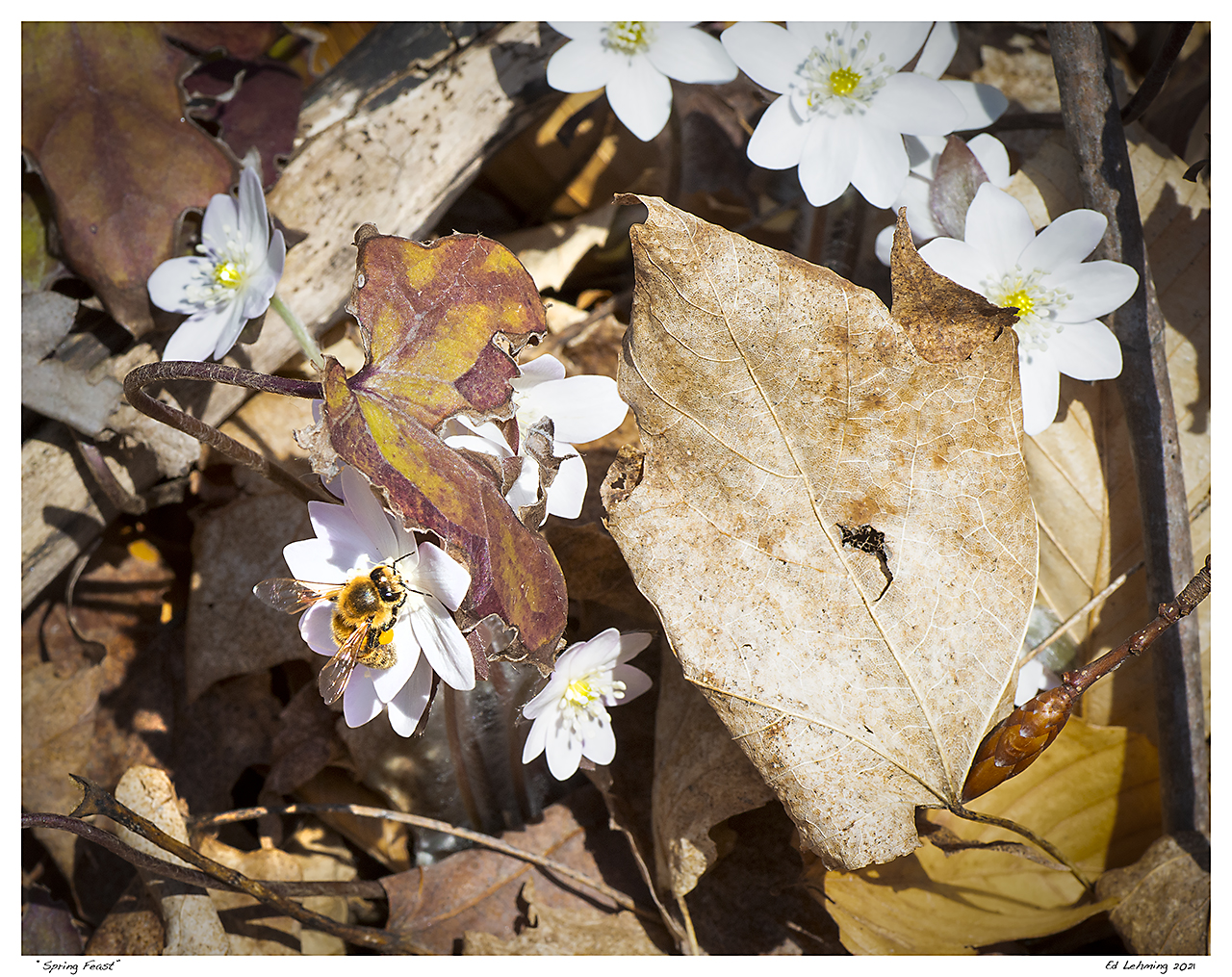
“Ah spring, a time of plenty, for those who know what to look for. For many, it represent a first meal after long hibernation. As for me, I feast on the simple beauty of fresh wildflowers and warming days.” – Ed Lehming
As a follow-up to yesterday’s post, here’s and image of a hungry honey-bee enjoying the nectar of freshly blooming Hepatica flowers. The bee was not something I had anticipated and became a hand-held bonus shot. It moved around afar too much to allow me to set up a tripod and get a better picture.
Shooting this kind of image hand-held presents a bit of a challenge; even at f/20 the depth of field this close up is very narrow and the bee is on the move, in and out of that focal plane, so I shot multiple images, hoping to catch the bee in focus in at least one of those images. The resulting image is the result of some level of luck and experience.
I really should not have been surprised by the honey bee since I have seen other insects like butterflies and flies flying around in search of a meal, though with the spring flowers just starting to bloom, those meals are still a bit scarce.
It seems that everything is a bit ahead of schedule this year and the week ahead promises to be a mild one, which will bring forth a profusion of new growth and with it, more insects, including the less desirable biting kind. For now, I will simply enjoy what is available and keep an eye out for fresh growth on the seemingly barren forest floor.
Nikon D800
Tamron SP AF 90mm f/2.8 Di Macro 1:1 (272ENII)@90mm
1/200 sec, f/20, ISO 800
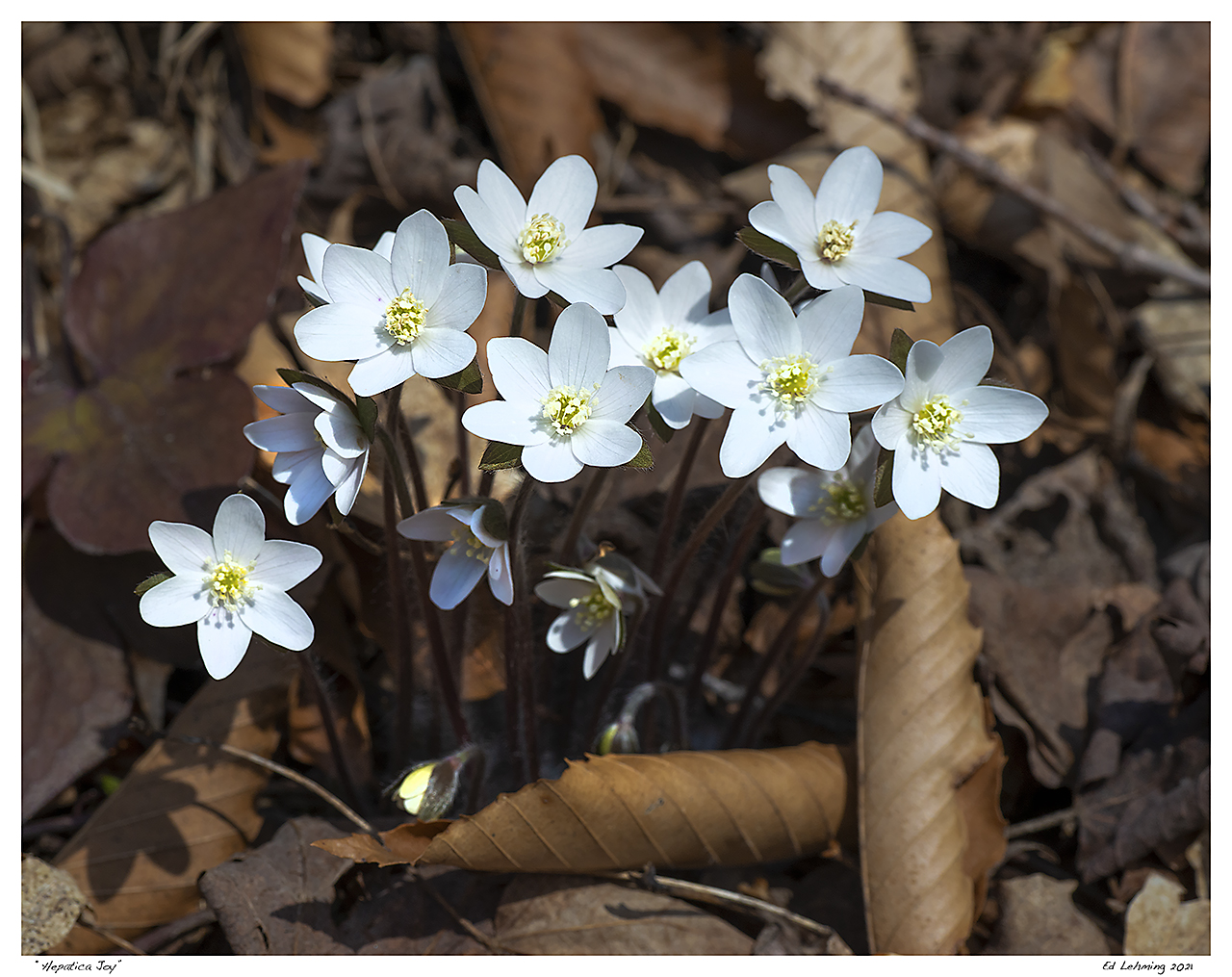
“Spring flowers have the amazing ability to bring a smile. They represent newness, freshness, and the hope for better days after a long dreary winter.” – Ed Lehming
Yesterday, I returned to the patch of Hepatica that I had discovered last week. In my prior post, “April’s delicate Wonders” the flowers had not yet opened, but a few warmer days have done wonders and all the blossoms are now fully opened and beautiful. Those same, seemingly delicate buds now fill an entire hillside with their beauty, a full month ahead of schedule.
A bonus of this early opening is that the blossoms are absolutely pristine. There is no damage from frost or insects yet and the flowers seem to have just opened when I arrived mid-morning. It certainly was nice to be able to watch this patch evolve into its present state. As I was making other photos I heard the sound of a honey-bee buzzing around and happened to catch a quick shot of it enjoying nectar from this plant. I’l be posting that image tomorrow.
Nikon D800
Tamron SP AF 90mm f/2.8 Di Macro 1:1 (272ENII)@90mm
1/400 sec, f/20, ISO 800

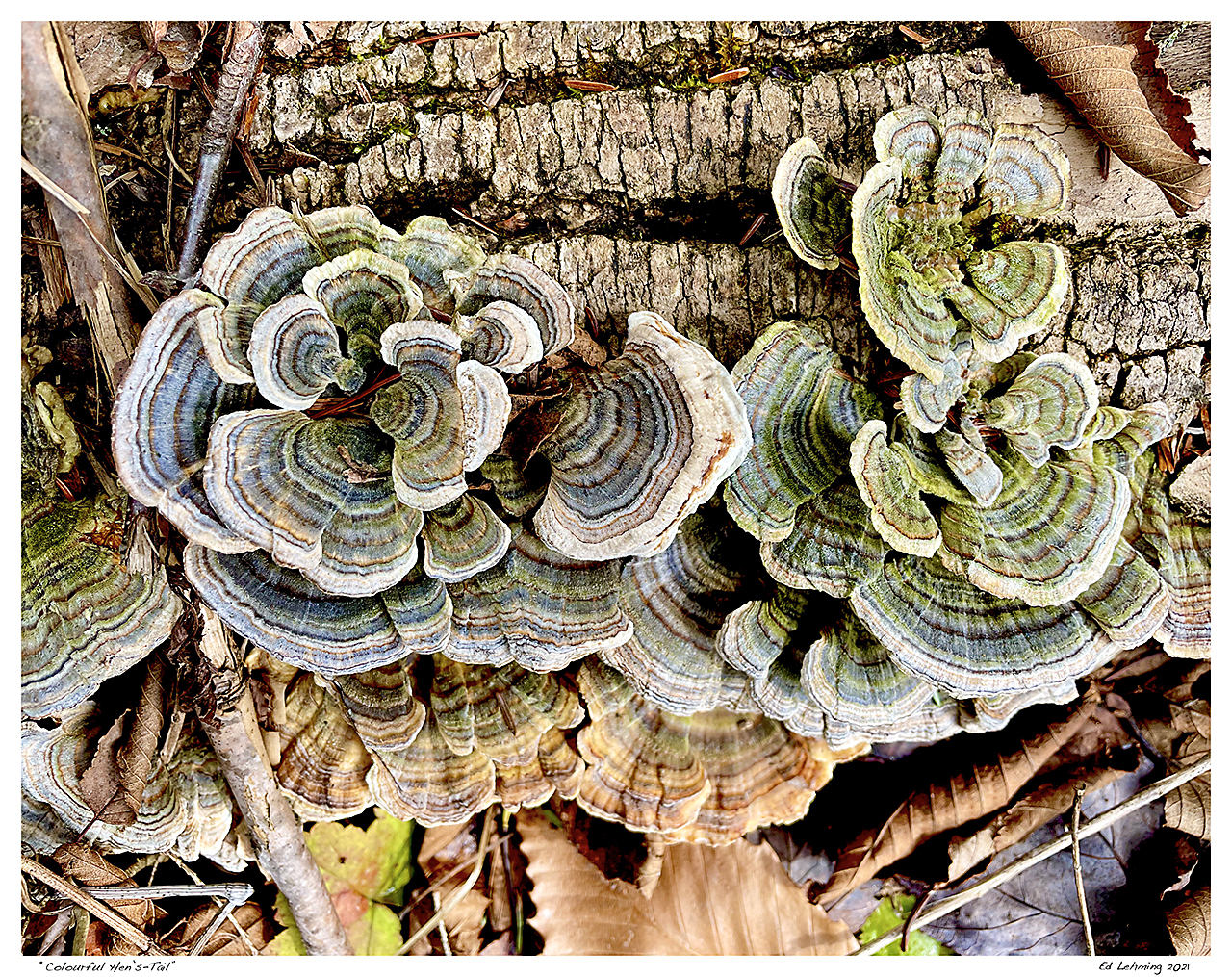
“The forest has so many beautiful gifts to share. Seemingly simple things, like fungi can be wonderful when we take the time to appreciate them.” – Ed Lehming
As the snow has melted away, some of last year’s buried treasure has emerged and I’m constantly amazed at the things I have missed. Having walked this particular trail dozens of times in the autumn, somehow I missed this colourful Hen’s Tail right next to the trail. Usually I have an eye for seeing anything different but I don’t recall this.
The fungus, which is mostly found on fallen trees has been here for a while, judging by the green mildew on part of it, yet much of it is surprisingly fresh looking, bringing a lovely splash of colour to the image. It seemed like a natural iPhone composition.
Today, I will return to this section of forest again to check on the progress of the Hepatica patches that I discovered the same day that I made this image. With a few mild days, I’m sure things have changed again.
iPhone 12 Pro @ 4.2 mm
1/427 sec, f/1.6, ISO 32

“Spring is a time of firsts . There is always a first blossom, a first leaf, or a first new growth. After months of watching things fade away, firsts are so refreshing.” – Ed Lehming
Last week, as I was out taking photos of an early blooming patch of Hepatica. Since I was shooting with my macro lens, I was up close to the ground and paying close attention to the area adjacent to the subject of my photos. It was at this time that I just happened to notice this very tiny Cohosh blossom. It’s only about two centimeters tall, and because of it’s deep blue-purple coloring, it’s next to impossible to see from a standing position.
What surprised me even more was the fact that they were already blooming. I don’t recall ever seeing them bloom before they leaf out, but it also explains why I am seeing butterflies already; the early blossoms are providing early nectar for the butter flies to feed on. Overall, this has been a very strange spring. I’m looking forward to what the next few weeks have to offer.
Nikon D800
Tamron SP AF 90mm f/2.8 Di Macro 1:1 (272ENII)@90mm
1/320 sec, f/16, ISO 800
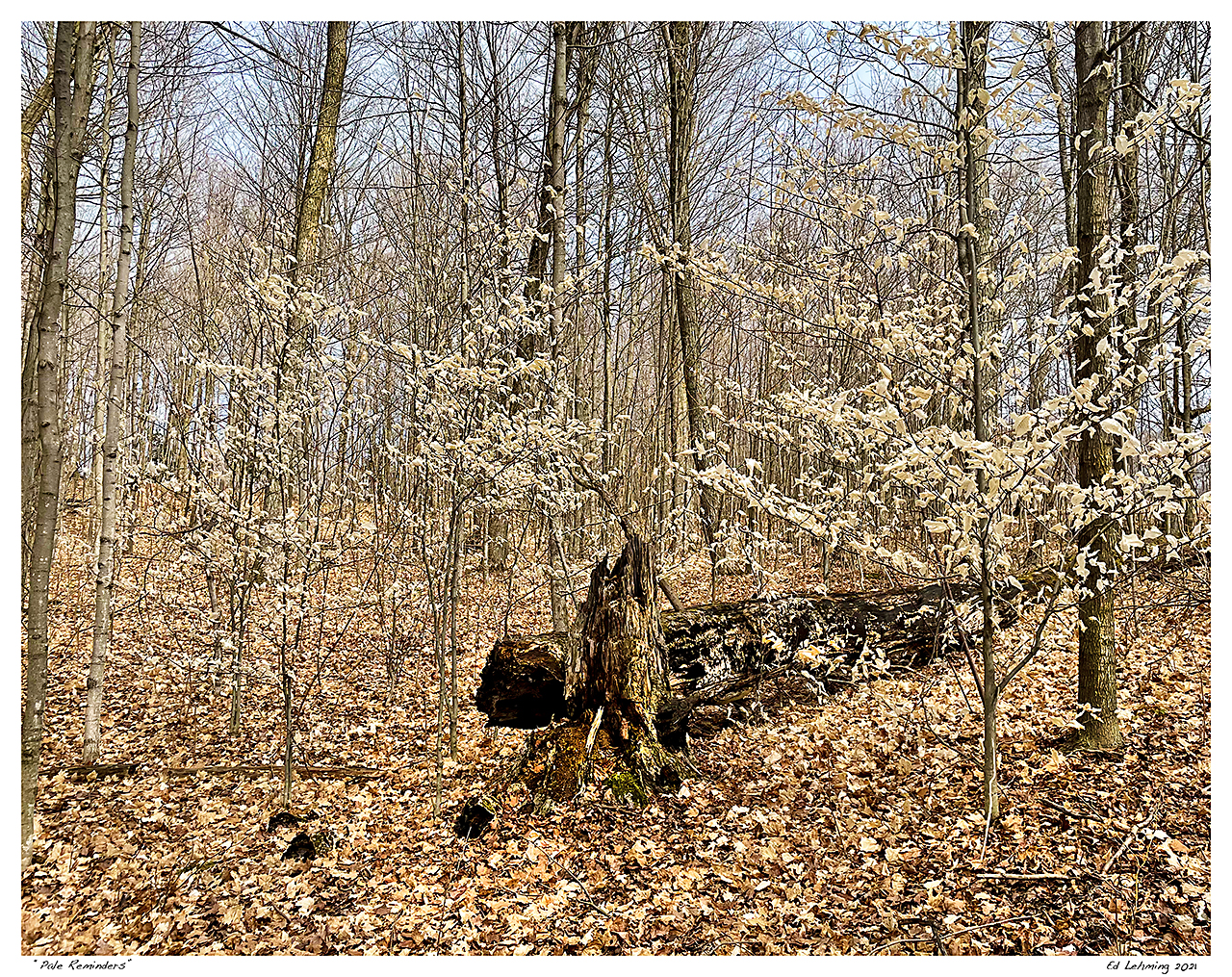

“Between seasons, old colours fade and new colours arrive. The once bright orange of beech is replaced by the pale greens of spring.” – Ed Lehming
Things are changing quickly now. Only few mild days and a pale flush of bright green can be detected in the spring forest. The beech trees that provided me colour throughout the winter are fading, the leaves tattered and pale, like ghostly versions of their former selves. This grove is barely visible against the forest backdrop. I’ve noticed buds are starting to form, so it’s only a few days or weeks till even these leaves fall to the ground.
I do like this season, though it’s not as bright and cheerful as autumn with it’s vibrant colours, but there is joy is seeing new growth and the first few budding wildflowers.
This location appealed to me because of the darker log which added contrast to the scene, otherwise it would have been a flat and boring image.
iPhone 12 Pro @ 4.2 mm
1/3200 sec, f/1.6, ISO 32

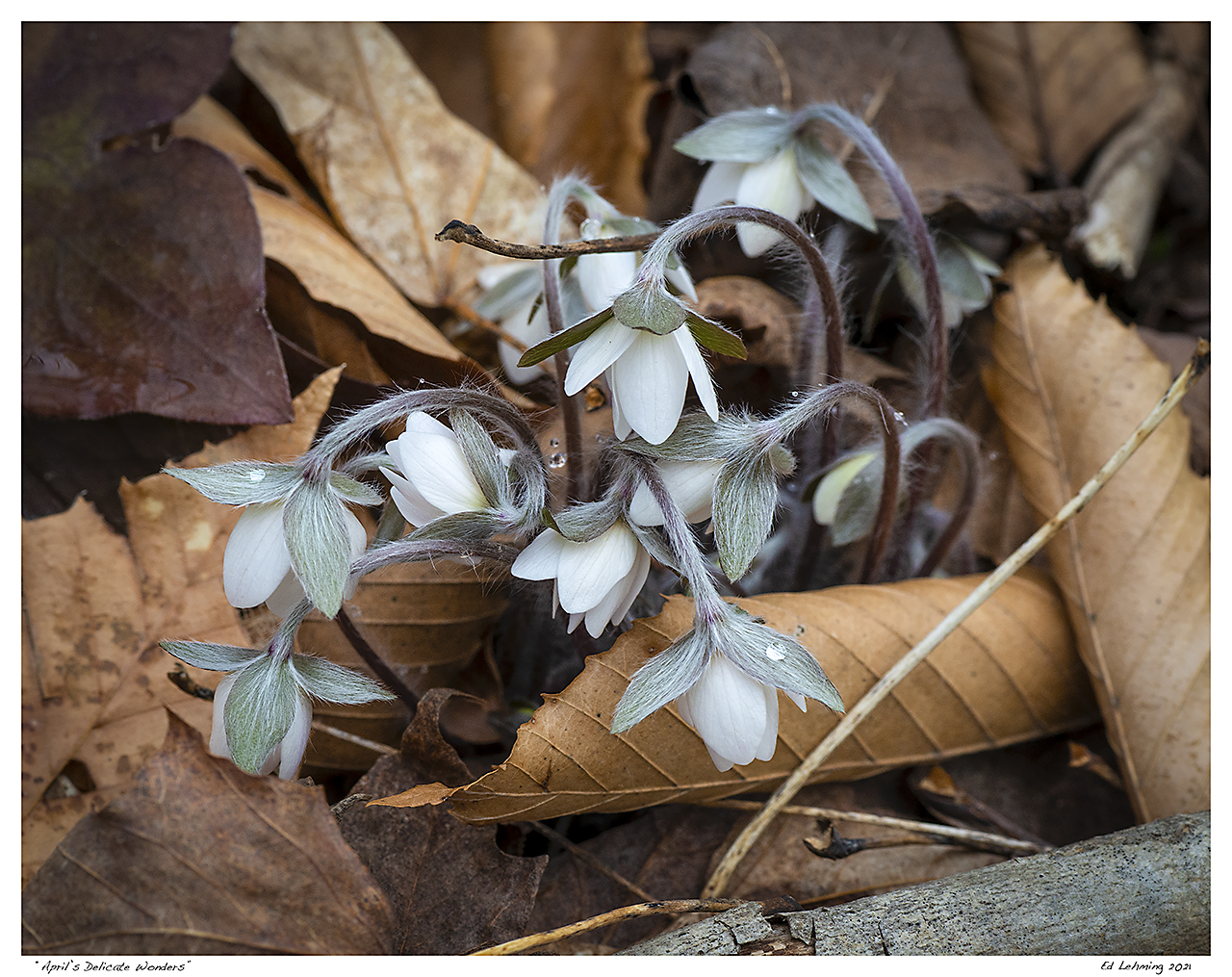
“Do not assume that tender equates to weakness. There is often great resilience in things that seem delicate at first sight.” – Ed Lehming
The natural world continues to astound me. On the final day of March, I came across a patch of Hepatica, also known as Mayflower locally. Well, Mayflower seems to be ‘Marchflower’ this year. I had found this small patch and took a quick photo with my zoom lens, since that is all I had with me that day.
I returned yesterday, April 1st, with my macro lens, intending to do justice to these beautiful emerging blossoms. In the day I found them, the temperature was 17C or 63F, so quite mild. When I got back today, it was -5C or 23F, quite a different day, and a light snow had fallen overnight. The sunlight had melted most of the snow around the plants I wanted to photograph and had left some wonderful droplets of water to enhance the image.
There were several well established groups of flowers but I selected the ones above because they were nicely and evenly lit. One of my challenges in capturing this image, as is the case with most macro images, is that even a slight movement of air will make the image blurry, and I was contending with a fairly strong and chilly breeze, so had to wait between gusts to capture the photo successfully, so good light was critical.
Something that I really like about macro photography is the very fine details that are picked up by the lense, details often missed on casual observation without a magnifying glass. What really stands out in these blossoms is the delicate hairs that cover the stems and sepals. The plants leaves have not developed yet. These hairs protect the flowers from frost by trapping air close to the stem and blossom, which clearly works, given the cold temperatures when this photo was made. The cover of fallen leaves further protects the plant itself, which still has to develop.
The photo also bring to mind the photo that I shared yesterday of the Mourning Cloak Butterfly, which probably would not have emerged from hibernation, had here not been nectar available to feed on. It seems the butterflies are more aware than I am of the timing of this spring.
While making this photo, I had the opportunity to carefully scan the forest floor and noticed a few early Cohosh blossoms starting to form, also very early this year and also something I would not have noticed had I not been low to the ground to make this photo.
Nikon D800
Tamron SP AF 90mm f/2.8 Di Macro 1:1 (272ENII)@90mm
1/320 sec, f/16, ISO 800
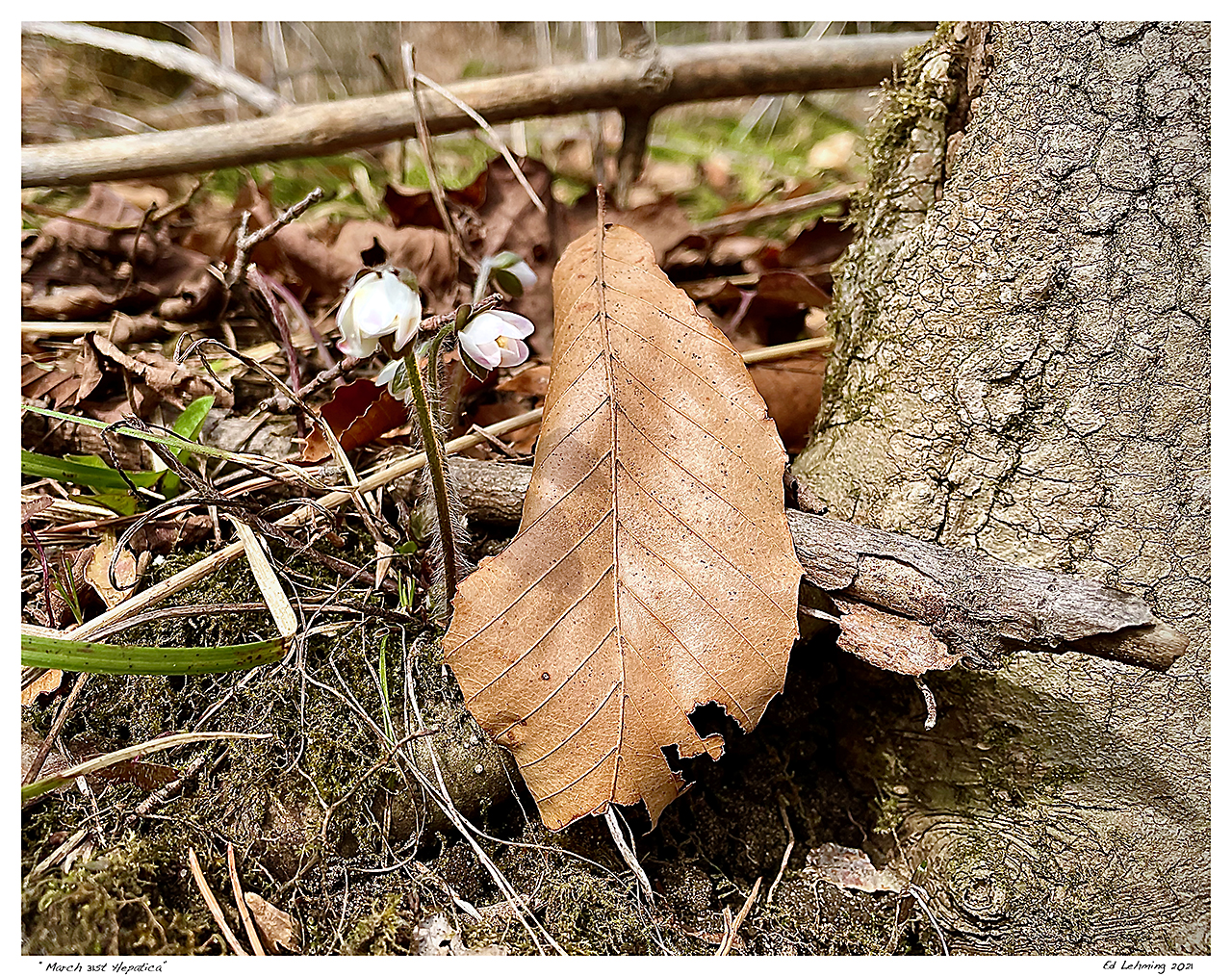

“Spring knows no bounds, when life feels the need to erupt, it does so in its own time.” – Ed Lehming
This has been a truly remarkable year. Just a few days ago, the forests still had patches of ice and snow and the ground was locked in frost. Today, March 31st, I returned to a patch of Hepatica which seemed to have survived the winter unscathed only to find it, and others around it, had started to bloom.
In all my years hiking the local forests, I have never seen them bloom this early. If you look through my posts, you will see the bloom happens in early May, a full month later.
That bodes well for an early spring, something that fills me with real joy. After months of winter, even the thought of greenery returning early is like the scene in the movie The Wizard of Oz when the film shifts for black and white to full colour. It feels like an awakening. It’s a much needed injection of life into a world that has seemed so dark. Sure, I have been out enjoying what nutre had to offer, but the rest of the world around me has been a dark and fearful place. To see new life arriving so soon and with such vigour certainly is encouraging.
The image above was made with my trusty iPhone 12 Pro, which I take with me on hikes when I don’t have a specific reason to carry my full kit. The iPhone has been great for capturing moments as they pop up. It’s not as versatile as my Nikon bt did provide me with a ‘primer’ image, something to look at as I plan a return visit today with my tripod and macro lens. Stay tuned, the time of wildflowers is upon me.
iPhone 12 Pro @ 4.2 mm
1/1233 sec, f/1.6, ISO 32


“Spring reveals new things and new life. Sometimes, it has unexpected and early surprises, each received with joy, and curiosity.” – Ed Lehming
This has been a very odd spring. It seems to be progressing at a quicker pace than usual, so I find myself looking back at my photos and notes from the past few years to validate what I am experiencing this year. It really is an advanced spring and I am seeing plants and animals earlier than usual.
I have been out hiking twice already wearing just a long sleeved tee shirt, while trials still have icy sections. It’s like being in spring with winter only steps away. That was the case late last week when I posed the question, “What Season is it?” I entered the forest on muddy early spring trails, at a time when they are usually still snow covered, I hiked through dry, leaf-covered trails, and enjoyed gentle spring creeks. Only a few steps beyond that idyllic scene, I was faced with trails that were completely covered in ice and I had to put my cleats back on. Fortunately I had the foresight to bring them with me on this trip.
As I proceeded along this icy ribbon, the elevation gradually changed and the trail exited the valley system and the snow and ice was once more a thing of the past. Leaving this area and heading into the dry forest once more I spotted motion just off the trail. At first, I thought it was a dark leaf being tossed around by the wind, that is until the ‘leaf’ raised higher above the ground and began circling in the air above me. The ‘leaf’ was a Mourning Cloak butterfly, in March! It looked a bit weather-worn and on research discovered that they hibernate for the winter, so I’d say this one did OK surviving our Canadian winter is relatively good condition. This one must have just emerged and seemed content to sit on the leaf-lettered forest floor soaking up the warm sunlight.
I have since seen a few more butterflies and observed them sitting on maples that recent wind storms have damaged and feeding on the sap seeping from broken branches. There always seems to be something new to learn about the natural world around me.
Nikon D800
Tamron SP 70-200mm f/2.8 Di VC USD @ 200 mm
1/1250 sec, f/2.8, ISO 400
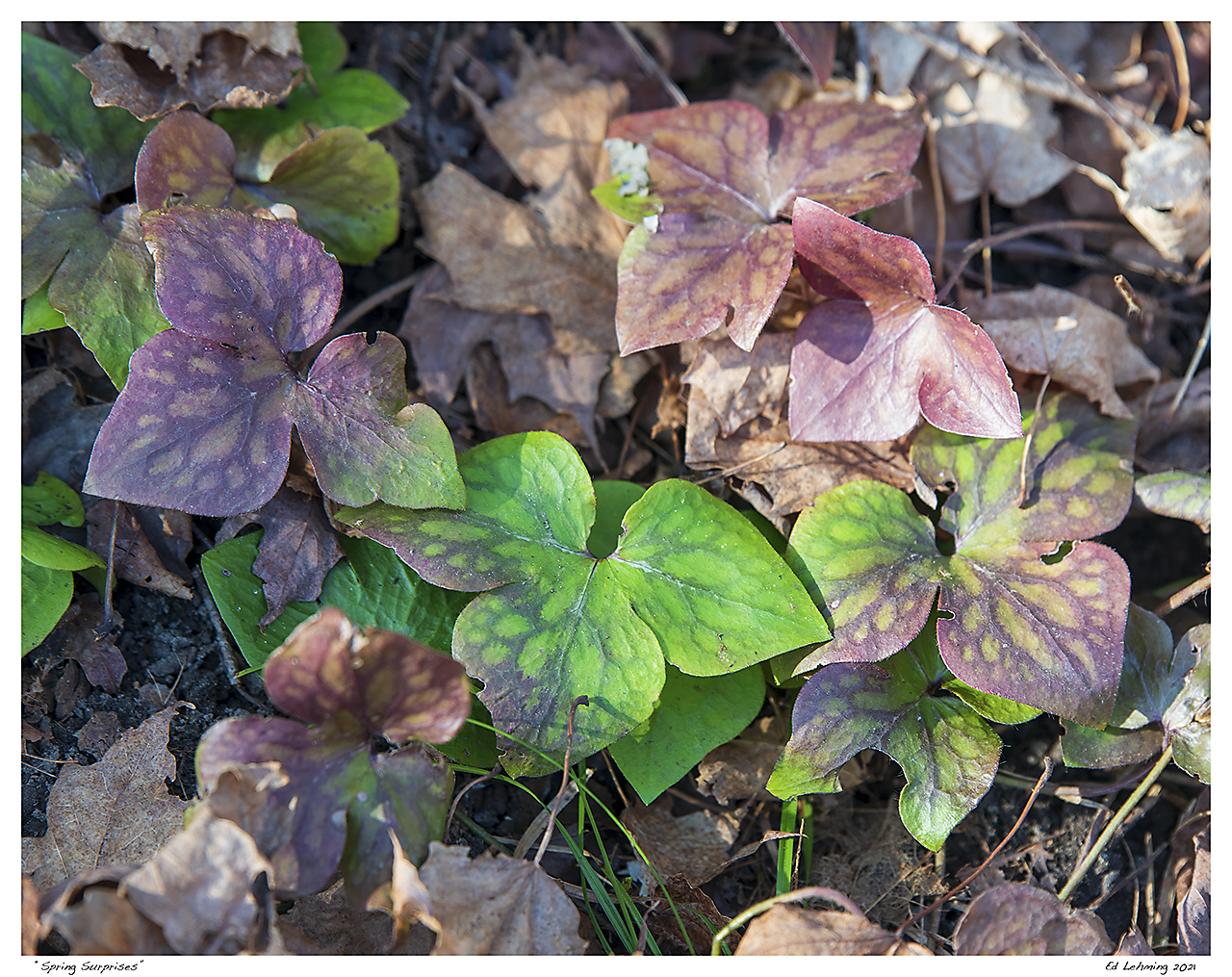

“The greens of spring bring so much promise, but the leftover greens of autumn speak of resilience” – Ed Lehming
This spring has offered some very interesting scenes. I’ve hiked March trails covered in ice one day and clear the next. Bright colours from beech groves have remained bright, and new growth seems to be ready for the full revival of spring. Then there are some complete surprises, like this patch of Hepatica, which looks like new growth, with its bright green foliage. The issue is, this is way too early for new growth, so the only explanation is that this wonderful greenery has survived the winter intact.
Our winter here has not been extremely cold or extremely anything, it has been an ‘average’ winter and I would have expected the usual cycle of plants gradually emerging from the leafy forest floor in the next few weeks. There are still a few patches of snow and ice, as I have documented in recent posts. It is, afterall, still late March, and as I write this post, a skiff of new fallen snow covers the ground outside my window.
It will be interesting to see how this particular plant fares over the coming weeks, it certainly is a testament to the resilience of nature.
Nikon D800
Tamron SP 70-200mm f/2.8 Di VC USD @ 200 mm
1/100 sec, f/5.0, ISO 400


“As we journey through life, we should be vigilant, not fearful, but keenly aware of the world around us.” – Ed Lehming
The title for this image came to me as I was making the photo itself. There was a lesson to be learned from the behaviour of the owl and how it interacted with its environment.
I first noticed this Barred Owl’s presence while shooting the previously posted image, “March Meander“. I was standing on a knoll just above the gently flowing creek when I first heard its call in the pine forest slightly to my left. I could not see it and I’m not sure it could see me yet. I don’t believe it would have been hooting had it been aware of me. Owls tend to be shy and cautious, in my experience.
As I completed my creek photo, I slowly and quietly entered the forest, my eyes to the treetops, looking for any movement. Within a few minutes, the owl must have spotted me and flew from the thick canopy to a more open area of hardwoods, further away.This would provide a better view for the owl and a margin of safety. It did not help me much, because I could see the owl clearly, but in typical fashion, slender branches blocked a truly clear and unobstructed view of the owl.
The owl watched my slow and steady progress as I got closer, being careful not to spook it with any quick movement or noise. I moved between and around the tangled branches, constantly stopping to see what kind of image I might get, taking a few “just in case” shots, if nothing better presented itself. I was finally able to maneuver into a spot close enough to frame the owl through an opening in the branches.
I took my time, watching the owl and simply enjoying one of those rare moments where you can be this close to wildlife in its natural environment, also making sure that my camera’s shutter speed was set to compensate for the owl’s movements. This time was also spent observing those same movement as it rapidly pivoted it’s head to survey the valley below it, always making sure it checked back on where I was and that I continued to not pose a threat. It also took time to preen itself and continuously looked around and focused on the sounds of Red Squirrels and birds who, I’m sure, were aware the owl was on the hunt.
What really struck me, and gave me the title for the image, was the vigilance, the keen observation of its environment for signs that anything might pose a danger to it. The owl was not particularly nervous. I think the vigilance is simply part of its nature because after about ten minutes of roosting in the tree top, it took a quick poop and casually took off, following the curve of the valley.
I was grateful to have had the opportunity to spend time with it and being able to capture a few decent images. With wildlife photography, it seems that your lense is never quite powerful enough, but this image will suffice because it also comes with the experience of having been there.
Nikon D800
Tamron SP 70-200mm f/2.8 Di VC USD @ 200 mm
1/1000 sec, f/2.8, ISO 400


“Water slowly percolates from the ground, joining with spring run off. Drop by drop, a meander is formed, winding gently through the valley, nourishing all along her shores.” – Ed Lehming
This sun-filled valley represented more elements of my hike this past Thursday. The water, freshly emerged from a wetland spring behind me shimmers with life and energy. I can almost hear its gentle babbling in the photo; blue skies reflected on the water.
The meander slowly and steadily weaves its way through the shallow valley, growing larger as melt-water joins in the flow. In the distance, you can still see a snow-covered hillside, melting in the sunshine and warm breezes. Though not visible in the photo, a barred owl hoots in the forest to one side of the valley, scanning for its next meal. Yesterday’s image was the result of entering the forest in search of the owl.
The photo and the visual of meandering is also representative of the that day’s hike. I set out with no particular destination in mind, I simply knew that I wanted to be outdoors and enjoying the day. I travelled unfamiliar trails, staying off the main tracks in hopes of some new discovery.
This valley was one of those places. I take great pleasure from being able to capture these chance moments; those times when the photo evokes an emotion from me. This image brings me peace, as my eyes scan the details, following the flow of the water, the slope of the valley, and the tangle of tree branches. Stopping here, to make this image in silence also afforded me the opportunity to hear the owl’s call which provided a few more photos once I got close enough to frame it decently.
All in all, my own meander covered sixteen kilometers of woods, hills, and meadows and provided my with some beautiful vista to enjoy and photograph. Sometimes an ‘meander’ proves very fruitful.
Nikon D800
Tamron SP 24-70 mm f/2.8 Di VC USD @ 24 mm
1/250 sec, f/16, ISO 400
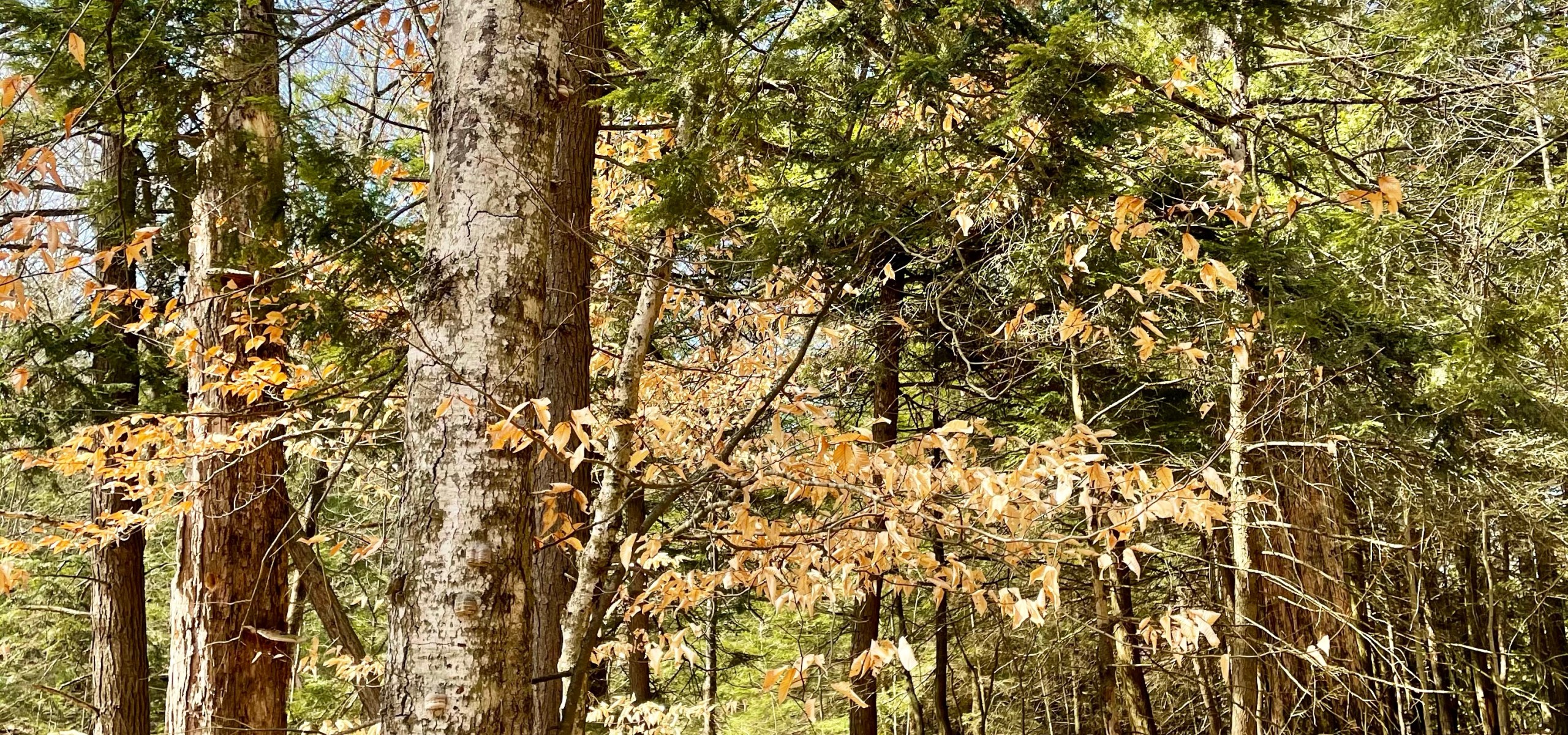
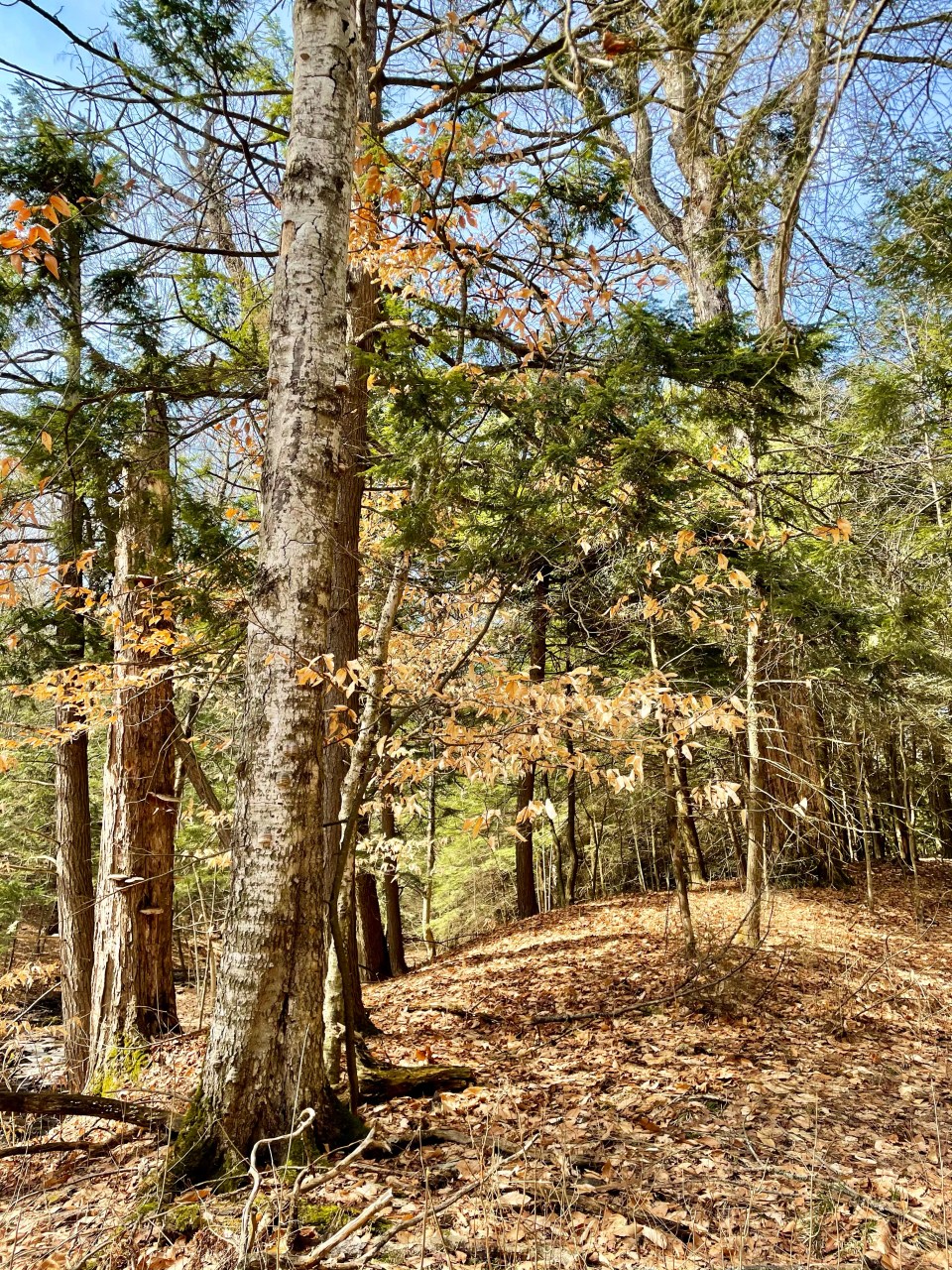
“Seasons blend and confound, spring is fall and fall is spring; my senses are overwhelmed by the shear beauty of the confusion.” – Ed Lehming
I spent most of the day out on the trails yesterday. The forecast was for milder than usual temperatures and the day exceeded expectations. I spent the day outdoors in a long sleeved tee shirt, with my sleeves rolled up. The sun shone brightly above and had already started the process of drying the muddy tracks. I brought my ice cleats with me, just in case, which felt very odd, given the warm temperatures.
It was an incredible day of what felt like blended seasons. If I did not know it was March I would have sworn this was late October. The ground was drying, leaves rustled in the breeze and wildlife was plentiful. I even had the opportunity to enjoy two owls, high in the treetops.
Meltwater-fed creeks flowed gently through the valleys and snow seemed pretty much absent. Then, as I crested a hill and surveyed the valley ahead of me the world switched suddenly to winter, with the main trail completely covered in wet ice. I have never been so happy for my cleats. This icy path continued for some four kilometers till the trail rose out of the valley and the world around me transformed again.
As my hike continued I made some photos of a gently flowing brook and as I completed my shots I heard the distinctive sound of a Barred Owl, hooting deep in a pine grove. I followed the sound and caught a glimpse of the owl departing its roost for a nearby tree with a better vantage point of me. I slowly approached it and got some decent images, which I will share in an future post. Owls are fascinating creatures and I stood on a hillside simply admiring it as it looked back at me, taking time to groom itself every now and then before departing. Once my own time was concluded, I turned to head back to the trail to experience the scene above. It looked like late fall with a few orange leaves still hanging on and bright sunlight shining through the canopy. It was lovely but somewhat confusing, yet all a part of this wonderful day out in nature.
iPhone 12 Pro @ 4.2 mm
1/600 sec, f/1.6, ISO 32

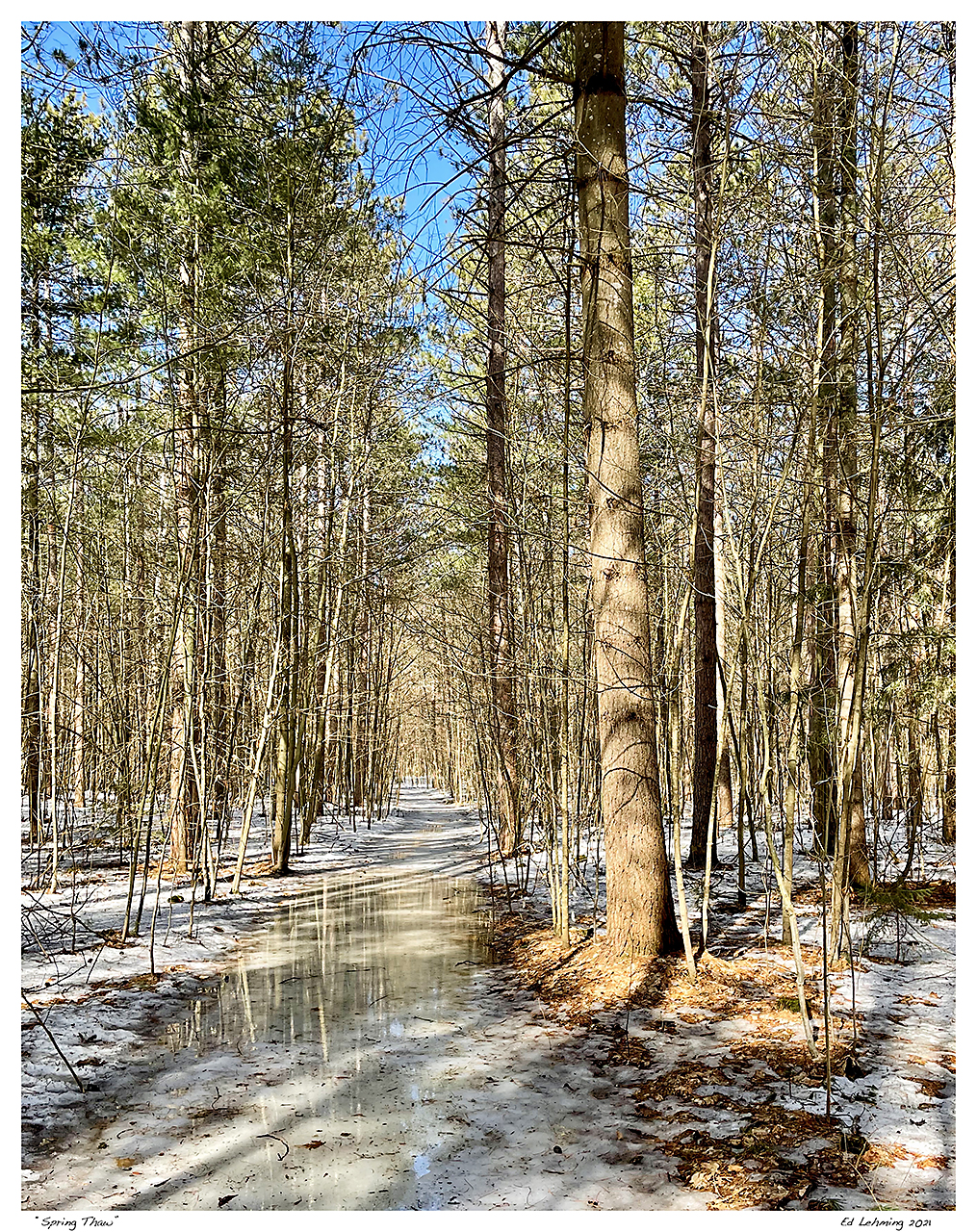
“Water, in all its forms, fills the landscape. What was ice at night now flows and pools, seeping into the ground, providing nourishment to to forest. High above, moisture steams in the sunlit canopy. Spring thaw is upon us.” – Ed Lehming
The forest seems to be transforming every day, shifting from its winter repose to spring activity. There are times when I simply stand in the forest, quietly, and take it all in, trying to figure out ways to capture some of the feelings in my photographs. Much of what is happening is movement, slow and steady movement, accompanied by the sounds of the forest itself.
There are moments like this when the scene itself seems to fill in those elements. As I look back on the photo, I can hear the gentle flow of meltwater along the sides of the the trail, see the shimmer of the sun in the puddles, hear the sounds of cheerful birdsong; so long absent, and feel the gentle breeze on my skin, varying between warm and loamy to chilly, depending on its direction.
There is a feeling of awakening in the forest; a slow revelation of things hidden under the snow, as the winter blanket slowly recedes. It’s something that feels even more precious this year after months of lockdowns and the absence of physical interaction with friends and family. It feels like hope; like a return to something familiar. On the flip-side, it’s also a bit like this photo. The path ahead is clear but needs to be navigated carefully.
iPhone 12 Pro @ 4.2 mm
1/682 sec, f/1.6, ISO 32

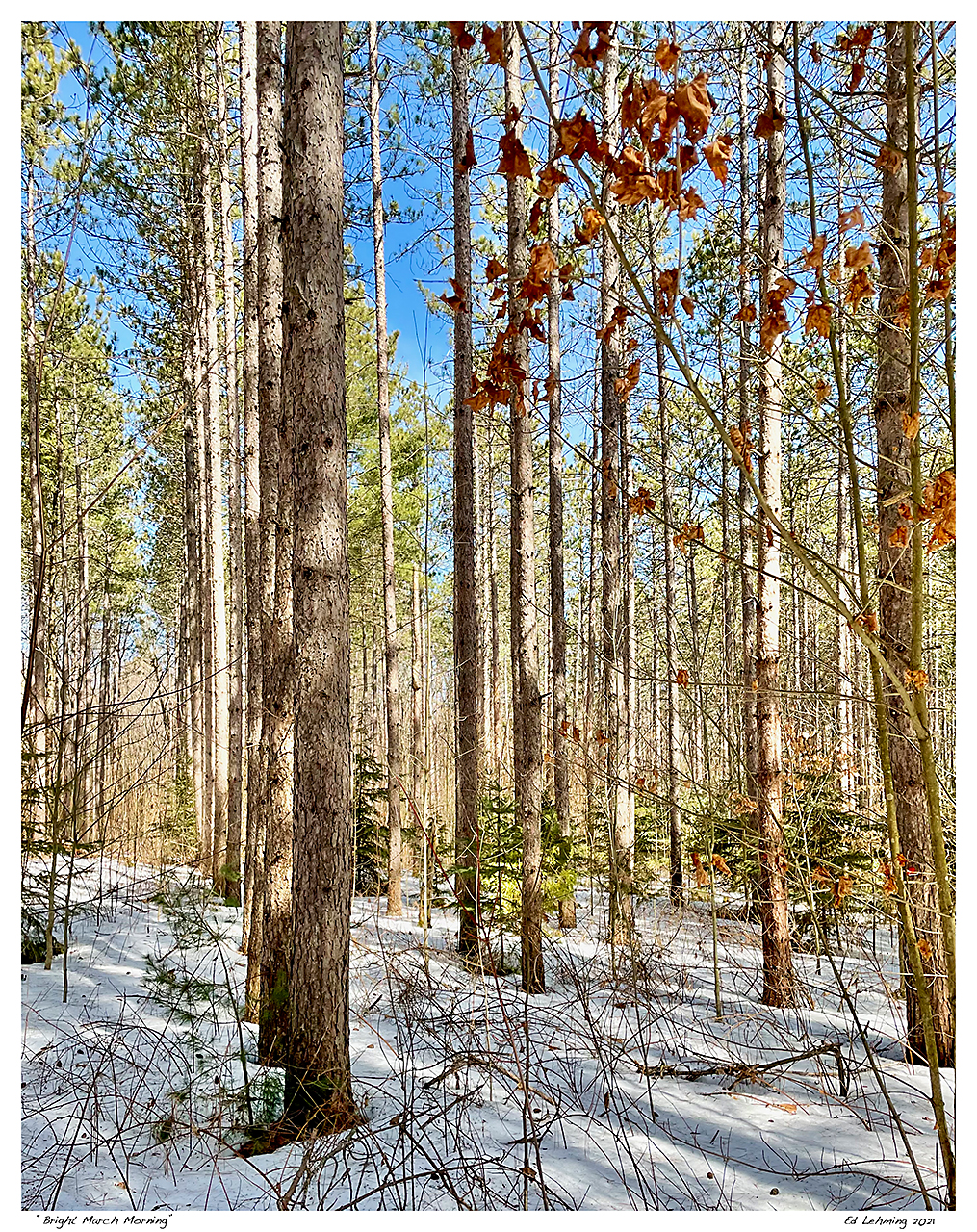
“Bright sunlight beams through hills, still snow covered. March is upon us and the forest takes a deep morning breath. The awakening begins with spring’s bright light.” – Ed Lehming
It’s nearing the end of March. Much of our snow is now melted, yet patches remain in the deeper recesses of the forest to remind us that winter is not so far passed. If the typical weather patterns hold, we are still in for a significant snowfall before we slip into spring. At this point, I’m hoping all we get is a dusting before spring takes full hold.
In the gardens, the tulips and crocus are popping through the warming ground. They will soon be followed by the wildflowers in the cooler forests. Last year, that was a long, drawn out event, with cool dry weather. I’m also recalling our first full COVID lock-down and the guilty feelings about travelling the short distance to the trails. That guilt is gone and regardless of what the next steps are with our local government’s decision roulette, I will be out and enjoying this spring.
Nikon D800
Tamron SP 24-70 mm f/2.8 Di VC USD @ 40 mm
1/125 sec, f/20, ISO 400
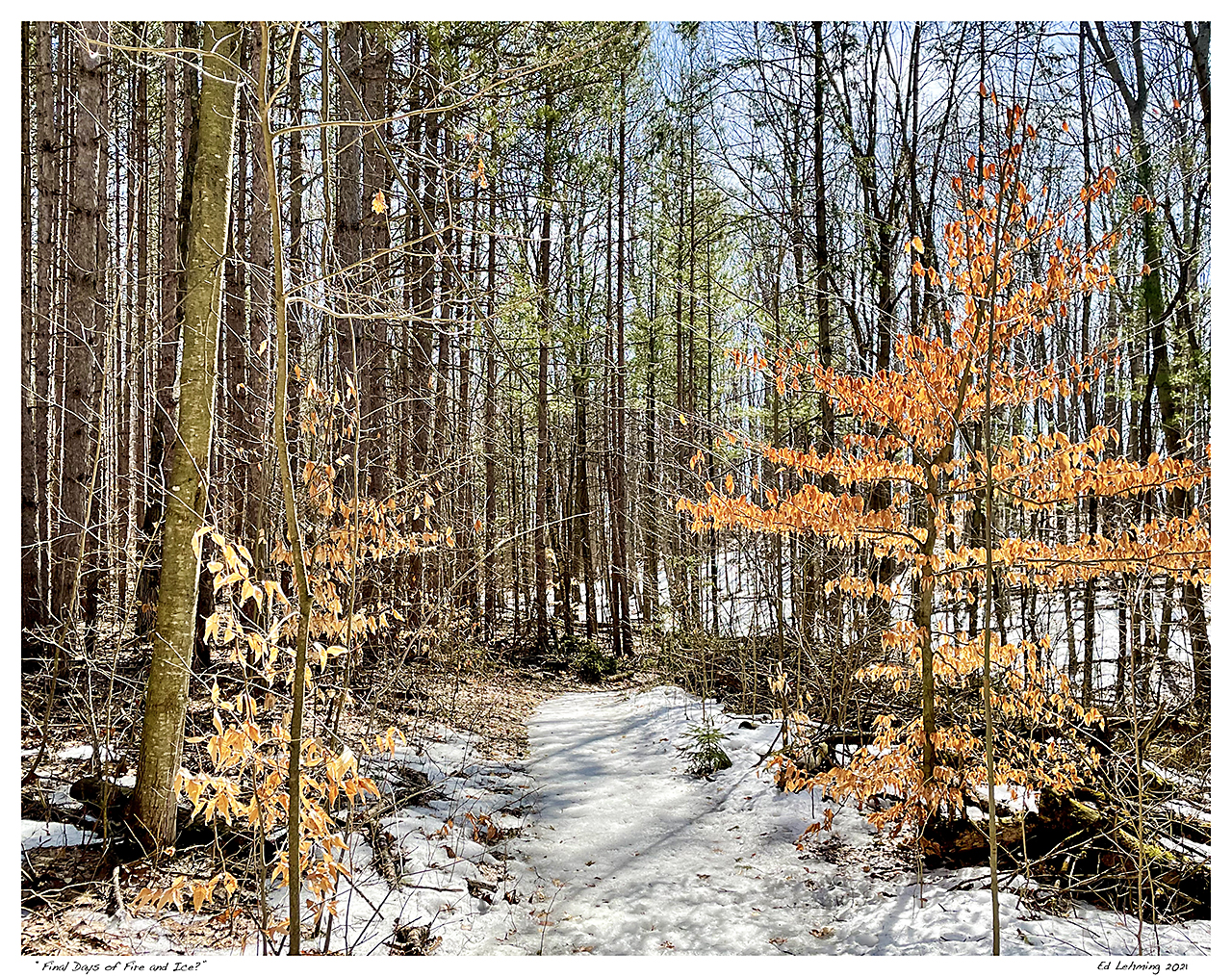

“These are the final days of fire and ice, the fiery foliage of the beeches begins to fade and drop and the ice and snow will soon be only a memory.” – Ed Lehming
The forest these days is filled with contrast and transition. The trails, covered with snow and ice mere days ago are strips of ice and slush. The only snow remains in sheltered valleys and north-facing hillsides. The beech leaves that I have been so fond of all winter long are, for the most part, tattered remnants of their former glory. With warming days, wind, and moisture, many are beginning to wear and decay, yet still clinging to their branches. I’m seeing the start of new buds forming, which will soon force last year’s growth to fall.
The beech tree on the right is one of my favourites. For some reason, it’s foliage remains thick and brightly coloured every winter since I found it. It’s like a signal fire that can be seen through the forest long before I get close to it.
It is beautiful, seeing this transition to spring, though there are only traces of green starting to show. The forest floor remains littered with a compacted layer of leaves, keeping the ground below frozen. Once the sun warms this layer for a few days, that same layer will provide protection for the delicate emerging ephemerals, something I always look forward to.
Winter is fading to spring and I suspect that I will only have a few more photos of ice-filled forests before they are replaced with greenery and spring flowers.
iPhone 12 Pro @ 4.2 mm
1/1667 sec, f/1.6, ISO 32

“The forest shifts and bends gently towards spring, each curve in the trail revealing a bit more earth along the icy edges of the trail. Distant hills, still snow covered, await the sunlight, so that they too can partake in the transformation.” – Ed Lehming
I really do enjoy this time of year. With the proper gear, the icy trails are easy to navigate and it’s such a pleasure to be able to participate in this change of seasons. It’s a surprisingly quick process, once it gets started, especially with the milt temperatures we have had the past few days.
As I write this post, I’m preparing to head out once more to see the changes that have taken place over the past few days. I’m certain that most of the ice will have receded and splashes of pale green from some of the heartier grasses and sedges may be poking through already.
Nikon D800
Tamron SP 24-70 mm f/2.8 Di VC USD @ 45 mm
1/4 sec, f/22, ISO 100

“The final day of winter and I stand on the edge of spring. Before me, two seasons meet and blend; only a few steps forwards and the snows of winter are behind me.” – Ed Lehming
This really is a wonderful time of year. I get to experience two seasons at once, mere steps apart. In this image, the forest floor is still covered in snow, gradually melting but still very present. On the edge of the same forest, the sun has begun warming the ground, the snow melted away only a week before. It’s like standing at a gateway. I can feel the cool air around me yet the sun still warms my face.
If this week’s forecast is accurate, the last of the snow will be a memory within days, as the temperatures are supposed to remain exceptionally warm for March and then there will be a few more days of warm rain; that will remove the snow and melt remaining ice quite quickly.
I decided to employ my intentional camera movement technique to give this image the painterly look that I enjoy so much. That slight blur and movement brings life to the image and the wider aperture required for the effect also saturates the sensor a bit more, lending some needed vibrance.
Nikon D800
Tamron SP 24-70 mm f/2.8 Di VC USD @ 52 mm
1/4 sec, f/22, ISO 100
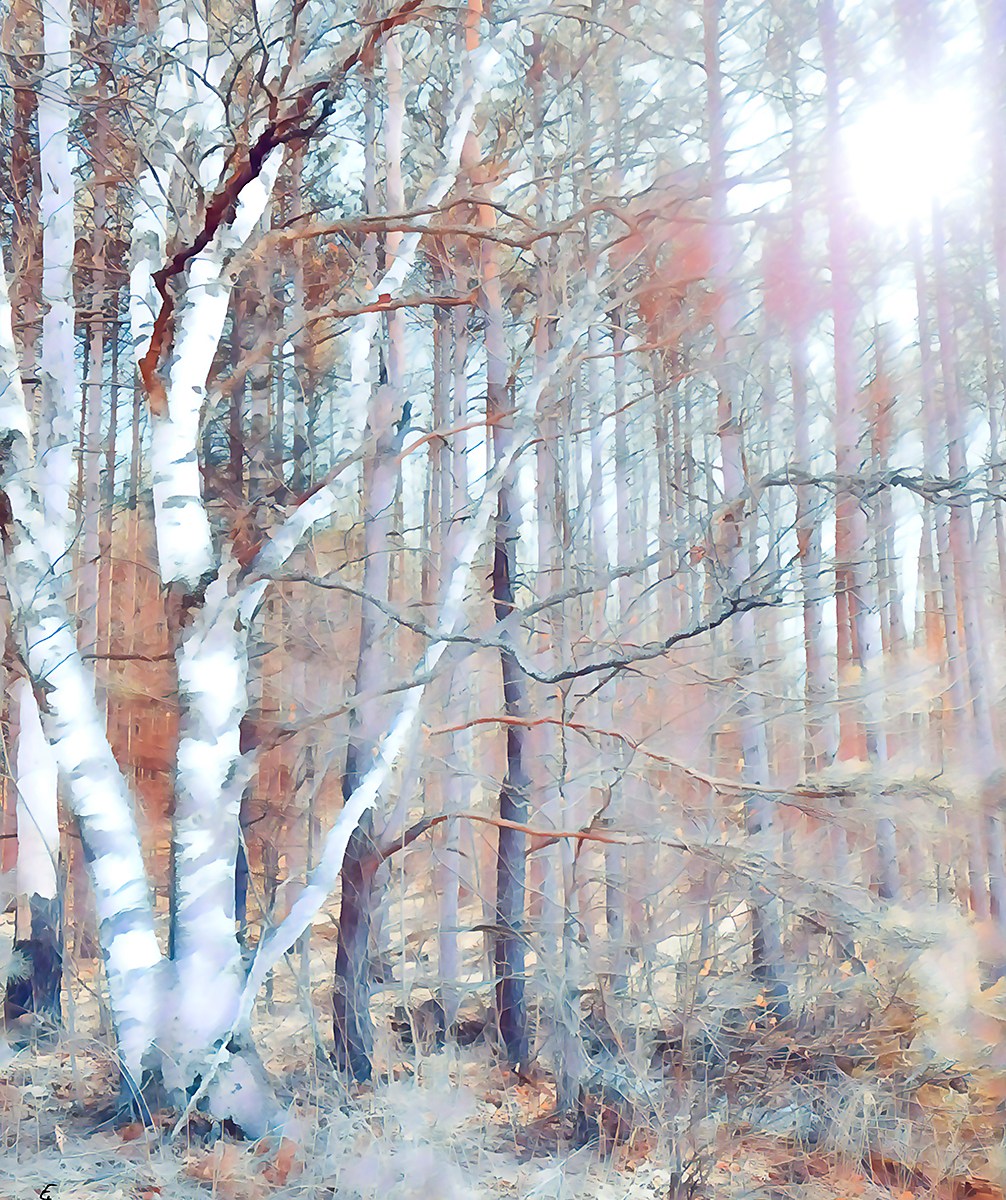

“The final day of winter; I walk through familiar forests. Ice and snow recede around me, revealing their long buried secrets. The days warm; brightening light seeps between bare branches; the muted landscape prepares once more to be filled with colour.” – Ed Lehming
I was not planning on returning to this style again, but the composition, which looked quite nice right from the camera, simply lent itself for one more go.
Yesterday was the final day of winter and the day expressed itself as such. As I began my hike the day was bright, cold, and windy but the forecast promised it would warm up by mid-day. The forest showed very clear signs of a transition as well. Hillsides exposed to the late winter sunshine were almost completely devoid of snow, yet the valleys remained locked in the winter world. It’s quite the effect really, to look at leaf-covered hillsides on one side of the trail and see a winter world on the other.
I had set out with my son to gather a collection of new photographs, not knowing exactly what to expect but really enjoying the mid-morning sunlight and the softness of the shadows it produces. It was really ideal and warmed our skin when we got out of the cold wind.
This soft light shone between the trees along the path and yielded several pleasing images, including this one, which was among the first compositions I made that day. I like the muted tones and serenity of the image, it’s focal point being the gnarled birch tree to the left side with the sun beaming brightly above. It seems a fitting image to say farewell to winter as days warm and colour returns to our world.
iPhone 12 Pro @ 42 mm
1/454 sec, f/1.6, ISO 32

“A painter should begin every canvas with a wash of black, because all things in nature are dark except where exposed by the light.” – Leonardo da Vinci
I set out to create a macro image of a Calla Lily which recently appeared in one of my flower pots. I say appeared because I did not plant it, so the rhizome must have already been present in the soil. It was a pleasant surprise and I wanted to make a photo of it as a reminder of that.
It’s been a while, three years to be precise, since I have gone to my studio setup but the technique and setup quickly came back to me. After a few test shots I had the image I wanted. As I edited it, the blossom looked ‘nice’ but I wanted to pull something more out of it.
The black background that I use for my flower shots is the black wash that da Vinci refers to in his quote. I have found that the emergence of colour from the blackness adds incredible drama to images. That colour was already there but I employed a few filters to really pull the colours out and make the photo dramatic by extracting as much colour and light as I could while staying to to the original image. In the end, it ends up looking more like a painting, which I am pleased with.
Nikon D800
Tamron SP AF 90mm f/2.8 Di Macro 1:1 (272ENII)@90mm
2.0 sec, f/29.0 ISO 100
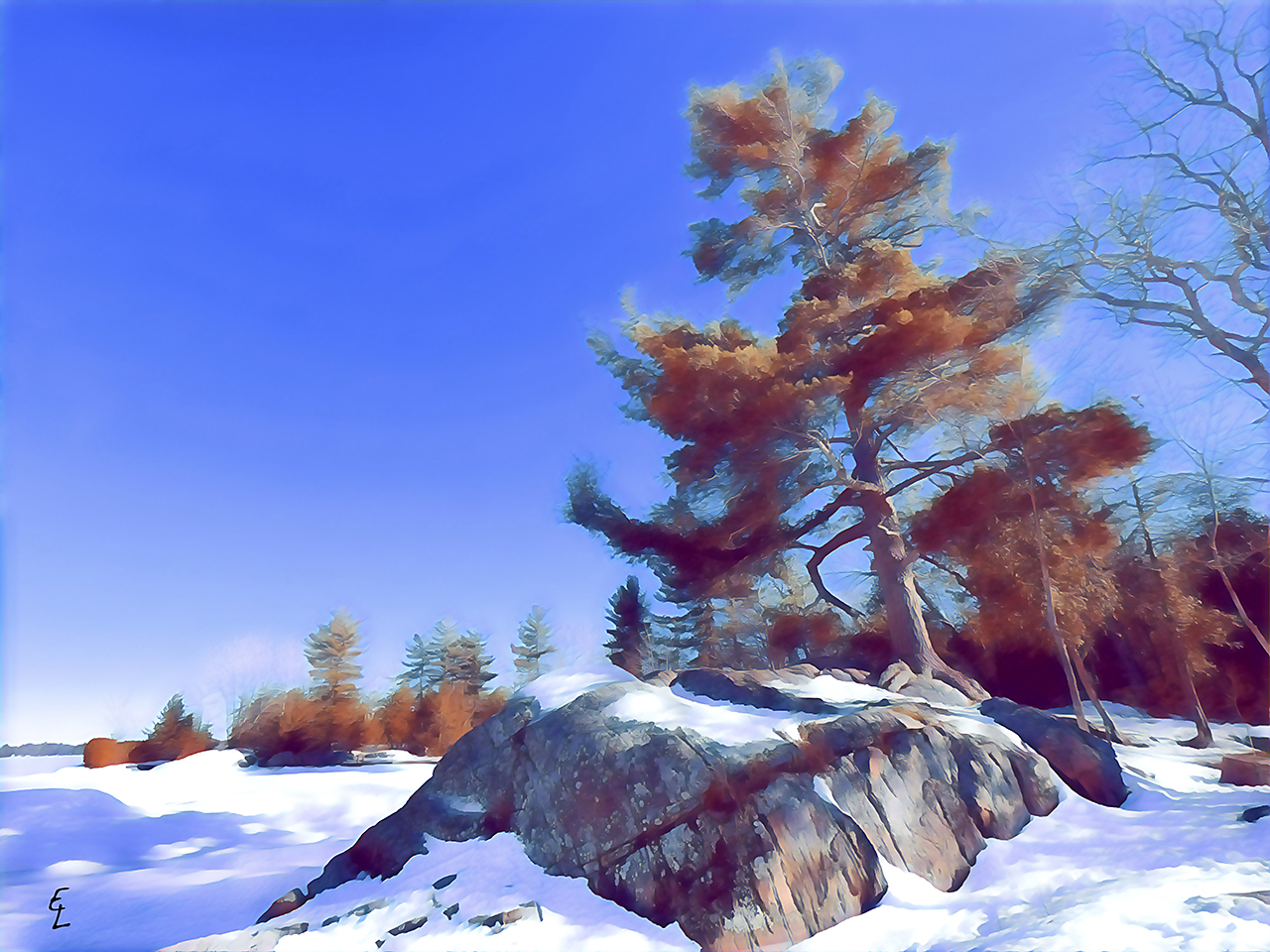
“The forces of nature affect everything. Though the mighty may resist, over time, nature still leaves her mark.” – Ed Lehming
This image may be the departure, for a while at least, from my re-imagined series of photos which I have shared over the past few weeks. With spring on our doorstep, the colour shift is already underway and that change affects the colours of the modified images. I find them less appealing.
The scene portrayed above is from a recent trip to Burleigh Falls, Ontario. As I have noted on a previous post, these falls are at the very edge of the Canadian Shield, a vast and ancient rock formation that covers much of northern Canada. The Shield and its forests are what many people envision when they think of Canada. The exposed granite outcrops, lakes, rivers, and stands of tall White Pine evoke images of Canada in its natural state; all those elements are present in this image.
It is quite incredible though, when you look at this image, just how much impact the natural environment has in creating these scenes. For example, the granite outcropping has been worn smooth over centuries, if not millennia by the constant flow of water , plants have invaded the cracks in the rock itself, allowing water and ice to spread those cracks even farther. The wind, has been blowing through the narrow channel that forms the Burleigh Falls cascade, slowly but steadily causing the massive White Pine to lean in the direction the wind blows. These elements, the rocks, the water, and the trees are all mighty of their own accord, able to resist most temporal forces, but still succumb to the slow and relentless forces of sun, wind, and water.
I find myself spending more and more time in my photographic practice truly appreciating that many of the scenes that I capture have taken a very long time to create, particularly those where nature is the creator.
Nikon D800
Tamron SP 24-70 mm f/2.8 Di VC USD @ 40 mm
1/125 sec, f/20, ISO 400


 Ed Lehming Photography
Recent Comments