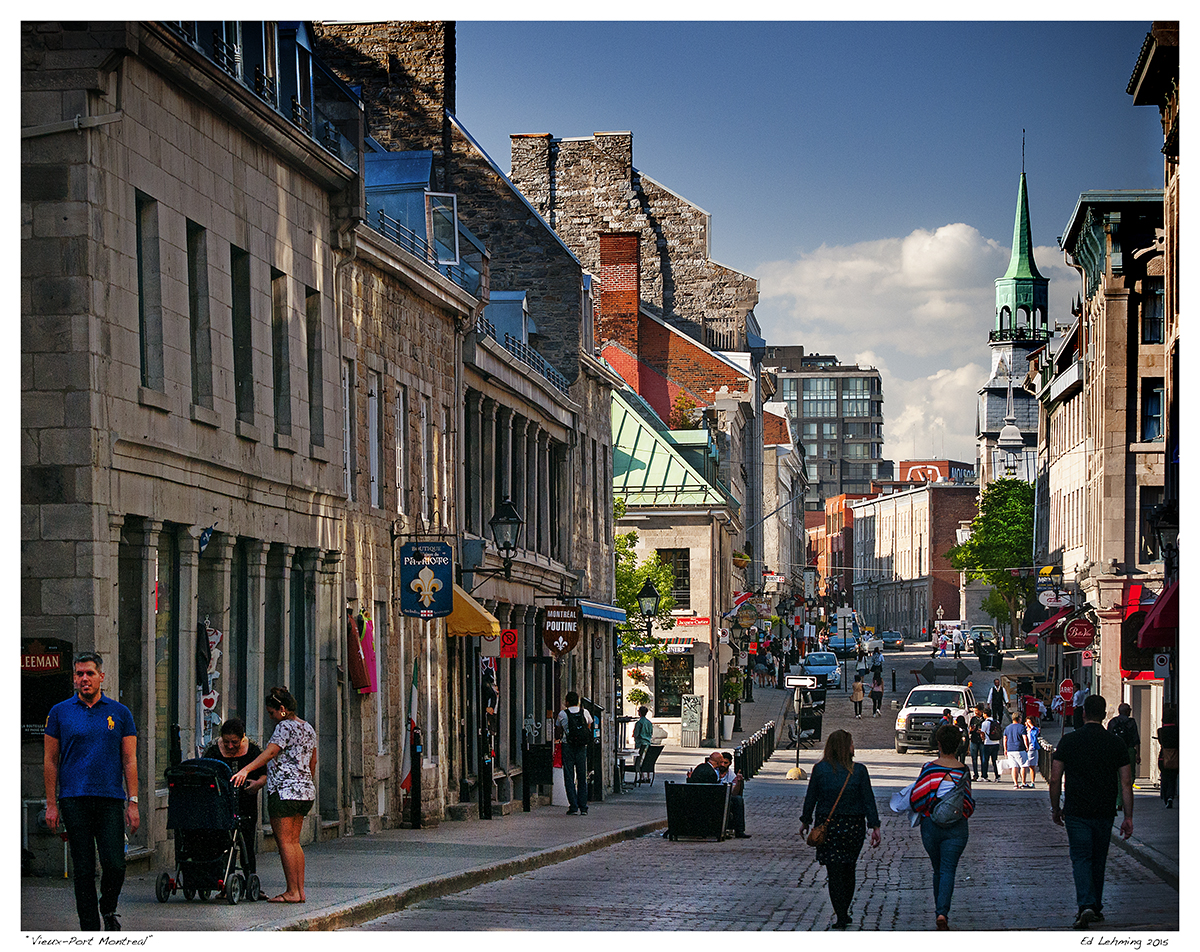
A very pleasant day in Old Montreal.
In my 50 some years growing up in Canada, I missed this marvel of culture. I know it has existed in various iterations and many of my friend s have enjoyed this cultural gem in my absence. I discovered Old Montreal a few years ago, while visiting with cousins and long to return whenever I get the chance, especially on recent business trips.
Montreal has a gorgeous “Old Town” near the port of area Montreal known as “Vieux Port Montreal”. This area is known for its European look and feel (and some rather fine restaurants).
This particular photo was made in late May. The day was unusually hot for the time of year and Betty and I spent some time touring around and enjoying the atmosphere, before sitting down for a wonderful dinner at a local steak house. The nice thing about May is the soft light at the end of the day and how it filters down the narrow streets.
This was a fairly complex photo in that it was significantly underexposed to avoid blowing out all the details in the sky and background buildings. I spent a bit of time dodging and adjusting shadows in Adobe RAW to bring out the details in the foreground to capture the interactions of the people in the street, which was an important part of this composition.
In the end, I was pleased with the details I was able to recover for the shadows to recreate the scene as I saw it that warm, late spring day, a few months back.
Nikon D300
Tamron 70-200mm @ 70mm
1/200 sec @ f/7.1, ISO 250
For more images like this, please visit my Facebook page:
https://www.facebook.com/EdLehming
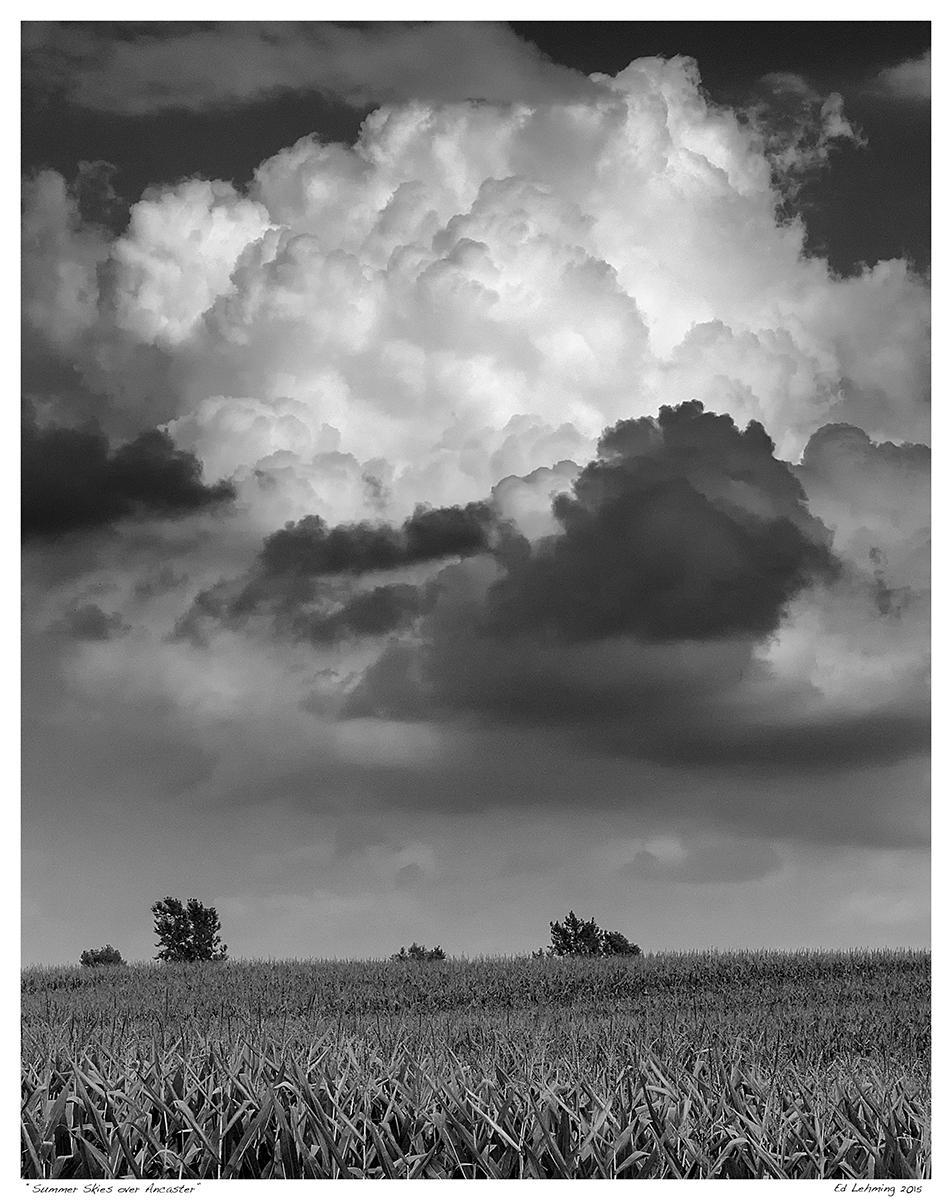
This is a VERY recent photo I made this past weekend during a family event near Ancaster, Ontario.
As usual, I had my camera along to capture those family moments, but I found my kids had that pretty much covered off. Yes, my children like photography too. I had visited this location many times before and had photographed it many times, and so, was having a hard time figuring out what I might photograph that had not already been done. Photographer’s block?
After dinner, I walked out into the nearby corn field looking for opportunities. Last Sunday was a hot, somewhat humid day, typical of southern Ontario this time of year. The forecast called for a chance of showers, but as the day progressed, the showers never materialized. But, some beautiful clouds formed. As I walked the field I was struck by the appearance of this particular cloud in the distance. It had the making of a potential rain storm. It was big, billowy, and white, with the appearance of cotton balls. What set this cloud apart was the contrast of dark portions in the foreground against and white clouds within the same structure, against a deep blue blue sky. All this floating over fields of corn and a few trees.
I made the photo and when I got to my iMac to process the image I found it required very little work. I boosted the contrast a touch to get the ‘look’ of the cloud as I remembered it. Then, I just desaturated the whole thing and sharpened it a touch. The result is the attached image. For me, it really portrays the scene as I saw it, with a bit of extra drama for the black and white treatment. Overall, I am very pleased with this photo and hope you enjoy it too.
Nikon D300
Nikor 70-300mm @ 70mm
1/400 sec @ f/10, ISO 250
For more images like this, please visit my facebook page:
https://www.facebook.com/EdLehming

Another favourite photo and a venture into street photography for me. This photo was made last year at Toronto’s annual Buskerfest.
I was walking the street, knowing there would be some interesting scenes to photograph. The street was extremely busy and it became difficult to get a shot that was not full of distractions. I like to isolate my subject as much as possible. Off the main venue, Toronto’s Yonge Street, which is closed to traffic for Buskerfest, there were several people sitting and chatting, including this woman, who was searching through her purse for something. For her, it was a break from the busy crowds and a chance to sit and have a smoke.
Originally, I had titled this image “Old Lady at Buskerfest”, but on further reflection, I can’t tell if she is really that old. I don’t know her story, but the photo makes me want to know more. For now, it remains a moment in someone’s life, captured in a single image.
Nikon D300
Tamron 70-200 f/2.8 @185 mm
1/60 sec @ f/2.8, ISO 200
For more images like this, please visit my Facebook page:
https://www.facebook.com/EdLehming

This remains one of my favourite photos. Partially because it was just a chance, unplanned, opportunity and secondly due to the sense of serenity it instills in me.
The unplanned aspect of this photo was that I was travelling to the Yosemite Valley proper, with the intention of photographing some of Yosemite’s grand waterfalls. On the trip in, I happened to glance over my shoulder into one of the many steep ravines that the road crosses. I noticed a small cascade and pulled the car over to have a closer look.
As I descended into the gully, I was greeted by this gorgeous scene of Alder Creek flowing over and around the moss-covered boulders. I was especially drawn to the water flowing lightly across the round boulder in the foreground.
I find myself going back to this image time and again when I need to wind down. As a photographer, I’m finding more often, that these chance encounters, with my natural surroundings, provide more satisfying and unique images than some of the grand vistas.
I hope you enjoy it too.
Nikon D300
Tamron 70-200mm @ 70mm
0.4sec @ f/6.3, ISO 200
For more images like this, please visit my Facebook page: https://www.facebook.com/EdLehming

Another visit to High Falls, the outlet of Baptiste Lake and the beginning of the York River. I keep trying to imagine the waterfall as it would have been before the dam was built above it. That would have been a sight to behold. As I noted in an earlier post, the dam was built to protect the town of Bancroft, some 5 miles down river, from being flooded in the spring (it still happens, but to a lesser extent).
This was simply an opportunity to do a hand-held time exposure of the water spraying out between the logs. My maximum shake free exposure with my Tamron 70-200 f/2.8 is 1/8 of a second. It still amazes me just how good the Vibration Reduction technology is these days. I closed the aperture a bit on this to keep everything in focus.
I liked the way the spillway naturally framed the image, the texture and colour of the wood, and how the spray stood out against the dark background. I may have to try this as a black and white at some time as well. There is something calming in images with soft flowing water that I really enjoy in this busy world.
Nikon D300
Tamron 70-200mm @ 90 mm
1/10 sec @ f/14, ISO 250
Like this blog? Check out more images at https://www.facebook.com/EdLehming

A few weeks ago, I had the pleasure of spending the weekend with family and friends at Ontario’s Sauble Beach, on Lake Huron. It began as a wonderful hot summer day splashing in the surf and playing hours of volleyball. The forecast was for thunderstorms late in the day. We watched across the water as the sky gradually darkened. The storm approached over the lake like a black wall, slowly creeping our way.
I took this as a wonderful opportunity to get some powerful storm photographs. As I stood on the shore making photos of the storm, I was struck by just how bright the circling seagulls were, in strong contrast to the dark skies.
This one kept circling me at just the right distance to make some good images. I’m really pleased at how it turned out. The biggest challenge was trying to keep him focused and framed properly.
Nikon D300
Nikor 70-300 mm @ 210 mm
1/60 sec @ f/10.0, ISO 450
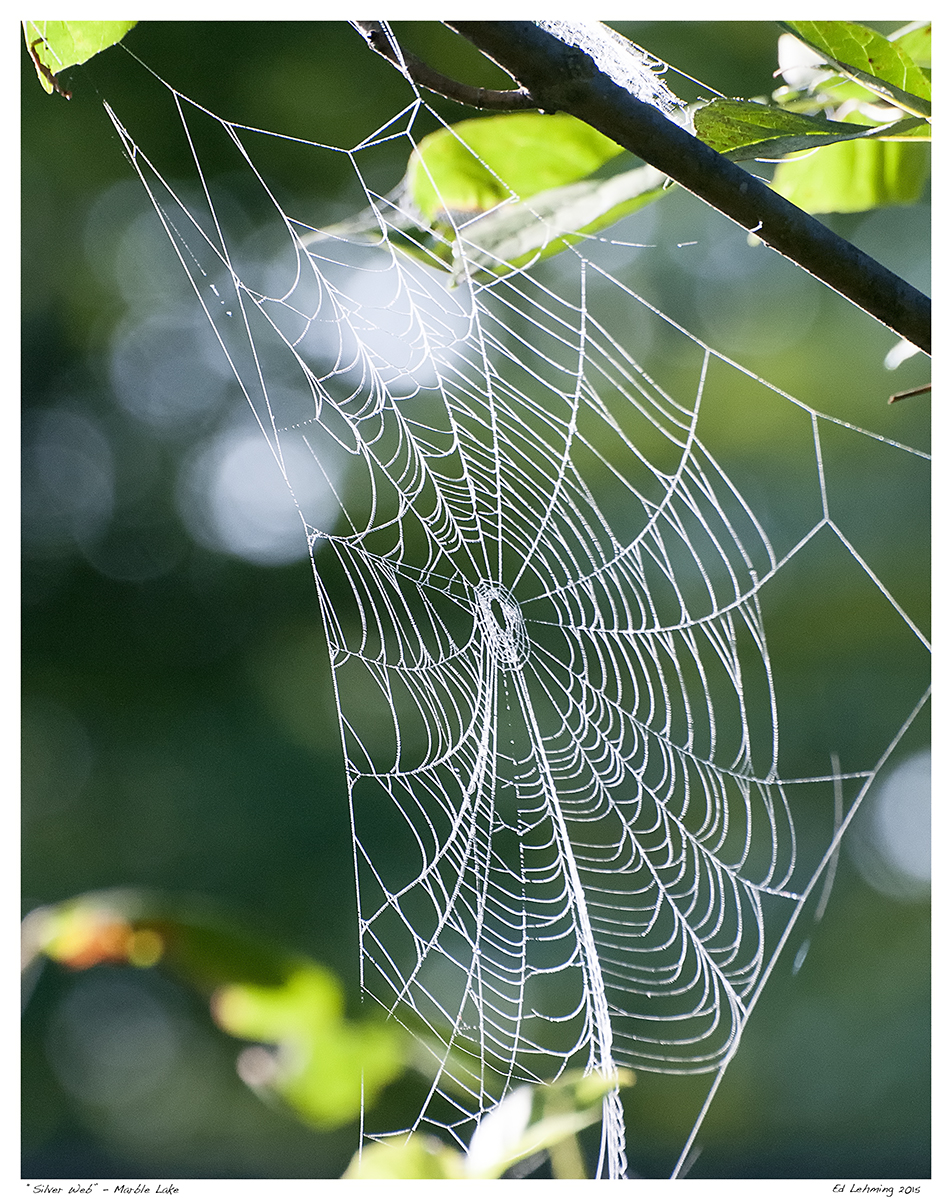
Another early morning image. It’s the time of year when nights get cool and the mornings are damp and misty. Dew clings to everything and the low rising sun lights up the world in silvers and golds. Spider webs that go unnoticed during the day shine with water droplets that appear like silver threads.
I noticed this web in a tree near our camper and the light was just right to reveal the fine details of this particular spider’s work. The curves and arches in the web really jump out, though it appears this web may be in need of some work.
Nikon D300
Nikor 70-300mm @210mm
1/60 sec @ f/9, ISO 800

A classic scene to those of us who spend time in the north.
After a cool night, the waters of the lake are warmer than the surrounding air and a thick fog forms. As the sun rises higher in the sky the fog begins to rise higher and higher to eventually form small clouds. The small clouds eventually join together to form larger clouds. It’s a fascinating process to watch. I often look up at summer clouds and wonder what lake that cloud came from.
Last Sunday was no exception. The warming sun played across the lake as mist swirled and rose higher and higher. The warm glow of the rising sun shone on the distant shoreline in golden hues.
For me, it’s such a calming scene and I could spend day after day watching each new day dawning, just like this.
I hope you enjoy the view.
Nikon D300
Nikor 70-300mm @ 240mmm
1/160 sec @ f/6.3 ISO 2500

I can’t turn it off. I see patterns and photos everywhere. Last weekend I was volunteering at A Place for the Arts in Bancroft, looked out the back window and saw these beautiful patterns in the sand in the back parking area.
There had just been a big storm with torrential downpours the day before (which seems to be the norm for Bancroft lately). The deluge of rain created a wide band of water in the parking lot, sorting the sand and making these wonderful patterns.
It may not seem interesting to some, but I thought you’d enjoy this artwork that nature creates, on a fairly regular basis for those who take the time to notice and appreciate it.
Nikon D300
Nikor 70-300mm @ 135mm
1/60 sec @ f/9.0 ISO1000

You really never know what you will come across in your day. This past weekend I drove to High Falls, the source of Bancroft’s York River and the terminus of Baptiste Lake. The dam there was built to prevent flooding of the town of Bancroft in the spring and features a beautiful, complex waterfall below the dam. There is a bit of a pool of water immediately above those falls.
That particular day i was surprised to find a family of ducks standing on the rocks and swimming in the fast moving water. Every now and then one of the ducks would venture into the faster moving currents. Some would be nearly swept over the edge, only to fly away at the last moment. It was interesting to watch and I was surprised that none ever got overtaken by the current. There must have been food in the water because the duck could have moved a few yards up river into calm water.
This particular fellow seemed to be contemplating his next move, standing right next to the fast flowing current. Eventually he made his choice and flew over the current to a calmer section.
Nikon D300
Tamron 700-200mm f/2.8 @ 200mm
1/13 sec @ f/14.0, ISO 250
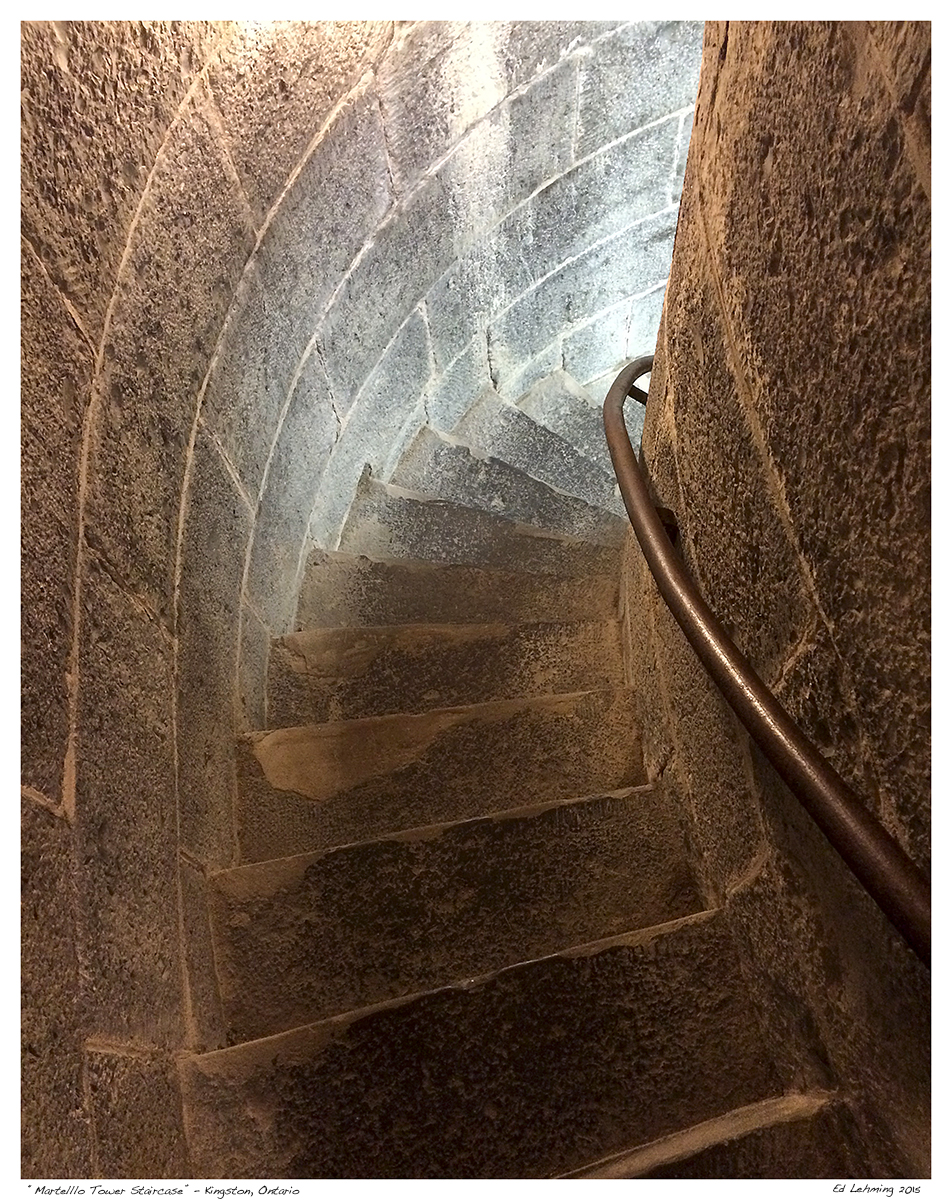
The city of Kingston, Ontario was a military outpost for many years. The War of 1812, between America and Britain (Upper Canada), caused to be built many fortifications. Among them Fort Henry and supporting structures such as several Martello Towers which still stand today, beautifully preserved.
I had the opportunity this summer to tour one of these amazing structures, which at one time held about 20 soldiers to be on watch for, and repel, any attacks from America over Lake Ontario and the adjoining shoreline. The tower also contains a 35 pound cannon which rotates 360 degrees.
I was particularly taken with the amazing stonework and especially this winding staircase which come down from the upper cannon level to the main floor. I like the way the light shines up the stairs and reflects off the stonework.
iPhone 5S
1/120 sec @ f/2.2, ISO 320

I find interesting pattern everywhere. It’s something I can’t turn off, nor would I want to. Last week, during a trip to Montreal, I looked out my hotel window which faced an office tower cross the street.It would seem that different companies have varied tastes in lighting and this building went from bright warm lighting, to a cooler ‘sunlight’ style light, to dimmed lights.
The unfortunate thing was that the hotel windows were quite dirty and I was not able to sharpen the image beyond this. I had my Nikon DSLR with me but those shots were not much better than the iPhone. So, here it is. From a distance, people think this is a contact sheet and then they look closer. Every window seems like its own little world and no two are exactly alike. I hope you enjoy it.
iPhone 5S

A simple photo of three columns at Place d’Armes in Old Montreal. The building is directly across the square from the well known Notre-Dame Basilica. I simply enjoyed the form and details of the columns. I’m not sure if this would be street photography, urban, or architectural. Technically, it’s travel photography, though I did not travel far.
What I also find interesting is the fine details that emerge from the photo, not visible in the viewfinder. I did not notice the meshing to keep pigeons off the scroll-work or the bolts stick from the fluting. Yes, thats what the official name of the carved out part of the column is. Something new I learned today. I also learned that the top of this type of column is a Corinthian Capital. Amazing what you can learn when you look at details and want to know more. I feel so enriched 🙂
Nikon D300
Nikor 70-300mm f/4.5-5.6 @ 165 mm
1/60 sec @ f/5.0, ISO 250
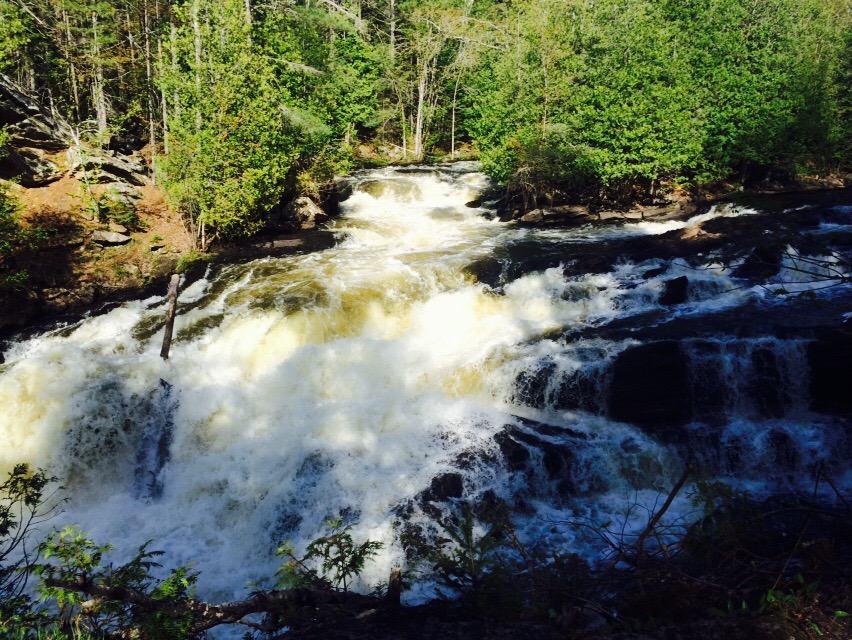
One of my favourite places to visit in the Bancroft area is Egan Chute, on the York River. It’s the first of a series of three chutes within a fairly short distance. It is amazing to watch the volume of the York River be compressed as it races through the narrow and steep chute area. The water this spring was surprisingly high and the right channel, which is often just a trickle, was in full flow. In the summer, as the water level subsides, the chute becomes a series of fans, with a faster, central channel still dominating. If you like this image, I will be posting more to my Facebook page later this week. Ed Lehming Photography
iPhone 5s

It’ the first long weekend of the summer. Victoria Day, here in Canada. For many, this is the start of cottage season, camping season, times in the outdoors. It’s the time of black flies and mosquitoes. But for me, it’s the time to just unwind. There is something about being on the water or near the water that creates serenity for me. I can sit for hours on the shore or in a canoe just being near water. The clouds are ever changing, ever moving. The day progresses from foggy mornings, to warm afternoons, and ends with beautiful sunsets. I watch wildlife in action on the shores and in the water. Dragonflies flit and fly like crazed helicopters among the shore plants and bullfrogs share their voices in and ongoing evening chorus. Yes, another start. Time to get out there and enjoy it.
iphone5S


One of the unfortunate characteristics of our generation is that we have tended to live highly structured lives. Those of us born in the 1980s, who spent their twenties in the transitional era of the early 2000s, amidst the violent cacophony of the two Bush Wars, have experienced at least some shared sense of structure to our lives.
The typical life of an upper-middle class son or daughter born in Canada during that generation would go something like this: a childhood spent in public schools, with no lack of activities in which to immerse oneself (soccer, piano, theater, etc.). Then high school hits, with its swirl of hormonal desire combined with the looming pressure of standardized tests. It is generally here that the adolescent learns the rhythms of capitalist work-time: school during the day, nights filled with study and ever more structured activities.
If the student is lucky he or…
View original post 2,825 more words
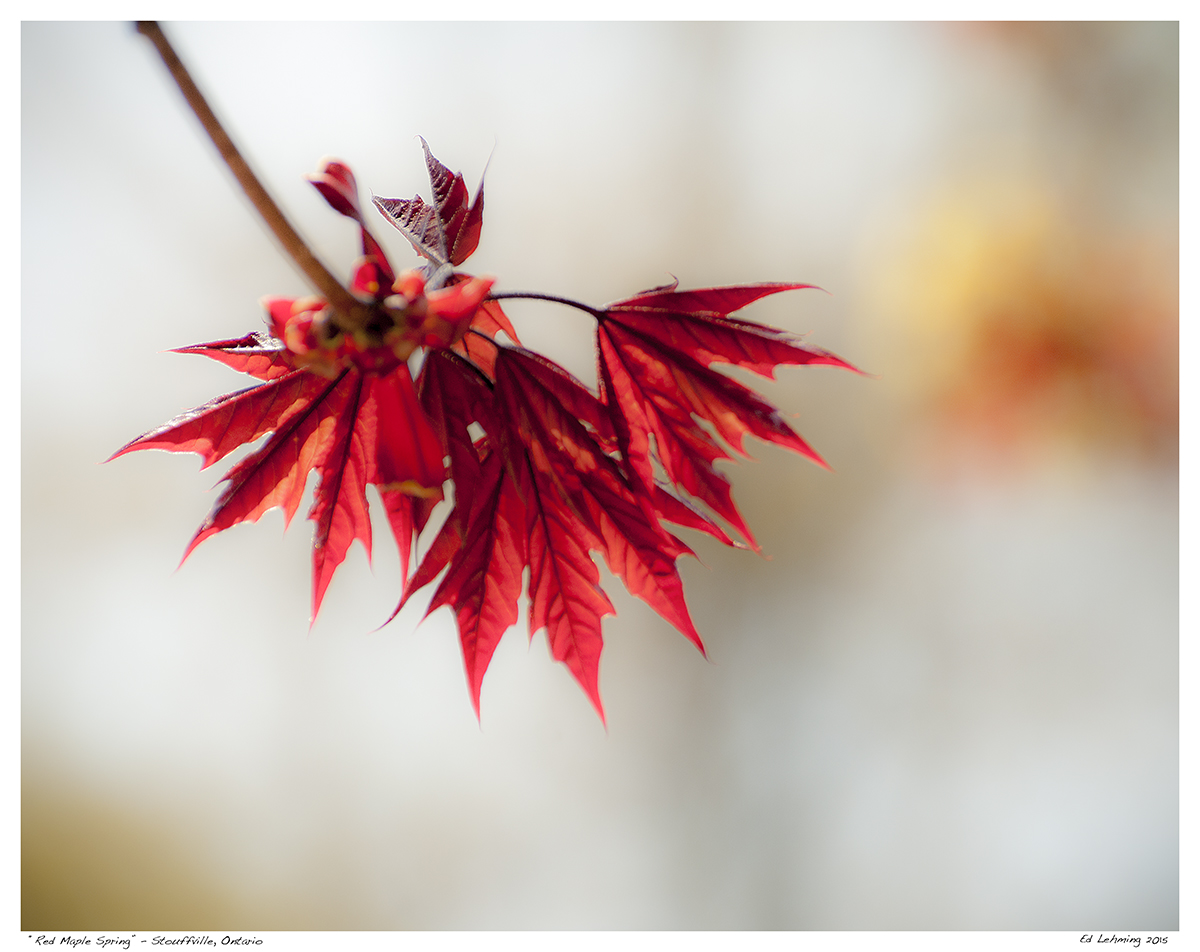
As spring continues, more colour and new life emerges, following the cycle of death and re-birth. The delicate structures of new leaves exploding from once tight buds are part of that cycle. A few short days ago, these red maple leaves were just bumps on a branch. Now, you can see the future shape in miniature. The soft morning light created a nice back-lit effect that shows all the structures nicely and soft focus blurs another cluster of leaves in the background. There is something soothing about these photos. I think it’s the freshness and promise each sign of new life holds.
Nikon D300
Nikor 70-300 mm @ 165 mm
1/125 sec @ f/5.6, ISO 250
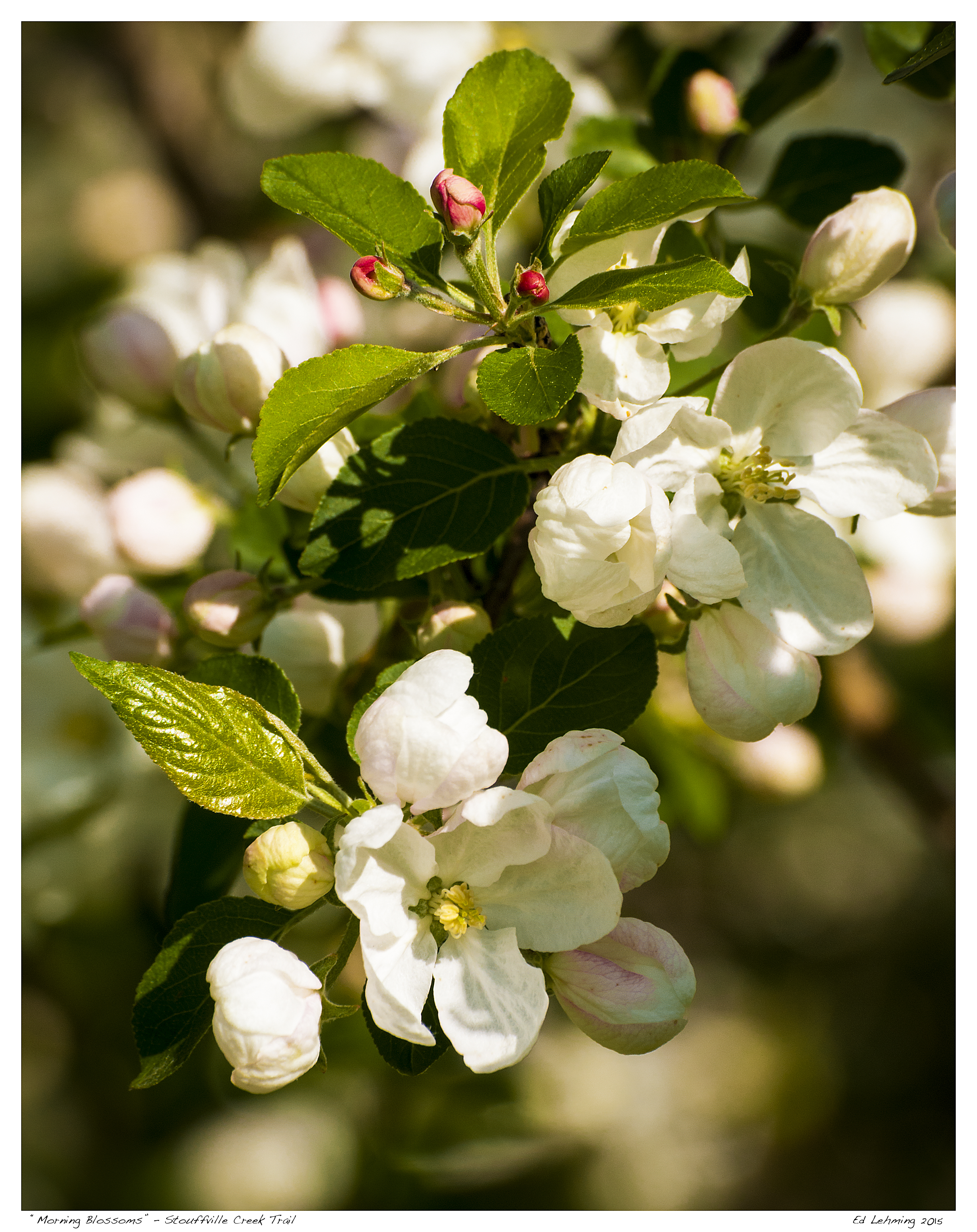
Ah, spring!
I went for an early morning walk this morning and was greeted by yet another gift of spring – a beautiful crab-apple tree loaded with delicate pink-white blossoms. The sun was just up and provided a wonderful soft light. I tried to keep as much of the flower-head in focus while keeping the background soft.
I spent quite a bit of time with this particular subject and will be posting more photos in the next few days.
Nikon D300
Nikor 70-3000 mm f/4.5-56. @ 170 mm
1/250 sec @ f/11, ISO 250
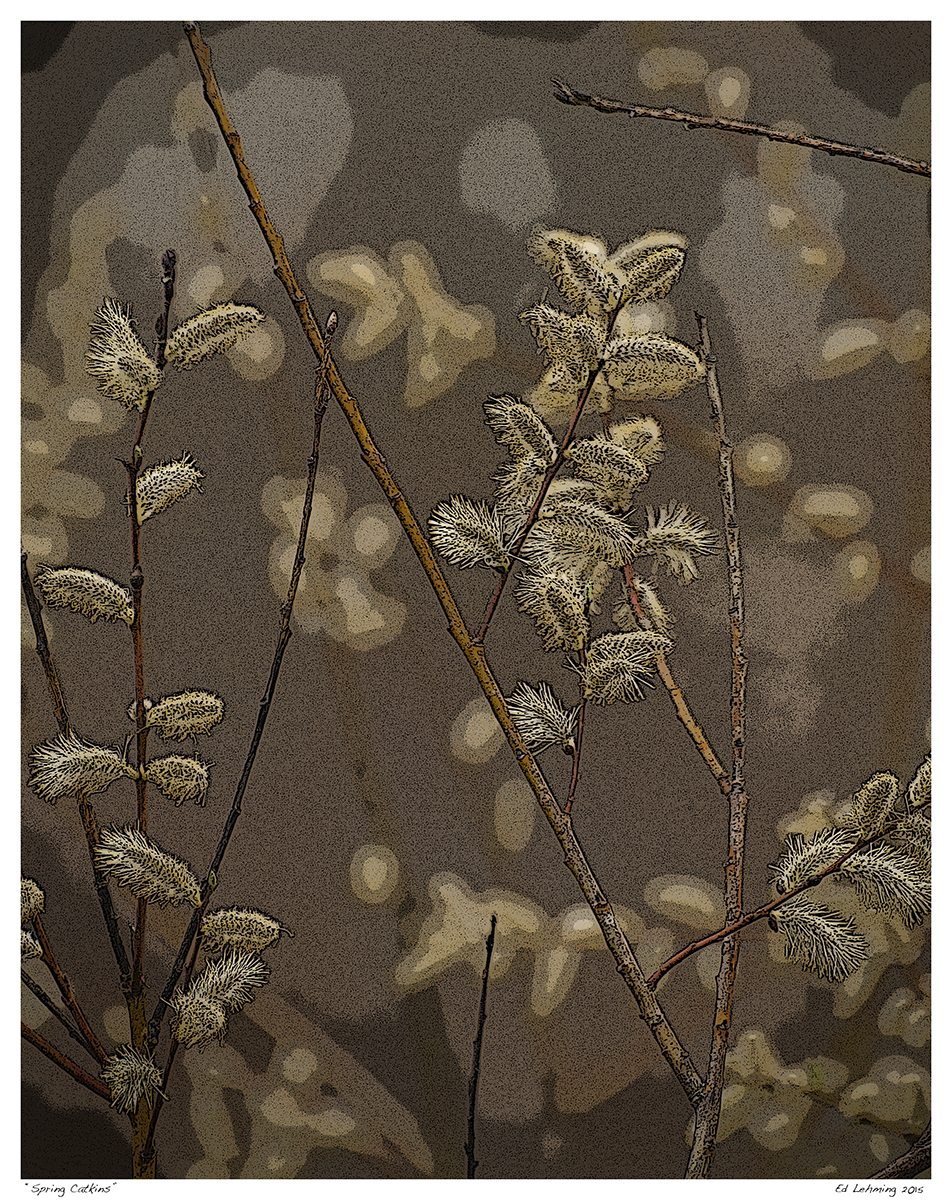
Today’s post is just a little abstraction of a photo I made last week.
With the ever warming days, many of the willows have put out ‘catkins’. This is the flower of the willow tree. Many would recognize ‘Pussy Willows’. These are the same but not as densely packed as the Pussy Willow variety and have already matured into full flower. They are still beautiful to look at. These are the catkins of the Sand willow. The photo was made along the banks of Duffins Creek, near Whitevale, Ontario.
I wanted to do a bit of a special effect on this since it did not ‘grab’ me when I first looked at the image. This is not my usual style but a bit of a learning exercise. Have had several comments that it would make a nice wall hanging.
Thoughts?
Nikon D300
Nikor 70-300 mm f/4.5-5.6 @ 185 mm
1/100 sec; f/5.0; ISO 250
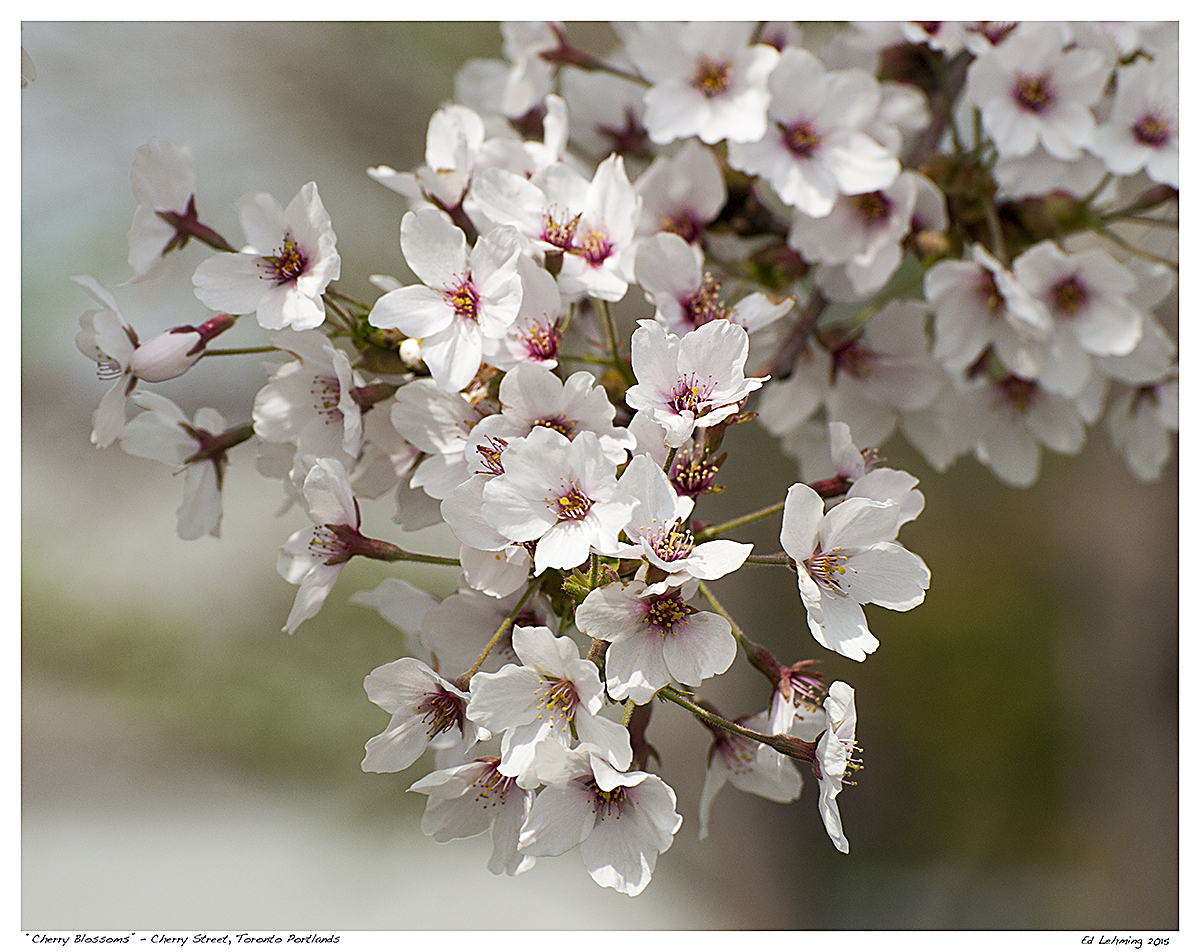
It’s spring in Toronto and cherry blossom season. While multitudes of people went to High Park for the annual display, I happened upon a small cluster of trees in the Toronto port lands, on Cherry Street, of all places.
I had originally set out to photograph some industrial scenes and was disappointed by the lack of parking and very limited access to the docks, where I was hoping to make some images of ships and heavy equipment. But, I was pleasantly surprised to find this grove of trees in full blossoms and I didn’t have to fight my way though crowds to get to them. Overall, I’d call it a successful day.
Nikon D300
Nikor 70-300mm f/4.5-5.6 @ 155 mm
1/320 sec @ f/9.0, ISO 250

Today, a change-up from the recent posts of flower heads. Last week I spent a few days in the Bancroft area, visiting my art friends and opening up our trailer for the season. It was a gorgeous, warm spring weekend. The air was fresh and clear with a very light breeze, all weekend long. Betty and I decided to head down to the waterfront on Marble Lake to see how my sister’s trailer fared through the winter. We were greeted by the scene above. The lake was almost mirror-like, producing stunning reflections of the clouds and shore-line. It was around 5;20 and the sun was just starting to soften. Creating the right combination of conditions to produce this stunning scene.
I had intended to make a few photos of the lake and shoreline but only had my zoom lens with me. Fortunately, I had my iPhone with me to make this image and am pleased with how well this image conveyed just what I saw. I hope you enjoy it as much as I do.
My friends on Facebook will already have seen the image, but not the story behind it. If you like this image, please check out my Facebook page for more:
https://www.facebook.com/EdLehming
iPhone 5s back camera 4.15mm f/2.2
1/800 sec @ f/2.2, ISO 32

Similar to yesterday’s post, this photo was also made at Wendat Pond in the “Golden Hour”. This image took a bit more effort to set up, as I was deliberately trying to get the golden glow of the trees on the far shore as a backdrop and I was not very happy with my first few attempts. The bright glow I saw with my eyes was not being captured by the camera. So, a few more attempts later and this is the result. My goal is to represent not just what I see, but how I see it, through my photography.
It almost looks like a fall image, but it is really mid-spring and the air is warming nicely and the tree in the background is a poplar, just coming into new leaf. The pale green leaves are catching the sun just right to reflect just the yellow tones and warming up the background.
Nikon D3000
Nikor 70-300 mm f/4.5-5.6 @ 95 mm
1/800 sec @ f/4.5, -0.33, ISO 250

One of the things I also enjoy about spring is the fact that some plants seem to weather the winter quite well. Despite heavy snow and ice, these flowers heads have managed to make it through the winter intact.
I often walk around Wendat Pond in Stouffville because the early evening light is so nice and offers some great composition opportunities. Yesterday was no exception. The sun was just starting to set and lit up the far shore of the pond in a mix of browns and golds, with splashes of green. Using a wide aperture softens these background tones nicely and makes a beautiful backdrop for photographing the plants on the near side of the pond.
Nikon D300
Nikor 70-300 mm f/4.5-5.6 @ 200 mm
1/125 sec @ f/5.3, -0.33, ISO 125

You know it’s going to be an awesome summer when full-grown dragonflies are out and about in May to eat those pesky mosquitoes and blackflies.
This year’s super warm May (so far) certainly has changed or accelerated some of the usual patterns around here, As I walk around, I see fresh leaves emerging from trees and shrub, birds in their nests, and a wonderful growth of wildflowers. I’ve seen a few dragonflies in the past day and realized it’s quite early to see this many.
Well, here’s hoping this is a good sign.
I have not seen an orange one like this around. Most are blue or black, so I’ll have to look this species up. That aside, I was very pleased at how the orange background just enhances this photo.
Nikon D300
Nikor 70-300 mm f/4.5-5.6 @ 300 mm
1/125 sec @ f/5.6, ISO 250

You never know what you might come across when you enter a natural setting. Today I took a lunchtime stroll to one of my regular haunts, the Stouffville Reservoir. Near the start of the trail there is a swampy area, where a small brook runs across the trail. This time of year it is particularly mucky and tricky to navigate.
Generally, the water flows through at barely a meander and you might see some water-striders or the occasional frog. As I was jumping from log to log, crossing the muddy path, I looked up to see this magnificent creature. A snapping turtle about two feet long, lying in a small pool, sunning itself. The tiny water hole seemed barely large enough to sustain a creature of this size, and I can’t believe this would be its full-time habitat, but I sure was nice to see. The turtle did not seem to be bothered with me and I had the opportunity to make several photos before it slowly buried itself in the mud, leaving not a trace that it had ever been the. It was an amazing thing to watch.
Nikon D300
Nikor 70-300 mm f/4.5-5.6 @ 86 mm
1/100 sec @ f/5.0, ISO 250
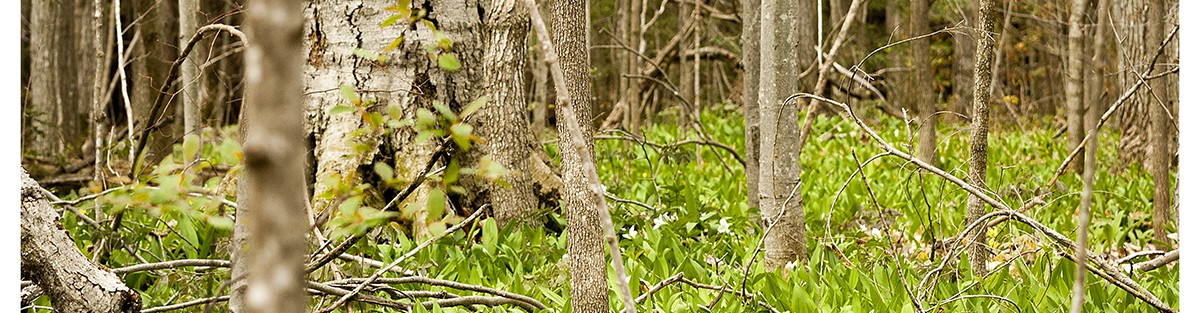
A slightly different view of the forest for you to ponder.
I spend a lot of time in the forest hiking and making photographs. People ask me where I find the wildflowers that I photograph. My response is, “Along the way”. I see them, because I know what to look for, where to look, and when to look, since I have experienced them in previous walks. Many of the flowers only bloom for a short period. So, if you miss them, your chance that year is gone.
A few years ago I went for a walk with a friend who wanted to show me the creek where the trout run. As we walked to the site, which he was very familiar with and had visited many times, I stopped and made several photos. He really had no idea why I kept stopping, until he saw the photos from the walk. He had no idea he had walked past so many beautiful sights. That’s the day I realized that the trick, if that’s what you call it, is to slow down and immerse yourself in your surroundings, to start really ‘seeing’ the finer details. I’ve found that once my eye picks up on a particular flower or plant that I have not seen before, I suddenly see them everywhere. It’s not like they were not there before, I’ve simply tuned in at a different level.
Many experiences in life also seem to be like that. Things go unnoticed until you encounter them once, then you see them easier and know them for what they are. As above, you become an experienced observer.
The photo above contains all the wildflowers I have recently photographed. Can you spot them?
Nikon D300
Nikor 70-300 mm f/4.5-5.6 @ 70 mm
1/125 sec @ f/5.6, ISO 250

The next in my spring wildflower series. Yesterday I went for a lunchtime stroll to my local nature retreat, namely, the Stouffville Reservoir. This area was created as a water conservation site after Hurricane Hazel roared through the region many years ago, creating floods and taking many lives. So, conservation areas were set up to ‘moderate’ water flow through a series of holding ponds. These areas made wonderful nature preserves and allowed for the preservation of many natural environments.
It is in one of these areas that many of my favourite wildflowers grow. Yesterday morning I checked on this stand of Trout Lilies, also known as ‘Dog Tooth Violets’ locally. They were not quite ready to open. But, a warm day and some sunshine changed that and they were in full bloom at noon today. Above is the photo I made of three beautiful specimens. The name is derived from the colouration of the leaves, which resembles the colour of trout. Many stands of these delicate wildflowers do not bloom for years and then, suddenly, they are full of blossoms. I have yet to figure that one out.
Nikon D300
Nikor 70-300 mm @ 220 mm
1/1600 sec @ f/6.3, ISO 250

Yesterday I talked about the cycles of nature and how wildflower blossoms follow a sequence. I posted a series of photos recently, documenting the blooming of several local wildflowers in a bit of a sequence and noted that the white trilliums should soon begin to show. Alas, show they did!
I went back to the reservoir trails today, at lunch, to check on a stand of Trout Lilies, also known locally as ‘dog-tooth violets, which were not quite open yesterday morning. They were in full bloom today, and after making several photos of the lilies, I ventured further into the woods. Of course, the Red Trilliums were still in full bloom, and there were plenty of Spring Beauties, also referred to as “May Flowers” by some. What I was not expecting, quite yet, was the small clusters of delicate white trilliums interspersed between the wild leeks. By the looks of them, this was the first bloom of the season, and the photo above is the first one I saw, thus the title, “First Up”. I spent the rest of my lunchtime walk enjoying and photographing the abundance of flowers on the forest floor and will share them in subsequent posts.
Nikon D300
Nikor 70-300 mm f/45.-5.6 @ 220 mm
1/160 sec @ f/6.3, ISO 250
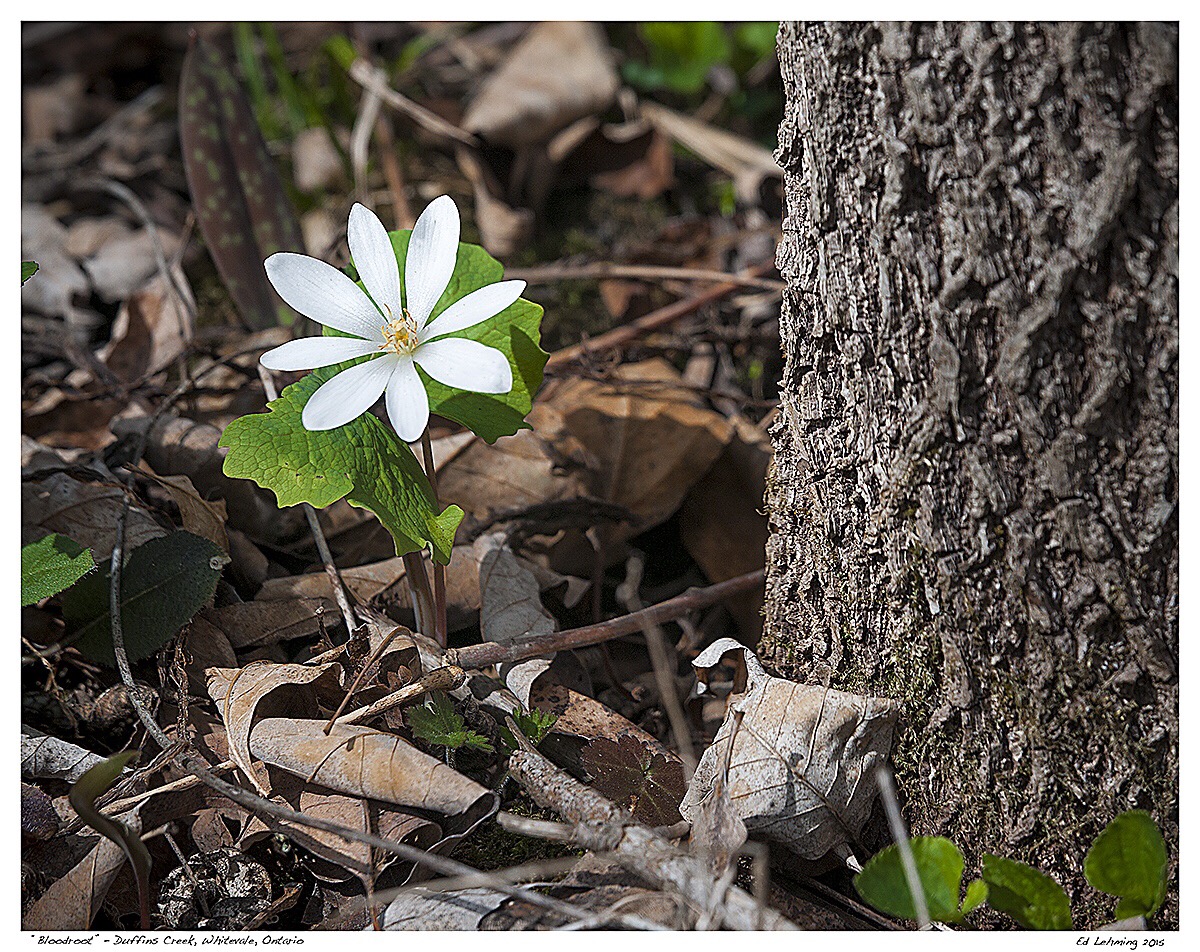
Here’s the post that was supposed to happen on Friday, but I was in the Bancroft “no service” zone most of the day and forgot to update this.
Another harbinger of spring in our area is Bloodroot. The beautiful white blossom emerges from a “shroud” created by its large green leaves. This particular specimen was found along the shores of Duffins Creek, near Whitevale, Ontario. It’s amazing just how fast it springs to life from the grey forest floor. One day there is nothing and the next, a blooming flower is up and ready to be enjoyed.
Nikon D300
Tamron 70-200mm f/2.8 @ 200 mm
1/200 sec @ f/7.1, ISO 250

What the heck, two posts in a day isn’t so bad, is it? After all, I missed Friday. I could not resist posting this photo of the Trout Lilies I mentioned on my previous post. There’s a regular cluster I go to every year and they never disappoint. It was earlier in the morning and they are not quite open yet. Give it a few hours and there will be several delicate bell-shaped flowers showing.
I’m hoping to get out again tomorrow to capture them in bloom and will share that image too.
This is one of my favourite times of year. Following the cycles of the plants and the emerging growth fascinates me. Out of dead-looking ground and grey branches come perfectly formed and fresh growth, year after year.
Nikon D300
Nikor 70-300 mm f/4.5-5.6 @ 240 mm
1/60 sec @ f/5.6, ISO 250


Recent Comments