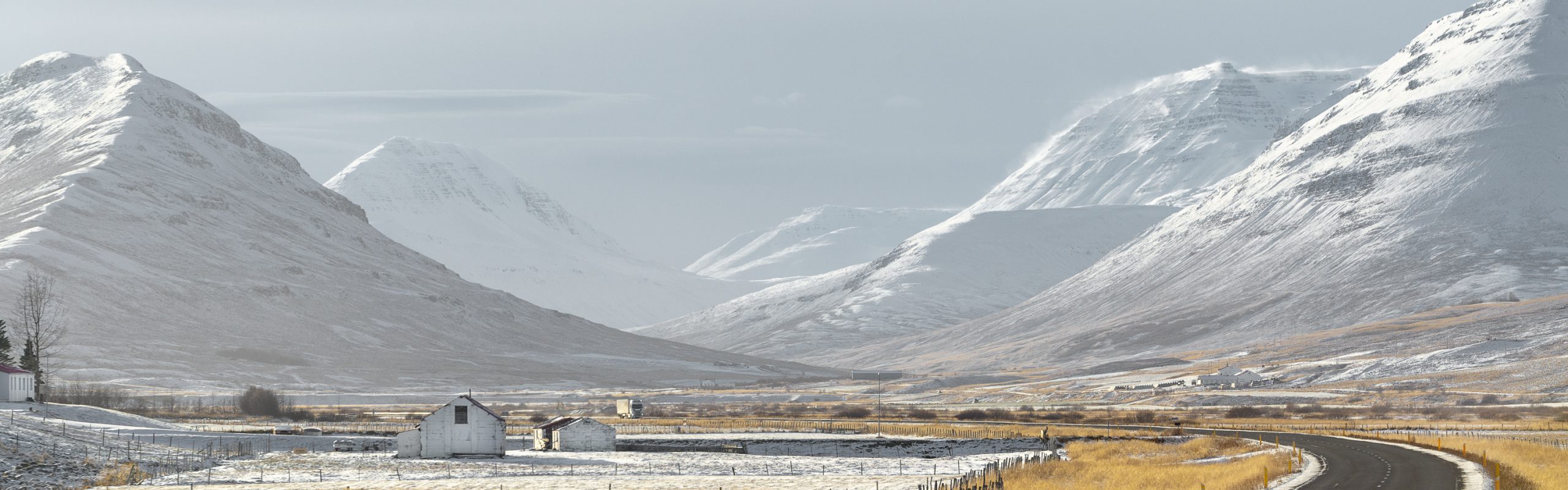

For more images like this, please visit my Facebook page:
https://www.facebook.com/EdLehming
or my website
http://www.edlehming.com
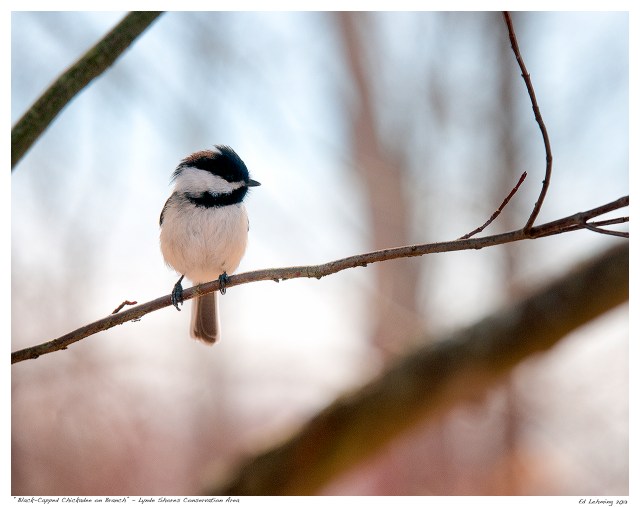
There’s something strangely calming about these little birds, so common in Southern Ontario. Which strikes me odd, since they are constantly flitting about and are rarely still.
In fact, they seem a bit nervous most of the time. Perhaps it’s moments like the one, captured above, where the chickadee is resting briefly on a branch that gives that sense of peace? A bit like many of our days, where we move rapidly from task to task and take a brief moment to pause.
Do we appear calm to our peers who also long for rest, or does our outward appearance betray the fact that, as we pause, we are only considering our next task?
Nikon D300
Tamron 70-200 mm f/2.8 @ 200 mm
1/160 sec, f/6.3, ISO 200
For more images like this, please visit my Facebook page:
https://www.facebook.com/EdLehming
or my website
http://www.edlehming.com

In November 2014, I was walking along a ridge on the Fraser Lake Camp property, near Bancroft, Ontario and became fascinated with this line of leafless trees on the top of an adjacent ridge. They stood silloetted against the slate-gray November skies, as a narrow beam of bright sunlight lit up the yellow hay stubble just in front of them. The result was a layering of cold blues in stark contrast to the warm yellows with small patches of brown-green grass and a thin dusting of snow.
As a photo, it did not appeal much to me. But, when I manipulated it with Photoshop, to look like a painting, I was very pleased with the results and the ‘feel’ it had. I think the slight sense of obscurity in this image makes it more powerful than the photo, with it’s clean lines and sharp edges. The Photoshopped version seems to allow for better separation of colours and what was fine details now show through in the splashes of red among the tree branches, which was not the case in the photo.
As I’ve said a few times before, I wish I could paint, but since I can’t, I can paint with light within my photos and editing software and I can turn what is an average photo into something I can really enjoy looking at.
Nikon D200
Nikor 70-300 mm f/4.5-5.6 @ 127 mm
1/320 sec, f/9.0, ISO 200
For more images like this, please visit my Facebook page:
https://www.facebook.com/EdLehming
or my website
http://www.edlehming.com

One of my sacred places is Yosemite National Park, in California. I fell in love with this sanctuary on my first visit in 1990, when my wife and I were just starting to date and I have returned several times since.
The sheer vastness and majesty of this place is difficult to describe. There are literally millions of photos taken here, as other visitors try to capture a fragment in time but few images can do this place justice.
The appearance of the valley, high in the Sierra Nevada, is constantly changing. Between seasons, time of day, and location. The light is almost fluid and, in my limited experience here, the same view rarely repeats itself. We are offered mere ‘moments’ to carry in our images and memories as we journey here.
A case in point is the image above, which was made in May 2013, my most recent visit to Yosemite. It was a cool and misty day, with of and on rain showers and brief intervals of sunshine. The cliffs pictures are just above Currie Village and just right of Upper Yosemite Falls, which were obscured by clouds when this image was made.
The movement of the clouds among the rocks and trees high above the valley was magical as the jagged granite cliffs would reveal themselves and then vanish like revenants behind the next billow. Each wave of mist would reveal, then obscure some new layer, then, like an ethereal set change, it would be gone again, replaced by something completely different and marvellous. I could have spent the whole day transfixed by this phenomenon and never seen the same combination twice.
I was fortunate to capture this image that reveal several layers as well as the raw beauty of the tree topped cliffs. I’m going to return to my beloved park sometime soon to see what further magic it has to offer me.
Nikon D300
Tamron 70-300 mm f/2.8 @ 200 mm
1/200 sec, f/5.0, ISO 200
For more images like this, please visit my Facebook page:
https://www.facebook.com/EdLehming
or my website
http://www.edlehming.com
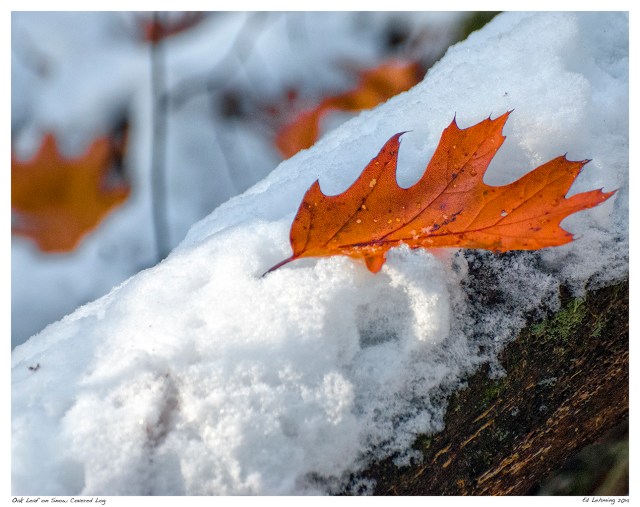
A New Year is upon us and already I am a few days behind my goal of daily blogging. I have numerous excuses but have decided to step into this year excuse free and just look forward rather than dwelling on why I did not do something, by simply doing what is required, to the best of my ability, going forward.
The purpose of blogging, for me, has multiple levels: Firstly, it is to provide myself a space and time that allows me to focus, without distraction, on my photography and my world. Secondly, (and this has been transformative to me) it is forcing me to look at my images and discern what, exactly, it is about the composition that makes the image appealing. People have told me I have an ‘eye’ for this, but since it seems to be a natural thing for me, I’d like to understand what drew this ‘eye’ to the composition in the first place.
Many images from the past year have had an appeal to me which I don’t fully comprehend and I mean to seek out what this is. This introspection seems to be working. In the past I would go out and make about two hundred photos and have two or three good ones. By being intentional about my compositions, my ratio is now around ten to one. The final reason is that I am often being asked about the story behind my photos. I was asked details such as where was this, what camera did you use, and how were you able to see this the way you did?
Last year, I started to blog as often as possible to create individual pages for a book of my year and thoughts. This came to fruition last year ,as I published my first book of some 130 images and thoughts. I’m also making note of camera settings (which I share) and learn what is working for me and why. I have recently stared locking my ISO in at 250 to force me to be more deliberate in shutter and aperture settings as well as my selection of lens.
One final thing I am hoping for this year is a more interactive blogging experience, whereby I get feedback, both positive and negative on my images, so that I can continue to improve and be able to document and share more effectively my journey through this world.
So, please take a few minutes and offer your feedback. I’d love to hear from you.
Nikon D200
Nikor 70-300 mm, f/4.5-5.6 @ 165 mm
1/100 sec, f/5.0, ISO 720
For more images like this, please visit my Facebook page:
https://www.facebook.com/EdLehming
or my website
http://www.edlehming.com
“The fire crackles and dances in the darkness of the night. The reflections on Fee Lake of the spruce and white pines are faintly seen with the light of the slivered moon. Across the glassy plane in the forest the whippoorwill calls, taking watch of the wilderness from the white-throated sparrow who keeps eye on this beauty during the day. In the evening, near sunset, the sparrow sings its musical departure, letting all the woods know that it shall take post with the rising of the sun.

Somewhere in the water I can hear the beaver moving, working to complete his next task, to accrue enough wood for the lodge or cut enough leafy timber to eat for the winter. Every once in a while he will catch wind of my presence and with all his power throw his tail against the water to break the silence and let…
View original post 223 more words

This year’s final post is a reflection on a winter past. As I noted throughout the fall, it has been a particularly mild year and we had no significant snow or cold weather till a few days ago, and even that was fairly insignificant.
Two years ago, we got hammered with an ice storm that buried us in a combination of wet snow and ice. This mixture quickly froze into solid ice and remained frozen for weeks. Power for hundreds of thousands was knocked out, mature trees toppled under the weight of the snow and ice, and our world was locked into the land of winter. Due to the extreme cold temperatures we experienced such things as ‘frost-quakes’ where the rapid cooling of ice caused the ground to boom as it contracted and the ice accumulations on the rooftops echoed with similar thuds which sounded like the roof was collapsing.
It was, a winter wonderland, and beautiful, for those who were not contending with power outages or downed trees. This image above was made looking down my street as a neighbour walks her dogs under a canopy of snow and ice.
Nikon D300
Nikor 70-300 mm f/4.5-5.6, @155 mm
1/160 sec, f/6.3, ISO 200
For more images like this, please visit my Facebook page:
https://www.facebook.com/EdLehming
or my website
http://www.edlehming.com
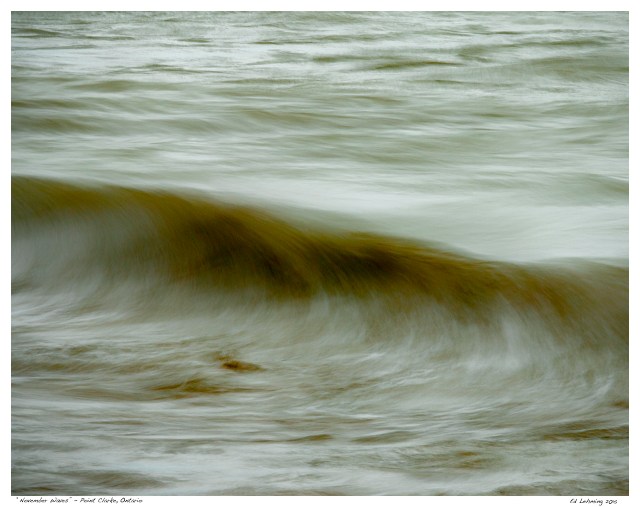
As my fingers froze inside my gloves, I still took the time to look at the wind driven waves in awe. With 50 km/h winds pushing the waters toward the beach, long ribbons of water rolled over themselves, pulling sand from the shallow waters below them.
Such is the case here. A long wave, about a meter high, rolls in and carries strange forms within it, as the darker sand is lifted from the lakebed and mixed inside the wave as they are driven ashore.
I was trying to capture the variations inside these waves but only have a few images to share, as it was too cold to remain on the exposed beech more for more than a few minutes. If I let my imagination wander, this one remains me of some of the prehistoric cave paintings of bison, which I can almost see moving inside the wave.
Nikon D300
Tamron 70-200 mm f/2.8 @200 mm
1/4 sec, f/32.0, ISO 250
For more images like this, please visit my Facebook page:
https://www.facebook.com/EdLehming
or my website
http://www.edlehming.com

In stark contrast to the past few weeks, the final remaining days of December are reminding us that, despite the delay, the inevitable cycle of autumn to winter has continued.
The past weekend I had an opportunity to visit the shores of Lake Huron once more. I was there in January of this year and there is a significant difference. In January, the lakeshore was a wonderland of bizarre and outlandish shapes and structures, ranging for ice-volcanoes to vast sheets of clear blue ice strewn with soccer-ball sized spheres of ice, as far as the eye could see.
Due to our extremely mild fall, the lake remains ice-free, yet starkly cold looking. Yesterday, the winds came in from the North around 50 km/h with an air temperature around minus three degrees Celsius. In the time it took to set up my tripod, the combination of damp wind from the lake and cold temperatures, had removed the feeling from my fingers. The wind howled and raged around me as I made a few photos of the Point Clarke lighthouse and the adjacent shoreline, before packing up and heading inland and out of the biting wind.
The photo above is one of several I made of this scene. I believe it captures the violent movement of the wind-whipped waves, the sale blue December sky and the brilliance of the pale white lighthouse nicely. It looks like I’m moving into winter photography mode now.
Nikon D300
Tamron 70-200 mm f/2.8, @ 70 mm
1/4 sec, f/32.0, ISO 250
For more images like this, please visit my Facebook page:
https://www.facebook.com/EdLehming
or my website
http://www.edlehming.com
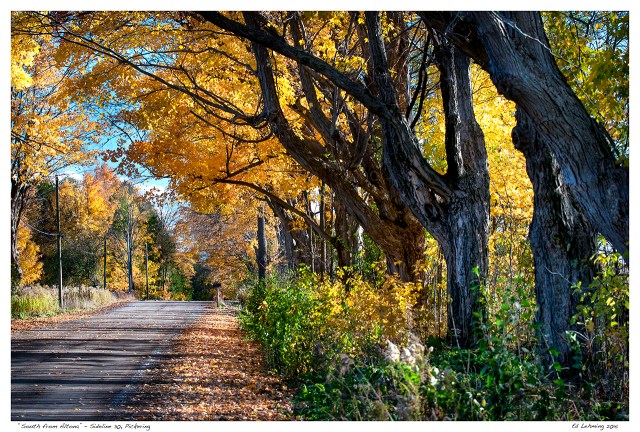
Close to the last post of the year. Another fall photograph. Why, I simply have so many good images from the fall. This photo was made looking south on Sideline 30 south of Altona, a hamlet of Pickering.
It’s hard to believe this was once a thriving community, with a hotel, several churches and a school. The hamlet lost it’s life to the “Pickering Airport project”, a topic of a previous post. Al that remains of the hamlet are a few building and a pre 20th century Mennonite meeting house. The only reason the meetin house has survived is because of the efforts of volunteers who wanted to preserve this important heritage site. Almost all the remaining building, including the school/community centre were demolished last year, to make way for an airport that will likely never be built in my lifetime. In the meanwhile,an important part of Durham region’s history has, effectively, been erased.
The hamlet of Altona will only live on in the memories of those who were once a part of its life and rhythms. I did i bit of research and could not believe the stark contrast between present day Altona and what it once was. A brief history, by Joseph Nighswander, is included here, for your further reading. What has become of this hamlet, is a sad testament to our values and the price we pay for ‘progress’.
Nikon D300
Tamron 70-200 mm f/2.8 @ 70mm
1/160 sec, F/6.3, ISO 250
For more images like this, please visit my Facebook page:
https://www.facebook.com/EdLehming
or my website
http://www.edlehming.com

A final (possibly) view to the autumn of 2015, though there are so many more memories to share. The image above was made on one of the many wide trails that criss-cross through the Durham Forest. I like the feel of this scene. The wide trail meanders through the forest, following the general contours of the land. There is something about a meandering trail that I like. Perhaps it’s that there is a destination, but the straight line may deprive you of some deeper experience. I enjoy ‘wandering’ through the forest and taking in all it has to offer. It’s a deliberate wandering though. I always have a destination in mind and am generally in no hurry, other than when sunset nears. As J.R.R.Tolkien said, “Not all who wander are lost.”
There certainly was no hurry on this particular day. The trails were uncrowded, at least not where I was, and it was absolutely beautiful and mild, the late day sun glowing between the branches and warming the ground. This past fall will be well remembered as one of the nicest I have experienced.
Nikon D300
Tamron 70-200 mm f/2.8 @ 70 mm
1/100 sec, f/5.0 -0.33, ISO 250
For more images like this, please visit my Facebook page:
https://www.facebook.com/EdLehming
or my website
http://www.edlehming.com

Two years ago, southern Ontario, Quebec, and much of the north-eastern United States was hit hard with an exceptional ice storm. In its wake, the storm left hundreds of thousands without power and a literal wonderland of ice and sub-zero temperatures that lasted for days.
This storm was an exception in many ways. One of these was that the ice, which normally melts off shortly after the storm remained intact and stayed for many days. The wonderland I mentioned earlier was everywhere. I thick coat of beautiful, clear ice clung to everything. Large branches broke off under the weight, as well as power lines. People could not get into their cars and walking was treacherous because the ice would not break, it simply sat atop the snow and made everything into an ice rink. In fact, we witnessed people skating down our street. Not in their shoes, but wearing skates!
It was so beautiful, in fact, that it was hard to find any one thing that stood out from others. Since the ice remained for several days, it gave me time to pick my subjects for the bounty the ice offered.
The cardinal above was photographed at Lynde Shores, a local conservation area, known for it multitude of birds. The female cardinal pictured is not as bright as her male counterpart but she looked wonderful surrounded by the ice and red berries. You can get a sense of how thick the ice was by looking at the small branches. It’s a far cry from this year with fog, showers and temperatures more suited to light sweaters and running shoes than winter coats and boots.
Nikon D300
Tamron 70-200 mm f/2.8 @ 200 mm
1/160 sec, f/5.0, ISO 200
For more images like this, please visit my Facebook page:
https://www.facebook.com/EdLehming
or my website
http://www.edlehming.com

Merry Christmas, to all who follow and interact with me. It’s been a year of learning and progress. I have successfully written a book based on my photos and blog posts and I have many of you to thank for your insights and words of encouragement.
The photo above was made at a small building in Whitevale, Ontario after a very productive hike along the Seaton Trail.
May this season find you happy, healthy and filled with joy!
Ed
Nikon D300
Tamron 70-200 mm f/2.8 @ 135 mm
1/2-sec, f/2.8, ISO 250
For more images like this, please visit my Facebook page:
https://www.facebook.com/EdLehming
or my website
http://www.edlehming.com
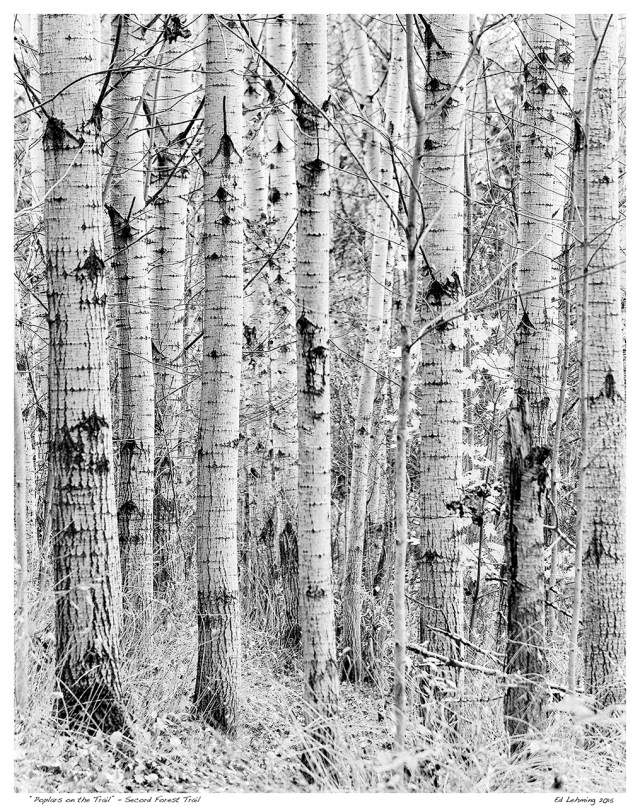
Back in October, I spent quite a bit of my free time on the local trails, enjoying the mild fall, spectacular colours, and some quiet time to just appreciate the stillness of the forest.
At one point on the Secord Forest trail, the path runs through a large group (or stand) of poplars. I’ve tried on a few occasions to photograph them in a way that shows the interesting texture of the tree trunks and a sense of uncertainty, as the narrow path weaves into the distance between the many trees. You can’t see very far ahead at this point in the trail because of how the poplars block your view.
When viewed in colour, there are a lot of distractions caused by the bright leaves and grasses. So, I thought I’d try this as a black and white. I’m very pleased at how the textures really stand out, the ‘layering’ of the seemingly endless rows of trees fading into the background, as well as how the path between them is not obvious, which was my intent. The image is surprisingly stark, but I like the effect.
Nikon D300
Tamron 70-200 mm f/2.8 @ 70 mm
1/100 sec, f/5.0 -0.33, ISO 250
For more images like this, please visit my Facebook page:
https://www.facebook.com/EdLehming
or my website
http://www.edlehming.com
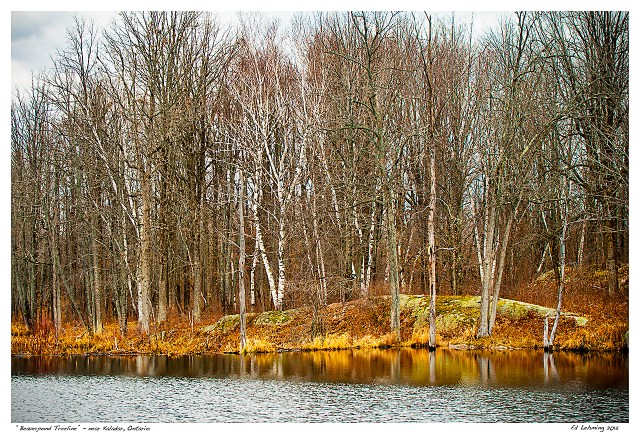
As noted in a recent post, there is an area along Highway 7, in Eastern Ontario, with a very unique topography, made up of long bands of granite and close packed, narrow, and parallel valleys and ponds. Unlike regions like the Adirondacks, with its beautiful rolling mountains, this is like a miniature, compressed version. From the highway, the ridges don’t seem to be for than a few meters high and are populated with thin trees.
I imagine the reason for the thin trees is that they seem to be growing on a very shallow layer of soil. I don’t see very many large, mature trees, and I wonder if they were harvested aggressively at some recent point in history, or if this is a natural phenomenon.
The long, narrow valleys are also perfect for beavers to build their dams and make long chains of connected ponds, that follow the highway along, sometimes fading to a grassy meadow, before transforming into a pond again. The challenge to photographing this area from the road is that the highway winds along these ponds quite closely and there are very few places where you can pull over safely to make a photo.
The photo above was made at one of these few pull-outs but represents the scenery fairly well. I’d like to come back here some time and spend a few days hiking the ridges or canoeing the ponds to get a better sense of this strange place that is so unlike anything I have experienced before.
Nikon D300
Tamron 70-200 mm f/2.8 @ 70 mm
1/80 sec, f/4.5, ISO 250
For more images like this, please visit my Facebook page:
https://www.facebook.com/EdLehming
or my website
http://www.edlehming.com

This photo is a slight flashback to mid-November, when I went on a long hike through the Durham Forest, south of Uxbridge, Ontario.
At the time, we were in the midst of a wonderful, extended fall and many of the maple and beech leaves were still on the trees, but enough had fallen to let ample light into the forest. I had been hiking for a few hours and decided to take a lesser path, as a shortcut, back to my car. The shortcoming of this decision was that the trail went up a steep incline, but saved be about half an hour of additional walking. By this point, I’d already walked about 20km. But, I’m not complaining, because the trail also went through a wonderfully diverse hardwood forest, filled with poplar, birch, maple, beech, and oak.
The photo above shows the incline with the trail gradually fading away behind the canopy. It also reveals many of the bright colours of the remaining leaves, as the branches reach across the trail to form a bit of a tunnel above me. What a wonderful day that was to be out on the trails.
Nikon D300
Tamron 70-200 mm f/2.8 @ 70 mm
1/60 sec, f/4.0 -0.33, ISO 250
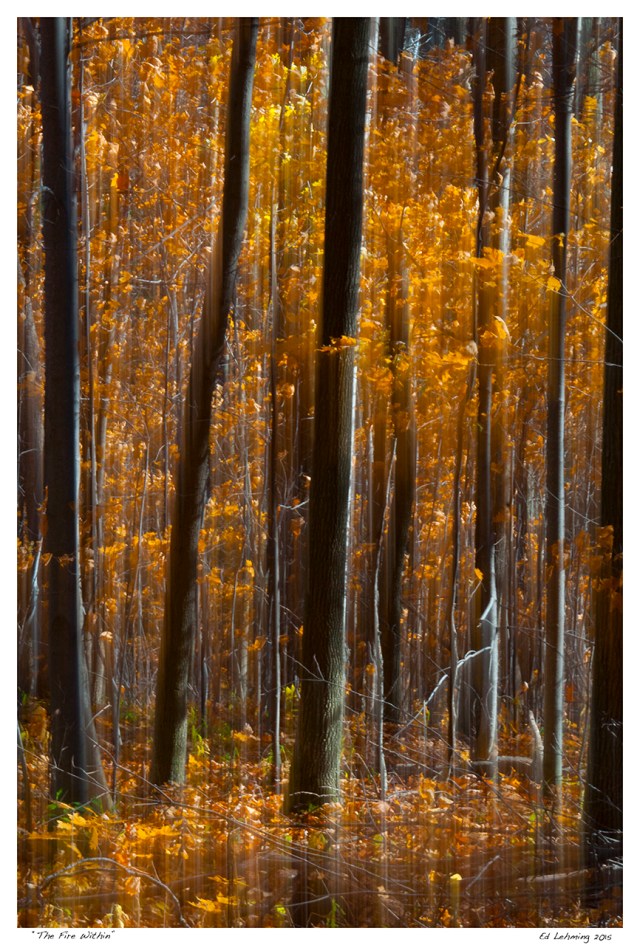
This photo was made in early November and autumn had settled in comfortably, for an extended stay. The days had already shortened enough to bring out amazing, bright colours, but the air was warm and comfortable. Best of all, the bugs were gone; even the dopey fall wasps.
Along a minor path of the south-east corner of the East Duffins Creek Headwaters trail is this beautiful grove of maples, interspersed with beech trees. The maples had already dropped many of their leaves, but the beaches, with their smooth,metallic looking, trunks, were magnificent, as the soft, warm sun shone through the canopy and set them ablaze with golden light. I stood here for a long time, reveling in the beauty. The leaves seemed to be almost on fire with their own light, thus the title, “The Fire Within”. There really was no other way to describe this scene. I also employed my vertical-pan abstract technique to further enhance the surreal feeling of this place. I think it nicely locks in some fine details but the movement adds life to it.
Nikon D300
Tamron 70-200 mm f/2.8 @ 135 mm
1/4 sec, f/32.0, ISO 250
For more images like this, please visit my Facebook page:
https://www.facebook.com/EdLehming
or my website
http://www.edlehming.com
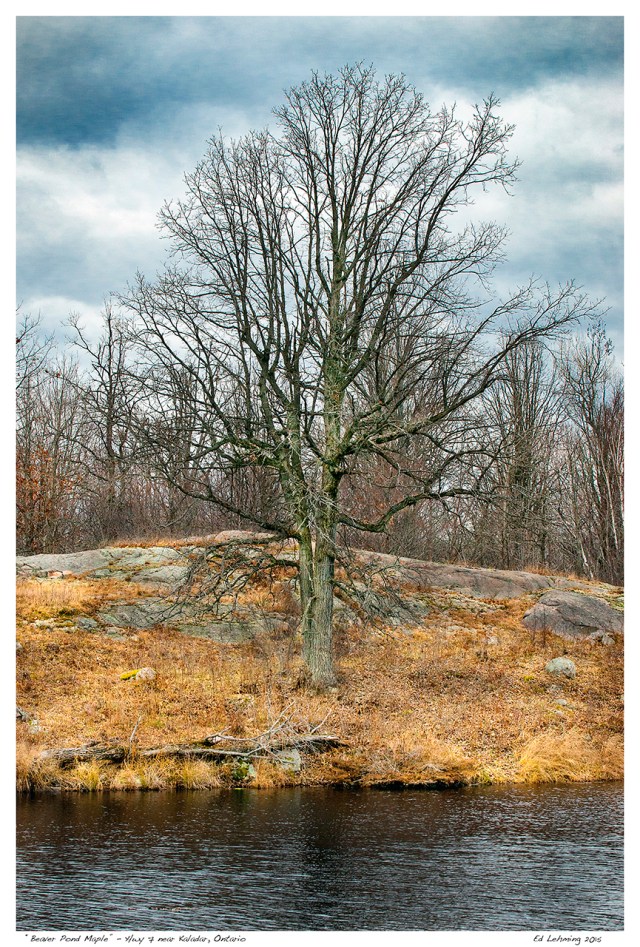
There is an interesting stretch of highway in eastern Ontario, where the road follows the unusual topography, consisting of many long ponds between low strips of granite. When viewed from above, it’s like a large series of wrinkles in the earth’s crust. The bare rock and water filled valleys are so different from anything else along that road that it made me pay attention to it. Among those rocks and ponds are numerous ‘solitaires’, as I have begun to call them. That is, trees that stand apart from others for any number of reasons.
This maple looks to have had a companion at one time, but that one, lying along the shore, has not faired as well. It’s amazing this tree has reached the size and age it has, given the scant soil it has grown in. There were a few of these solitaires visible from the road but this one was in a location where I could safely pull over and compose a photo as the highway snakes along the edge of the pond.
The photo nicely captures the cool mid-December feeling. It will be winter in a few days, yet there is no snow and the water remains unfrozen. It was a bit dull and the sky was filled with variable clouds, yet the diffused light still lit up the pale yellow grasses along the shore. I’m hoping that the mood is conveyed adequately without making it depressing, which it was not.
Nikon D300
Tamron 70-200 mm f/2.8 @ 70 mm
1/200 sec, f/7.1, ISO 250
For more images like this, please visit my Facebook page:
https://www.facebook.com/EdLehming
or my website
http://www.edlehming.com

There was something about this stand of poplars that made me pull over on a drive back from Ottawa last week and make this image. At the time, I couldn’t quite put my finger on what, exactly, it was that made this scene so interesting. As I worked with the image I looked at several aspects and edited it various ways, looking for what it was that first drew my eye to the composition. It was not till I looked at it in black and white that all the fine detail emerged.
That was it, the contrasts between the bright bark of the poplar trunks offset by the dark background and the texture and glow of the grasses in the foreground. You see, this day was pretty much overcast with a few bursts of sunlight from the south. It was one of these moments of direct sunlight which lit up the poplars as I approached them, yet the background remained in shade, producing this image with three different bands of light: Bright in the foreground, from the grass in sun, the dark background, with the poplar trunks in the middle, and the grayish clouds above. And, as I look the the photo again, there is this wonderful arching of a few branches near the centre of the image, like a gate to somewhere within the stand.
To me, it make the whole image looks like a very complex sketch. I may have to pull the markers and paper out and see if I’m up to the challenge some day soon. That would be an interesting exercise.
iPhone 5S, @ 4.2mm
1/1500 sec, f/2.2, ISO 32
For more images like this, please visit my Facebook page:
https://www.facebook.com/EdLehming
or my website
http://www.edlehming.com

This was a typical shot from this past fall / Early December; bright golds and yellows, almost ‘aglow’, as the soft sunlight reflected from the dried plants. This Elecampane plant stood out to me because the leaves were darker and more gray than the surrounding yellows, and the seed heads varied from gray to a pale orange. The plant also stands out in sharp contrast to its neighbours since it is quite tall and generally survives the winter still standing due to its almost woody stalk. In the summer this is a beautiful plant, with flowers resembling small sunflowers, so it should not surprise me that it is also known in some areas as Wild Sunflower.
This plant has a long medicinal history dating back to ancient Greece. The latin name Inula Helenium is taken from a legend that Helen of Troy was carrying a bouquet of these flowers when Paris stole her away to Phrygia. The root, in particular, has been used in herbal medicines since ancient times and there are many mentions of its use in historical texts. It seems to be a cure for many different ailments, depending on how it is prepared.
It was also a common herb grown in the gardens of early north american settlers, as it could be used as an herb or as food. Thus, like many other plants, it has moved from gardens to wilderness paths quite well.
Nikon D300
Tamron 70-200 mm f/2.8 @ 122 mm
1/60 sec, @ f/4.0 -0.33, ISO 250
For more images like this, please visit my Facebook page:
https://www.facebook.com/EdLehming
or my website
http://www.edlehming.com

I titled this photo as I did for a few reasons. This is the last photo I ever took of my father before he passed away in 1979. He was determined to take a few last casts before he got in the car after a great family vacation on Moore Lake. He asked if I would come with him and take a picture. I complained about the mosquitoes and not wanting to be bitten, but relented and took this shot. Not knowing, at the time, it was not only his last chance at what he loved to do, but my last chance to capture a precious memory. He passed away later that summer.
I found the photo, which I knew I had, with a bunch of other photos from that time period. It was faded and dull. But technology is wonderful and I was able to touch it up and make it presentable. So glad I did not lose it.
Today also happens to be what would have been his 90th birthday. He’s the reason I have such a fond love of nature and all things outdoors. Dad taught me to appreciate the details and the cycles which are ever present. I often imagine him walking along with me, observing the marvels of the outdoors, discovering and celebrating new sights, and those sacred places I go back to time and time again.
So, on this day, December 16th, where he is especially present in my thoughts, I say, “Thanks Dad, for the deep reverence of nature, all you taught me, all the values you instilled in me, and the love you gave me, in your all too brief a time with us. You are ever missed and ever present in the thoughts of those who knew and loved you.”
In Memory of Harry Eugen Lehming 1925-1979
Pentax Spotmatic 35mm
Schneider-Kreutznach Edixa-Xenon 50mm, f/1.9
For more images like this, please visit my Facebook page:
https://www.facebook.com/EdLehming
or my website
http://www.edlehming.com
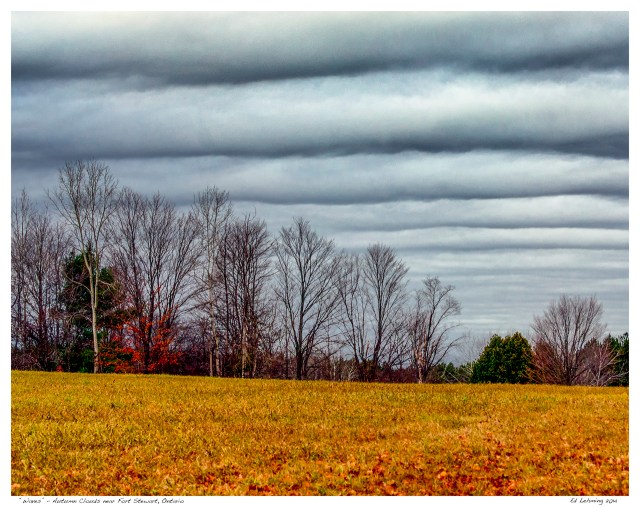
This photo seems appropriate for today. The weather here is dull and overcast, once more. It reminded me of this time last November, as I walked through a farm field at Fraser Lake Camp. It was also a gloomy day, and much cooler than this mild December. This was around 10:00am and the clouds, which had been just a flat sheet of gray, transformed themselves into this wonderful wave pattern, for about five minutes and then settled back to their previous state.
I wonder what atmospheric forces were at play to create this temporary ripple in the sky. I’ve seen it before, but not as wide or pronounced. It’s also important to note that it was a bit windy that day, so maybe there was some resonance in the gsts that set up this pattern. I’m open to opinions.
Nikon D300
Nikor 70-300 mm f/4.5-5.6 @ 70 mm
1/160 sec, @ f/6.3, ISO 200
For more images like this, please visit my Facebook page:
https://www.facebook.com/EdLehming
or my website
http://www.edlehming.com
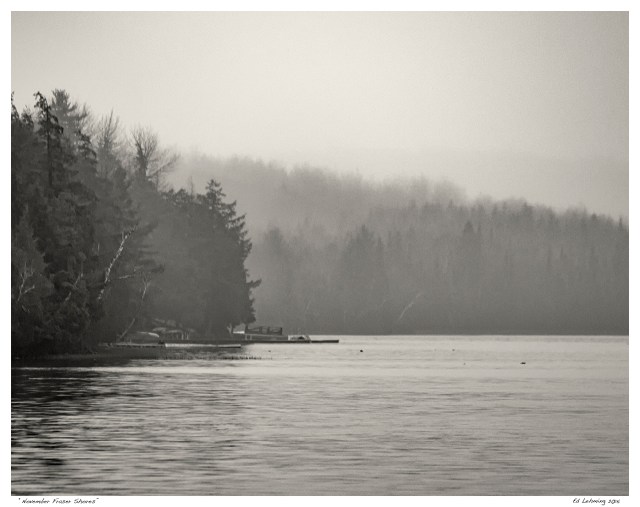
A look back to last month, when I spent a few rain soaked days in the Fraser Lake area. This photo, made from the boat launch at the north end of the lake, encompasses a lot of what those days were like. It was still quite mild for mid-November, but a slow moving low pressure system had set up and filled three solid days with off and on rain, mist, and variable winds.
The mist created the nice layered effect of the trees on the far shore, while mid-frame, a few late migrating ducks take a rest just off shore.
For friends of mine who know the lake, you can see the Fraser Lake Camp ‘barge’ resting on the dock as well as the connecting bridge that spans the dual swimming docks.
For me, the image portrays the ‘resting’ time between a busy active summer on the lake and the inevitable winter to come. It’s a bit melancholy and that is the reason I chose to produce the image as a black and white.
Nikon D300
Tamron 70-200 mm f/2.8 @ 200 mm
1/30 sec, @ f/2.8 -0.33, ISO 250
For more images like this, please visit my Facebook page:
https://www.facebook.com/EdLehming
or my website
http://www.edlehming.com
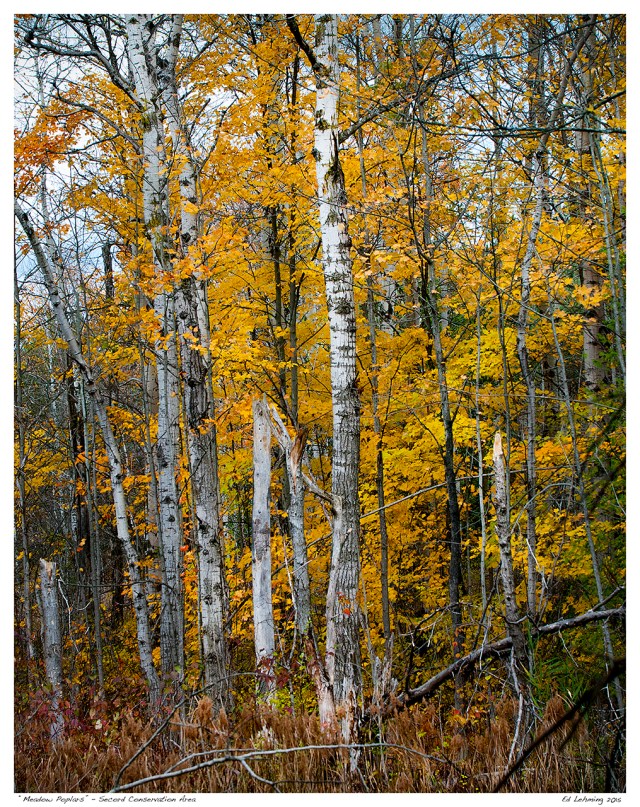
About mid-way through this trail are several groves of poplars, which I have photographed and shared in the past. This particular grove is in the middle of a meadow, which the trails grows around. Because of the nature of this area, it’s also difficult to get an unobscured view of these trees, without some branch interfering with the overall shot. That becomes a common issue for photographers, at least in my experience. You can envision a great composition, but the reality is it does not alway play out as planned, since that perfect angle and lighting is tough to achieve because of the surroundings.
Fortunately, I did find a narrow slot between the trees which provided the attached image. There are still a few stray branches in the foreground, but they don’t interfere with the image as a whole.
As I look at the photo, I once again see it as a painting, even without any manipulation. So, I pulled it into Photoshop and the following is the result.

I’m not sure which I like more?
Nikon D300
Tamron 70-200 mm f/2.8 @ 70 mm
1/200 sec, @ f/7.1 -0.33, ISO 250
For more images like this, please visit my Facebook page:
https://www.facebook.com/EdLehming
or my website
http://www.edlehming.com

Not the most catchy title in the world, but that, essentially, is what this is. A bunch of maple keys, hanging from a tree at the Secord Trailhead. The tree was laying on its side, but I’m not sure exactly what happened to the tree to put it in its current state.
What struck me as odd, was that the keys, or seeds, were still attached to the tree at this time of year. I would have expected them to have been released at some point earlier in the year. Maybe that has something to do with the tree being on its side or maybe it’s just the nature of this species, which I have not identified yet. The other possible answer is this bizarrely mild fall has somehow affected it. That will remain a mystery, for now.
Aside from the mystery of the keys, I was simply drawn by the glowing clusters and the fine details. It’s one of those generally mundane things we all walk past on any given day. But, if you stop and observe, it is wonderfully complex, from the veins in the key ‘wing’, to how the cluster is connected to the terminal branch. I thought it made for an interesting composition to spend some time looking at. Take a moment to see if you agree.
Nikon D300
Tamron 70-200 mm f/2.8 @ 200 mm
1/100 sec, @ f/5.0 -0.33, ISO 250
For more images like this, please visit my Facebook page:
https://www.facebook.com/EdLehming
or my website
http://www.edlehming.com
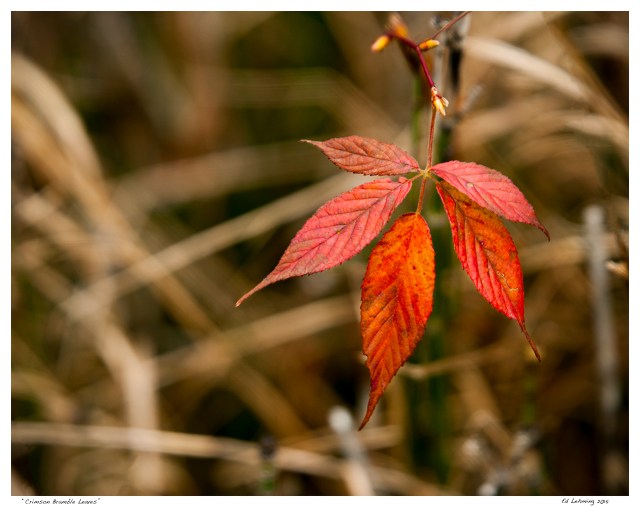
Every now and then, a splash of colour catches you, unexpectedly. That was the case a few days back when I was hiking the Seaton Trail, near Whitevale.
Let’s keep in mind that was the first week of December. Last year we had already experienced a few substantial snowfalls and cold temperatures, well below freezing. This year, we are still well above freezing but everything has had a good frosting. So, with the exception of evergreens and a few frost resistant shrubs and grasses, almost everything had turned a mottled tone of late-fall brown-gray. The sun was shining this day, but the forest and fields were generally quite muted. Across a rise, I spotted this patch of intense red and had no idea what plant could still be in fall colours. As I drew nearer, I found it was a small patch of brambles, or blackberry bushes (bramble is a general term for the blackberry family of thorny fruit-bearing shrubs).
Not only were the leaves still colourful, if you look carefully, you will see they have started to bud into leaf again. A strange year indeed. I imagine this will be the last we see of bright reds for some time, with the exception of some winter-hearty berries that the birds don’t like. The forecast is for cooler temperatures for next week, but still not typical for December. Part of me likes it, but another part wants some snow, simply for a change from brown and to brighten the days that start off dark and turn dark far too soon.
Nikon D300
Tamron 70-200 mm f/2.8 @ 200 mm
1/40 sec, @ f/3.2 -0.33, ISO 250
For more images like this, please visit my Facebook page:
https://www.facebook.com/EdLehming
or my website
http://www.edlehming.com
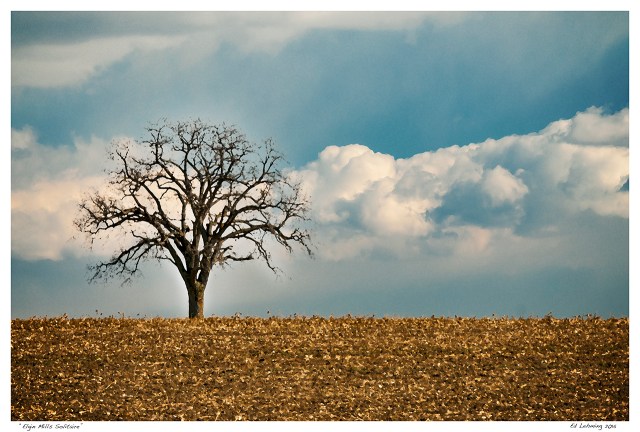
I wish I could paint. There are so many scenes that I see on a regular basis and say to myself, “That would make a beautiful painting”. Especially if the light is just a bit off and I envision the image a bit different.
That was the case with this photo I made a few days ago. All the elements were just right, the light was soft from the west and a bank of clouds hovered low to the east, yet the image did not convey the scene in the same way as it struck me.
So, since I can’t paint, yet, I went to my Photoshop toolbox and started playing with some effects. And, lo and behold, I got the effect I wanted, as if it had been painted. Now, I will have some purists say that this is not photography, and I would agree, it’s art, based on photography. Be it a painting or a digitally manipulated image, it makes no difference to me and I don’t want to be limited by a particular discipline. Does that change how I approach my photography? Not in the least. As I’ve stated many time before: For me, it’s about ‘how’ I see things, rather than what I see. There is so much more at play than just making an image. I want to be able to communicate how it made me ‘feel’. That, to me is art, and I’m good with it.
Back to the photo, I see many of these lone trees and they have been the subject of several of my photos. I’ve started calling them “Solitaires”, because “lone tree” makes it sound a bit depressing and that there are no other trees around, which is not the case, these ones are simply “apart” from their neighbours.
Nikon D300
Tamron 70-200 mm f/2.8 @ 170 mm
1/200 sec, @ f/7.1, ISO 250
For more images like this, please visit my Facebook page:
https://www.facebook.com/EdLehming
or my website
http://www.edlehming.com
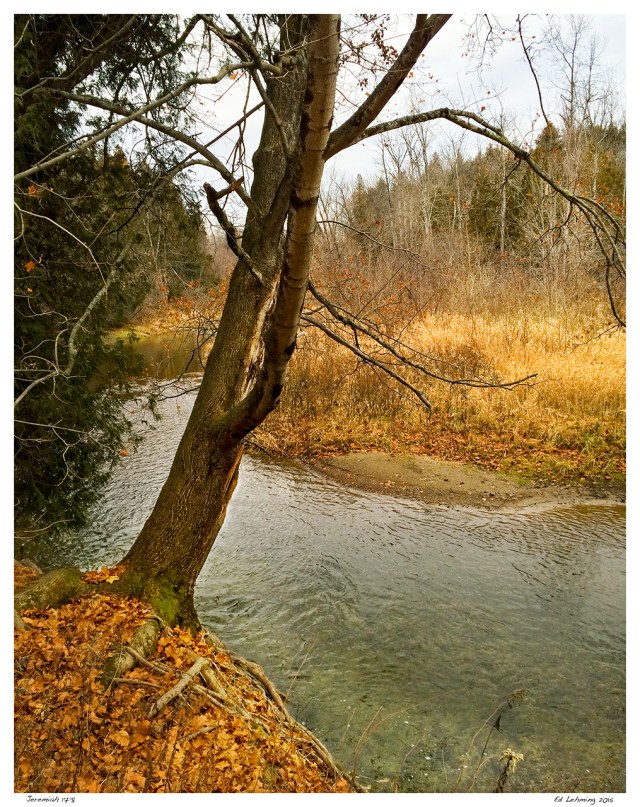
I can’t help but reflect on this verse when I seen this scene on Duffins Creek, just south of Whitevale, Ontario.
“They will be like a tree planted by the water
that sends out its roots by the stream.
It does not fear when heat comes;
its leaves are always green.
It has no worries in a year of drought
and never fails to bear fruit.”
The image of this tree, rooted firmly to the shore, like a hand clenched and holding on, has always fascinated me, to the point where I have seen it in dreams.
Though the leaves are not always green, like in the referenced verse, it is still very much alive and anchored, drawing life-giving water from the stream that flows at its roots. It certainly has no fear of drought, as the cool waters run abundantly throughout the year.
This tree is, however, not without its challenges. It is located at a bend in the stream, which is prone to ice build up in the spring, and it has the scars to prove it, yet it hangs on, leaning tenuously over the creek, gripping the shore. I imagine it would take some force to move this tree from its moorings. It’s also not a picture of perfection or symmetry, by any means, with random gnarly branches shooting out here and there. Yet, there is still some wonderful strength here.
I was very pleased to have been able to capture the image in such a way as I believe captures the essence of the scene, and conveys how I see it, which is always my goal. Welcome to my world.
iPhone 5S @ 4.2 mm
1/120 sec, @ f/2.2, ISO 64
For more images like this, please visit my Facebook page:
https://www.facebook.com/EdLehming
or my website
http://www.edlehming.com

Time for some brightness in this dull December. After numerous drab, but mild days, the sun finally shone though, albeit for only a few hours. As I looked out my office window at the beautiful warm glow, I decided my lunchtime would be spent on a trail. So, I packed my gear and headed off to the woods.
It’s such a wonderful benefit having all these woodlands so close by that I can step out to recharge without an extended drive.
Today’s all too brief hike took me down the Seaton Trail, just south of Whitevale, Ontario. As I started my walk, the sun was still shining, though it was a bit cooler than expected.
The nice thing about the sun this time of year is that it tends to be more indirect and softer, and it was late enough in the day to bring out the beautiful gold hues in the surrounding fields and meadows. It also afforded the opportunity to shot this scene of dead flowerheads from several angles and choose my favourite. By looking at it, you’d never expect it was made in the second week of December, in Canada. It’s also a nice thought that beauty can come from something that has died, at least on the surface. I hope this image brings some warm to you as well.
Nikon D300
Tamron 70-200 mm f/2.8 @ 200mm
1/100 sec @ f/5.0 -0.33, ISO 200
For more images like this, please visit my Facebook page:
https://www.facebook.com/EdLehming
or my website
http://www.edlehming.com

I’m finding myself going back to some photos from last year, around this same time. The primary reason for this is we are having a very mild December, the leaves have now come down and we’re in a bit of a mild, yet gray, time. The vibrant colours of November are a recent memory and days are dull and short.
Last year, in mid to late November, we had a few light snowfalls and the days seemed a bit brighter, at least to my recollection.
This photo was made at one of the nearby hiking trails, among planted pines. The area is known as East Duffins Creek Headwaters, though that reference really encompasses a very large area. I have hiked most of the numerous creeks that eventually end up becoming the main Duffins Creek, which flows into Lake Ontario. Because the headwaters cover such a large area, the landscape and scenery is quite diverse. It’s comprised primarily of farmland, and some large gravel pits, with vast tracts of conservation lands, which I often visit: Goodwood Forest, Claremont Conservation Area, Secord Forest, and Durham Forest, to name a few of the larger sites.
I’d categorize specifically East Duffins Creek Headwaters trails as primarily planted pine, interspersed with hardwood forest. The planted pines, with their straight rows and uncluttered bases make ideal subjects for my abstract photography. In this case, I had the straight lines of the trees, some highlights of early snow on the ground, a bit of remaining greenery, and a beautiful late afternoon sun lighting it all up.
There’s a lot going on in this composition and I find myself drawn into the background details. Take some time and enter this space, take a deep breath and imaging the scent of pine in the crisp November air.
Nikon D300
Tamron 17-50 mm f/2.8 @ 32mm
1/4 sec @ f/32, ISO 200
For more images like this, please visit my Facebook page:
https://www.facebook.com/EdLehming
or my website
http://www.edlehming.com

This photo was made last November at Fraser Lake Camp, near Fort Stewart, Ontario. It is a wonderful children’s camp, established some 60 years ago. The Old Barn is the only original building still standing on the property. It’s all log construction and sits at the edge of a field, surrounded by planted pine forest. I found this to be a wonderfully serene image, full of transitions. The lines of dark clouds are harbingers of the winter to come, yet grass still shows through. There is snw on the ground, but it would stay for long, as the meager sun warms the ground. There is also a shift from agriculture to native forest.
I have found several other buildings like this is the area, which was hoped to provide farming opportunity at one time, but the soil is just too shallow to support any sustainable farming. There are still a few operating farms, mostly livestock and hay.
It is interesting also to see gradual transition to native hardwoods, as can be seen to the left and right, with encroaching birch trees and poplars. The world is full of change, some rapid and some that can only be observed over years and decades.
Nikon D300
Nikor 70-300mm f/5.6 @ 70mm
1/160 sec @ f/8.0, ISO 200
For more images like this, please visit my Facebook page:
https://www.facebook.com/EdLehming
or my website
http://www.edlehming.com


Recent Comments