“I will not be just a tourist in the world of images, just watching images passing by which I cannot live in, make love to, possess as permanent sources of joy and ecstasy” – Anais Nin
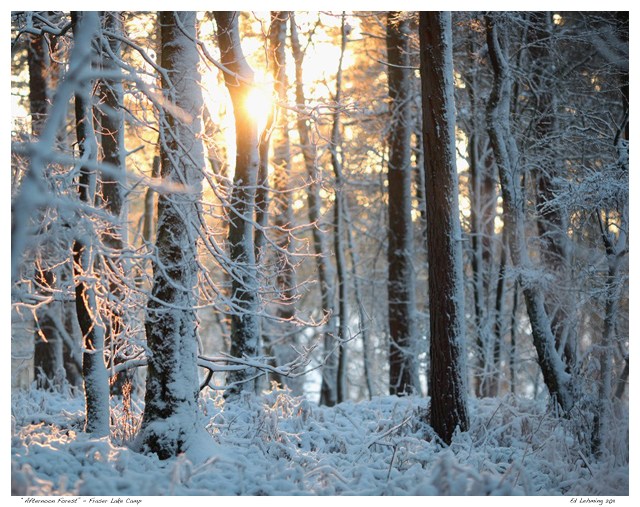
It is a joy to experience, at the deeper level, some of the scenes I come across in my journey through life. Places my feet have travelled many times, at once become magical with the addition of the elements of light. It’s that particular moment when the sun shines between the trees in a winter afternoon can makes a simple forest into a wonderland of light and texture, and then, it’s gone, never to look quite the same again, except in that brief moment, as an image captured and remembered.
Above is an image of the forest along the shores of Fraser Lake, near Bancroft, Ontario. I’d spent most of the day snowshoeing through the forest trails and along the frozen lakeshores. Overnight, a wet snow had fallen and stuck to trees and grasses. A rapid daytime cooling preserved the effect well into the day. I was fortunate to be returning to camp by way of the Lone Pine trail when the scene presented itself to me.
Nikon D300
Tamron 70-200mm f/2.8 @ 120mm
1/120 sec, f/2.8, ISO 250
For more images like this, please visit my Facebook page:
https://www.facebook.com/EdLehming
or my website (some images available for purchase)
http://www.edlehming.com
“When photographers get beyond copying the achievements of others, or just repeating their own accidental first successes, they learn that they do not know where in the world they will find pictures. Nobody does. Each photograph that works is a revelation to its supposed creator.” – Robert Adams
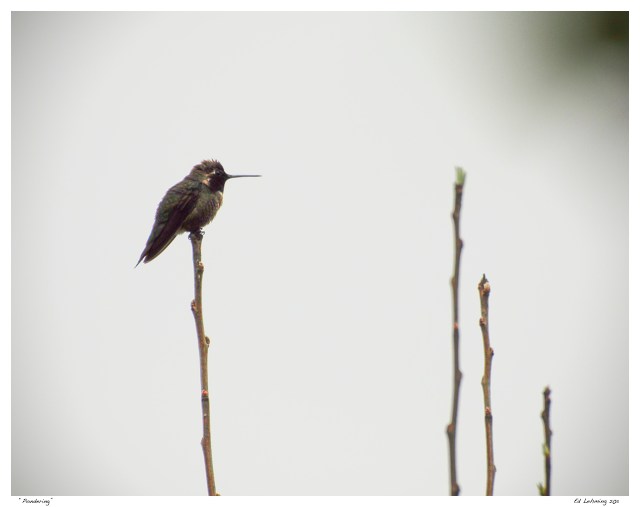
As the above quote articulates so nicely, I never know where a photograph may be waiting. All too often an image reveals itself and I don’t have my camera with me. Then there are the simple moments where some slight movement catches my eye and what has become instinct takes over. I’ve made a practice over the past few years to photograph in as many conditions as possible, to take what was at first, technical learning of what my equipment was capable of, and making it an automatic extension of me. This has enabled me to capture those things in my world that provoke thought and emotion and ponder on them further. Every one of these moments being an opportunity to expand my understanding of the world I live in.
I spent quite some time watching this little fellow flitting to and fro, in an Ojai California meadow, protecting his little patch of the world from intruders. He had an assortment of perches to choose from but always returned back to this one. Then he’d sit, for long periods, surveying his realm. There was not much happening during these quiet times and it made me wonder what thoughts must be going through his head.
Nikon D300
Nikor 70-300 mm f/4.5-5.6 @ 300 mm
1/125 sec, f/5.6, ISO100
For more images like this, please visit my Facebook page:
https://www.facebook.com/EdLehming
or my website (some images available for purchase)
http://www.edlehming.com
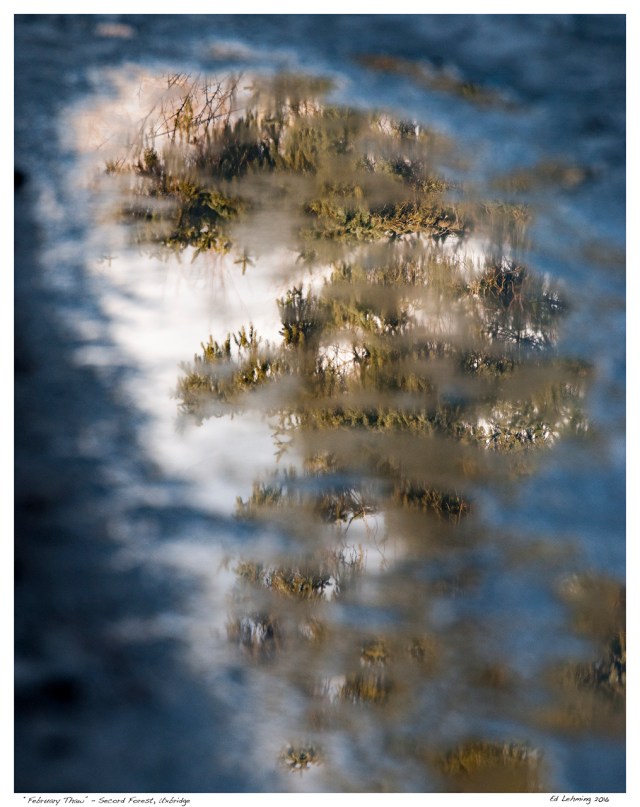
The photo title says it all. An image of a pine tree reflected in an ice puddle on the trail.
Here we are, early February and much of the scant snowfall we’ve had has melted off, running into creeks or pooling in icy puddles. The light this day was wonderful and lit the pines up with a soft glow. It was this ‘glow’ that attracted me to look closely at the puddle and choose this composition. I felt it was a nice way to communicate the concept of the thaw by reflecting the tree in the puddle itself. As you can also see from the blue tones of the ice, it was a bright, blue-sky day. It’s a bit of a different shot for me but I was in the mood for experimentation. I’d value your comments.
Nikon D300
Tamron 70-200mm f/2.8 @ 200mm
1/160 sec, f/6.3 -0.67, ISO 250
For more images like this, please visit my Facebook page:
https://www.facebook.com/EdLehming
or my website (some images available for purchase)
http://www.edlehming.com
“Art is a kind of innate drive that seizes a human being and makes him its instrument. The artist is not a person endowed with free will who seeks his own ends, but one who allows art to realize its purpose through him.” ~Carl Gustav Jung
I am inspired by the art and writings of other creatives. That’s one of my reasons for blogging, connection to a larger community, people who see, muse, create, and share their experiences. The other reason is introspection. To reflect on my experiences. As expressed in the quote above, I want art to seize me and influence me. Art and creativity is a very real part of me that I require in this busy, technology, and anxiety filled world and I’m grateful for it, every day.
Nikon D300
Tamron 70-200m f/2.8 @200mm
1/320 sec, f/9.0 -0.33, ISO 250
For more images like this, please visit my Facebook page:
https://www.facebook.com/EdLehming
or my website (some images available for purchase)
http://www.edlehming.com

The title is a bit misleading, as the water is not frozen. I took the word frequencies from the delicate ripples in the water and the effect they had on the reflection. The image is actually inverted and I was debating leaving it that way. However, the composition I was envisioning is better communicated this way. You can see a little hint of the shoreline, still coated in ice and snow. The photo was best expressed in black and white with a slight Selenium toning to cool it down.
It has been a different winter here in Southern Ontario, Canada. It’s early February and there is little snow, days are moderate and most water bodies have at least some open water. Secord Pond, where this image was made, had a thin coating of ice, the remnant of a few colder weeks, but that’s changing too and a large patch of open water is now expanding.
This season has been a bit different for my photographically as well. Generally, I’d be out and about on snowshoes, making photos of snow covered pines and frosty landscapes, compensating for the bright reflection of snow and ice as I compose my images. While there is still some snow and ice, it’s patchy and the light soft and almost warm. It is becoming a learning experience, making non typical photos in a non typical winter.
Nikon D300
Tamron 70-200 mm f/2.8 @ 145mm
1/160 sec, f/6.3 -0.33, ISO 250
For more images like this, please visit my Facebook page:
https://www.facebook.com/EdLehming
or my website (some images available for purchase)
http://www.edlehming.com

A challenging composition. Part of the ‘trick’ to capturing the motion of water is to create a time exposure based on the speed of the water and the light available. I tend to do most of these earlier in the day, or late afternoon, when the sun is soft and indirect.
Last week I found myself, mid-day, looking at these wonderful scenes of water rushing past icy shores and trying to figure out how to take this home with me in photos. The challenge is being able to leave the shutter open long enough to create the nice motion blur without overexposing the snow and ice and losing all that texture. The additional challenge on this day was that I did not have a tripod with me and had to shoot hand-held at 1/8 seconds to get the effect I wanted and I force myself to shoot at 250 ISO as much as possible, to retain the ability to shoot as if I was using film.
I seem to have accomplished that in this photo and a few others I posted earlier. The water moves smoothly across the frame, the dappled sunlight reflects off the surface and lights up some of the rocks below the surface, yet you can still make out the details of the icicles and layers of snow along the shore. It was a wonderful feeling when I got home and saw the results of this outing.
Nikon D300
Tamron 70-200mm f/2.8 @ 135mm
1/8 sec, f/32.0 -0.33, ISO 250
For more images like this, please visit my Facebook page:
https://www.facebook.com/EdLehming
or my website (some images available for purchase)
http://www.edlehming.com
The words “Seeing the extraordinary in everyday places.” has become a mantra for me. It resonates through my entire being. I’ve said before that I can’t seem to turn it off and would not want to.
As I walk the streets or hike the forest trails, I am able to see beauty almost everywhere. So, why would I want to turn that off. It becomes my connection with my Creator, a reminder of the marvelous detail that I miss when hurried. I revel in the quiet times, where it’s just me. Those solitary times are energizing for me, as I look around and notice a play of light, the soft motion of water, or plants in the breeze. Learning to effectively capture and sharing those moments bring me joy. As I sit and review my photos and try to put into words what that experience was like, I’m constantly reminded, that moment was in front of me to enjoy, a very brief part of an ongoing story in light, motion, and colour.
The inner creative in me likes to push boundaries and experiment with different ways of seeing things. I view other’s works, get inspired by images and words, to push my own boundaries and beliefs. As I share these experiments, I’m also sharing part of my journey, and opening an intimate part of my essence. Perhaps that journey resonates with others and brings them to the same place.
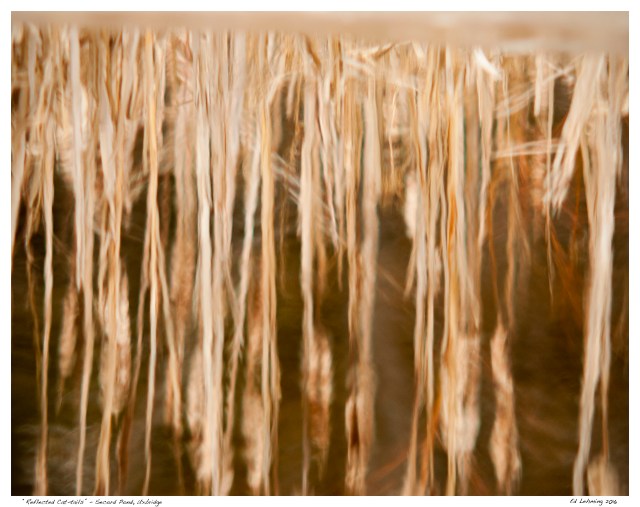
The image above is just such an experiment. I used an old Takumar 500mm f/5 lens that belonged to my father. For years I had considered selling it since it did not work with any of my cameras. Last week I acquired an adaptor that allowed me to use this lens for the first time in nearly thirty years. I had forgotten what a monster it is. Weighing in at nearly seven pounds and close to two feet long, this glass is not for the faint of heart and certainly not something I care to carry around on a regular basis.
I took it with me, along with a sturdy tripod, to Secord Pond, a small lake at a local conservation area. While it was nice to make long telephoto images, I really enjoyed the effects it had when photographing the shoreline plants reflected in the water. Above, are cat-tails, reflected in the gently rippling water.
Nikon D200
Takumar 500 mm f/5 @ 500mm
1/60 sec, f/5.0, ISO 200
For more images like this, please visit my Facebook page:
https://www.facebook.com/EdLehming
or my website
http://www.edlehming.com
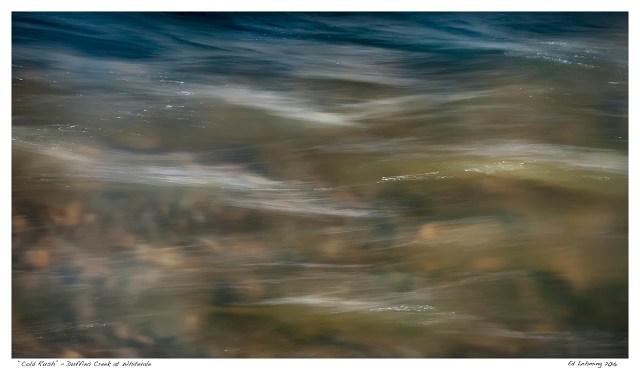
Moving water and the light playing of the waves. A few years ago, I started experimenting with different shutter speeds, trying to capture the movement well, without loosing details. The shutter speed needs to match the speed of the water or the image is too soft. Doing so in the winter is a particular challenge, since long exposures can blow out all the whites. That said, I like the soft winter light.
The photo above was made at Duffins Creek, in north Pickering, Ontario. Most of the river was frozen but there were a few open patches. This is a fairly tightly cropped view of one of those places.
Nikon D300
Tamron 70-200 mm f/2.8 @ 130 mm
1/8 sec, f/32.0, ISO 250
For more images like this, please visit my Facebook page:
https://www.facebook.com/EdLehming
or my website
http://www.edlehming.com

This was an interesting phenomenon. With a change in temperature, the ice sheets had shifted and the water at this point of the river seemed to have to decide whether to go over the ice or under it. Most of the water went under the ice and seemed to pull at the surface water. The effect, which I tried to capture here, was a vortex of water which rotated on the surface before eventually being pulled under. It looks even nicer with the semi-transparent ice sheet which turned the surface water a slightly blue colour.
Idelly, I would have liked to do a longer time exposure, but I did not have a tripod with me and the sky was so bright that anything longer would have been blown out. I am happy with what I got.
Nikon D300
Tamron 70-200mm f/2.8 @ 98 mm
1/8 sec, f/32, ISO 250
For more images like this, please visit my Facebook page:
https://www.facebook.com/EdLehming
or my website
http://www.edlehming.com
Today, a break from ice water 🙂
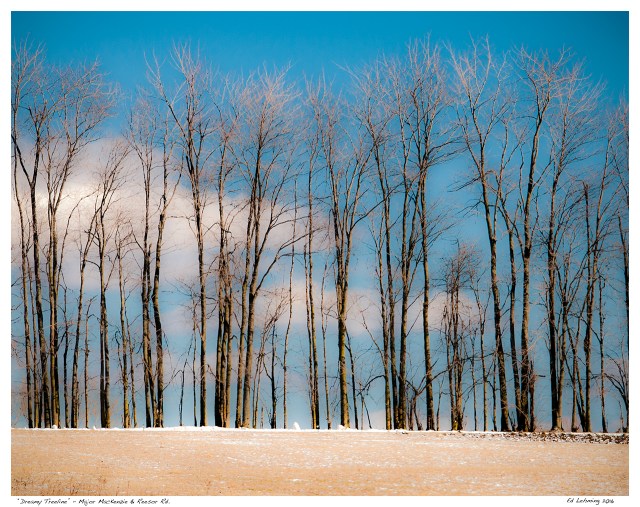
I’ve driven past these trees on several occasions and could always see potential for a good photo, but the light has not been ideal. On this particular day, I think the conditions were just about right. It was a bit hazy and the sun reflected brightly from the upper branches. I fiddled with a few different styles for this image and it’s still not quite what I envisioned, but close. Maybe if I look at it long enough I’ll be inspired?
Nikon D300
Tamron 70-200 mm f/2.8 @ 175 mm
1/125 sec, f/8.0, ISO 250
For more images like this, please visit my Facebook page:
https://www.facebook.com/EdLehming
or my website
http://www.edlehming.com
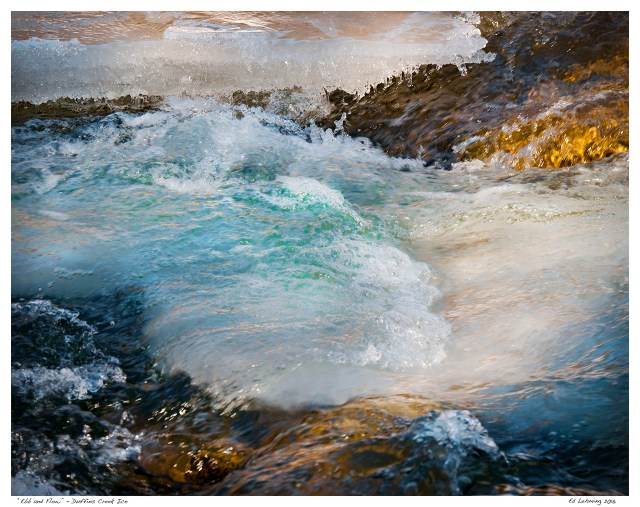
Above is another photo of the winter waters of Duffins Creek, north of Pickering , Ontario. It seems the creek had frozen solid to the bottom recently, as water was flowing over the ice in many places.
This scene caught my attention as the sun revealed interesting aqua tones in the ice beneath the surface. The ice had tilted slightly, causing a bit of an ebb, or backflow, and created this wave that seems to be going against the current. The sunlit up the rocks under the water as well as the ice slab in the background. It was a great day for light and that makes my day. It’s not a grand cascade in the mountains, but it is beautiful, nonetheless. The magic is in the light and the details the light brings forth. In this case, I chose a faster shutter to freeze the wave above the ice slab, as a long exposure lost much the detail.
Nikon D300
Tamron 70-200mm f/2.8 @ 135mm
1/200 sec, f/7.1, ISO 250
For more images like this, please visit my Facebook page:
https://www.facebook.com/EdLehming
or my website
http://www.edlehming.com
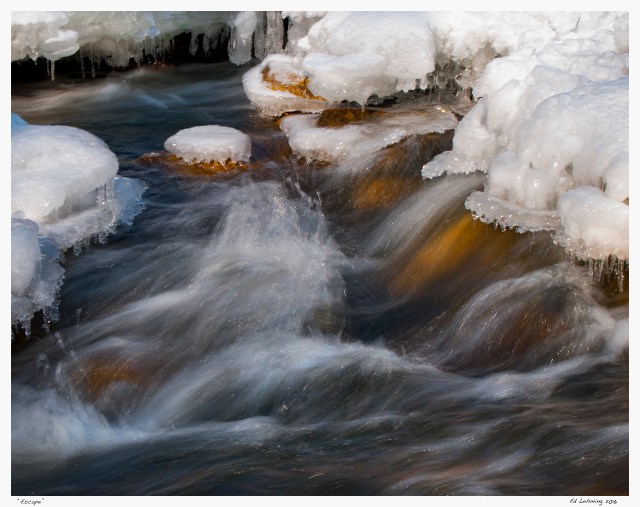
It appeared that the water was escaping from beneath the weight of the ice and dancing across the rocks and another more appropriate title did not come to mind.
The early afternoon light filtered through from behind me and lit up some of the rocks, creating a beautiful glow on the rocks under the fast moving water. Once more, I tried to convey the sense of movement and urgency by doing a long exposure. There will likely be more in this series over the next few days.
Nikon D300
Tamron 70-200 mm f/2.8 @ 78mm
1/8 sec, f/32, ISO 250
For more images like this, please visit my Facebook page:
https://www.facebook.com/EdLehming
or my website
http://www.edlehming.com
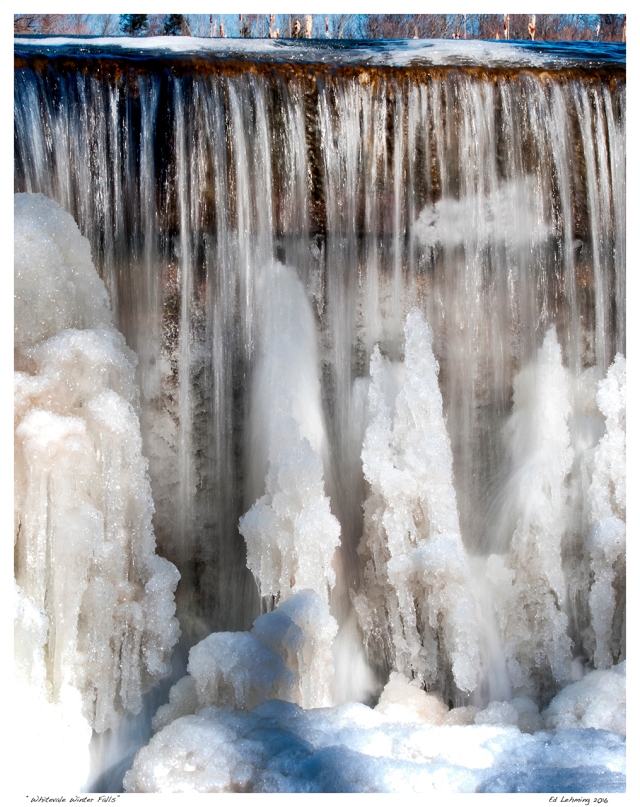
I have to admit that I have been to these falls many times over the past few years, but never in winter. The falls are the result of a dam being build to keep and introduced species of trout from migrating too far upstream and eating the eggs of the native brown trout. I’ve posted a few photos of this dam in the past.
The winter scene is beautiful, especially in the right light, which I was blessed with on this visit. It has been particularly cold over the past few weeks, which created a substantial buildup of ice to almost the height of the dam, which is about 5 meters. If you look carefully at the top of the photo you can also see the water coming from under the ice covered pond above the dam
The light plays nicely through the columns of ice and I decided to challenge myself with a long exposure. The results are very satisfying.
Nikon D300
Tamron 70-200 mm f/2.8 @82mm
1/8 sec, f/32, ISO 250
For more images like this, please visit my Facebook page:
https://www.facebook.com/EdLehming
or my website
http://www.edlehming.com

I love the movement of water. So, on my visit to Yosemite in 2013, I spent a good portion of my time hiking the shores of the many creeks and cascades throughout the park. Tenaya Creek, pictured above, parallels the Mirror Lake Loop trail and there are many opportunities, close to the trail, to view and photograph the creek as it churns down toward the main valley. What makes it even more beautiful, is the effect of the large granite boulders that litter the creekbed. The water churns over and around these boulders with such power and urgency. Close to my home the creeks are small, slow flowing meanders filled with small rounded rocks, with very little colour.
The mountain cascades, in contrast, are fast flowing, crystal clear and flow over pink and gray boulders. It’s much more active and colourful.
Nikon D300
Tamron 70-200 mm f/2.8 @ 70mm
1/2 sec, f/29, ISO 280
For more images like this, please visit my Facebook page:
https://www.facebook.com/EdLehming
or my website
http://www.edlehming.com
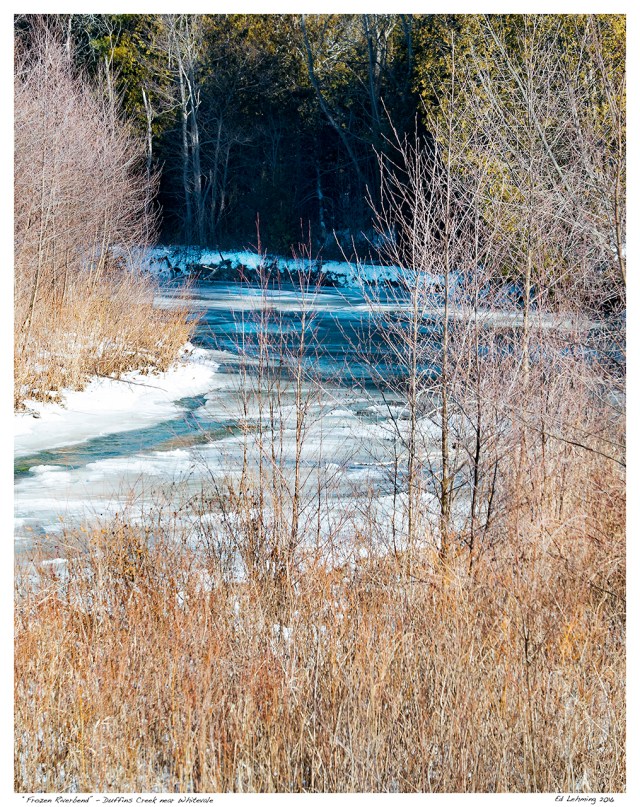
On a particularly nice day in mid-January, I went for a much needed hike along the Seaton Trail, south of Whitevale, Ontario, with my son. The day was an opportunity to enjoy the outdoors and make some photos.
The creek was partially frozen over and full of wonderful detail in hues of blue and green. Above is a view of the typical scenery showing ice coverage and flow. The plants are all brown or yellow. You’d expect it to be drab and washed out, but the bright snow lights things up so nicely. Despite the cold air, it was a great day to just be out and about and the light was beautiful.
Nikon D300
Tamron 70-200 mm f/2.8 @ 110 mm
1/250 sec, f/8, ISO 250
For more images like this, please visit my Facebook page:
https://www.facebook.com/EdLehming
or my website
http://www.edlehming.com
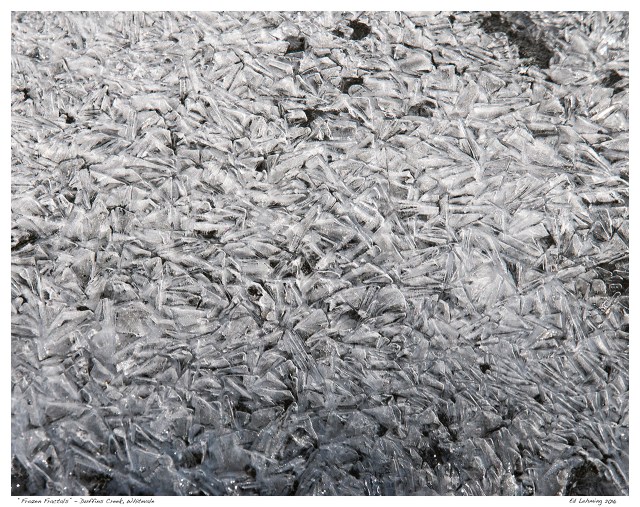
Never the same twice
Wonderful patterns in the ice
Beautiful randomness of nature
Just add water
Nikon D300
Tamron 70-200mm f/2.8 @ 200 mm
1/320 sec, f/9.0, ISO 250
For more images like this, please visit my Facebook page:
https://www.facebook.com/EdLehming
or my website
http://www.edlehming.com
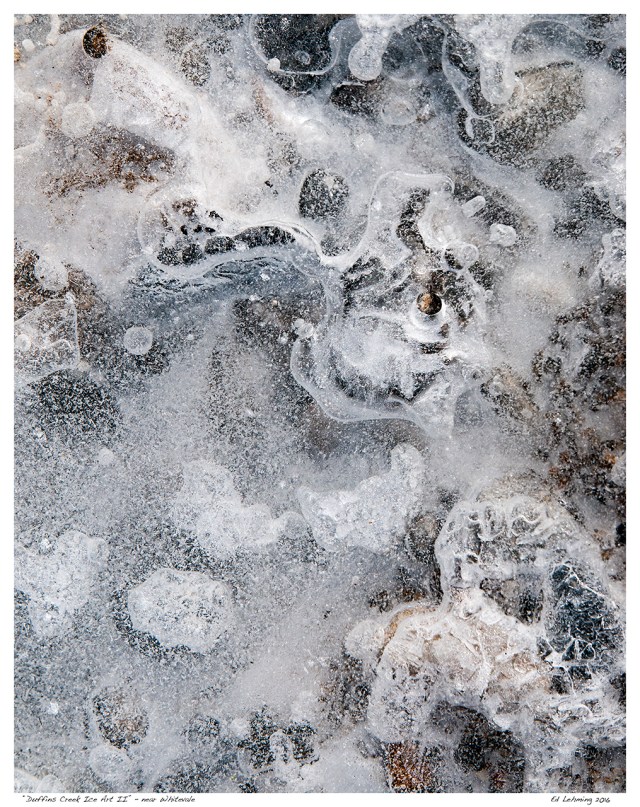
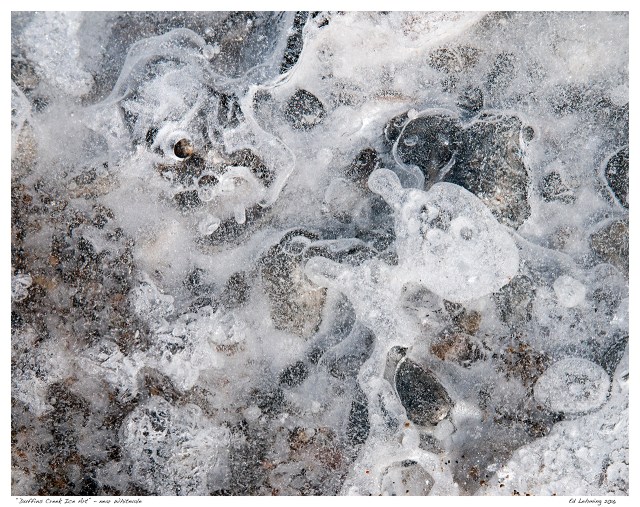
Nature is constantly amazing me. The image above is a simple shot of a frozen Duffins Creek. It looks like some marvelous abstract art piece that you would see in an expensive downtown gallery. But, this one’s free and created through the natural freezing process.
If you take the time to really look, you can see how the layers may have built up, how the water ebbed and flowed between the rocks on the creekbed, creating intricate curves, and trapping air bubbles.
I may start a whole series of these and compare different creeks in their ability to create art.
Nikon D300
Tamron 70-200mm f/2.8 @ 170mm
1/320 sec, f/9.0, ISO 250
For more images like this, please visit my Facebook page:
https://www.facebook.com/EdLehming
or my website
http://www.edlehming.com
To start this out, I’m stealing a wonderful quote from a fellow blogger spanishwoods.
“In my opinion, the most ordinary things, the most common and familiar, if we could see them in their true light, would turn out to be the grandest miracles . . . and the most marvelous examples.”
—Michel de Montaigne
The above statement resonates with me on so many levels. I don’t live in an area with grand vistas, mountains, or oceans. The countryside surrounding my home is, at first appearance, quite bland.
But, if you have the eye to see deeper, and appreciate the fine details, the landscape opens up into a world of light and colour.
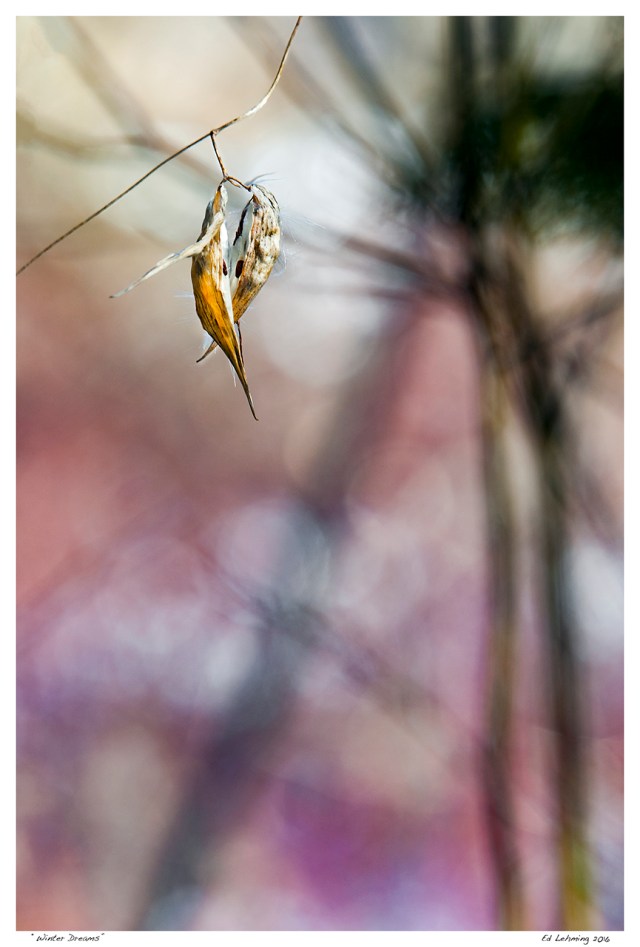
Today, after nearly two weeks of not venturing very far afield, I got up, looked at the stunning, clear light, and despite it being -12 degrees celsius outside, headed out with the intention of a much needed walk in the woods (and some photos). I made about 40 photos of forest trails, frozens creeks, and plants along the way. As the quote above states, it’s often the ordinary things, that on further observation, become quite spectacular. On occasion, I’m surprised by some detail I did not notice as I made the photo. After all, I’m limited to what I see through the viewfinder. Along my walk I stopped in a few locations to photograph the tiny seed pods of a plant called Dog Strangling Vine. Apparently, it’s an invasive species, imported deliberately or accidentally from Europe some 150 years ago. I don’t know that a dog has ever actually been strangled by it. The plant’s real name is European Swallow-Wort. These plants often grow in thick tangles, clinging to and climbing up trees, but every now and then a single tendril reaches between trees and those tend to make good subjects for photos where I can isolate a single seed pod or two. They are quite ordinary, but unique in how they grow.
I was very surprised today, in reviewing my photos that, despite it being mid January, my camera picked up the most awesome purples, and pinks as a burst of colour bokeh behind the seed pods. I don’t recall seeing anything pink or purple in the background when I made the photo. So, I’ll take this as a special gift. It adds a real dream-like effect to the image, coupled with the burst effect of a few background branches. If I had planned this, I would have been pleased. But, to have a complete surprise is awesome and keeps me inspired to seek out more of these special moments.
Nikon D300
Tamron 70-200mm f/2.8 @200mm
1/100 sec, f/5.0 -0.33, ISO 250
For more images like this, please visit my Facebook page:
https://www.facebook.com/EdLehming
or my website
http://www.edlehming.com
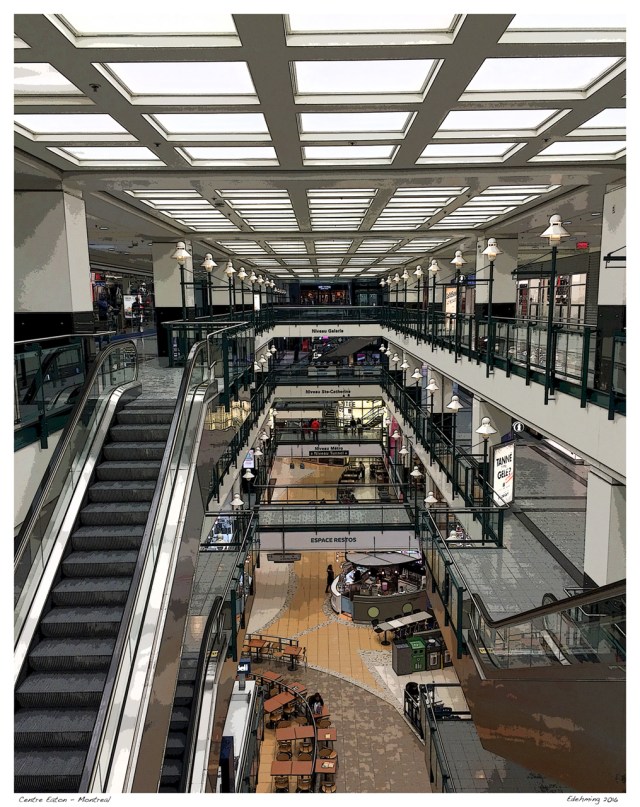
Never let me say “There’s nothing to photograph”.
Though my preference is really nature and outdoors images, I also, occasionally, have a ‘thing’ for patterns and urban scenes. Today, after a day spent in several corporate offices, I took a walk through ‘underground Montreal’. It’s a series of connected shopping complexes that reaches several kilometers under downtown Montreal.
During the day, this is a very busy place, full of commuters on their way to work, students, attending the adjacent McGill University and shoppers, out for a bargain. In the evening, it is essentially vacant, and I find it a nice place to walk and stretch my legs after a day sitting through meetings.
Today, I made my way to the upper level of this section of the complex, the Montreal Eatons Centre, to get a view of the complex from a higher vantage point. The above image is the result. I like the strong lines and flow of the place and added a bit of ‘posterizing’ to accentuate that effect.
iPhone 5s back camera 4.15mm f/2.2
1/40 sec, f/2.2, ISO 40
For more images like this, please visit my Facebook page:
https://www.facebook.com/EdLehming
or my website
http://www.edlehming.com
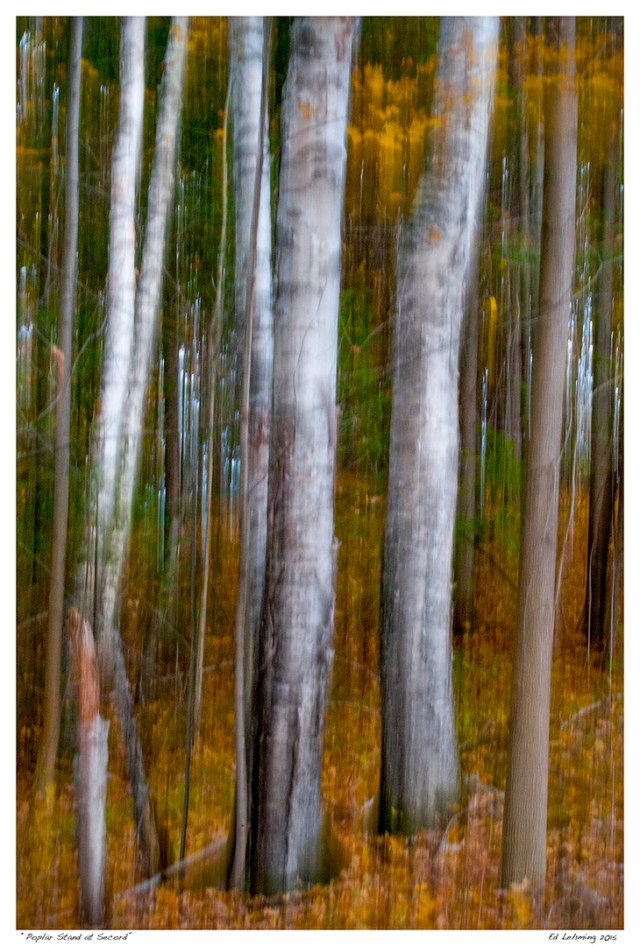
Hearkening back to milder days, as I ride the train through snow filled landscapes to Montreal. This image was made back in mid-October 2015, as I hiked the southern trails of the Secord Forest. I have made many photographs in the area, but as with many of the photos, the light is always a bit different and what seems familiar suddenly transforms into something altogether new and wonderful.
This image is a fine example of that phenomenon. There are many small poplar groves in this forest and I’ve sen and photographed most of them. Primarily because the long, straight trunks lend themselves so well to these painterly effects. As I recall, this was a mild afternoon on a Saturday and the light was soft and warm and the leaves had just started to turn to their bright yellow fall hues. I stood and looked at these familiar trees but there was something a bit different than previous visit because the sun lit up the background nicely so I made a few vertical pans. I was pleasantly surprised at the show of colour layers in the image and the retention of some of the finer details in the tree bark.
I hope you enjoy it.
Nikon D300
Tamron 70-200 mm f/2.8 @ 80 mm
1/4 sec, f/32, ISO 250
For more images like this, please visit my Facebook page:
https://www.facebook.com/EdLehming
or my website
http://www.edlehming.com
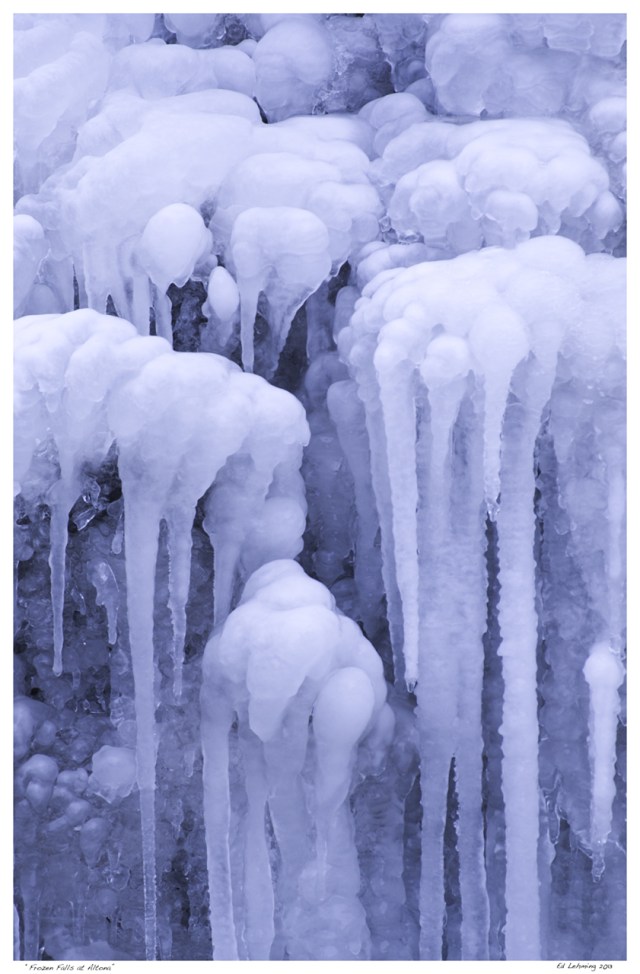
Many years ago, just north of Pickering, Ontario, was a flourishing hamlet called Altona. There was a school, a couple of churches, a hotel and many beautiful farms, as well as a mill. In the 70’s the lands were expropriated by the Canadian government to build an airport. Well, the airport seems to have become a distant memory and the lands sat, essentially abandoned. The mill, and several other historical buildings, along Altona Road, were demolished a few years ago, as they sat decaying and neglected. The mill pont silted over to become a weedy meadow, indistinguishable for the surrounding fields. However, Duffins creek, the source of the former pond, continues to flow through and beneath the remnants of the pond and eventually, spills out over a small waterfall at the the end of the man-made pond. It’s quite interesting to find a waterfall in the middle of nowhere.
These ‘small falls’ have offered me many photo opportunities over the years. I happened to visit them in the winter a few years back and they had frozen almost solid, over a few particularly cold days. The resulting ice sculptures were beautiful and the cool winter light made for some interesting effects and colours.
Above is a view of a small section of the falls which had frozen into a multi-layered formation of icicles. The day I made the photo was particularly cold and the photo captures this feeling quite well.
It’s sad that all that is left of Altona is a few shells of buildings and hints of things that once were, but there is still some beauty left in this mostly abandoned space and I can see why early settlers were drawn to the area.
Nikon D300
Nikor 70-300mm f/4.5-5.6 @ 185 mm
1/60 sec, f/5.0, ISO 200
For more images like this, please visit my Facebook page:
https://www.facebook.com/EdLehming
or my website
http://www.edlehming.com
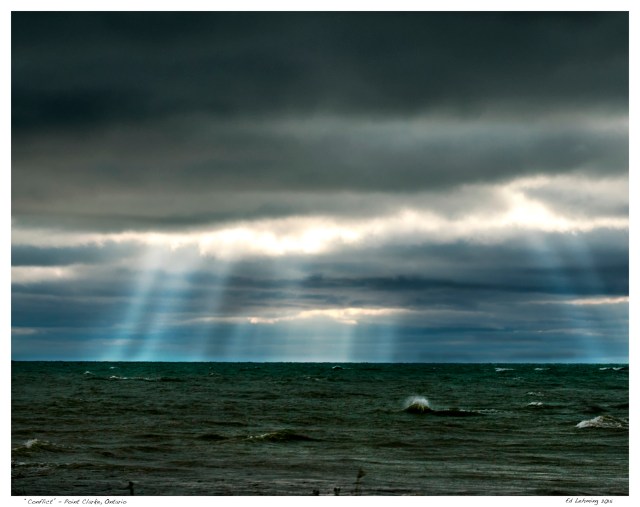
I could not think of a better title for this photo. To me, it speaks conflict in so many forms. This day in late December was the transition from an extended mild fall to a bitter, biting winter. The crepuscular rays (yes, that’s what they are actually called), offer a sense of peace in contrast to the tumult of the icy waters below. Crepuscular rays are colloquially known as a Jacob’s Ladder, Gateways to Heaven, Buddha’s Fingers, Jesus Beams, God’s Rays, sunbeams, cloud breaks and many other names. It is not surprising that many of the names have religious connotations as crepuscular rays seem to be a message from the gods. What message is being expressed here? “Winter is coming?”
The very waters are churning in conflict, rising in sharp peaks and churning over each other, urgent for the shore.
The temperatures had dropped from a wondrous 13 degrees celsius mere days ago to a blustery minus 6 with a 60km/h wind that literally sucked the breath from my lungs and froze my fingers numb in minutes. While I love being outdoors whenever possible, this instance may be an exception, as it was truly unpleasant, except for the scene unfolding in front to me. From the comfort of a warm car or house, this may have been a vista I could have revelled at for hours.
Nikon D300
Nikor 70-300 mm f/4.5-5.6 @ 82mm
1/200 sec, f/7.1, ISO 250
For more images like this, please visit my Facebook page:
https://www.facebook.com/EdLehming
or my website
http://www.edlehming.com

On a cold, dull November afternoon in 2014, I stopped for a few minutes at Burliegh Falls, a set of fairly intense rapids just off Highway#28 in the Kawartha Lakes region of Central Ontario, between Lower Buckhorn Lake, above and Stoney Lake, below.
It’s a very scenic location, easily accessible from the road, and therefore, very busy in the summer and early autumn. The rapids, adjacent shoreline, and calm pools below, are a destination for tourists, photographers, painters, swimmers, and fishermen.
The intensity of the rapids is dependant on the flow of water through a dam above them, designed to regulate water levels on the Trent-Severn canal system, parallel to the rapids. That November the flow was quite intense. This particular day was cold, windy, and overcast. Not ideal sightseeing conditions but, with the exception of the cold and wind, very nice for photography. The dull skies allowed me to make several long exposure images of the falls/rapids, including the one above, which I manipulated in Photoshop to look like a painting to get the effect I wanted to show. Again, for me it’s about how I see and experience things, rather than being simply an image in time. Don’t get me wrong, the original image is very nice as a photo, but did not communicate ‘how’ this scene unfolded for me at the time.
I’ve mentioned several times in the past that I can’t paint, but would love too. I like to look of the long brush strokes, the intense whites with hints of green and purple, and how it imparts so well the power of the water as it rushes by the far shore. The ‘painterly’ style, also intensifies the texture of the granite in the background. In my mind, this image captures the raw beauty of the province I live in and have the opportunity to enjoy and share.
Nikon D300
Nikor 70-300 mm, f/4.5-5.6 @ 75 mm
1/4 sec, f/32.0, ISO 200
For more images like this, please visit my Facebook page:
https://www.facebook.com/EdLehming
or my website
http://www.edlehming.com
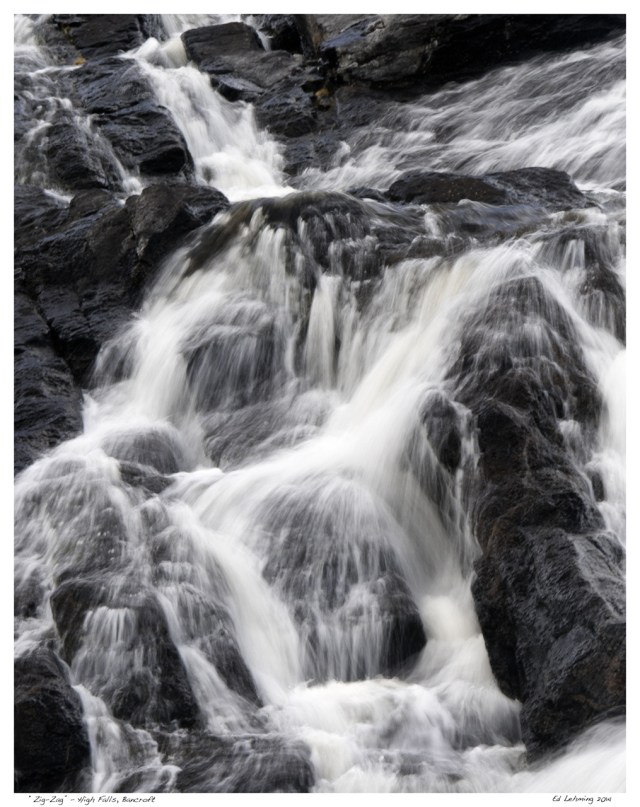
High Falls, pictured above, is the result of a dam built at the terminus of Baptiste Lake to control the flow of the York River, which begins at this point. The river, while very useful for logging, used to cause catastrophic flooding in the town of Bancroft a few miles below. The dam sits atop a large mass of rugged rock above a valley with steep banks. I would love to have seen this area before the dam was built. It must have been quite a sight to see all that water rushing through this valley. While I imagine the lake was lower too, it would still have seen a significant flow, especially in spring.
The nature of the rock below the dam creates some pretty unique flow patterns, especially on long exposure, and it changes with the flow of the water. In spring, when there is a higher flow of water most of the central rocks are obscured. As summer progresses, the flow is reduced and small rivulets of water create intricate patterns between the rocks.
I spent an afternoon shooting a series of photos that cover many aspects of this cascade that I will share from time to time, each offering a different vantage point and conveying the varied nature of this wonderful place.
Nikon D300
Tamron 70-200 mm, f/2.8 @ 165 mm
1/8 sec, f/32.0, ISO 250
For more images like this, please visit my Facebook page:
https://www.facebook.com/EdLehming
or my website
http://www.edlehming.com
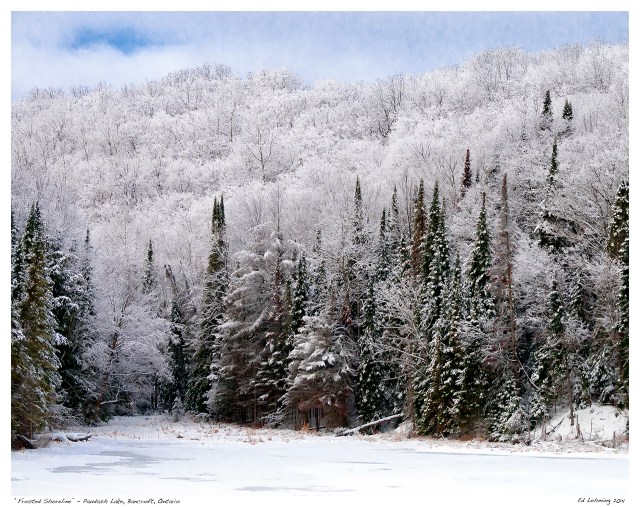
Winter can be such a thing of wonderment. The photo above was made in December of 2014 while on a trip to A Place for The Arts, an artist cooperative in Bancroft, which I am a member of. The drive was generally uneventful, with the occasional blowing snow and a few drifts over the road. There had been a slight warming the day before and a quick cooling down which created a marvelous, almost magical, frosting on the tree branches along the road. It was beautiful to see the frost shining and twinkling in the trees along the road but it was not till we got into open areas with higher elevation that this effect really revealed itself. Along the far shores of Paudash Lake there are several high ridges and all the trees on these ridges were completely encrusted in a thick, pure white, layer of frost. I have rarely seen a scene of such intense purity as it dazzled in the mid-morning sunlight.
This is like a scene from Narnia where the White Queen has made her presence known in ice and snow. The frosted pines along the shore just accent the effect. A photo can hardly convey this type of scene, but this one come as close as I could have wished for. By early afternoon the frost had melted, or been disturbed by the wind, and the drive home was nowhere near as beautiful.
Now, when I drive along this lakeshore, even in summertime, and look at this shoreline, I will always be reminded of this particular moment in time, when winter came visiting the Paudash shores.
Nikon D300
Nikor 70-300 mm f/4.5-5.6 @ 78mm
1/200 sec, f/5.6, ISO 200
For more images like this, please visit my Facebook page:
https://www.facebook.com/EdLehming
or my website
http://www.edlehming.com

While winter has been slow to arrive in southern Ontario this year (we’re in fog and rain right now), that was not the case last year. The image above was made last winter on Ahmik Lake, near Parry Sound, Ontario. It had snowed gently most of the night, partially obscuring the tracks of others and was quite cold, but the day quickly brightened up. At the top left of this image is an island which I set out to explore in the morning. The snow on the lake was too deep to just walk on, so I donned my snowshoes and headed out.
As I got back to the cabin, I looked back and saw the scene I’m sharing today. It’s an interesting introspection on the ‘why’s’ of our journeys. When I set out, I headed straight toward the end of the island, but there are rises, drifts, and other structures in the way of a straight walk, so I recalibrated a few times. It’s interesting that these ‘objects’ to not appear on the photo very well, but they were there and very real. Then I adjusted my path a few more times. I can’t think right now why, but it was probably to get a different view of something interesting on the shoreline of the island.
The analogy here is: when looking at my path, you would have no idea why I did not just make my way directly to my destination. Even I, having made the journey, can’t explain the whole thing, only that I made it and enjoyed the experience.
Nikon D300
Nikor 70-300 mm f/4.5-5.6, @ 75mm
1/400 sec, f/10.0, ISO 200
For more images like this, please visit my Facebook page:
https://www.facebook.com/EdLehming
or my website
http://www.edlehming.com
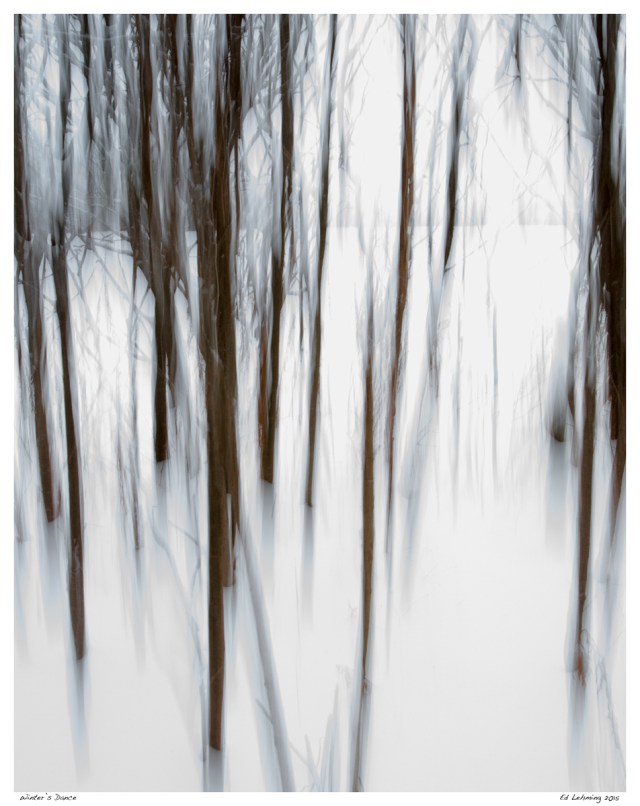
A switch today from my mono posts of late and a look back to a winter past, in abstract. The above is a view through the edge of the forest at Fraser lake Camp, near Bancroft. There was a bit of fog in the air and frost on the branches. The whole scene had a dreamy feel to it. Since the vertical elements were present, I decided to try a vertical pan to add more of a surreal feel to the image. When looked at the final product, I had the sense that the trees were dancing, as they seemed suspended above the ground, as the branches wove and blended together. The thin horizon helps to anchor the whole scene.
Nikon D300
Nikor 28-70 mm f/3.5-4.5 @35 mm
1/2 sec, f/25.0, ISO 200
For more images like this, please visit my Facebook page:
https://www.facebook.com/EdLehming
or my website
http://www.edlehming.com
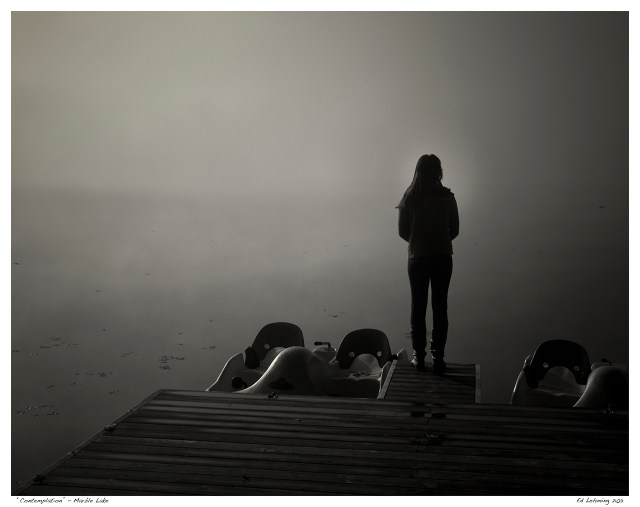
Early one morning in late summer 2014, I went down to the lakefront with my daughter. It was one of those typical cool mornings on the lake where the mist from the warm water rises up and just hangs there for a few minutes before rising higher in the sky to become a cloud.
We spent some time on the dock, both making photos of the ethereal beauty of the mist as it moved in an intricate dance above the water’s surface. I was just about finished when I looked back and saw her standing on the dock and gazing across the lake. Only she can say what she might have been thinking at that moment, but she seemed transfixed by the mist, contemplating the scene in from of her. Given the slight halo around her head, she was probably reviewing her photos. It’s very serene and a moment I’m happy to have been able to capture and carry with me.
I was going for high depth of field to show some of the details in the swirling fog and a faster shutter to compensate for the brightness of the fog. It had a nice effect on the overall lighting.
Nikon D300
Tamron 17-50mm f/2.8 @ 24mm
1/640 sec, f/13.0, ISO 200
For more images like this, please visit my Facebook page:
https://www.facebook.com/EdLehming
or my website
http://www.edlehming.com
It would seem I am on a black and white theme lately?
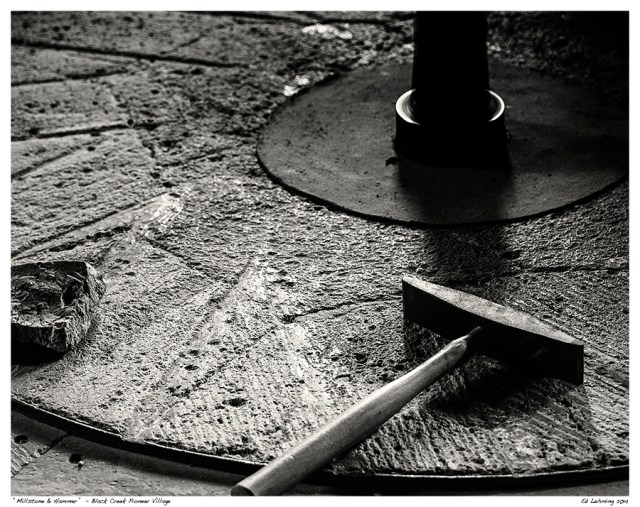
The photo above was made at a local pioneer village, which is made up of many historic buildings from the area which have been moved to a central location. Inside this village sits Roblin’s Mill which was originally built in 1842 in Ameliasburg, Ontario in Prince Edward County. It is a fully functioning mill, and as such, is the only operating stone mill in Toronto.
I have been to this building may times and made photos of windows, timberland gears. On this particular day, the dim sunlight was shining on one of the mill wheels that was exposed to show how it worked. Someone had left a hammer sitting on the wheel and it made a nice composition.
It was a low light situation and I did not use a flash and was pleased at just how well the VR on my sense worked at 1/10th of a second handheld. I really should have used a tripod!
Nikon D300
Nikor 70-300 mm f/4.5-5.6, @ 70 mm
1/10 sec, f/4.5, ISO 800
For more images like this, please visit my Facebook page:
https://www.facebook.com/EdLehming
or my website
http://www.edlehming.com

While on a walking tour of Old Quebec a few years ago, I came across this man sitting in Parc Montmorency. When I first saw him, I had a front view and he was talking to a lady in a nurse’s uniform and she walked away laughing. I imagine she knew him and they had just shared a joke.
As the tour progressed I came around behind him, at a distance. He was now sitting alone and was writing in a note book. The angle I shot from was ideal and incorporated all sorts of elements which make this, in my option, a wonderful photograph. There is the light reflecting off the bench, the diagonal lines of a staircase in the background, wonderful shadows and textures, and the pigeon (which I did not notice when I made the photo).
This solitary gentleman sitting alone in a park, writing in a book, or journal, pulls me in and has me wanting to know more about him and his situation, like: who is he, why is he sitting on a bench writing, what is he writing. The title came from my imagination as I pictured him sitting there, watching the world around him and keeping score as it unfolded.
Nikon D300
Nikor 70-300 mm f/4.4-5.6, @ 300 mm
1/60 sec, f/5.6, ISO 450
For more images like this, please visit my Facebook page:
https://www.facebook.com/EdLehming
or my website
http://www.edlehming.com


Recent Comments