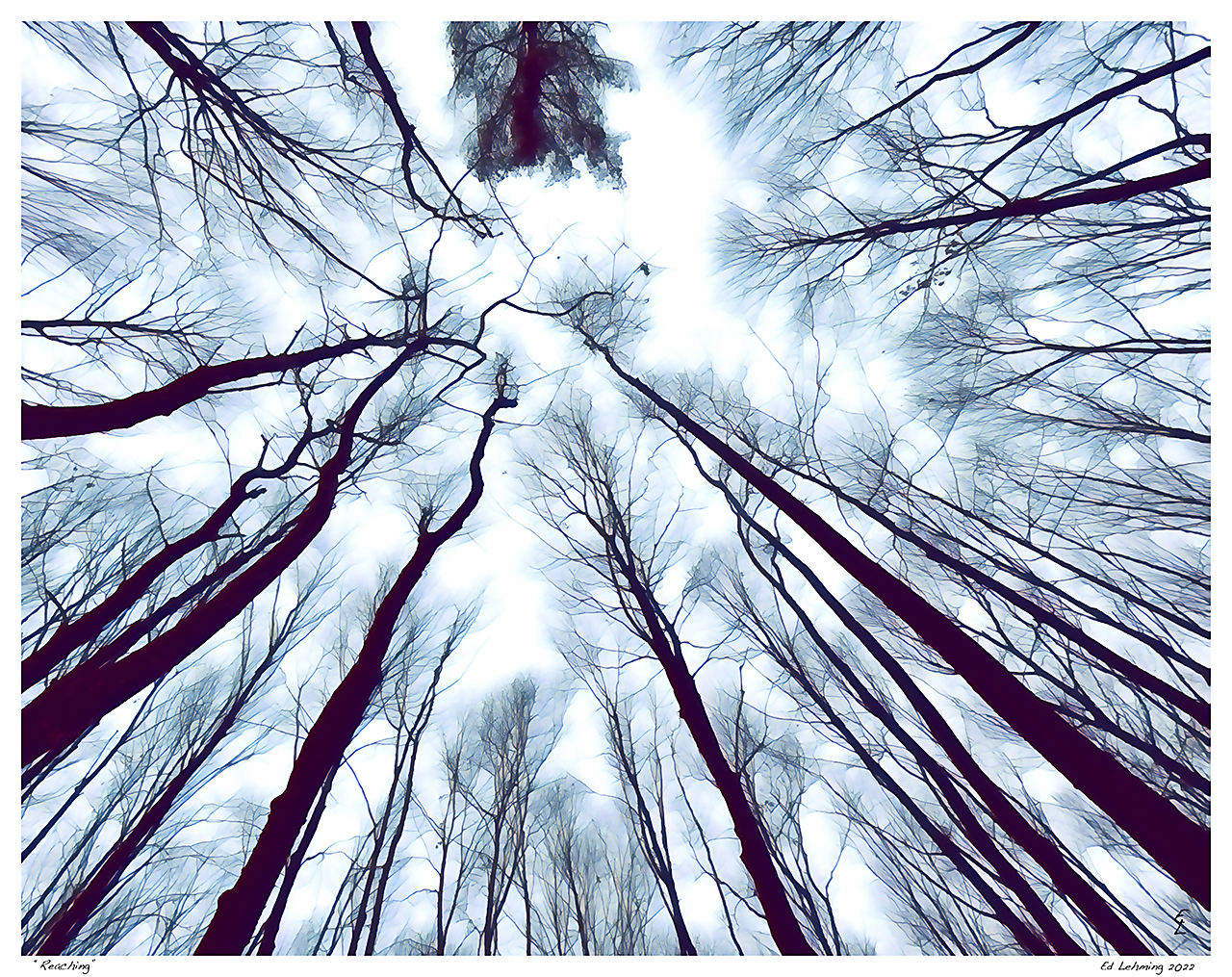
“We all find ourselves reaching for something lately. For some, we have reached our limits, for others, it’s more of a stretch than a reach. On dull and cloudy days, the trees continue to reach, with no clear goal visible, other that reaching upwards, to eventual light and life” – Ed Lehming
I have found myself considering this image several times this week. I recall the day I made it, very clearly. It was an untypical image for me, the only real interest was the upward stretching of the trees. I compared it to other similar images I have made and this one stood apart. The day was dull, grey, and cloudy and I simply enjoyed the contrast of the dark tree trunks reaching into the flat grey sky.
My images are often informed by the world around me and it seemed the very act of ‘reaching’ or ‘stretching’ has been a very real element of my day to day life. The politics and events globally have forced me to expand my understanding, to challenge my established norms. If there has been growth for me, it has been slow, but bit by bit, the growth has occurred.
Going back to the image, it would be fairly easy to tie the growth back to a goal, like the bright sun in the sky. But, in this image, the sun is hidden; diffused. There is no clear goal, simply the obscurity of a grey sky, yet there is growth, based on a need for light and energy, no matter how faint the memory of sunshine might be.
iPhone 12 Pro @ 4.2 mm
1/170 sec, f/2.4, ISO 25
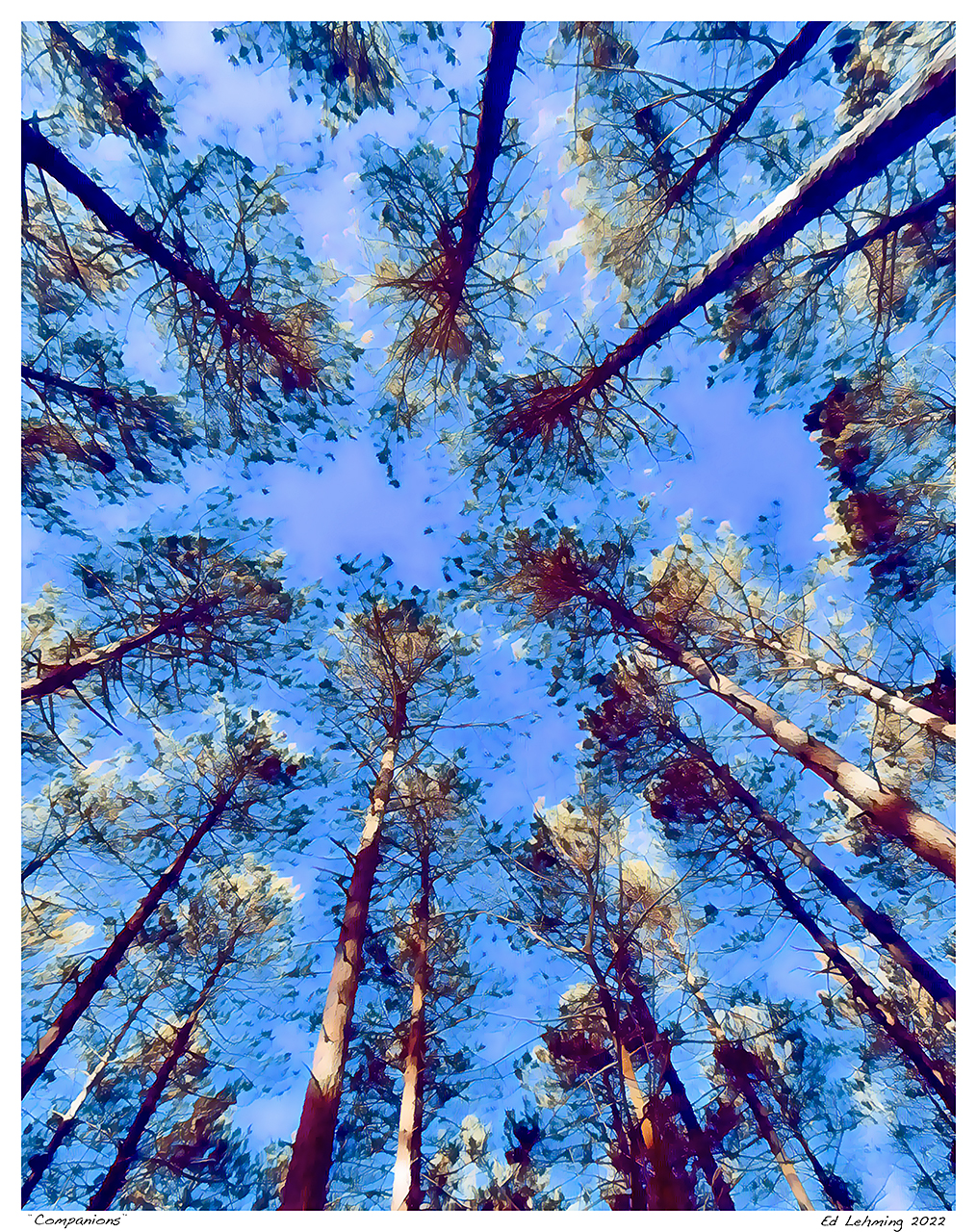
“On my forest journeys, the trees are my constant companions. Their aspect changes, depending on how you see them. They are the same, but appear different. Perspective changes everything.” – Ed Lehming
I have avoided this type of shot because it seems a bit ‘put on’. I look at these images on web sites and Instagram with some interest but tend not to spend much time with them. A few days ago, I had a bit of a revelation. Looking up into the tall pines, I reconsidered what I was seeing. These trees are everywhere in this ‘plantation’ forest and I enjoy them immensely, but I suppose I take them for granted and almost always view them for the same viewpoint.
That day, I pointed my camera up and the image just felt right. It reminded my of summer days, laying on the forest floor and looking up at the swaying canopy. It’s those summer daydreams that I miss a lot on cold winter days, but this viewpoint brought back that dreamy feeling.
It’s funny, looking at this image. If you were not told that this was winter image, it would not take much to imagine a warm summer forest. I further enhanced the original image to give it a bit more of a dreamy look and causes me to enjoy it all the more. These trees are my companions in all seasons and will be a bit more deliberate in seeing them in new ways.
iPhone 12 Pro @ 4.2 mm
1/170 sec, f/2.4, ISO 25
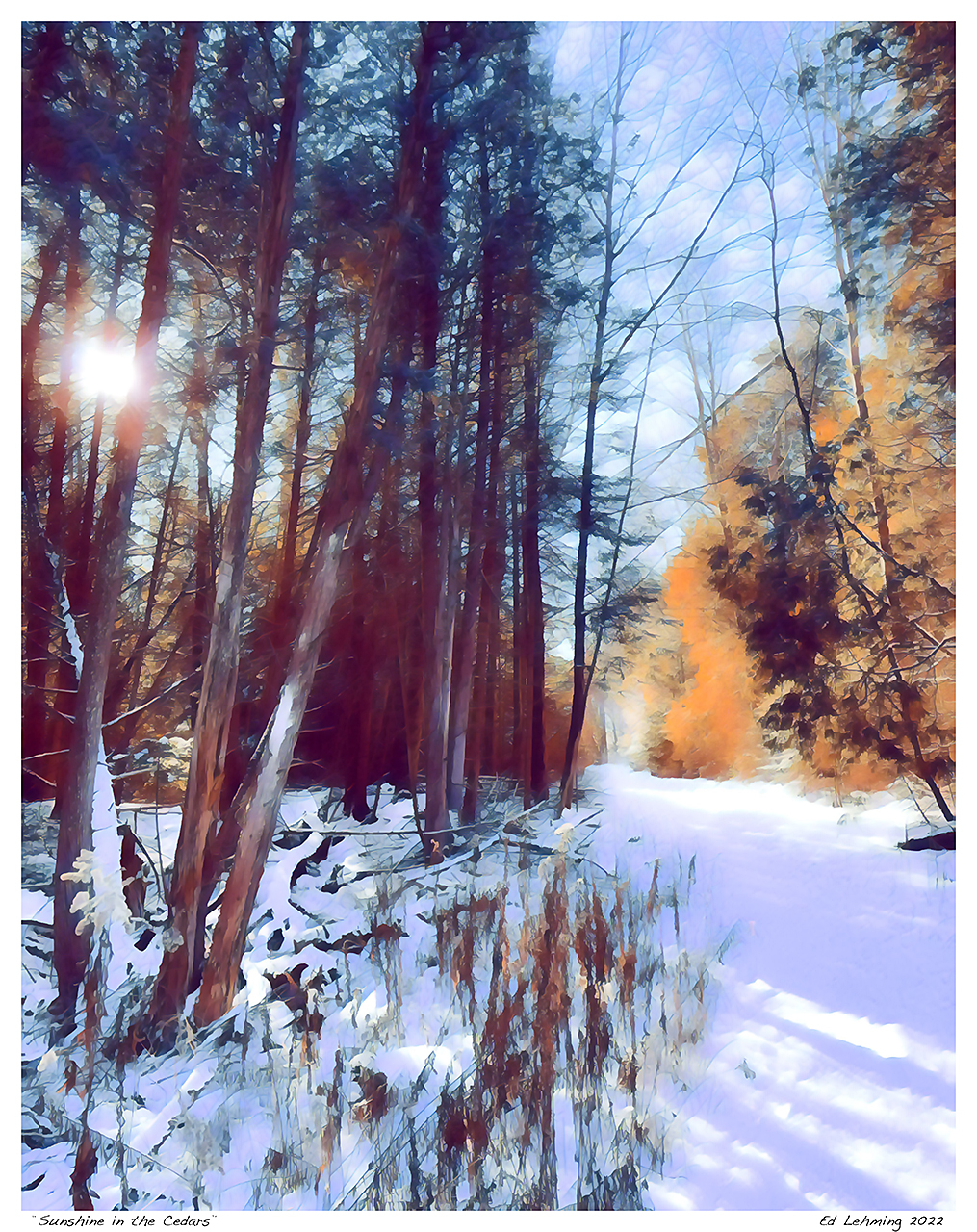
“When we can find joy in the commonplace, we can endure almost anything.” – Ed Lehming
There was a quality to this scene that made me stop and pause. As with many of the images I make, it’s the simple act of appreciating the commonplace, the things most would pass by without a notice, that allows me to appreciate just how wonderful the natural world can be, and just how much that appreciation has sustained me.
I’m especially conscious of this when I am outdoors; the ‘noise’ of the human world muffles and obscures this sense in me, so I am grateful for every moment I am able to be outdoors and surrounded by nature.
When I made this image a few days ago, I was out for a hike before a major winter storm arrived. I had no real intention of what I was going to photograph, it was simple a chance to be outdoors again. I have trodden this same trail countless time, yet I still come across scenes like this that make me pause and enjoy the simplify and wonder of it. I may be this particular day, when the sun peeked between the cedars and lit the background a soft orange. I can’t say for certain, even when looking at the photograph now. It was just a moment that was meant to be, and one that added to the overall enjoyment of the hike itself. It’s those successive and cumulative ‘moments’ that build a narrative that sustains us, which is especially true for me right now.
iPhone 12 Pro @ 4.2 mm
1/355 sec, f/1.6, ISO 32

“Around the next bend, the forest glowed in rusty orange, inviting me forward from the snow-filled pines. It truly feels like a time of fire and ice.” – Ed Lehming
As I sit and write this post, the world outside my window is filled with ever deepening snowfall. A major winter storm came in last night and continues this afternoon. So far, over 40 cm have fallen, and though the end is promised, the storm seems to have different ideas. So, it gives me time to reflect on yesterday’s images.
It’s a far cry from yesterday’s crisp air and bright sunshine. I knew this storm was coming so made a point of getting out on the trails before the snow started falling. I’m glad I did, because it will take a while for roads to become safely navigable again.
As I stood at this bend in the trail, I was keenly aware that I had photographed it on several previous occasions. It’s a location that is just naturally photogenic with its many layers and tones. Yet, the forest is a living thing and always changing, so I should not have been surprised that it offered me a slightly different aspect of itself yesterday.
What caught my attention, as a I approached the bend, was the warm orange tones emanating from the beeches and a few maples which had, for some unknown reason, not shed their leaves yet. The resulting glow was further enhanced by the low winter sunshine. Overall, I find it a very calming scene and a lovely reminder of why I spend so much time on these local trails. Even on the coldest winter days, they have gifts to offer me. Sometimes fire and ice show themselves in the same scene.
iPhone 12 Pro @ 4.2 mm
1/405 sec, f/1.6, ISO 32

“It emerges from the ground, mindless of timing or conditions. Fresh, spring water wells up from deep underground to begin its long journey to rejoin the sea.” – Ed Lehming
I have stood here many time before. It is the source of West Duffins Creek, a small local creek that flows from the Oak Ridges Moraine and empties into Lake Ontario, many kilometers south. It begins as a series of springs within a thick cedar bog some hundred meters or so behind this scene. The waters well up from the forest floor at the same rate, year round. The waters don’t slow in the heat of summer or the cold of winter. The cycle is continuous and wonderful. It’s like watching the very life of the forest begin before my eyes.
Because the water rises from deep below, there is some latent warm and even with this week’s frigid temperatures (between -25C and -13C) the water flowed forth steadily, with a few ice clumps forming much further downstream as the waters slowly cooled..
It is beautiful to see this creek flowing when everything else is frozen solid. Even the trees along the shore creaked and crackled in the deep cold. Yet the water flows, regardless of the extreme cold.
In the summertime, as mosquitoes buzz and frogs croak, the creek provides cool waters to sustain wildlife along its course.
It really is a thing of wonder, the very life-blood of the forest, the ‘source’ that sustains life, season in and season out. It really is a privilege and a blessing to able to participate in this timeless cycle.
iPhone 12 Pro @ 4.2 mm
1/121 sec, f/1.6, ISO 64

“Among the shadows of the cold forest, the winter beeches shine with unexpected light, filling the darkness with brightness and joyful energy.” – Ed Lehming
Today I’m sharing another image from yesterday’s frigid hike to Walker Woods, a large forested tract close to home that I visit often. The forest itself is largely ‘plantation’ red pines.That is to say, pine trees that have been planted to reestablish lands that had been largely clearcut and farmed in the not so distant past. There are also a few tracts of native hardwoods: maples, oak, elm, beech, and ash, to name but a few. This region has several patches of what is referred to as Carolinian Forest and boasts many species that occur quite a distance south of here, protected by the unique geological features and a large body of water, Lake Ontario which moderate the climate enough for some of the souther species of flora to thrive.
One of the features and primary purpose of ‘plantation’ forests, besides lumber, is that they are planted to shelter tender hardwood species as they grow between the planted trees. The red pines grow fairly fast and straight, leaving room for hardwoods to establish between them. As the pines are harvested, some twenty years after planting, this offers even more room for hardwoods to establish and grow tall.
One of the Carolinian species that thrives in certain parts of the forest is the Beech tree, and in a few isolated locations in the vast tract, the Beeches flourish. I have found many of these locations and find myself constantly drawn to them, as was the case yesterday.
The low winter sun casts dark shadows among the pines, but just enough light finds its way through to set the beeches ablaze, in strong contrast to the shadows of the pines. It’s quite a phenomenon and I think this image illustrates it exceptionally well, as the copper leaves of the beeches glow with a brightness that seems to come from within the leaves themselves.
I also see this analogous to the time we face right now. The constant barrage of negative news saps my strength and I am always looking for something to focus on that brings me some level of joy to face each day. These beeches do that for me and I am happy to be able to capture the effect to take with me once I depart the forest. I’m hoping this image can also bring that sense of cheer to others viewing it here.
iPhone 12 Pro @ 4.2 mm
1/283 sec, f/1.6, ISO 32
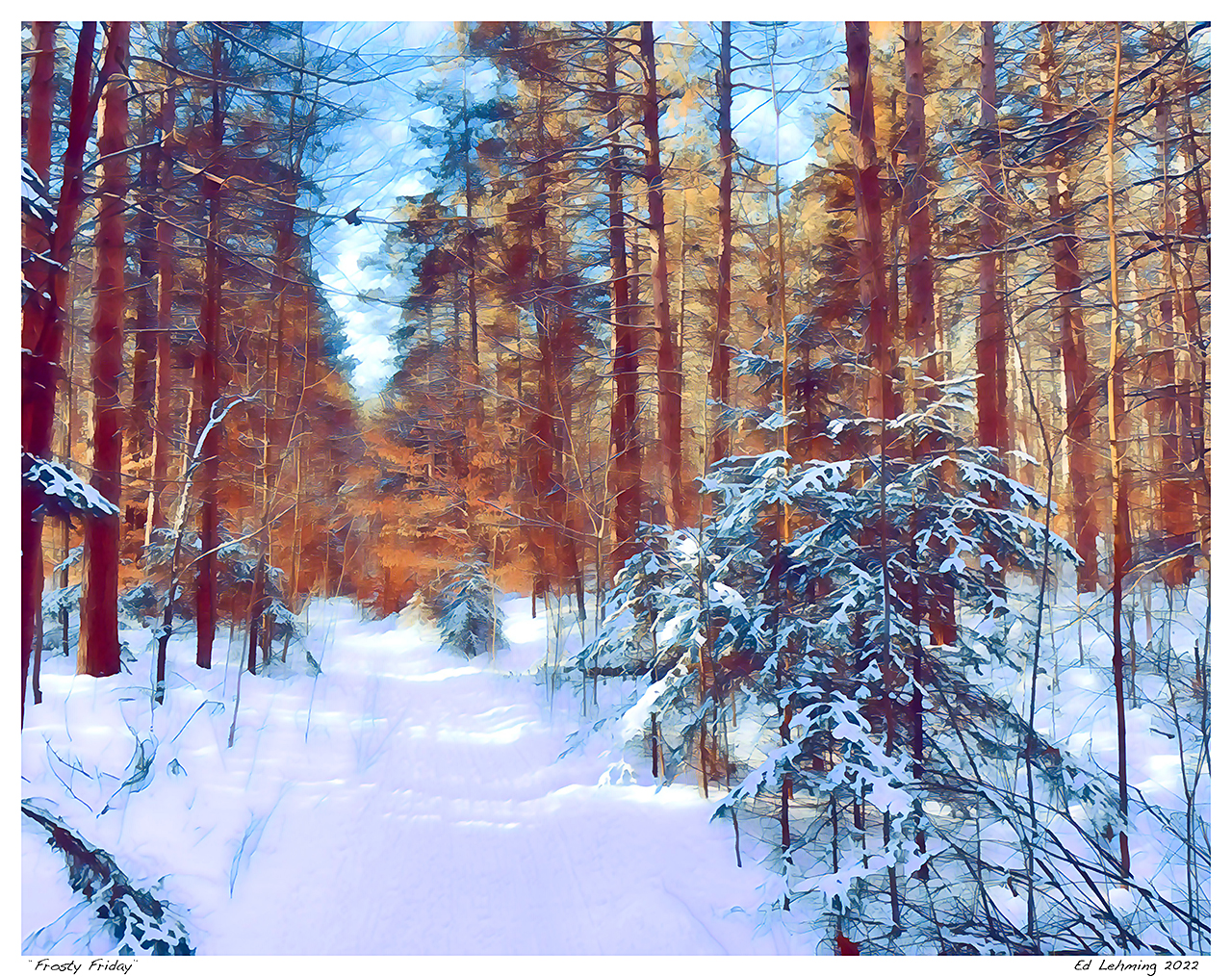
“On even the coldest winter days, the warm glow of the beech leaves radiate with a warmth that makes my very soul glad. I cannot help but smile with joy when I am blessed to be among them.” – Ed Lehming
I’ve posted about the beauty of beeches in the winter on many occasions, yet I continue to find myself drawn to them. They provide me an inexplicable sense of joy in the dull and frigid winter time.
As I set out on the trails today, the temperatures hovered around -14C. There was no wind and the sun shone brightly yet low in the sky. Despite the extreme temperatures, the rays of the sun still found their way between the tall pines and set the beech leaves ablaze in copper splendour.
I stood among the trees, basking in the simple beauty of these trees. My spirit soared and a huge smile formed on my face. It was a tonic to my very being in these depressing times. So, I remained there for some time, refuelling my emotional reserves. I’ve been in this glade many times and it is a place that I find myself whenever I need a recharge. There is an inexplicable energy here, I can feel it in my bones.
The image above was made on the trail as I approached this sacred place. You can see a few of the beeches rising in the distant path as well as the golden glow they produce in the underbrush of the pine forest. I also decided that to really communicate the mood of this scene, that I would digitally enhance it to give the painterly style that I am so fond of. Looking at it now, I believe I have achieved that.
Today also reminded me that no matter what the conditions around me are like, there is almost always something precious to sustain us, if we simply slow down and look around with expectation.
iPhone 12 Pro @ 4.2 mm
1/241 sec, f/1.6, ISO 32

“As winter’s touch fills the days, November’s light holds the final memories of autumn’s warmth.” – Ed Lehming
Once more, I have chosen to digitally enhance an image to bring a bit more mood to the image. The image itself was created just around noon when the sun lines up with the forest trail, creating a wonderful column of sunlight that brightens the trail as well as the trees that line the trail.
As I beheld this scene, I was reminded that even though we are near the end of November and snow has covered the landscape, some reminders of a mild autumn remain in the warmth of the sunlight.
iPhone 12 Pro @ 4.2 mm
1/932 sec, f/1.6, ISO 32
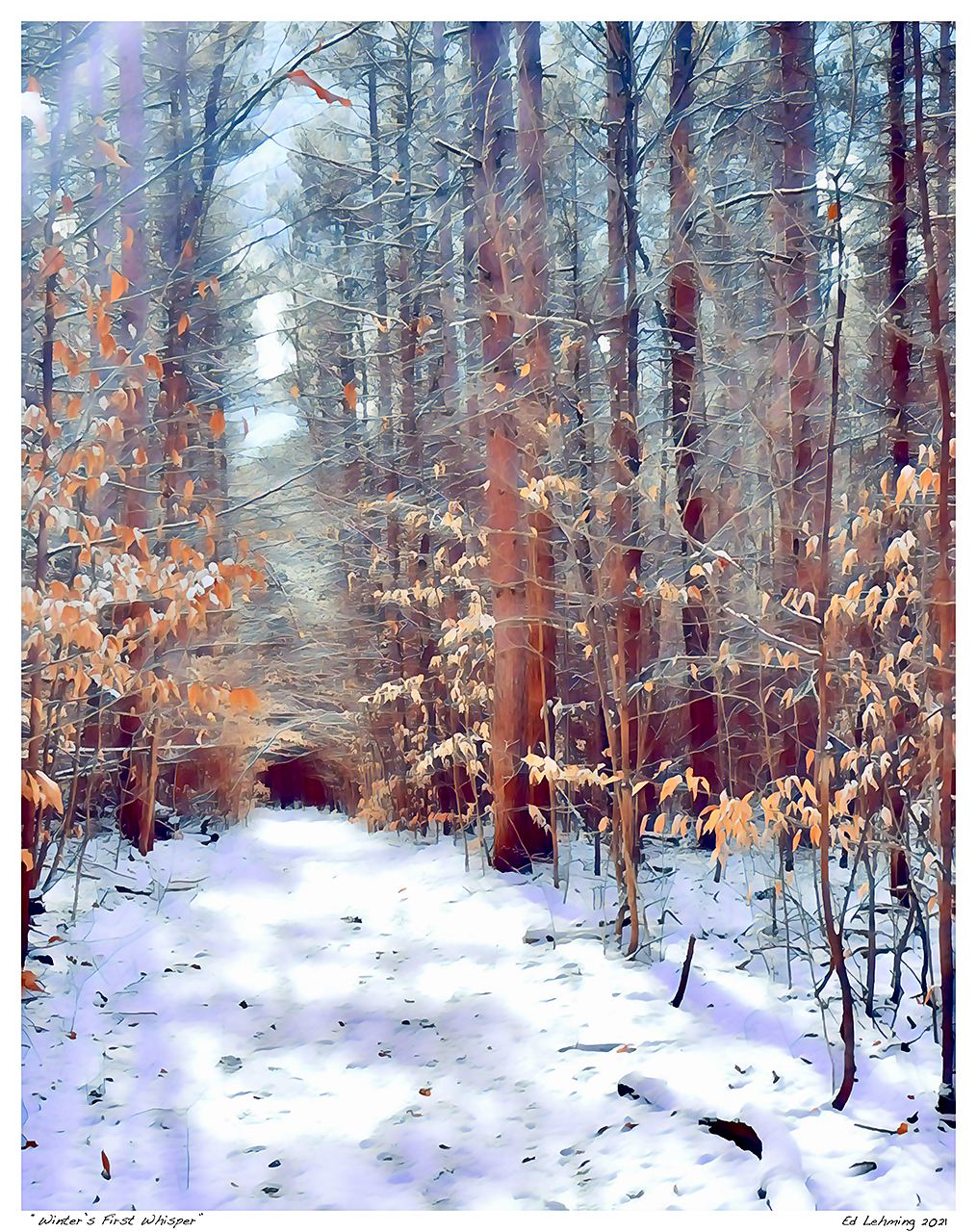
“It’s late November and though it’s still autumn, winter’s first whispers hint at snowy days to come as frost clings to slender branches and the world prepares once more for its winter slumber.” – Ed Lehming
I recently realized that it has been many months since I have posted here. I really can’t recall the event that led to my absence but I have been making photos all along, I simply have not made the time to post them.
Last week I went for quick hike and made several photos which I modified as digital paintings. The original photos were pleasing but did not quite convey the scenes that I witnessed that day. So, I unapologetically tweaked them till the scene as I saw it emerged.
It was the first significant snowfall this season and the frost played beautifully in the late morning light, creating a soft glow that brightened the shadows. I found the scene very soothing, though I will miss the wonderful autumn colours we have been so blessed with lately. I will be sharing those images over the next few days and weeks.
iPhone 12 Pro @ 6.0 mm
1/505 sec, f/2.0, ISO 25

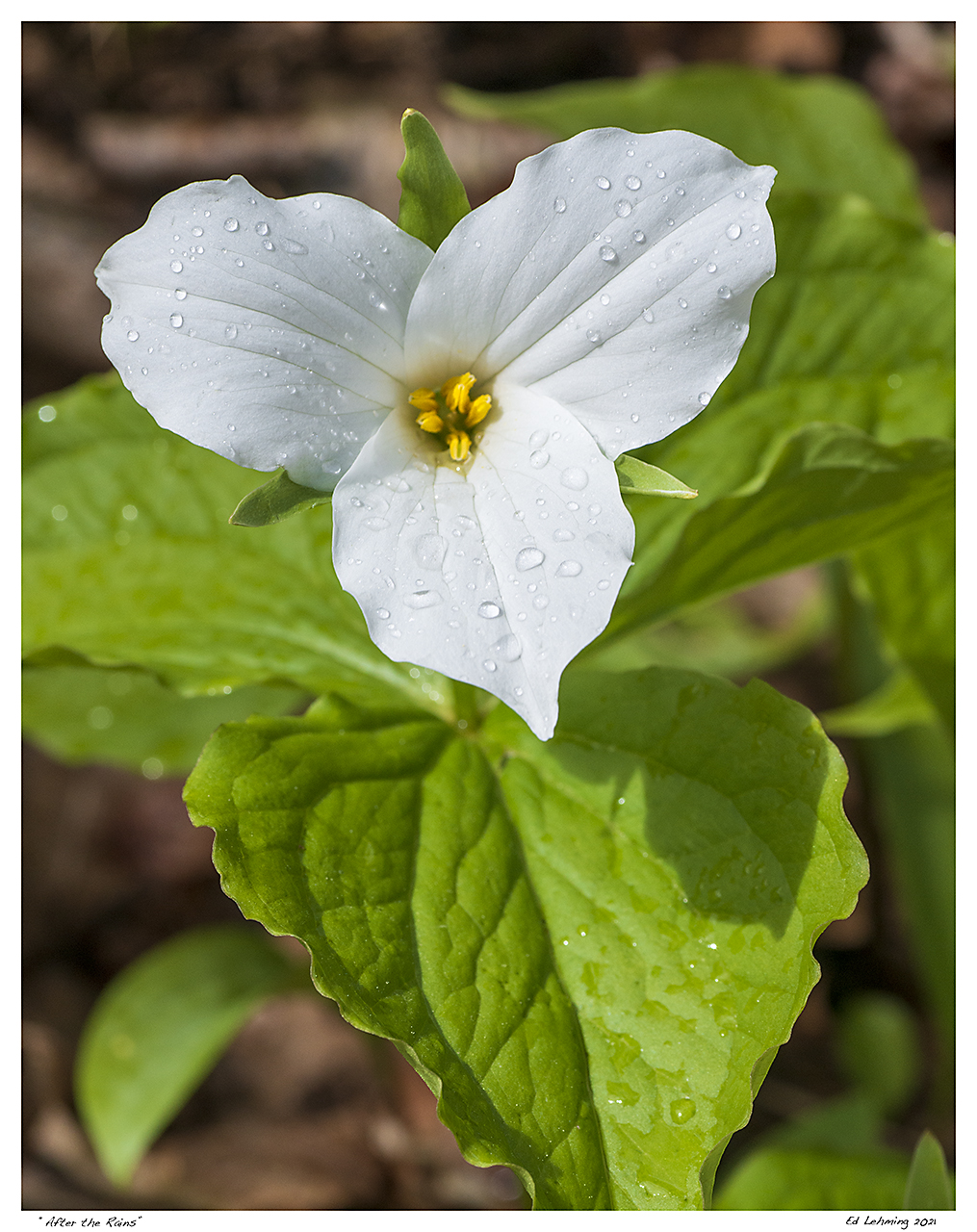
“After the cool spring rains, sunshine dazzles through the still open canopy, bathing the forest wildflowers with its warming light, transforming the recently dull forest into something magical and alive.” – Ed Lehming
Yesterday, after a few days inside, waiting for the cold and rain to let up, I went for a hike at one of my favourite local conservation areas, North Walker Woods. This locale has a special appeal to me, primarily because of two large patches of wildflowers, similar but different. One area is south-facing, opening up to farm fields, and usually a few weeks ahead of its companion patch, nestled within the forest on the opposite, north trail.
The two parts of the trail both offer me large tracts of wonderful white trilliums (trillium grandiflorum), but the south trail has a completely different variety of companion plants, like Early Meadow Rue, Large Flowered Bellwort, and Violets, which are not broadly present in the north tract, which features Trout Lily, Spring Beauties, Hepatica, Wild Ginger, and Wild Leeks.
I enjoy the ability to take in two slightly different environments and it also allows me a larger window of time in which to enjoy and photograph such variety of spring wildflowers, all within the same hike of about 8 kilometers.
As I ventured out, the day was still very cool and rain and sleet kept falling intermittently. But, I had had enough of being inside and wanted to see how far the recently opening white trilliums had advanced. Despite a few soakings, there were some moments, like the one pictured above, of wonderful sunshine that fell on the rain soaked flowers, giving them a beautify dewey appearance.
The forecast today is for much nicer weather but I expect that will also bring on a few more biting insects, like black flies, which take away some of the enjoyment I have experienced the past few weeks.
Nikon D800
Tamron SP AF 90mm f/2.8 Di Macro 1:1 (272ENII)@90mm
1/400 sec, f/14, ISO 800
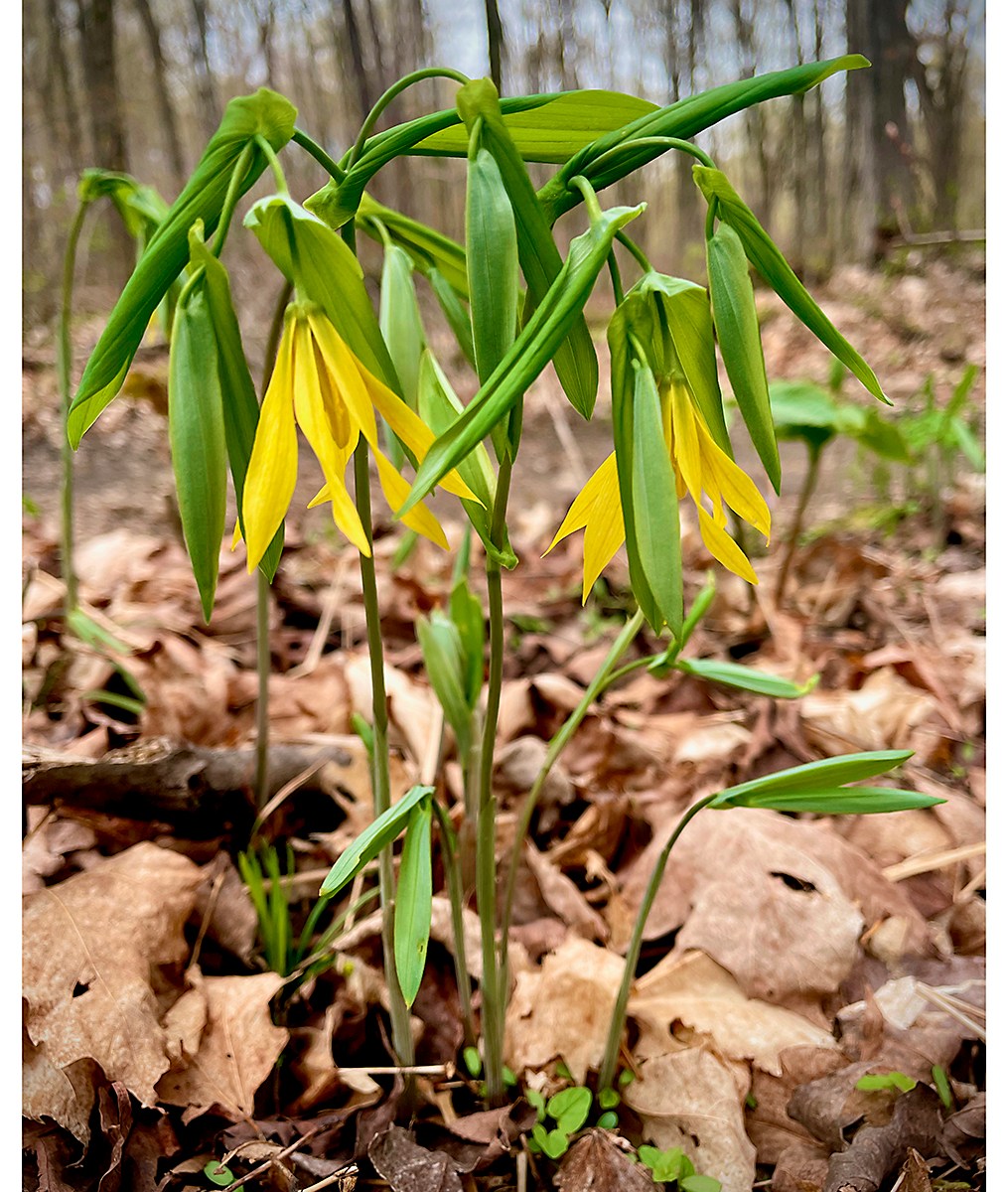

“It’s spring, and beautiful tones of yellow, in all shapes and sizes, return once more to the forest floor.” – Ed Lehming
Once more, spring starts and stalls. The warm days of April have been replaced by a particularly cool and wet May. But, there is no going back, a spring warm up is inevitable and the forest wildflowers continue to progress.
The regular schedule this year is a bit messed up and I was quite surprised to see as many Large-Flowers Bellworts blooming. They usually come on just as the white trilliums are finishing of, but this year, because the cool temperatures have stalled things, the Bellworts are blooming just as the trilliums are starting, so I have a particularly wide selection of blossoms to choose from and the nasty, biting black flies are just starting up, but not biting yet, so I will, hopefully, have a few more days of enjoying the wildflowers without bug spray.
Nikon D800
Tamron SP AF 90mm f/2.8 Di Macro 1:1 (272ENII)@90mm
1/125 sec, f/20, ISO 800


“The cycle of spring continues and familiar wildflowers grace the forest floor, each in their own time, marking significant dates with their presence.” – Ed Lehming
Happy Mothers Day to all the Moms out there, and also to those who have filled that role.
It’s interesting, looking back at years worth of photos from this date. Last year, which was cool and wet, did not offer me any white trilliums, it was a snow and sleet filled day. I clearly remember going out just to find a trillium to help celebrate the day, but only found a handful of red ones.
This year has been so much different, red trilliums have been blooming brilliantly for the past three weeks and the cool temperature have kept them in good condition, with early bloomers just starting to fade. The white trilliums (trillium grandiflora) just started blooming mid-week and will continue to expand their bloom for a few more days. Temperatures are forecast to be much warmer by the end of the week which will accelerate the bloom but also make it more short lived. It also means the return of biting insects as the forest canopy thickens and provides them shelter from the sun.
The trillium photo above is of the first nicely formed blossom of the year, conveniently framed against a granite boulder. I thought it made for a nice composition without too much effort, since the rock was already there.
Nikon D800
Tamron SP AF 90mm f/2.8 Di Macro 1:1 (272ENII)@90mm
1/125 sec, f/20, ISO 800


“The recently closed buds now look like fireworks as warmer days trigger the trees to leaf out and spring comes on in full force.” – Ed Lehming
I’ve always been fascinated with just how quickly the forest transforms from its winter phase to full leaf. The tight buds expand quickly and within days fully formed green leaves abound. As I look closely at the new growth, I can almost see the new growth expanding and changing colour from pale yellows, oranges, and bright reds. I also notice that the colour of the fresh leaves is similar to the fall colours, since the green colour is due to chlorophyll, which is also lacking as the buds open.
In this image, a maple bursts forth in rusty orange tones.
From a distance, the new leaves are interesting, but close up they remind me of fireworks or bright colours and complex shapes, reaching upward to the sunlight. I’ve taken the time to capture many of these as I roan the forests in search of wildflowers. They also serve as a reminder that there is a lot of competition for available light and each tree reaches out as quickly as possible once conditions are favourable. It’s a balancing act though. If they open too soon, they are at risk of damage from late frosts and if they open too late, they may be blocked from getting all the light they need by other trees.
Nikon D800
Tamron SP AF 90mm f/2.8 Di Macro 1:1 (272ENII)@90mm
1/160 sec, f/18, ISO 800
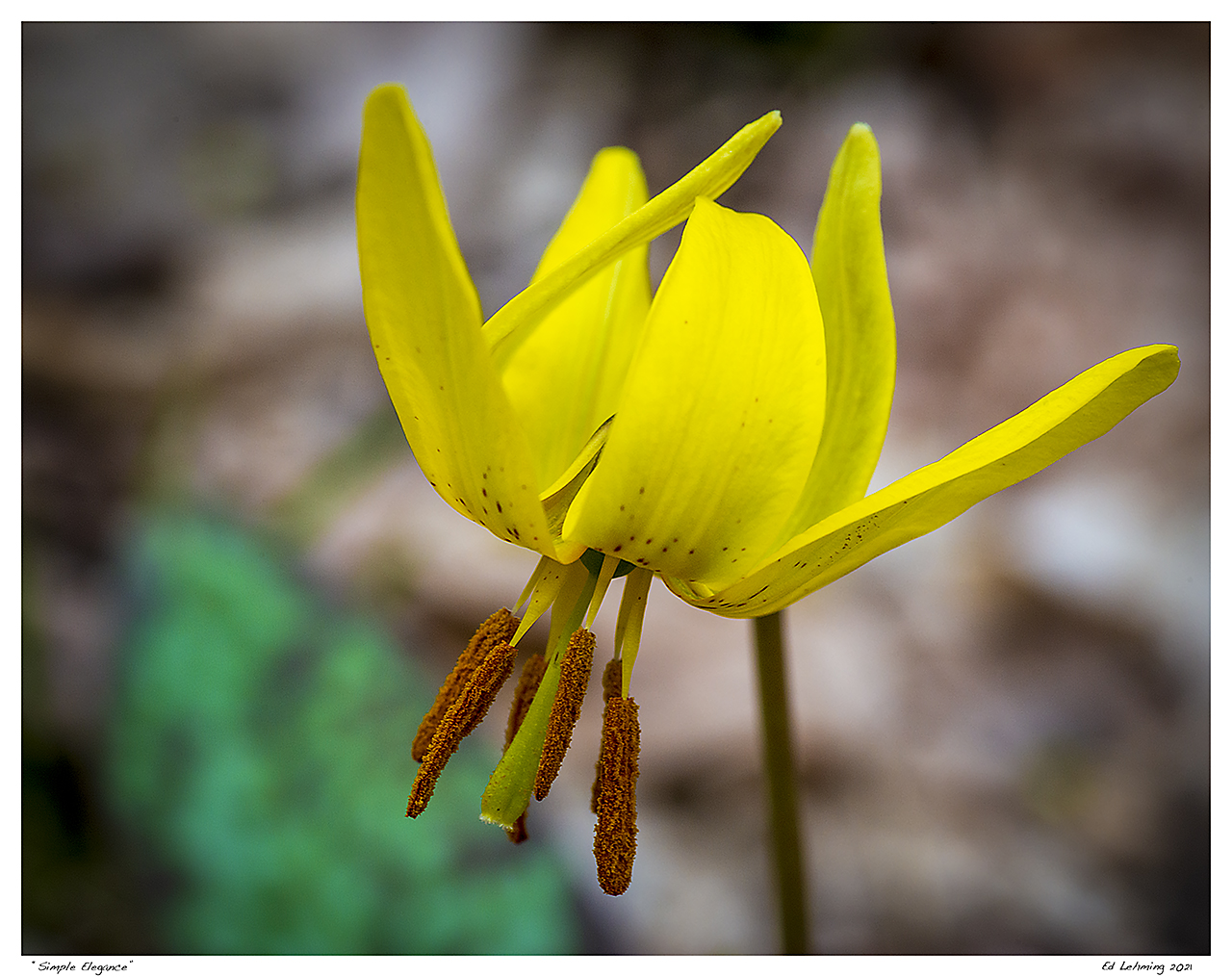
“Simple, yet complex, the flower of the Trout Lily continues to bring me joy as they appear in greater numbers daily. I can hardly decide which I like best.” – Ed Lehming
On my nearly daily excursions into the local forests, every day gets a bit brighter and, supposedly, a bit warmer, and more and more wildflower blossoms appear along the trailside. The leafy patches of Trout Lily now offer more and more blossoms and I find myself greedily taking them all in.
The Trout Lily (Erythronium americanum), as I have said before, is a simple delight for me. I still don’t know exactly why, but these miniature drops of sunlight have fascinated me since I first saw them many years ago. I always look forward to their bloom, which often starts out quite tentatively, with only one or two flowers opening near the end of April, if the conditions are right. Then they bloom in profusion with so many slight variations to the shape of the flower. Some open right up, looking like a sunburst, while others are a bit more demure and only partially open. There is even a variation in the colour of the anthers, with some being bright yellow like the petals, while others are deep orange, almost brown. This mix happens between and within colonies and provides the variety I mentioned.
Yesterday, I found myself enjoying them once more, looking for some new composition that would show them off the best. I decided on this low angle side shot which shows the slight curl of the petals and the pollen-laden anthers very clearly. There will be more shots, I’m sure, since I doubt I will ever tire or these wonderful, though short-lives flowers. Once the forest canopy closes in, their blooming will be at an end for another season.
Nikon D800
Tamron SP AF 90mm f/2.8 Di Macro 1:1 (272ENII)@90mm
1/125 sec, f/20, ISO 800


“It’s spring, the forest bugs have begun their cycle: eat, poop, breed.” – Ed Lehming
As I’ve noted quite a few times, their are so many details that we miss on casual observation, especially if what we are observing is unexpected to start with.
I was out making photos of local wildflowers a few weeks back and happened to notice an unusual shimmer of metallic blue next to the Bloodroots I was focused on. As I looked closer, I found that what I at first thought was a small piece of discarded metal wrapper, after all, what else would be blue and metallic, turned out to be a fairly large blue beetle.
The beetle did not seem to mind me as I got closer for a shot, as it was busily feeding on the stem of a plant. Even as I moved some debris out of the way, the beetle was so fixated on it’s meal, it didn’t move at all. I wondered if it was dead. On closer observation, I could see slight movement of its antennae and head. I took advantage of that lack of movement and made a few close-up images, first because it was a really cool looking bug and secondly, so I could identify it later, since I have never seen this kind of beetle around here. It turned out to be an American Oil Beetle, part of the Blister Beetle family. There is a significance in the name blister beetle and oil beetle. It turns out that their primary defense is producing a caustic oil that will cause skin blisters. I just learned something valuable, not that I am about to go around picking these things up.
As I looked closer at the image, during my editing process, I noticed that not only was the beetle busy eating, it had also produced quite a pile of green poop. It also looks like it’s been there for a while since there are two other piles of refuse that have since dried up and turned brown. The things you see when you really spend time looking at something.
So, my day of wildflower photography also turned into a lesson on beetles. It seems there is always something new to learn.
Nikon D800
Tamron SP AF 90mm f/2.8 Di Macro 1:1 (272ENII)@90mm
1/160 sec, f/20, ISO 800

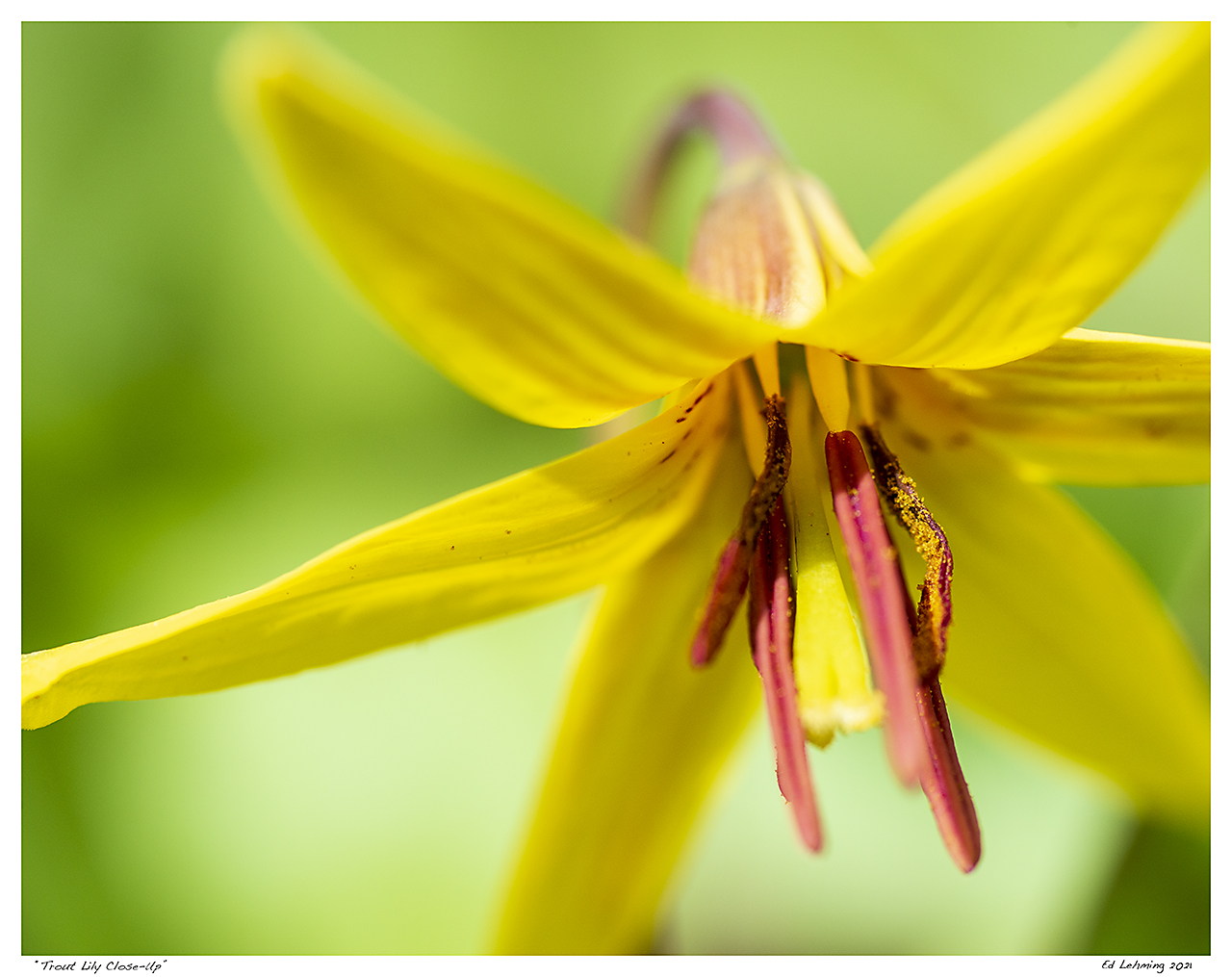
“Delicate yellow flowers fill the forest floor, nodding timidly in the soft spring sunshine.” – Ed Lehming
There is something wonderful about Trout Lilies, also known as Dogtooth Violet, though I prefer Trout Lily, since I don’t see any resemblance to violets in their form. They are one of several spring flowers that I look forward to every year as they seem to appear overnight. They are also not fond of cold, so the blossoms remain tightly closed till warm days or sunlight coaxes them open.
I’m also very fond of the structure of the blossoms which seem so delicate. They appear almost shy, as the flowers tilt downward on their slender stems. This also makes them a bit of a challenge to photograph. To get a good image means I have to get down low to the ground and shoot up or use a stick or rock to push the stem back to reveal the flower face, something I am hesitant to do because I want to photograph things as naturally as possible.
I have an image in my mind from and old children’s book where one of the characters, a fairey, is wearing this flower as a hat and that image remains with me as I photograph them. As I’m on the ground making photos I half expect to see a pair of small eyes looking back at me.
Yesterday was still a bit breezy, so I left my ISO high and set my aperture to f/11, wanting to add a bit of softness to the image. The sacrifice was that I had to shoot with a higher shutter speed to offset any change of movement due to the wind.
With the past two weeks of cool weather, the blooms have been delayed and it was not till yesterday that the flowers started opening up in significant numbers. Today promises to be warmer yet, with bright sunshine, so I will be returning to this patch to see what it has to offer me.
Nikon D800
Tamron SP AF 90mm f/2.8 Di Macro 1:1 (272ENII)@90mm
1/1000 sec, f/11, ISO 800
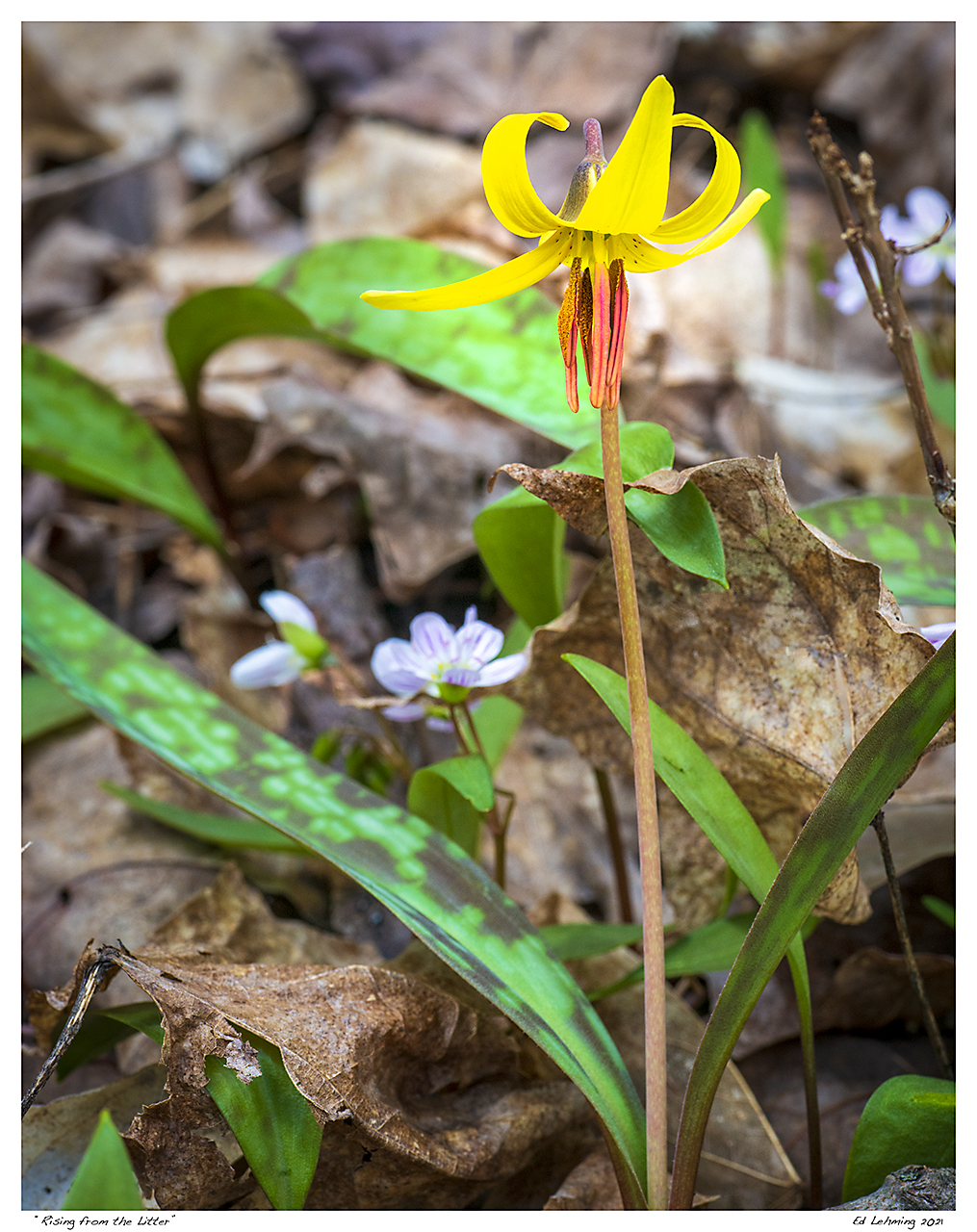
“Day by day, the compacted leaf litter of the winter is pushed up by spring flowers, each in their time, brightening the once dull brown forest with new life and colour.” – Ed Lehming
I do believe that spring is my favourite time of year. I enjoy the daily transformation of the seemingly lifeless forest to a wonderland of colour and vitality. This year started off earlier than expected and then slowed down as the days cooled a bit, extending my opportunity to enjoy the spring blooms.
I’ve spent enough time in the forests be able to predict, fairly well, the next bloom cycle. It’s a progression of different species rising from beneath the carpet of fallen leaves, one generally precedes another in a regulars sequence, and for a brief while, they are all blooming at the same time. In this case, the photo taken a week ago, shows a bright yellow Trout Lily sharing the frame with Carolina Spring-Beauties. The Spring-Beauties have been blooming for about two weeks now and Trout Lilies had just starting to bloom.
The blooming of the spring ephemerals can also be quite condensed as they need to complete their pollination cycle before the trees leaf out and block the available sunlight that they need to flourish. This year, that window has been extended by a few weeks of cooler weather, so I’ve been able to cover more areas and find new locations where these little wonders flourish.
As I look out my window today, the skies are still gray and the air is cool, so another venture out will be in order. The gray days are actually better for my photography as I don’t need to contend with harsh light or shadows. As soon as it warms a bit, the trees will leaf out fully and blackflies and mosquitoes will be back in the places I have enjoyed, bug free, for the past few weeks.
Nikon D800
Tamron SP AF 90mm f/2.8 Di Macro 1:1 (272ENII)@90mm
1/160 sec, f/20, ISO 800


“Draped in leafy cloaks, the Mayapples looked like tiny phantoms, gathering on the forest floor.” – Ed Lehming
I could not not resist this image of an emerging Mayapple that I found last week. As I scanned the forest floor, I noticed a dark patch of foliage in the distance. Upon investigation I found it to be a large colony of Mayapples (Podophyllum peltatum), hundreds of them occupying an hollow.
Mayapples around here tend to be fairly interspersed, but do grow in colonies, seemingly quite fussy about where they grow, so to find a large patch like this was unique. As I looked around at the recently emerged plants I could not help but see them as a meeting of cloaked phantoms, a bit sinister looking, as if the leaves covered some hunch-shouldered creature, especially the ones with fruit on them.
We are still having cool evenings in this area, so it’s not surprising that the Mayapples, as with so many other spring flowers, have mechanisms to protect the tender plants from the cold. The tight ‘cloaks’ protects the flower buds from freezing and will eventually open up a broad umbrella-shaped leaves.
I’m hoping to get back this week to photograph them in bloom.
Nikon D800
Tamron SP AF 90mm f/2.8 Di Macro 1:1 (272ENII)@90mm
1/160 sec, f/14, ISO 800

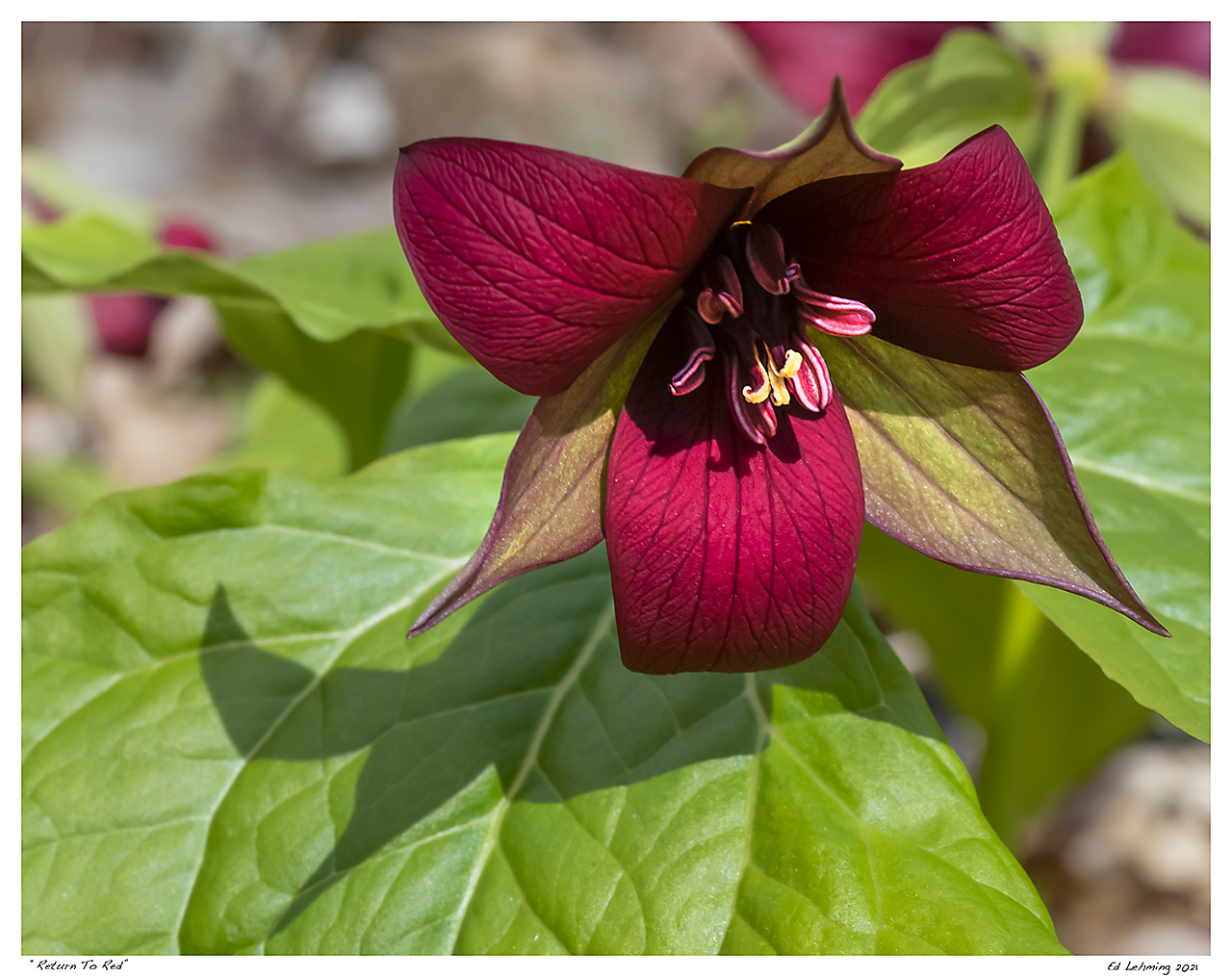
“In springtime, the changes happen so quickly, you really need to enjoy things in the moment, and then the moment is gone, till next time.” – Ed Lehming
So far, this spring has offered many surprises, some longer lasting than others, and some, I’m still waiting on. In my many years of hiking the local forest trails, I don’t believe I have seen such a profusion of Red Trilliums, and with the cool temperatures, they seem to have lasted longer and offered me more opportunities to spend time enjoying them and photographing them. This year I even came across a few interesting variations.
I’ve found myself returning to the same spots, checking on the progress of the trilliums I photographed days and even weeks prior. On those visits I’ve had the rare opportunity to re-photograph some of them, in different light or from different angles. Often, I find myself in the midst of the editing process and wishing I had done something slightly different. This year I was able to do just that; return for a second chance at the same shot. Thus the title for this image, “Return to Red“.
I went back with the intention of shooting from a slightly different angle, getting lower to the ground and shooting up. The reality is that when you return to do this kind of thing, conditions have changed: it’s a different time of day, the light is more direct, and the plant itself has continued to grow. Nature is not a static thing and you have to adapt to compensate for this. Fortunately, with years of experience, including many, many failures, you learn what works and what does not. In this case, the light that had been diffused by clouds on my first visit was bright and clear, which makes it more difficult to show red effectively. So, I simply adjusted my angle to take advantage of light reflected from the forest letter as a natural fill. The revisit, that was not as expected, turned out quite nicely after all.
Nikon D800
Tamron SP AF 90mm f/2.8 Di Macro 1:1 (272ENII)@90mm
1/160 sec, f/20, ISO 800

“Nothing matches spring’s first colours; bright greens, yellows, and reds fill the forest with freshness and joy.” – Ed Lehming
I do tend to spend a lot of time looking forward and down, hoping to discover some new wildflower. On this day, I looked up and was greeted by a virtual ‘fruit-salad’ of spring colour. In the foreground, oaks in red flower and in the distance maples.
This spring flush is also evident as I drive to my favourite hiking trails. The forests have taken on a bright yellow-green tone due to the profusion of pollen laden flowers. There are splashes of red and orang, but green dominates. It truly is a great time of year, though this flush lasts only a few days and then leaves dominate and the forest once more becomes a sea of deep greens.
Nikon D800, Nikkor 70-300mm f/4.5-5.6 G I AF-S VR Zoom @ 300mm
1/320sec, f/9, ISO 800


“Spring breezes roll across land and water, touching and refreshing everything in their path.” – Ed Lehming
There is a freshness and vitality to spring breezes; they feel like they carry life itself in their warming caress. The wind creates change, movement, new life itself. I wanted to convey this vitality through an image and felt it appropriate to use an intentional camera movement (ICM) technique that I have grown so fond of to achieve this.
This image was created using a long exposure and sweeping the camera horizontally, following the movement of the waves created by the western winds. The bright turquoise of the water is created by the sun shining through the shallow waters. The deep blue in the distance is where the sandbank drops off steeply, and the tans are from rocky outcroppings near the shore.
I made several of these images while standing on the shores of lake Ontario at Sandbanks Provincial Park, abut a ten minute drive from my Picton home this past weekend. COVIS has significantly limited travel to this region and I shared the scene with only a handful of people.
It was a great experience, watching the wind-swept waves rolling in to shore, creating small white-caps, a continuous play of water on water. Though the air and water were chilly there was a feeling of warmth created by the water. If I did not know the location, I would have guessed this was somewhere tropical. It brings back memories of my trip to Mexico over the past few years.
The effects of the wind also brought to mind that this churning refreshed the lake bottom just like it refreshes the land by churning the compacted forest litter to allow new growth to penetrate.
Nikon D800, Nikkor 70-300mm f/4.5-5.6 G I AF-S VR Zoom @ 70 mm
1/4 sec, f/32, ISO 64

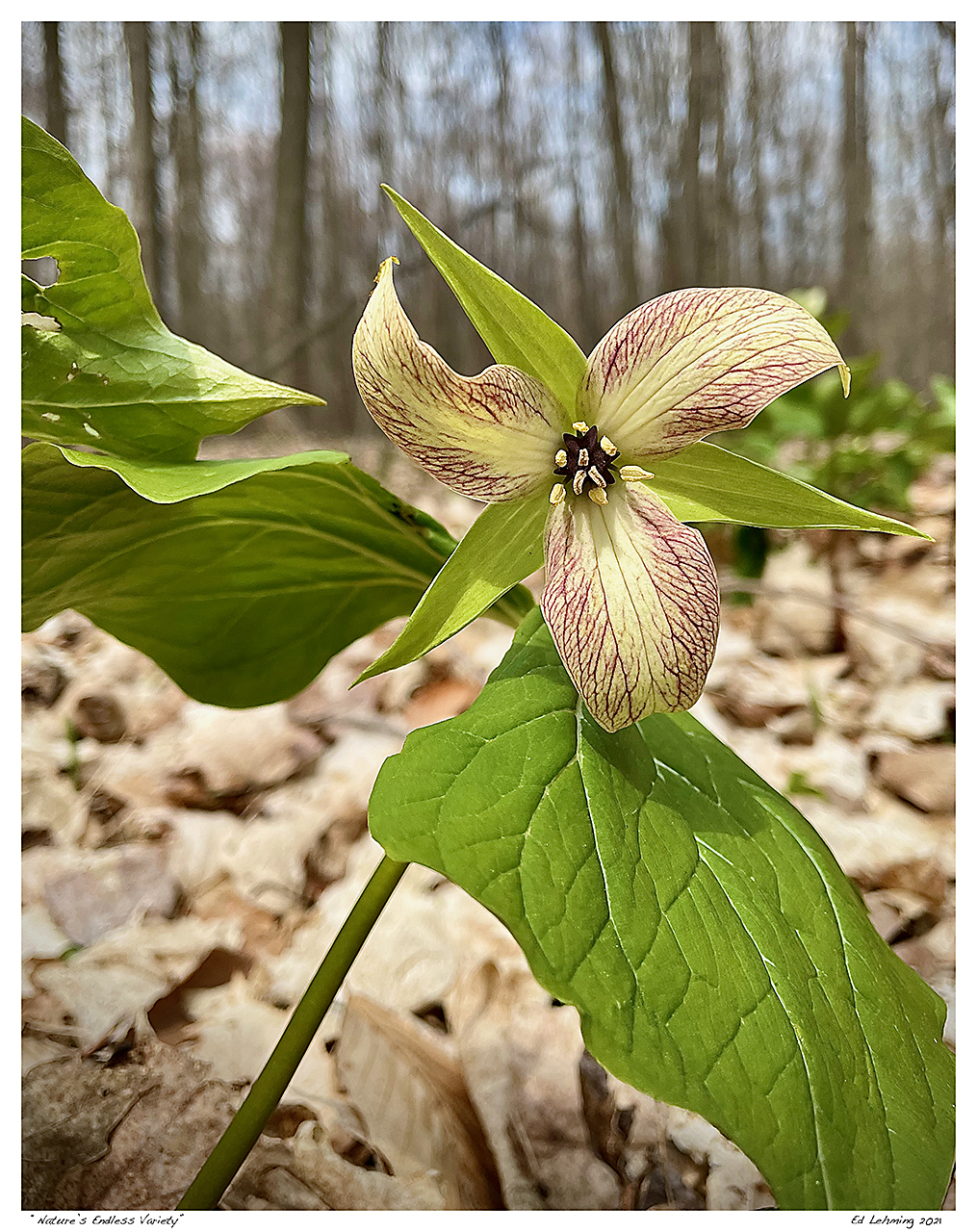
“Nature never ceases to amaze me with her endless variety, slight changes in form and colour are a joy to witness.” – Ed Lehming
One of the things, perhaps the main thing, that I love about my hikes is the seemingly endless variety that I see. A flower, like red trilliums (trillium erectum) has so many different shapes, from broad petals to more slender versions. Deep crimson blossoms to pale pinks. The iterations seem boundless. And then, a completely new option appears.
In this case, a slightly yellow version with dark red veining. It’s still trillium erectum, growing next to a large clump of the typical red variety, but for some reason this blossom has been changed to its present form, which I absolutely love, since it maintains it’s form and hints at the original, but is something altogether unique.
I’ve taken to very low angle shots this year, trying to capture the environment and surrounding forest to better represent the blossoms. In this image, the pale leaf litter can be seen behind the plant as well as the surrounding forest and sky. It shows a more complete picture of the plant as I found it.
Though I had my D800 macro kit with me, the image from the iPhone is actually more effective. To get the same shot with my Nikon I’d be lying flat on the ground and damaging surrounding plants. This is a better option for me in this situation and the iPhone performs incredibly.
Interestingly, during my 16 km hike yesterday I had discovered another specimen similar to this earlier in the day and in a whole different section of forest some 5 kilometers away.
iPhone 12 Pro @ 4.2 mm
1/1916 sec, f/1.6, ISO 32


“Spring will not be stopped. Despite a few snowfalls and cool nights, life continues to emerge” – Ed Lehming
Yet another allusion to the current COVID situation. Like the quote I associated with this photo, life will continue, in time. We are sure to have some unpleasant bumps along he way, things will not go according to humanity’s schedule, but they will continue and as has happened since the dawn of time, balance will return and the world will thrive, perhaps not in the same way, but it will thrive.
Like this wild ginger blossom I happened across by chance. Given the cooler temperatures, I had not planned on even looking for these hard to spot blossoms for a few weeks, but it was poking out from beneath a sheltering cover of leaves. I did notice the leaves first, while having a closer look at some trilliums. As I investigated a bit more I noticed the blossoms. They are hard to spot because of their colour, small size, and habit of being very close to the ground.
Something that I had not paid much attention too in previous years, but which stood out to me this time, primarily because of the snowfall and my many red trillium encounters as that these small blossoms are very similar to the trilliums in colour, I also noticed they were quite pungent, so like the red trilliums, I expect the smell that way to attract flies to pollinate them. The plant stems and flowers are also covered in fine hairs, to trap warm air against the stems, much like the Hepaticas that I have been enjoying these past weeks.
Nikon D800, Nikkor 70-300mm f/4.5-5.6 G I AF-S VR Zoom @ 220 mm
1/1000 sec, f/14.0, ISO 800
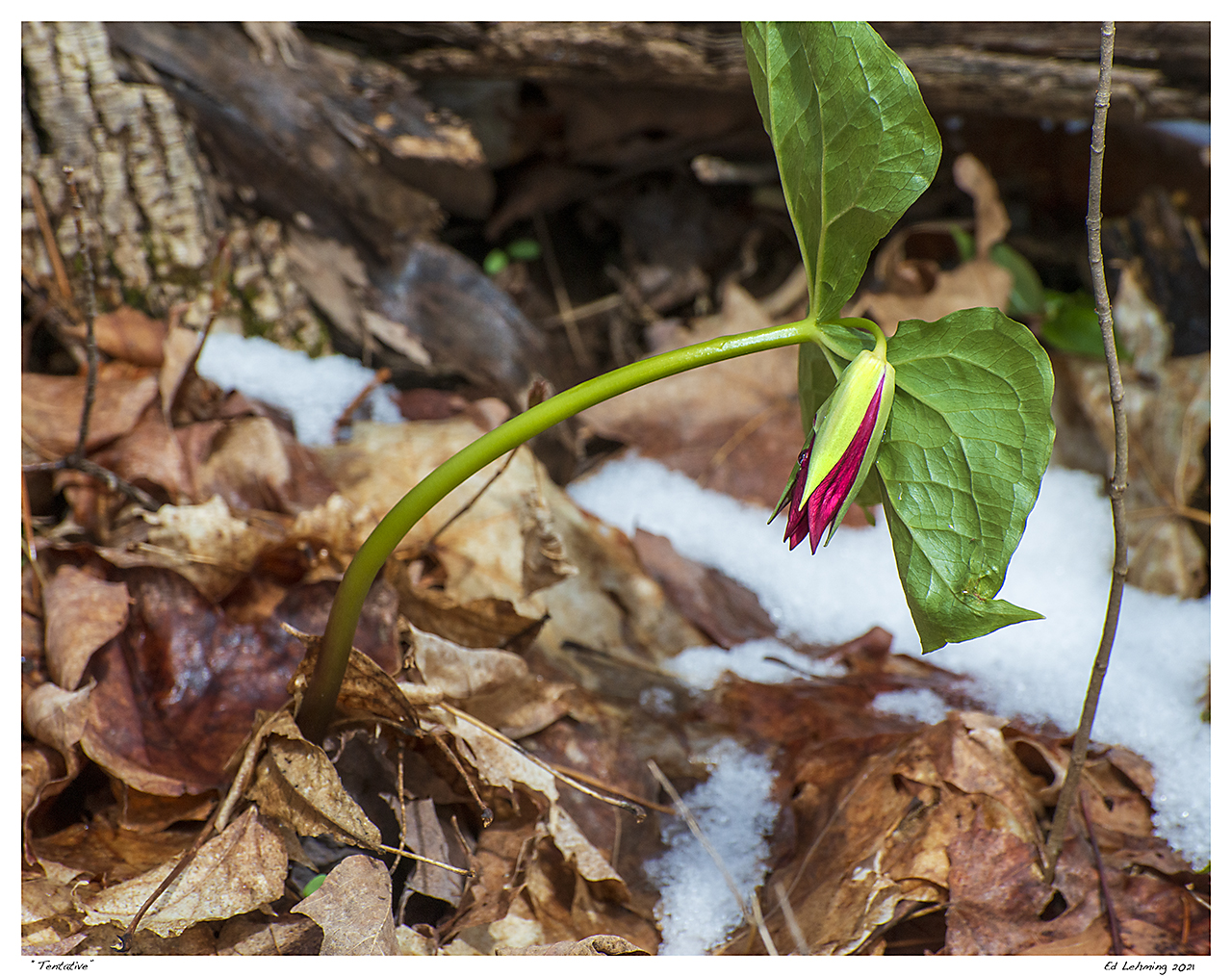
“After a mid-April snowfall, even the plants seem hesitant to re-open.” – Ed Lehming
It’s a bit odd that I keep finding allusions to COVID in my photos. Living in the province of Ontario, Canada, with it’s high case count and obscure lockdown measures to come at COVID, my thoughts often tie back to ‘opening up’. Currently we are under a 6 week ‘stay at home’ order, meaning we are to stay home except for ‘essential’ reasons, such as groceries, exercise, and work that can’t be done remotely.
It’s been a very frustrating year and change, with government strategies, supposedly informed by science, poorly executed and seemingly random. I’m happy that I have been able to spend time outdoors, hiking and making photos, but the effects of not being able to socialize, especially with family and close friends is wearing me down.
It’s a bit like our weather lately. We had several beautiful, mild days in March, ice and snow melted, and wildflowers began to emerge. There was so much symbolic hope and promise in those days, and it has remained relatively mild since then. That is, until last week, when it got colder and we had two days of intermittent snowfall, which felt like the lock-down measures imposed after weeks of improving news.
I’m feeling much like this trillium, seemingly surveying it’s environment, deciding whether to take it’s chances in opening up, becoming vulnerable to the environment. I remain hopeful that this COVID situation improved as more people are vaccinated, but supply is erratic and unpredictable, with hope being offered and then delayed once more. I remain hopeful and take joy in the natural world around me to sustain me, but remain uncertain in a summer of relative normalcy.
Nikon D800, Nikkor 70-300mm f/4.5-5.6 G I AF-S VR Zoom @ 220 mm
1/1000 sec, f/14.0, ISO 800


“If you don’t like the weather, wait ten minutes” – unknown
The quote above has applied so many times and seems to be universal in regions with complex weather patterns. My area, in south-central Ontario, is no exception. Despite the best planning and preparation, April can throw some surprises at you.
For those who follow my posts regularly, you will have seen a progression of warming days and an abundance of fresh wildflowers. Back in late March I posted about hiking on ice while wearing a tee shirt, photographing owls in bright spring valleys. The days have been particularly mild here and the feeling that winter had departed early pervaded everyone’s thoughts. But, it is still April and we tend to experience one last shot of winter as a matter of course. It tends to be short lived but usually means snowfall of some sort before we move on.
I thought that snowfall had happened on Wednesday, when five centimeters, about 2 inches, of wet snow blanketed the region and buried all the wildflowers I have been documenting recently. I checked the forecast in the morning, which is my regular habit as an outdoor photographer. It was forecast to be cool, with a mix of sun and cloud, typical for this time of year. Outside, some remnants of the week’s snowfall remained in sheltered areas plus a light dusting that had fallen unexpectedly the night before. This was all beginning to melt as temperatures climbed above freezing and the sun shone through. I honestly was not expecting much in the way of wildflowers, so had my camera fixed with my 70-300 mm lens, hoping to see some wildlife, my 90 mm macro lens was in my bag, just in case (I have learned to prepare for eventualities to arise).
As I got on the trails puffy clouds floated above and the morning sun melted remaining snow in much of the forest. It made for some interesting photos of spring wildflowers surrounded by snowy patches, some still carrying a burden of snow form the previous day. The light was beautiful and I was able to find and identify some new species of flora as the day continued to drift between sun and cloud, the occasional flurry still floating in the air or falling from the canopy of budding trees.
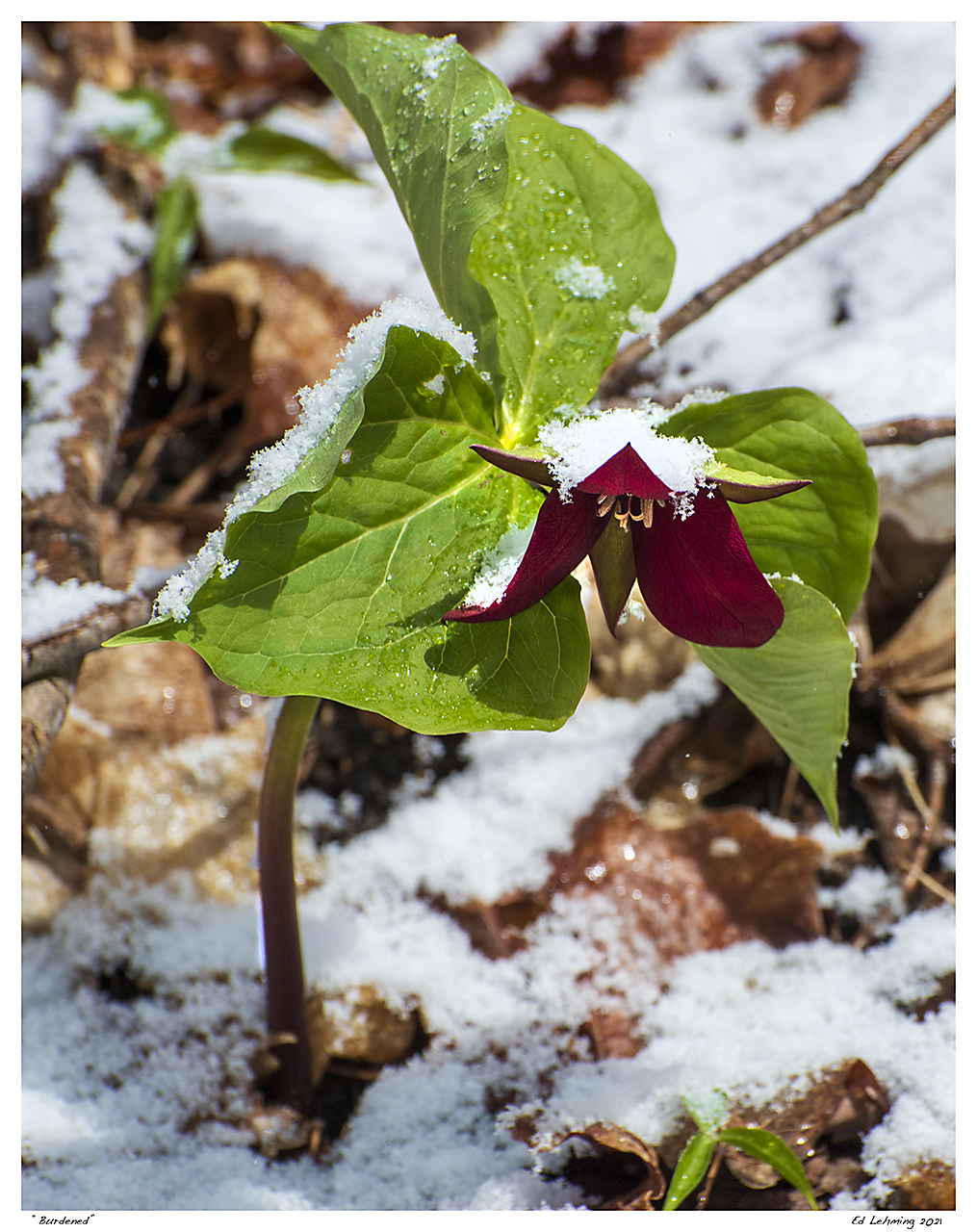
Quite satisfied with the conditions, I decided to extend my hike and check out the plant life on trails a bit further on. Without warning, a snow squall descended on me and turned the spring forest into snowglobe-like environment, pictured above. I checked my weather radar app on my phone and noticed a squall had developed far to the north-west of me, over Lake Huron, and the winds had extended it all the way to my location. The squall lasted for a good fifteen minutes, enough to bury any future photography subjects, so I carried on, resolved to my opportunity being pretty much done. But again, in typical fashion, within another fifteen minutes, clouds had cleared and the sun shone as it had earlier on and melted off the recent snowfall. All was back as it was when I started off.
I’m hoping this is the last snowfall I see this year, though I still expect some frosty nights.
Nikon D800, Nikkor 70-300mm f/4.5-5.6 G I AF-S VR Zoom @ 80 mm
1/125 sec, f/14, ISO 800
Nikon D800, Nikkor 70-300mm f/4.5-5.6 G I AF-S VR Zoom @ 220 mm
1/1000 sec, f/14.0, ISO 800


“As the world warms, Spring slowly pulls away from Winter’s embrace and reaches out for the promise of Summer’s warming touch.” – Ed Lehming
The title for this image, as well as the quote, came to me as soon as I looked at it in my viewfinder. It’s one of those spontaneous images that are created when I am simply looking around me while in the forest. The single spruce bough, with fresh buds forming drew me in and spoke of good things and renewed life that awaits in the coming weeks. While the forest floor is filled with a profusion of emerging wildflowers the trees are also preparing for warmer days, the days where they will grow and put out new growth.
Other trees around this one, particularly hardwoods, are blooming and budding and will explode with life as soon as the temperatures warm up again. Yesterday’s snowfall put a pause on this, but I know it will start back in earnest in the next day or so.
It was not till I looked at the image on my larger screen that I noticed the small spider webs at the tip of the bough. Insects are also preparing for the change of seasons, here taking shelter from cool nights and predators in the dense needles.
There is also promise in the bright and fresh green, a significant change from the dull and dark greens of winter.
Nikon D800
Tamron SP AF 90mm f/2.8 Di Macro 1:1 (272ENII)@90mm
1/200 sec, f/7.1, ISO 800
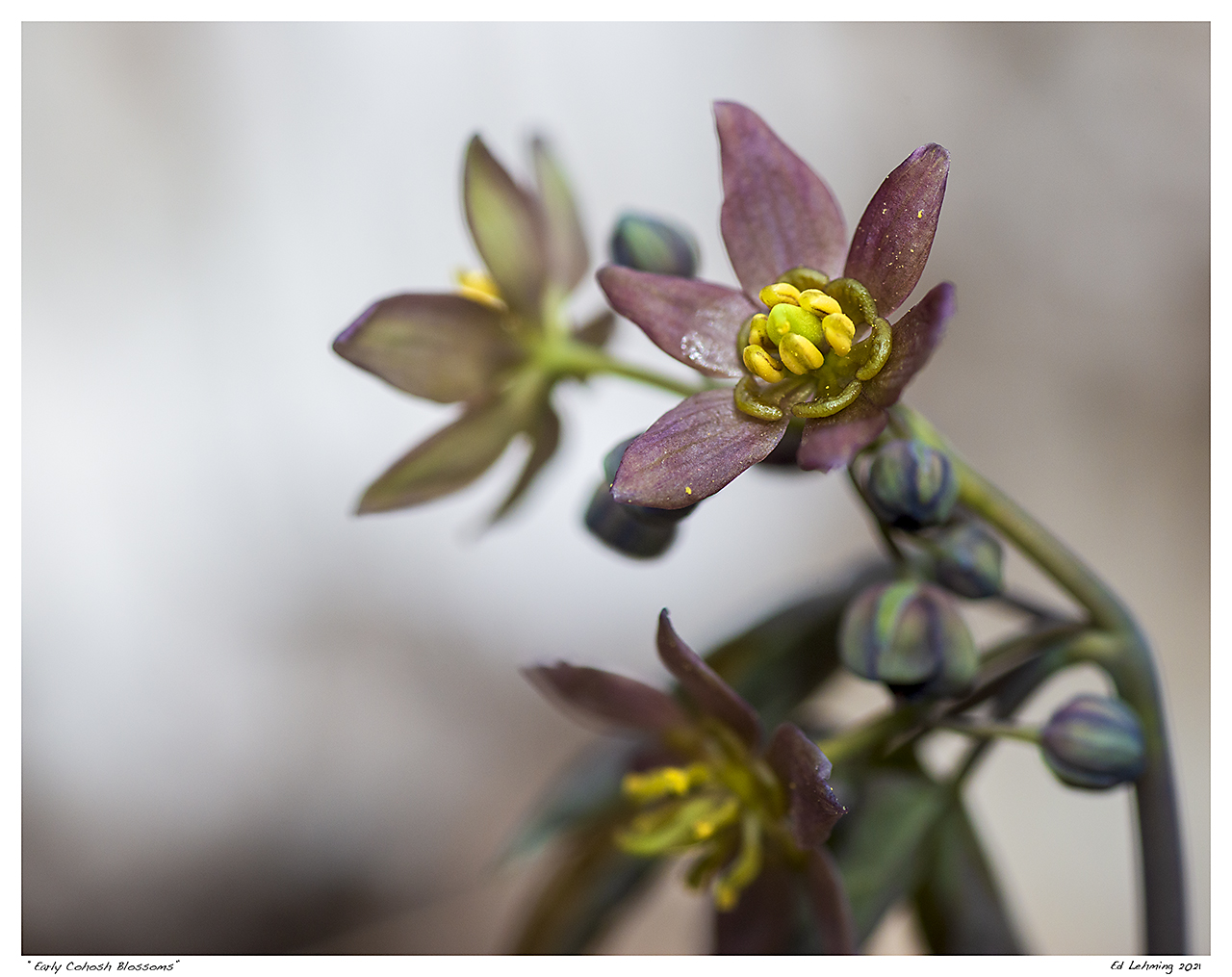
“The urgency to reproduce is everywhere. Early plants forgo their leaves so they can be the first to be pollinated, flowering at all costs.” – Ed Lehming
I have noticed this over the past many years and it dawned on me out of the blue. Every form of life, no matter how miniscule, is driven by the need to reproduce. There are so many spring flowers that do this. The first to bloom in my area is Coltsfoot. It puts up it’s bright pollen rich blossoms weeks before other spring flowers. In fact, I use it as my signal that other flowers will be blooming soon.
The more I observe these local wildflowers, the more it makes sense. There are rugged-looking flowers, like the Coltsfoot that immediately seem suited to this early spring blooming, with their short, thick stems. And, are others, like Sharp Lobed Hepatica that are seemingly more delicate, yet they are protected by fine hairs that shield tender stems from cold spring temperatures. Others, like Carolina Spring Beauties, close their small flowers completely on dull or cool days to protect their reproductive organs. Then there is Blue Cohosh, which, if you are not familiar with it, is has a deep purple/blue colour that makes it difficult to spot easily. The flowers are also very small and not obvious, also because of the plant’s unique colouring.
Once I discovered these beautiful early bloomers they became part of my regular photographic subjects. The flowers themselves are almost alien looking with their thick and gelatinous looking ovaries. I’m usually photographing them once the plant is about 20 centimeters tall and leafed out, mostly because it is difficult to find thill them, again because of its colour.
This year however, I noticed several plants growing near trilliums that I was photographing. These plants were just emerged and only a few centimeters tall, yet the flowers where fully formed and attracting many small spring flies. The specimen that I concentrated on for this image had a few freshly formed leaves bt already had three blossoms and more at the ready. Already competing with other ephemerals for pollinators.
Nikon D800
Tamron SP AF 90mm f/2.8 Di Macro 1:1 (272ENII)@90mm
1/500 sec, f/14, ISO 800
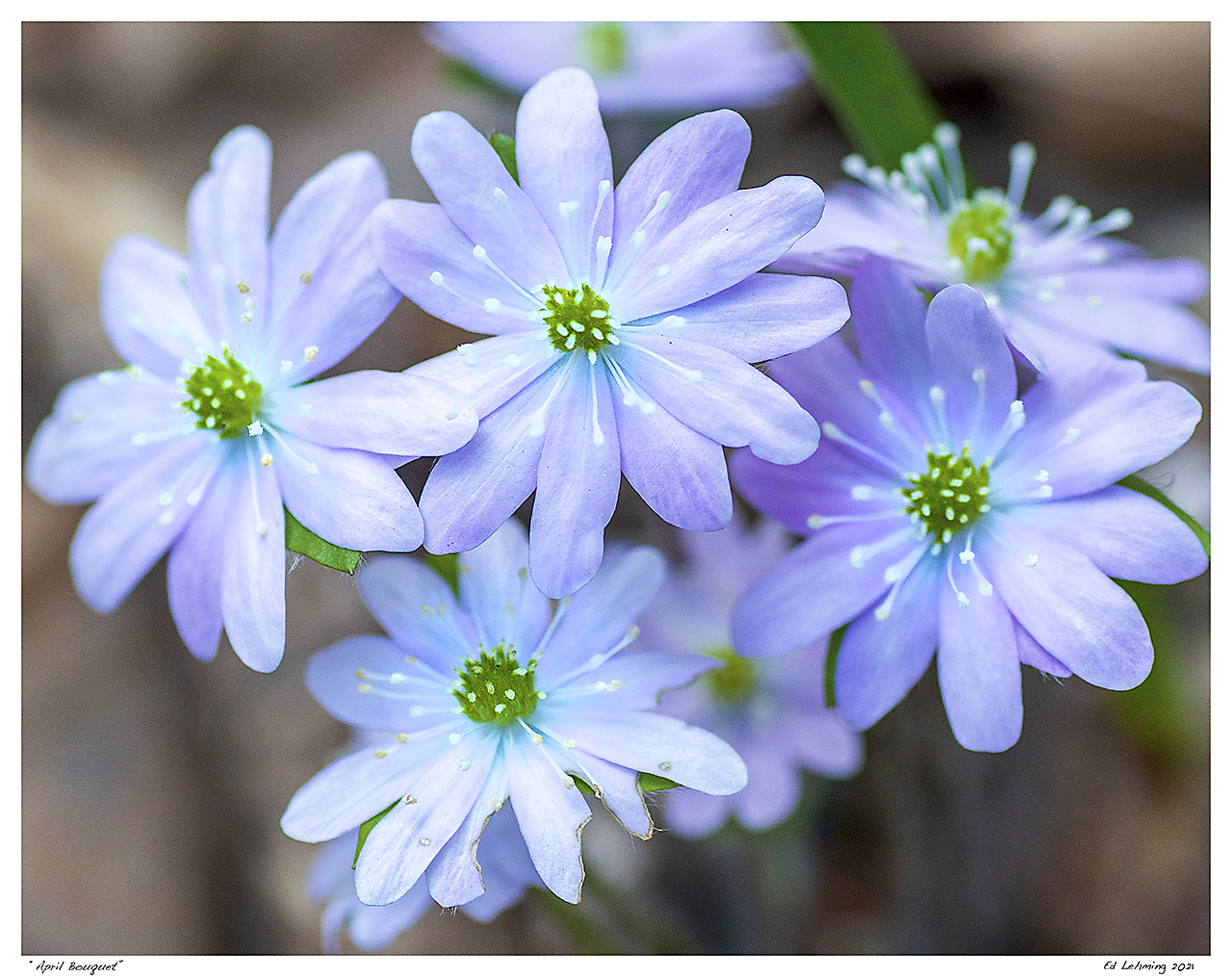
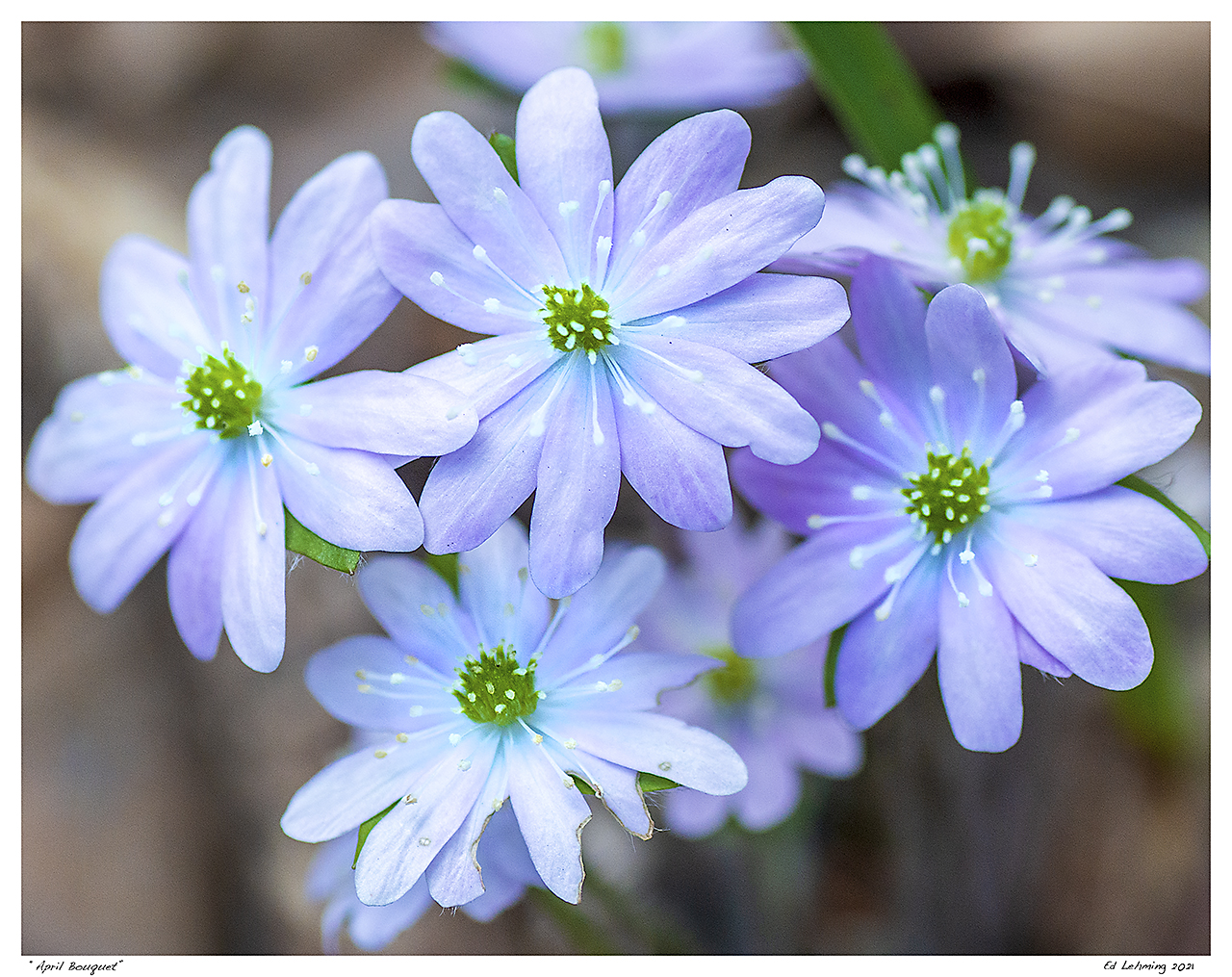
“The forest comes alive with wildflowers, each in their turn, offering an endless bouquet of beauty.” – Ed Lehming
As I write this, 5 centimeters (2 inches) of snow have fallen, burying what yesterday was a gorgeous display of wildflowers, but that is April in my part of the world. Where mere weeks ago I was hiking on ice wearing just a tee shirt, yesterday’s blossoms lay beneath a blanket of white. I’m not overly concerned as temperatures are forecast to increase through the day and the snow will be short lived. I’m sure it will have done some damage but it never got cold enough to freeze most of the plants, they are, afterall designed for this climate and there will still be plenty of cool nights ahead.
The snowfall makes me appreciate even more what has been offered thus far, including this lovely grouping of Hepatica blossoms. I was initially attracted to them by the nice mauve colouration and as I composed the shot I also noticed the slight teal glow near the centre of the blossoms. And, as I find more and more now that the insects are at work, something has already begun to snack on the edges of the petals, though for me, it makes it a bit more natural than a pristine blossom.
So, as the snow outside my window begins to melt away, I have this image to remind me of the promised beauty yet to come.
Nikon D800
Tamron SP AF 90mm f/2.8 Di Macro 1:1 (272ENII)@90mm
1/1600 sec, f/5.6, ISO 800


“Seeing nature really close up reveals so much more. Fine details and endless variation brings curiosity and encourages learning.” – Ed Lehming
It seems the more time I spend observing and photographing the forests around me, the more I am drawn into the fascinating variety and complex systems that they present. Yesterday was another nice day, with sunshine and comfortable temperatures which meant that some of the blossoms which had been stalled now started opening up again. I found new clusters of Bloodroot blooming, when I thought their brief season had already passed.
Bloodroot has a special place for me, it is the first ‘surprise’ wildflower that I discovered in an area that I thought I was already familiar with. A few years back, a friend and I went for a hike in mid-April. He wanted to show me the annual Rainbow Trout migration at a local stream. I warned him that I may slow him down, since I wanted to get some photos of the wildflowers. It’s at this time that I saw my first Bloodroot. I noticed it as a bright white splash among the rusty leaves. At the time, it seemed like the most perfect flower I had ever seen. The petals where the whitest white I had ever seen, centred with a bright yellow anthers. I could not believe I had not noticed these before. Since then, Bloodroots are must on my list of spring wildflowers and I anticipate there blooming every year, shortly after the Coltsfoot blooms.
The Bloodroot is part of a regular spring progression, as each species blooms and matures in its specified time, one followed by another, with some awesome overlap when they all bloom at the same time. The beginning of such a time was yesterday, when I set out to revisit some Wake Robins, thinking the Bloodroots where ‘done’. I found a few near perfect specimens. Well, near perfect in my mind, and I set out to make a few images , including this close-up that really nicely shows the details of the flower’s components. Of course, just as I snapped the shutter, a light breeze flipped one of the petals up, just to keep it interesting.
I’m shooting at a fairly high ISO because even a slight movement of air will blur these narrow aperture close ups, so I need a fast shutter speed to compensate. All lessons learned over many failures.
Nikon D800
Tamron SP AF 90mm f/2.8 Di Macro 1:1 (272ENII)@90mm
1/640 sec, f/20, ISO 800
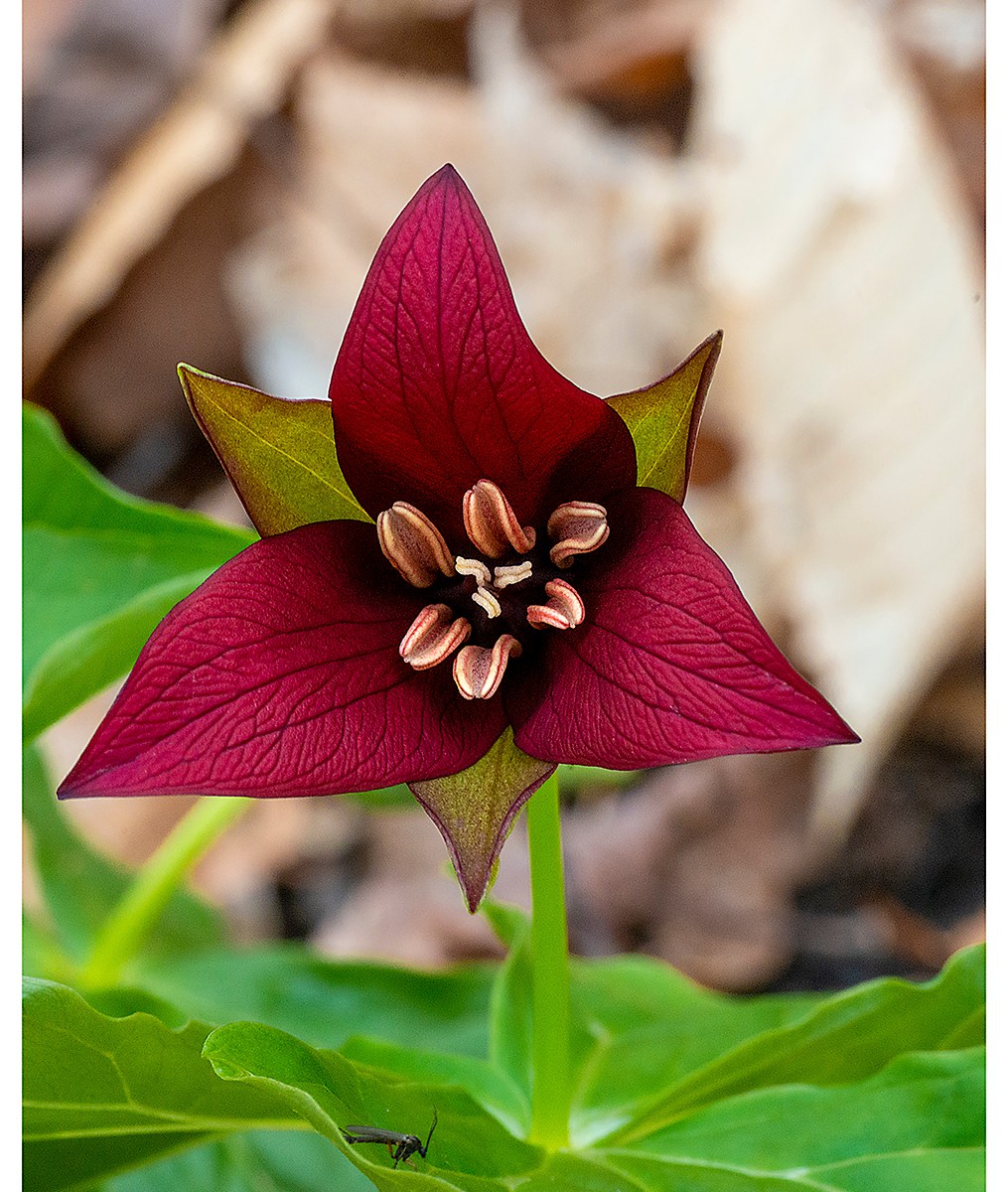
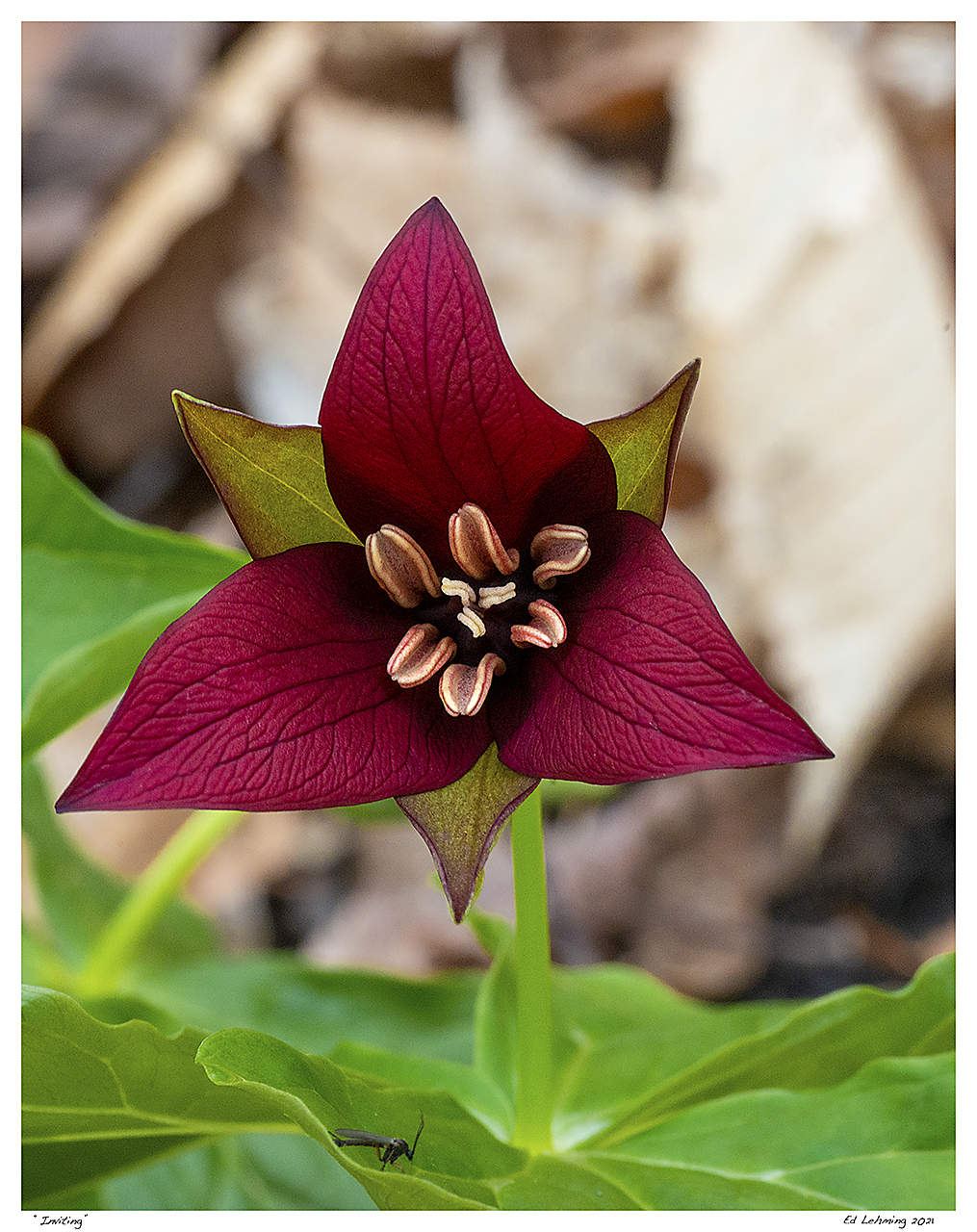
“There is nothing quite so inviting as a good meal in a beautiful environment” – Ed Lehming
Sometimes, it’s what I don’t see that makes an image interesting, and provides me with a title. When I was out on Saturday, enjoying a few of the early Wake-Robins, I set up to make an image of this specimen. My process is generally the same: find a good angle, adjust for lighting and composition, carefully focus on the details that I want to highlight, and snap the shutter.
During this process, I tend to be very focused on the primary subject of my image and making sure it is sharply in focus. I do this by using my camera’s ‘live view’ feature, where I use the camera’s rear display to compose the shot. This allows me to zoom in on a small focal area to make sure it is in sharp focus. The advantage is that the images are extremely crisp and sharp, where I need them to be. The disadvantage is that this narrows may point of view, so I have to compose the image prior to zooming in. This means all sorts of things can happen within the frame that I can’t see while focusing, like a fly landing in preparation for a meal. These tiny flies are hard to see with the naked eye and I missed seeing it as I snapped the shutter. I did not notice the fly till I opened the image for editing today on my 24″ monitor.
For those interested, here’s how I set up for this shot:
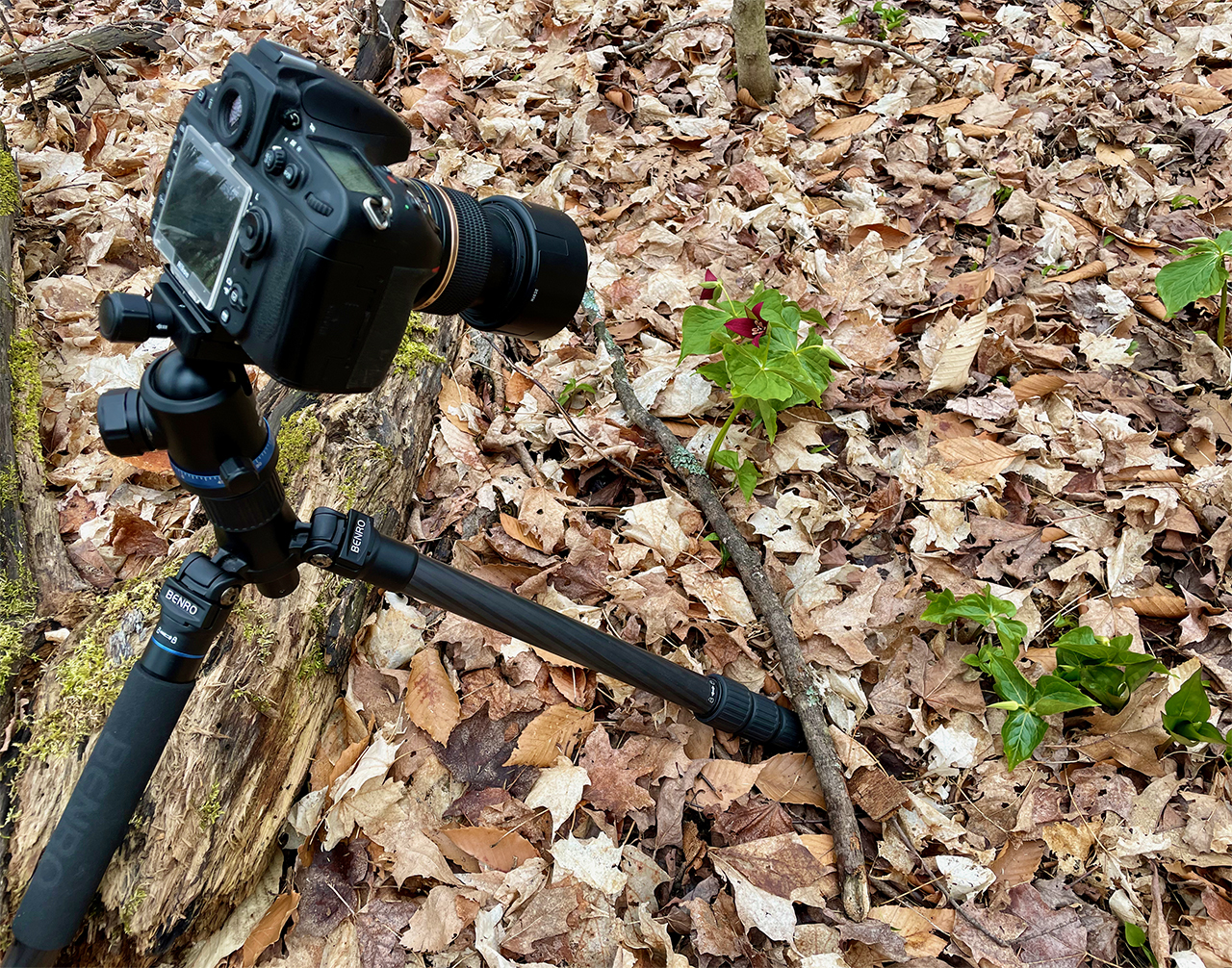
The end result, like so many of these, is that it makes the image a lot more ‘realistic’. These flies are part of the natural environment and serve the important role of pollinating the flowers, so It’s actually quite nice to see them in the image. I would, of course, have prefered to have an image of the fly actually feeding, but that, I believe is a matter of timing that I can work on for future shots. So, the image transformed from an inviting shot of the flower to something more, real purpose of the flower itself, to invite insects to pollinate it and help it reproduce.
Nikon D800
Tamron SP AF 90mm f/2.8 Di Macro 1:1 (272ENII)@90mm
1/100 sec, f/22, ISO 800


 Ed Lehming Photography
Recent Comments