
“The most amazing thing about the winter is that even a frozen world may be perceived as a heaven!”
―
Here we are in March and the temperatures are finally starting to moderate. What better time than today to post this self-portrait I made back in late January.
It seems to me to have been a particularly harsh and too oft ice-cold winter in Southern Ontario this year. That weather has not deterred me from getting out there and making images, as evidenced from the included photo, which reminds me of those vintage images of the Antarctic explorers, so I ‘grunged’ it up a bit for effect.
I recall that day well, having spent a few hours out in the ridiculously cold weather. A day where my long lens seized up because it was so cold out. On my return to the truck, I stopped for a moment to snap this self-portrait to remind me just how cold I felt.
Yet, despite the deep and intense cold that day, I was able to capture a few images that would otherwise have gone unrealized. Like the accompanying quote states so well, there is still stunning beauty to be witnessed, even on the coldest winter days, yet only those of us brave, or stupid enough to go out in it bear witness.
iPhone 7 front camera @ 2.87mm
1/20 sec; f/2.2; ISO 250
For more images like this, please visit my website (images are available for purchase)
http://www.edlehming.com
“Beneath the rust and grime which dulls the shine of our weathered hearts, joy patiently waits to be rediscovered”
―
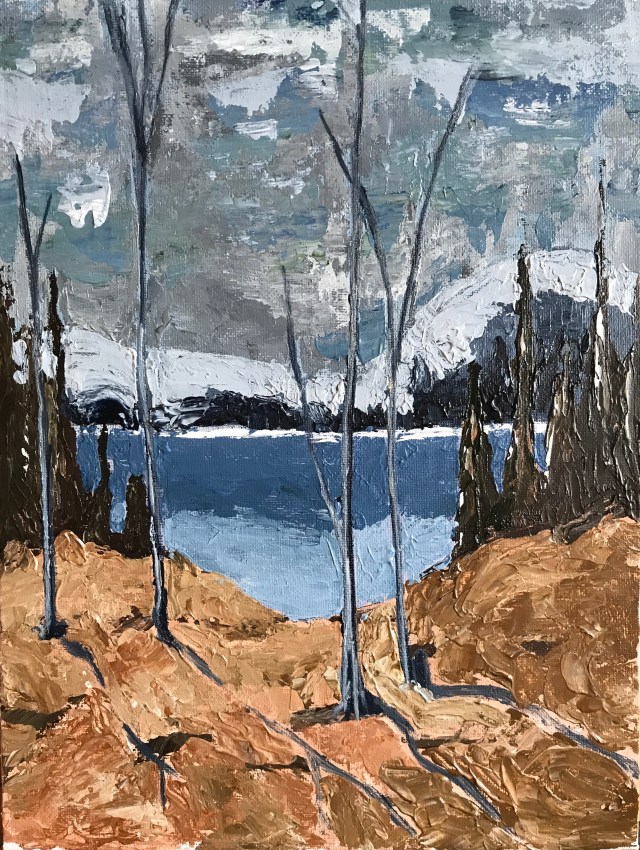
For my photography, image titles often come quite easily. As I venture into the world of acrylic painting, I’m finding that that’s not the case. Perhaps it’s the extended creation process, where I am spending a longer period of time creating the art itself?
Photos come naturally to me. I see a scene before me that is interesting, compose the image, set lighting, exposure and depth of field, and voila! I have a photo that I am generally pleased with.
The same holds true with painting. There is a lot of thought that goes into the process that I had not considered until I started painting a few short years ago and I have not been doing much lately. But now, I have taken a course and understand that the creative process is very similar and all the elements that make a good photo also hold true for painting.
I’ve always enjoyed impressionist paintings and have striven for that same feel with my photos. Now, I’m trying to merge the two, simply to stay creative, especially in winter months where outdoor activity can be quite limited. So, I’ve pushed myself a bit, trying to add some texture to my work by doing an entire painting with a palette knife, way out of my comfort zone, but so very satisfying.
Once again, I remind myself this is my photo blog, but I think that painting is helping me in my creative process for photography and this is, after all, a photo of a painting.
“Hark, now hear the sailors cry,
Smell the sea, and feel the sky,
Let your soul & spirit fly, into the mystic.”
– Van Morrison
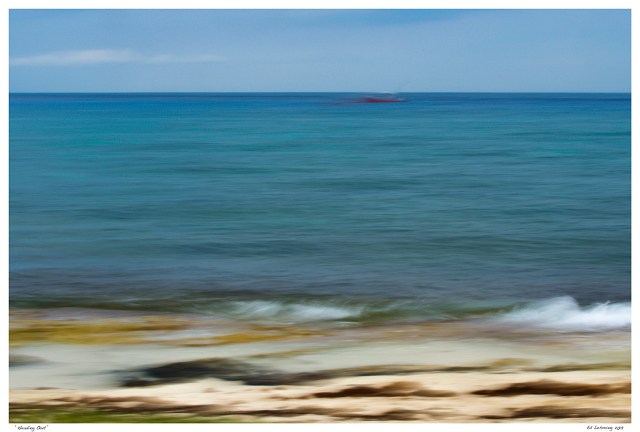
During the days I spend sitting on the shores in Cozumel this past January, one thing that was every present, except one stormy day, was the non-stop traffic of boats going by, just offshore. It was a mix of dive boats, fishing boats, and pleasure craft, but it was ceaseless.
From the break of dawn till early evening, the boats floated by, some lazily and others seemingly in a race to get the best spot first. And all the while, their wake rolled gently to the beach, long after their passing.
There was a certain pleasure in the act of simply resting on the beach and watching this activity, which was the only real measure of time, simply through its regularity.
I tried to capture that lazy feeling through a timed horizontal pan, rendering the photo a deliberately blurry and abstract image, as if waking from a dream. The red boat, just passing, is visible, but not immediately, as your eyes scan the scene presented.
It’s very calming for me now, reflecting back on these lazy, sun-baked days, with not a care in the world where, like the Van Morrison song, my soul and spirit did fly, into the mystic.
Nikon D800
Tamron SP 70-200mm f/2.8 Di VC USD @ 70 mm
1/4 sec, f/32.0, ISO 100
For more images like this, please visit my website (images are available for purchase)
http://www.edlehming.com

“We sat together silently in the tropical warmth of the beach, gazing over the calm waters and watching the sun slip closer to the horizon, marking the end of another day in brilliant splendour”
– Ed Lehming
I know, I’m mixing winter images with summer-like scenes but can’t help but be drawn back to this time spent in Cozumel with friends and family. Every day more relaxing than the previous one.
The days started and ended on the beach, watching gentle waves roll in from faraway places. My hope was to capture some of this experience in photos. In this image, the sun hangs lazily just above the horizon as a final dive boat heads out for a night dive.
Nikon D800
Tamron SP 70-200mm f/2.8 Di VC USD @ 105 mm
1/200 sec, f/7.1, ISO 100
For more images like this, please visit my website (images are available for purchase)
http://www.edlehming.com

“It’s the unexpected beauty in the most commonplace that often surprises us”
– Ed Lehming
This has been the nature of winter in my region. The days warm and cool rapidly, causing condensation and wonderful frost patterns on windows.
The window here happens to be right next to my desk, so I see the patterns change on a regular basis. It’s especially nice in late afternoon, when the low sun shines between the pine trees behind my house. It’s been a nice bit of colour in the otherwise dull winter we have had lately.
iPhone 7 back camera @ 4.0mm
1/500 sec; f/1.8; ISO 20
For more images like this, please visit my website (images are available for purchase)
http://www.edlehming.com
“In the deep of winter, colour and sound fade to nothingness. The world becomes muted and silent as it slumbers beneath the snow”
– Ed Lehming
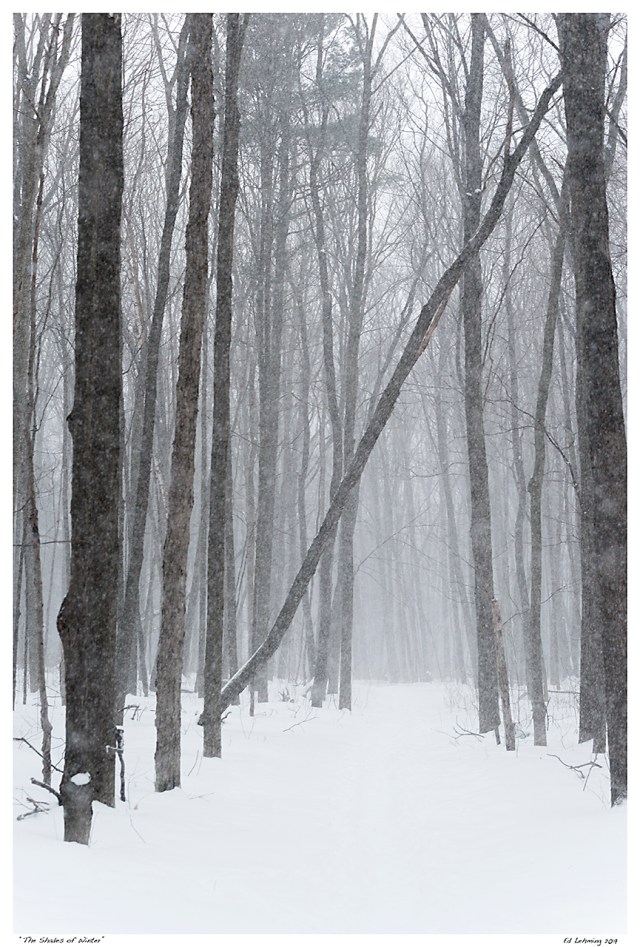
As a lover of light and colour, winter can often be the hardest on me, especially when seeking inspiration and beauty. In the winter months, it’s not just the drastic reduction of colours, but also the silence. So many times, the only sound I hear is the crunch of snow beneath my feet, the wind, above, and the groaning of the trees as the frost takes hold.
Occasionally, a flash of colour shows through, but for the most part, the world is plunged into innumerable shades of gray; the only colour being the rare blue sky above or the bright yellow of exposed wood, where a branch has broken off or a woodpecker has exposed fresh wood through its labours.
As I hiked last weekend, I was caught in a bit of an unexpected squall. There was really no wind to speak of, just an ever-increasing snowfall which further muted the world. There is a certain beauty in this silence. I find my senses more attuned and I become more aware of the world around me as my path leads forth into the white haze ahead.
Here, I simply stood still and let the silence fill me for a few minutes as I made the image, a reminder when I complain about the heat of summer.
Nikon D800
Tamron SP 70-200mm f/2.8 Di VC USD @ 70 mm
1/160 sec, f/6.3, ISO 400
For more images like this, please visit my website (images are available for purchase)
http://www.edlehming.com
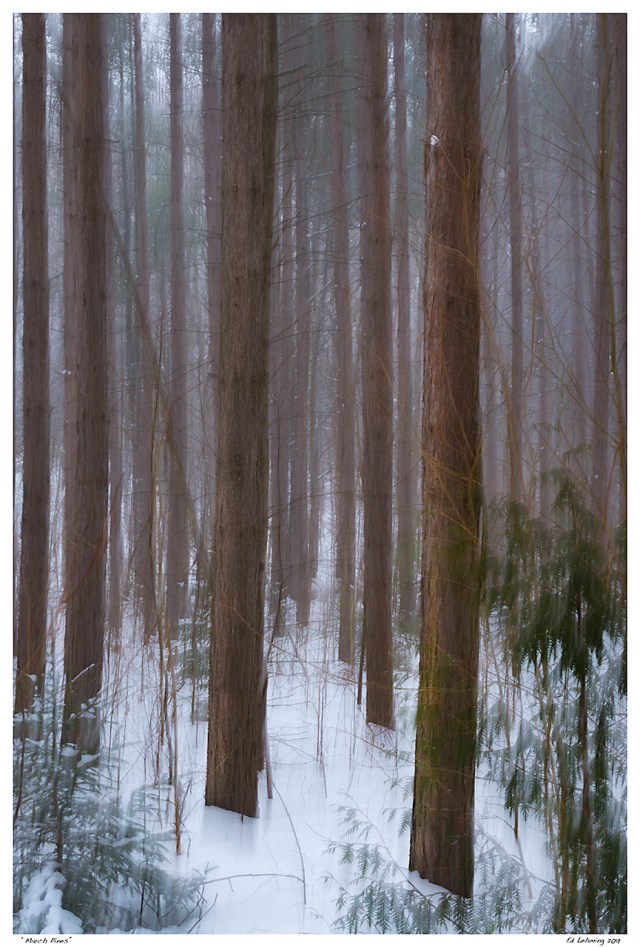
“The snow began, as a faint mist, floating in the air, gradually softening the distant trees”
– Ed Lehming
So it was, that March morning, a day that started out dull, the forecast calling for light snow, which did not seem to materialize as I started my hike. Then slowly, a beautiful and unexpected brightness filled the forest, taking away some of the dull cast of ceaseless clouds that have dominated this winter.
It was at this moment, when I stood surrounded by tall pines, that I noticed the first traces of snowfall. The snow began, gently at first, and the colours of the trees seemed just a bit more intense, a brief flash of vibrancy before the coming squall turned them dark once more.
That cycle of light is quite amazing and once you really experience it, I find it makes you more attuned to the surroundings and that ever-present play of light is what makes photography so enjoyable. Even on a dull and snow filled day in early March.
Nikon D800
Tamron SP 70-200mm f/2.8 Di VC USD @ 70 mm
1/4 sec, f/20.0, ISO 400
For more images like this, please visit my website (images are available for purchase)
http://www.edlehming.com
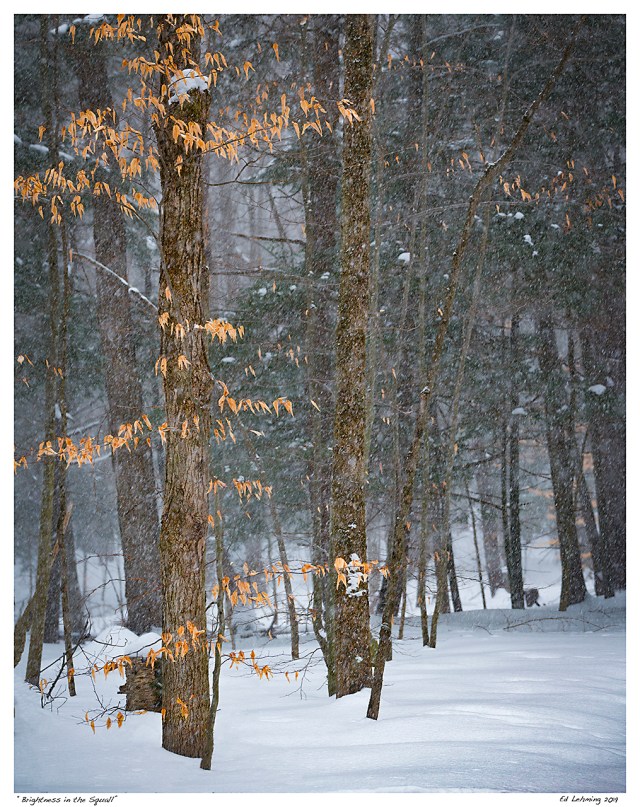
“The difference between darkness and brightness is how you thrive on those moments and how you use such circumstances with goodwill in your spirit.”
―
I find myself, on this day in early March, wondering where time has gone. It’s been many weeks since I felt inspired to sit and write. I’ve been out making photos, but the days have been cold, dull, and largely uninspiring.
Today, I set forth to spend some time in nature and see what she had to say to me, among the trees. And, once more, I found myself alone on the trails, the solitude and quite refreshing me. The only sounds I heard were the crunching of my boots in the crisp snow and the gentle breeze among the branches.
I’d only gotten a few minutes into my hike when light snow began to float down around me, further quieting the world around me. The sparse snow soon built into a full squall by the time I got further along the trail, refreshing the scenery and sticking to the thin branches along the trail.
Through this curtain of white, the occasional shimmer of bright colour flashed life into the winter world. The dried leaves of the beech trees, which hold fast throughout the winter, were like orange flames dancing in the dark branches. One that really stood out for me is pictured above. The thin beech tree appears to adorn the large maple behind it with it wonderful leaves, to the point where you hardly notice the beech and are fooled, without closer inspection, to believe the colour belongs to the maple.
It’s moments like this, where I simply need to pause and enjoy the scenes before me that continue to draw me outdoors, regardless of the weather.
Nikon D800
Tamron SP 70-200mm f/2.8 Di VC USD @ 100 mm
1/100 sec, f/5.0, ISO 400
For more images like this, please visit my website (images are available for purchase)
http://www.edlehming.com

“The waves lapped lazily on tropical shores,
warm and gentle breezes caressed the palms.
My very soul is refreshed by the peace of the day.”
– Ed Lehming
This image is in stark contrast to my recent Iceland series. I had not considered that I might be in the tropics mere months after my northern adventures. Both experiences have been incredibly refreshing, in completely different ways. The warm breezes and lush growth is so completely different from Iceland.
The similarity is that both places offered a slow pace. There was no urgency to be anywhere or do anything, which is a much-needed break from my busy work life. And both places offered experiences which I will hold in my memory forever.
While one felt nearly devoid of life, the other was bursting with life, colour, and diversity. The harsh and wind-swept lava mountains of the near arctic were replaced with palm trees and teaming ocean life.
I’ve been truly blessed in my ability to experience both places so close together in time that I can readily compare their virtues. What a fabulous world we live in!
iPhone 7 back camera @ 4.0mm
1/320 sec; f/1.8; ISO 20
For more images like this, please visit my website (images are available for purchase)
http://www.edlehming.com
 “Autumn carries more gold in its pocket than all the other seasons.”
―
I know, I’m a bit behind. This image was made on December 20th of last year. This image keeps popping up as I review my photos and I knew that I wanted to post it at some point soon. That time has now come.
This is actually an odd image in that the leaves are actually compressed by multiple snowfalls and thaws, three or four to my recollection, to the point in time when I made the image. The oak leaves, which dominate this scene hung onto the trees until early November this past autumn, which is odd as well.
The main reason I keep going back to this image is that most of my time spent on the trails is enjoying the scenery around me; the trees, the sky, the rolling hills, and such. Yet, I do spend even more time looking at the ground, as I navigate my way along trails, watching my step. Yet, I rarely consider the ground as a subject for my photos. I could actually create a whole series of interesting images documenting even a small section of the trail, since the composition changes so much over even a few meters.
The forest floor documents the surrounding forest so well. All the species of trees are proportionately represented here. In this case, it’s primarily red oak, with some sugar maple, and a smattering of poplar. There is also great variation in the colours of the leaves. Here the oak leaves vary from deep copper to pale yellow.
It’s like a painting made of leaves and I’m disappointed that I have not made more of these. They are so interesting and, if composed correctly, a very natural form of art.
iPhone 7 back camera @ 4.0mm
1/120 sec; f/1.8; ISO 40
For more images like this, please visit my website (images are available for purchase)
http://www.edlehming.com
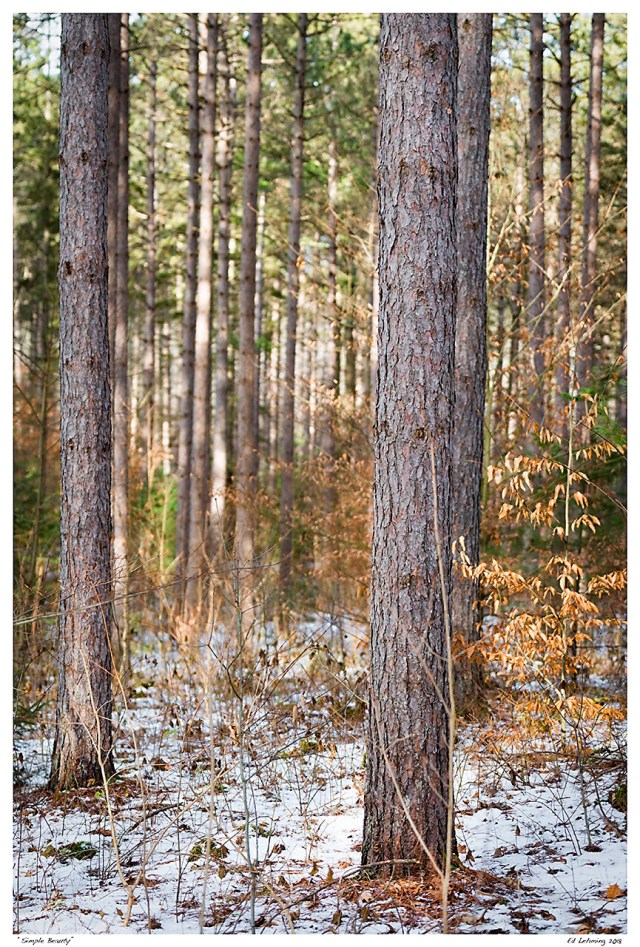
“Beauty is subjective, yet there are times when even the simplest thing can bright joy to our lives.”
– Ed Lehming
One of the many reasons that I spend time outdoors hiking and making photos is the sheer joy of seeing something breathtaking in what many would consider mundane circumstances.
Many of the trails I’ve hiked, I have hiked hundreds of times and yet, almost every time, I see something new and wonderful. It may be a new flower where none has bloomed before, or a new sapling emerging from a decaying stump, or simply the way light catches the growth at a certain time of day or year.
It’s scenes like this, within a planted forest in transition, that make me stop and look deeper. Beneath the canopy of planted red pines, new growth emerges in the form of young red pines and beech trees. There are other shrubs emerging too but the bright green of the pine and the twinkling gold of the beech trees in the afternoon sunlight is almost magical to me and they stand out from the scene. It may be a simple composition, but it does what I intend, it captures the ‘feeling’ of this small patch of forest on a late December afternoon, through colours and texture. And for me, that is beautiful. I can almost feel the rough bark of the pines and hear the birds singing high in the branches above me.
As I have often said, it’s not always the grand vistas that amaze me, even more so, it’s the simple beauty right in front of me that most would pass by without a second glance.
Nikon D800
Tamron SP 70-200mm f/2.8 Di VC USD @ 70 mm
1/40 sec, f/3.2, ISO 100
For more images like this, please visit my website (images are available for purchase)
http://www.edlehming.com

“A rock may seem a sound foundation but deep, nourished, and interwoven roots will hold surprisingly fast over time”
– Ed Lehming
This tree growing around a large boulder at the top of a hill got me really thinking, as I made this image a few weeks ago. It seems that the boulder would be a challenging place to grow. In fact, as I considered this image, I tried to think of the process that would create this oddity. Did the tree start growing here and the frost gradually pushed the boulder up? Or did the tree start growing in a small patch of soil on top of the boulder?
It also got me thinking of the notion of the rock being a solid and somewhat permanent object to use as an anchor, yet the rock is not connected to anything and that diminishes its ability to support the tree. I imagine a strong wind or more heaving from frost will loosen this perch over a few years, yet there is a conflict here. The roots, wrapped around the rock fasten it in place, preventing movement.
The real strength here is in the deep roots, spreading and anchoring the tree and rock. Based on the size and age of the tree, this seems to be working but it’s very strange and unique.
How often do we embark on projects, firm in our resolve that things are solid when, in our limited perspective, we are anchored on less than we think?
Nikon D800
Tamron SP 70-200mm f/2.8 Di VC USD @ 175 mm
1/50 sec, f/6.3, ISO 200
For more images like this, please visit my website (images are available for purchase)
http://www.edlehming.com

“There is something sacred about stillness. The world has not changed, outside our bounds, we just realize peace and tranquility are possible, if we make space for it.”
– Ed Lehming
This is what I’m often faced with, as I take time to hike the local forests. It’s not a grand vista or a festival filled with brightly dressed people. The forest, in its simplest form, even at its gloomiest, still has pockets of beauty to share.
Here, bright orange beech leaves and the occasional stray oak leaf brightened the path in contrast to the dark December trees. Gentle snow drifted between the boughs and all the world was silent as I stood still on the trail, simply enjoying the peacefulness of the moment, my visible breath rising through the air around my face.
I love these times, where my senses are filled with the life of the forest. It’s what draws me here. You see, even in apparent stillness and calm, life in the forest goes on. Soon, small birds flit between branches, seeking seeds, squirrels scamper out of sight and into the high branches, and the very trees crackle as the temperature dips, yet the sense of stillness rarely departs. The other sound that fills my ears is the crunch of the snow beneath my feet, seeming so loud in this quiet retreat.
Though summer hikes have their appeal, I think I prefer the stillness and bright purity of winter, especially after a fresh snow, when the whole first seems to be inhaling deeply during its long rest.
Nikon D800
Tamron SP 70-200mm f/2.8 Di VC USD @ 95 mm
1/60 sec, f/5.6, ISO 400
For more images like this, please visit my website (images are available for purchase)
http://www.edlehming.com
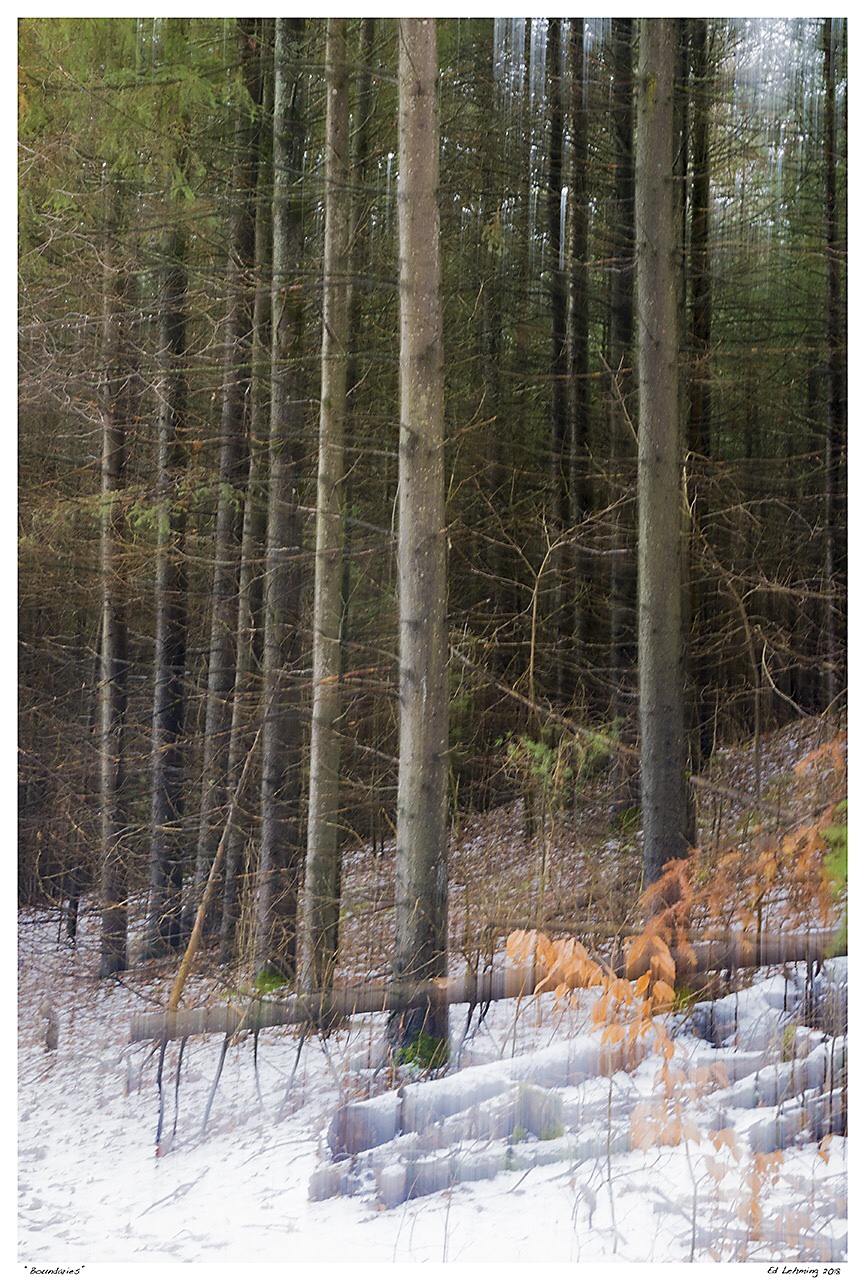
“Like most boundaries, they have two aspects. What is inside it and what is outside, it all depends upon which side you are on”
– Ed Lehming
I’m still in retrospect mode, moving through photos I made last year, considering the thinking behind their creation and the feelings I was experiencing when I made them.
Much of this is influenced by the world around me, though I try my utmost to detach from the negatives constantly bombarding us these days. One of the themes that was inescapable is the concept of boundaries, both physical and conceptual. A boundary is a point of separation, some boundaries have a transition zone and others are abrupt, often driven by the intent of the boundary.
In the case of this photo, the boundary between winter and autumn is quite abrupt, which is what made me stop to consider what I was seeing. The entire autumn in my area has been highly changeable, transitioning from snow, to rain, to sunshine, with snow never remaining on the ground for more than a few days. This also meant that any snowfall was temporary, at best. Here, the shade of the pine trees shelters a section of snow, creating a very defined boundary.
As I made the image, the thought about the nature of boundaries began to form. After all, if I stand on the boundary and look one way, I’m greeted with a snow filled and wintry view. Yet, if I remain in the same spot and turn around, it’s a late autumn day. If I did not have the benefit of seeing the whole picture, I could assume it is one season, when it is not. So, the boundary is, like I noted in my quote, really dependent on which side you are on and which way you are looking. It’s a concept I would like to continue to build on over the next few months.
Nikon D800
Tamron SP 70-200mm f/2.8 Di VC USD @ 92 mm
1/4 sec, f/16.0 ISO 400
For more images like this, please visit my website (images are available for purchase)
http://www.edlehming.com

“Heaven knows we need never be ashamed of our tears, for they are rain upon the blinding dust of earth, overlying our hard hearts. I was better after I had cried, than before–more sorry, more aware of my own ingratitude, more gentle.”
―
On January 2nd, 2019 the world, for me, became a bit less joyful. On reviewing my Facebook feed yesterday evening, I noticed that an old friend, Blair Koski-Klien, had “updated her story” which intrigued me, since she’s usually not one to do so.
I was surprised to find that the update had been written by her husband, Andy and was, in fact, an announcement of her passing, in the early hours of the morning, the final pages of her story. It felt quite surreal.
His words were beautiful and summed her up so well, yet I felt profoundly saddened at the news. You see, Blair, though we were not close friends, was one of the most genuinely joyful people I have ever met. If she had personal struggles, she soldiered through them with a bright smile on her face and a twinkle in her eye.
That smile, that radiant, exuberant smile, is what I recall of Blair. Our life paths crossed for only a few years and we shared a circle of friends. I regret that I never got to know her real well. She was also a few years younger than me and though we would chat from time to time or meet socially, I must admit, I never really got to know the person. Such is life in our teens it seems.
Life continued on and our circle of friends went our separate ways. I thought of her occasionally, usually when I met someone like her, that smiling spark in the room, memories would surface, but nobody ever matched Blair. There was a contagious positive energy in her that brought life and laughter to any occasion.
Over the years, friends reconnected through Facebook and other social media and, eventually, Blair showed up. It was so nice to see where her life had taken her; to see her as a happy mother to her son, Carson, and wife to Andy. I’ve not had the pleasure to meet them, but I’m certain that her love and energy filled their home.
As I sit and consider Blair, tears fill my eyes, at the thought that this beautiful young woman has been taken from us. Today, the world feels a bit colder, a bit less joyful, and a bit emptier without her. Yet, through my sorrow, I see that face, that smile, and hear her laughter and it’s all OK again. I’m grateful to have known her for even a short time and she has made an impact on my life. My regret is not to have been able to tell her that while she was still with us, something so many of us are guilty of.
There are so many people who enter our lives, though briefly, who have a subtle yet profound impact on our lives. We may not realize it at the time but when we do, it’s important that we acknowledge it and let them know. Our time here is often brief and unpredictable and we need to let those who enrich our lives with theirs know just how important they are to us.
One of God’s bright lights has gone out, leaving us seeking it’s light, and knowing it’s still shining, unseen by us, in places we have yet to see.
RIP Blair

“Trees are sanctuaries. Whoever knows how to speak to them, whoever knows how to listen to them, can learn the truth. They do not preach learning and precepts, they preach, undeterred by particulars, the ancient law of life.”
– Herman Hesse
As I start into 2019, I can’t but help reflecting on the profound influence trees have on me. I spend so much time among them, feeling their energy, sheltered under their branches, observing their slow but steady growth, season by season and, listening to them. Indeed, they have much to say about life itself.
Trees have influenced my photography and pursuit of painting as well. I am intimate with and thankful for the trees I am so blessed to live near. As my chosen quote states so well, trees are my sanctuary. In times where life gets hectic and work is overwhelming, the forests offer me respite, a place where I can simply be. To be among the trees is so incredibly refreshing to my senses. I smell the sap, hear the creak, groan and crackle of the wood as it heats and cools or resists the weather; my eyes are filled with the colours of fresh life as well as slow decay, all in their time. I feel the cool summer breezes among the branches and savour the shelter they offer in the storm.
So, when I came across this plantation of trees near Bancroft, Ontario, I could not help but notice the growth of young trees among their mature ancestors. Truly, among the giants and bathed in the soft winter light.
This is also an image that speaks of transition, from old to new and from past to future. I have no idea what 2019 has to offer. The year 2018 was a true blessing to me, personally, spiritually, and artistically and I expect the trees will continue play a large part in my future pursuits; I’m glad for the companionship.
Nikon D800
Tamron SP 70-200mm f/2.8 Di VC USD @ 70 mm
1/60 sec, f/8.0, ISO 400
For more images like this, please visit my website (images are available for purchase)
http://www.edlehming.com
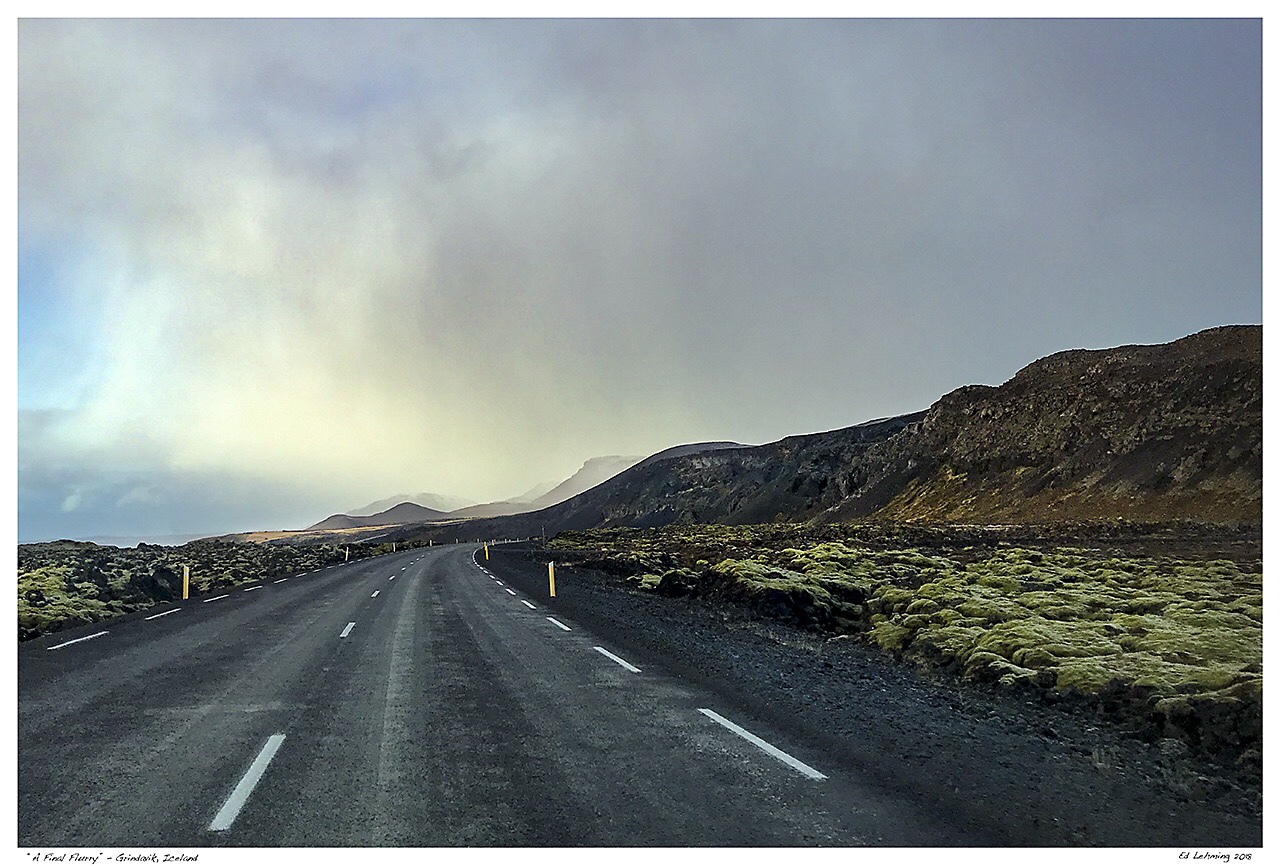
“And what began as a dream, becomes reality, becomes memory…”
– Ed Lehming
So, concludes my Iceland Journal (this one at least),as it began, an image of vast stretches of wondrous, raw, and ever changing landscape.
It has been a real joy going back through my photos, triggering memories of moments, which I have been able to document and share.
And so, I end this chapter of the story, as we end the year 2018 and head into 2019.
I would not have believed, at the start of 2018 that it would include a trip to Iceland, who knows what this year will bring?
Wishing you all a Happy New Year 2019!

“We went down into the silent garden. Dawn is the time when nothing breathes, the hour of silence. Everything is transfixed, only the light moves.”
―
The light in Iceland is incomparable, it possesses a magical quality and softness that simply pervades everything. I think, in part, is was partially due to the time of year, late October, when we visited. The sun never gets up very high and wonderful shadows are created. This ‘low’ sun also makes the light softer and warmer.
Here, along the shores of Kleifarvatn, the sun catches the yellow grasses on the low hillsides and makes them glow with light. Despite the snowy conditions, the whole scene is warm looking. Trust me, it was not warm when I made the photo!
There are colours here that are unrivalled in my experience, an inner glow, that I fell in love with. I can fully understand how Iceland holds other photographers in its thrall. The light shifts, dims, brightens, and brings out details like a spotlight, then moves on to the next subject.
It’s really quite remarkable, upon arriving here, we entered a world that looked blasted, tortured, and lifeless, yet the land slowly reveals its wonder, moment by moment until you are fully emerged in a sublime beauty that is so unexpected and so ceaseless that it’s almost overwhelming. And it’s all driven by the light, the magical sub-arctic light, and those beautiful mosses and grasses, which stand in such incredible contrast to the black sand and jagged rock.
As this year winds down, I’ve been able to send a lot of time recalling this memorable trip, through photos and memory.
Nikon D800
Nikkor 70-300mm f/4.5-5.6 G I AF-S VR Zoom @ 70 mm
1/320 sec, f/9.0 ISO 400
For more images like this, please visit my website (images are available for purchase)
http://www.edlehming.com
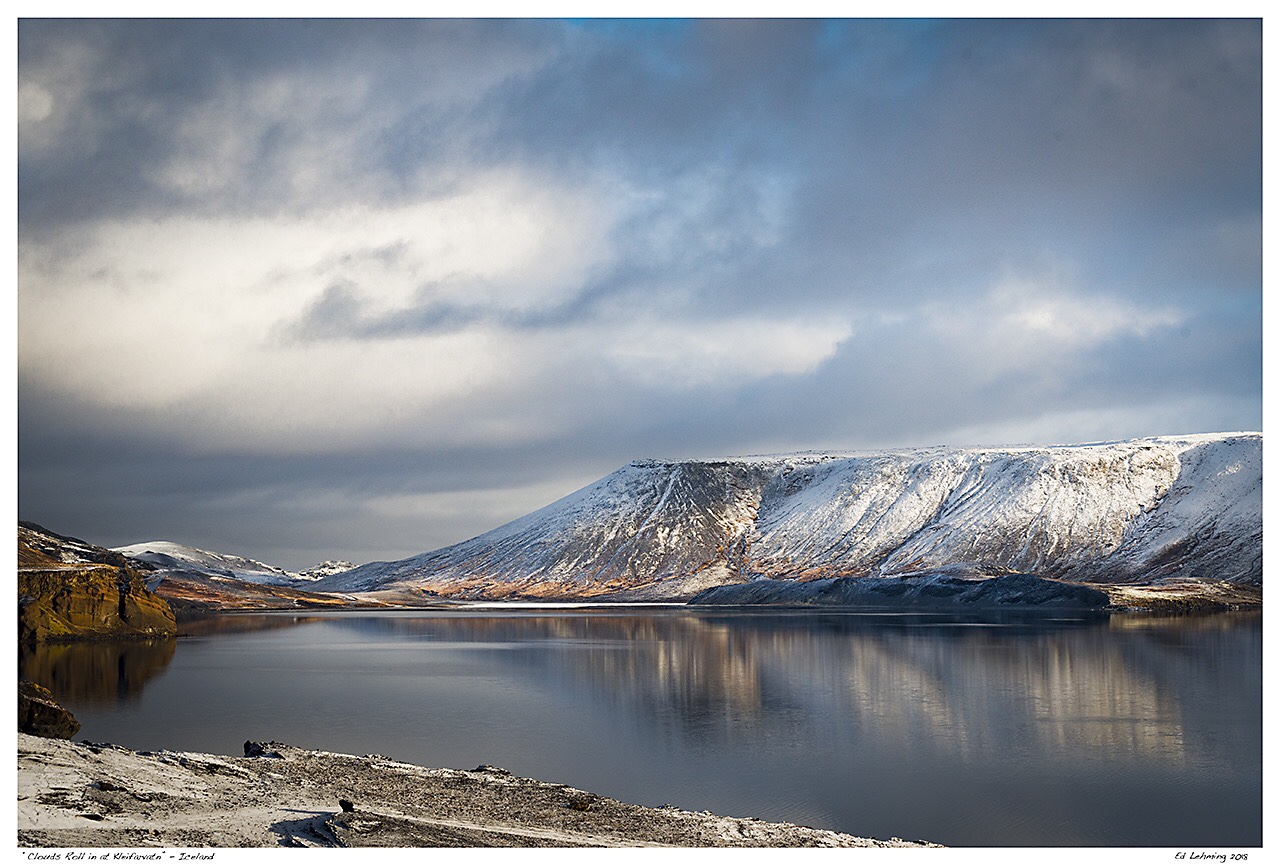
“The clouds roll in, but don’t persist, they bring a welcome contrast and make us more aware of how lovely the sunshine is.”
– Ed Lehming
I really can’t imagine Iceland without its marvelous clouds. During our ten-day trip, every day had some cloud. Often, there are multiple layers, each slightly different and moving in different directions, creating a magical yet fleeting, play of light.
As a photographer, the quality of light is very important and I did not have to wait long for lighting conditions to shift. The clouds would tease and taunt me as they danced among the mountains, often hinting at what lay within their shroud and revealing glimpses of high mountain tops. Sometimes shafts of sunlight would pierce them, creating brilliant patches of illumination.
I’ve seen the photos made by other photographers, of places I visited, in bright sunshine, but some of the character is missing. It seems to me, that Icelandic landscapes require some quantity of cloud to show their true essence. This is, after all, a wild and rugged country and the ever-changing weather is part of that.
In the photo above, one of the last ones I made as we departed Reykjavik and headed toward the airport, by yet another ‘indirect’ route. The lake is Kleifarvatn and is a moderately sized lake about 15 kilometers south of Reykjavik. Our destination on our final day was the geothermal hot springs at Krysuvik, just south of the lake. The road followed the shore of the lake for some time and gave the opportunity for several final images of this enchanted land.
The water was just smooth enough to give a soft reflection of the flattened Vatnshliðarhorn mountain to the north, the sun brightly illuminating the yellow grasses along its base.
It’s this wonderful mix of sun and cloud that has provided the beautiful mood for many of my photos; ever-changing and creating new vistas by the moment. I look back on these photos fondly as I near the end of this series and close out the year feeling blessed to have experienced this majesty with my son.
Nikon D800
Nikkor 70-300mm f/4.5-5.6 G I AF-S VR Zoom @ 70 mm
1/320 sec, f/9.0 ISO 400
For more images like this, please visit my website (images are available for purchase)
http://www.edlehming.com
“I take pleasure in solitude, many see me as distant but only few know it’s when I’m most alive.”
―
On day eight of our Icelandic tour, we headed inland from Borgarnes towards Geyser. The trip took us around a fjord still used as a whale processing area, with a large plant at the farthest end of the fjord. The plant was notable for the many talks along the surrounding will sides, used to store whale oil. It was off-season, so the plant sat mostly dormant with only one ship docked at it’s pier.
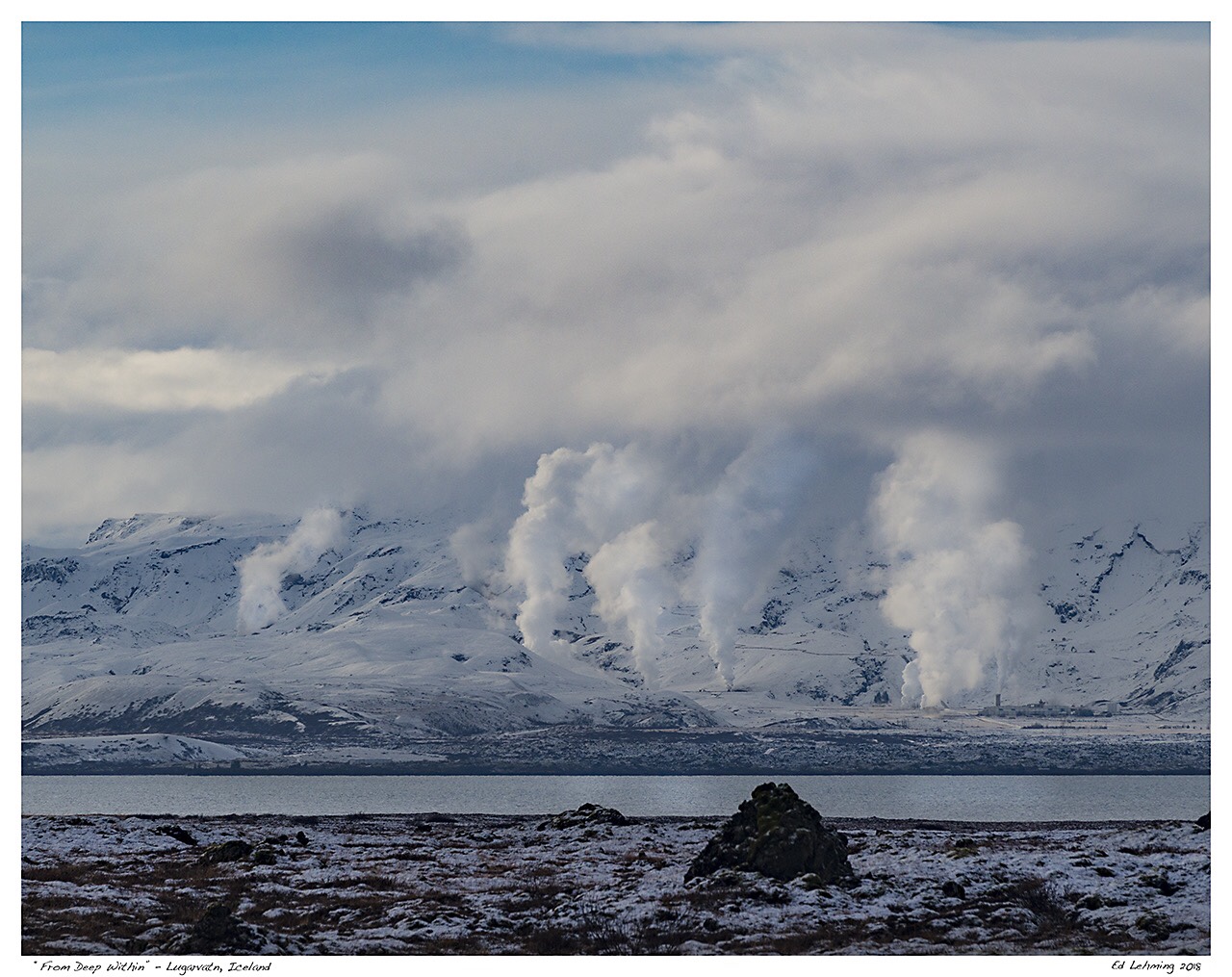
As I said, the trip took us inland and into more high plateaus, which were fairly unremarkable except at this highland lake near Laugarvatn, the far shore filled with geothermal plants and vents, belching out steam into the cold sky , which stood in contrast to the snowy hillsides.
I would have liked to have gotten closer, but we wanted to get to Geyser in good time and then to Reykjavik by the end of the day, so we had to choose our stops carefully.
Though our primary destination for the day was Geyser, these areas of activity made the drive more interesting.
Nikon D800
Nikkor 70-300mm f/4.5-5.6 G I AF-S VR Zoom @ 210 mm
1/400 sec, f/10.0 ISO 400
For more images like this, please visit my website (images are available for purchase)
http://www.edlehming.com

Wishing everyone around the world peace and joy this Christmas season.
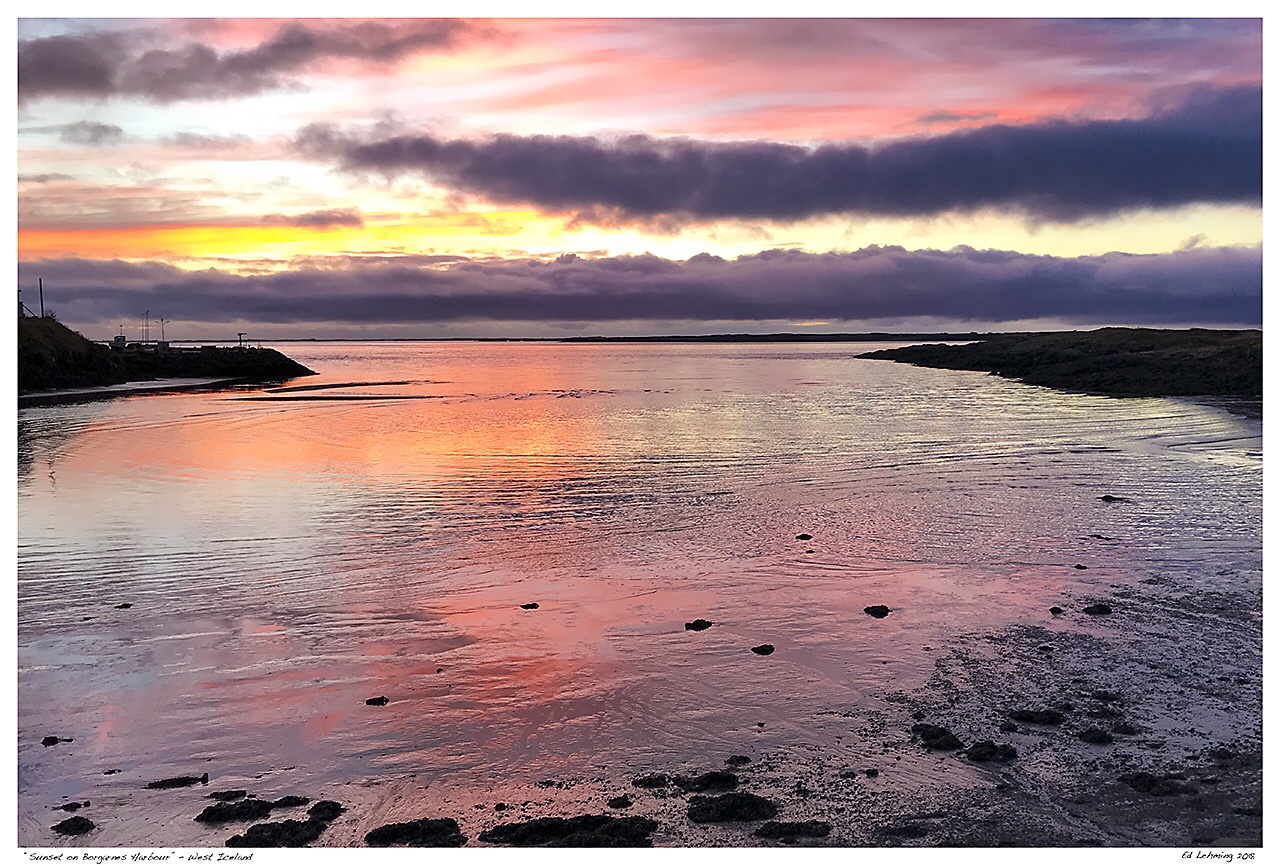
“It was dusk and the light had an ultra-violet quality to it, a final burst of pigmentation as night and day rushed at each other in a clash of colour prisms before darkness finally, inevitably won out.”
―
Though much of our trip was filled with the overcast, misty, and often gloomy light of autumn, we were, on this occasion greeted with the magnificent colours of an Icelandic sunset.
On our arrival in Borgarnes, a large town on Iceland’s west coast, we decided to end our day of travelling with a walk to the harbour and were treated to a lovely, though brief, show of light over the water. I do recall making this photo and looking at my phone, a bit disappointed that the full spectrum of colour was not truly captured; close, but not quite the real thing.
iPhone 7
 “From the deep places of the earth, pours forth a cool purity few can fathom”
– Ed Lehming
The mere sight of these falls brought freshness to my day. There is something in flowing water; a virtual baptism and washing away of the days heaviness happens, and the joy of simply living in such a marvelous world is reaffirmed.
This is yet another image of a section of Hraunfossar, in Southwestern Iceland. I left this one a bit darker to allow the brightness of the water and rich colours and textures of the mosses to dominate over the dark rock.
I keep having to remind myself that the water here comes not from surface streams, but a complex network of underground rivers that flow beneath the surface, through ancient lava fields. Here, it escapes to the surface through the side of a steep embankment. Many visitors to Iceland don’t realize that all the tap water comes from such underground streams. That’s right, the tap water is actually spring water. I started my trip with the purchase of a single bottle of water which I kept refilling with tap water or from mountain streams, after ensuring there was not a large, sheep filled pasture upstream.
Though warned to the contrary, I found nearly all the water at our various overnight stays was lovely and fresh. The exception being Reykjavik, where the water at our hotel reeked of sulphur. Though safe, I had a hard time convincing myself that it was OK to drink.
Once more, I am including a link to the high resolution version of this image should you wish to take a closer look at the details.
Nikon D800
Nikkor 70-300mm f/4.5-5.6 G I AF-S VR Zoom @ 170mm
1.0 sec, f/36.0, ISO 200
For more images like this, please visit my website (images are available for purchase)
http://www.edlehming.com
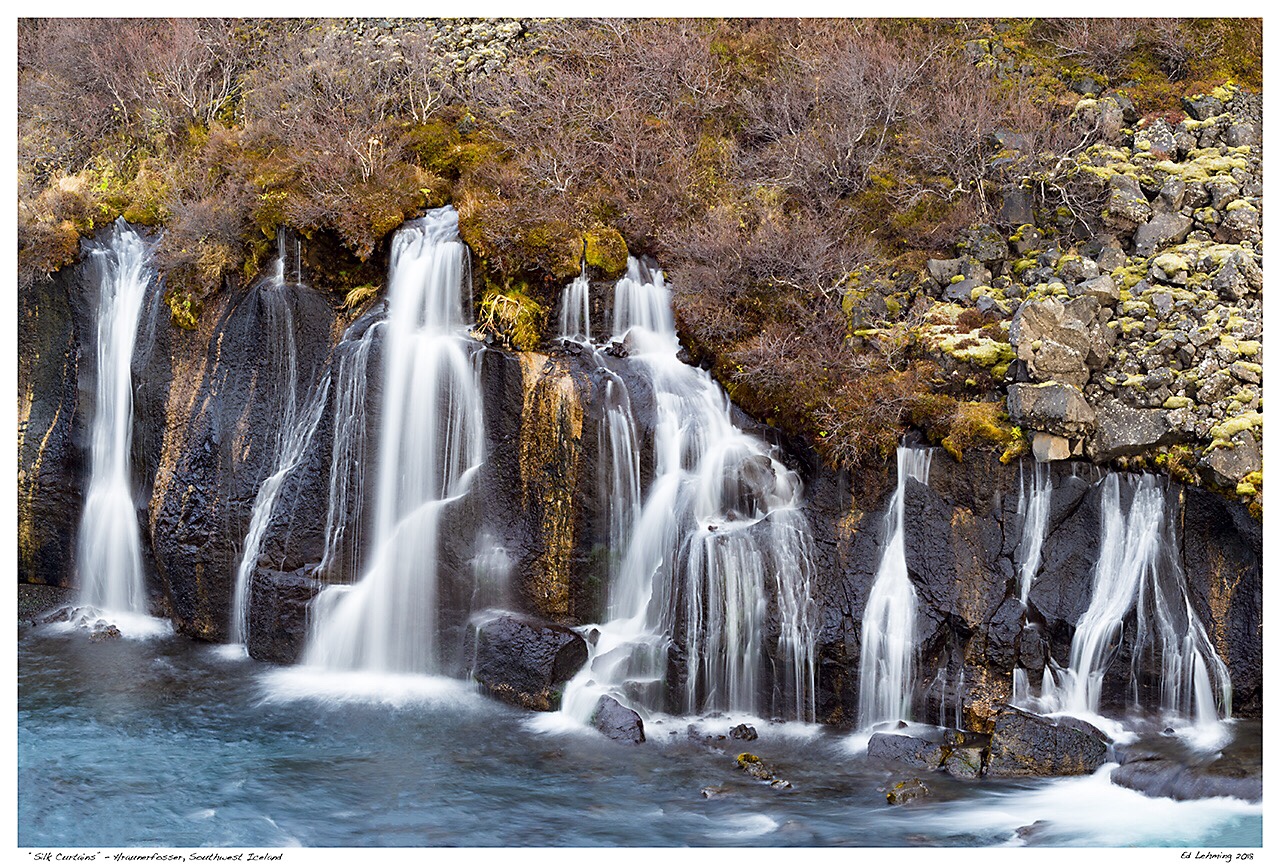
“The waters flowed over the rocks like dancers clad in ribbons of silk, some fluttering like gossamer curtains in a summer breeze.”
– Ed Lehming
I know that I have shared previous images and thoughts of this magnificent series of waterfalls. As I continue to review my images, new perspectives reveal themselves. Here’s an image of a small section of the broad and complex waterfalls, just to the right of my prior image. I chose it because it represents the beginning of the falls and water flow is scant and complex here. The details of the water losing over the rocks is almost magical when seen as a long exposure.
The long exposure also enhances the colours, adding a slight, natural saturation which causes the abundant mosses and lichens to stand out, as well as the short and scrubby Icelandic birches, which also share this scene, the every detail shining through. It also lets the subtle blue tones of the glacial water to reveal themselves. It’s a very pleasing image to me personally, another fond memory of this trip, which still occupies my dreams so vividly.
I could have spent the day examining and photographing this waterfalls, but alas, we had to move on to our next stop and more of the beauty Iceland had to offer us before heading to the coastal town of Borgarnes for the evening.
Nikon D800
Nikkor 70-300mm f/4.5-5.6 G I AF-S VR Zoom @ 86mm
1.0 sec, f/32.0, ISO 200
For more images like this, please visit my website (images are available for purchase)
http://www.edlehming.com

“I am reminded that the most fertile lands are often built by the fires of volcanoes.”
―
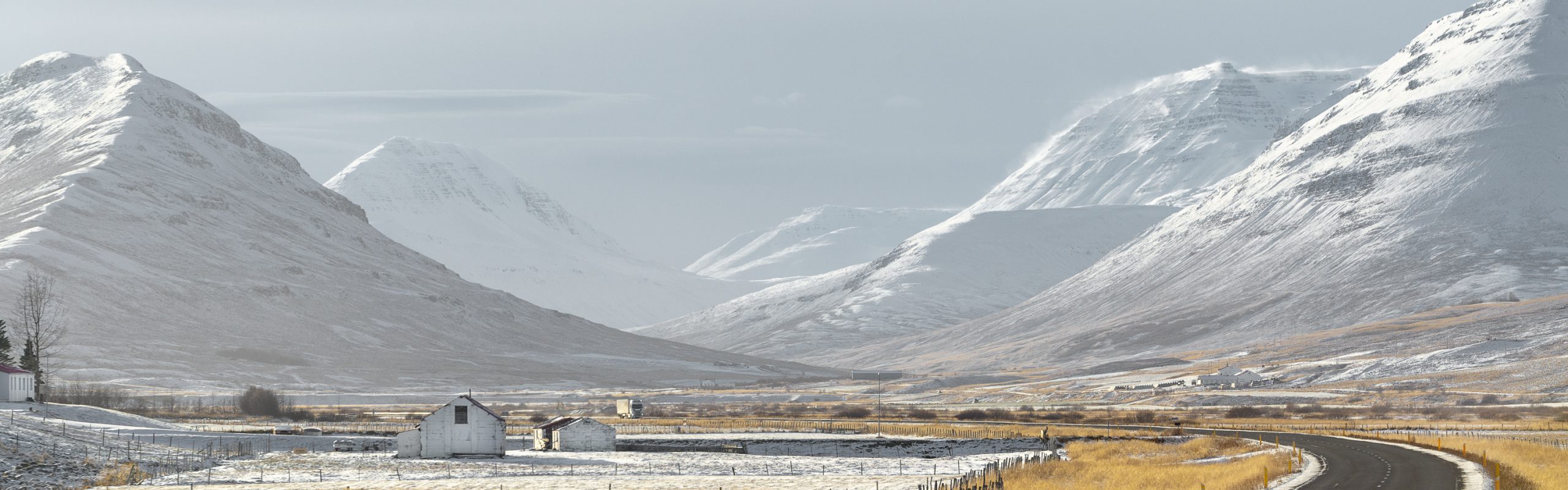
On the seventh day of our Iceland journey, my son and I travelled through the high mountain passes at the base of the West Fjords, southward along Highway 60 to rejoin the Ring Road, just north of the town of Bifrost.
We were greeted by this spectacular view of a broad valley, filled with meandering rivers and lush farmlands, stretching to the horizon, some 30 kilometers distant, which is bounded by the Skarðheiði mountain cluster and dominated by steep sloped Skessuhorn, poking from a persistent cloud bank, which did not break up all day and kept the rest of the mountains obscured. I could not keep my eyes off Skessuhorn as we drove along, and eventually into, the valley, which is bounded in this view by the Norðurá river. The Norðurá joins several other rivers to form a small delta, just north of the town of Borgarnes, our final destination on this day of travels. I have included a link to the high-resolution version of this image, should you care to have a closer look.
This is a truly remarkable area for Iceland, in that it a very large expanse of farmland, though it is still a very active geothermal area, interspersed with hot springs throughout the valley. An aerial view of this region shows it to have been formed by glaciers, carving and eroding the volcanic bedrock and creating ideal conditions for rivers to flow and deposit their rich, mineral laden silt within the valleys carved by the glaciers.
It was this area that we intended to explore that day and it led us through the farmland, past steaming vents, cold glacial streams of turquoise, and up into the highlands and lava fields of the Hallmundarhraun and the peaks of Ok and Eiriksjökull. It was, in the typical fashion of Iceland, an incredible change in environments, within a fairly short distance of some 30 kilometers. The trip also included a stop at the magnificent Hraunfosser waterfalls, which I have already discussed in a previous post.
Nikon D800
Tamron SP 70-200mm f/2.8 Di VC USD @ 116mm
1/320 sec, f/9.0 ISO 200
For more images like this, please visit my website (images are available for purchase)
http://www.edlehming.com

“The experience was powerful and fundamental. It seemed to me that it had always felt like this to be a human in the wild, and as long as the wild existed it would always feel this way.”
―
Most of Iceland remains wild, and untamed, and that is a good thing. As humans, in this era of convenience, it’s refreshing to be in a place like this; a place where we can still feel vulnerable and humbled by nature in its most elemental form.
This is something that has stayed with me, now that I sit comfortably at my desk, recounting this journey through Iceland. Even though we spent much of our time on the road, we did take the opportunity to wander off the beaten path a few times and feel Iceland in its natural form. You don’t have to venture more than a few meters off the road to experience this, as the road is but a thin, temporary, ribbon of civilization.
For example, here in the Gullborgarhraun, or Gullborg lava fields of the Snæfellsness Peninsula you are faced with kilometers of ancient lava, twisted and jagged, slightly softened by the ever-present mosses and lichens, which offer a splash of colour in the otherwise bleak landscape of black and grey rock.
At the centre of the scene sits Gullborg, a short volcanic cone, at one time, the source of all this lava, now rising from the deep lava field and littered with and accumulation of sharp black ejecta, attesting to the active volcanic nature of this region. It’s a rawness that I’ve never experienced before and something I really appreciate given my formal education in geology, so many years ago.
The first word I used to express the nature of Iceland was ‘raw’, and that stands ever more true, several days into the journey. I suppose that is the real appeal for many of us who have travelled here. It’s one of the few places left in the world where we can experience this kind of wilderness, to enjoy such primal diversity within a relatively small geography. It’s like stepping back in time, to a place where nature ruled and mankind was merely a participant at its mercy.
iPhone 7 back camera @ 4.0mm
1/35 sec; f/1.8; ISO 32
For more images like this, please visit my website (images are available for purchase)
http://www.edlehming.com

“It’s not about inviting great things into our lives. Rather, it’s about accepting the invitation of great things to step out of our lives.”
―
For those following my Iceland journey from late October, you will know that it was made up of a series of ‘general’ destinations. We simply set up a schedule to take us from one overnight stop to the next, leaving time between those destinations to enjoy the journey along the way. This meant roughly two to three hours of daily driving and we never had a particular ‘sight’ as a destination. We allowed each day to simply ‘happen’.
The only exception to this ‘plan’ was Kirkjufellsfosser, which I addressed on a prior post, which includes a photo of this iconic waterfall which appears on almost every Iceland travel brochure. Choosing Kirkjufellsfosser as a deliberate destination also made for the longest travel day, most of which was spent simply driving to get there and then back, the entire length of the Snæfellsness Peninsula, to get to our accommodations for the night. Yet again, despite the extended ‘windshield’ time, and off and on rain, we were still able to enjoy the ever-changing and wondrous scenery.
The travel brochures hardly do Iceland justice and it’s impossible to portray the incredible diversity we witnessed effectively. Those brochures often show scenes from the same vantage point, so when you arrive, the scene before you is quite different from what you expected to see. This image is a prime example. The ‘iconic’ image is made from near the top of the cascade, with Kirkjufell mountain in the background. That vantage point is near the top of the photo above. However, there are many other ways to view this waterfall, including from near the base, which is where this photo was made. It’s important to note, that these falls are named, fosser, which is the plural to foss, or waterfall. In fact, many of the waterfalls in Iceland are made up of multiple sub-falls.
Nikon D300
TAMRON SP AF 17-50mm F2.8 XR Di II LD Aspherical IF A16NII @ 32 mm
1.3 sec, f/32, ISO 200
For more images like this, please visit my website (images are available for purchase)
http://www.edlehming.com
 “Some beautiful paths can’t be discovered without getting lost.”
―
This, our sixth day of travel, did not leave us lost, as the quote may imply, but it did send us down some ‘interesting’ paths.
As I noted in previous posts, there are roads which enter Iceland’s mountainous and rugged interior known as “F” roads, which we were prohibited from driving on with our rental vehicle, despite studded tires and four-wheel drive. As Iceland approaches late autumn, these roads can quickly turn treacherous and they are very remote, so emergency assistance would be very expensive, if even available.
As we mapped out our path from Svínavatn to the Snæfellsnes Peninsula, we noticed that travelling the Ring Road would have taken us further south than we wanted, meaning extra distance and time lost driving. We were directed by locals to take a ‘shortcut’ cross-country from Staðarskáli to the town of Buðardalur, at the base of the West Fjords. It turned out that the ‘shortcut’ was an “F” road, so we sought other passages. It turns out that just north of the “F” road is an ‘official’ road, in the form of Highway 59, which parallels the “F” road. I’m really not sure how much better than the “F” road this highway was, since it was roughly thirty kilometers of black, icy, and potholed track through some of the most desolate landscape we had seen yet. I think we drove nearly twenty kilometers without seeing a single building. Barren grassland and low hills reaching to the horizon.
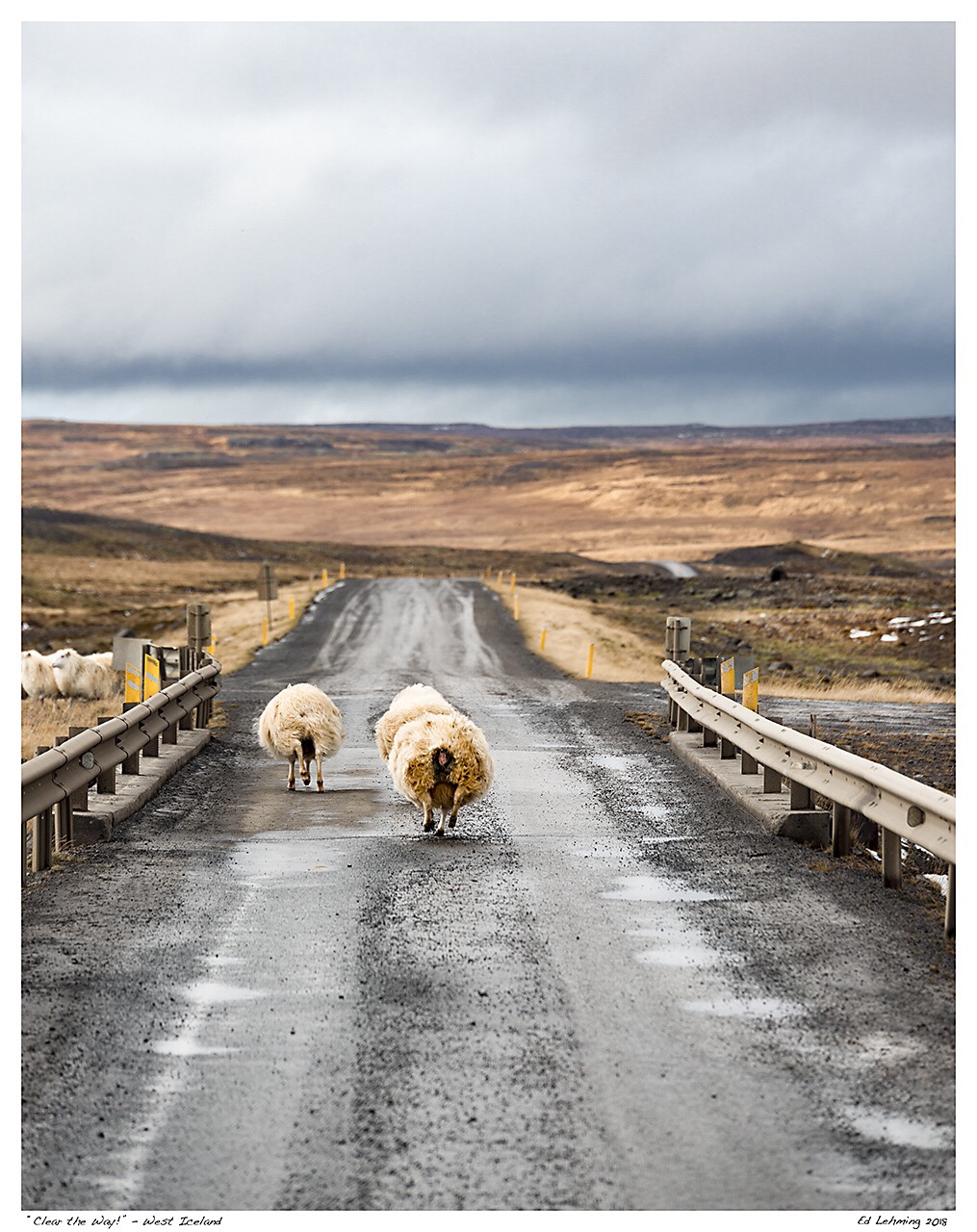
What we did see lots of was sheep. Despite the barren, windswept landscape, sheep were everywhere. That was true, not just here, but throughout Iceland. There are just over three hundred thousand people in Iceland, and at last count, there were over eight hundred thousand sheep. They are everywhere, in open fields, on high mountain sides, in the tortured and twisted lava fields, and often, on the road. Yes, there are fences aplenty, but the sheep seem to find their way over, around, and under the fences, often grazing right next to the road, or like here, on the road. So you have to be ever vigilant while driving.
This troupe was very cooperative, except for a few stragglers, who hurried to catch up with the rest of the flock, who were waiting patiently on the far side of the bridge. I just had to stop to take a picture, since this captured yet another aspect of our drive.
Nikon D800
Tamron SP 70-200mm f/2.8 Di VC USD @ 200mm
1/125 sec, f/35.6 ISO 200
For more images like this, please visit my website (images are available for purchase)
http://www.edlehming.com
 “Faeries, come take me out of this dull world,
For I would ride with you upon the wind,
Run on the top of the dishevelled tide,
And dance upon the mountains like a flame.”
―
I can’t say enough about how stunningly raw the landscape in Iceland is. Even on dull, slightly overcast days, there are these short breaks in the cloud where the world is alight with colours, and these colours stand in sharp contrast to the black, volcanic mountains and plains.
Above is a prime example. This mountain stands along the shores of Kolgrafjörður, one of the many fjords found along the rugged and beautiful Snæfellsnes Peninsula of western Iceland.
On the sixth day of our Iceland excursion, my son and I were on our way to Kirkufellfoss. That’s the waterfall with the odd-shaped mountain in the background that is on virtually every Iceland brochure. It’s located about three-quarters of the way out to the tip of the peninsula itself, along some pretty rough roads. Though Kirkufell was our destination, the journey there was simply breathtaking and varied. The landscapes included vast fjords, filled with hundreds of small islands, winding mountain roads, dormant volcanoes and high glaciated mountains.
As with other regions in Iceland, the scenery changes quickly and unexpectedly, each turn in the road presenting some new wonder. I recall this particular mountain well because of the way the yellow grasses glowed in the brief and diffused sunlight and how the bright green mosses stood out against the dark talus slopes of the mountain. I found, as I reviewed the photo, that there are so many details that my eyes did not pick up on, even as I composed the image. For that reason, I’m posting a link to the high-resolution image here and encourage you to spend some time, zooming in and looking for the sheep, the waterfowl, and exploring the mountainside details that are lost in the image above.
Nikon D800
Tamron SP 70-200mm f/2.8 Di VC USD @ 70mm
1/40 sec, f/3.2 ISO 200
For more images like this, please visit my website (images are available for purchase)
http://www.edlehming.com

“The tree which moves some to tears of joy is in the eyes of others only a green thing that stands in the way. Some see nature all ridicule and deformity… and some scarce see nature at all. But to the eyes of the man of imagination, nature is imagination itself.”
―
Today, a brief reprieve from my my Iceland series, which is not nearly complete. Yesterday, as the early snowfalls melted away, it took the the local forest for a moderate hike.
I’m blessed to live in an area with lots of forest and lots of easily accessible trails. There are favourites which I return to regularly, one being North Walkers Woods, which has a good network of interconnecting trails. The one I chose is what I refer to as the ‘ outer loop’ which follows the forest perimeter and is six kilometres long.
The day stared out dull and overcast, but sitting inside was not an appealing option for me. After a particularly horrible workweek, many of my co-workers were let go, in the ever present world of downsizing, I ended my week family ‘numb’ and simply needed to get out and recharge.
When I’m out hiking and making photos, the outside world fades away and I am simply present in the forest. I hear lots of people talking about this state of being present. I suppose I have always had the ability to do that, without having a formal name for it.
So, here I was, enjoying a good late autumn walk and seeing the dull day turn ever brighter. The sun never fully emerged from the clouds but the light was soft and warm enough to make a few simple forest images, including the one above.
I played with my Prisma app to get the slightly graphic effect, which is quite subtle, and you have to look closely to see the effects.
iPhone 7


Recent Comments