
“Ants always eat sweet food … but none of them haven’t diabetes ?”
― Ali Ghasaby
Among the residents of peonies are, of course, ants. Ants of all sizes and shapes thrive on the sweet nectars the peonies offer from bud to blossom. It would be a rare occasion when I bring a peony blossom indoors that an ant does not emerge at some point. It’s a given.
As I photographed my post-rain peonies, I took the opportunity to try my hand at photographing the ant as it clung to the edge of a leaf. Since I was shooting handheld, I had to adjust my aperture up a bit, which meant I sacrificed depth to get an acceptable shutter speed. If I had to do this again, I would have bumped my ISO, and closed the aperture a bit more, but this is how I learn. There will be more ants.
Nikon D800
Tamron SP AF 90mm f/2.8 Di Macro 1:1 (272ENII)@90mm
1/320 sec, f/5.0 ISO 100
for more images like this, please visit my Facebook page:
https://www.facebook.com/EdLehming
or my website (some images available for purchase)
http://www.edlehming.com

This week’s submission to Norm 2.0‘s Thursday Doors.
Thursday Doors is a weekly feature allowing door lovers to come together to admire and share their favourite door photos from around the world.
“322 Dundas Street West” – Toronto
In this image, it’s the doorway, not so much the doors that draw my attention. Along this stretch of Toronto heritage buildings, and across from the Art Gallery of Ontario, this one really stands out, with its fuchsia columns and yellow brick. I had to go through my media library to verify I had not posted it previously and it turns out that I have not.
I found that odd, that I have not yet posted an image of doors that I have enjoyed for several years. As it turns out, my oldest daughter’s friend lived here for a few years. It is a small world.
iPhone 7 back camera @ 4.0mm
1/300 sec; f/1.8; ISO 80
“Green was the silence, wet was the light,
the month of June trembled like a butterfly.”
― Pablo Neruda
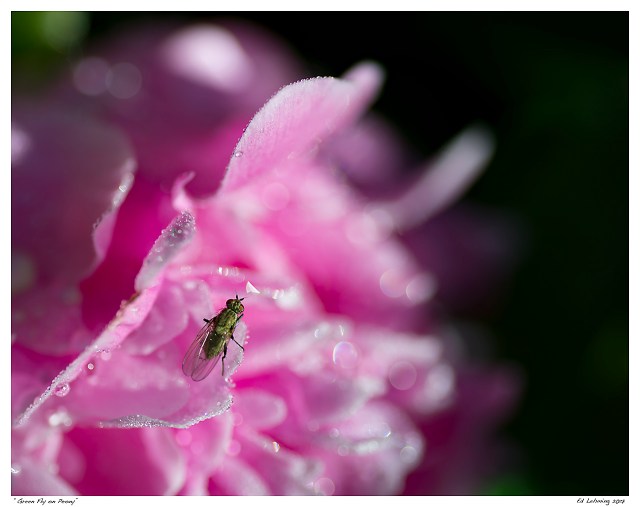
As I came outside yesterday, I was filled with the sweet aroma of Peony. Our walkway is bordered by two enormous peony plant. They stand nearly five feet (just under two meters) tall and are now so big that an extra large peony ring will not hold them. I’ve taken to using rope to hold them in place. Each bush has close to fifty blossoms open at any given time and, being heirloom peonies, the fragrance is beautiful.
It rained on and off most of yesterday, yet they did not flop over too badly. The flowers, though plentiful, are not huge, so that may be a saving grace. Because of the rains, the blossoms were completely dew covered and I went inside to grab my camera to make a few photos of this morning delight.
As I was making the images, I became aware that I was not alone in enjoying these blooms. Ants, spiders and flies were active as well. This little green fly caught my eye and did not take of as I got closer to make the image. I have no idea of what type of fly it is, but it made for a pleasing image, posed on the pink dewy petals, basking in the early morning sunshine, the first day of summer.
Nikon D800
Tamron SP AF 90mm f/2.8 Di Macro 1:1 (272ENII)@90mm
1/800 sec, f/5.0 ISO 100
for more images like this, please visit my Facebook page:
https://www.facebook.com/EdLehming
or my website (some images available for purchase)
http://www.edlehming.com
“As I leave the garden
I take with me a renewed view,
And a quiet soul.”
― Jessica Coupe
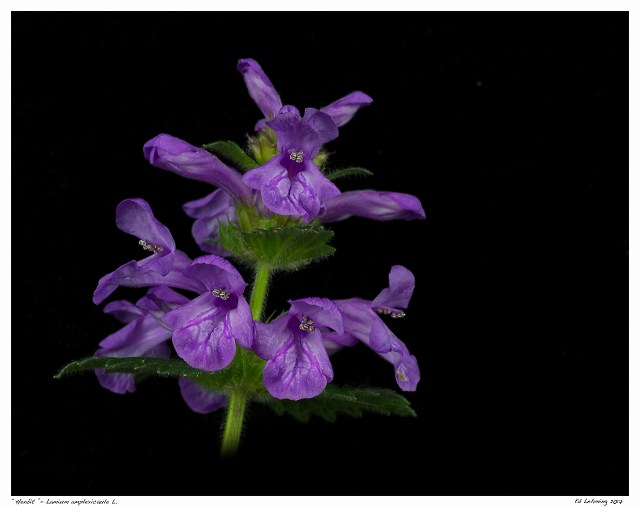
This lovely purple flowered plant was given to me by my grandmother many years ago and is well established in the garden. For years I called it Bee-Balm, being uncertain of what it really was. It always reminded me a bit of nettle or overgrown Creeping Charley.
One of the joys of photography, which I have mentioned before, is that it allows me the ability to look at things more carefully and to use internet tools to search images. So, I now know that this plant is called Henbit or Henbit Dead-nettle. That explains my perception of it being some variety of nettle. Honestly though, I’m a bit disappointed in the name. It seems so dull for such a beautiful plant.
The plant is a great attractor of bees and hummingbirds, though a bit unsightly till it puts up flowers. The flowers are quite long lasting and we enjoy them through most of late June into July. It’s also quite photogenic and has given me a break from my peonies, which continue to provide their enjoyable fragrance and beautiful blossoms.
Nikon D800
Tamron SP AF 90mm f/2.8 Di Macro 1:1 (272ENII)@90mm
2.0sec, f/32.0 ISO 100
High Resolution image on 500px
for more images like this, please visit my Facebook page:
https://www.facebook.com/EdLehming
or my website (some images available for purchase)
http://www.edlehming.com
May you understand my love–because it is the only thing I have that is really mine, the only thing that I will be able to take with me into the next life. Please allow it to be courageous and pure; please make it capable of surviving the snares of the world.”
― Paulo Coelho
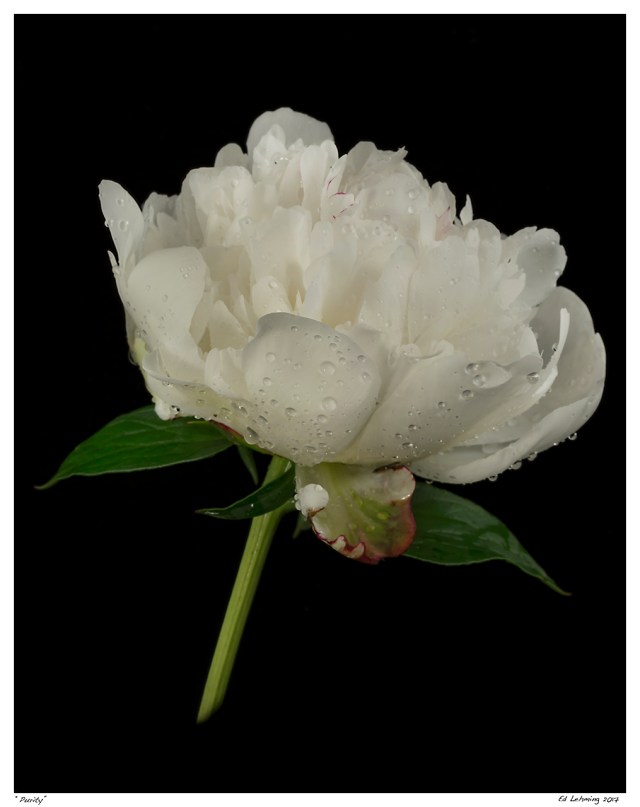
A simple title that describes my first impressions of this single, rain speckled, white peony blossom. Yesterday rained heavily and quite steadily, less than ideal conditions for peonies. So, I spend some time early in the morning salvaging a few of them to photograph and remember, before they get battered too badly.
Needless to say, this has been a spectacular year for my peonies and I’ve enjoyed photographing them at their peak. The raindrops are just an added bonus.
Nikon D800
Tamron SP AF 90mm f/2.8 Di Macro 1:1 (272ENII)@90mm
0.8 sec, f/36.0 ISO 100
High Resolution image on 500px
for more images like this, please visit my Facebook page:
https://www.facebook.com/EdLehming
or my website (some images available for purchase)
http://www.edlehming.com
“It’s so curious: one can resist tears and ‘behave’ very well in the hardest hours of grief. But then someone makes you a friendly sign behind a window, or one notices that a flower that was in bud only yesterday has suddenly blossomed, or a letter slips from a drawer… and everything collapses. ”
― Colette
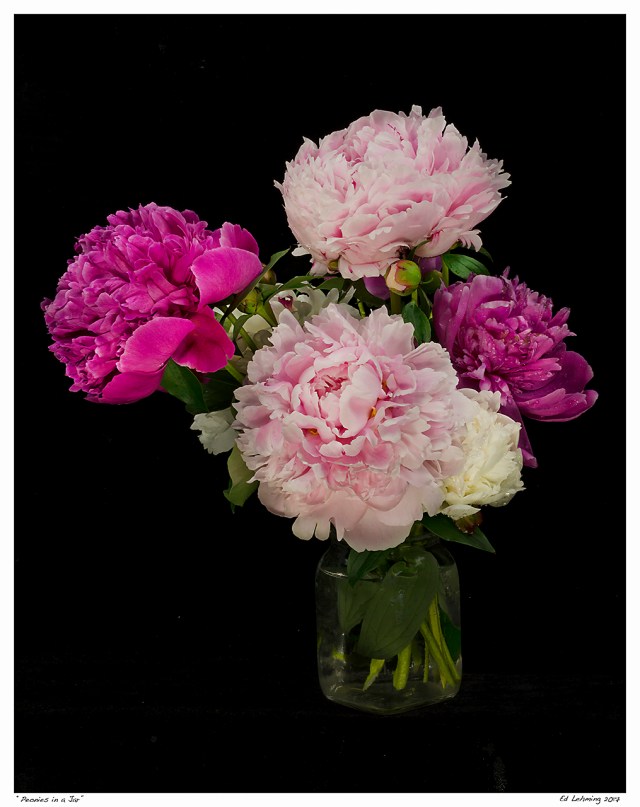
Here’s an assemblage of several of the peonies I’ve shared over the past few days, placed in a convenient mason jar. I do have a few more formal peony vases that my grandmother used, but I have not done a large blossom harvest yet. It’s been more of a select and cut as individual plants began to bloom, which has been a daily activity for the past week or so.
Though casually placed, I think they make a nice bouquet, showing the different colours and sizes in a single image, and the aroma is absolutely wonderful. The half quart jar also gives a reference point to gauge the size of the blossoms from. Some are quite large.
As I write this post, I can see several more ‘subjects’ ready to open. And, when the rain hopefully stops later today, I can get out and harvest them for the studio.
Since many came from my mother-in-law’s garden and her health is not great, I plan to document them all in a photo album. All that will be missing is the scent.
Nikon D800
Tamron SP AF 90mm f/2.8 Di Macro 1:1 (272ENII)@90mm
1.6 sec, f/36.0 ISO 100
High Resolution image on 500px
for more images like this, please visit my Facebook page:
https://www.facebook.com/EdLehming
or my website (some images available for purchase)
http://www.edlehming.com

A heavy sort of beauty,
yet delicate to the eye.
The peony welcomes the late spring sunshine,
and bears the burden of its rains.
Nourished, yet strained,
she bows to the beginning of summer.
– Ed Lehming
The peonies keep coming, and despite the rains, they are holding up quite well. As I’ve said before, how they hold up their heavy flowers is a real marvel. As I clip blossoms to photograph them, I am challenged to find a way to hold them up to photograph them. They either droop or pull the supports over. They are that heavy.
The blossom above is probably one of the heaviest so far. It’s thick magenta blossom is much larger than the earlier varieties which have been blooming in my gardens for the past few weeks. As you can also see, there are sub-blossoms ready to bloom as well, but they will yield smaller flowers.
This is my first year of really paying close attention to my peonies. Probably because they are all blooming around the same time. Since they are almost all from my mother-in-law, some have taken a few years to establish enough to come to full bloom. I had not realized that similar coloured blooms are actually different varieties. Such is the joy of gardening and learning.
My next challenge will be to figure out the names of these heirloom peonies.
Nikon D800
Tamron SP AF 90mm f/2.8 Di Macro 1:1 (272ENII)@90mm
1.6 sec, f/36.0 ISO 100
High Resolution image on 500px
for more images like this, please visit my Facebook page:
https://www.facebook.com/EdLehming
or my website (some images available for purchase)
http://www.edlehming.com
“Now a soft kiss – Aye, by that kiss, I vow an endless bliss.”
― John Keats
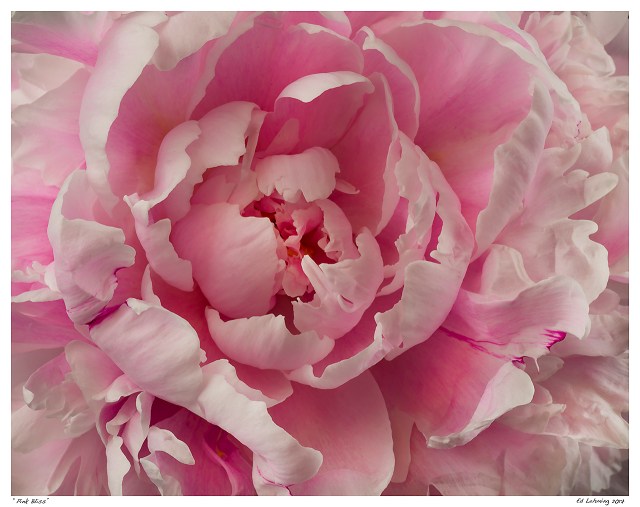
What more can I say, I am enveloped in pink. It is the colour theme of the season, the transition from whites to pinks and purples.
Our peonies, are redolent in pinks and magentas. The gardens, filled with pink ruffles, brilliant white ecstasy, and magenta glory.
Nikon D800
Tamron SP AF 90mm f/2.8 Di Macro 1:1 (272ENII)@90mm
2.0 sec, f/36.0 ISO 100
High Resolution image on 500px
for more images like this, please visit my Facebook page:
https://www.facebook.com/EdLehming
or my website (some images available for purchase)
http://www.edlehming.com
“Everything passes. Joy. Pain. The moment of triumph; the sigh of despair. Nothing lasts forever – not even this.”
― Paul Stewart
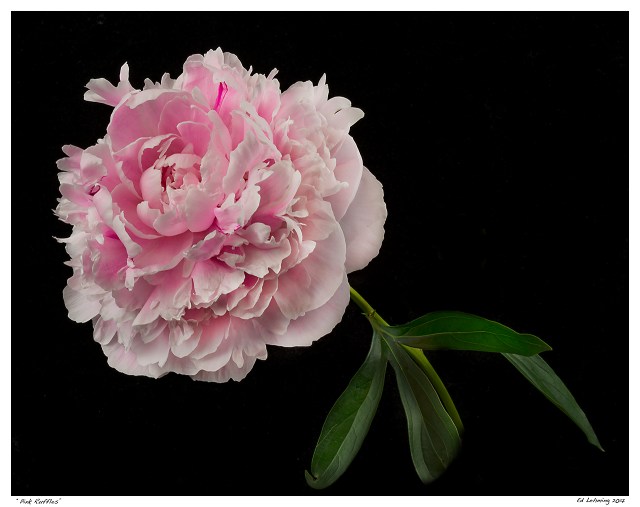
The ‘fancy’ pink peonies are blooming at last. The flowers this year are massive and I frankly have no idea how the weight of the blossoms is supported by some of the stalks. Were it not for surrounding vegetation and a fence, they would surely collapse under their own weight.
I’m hoping to enjoy them for at least a few days, before the heat of day takes its toll or a rainstorm adds so much weight that the just fold over. Perhaps it’s the brevity and uncertainty of their beauty that makes them so precious?
Nikon D800
Tamron SP AF 90mm f/2.8 Di Macro 1:1 (272ENII)@90mm
2.0 sec, f/36.0 ISO 100
High Resolution image on 500px
for more images like this, please visit my Facebook page:
https://www.facebook.com/EdLehming
or my website (some images available for purchase)
http://www.edlehming.com

“The long roots of the peony strike deep into the past.”
– Alice Coats
Today I’m sharing a peony that I have many of and I don’t believe this is the first blossom either. Several blossoms opened a few days ago, so it’s hard to know. The plant itself came from abandoned (expropriated) farm near my home. The family who used to live there (Spangs) were close friends with my wife’s family and are distant relations.
The land was expropriated (taken by the government) back in the nineteen seventies, with plans to build an international airport. Those plans never materialized and many families were displaced for nothing. Over time, houses and farm building were rented out or simply abandoned to rot. Many of these farms also had beautiful gardens at one point, now overgrown with grasses and thick shrubbery. I noticed the bright pinks of these peonies from the road, as I drove by and asked permission to dig them up. Permission was granted and I proceeded to recover some twenty plants, some of which went to my gardens and others were given to friends, as well as planted in the gardens at my kids’ school.
I have no idea how old the plants are, but peonies can live for close to a century and these have roots the size of yams. I have a touch with peonies and most plants bloomed the next year. These are also prolific bloomers, with each stem producing up to three flowers (you can see two more buds in the photo), making for a terrific display.
As I enjoy them, so do others and I’m often asked about them. It’s nice to be able to tell this story, give a bit of local history, and simply enjoy the lasting beauty of these deep pink blossoms, as they fill the air with their rich fragrance.
This richly fragrant, deep pink relic is one of the oldest peonies of all, and yet, writes expert Martin Page, it’s “still one of the best.” Introduced in France soon after the first lactiflora peonies arrived from China, it has been cherished ever since for its “good form, strong color, and delightful fragrance” (Boyd, 1928).
Nikon D800
Tamron SP AF 90mm f/2.8 Di Macro 1:1 (272ENII)@90mm
2.0 sec, f/32.0 ISO 100
High Resolution image on 500px
for more images like this, please visit my Facebook page:
https://www.facebook.com/EdLehming
or my website (some images available for purchase)
http://www.edlehming.com
“Spiders are anti-social, keep pests under control, and mostly mind their own business, but they somehow summon fear in humans who are far more dangerous, deceitful and have hurt more people. Of the two I’m more suspicious about the latter.”
― Donna Lynn Hope
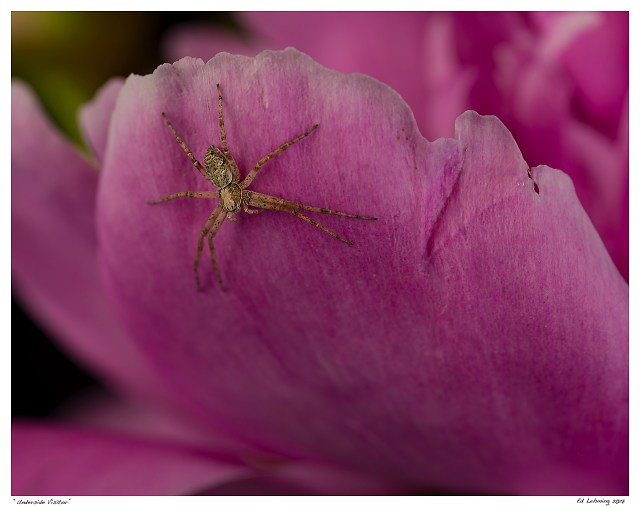
Finding a ‘visitor’ should not have come as a surprise. As I was making photos of one of my peonies, a spider, variety unknown to me (I’m not a big spider fan), popped out of the petals and chose the base of one of the outer petals as its perch.
Once it found this spot, it did not move and presented an opportunity to make an image of it. Like I said, I’m not a big fan of spiders, but I do enjoy looking at details and this one certainly has some interesting markings. He’s really quite small, but the macro treatment makes him look big in the photo.
Generally, I like to leave peonies on the porch for a few hours before bringing them and all their hitch-hikers into the house, mostly ants, but I expect this guy would have come in regardless.
Nikon D800
Tamron SP AF 90mm f/2.8 Di Macro 1:1 (272ENII)@90mm
0.4 sec, f/18.0 ISO 100
for more images like this, please visit my Facebook page:
https://www.facebook.com/EdLehming
or my website (some images available for purchase)
http://www.edlehming.com
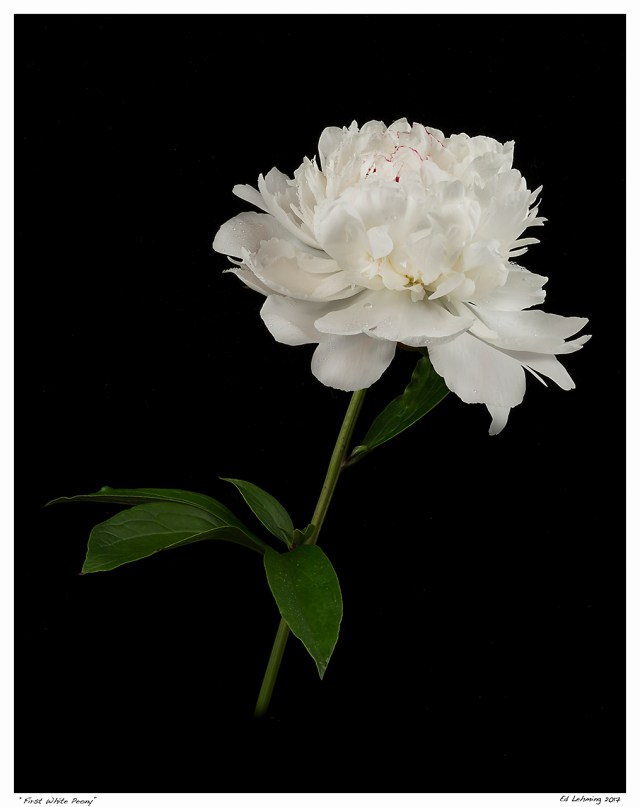
“She was pure, it was true, as he had never dreamed of purity; but cherries stained her lips.”
― Jack London
In this year’s theme of ‘firsts’, here’s yet another. The first white peony made its appearance in my gardens this morning. These white peonies hold a special place in our family, having been passed do from my wife’s grandmother.
It’s an interesting blossom, being a beautiful pure white, with a tiny red fringe on the inside petals. I have yet to discover the particular variety. We also have another variant, similar to this one, but with splashes of red in the interior petals rather than the fine fringe.
I love these heritage peonies for a number of reasons: they are extremely hardy, once established, they have an intense wonderful fragrance, which fills the morning air, the blossoms are long lasting and make beautiful floral arrangements for indoors. Finally, once flowers are shed, the foliage is lush and green and changes to a deep crimson in the fall.
Late spring and early summer is a great time of anticipation in the garden. Watching blossoms going from bud to flower overnight is almost magical. Knowing our family ancestors have also experienced these moments makes it even more special. Common expressions among my family generally have a theme like, “Oh, look! Grandma Fretz’s peony is blooming, just in time for Fathers Day.”
Nikon D800
Tamron SP AF 90mm f/2.8 Di Macro 1:1 (272ENII)@90mm
2.0 sec, f/32.0 ISO 100
High Resolution image on 500px
for more images like this, please visit my Facebook page:
https://www.facebook.com/EdLehming
or my website (some images available for purchase)
http://www.edlehming.com

This week’s submission to Norm 2.0‘s Thursday Doors.
Thursday Doors is a weekly feature allowing door lovers to come together to admire and share their favourite door photos from around the world.
“Beverly House Doors” – Royal Ontario Museum
Doors in a museum? Imagine my surprise.
On a visit to the Royal Ontario Museum a few months back, I entered a section of the museum tucked away from most of the traffic and discovered an entire section dedicated to the history of Canada. Why was I not previously aware of this?
Among this collection, I was surprised to see several historic doors on display. This was quite a surprise, that someone cared enough about doors to preserve them.
The above door , circa 1822, belonged to Beverly House, the residence of Sir John Beverley Robinson (1791 -1863), Chief Justice of Upper Canada, was one of the most impressive residences in early Toronto. It was located at the northeast corner of John and Richmond Streets. Robinson, the son of a Loyalist from Virginia, was one of the most powerful men in Ontario in his time. The house was demolished around 1913.
The door was a gift to the museum from the Ursuline Religious of the Chatham Union in Toronto.
Thank goodness someone had the foresight to preserve this door for generations to enjoy.
iPhone 7 back camera @ 4.0mm
1/7 sec; f/1.8; ISO 80

“Most misunderstandings in the world could be avoided if people would simply take the time to ask, “What else could this mean?”
― Shannon L. Alder
One of the great joys of macro photography is how it changes how you see things. Common flowers, or objects, take on a whole new look and feel when you get real close. Previously hidden details and textures emerge with clarity. The components of colour are separated and made visible.
Sometimes, the resulting image looks completely otherworldly, even unidentifiable. I left this image moderately zoomed, so that it can still be identified as a clematis bloom. But have a look at the centre. Imagine seeing the yellow stamen with just a touch of magenta around them. It would look like some strange sea creature reaching out with its tendrils, no longer a flower.
It certainly is fun, when editing my photos, to do these extreme zooms and let my imagination run free.
Nikon D800
Tamron SP AF 90mm f/2.8 Di Macro 1:1 (272ENII)@90mm
3.0 sec, f/29.0 ISO 100
High Resolution image on 500px
for more images like this, please visit my Facebook page:
https://www.facebook.com/EdLehming
or my website (some images available for purchase)
http://www.edlehming.com
“If today is not your day,
then be happy
for this day shall never return.
And if today is your day,
then be happy now
for this day shall never return.”
― Kamand Kojouri
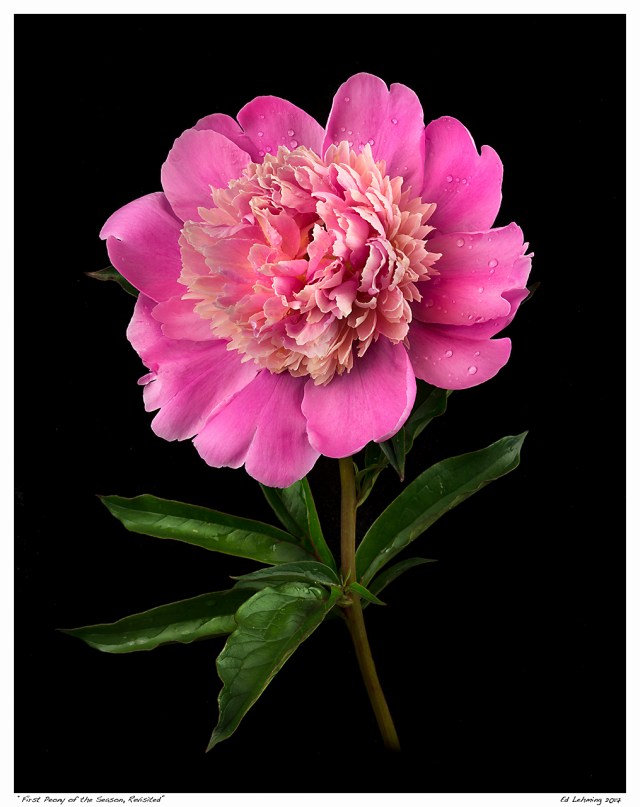
I wanted to revisit this first peony blossom today. The image is made from a slightly different angle. When I shoot in the studio, I almost always set the subject up intuitively and stick with that shot. A few days may pass till I shoot it again, but I rarely, if ever, change the initial composition. Except this time.
I don’t spend a lot of time setting these shots up. I just ‘know’ that a certain composition will work. As I experiment, I may make changes from the original setup, but am usually not happy with it and don’t even make an image.
In the case of this wonderful peony blossom, however, the first shot, which I shared yesterday, was my go-to, yet this view is equally pleasing and shows the full face of the blossom. Nothing else was changed, just the shooting angle. I think both work and am now stuck with which one I like better. Perhaps both?
Nikon D800
Tamron SP AF 90mm f/2.8 Di Macro 1:1 (272ENII)@90mm
2.0 sec, f/32.0 ISO 100
High Resolution image on 500px
for more images like this, please visit my Facebook page:
https://www.facebook.com/EdLehming
or my website (some images available for purchase)
http://www.edlehming.com
“With the utmost love and attention the man who walks must study and observe every smallest living thing, be it a child, a dog, a fly, a butterfly, a sparrow, a worm, a flower, a man, a house, a tree, a hedge, a snail, a mouse, a cloud, a hill, a leaf, or no more than a poor discarded scrap of paper on which, perhaps, a dear good child at school has written his first clumsy letters. The highest and the lowest, the most serious and the most hilarious things are to him equally beloved, beautiful, and valuable.”
― Robert Walser
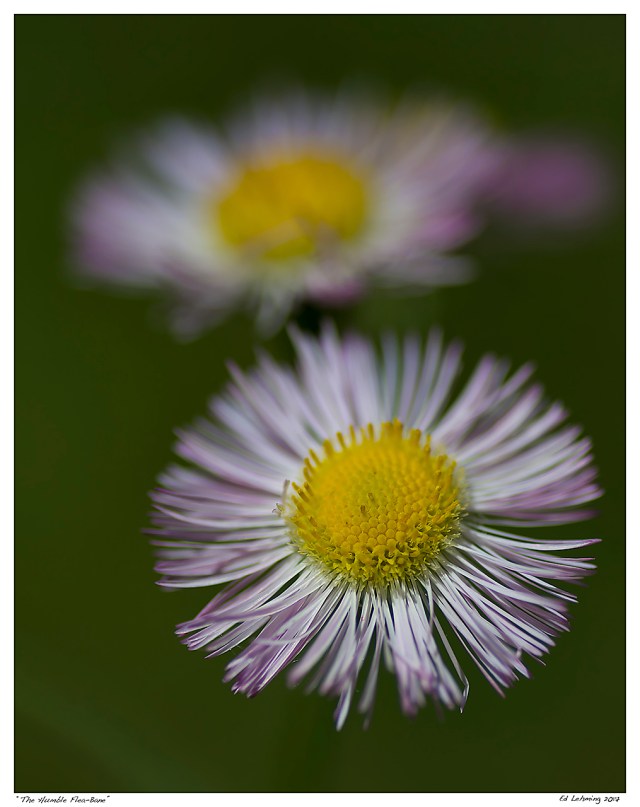
There is such beauty in even the most common of wildflowers, even this small member of the daisy family. I was going to title this First Fleabane of the season, since it is that, but I wanted to focus on commonplace beauty.
Over the past year or so of photography, my perspective on what beauty is has shifted dramatically. I’m now finding a richness in the more diminutive flowers, in dead or dying blossoms, the way light plays on a shrivelled leaf. Objects, that at first glance, don’t seem worthy of a second glance, or a more careful inspection.
I’ve become increasingly aware of how much of my world my brain filters out as ‘inconsequential’, causing me to pass it by. The more deliberate I become in observation, the more my world opens up to experiences I have missed in the past. Even at this, I’m still left baffled at what I’m missing. Through photography, I’m able to freeze that moment and really take the time to fully experience an image and my hope is that those moments are resonating with my readers.
Nikon D800
Tamron SP AF 90mm f/2.8 Di Macro 1:1 (272ENII)@90mm
1/2500 sec, f/5.0 ISO 100
High Resolution Image on 500px
for more images like this, please visit my Facebook page:
https://www.facebook.com/EdLehming
or my website (some images available for purchase)
http://www.edlehming.com
“When nothing else subsists from the past, after the people are dead, after the things are broken and scattered…the smell and taste of things remain poised a long time, like souls…bearing resiliently, on tiny and almost impalpable drops of their essence, the immense edifice of memory”
― Marcel Proust
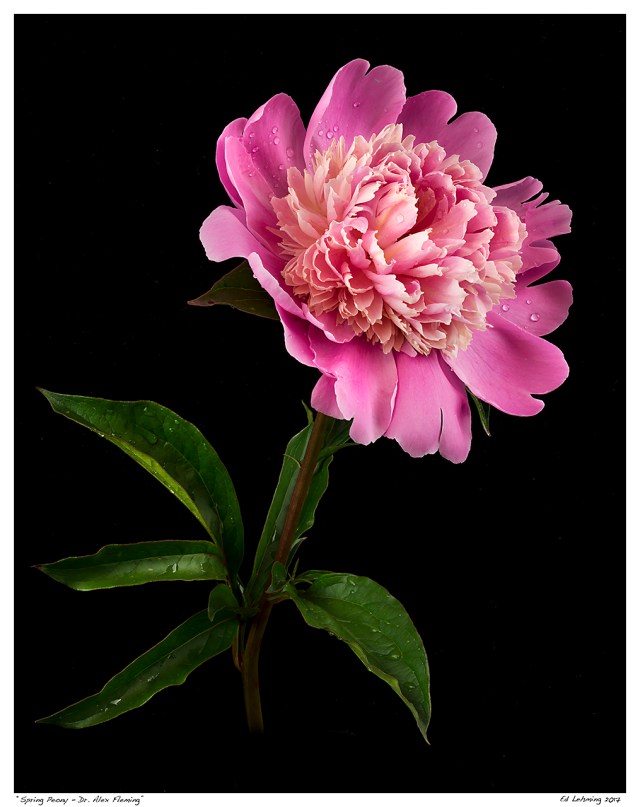
Peony, for me the queen of fragrance and memory.
As I stepped outside today, following a brief rain shower, the perfume of this peony struck my senses, causing me to smile as I recalled fond memories of the glorious gardens of so many dear to me, many no longer with us. It stopped me in my tracks, as I surveyed the garden, seeking the source. Yesterday, the peonies were just buds, filled with promise, but not ready to open. My eyes found the source, a single blossom, dew covered, and shining in the sun, the most intense pink petals fully and unexpectedly opened to the sun.
The memories are wonderful and intense. I recall gardening with my adopted grandmother, Margarete, as she tended a large bed of pink and white peonies, my maternal grandmother, Lola, also an avid gardener, with her own collection, handed down from her mother and cherished. Finally, my mother-in-law, Lois, who moved to a smaller residence a few years ago, leaving me her collection of peonies, not to be left behind. They filled every spare space in my gardens and I would have it no other way. They too have a history, having come from her mother and grandmother. Such seems to be the way of the peony. I’m sure each plant has fragrance and memory deeply intertwined.
As I sit and write this, the sweet aroma still in my mind, I can see each of them, out in their gardens, a smile of recollection on their faces as they reflect on their own memories and their cherished peonies.
Nikon D800
Tamron SP AF 90mm f/2.8 Di Macro 1:1 (272ENII)@90mm
2.0 sec, f/32.0 ISO 100
High Resolution image on 500px
for more images like this, please visit my Facebook page:
https://www.facebook.com/EdLehming
or my website (some images available for purchase)
http://www.edlehming.com

“Firsts are best because they are beginnings.”
― Jenny Han
The firsts keep coming. This time the first Clematis blossom, from our front flower bed. The first bloom has usually occurred around prom/graduation time, and has been prominent in many photos of our kids as they prepared for these events.
Graduations and proms are becoming not so distant memories and now the first flower is simply there for us to enjoy and evoke memories.
I’m sure as our children move through their lives, there will be many more firsts, some matching the blooming of a certain flowers and others, not. Nonetheless, I celebrate firsts much more than lasts. Though those too, are inevitable.
Nikon D800
Tamron SP AF 90mm f/2.8 Di Macro 1:1 (272ENII)@90mm
1/80 sec, f/10.0 ISO 100
for more images like this, please visit my Facebook page:
https://www.facebook.com/EdLehming
or my website (some images available for purchase)
http://www.edlehming.com
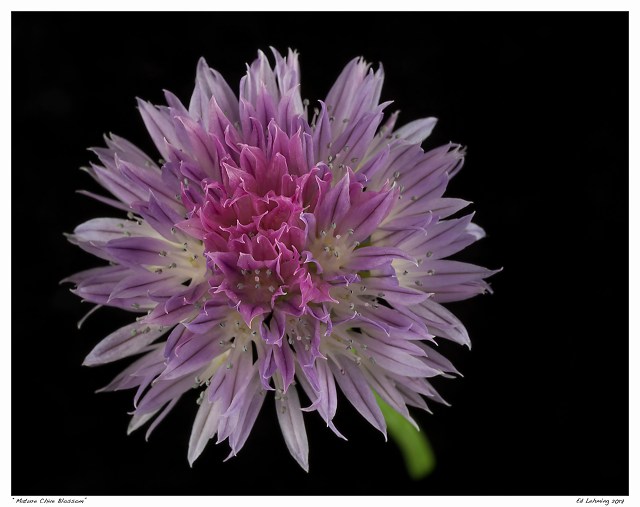
“Was it the case that colours dimmed as the eye grew elderly? Or was it rather that in youth your excitement about the world transferred itself onto everything you saw and made it brighter?”
― Julian Barnes
This blossom seems so appropriate as the late spring colour transition continues, with pinks becoming more purple and the introduction of oranges and reds.
I had photographed this blossom a few days ago and set it in a vase to preserve it. The flower continued to mature with the once purple flowers yielding to a magenta centre, which has continued to expand.
There’s something magical about the texture of this blossom that keeps me coming back. From first noticing the individual blossoms in the cluster to the delicate anthers and filaments. There’s just so much to see in this flower. It reminds me of a fireworks burst, with all the colours.
Nikon D800
Tamron SP AF 90mm f/2.8 Di Macro 1:1 (272ENII)@90mm
3.0 sec, f/36.0 ISO 100
High Resolution image on 500px
or more images like this, please visit my Facebook page:
https://www.facebook.com/EdLehming
or my website (some images available for purchase)
http://www.edlehming.com
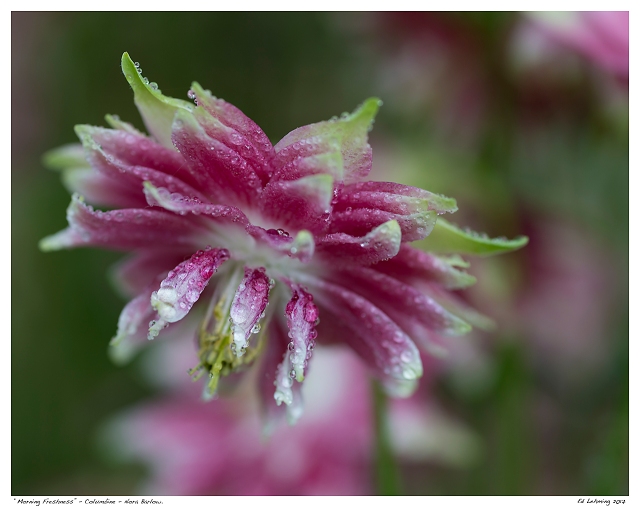
“When you arise in the morning, think of what a precious privilege it is to be alive—to breathe, to think, to enjoy, to love—then make that day count!”
― Steve Maraboli
As I sat, yesterday morning, sipping a coffee, on my back deck. I looked over my now lush garden. The rains have stopped, the temperatures are climbing and I can savour these moments, if only on weekends.
One of my columbine plants, is enormous, probably the result of several plants growing in a single location. Even at that, it towers almost a full meter in height, three times the height of its neighbours, and it is thick with blossoms.
I got up to take a better look at all the blossoms and noticed that the morning mist still clung thickly to the petals, like little jewels, adding further drama to the scene. Not wanting to miss this moment, as the lifespan of the blossoms is quite brief, I grabbed my camera and made a quick image to preserve this image to share today.
It reminds me of what a privilege it really is to be alive,as said so well in the quote I chose today.
Nikon D800
Tamron SP AF 90mm f/2.8 Di Macro 1:1 (272ENII)@90mm
1/40 sec, f/10.0 ISO 100
High Resolution Image on 500px
for more images like this, please visit my Facebook page:
https://www.facebook.com/EdLehming
or my website (some images available for purchase)
http://www.edlehming.com
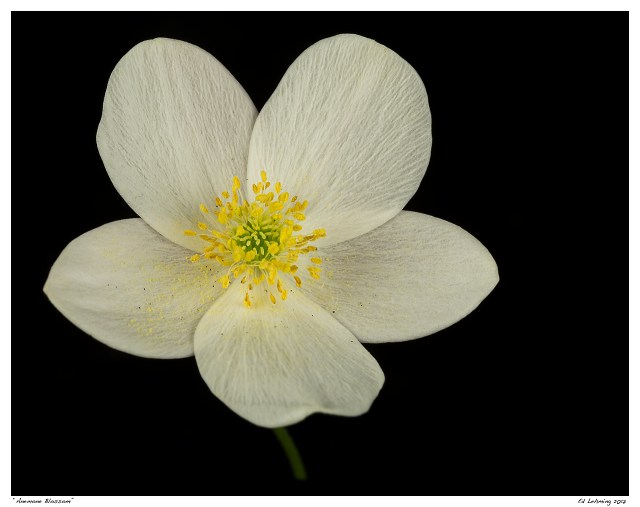
“I will be the gladdest thing under the sun! I will touch a hundred flowers and not pick one.”
― Edna St. Vincent Millay
Before they fade with the heat, I thought I’d make a quick image of this anemone blossom. Which, like all the studio close-ups, reveals wonderful details and complex structures. This blossom, a bit ‘mature’ has dropped a lot of pollen on the petals already. I’m not sure what pollinates them, but have not seen any bees pay them much attention.
Nikon D800
Tamron SP AF 90mm f/2.8 Di Macro 1:1 (272ENII)@90mm
1.6 sec, f/36.0 ISO 100
High Resolution image on 500px
or more images like this, please visit my Facebook page:
https://www.facebook.com/EdLehming
or my website (some images available for purchase)
http://www.edlehming.com
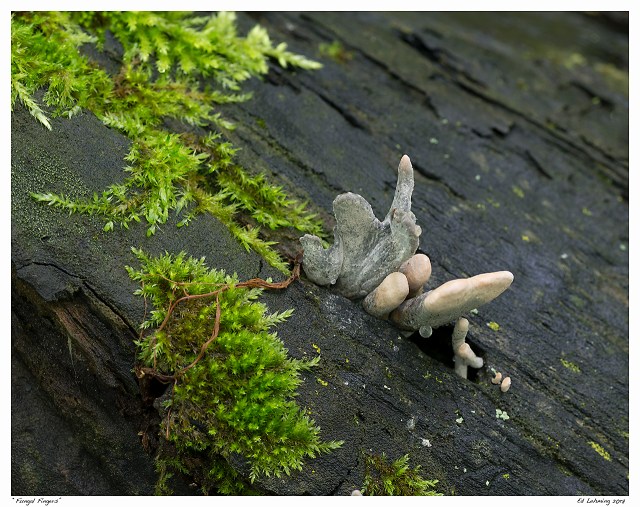
“This might be the most important question for every creator and maker in the world: how do you make something new if most people just like what they know? Is it possible to surprise with familiarity?”
― Derek Thompson
With a gradual warming and ample moisture, fungi are now beginning to emerge from cracks and crevices in rotting logs. I’m not skilled at early fungus identification, but I imagine these ‘fingers’ will soon develop into a more recognizable form.
They are also very good at concealing their presence. Even though my eyes are always scanning for something unique, it was not till I noticed this small grouping that I realized that there were hundreds of similar colonies growing close by.
Most looked simply like slender, fleshy fingers, this larger group seems to be a bit more advanced. I’ll have to keep an eye on them and see what develops.
I also found this an interesting composition, showing the developing fungus with a splash of colour from the adjacent mosses.
Nikon D800
Tamron SP AF 90mm f/2.8 Di Macro 1:1 (272ENII)@90mm
1/8 sec, f/16.0 ISO 400
for more images like this, please visit my Facebook page:
https://www.facebook.com/EdLehming
or my website (some images available for purchase)
http://www.edlehming.com
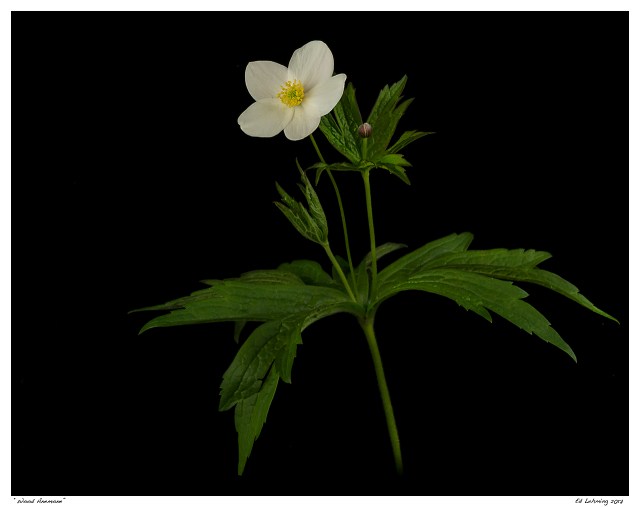
“Humans do artificial things
But nature always hits back naturally !!!”
― Akshay Shinde
I decided to give this one the studio treatment, to show all the complex textures apart from the ‘clump’ growing in my front garden.
The Wood Anemone is a native plant and through a natural process, ended up growing my gardens. I enjoyed watching it flower a few years ago, till it started taking over the entire flower bed. The next year, I waited for the bloom and then pulled them all out, their time in my garden being past. Yet, nature is not to be daunted, and the few root fragments that I missed took hold once more and I have two large clumps flowering away.
I’ve resigned to pulling just a single clump out this year, leaving the other for another season. At the very least, the beautiful white flowers are a pleasure to look at and have now provided me more photography material.
Nikon D800
Tamron SP AF 90mm f/2.8 Di Macro 1:1 (272ENII)@90mm
0.5 sec, f/32.0 ISO 400
High Resolution image on 500px
or more images like this, please visit my Facebook page:
https://www.facebook.com/EdLehming
or my website (some images available for purchase)
http://www.edlehming.com

“Our brightest blazes of gladness are commonly kindled by unexpected sparks.”
― Samuel Johnson
I’m revisiting this interesting flower one more time. When I first discovered it, I was not sure what it was, so I took several photos, hoping to identify it when I got home from my hike.
Sometimes, a surprise awaits, as in this image, which shows the Avens flower very nicely but also includes a guest, in the form of a black beetle merrily eating away at one of the leaves.
It surprises me every time, that I do not notice these little subtleties, while focussing on my primary subject. Of course, since I did not notice it, I also did not try to bring it into focus, which I why it’s a bit soft.
Nikon D800
Tamron SP AF 90mm f/2.8 Di Macro 1:1 (272ENII)@90mm
1/30 sec, f/10.0 ISO 800
for more images like this, please visit my Facebook page:
https://www.facebook.com/EdLehming
or my website (some images available for purchase)
http://www.edlehming.com

“All life is bound to a simple truth… that time goes on, that in each person’s life begins a tale, a tale that will either end in memory or in legend.”
― M.J. Chrisman
Here I am revisiting the dried flowers that I have kept from earlier in the spring. The textures and colours still fascinate me. Is this a weird thing, this enjoyment of the ‘expired’ flowers?
I have enough now to create a collection, and I am considering naming the series “Best Before”. For me, it’s really a study of flowers in an unconventional way. There is a certain beauty, which I have alluded to in previous posts. There is a delicacy, inherent with something that has dried out. The fine connecting tissues are weak and brittle, so handling them is a bit of an art in itself. Light transmits through them, as well as reflecting from them, creating interesting effects.
Consideration has also been give to really tight shots, where the flower itself is not recognizable, just the lines, textures, and colour, which has a certain curious appeal to me as I am editing, but I inevitably zoom back out to the whole once more.
So, this post is more of a series of thoughts than anything of substance, my way of processing my technique and considering next steps.
By the way, if you are curious, this daffodil was one of a grouping I shared earlier.
Nikon D800
Tamron SP AF 90mm f/2.8 Di Macro 1:1 (272ENII)@90mm
1.6 sec, f/36.0 ISO 100
High Resolution image on 500px
or more images like this, please visit my Facebook page:
https://www.facebook.com/EdLehming
or my website (some images available for purchase)
http://www.edlehming.com
“When life is not coming up roses
Look to the weeds
and find the beauty hidden within them.”
― L.F.Young
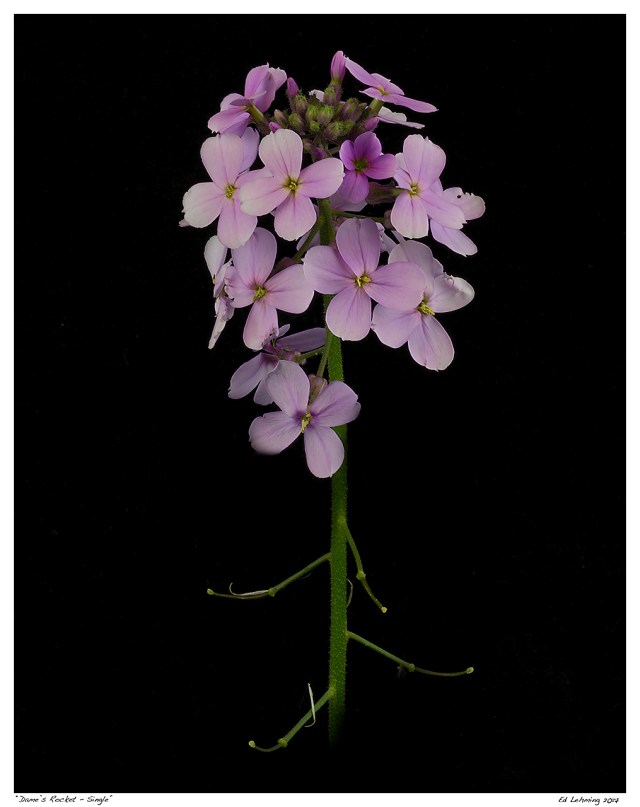
Another season is just about over for these pretty plants, whose colour ranges from white to dark purple.
I posted another image, a few days back, of the flowers, blooming in my garden. The post was also shared by me on an amateur botany page, where it received comments about being non-native, invasive, and a weed. All these points are true, to some degree. It is absolutely non-native, coming from Eurasia as a garden flower in the 17th century, along with other common wildflowers like dandelion, plantain, violets, and clover, to name a few. Is it invasive?
By the standard definition, an invasive species is one that can escape cultivation, that can crowd out other plants and that is not native to the ecosystem in which it is growing. It certainly can do that. In fact, I have found it difficult to cultivate, as it goes wherever it pleases. Currently, there is a large,flourishing colony, on the other side of my fence. So, by the above definition, it has ‘escaped’, it does crowd other native plants and, as I mentioned earlier, it’s not native.
Is it a ‘weed’? Like the well-known garden quote by Ella Wilcox, “A weed is but an unloved flower.” So, if I love them, are they weeds? The jury is out on that, depending on who you consult.
For me, the Dame’s Rocket adds a splash of early colour to my gardens, and the field behind it.
As for the studio image, like so many flowers lately, I’m enjoying the ability to take time to really appreciate the flower and all its complexities, and the isolated, studio images let me do just that. By the looks of this one, there are still a few days of bloom ahead.
Nikon D800
Tamron SP AF 90mm f/2.8 Di Macro 1:1 (272ENII)@90mm
0.5 sec, f/32.0 ISO 400
High Resolution image on 500px
or more images like this, please visit my Facebook page:
https://www.facebook.com/EdLehming
or my website (some images available for purchase)
http://www.edlehming.com

“Every flower is a soul blossoming in nature.”
― Gérard de Nerval
I had to go back to this location again and get just one more image of the bunchberries, before they fade into summer and memories. There are certain plants that have a subconscious draw on me. Bunchberry is one of those. perhaps it’s my love of dogwoods, a family of plants to which these also belong. Miniature dogwoods! It’s the only dogwood that grows in Ontario that is not a tree or shrub.
I’m really not sure what draws me to dogwoods. Perhaps its the symmetry of the flowers or the deep textures of the leaves? In any case, I’ve enjoyed finding this small grove, just off the trails and enjoyed having the opportunity to photograph them just after a gentle rain last weekend, along with many other native wildflowers.
Nikon D800
Tamron SP AF 90mm f/2.8 Di Macro 1:1 (272ENII)@90mm
1/20 sec, f/10.0 ISO 800
High Resolution Image on 500px
for more images like this, please visit my Facebook page:
https://www.facebook.com/EdLehming
or my website (some images available for purchase)
http://www.edlehming.com

“Some people walk in the rain, others just get wet.”
― Roger Miller
Another rainy day image, though the rain has finally moved on. It was so cool and wet this day that the Goat’s Beard blossoms remained partially closed. This one had a special appeal to me because of the raindrops that cling to it, a reminder that it was, in fact, raining that day, lest I forget.
Though I find myself grumbling about all the rainy days, it did make for some nice images. The dull skies allowed me to expose for longer, creating a bit more saturation and the rain gives everything a clean, lustrous appearance. This effect is especially noticeable in wildflowers, which just seem fresher when damp than they do on dry, sunny days.
As one who really does not mind getting wet, this all works out, provided I’m not caught in a downpour, and even those, have their magical moments.
Nikon D800
Tamron SP AF 90mm f/2.8 Di Macro 1:1 (272ENII)@90mm
1/500 sec, f/11.0 ISO 800
for more images like this, please visit my Facebook page:
https://www.facebook.com/EdLehming
or my website (some images available for purchase)
http://www.edlehming.com

This week’s submission to Norm 2.0‘s Thursday Doors.
Thursday Doors is a weekly feature allowing door lovers to come together to admire and share their favourite door photos from around the world.
“Abandoned”
This image is a far departure from my usual images of stately, ornate doors, yet they are still doors and I found them quite intriguing.
As I was out hiking earlier this year, I came across an abandoned maple sap evaporator, sitting in the middle of a mature forest. It seemed so out-of-place that I had to make a photo of it to show to friends and thought Thursday Doors might be another place to share it.
For those unfamiliar with maple syrup production, the ‘sap’, which is a sweet, watery liquid produced by Sugar Maple trees, is gathered, either in buckets attached to the trees or, for more modern facilities, via a ‘pipeline’ of plastic hoses, and boiled down in an ‘evaporator’, like this one (but not full of holes). A large fire is kept going under the evaporator to boil off most of the water in the maple sap. The remaining syrup, is then further boiled in a smaller finishing tank. At the end of the process, the maple syrup, is about 1/40th the volume of the original sap. So, it takes a lot of sap to produce even a small amount of syrup. This boiling process occurs late February to early March, just as days begin to warm and the sap rises into the tree, which requires cold nights and days above freezing. The cycle usually runs for just over a week.
So, I look at this image and can imagine someone, in days gone by, harvesting the sap and boiling it here in the forest. The tank would likely have been covered or enclosed in a large ‘sugar shack’ to protect the producer from the elements and keep foreign matter from surrounding trees from falling into the evaporator.
Nikon D800
Tamron SP AF 90mm f/2.8 Di Macro 1:1 (272ENII)@90mm
1/50 sec, f/10.0 ISO 200
or more images like this, please visit my Facebook page:
https://www.facebook.com/EdLehming
or my website (some images available for purchase)
http://www.edlehming.com
“Love softens the hardest edges of life’s tumult.”
― Bryant McGill
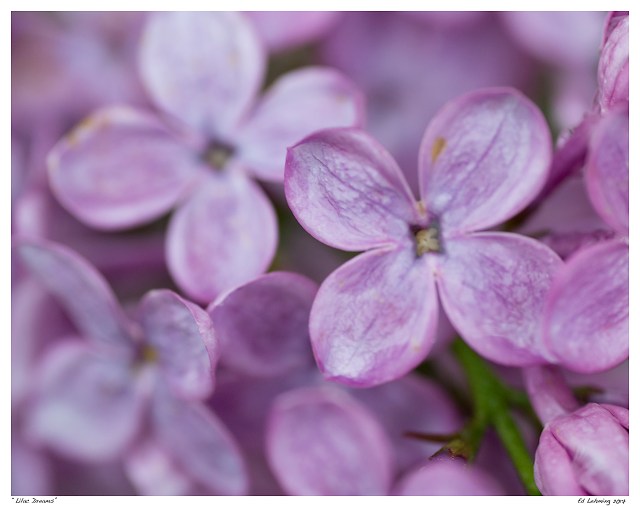
Along the dirt road that leads to one of my favourite hiking trails, are huge clumps of lilacs. There are many varieties, ranging from deep purples to the purest of whites. Their fragrance fills the air, even in the rain.
They certainly aren’t native to the location, likely planted as ornamental shrubs by the property owners many years ago. And, their beauty continues to please those who pass by to this day.
These lilacs are also very hardy, blooming long after most of the lilacs in town have faded. As I was passing, I stopped to make a few quick shots, enjoying the colours, textures, and of course, the fragrance of the lush and plentiful blossoms.
Since I was shooting with my macro lens, and there was a bit of a breeze, the images came out a bit soft, which bothered me at first. But, the more I looked at them, the more I began to like the soft, dream-like appearance. Perhaps, a bit of softness is alright on occasion?
Nikon D800
Tamron SP AF 90mm f/2.8 Di Macro 1:1 (272ENII)@90mm
1/250 sec, f/9.0 ISO 800
for more images like this, please visit my Facebook page:
https://www.facebook.com/EdLehming
or my website (some images available for purchase)
http://www.edlehming.com


Recent Comments