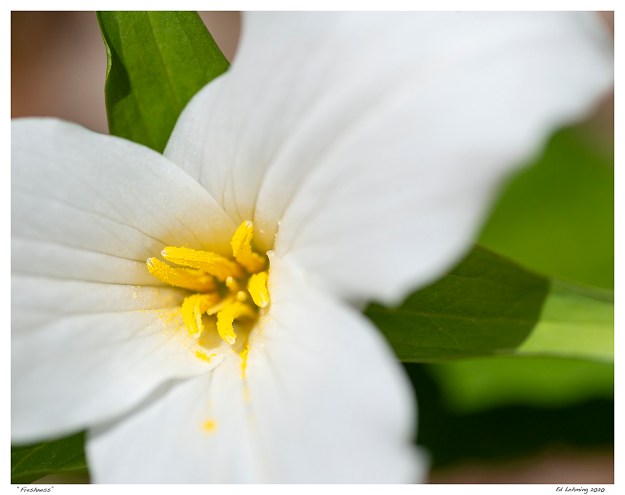
“I think I like spring the most. Everything is fresh and pristine, time and weather have not made their mark yet.” – Ed Lehming
I believe this may be my final trillium image for the season, the air has suddenly turned hot and muggy and what was once pure and white will already have begun to deteriorate. The white petals will turn a pale magenta but the pristine beauty they displayed last week will have faded.
This year has been a bit strange, very cool and dry. I fondly recall last year where cool temperatures lasted well into early June. I was enjoying trilliums for two weeks with a complete absence of biting insects.
The purity of this time of year is a special balm this year. With the uncertainty of the COVID-19 pandemic the freshness of the forest has restored me. I’ve extended my hike, taking time to really enjoy my forest surroundings and paying particular attention to all the new growth; leaves opening up, flowers filling the brown-gray forest floor with colour, and the sounds of birds returning. It really is a breath of fresh air.
From a photographic point of view, I had forgotten to turn my ISO back as I’d been shooting in mostly low light all day, so used a high shutter speed and moderate aperture to compensate. Sometimes these things happen.
Nikon D800
Tamron SP AF 90mm f/2.8 Di Macro 1:1 (272ENII)@90mm
1/2500 sec, f/10.0, ISO 800

“The forest fills with fresh green growth, as the cycle of growth begins anew, and with it, the inevitable return of insects.” – Ed Lehming
This image is now approaching a week old and represents the first solid growth of beech leaves in my area. On previous posts I have commented on the cool and dry spring we’ve had. Two weeks ago it snowed. Then seemingly overnight the temperature climbed into the high 20’s (celcius) and the forest literally exploded into life.
I’ve been waiting for a bit of warmth to bring on growth and add some colour back to the landscape, but along with the warmth come the stinging and biting insects. In this area, a particularly nasty critter known as a blackfly dominates May to early June. They are about the size of fruit flies but in their quest for a meal leave small itchy punctures which tend to bleed due to the anticoagulant in their saliva. The saliva also causes them to itch terribly in most people, leaving large red welts with a predominant puncture wound in the centre. You don’t feel them when they bite but you sure feel the itch afterwards.
I have not ventured into the woods since I made this image. I’m hoping the heat will ‘burn off’ some of the swarms of blackflies, yes there are literally clouds of them, before my next visit but I may not be able to wait that long. I know these leaves will be fully opened on my next visit and the delicate fuzz which protects them from late frosts will have been shed, leaving shiny, deep-green leaves to drink in the sun’s energy.
Nikon D800
Tamron SP AF 90mm f/2.8 Di Macro 1:1 (272ENII)@90mm
1/500 sec, f/8.0, ISO 200
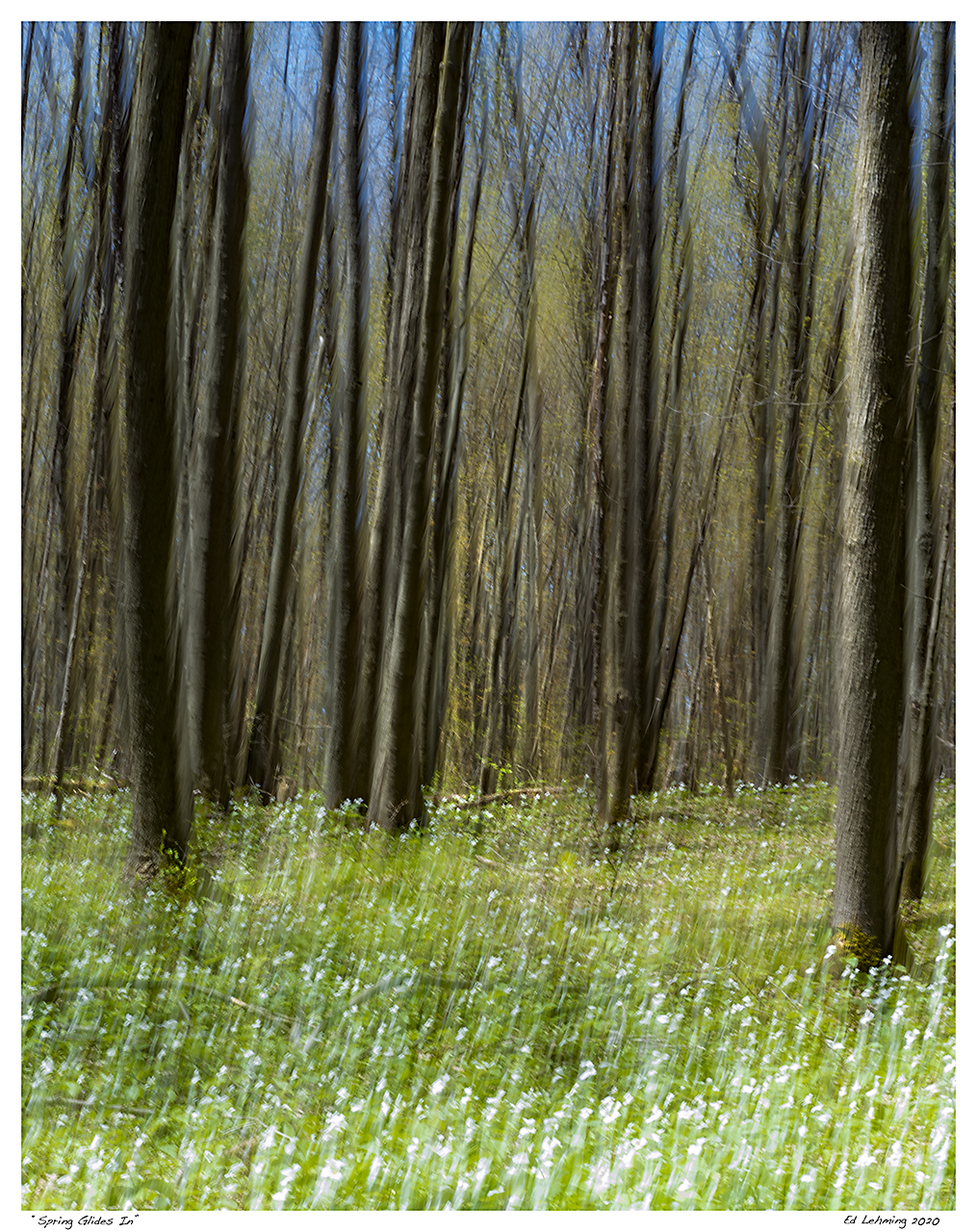
“Like a deep exhale, a flush of bright green, dotted with trilliums sweeps over the forest floor” – Ed Lehming
It’s a remarkable event to see unfold, even over the span of a few days. A mere two weeks ago snow was falling in the forest, the air was chill and only a few hearty plants poked from the cold ground.
Now the air has changed, the snow is a memory and the forest world is transformed. Around me trilliums flourish and fill the fill the scene as far as I can see. New growth emerges in the forest background as trees eagerly leaf out, creating a greenish mist between the limbs. It’s difficult to capture just how beautiful this is in a single still photo so I added some movement to bring some life to the scene and try to portray the feeling of this event.
Those who spend time in nature regularly will understand. There are things that are so difficult to convey accurately. The forest is not a still thing, it’s alive with movement and an energy that’s had to describe. I hope this image does that some justice.
Nikon D800
Tamron SP AF 90mm f/2.8 Di Macro 1:1 (272ENII)@90mm
1/4 sec, f/32, ISO 160
For more images like this, please visit my website (images are available for purchase)
http://www.edlehming.com
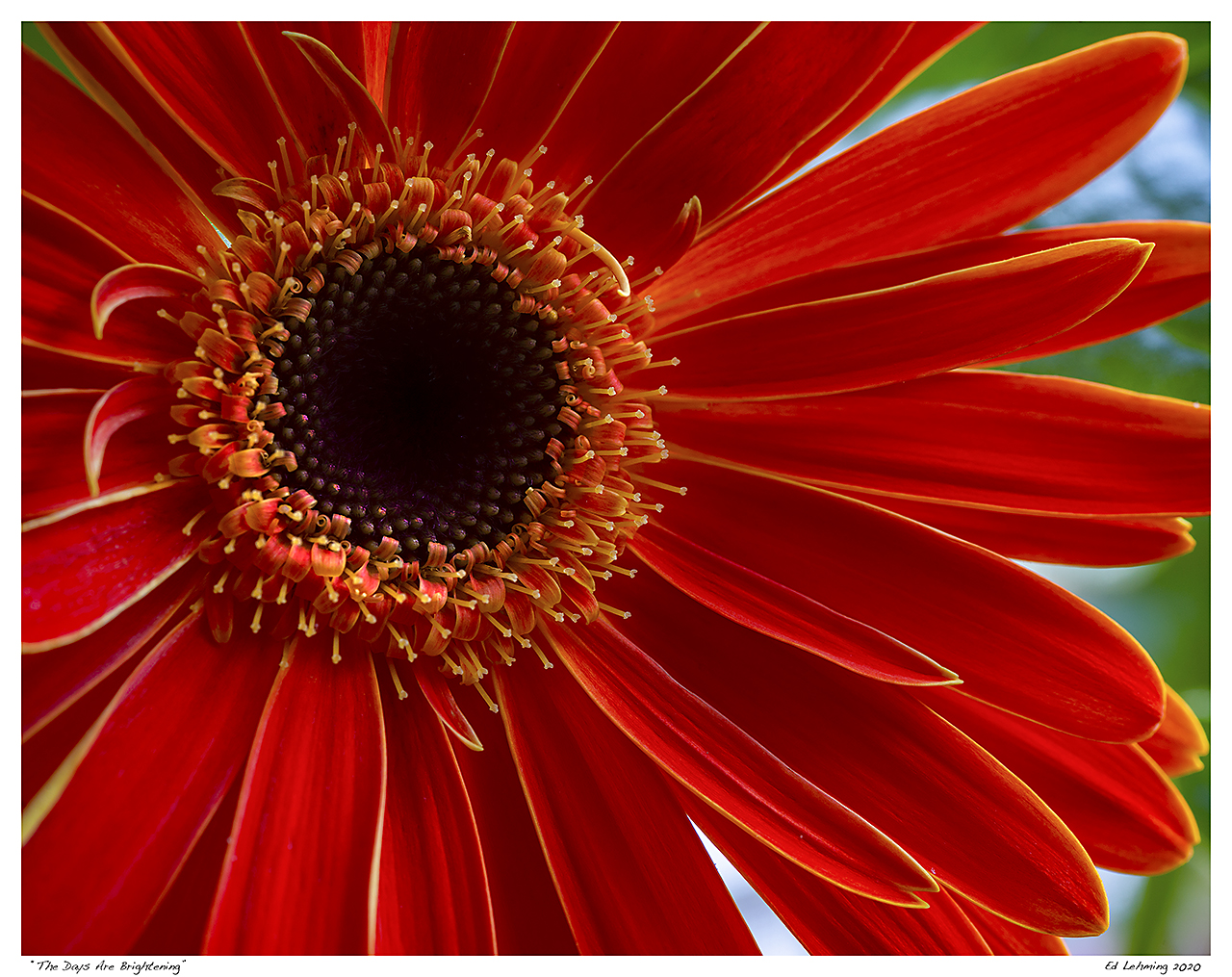
“Flowers bring to life even the dullest days” – Ed Lehming
The first day of May, in the midst of pandemic lockdowns, and I am blessed with the beauty of a single blossom from a Gerbera that I somehow managed to coax through the winter.
It’s been a bit, no, actually very distressing to not be able to get out and photograph local wildflowers like I have in the past few years. The photos I have posted recently were all taken on a single hike last weekend; which I’m hoping to repeat this weekend.
Till then, I am quite satisfied to be greeted every morning by this lovely plant, which I have noticed has two more blossoms forming. Hopefully, as sign of things to come.
Nikon D800
Tamron SP AF 90mm f/2.8 Di Macro 1:1 (272ENII)@90mm
1/6 sec, f/20.0, ISO 200
For more images like this, please visit my website (images are available for purchase)
http://www.edlehming.com
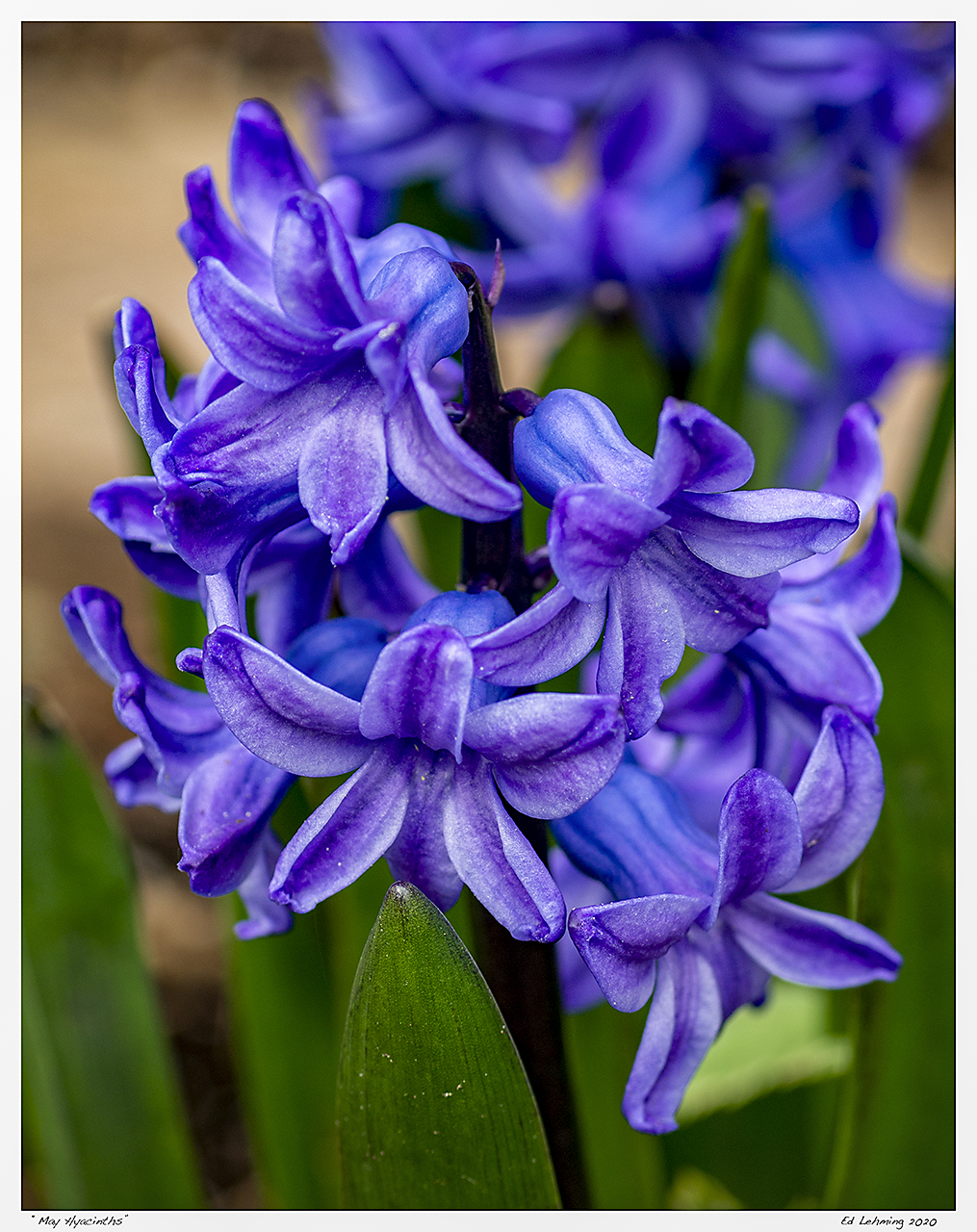
“It is spring again. The earth is like a child that knows poems by heart.”
―
It’s spring, and finally mild enough that it feels like spring, the gardens, which till now, have been waiting patiently for some warmth to stir life into them are now erupting with perennials.
This is such a needed reprieve from the past weeks of of staying home and waiting for signs of life. I know the cycles of nature will continue, but everything seems to have been delayed by cool weather and feels even more so with the monotony of being in self-isolation as this COVID-19 pandemic runs its course.
The warmer weather and blossoms also mean I can spend more time outdoors working on the gardens and getting rid of the winter’s litter. This time of preparation is therapeutic for me; it keeps me busy and focussed on the future. I’m looking forward to having a bit more time to nurture my garden this year, as I expect we will not be venturing far from home any time soon.
With the flowers now in bloom I’m also able to enjoy capturing the beauty with my camera and sharing it with others who may also be in need of some spring cheer.
Nikon D800
Tamron SP AF 90mm f/2.8 Di Macro 1:1 (272ENII)@90mm
1/60 sec, f/6.3, ISO 200
For more images like this, please visit my website (images are available for purchase)
http://www.edlehming.com

“Always something new and interesting. Nature offers so many exciting possibilities” – Ed Lehming
It’s time for the next wave of spring blossoms to make an appearance. I’ve been watching the little clump of leaves for the past few days, waiting for the blooms and was surprised to see blossoms already. It seems a few days of warmer weather makes a difference.
Squirrel Corn is an interesting plant, related to Dutchman’s Breeches, but with a slightly different shape to the flower. Even the blue-green leaves look similar and I was not sure which species this was till it bloomed. Sadly, they won’t last long as the temperatures warm and they will fade quickly.
Much like my photos of the white trilliums, getting good images without the white completely blown-out is a challenge, especially on bright days. I had to push my ISO setting down quite a bit and move my shutter speed up to expose it correctly as this plant was in full sunlight.
Nikon D800
Tamron SP AF 90mm f/2.8 Di Macro 1:1 (272ENII)@90mm
1/1250 sec, f/10.0, ISO 160
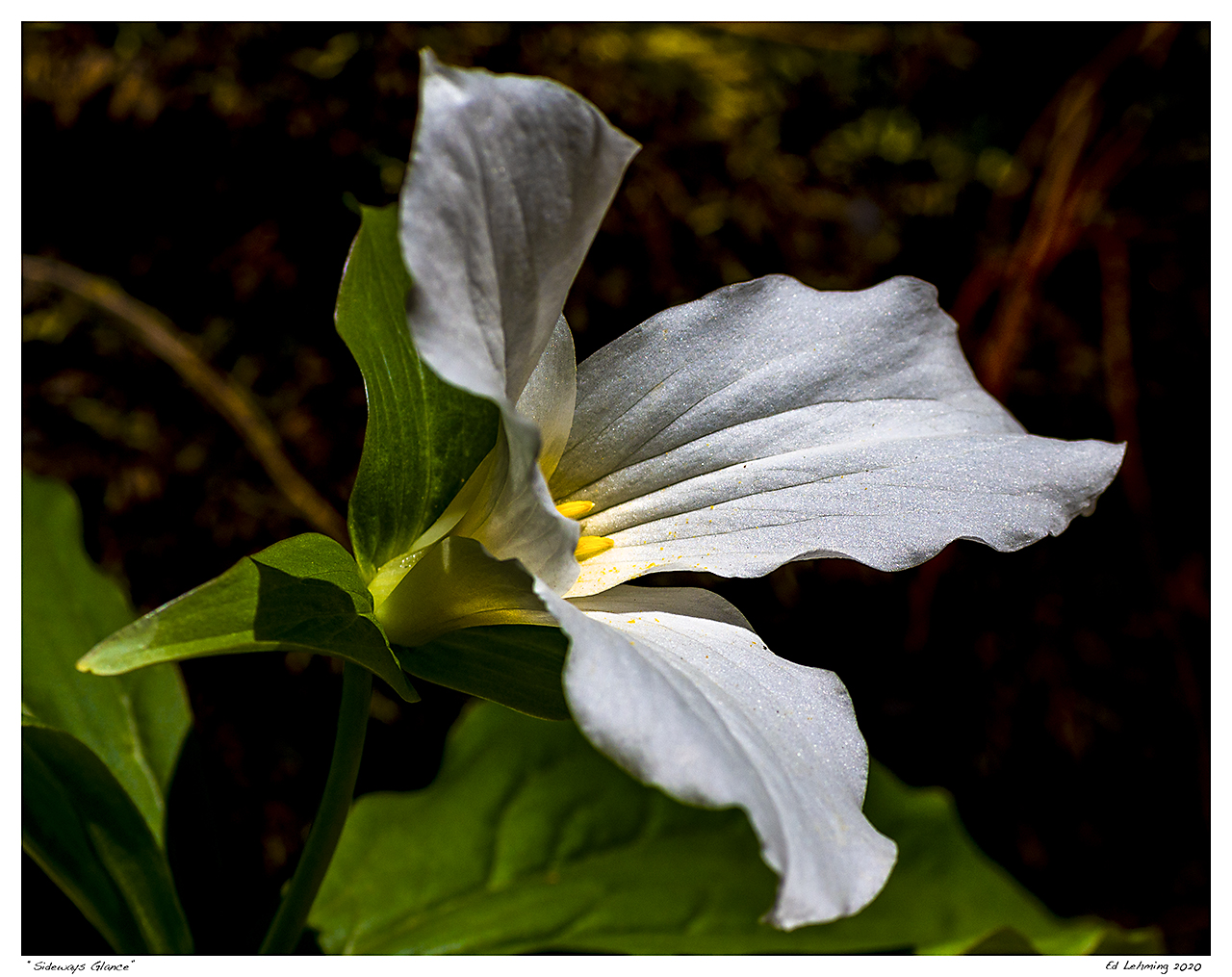
“One clear moment, one of trance
One missed step, one perfect dance
One missed shot, one and only chance
Life is all…but one fleeting glance.”
―
Being literally surrounded by trilliums poses a challenge: they all look so lovely and so perfect. How do you present them differently. It’s so tempting when composing shots to photograph them straight on or slightly off-centre. They are just so lovely. There are literally thousands of opportunities for a nice photo and I was not about to shoot dozens of images to sort through.
I just happened to catch the movement of a squirrel behind me, as I looked over my shoulder I spotted this blossom, slightly shaded and in profile. It was, just like it’s multitude of companions at this time of the year, perfectly and wonderfully formed, without blemish.
A bit of sunlight lit up the base of the flower and created a bit of shadow on the veins. After a quick setup, I had my image. Not typical, but I like how it turned out, all from a sideways glance.
Nikon D800
Tamron SP AF 90mm f/2.8 Di Macro 1:1 (272ENII)@90mm
1/180 sec, f/4.0, ISO 200
For more images like this, please visit my website (images are available for purchase)
http://www.edlehming.com
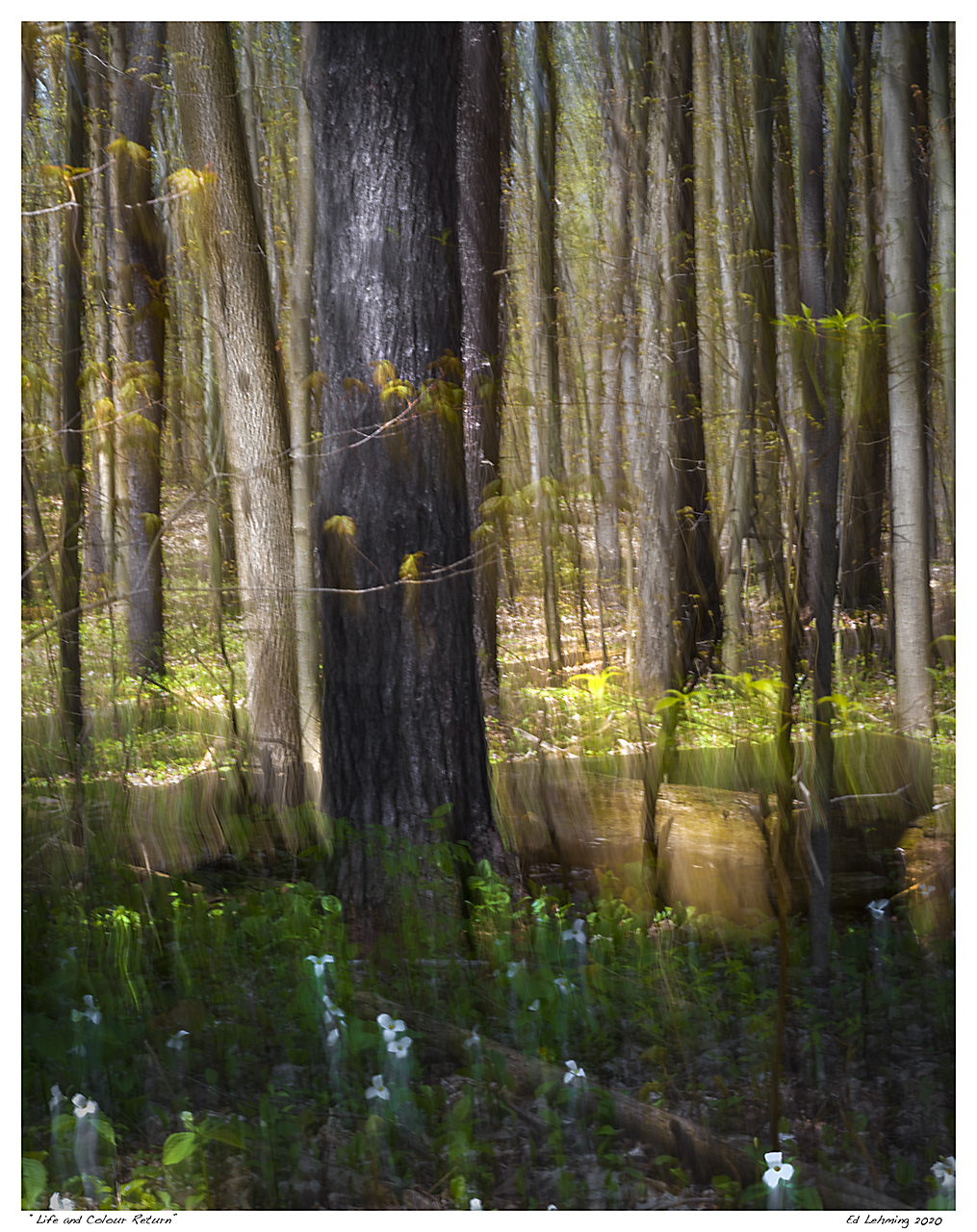
“Deep healthy greens and bright yellow now fill the spaces once dull and drab. Spring opens her mantle to the world in a flourish of health and brightness.” – Ed Lehming
A wonderful and much needed hike restored me once more. What started as a quest for trilliums offered so much more. The day was bright and warm; trilliums filled the forest floor like white beacons; the lime green flush of fresh Lily of the Valley, Clintonia, and Fiddle-heads stretched like a delicate carpet deep into the forest.
This is a time of year I love, there is freshness and new life everywhere, the light has changed as the sun rises higher in the sky each day. The growth is rapid, almost urgent, as each plant claims its place in the forest ecosystem. It’s also a time where ample light still finds its way between the developing canopy and fills the forest floor with light.
For this image I employed my favourite technique of deliberate camera movement. It brings out more colour and life through slight movement, far better than a simple static image. I can almost feel the energy of the forest in these images and they bring me such pleasure to produce. I find it draws me in and causes me to consider details I might otherwise overlook.
Nikon D800
Tamron SP AF 90mm f/2.8 Di Macro 1:1 (272ENII)@90mm
1/4 sec, f/25, ISO 250
For more images like this, please visit my website (images are available for purchase)
http://www.edlehming.com

“Nature’s gifts are always fleeting. These moments must be savoured while we can, and then the moment is gone, leaving only fond memories and dreams for tomorrow.” – Ed Lehming
Alas, the final days of the wake-robin are at hand. These flowers which have brought me so much joy this summer are fading fast, with only a few intact specimens remaining. What the sun has not dried and the wind and rain (and snow) have not pummeled, slugs have scarred.
I recall only ten days ago, seeing and photographing the first few blossoms to emerge on a rainy, sleet filled day. At the time, they were among the only blossoms brave enough to open on that cold spring day. But now, the sun is rising every higher and white trilliums dominate the landscape. I looked along the path for an intact flower, for one last photo, knowing that by tomorrow they will all be gone.
I’ve really enjoyed the wake-robins this year, more than others. They have been plentiful and I’ve been able to get good images through a combination of good fortune and getting down low to the ground with my tripod. The light has been exceptional, with a few slightly overcast days providing me ideal conditions. Today was quite a bit brighter but I was able to find this blossom on the edge of the shadows, just enough so that the image is not overly harsh. I also wanted to make sure that all the petals were in sharp focus, so I used a very narrow aperture, higher ISO, and slower shutter speed to get me what I was after.
So, here it is, the final blossom, so I can enjoy one last look.
Nikon D800
Tamron SP AF 90mm f/2.8 Di Macro 1:1 (272ENII)@90mm
1/100 sec, f/20.0, ISO 400
For more images like this, please visit my website (images are available for purchase)
http://www.edlehming.com

“The simple gift of light is all the more precious when in the presence of its companion, darkness.” – Ed Lehming
This tulip blossom has provided me a few interesting images. Considering that the photo was made in early evening, with a room filled with light and simply setting my camera to expose to the brightest part of the flower. The background fades to a deep blue in strong contrast to the yellows and orange of the flower.
It’s that strong contrast that yields the best images, the ones that grab my attention and make me consider why this works so well.
I tend to compose my images intuitively. There are certain elements such as framing and focal point, but a lot of what ends up making the image good is not something I notice consciously when I compose. I simply know it works. It’s not till I sit down and edit the image that the subtleties begin to emerge and the photo tells a bigger story.
For example, when I framed the photo, I instinctively set the base of the blossom as my focal point, making sure it was properly exposed and then tried to get as much of the petal detail in focus while shooting hand-held, so hand movement had some effect as well.
What I did not notice as I composed the image was the almost echoe-like blossom in the background, out of focus and slightly in the shadows.. I also did not notice the interesting shadows inside the flower itself, nor the wonderful yellow brightness of the petals within.
Nikon D800
Tamron SP AF 90mm f/2.8 Di Macro 1:1 (272ENII)@90mm
1/250 sec, f/3.5, ISO 200
For more images like this, please visit my website (images are available for purchase)
http://www.edlehming.com
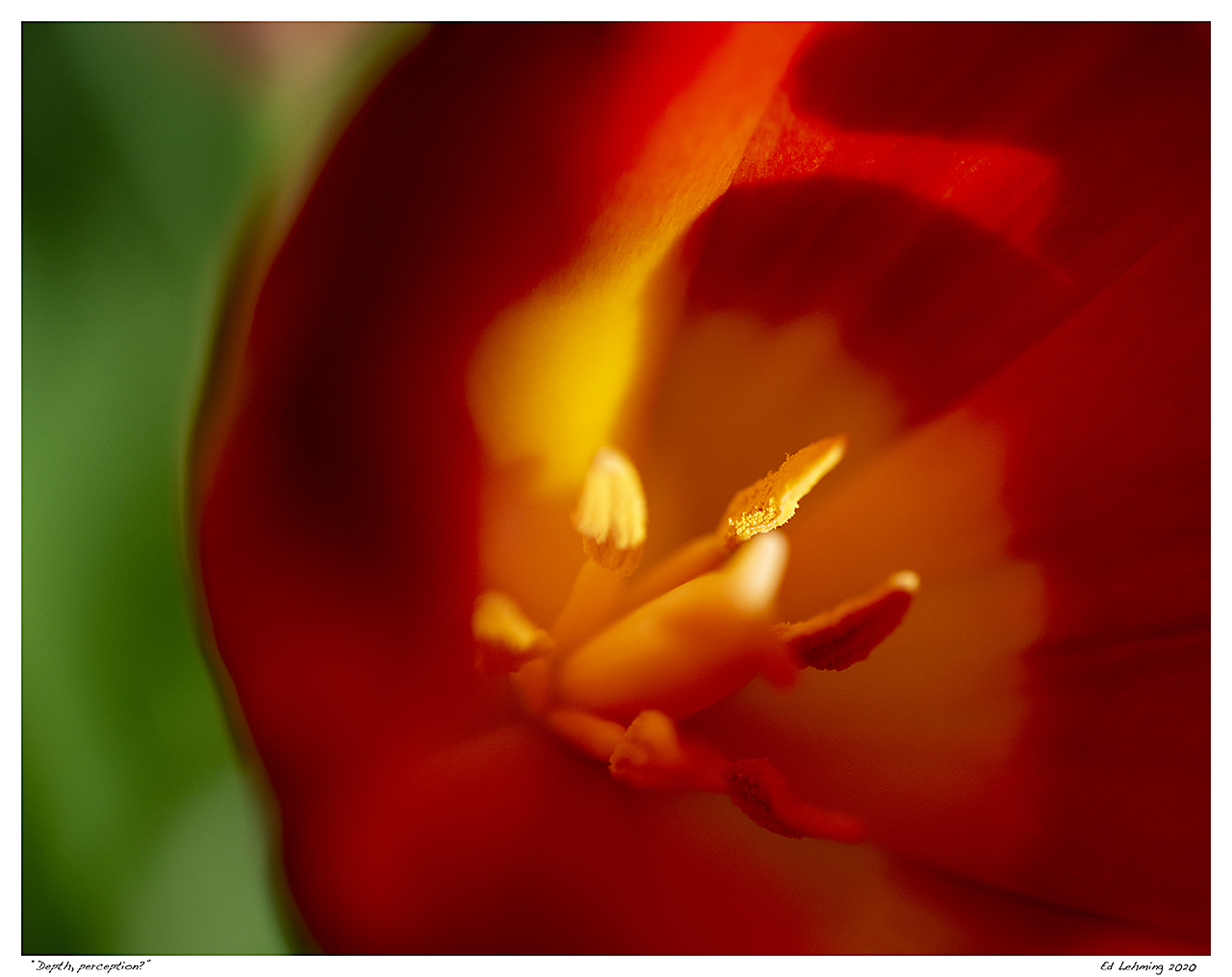
“What do we perceive when faced with something we don’t expect” – Ed Lehming
This image, made very spontaneously over dinner a few nights ago, has held my attention since I made it. It’s the result of evening sun shining through a tulip blossom and deliberate focus on one of the anthers within the flower.
It’s one of those joyous ‘accidents’ that all photographers get at some point. It’s also the joy of spontaneity that will linger with me every time I look at this photo. I will recall the lovely meal that I was enjoying as the sunlight entered through our kitchen window. I will recall the conversations with my wife and how those conversations were briefly and pleasantly interrupted by the lightshow of the sun on the tulips; how we both looked up at the same time.
I was very fortunate that my camera was sitting, conveniently, on the table in the living room, still affixed with my macro lens from my morning sojourn into the forest. With a few adjustments and a snap of the shutter this photo emerged. It should be noted that this is exactly what came from my camera. With the exception of a crop to my preferred aspect ratio there have been no alterations to this photo.
There are a lot of aspects to this photo that I enjoy. Primarily that I can identify the focal point quite easily, but then it fades off into something a bit more abstract, with no clear reference points. The leading petal just blends softly into the background fading into a red mist. Apart from the anthers, the entire image is slightly out of focus but still pleasing and altogether unexpected. It’s that unexpected element that keeps pulling me in, perhaps trying to understand what I’m seeing?
Nikon D800
Tamron SP AF 90mm f/2.8 Di Macro 1:1 (272ENII)@90mm
1/1000 sec, f/4.3, ISO 800
For more images like this, please visit my website (images are available for purchase)
http://www.edlehming.com
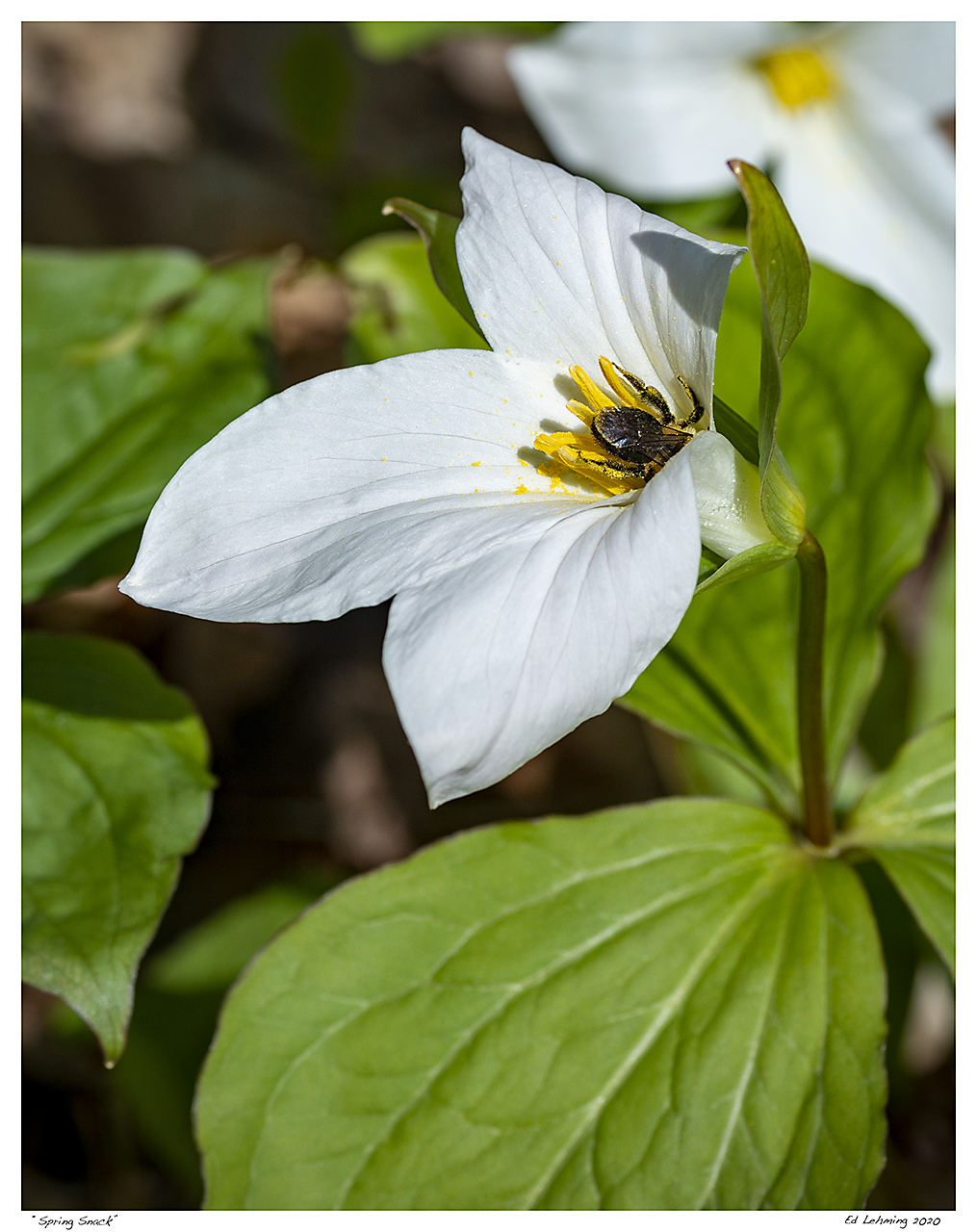
“As the world opens to springtime, hunger is a constant.” – Ed Lehming
All around me, the forest stirs to life, wildflowers open prompted by warmer days and sunshine and bees eagerly feed on the offered nectar. It’s not just bees, it’s every form of flying and crawling insect. Flowers and the forest floor are now teeming with life. As I was making photos of the trilliums, honeybees eagerly burrowed deep into the blossoms, almost disappearing into them.
There were also some comical scenes as bulky carpenter bees landed on flowers so tiny they simply folded under the weight. The bees did not seem to mind. I was hoping to get a photo of this, but the bees were moving from blossom to blossom so quickly I did not have time to compose a good focussed image. So it will remain a memory for now.
Nikon D800
Tamron SP AF 90mm f/2.8 Di Macro 1:1 (272ENII)@90mm
1/640 sec, f/13.0, ISO 250
For more images like this, please visit my website (images are available for purchase)
http://www.edlehming.com
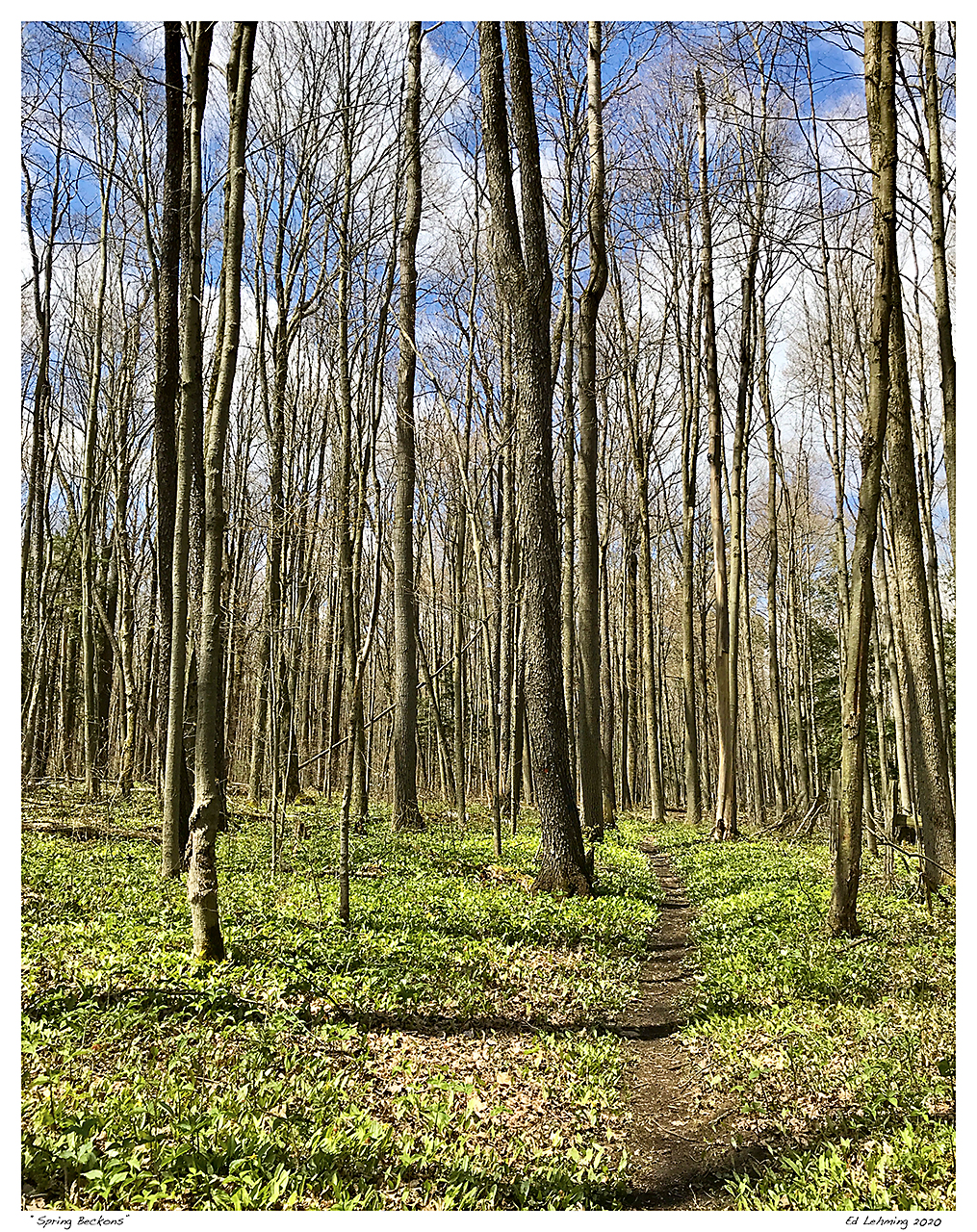
“The days warm and forest paths call me into the depths of nature, I am home again.” – Ed Lehming
The forest floor is now flush with green and visible life returns once more. Thought the trees are still bare I can see a fine haze od green and yellow high above me. It will be mere days till the canopy forms anew.
Narrow paths draw me forward to explore new places and my eyes see familiar things like Trout Lilies, Trilliums, and Lily of the Valley. Bright and healthy green with splashes of pink, yellow, and white blossoms stretch into the woods before me. This is like taking a fresh breath for me, it’s a balm for my spirit as I once more connect deeply with my beloved forest.
I have anticipated this “awakening” even more this year. With all the uncertainty in our world as we learn to deal with the evolving realities of COVID-19, there is nothing uncertain about the forest and that offers me hope and encouragement, as well as a place where I can be with my thoughts and emotions and simply ‘be’. It’s a real blessing to have this so close to me.
iPhone 7 back camera @ 4.0mm
1/1600 sec; f/1.8; ISO 20
For more images like this, please visit my website (images are available for purchase)
http://www.edlehming.com
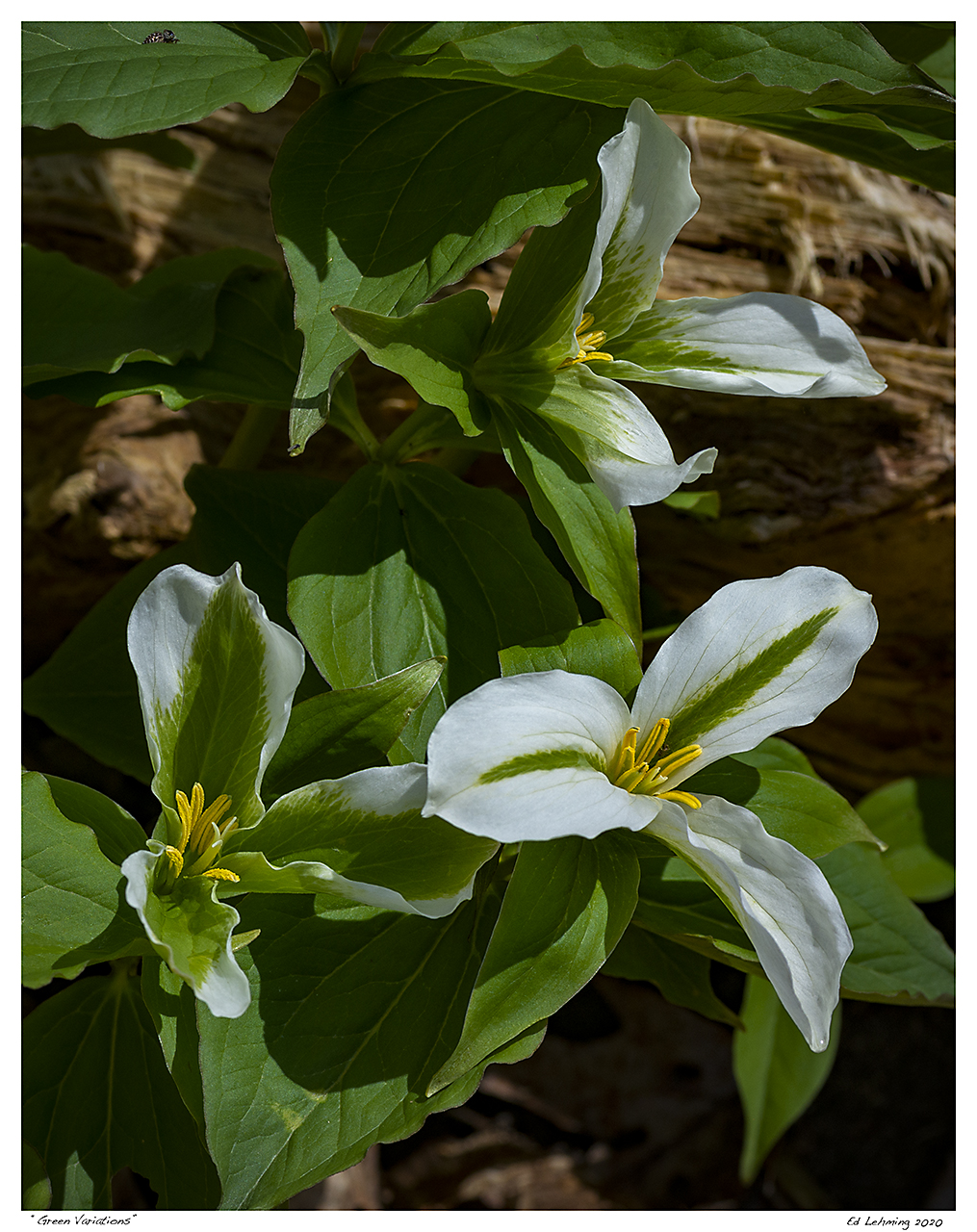
“Never the same twice and endless possibilities, nature continues to surprise me.” – Ed Lehming
Green Trilliums? Yes, I’ve seen them on a few occasions but there seems to be a high portion of them along the trails at North Walker Woods. The first time a saw these interesting variants of the white trillium I began studying them to understand why they look so different. It turns out that the green is caused by mycoplasma-like organisms, a kind of bacteria and will eventually cause the plant to die. I have not gone in depth on the topic but is seems this bacteria affects the plant at the genetic level and prevents the white petals from fully forming. These white-green varieties also have a lot of variability, two shown here, from full green petals to a thin green streak down the centre of the petal. I’ve also seen them as ‘doubles’ where there are six petals rather than three. All these ‘doubles’ have quite a bit of green in them.
As studies show, this bacteria affects whole colonies and I’m seeing some small groupings filled with it. Hopefully it does not spread.
It’s funny, once you start down the rabbit-hole of this variant, it seems there are several others who took it to a new level and have published papers on the subject:
Hooper, G. R., Case, F. W. and Myers, R. 1971. Mycoplasma-like bodies associated with a flower greening disorder of a wildflower, Trillium grandiflorum. Plant Disease Reporter, 55: 1108–1110.
Bertaccini, A., Fránová, J., Paltrinieri, S. et al. European Journal of Plant Pathology (1999) 105: 487. doi:10.1023/A:1008745206438
Arocha-Rosete Y, Morales-Lizcano NP, Hasan A, Yoshioka K, Moeder W, Michelutti R, Satta E, Bertaccini A, Scott J (2016) First report of the identification of a ‘Candidatus Phytoplasma pruni’-related strain in Trillium species in Canada. New Disease Reports 34, 19. doi: 10.5197/j.2044-0588.2016.034.019
Nikon D800
Tamron SP AF 90mm f/2.8 Di Macro 1:1 (272ENII)@90mm
1/500 sec, f/11.0, ISO 250
For more images like this, please visit my website (images are available for purchase)
http://www.edlehming.com

“There is something special about the first trillium of the year. As I walk the trails, I keep a keen eye open for this marvelous harbinger of spring, and when it see it, I know, warm days and beauty follow.” – Ed Lehming
Here it is, the first white trillium of the year. The original was a ‘nice’ photo, but I was looking for more, something to personalize it this year. This bizarre year of COVID-19, isolation, and emotions I still can’t process. So, I decided to render it as digital art, not something I do very often, but somehow it felt very appropriate today. I wanted more than a photo. I wanted something that connected me personally to this beautiful moment where I beheld this single, wonderful blossom. For me, some sign of hope of normality, and a future that I can look forward to.
I’m hoping that this image can bring some joy to others. Joy seems to be a rare commodity these days.

“As Trilliums fill my view, I take a deep breath and say farewell to winter.” – Ed Lehming
It’s that time at last. After a seemingly endless, cool spring, the first white trilliums have begun to open. They are still small and a bit sparse but they are a very welcome sight indeed.
Trilliums signal milder days ahead. They have been delayed by about a week, as days remained and dull. There has not been enough sunshine to warm the still chilly soil and prompt them into bloom.
Today’s hike took my back to the hardwood forests of Uxbridge’s North Walker Woods, a favourite place of mine to unwind and enjoy nature’s beauty. As I drove to the trailhead, I occasionally glanced into the forest seeking a splash of white, meaning trilliums might be blooming along the trail. It’s only been mild for one day and last week’s visit offered me red trilliums (wake-robins) and thousands of white trilliums just in bud, but not ready to open yet. I was very pleased to see so many in various stages of opening and look forward to the coming days where the hillsides will be filled with white.
Nikon D800
Tamron SP AF 90mm f/2.8 Di Macro 1:1 (272ENII)@90mm
1/800 sec, f/14.0, ISO 250
For more images like this, please visit my website (images are available for purchase)
http://www.edlehming.com
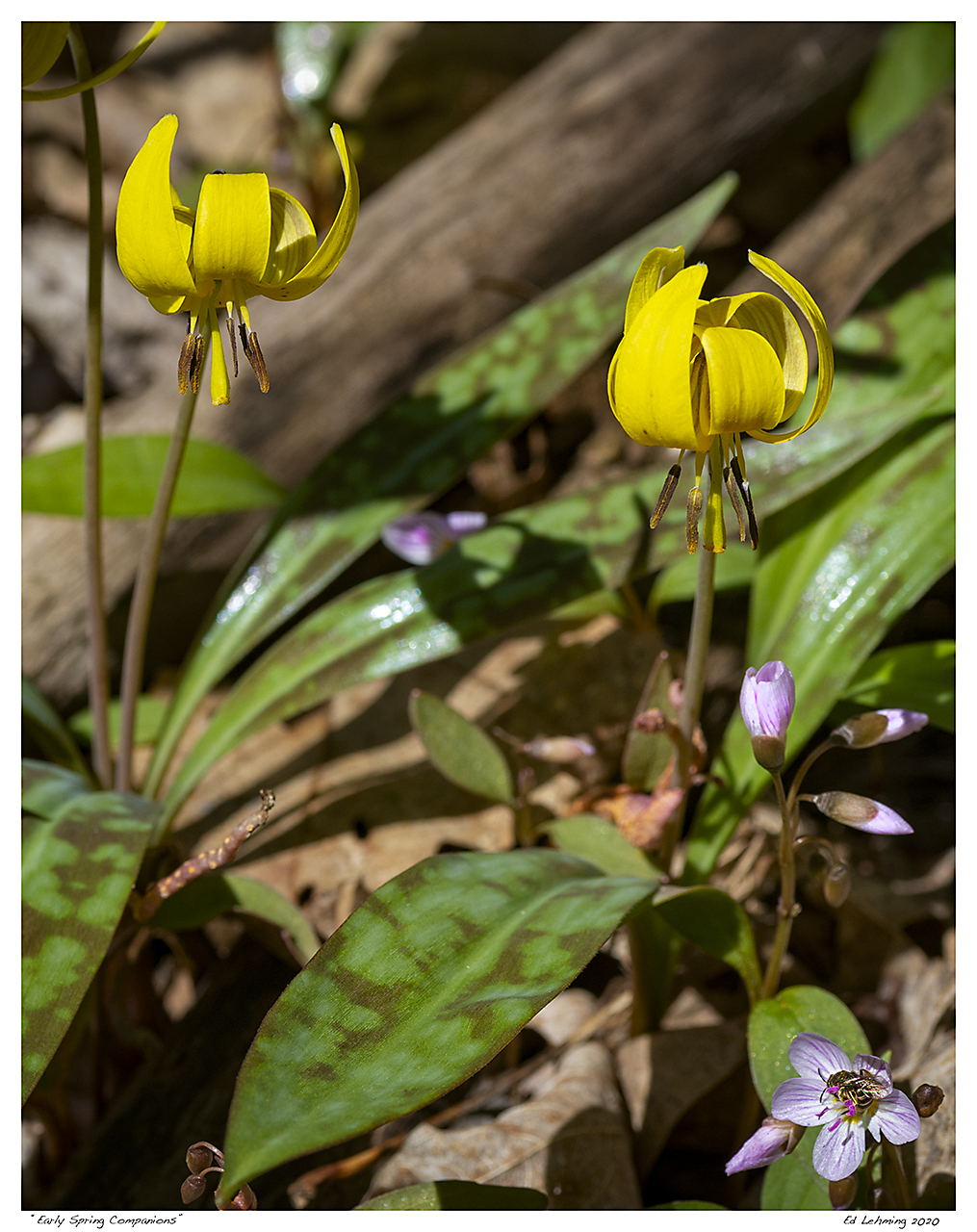
“Nature’s gatherings; nothing by chance; each with purpose” – Ed Lehming
As I spend more time on the trails, more and more patterns become noticeable to me, what once seemed random, begins to fit into patterns. Such is the case with early spring blossoms, one follows the next in a steady, often cautious progression.
It begins with the first few leaves unfurling from the forest litter of leaves, each plant slowly reaching out for the energy of the sun, gradually warming. Then the first few flowers open, bringing a splash of colour to the dull grays and browns of the forest floor.
Amonth the first of these are Spring Beauties, their tiny size and low profile protects them from spring frosts. They may be small and delicate but the do provide among the first nutrients to flying insect like bees and wasps. Notice the bee happily feeding on one in the lower right corner? I didn’t see it as I composed the photo, but it was a pleasant surprise when I reviewed it later in the day.
Next are the Trout Lilies. They first show as a bright green carpet of green and brown mottled leaves which resemble trout skin, thus the name. They also stay low to the ground for some time before putting up blossoms, but once they do, they fill the forest with wonderful splashes of bright yellow, complimented by the pinks and purples of the Spring Beauties, their early spring companions.
I’m hoping to get back out in the next day or two to see the trilliums, as I have now exhausted all my recent photos.
Nikon D800
Tamron SP AF 90mm f/2.8 Di Macro 1:1 (272ENII)@90mm
1/500 sec, f/11.0, ISO 200
For more images like this, please visit my website (images are available for purchase)
http://www.edlehming.com
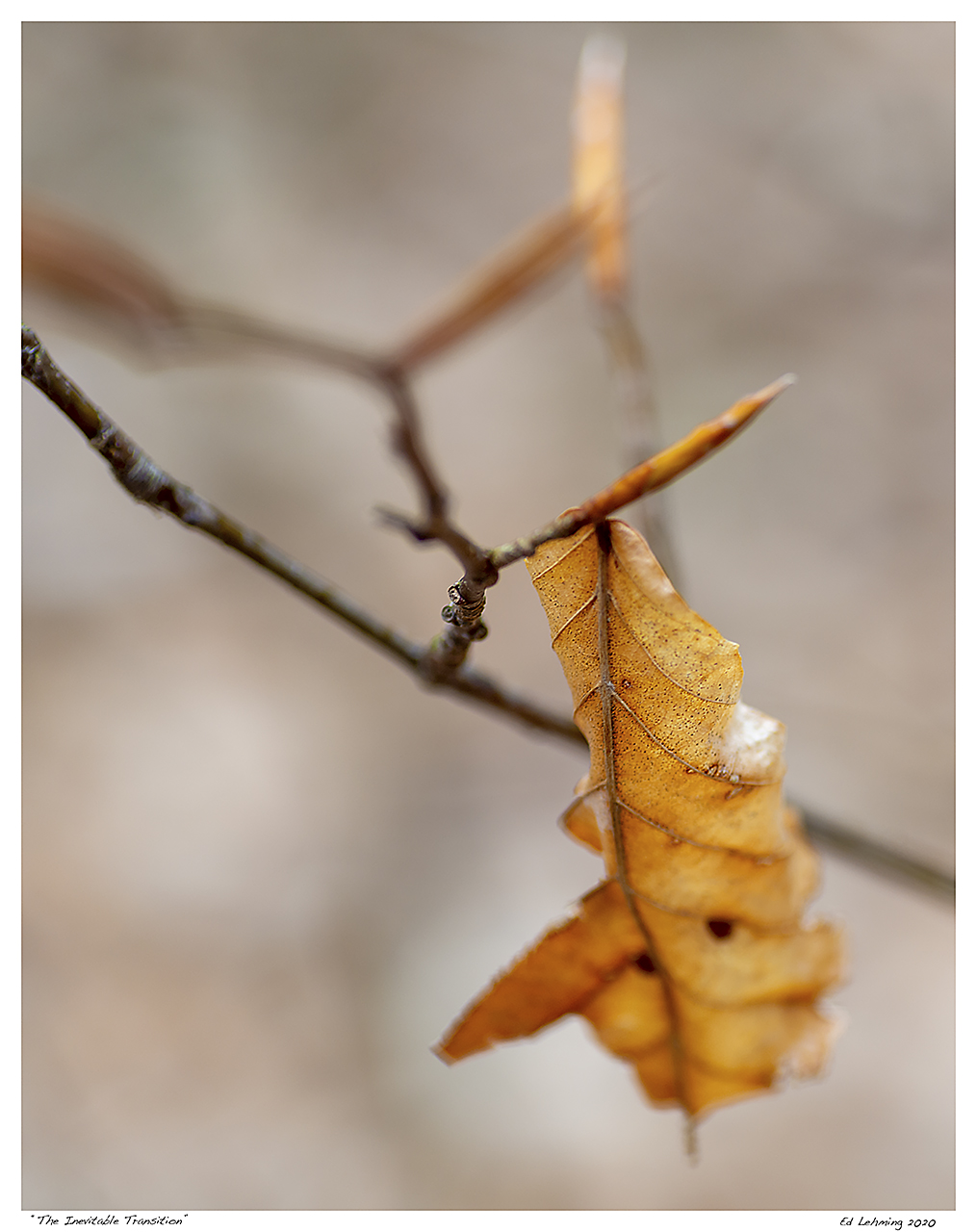
“All things change, it is inevitable, even the things that appear to be constants eventually pass into history. The cycles of time and nature cannot be stopped.” – Ed Lehming
I’ve written a few times about the beauty of beech leaves in the dead of winter. As other leaves have long since fallen to the ground, these leaves cling to the branches with incredible tenacity and offer much needed brightness to otherwise dull winter forests.
They hang on all winter long, and then, within days, they are gone, their purpose served. I’ve often wondered about this phenomenon and set out to understand it better. This spring I spend some time observing the ‘fall’ of the beech more closely and now understand the process better.
The previous years’ leaves are attached to the stem at a ‘bud point’. I’m sure there is a scientific term for this junction, but I’ll use my own expression here. Where other species’ leaves loose the connective fibres that attach the leaves, beech leaves do not. They remain connected to this ‘bud point’ all winter long. The connection is not broken till a new bud forms and pushes outwards, severing the connecting tissue. That’s why they all seem to fall off at the same time. Their cycle ends and another begins.
I can’t help but relate this analogy to what’s going on in our world right now. We are clinging with all out emotional strength to the world we have known for so many years and we will, by human nature, resist the change, each in our own fashion. But the change is already underway, all we can hope for is something better.
Nikon D800
Tamron SP AF 90mm f/2.8 Di Macro 1:1 (272ENII)@90mm
1/125 sec, f/5.6, ISO 200
For more images like this, please visit my website (images are available for purchase)
http://www.edlehming.com

“Sometimes nature creates its own compositions, using what’s on hand, usually with wonderful results.” – Ed Lehming
This is my second red trillium (wake-robin) photo, but I do like them so much. For those who have tried to photograph them, they tend to pose two challenges: first, red is difficult to expose properly against the greens and browns of the forest floor. Most images are overexposed or details are lost. Second, red trillium blossoms tend to droop or face the forest floor, so it’s tough to get a straight on shot, unless you are willing to get real low to the ground. With the more and more present ticks, many of us now hesitate to do this without taking special precautions.
This past Sunday, nature helped me out. It was a cold sleet filled day and I was surprised that they were even blooming; all the other spring flowers had closed for the day. However, despite the overcast sky, there was good diffused light to photograph by, meaning I did not risk blown-out or overly contrasty images. I was also helped out by a fallen branch that this blossom was resting on, showing the full face of a nicely formed blossom. The stick also runs diagonally through the frame making for a lovely, naturally occuring composition. With a few minutes properly framing the image for a good angle and light balance, the resulting photo is shown here.
Nikon D800
Tamron SP AF 90mm f/2.8 Di Macro 1:1 (272ENII)@90mm
1/80 sec, f/4.5, ISO 200
For more images like this, please visit my website (images are available for purchase)
http://www.edlehming.com

“Nature knows. Nature understands the cycles and adjusts.” – Ed Lehming
I was out last Sunday, Mothers Day, hoping to see even one or two open White Trilliums, that was not to be on that chilly, sleet filled day. It felt more like March than May and was in sharp contrast to the previous Sunday which was mild and sunny. Last week was filled with so much promise and so many spring flowers had begun to bloom as trilliums sat seemingly ready to open too.
If I pay attention, really pay attention, to the natural signs around me, I know there will be a delay, regardless of what I hope for and how nice a particular day may seem. The ferns are still in tight ‘knuckles’, not yet at the fiddlehead stage, and trees were in bud, but not leafing out yet. It’s a sure sign that frosty days are still coming, as these plants would be susceptible to frost damage of they opened too soon. Yes, the cycles continue, but the timing varies, nature knows and plants will not rush to open, knowing they will sustain irreparable damage. We as humans can learn a lot from them if we actually pay attention.
That said, the trilliums really are set to open soon. I this image the petals of the flower are clearly visible, but still tightly bundled to protect the petals from frost damage. I’ve suer they will fairly explode in the next few days as the temperatures warm up and remain warm, even overnight.
Nikon D800
Tamron SP AF 90mm f/2.8 Di Macro 1:1 (272ENII)@90mm
1/250 sec, f/8.0, ISO 200
For more images like this, please visit my website (images are available for purchase)
http://www.edlehming.com
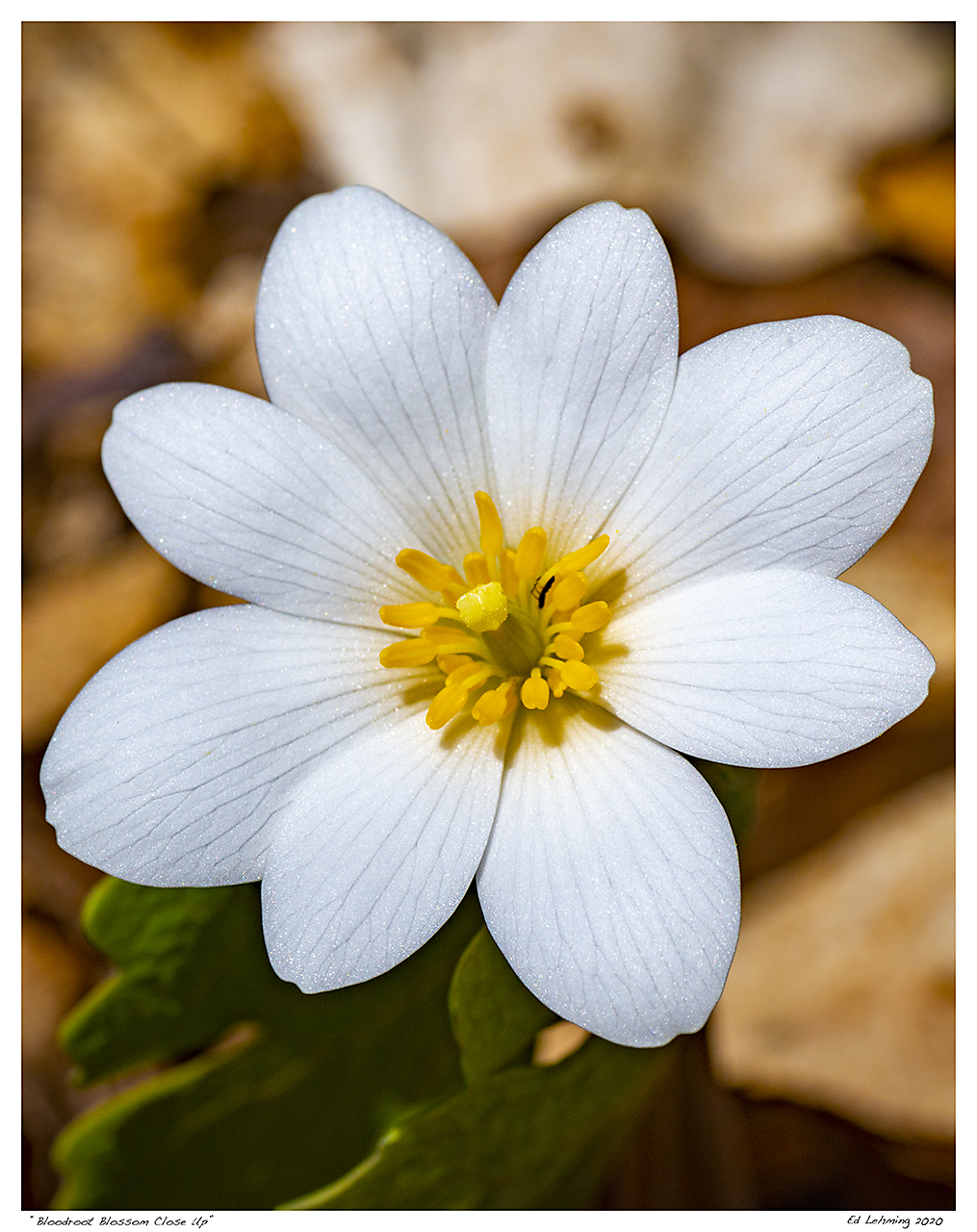
“For no particular reason, the purity of Bloodroot blossoms brings a smile to my face.” – Ed Lehming
I have found myself returning to Bloodroot blossoms for as long as they last, which is not long. Perhaps it’s this very brevity that makes them so appealing to me. They bloom spectacularly for a single day. By the next day they are withered or gone completely, dropping their petals as the shroud that encases them opens further.
It’s a fond memory, recalling the first time I ever saw one, a splash of the purest white along the trail. I was really just starting to explore the native wildflowers in my area and had not seen one before, again, it may be simply due to the fleeting nature of the blossoms and my timing. I may simply have missed the narrow window in which they bloom. They also seem to favor some areas more than others, forming small clusters that fill a space and then disappear in the spaces between. There are a few spots that I return to year after year because I’m always assured of some blossoms, provided I time it right.
This year has been a bit odd, they were delayed by the cool and dry conditions, but were plentiful this past weekend when it was a bit warmer. It was so nice to see pristine blossoms like the one pictured here. Again, they are quite delicate and it does not take much to damage or wilt the blossoms, most have sustained some frost damage, but not this one, it’s about as perfect as they come, with the exception of the tiny bug deep inside the blossom, which I did not notice while composing the shot.
Nikon D800
Tamron SP AF 90mm f/2.8 Di Macro 1:1 (272ENII)@90mm
1/160 sec, f/10.0 ISO 200
For more images like this, please visit my website (images are available for purchase)
http://www.edlehming.com
Nikon D800
Tamron SP AF 90mm f/2.8 Di Macro 1:1 (272ENII)@90mm
1/160 sec, f/10.0 ISO 200
For more images like this, please visit my website (images are available for purchase)
http://www.edlehming.com

“Be a Mother who is committed to loving her children into standing on higher ground than the environment surrounding them. Mothers are endowed with a love that is unlike any other love on the face of the earth.”
―
Mothers do not have it easy. They endure things that would make many give up, they weather the storm and are there for us when we need them, even if we don’t always know it. Despite all that is thrown at them, they still remain the most beautiful thing we can see.
That’s one of the reasons I chose this image, made only a few hours ago in a local forest. Despite unfavourable weather (it was a mere 4 degrees Celcius and sleeting when I made this image) these red trilliums or Wake-Robins were in full bloom this morning, while their white counterparts remained bundled up, waiting for warmer days. In fact, all the other wildflowers which had been blooming earlier in the week had pulled shut, but not these.
It seemed an appropriate image for this special day.
Nikon D800
Tamron SP AF 90mm f/2.8 Di Macro 1:1 (272ENII)@90mm
1/180 sec, f/4.0, ISO 200
For more images like this, please visit my website (images are available for purchase)
http://www.edlehming.com

“Alien yet familiar, careful observation shows us things we had not expected.” – Ed Lehming
Blue Cohosh is one of the first wildflowers that made me begin to better understand the natural environment around me. When I started spending more deliberate time in the forest, starting to see it as a participant rather than a casual observer, I could not help but notice this purple-blue plants that emerge with the rest of the spring flowers but standout because their colour is so different.
Among the bright greens of the surrounding plants, these appear very out of place. As a botany newbie, I had no idea what they were, so I set out to find out what I was seeing. This simple act started me on a path to learning much more about my environment than I had thought possible. My standard routine now is to constantly seek out and study new finds.
Back to the Blue Cohosh. For the longest time, I did not even think they have flowers, because they are so small; as with many other plants, you need to look closely to see details that are at first not obvious or easily observable to the naked eye. The Blue Cohosh looks almost alien when you get close up. Bear in mind, these blossoms are tiny, less than a centimetre across and they are a deep purple-blue that makes it difficult to observe details. This is the first one of the season and not quite as plump as others I have seen, so I’m hoping to collect a few more images before this year’s bloom is finished.
Nikon D800
Tamron SP AF 90mm f/2.8 Di Macro 1:1 (272ENII)@90mm
1/400 sec, f/10.0, ISO 200
For more images like this, please visit my website (images are available for purchase)
http://www.edlehming.com

“After a long winter, spring flowers offer much-needed cheer to our lives.” – Ed Lehming
Honestly, I don’t get tired of these lovely spring blossoms and their variations. The hepatica I have observed over the years go from pure white to shades of pink and purple, I suspect driven by the various minerals in the soil.
This year they seemed to bloom a bit early and I was very surprised to see a few clumps blooming even before the Bloodroots. There is a fairly set and predictable pattern to blooms but this year has been a bit different. It’s been cool but drier than usual. I’ve also been self-isolating and have held off spending much time on the trails, primarily driven by the guilt of it being non-essential travel. As the weeks passed I decided it was essential to my mental health and have been out a few times since.
Seeing these little clusters of cheery blossoms has made a world of difference to me and I’m enjoying being able to share them with others who may be in the same boat of being confined to their homes and properties.
Nikon D800
Tamron SP AF 90mm f/2.8 Di Macro 1:1 (272ENII)@90mm
1/500 sec, f/11.0, ISO 200
For more images like this, please visit my website (images are available for purchase)
http://www.edlehming.com
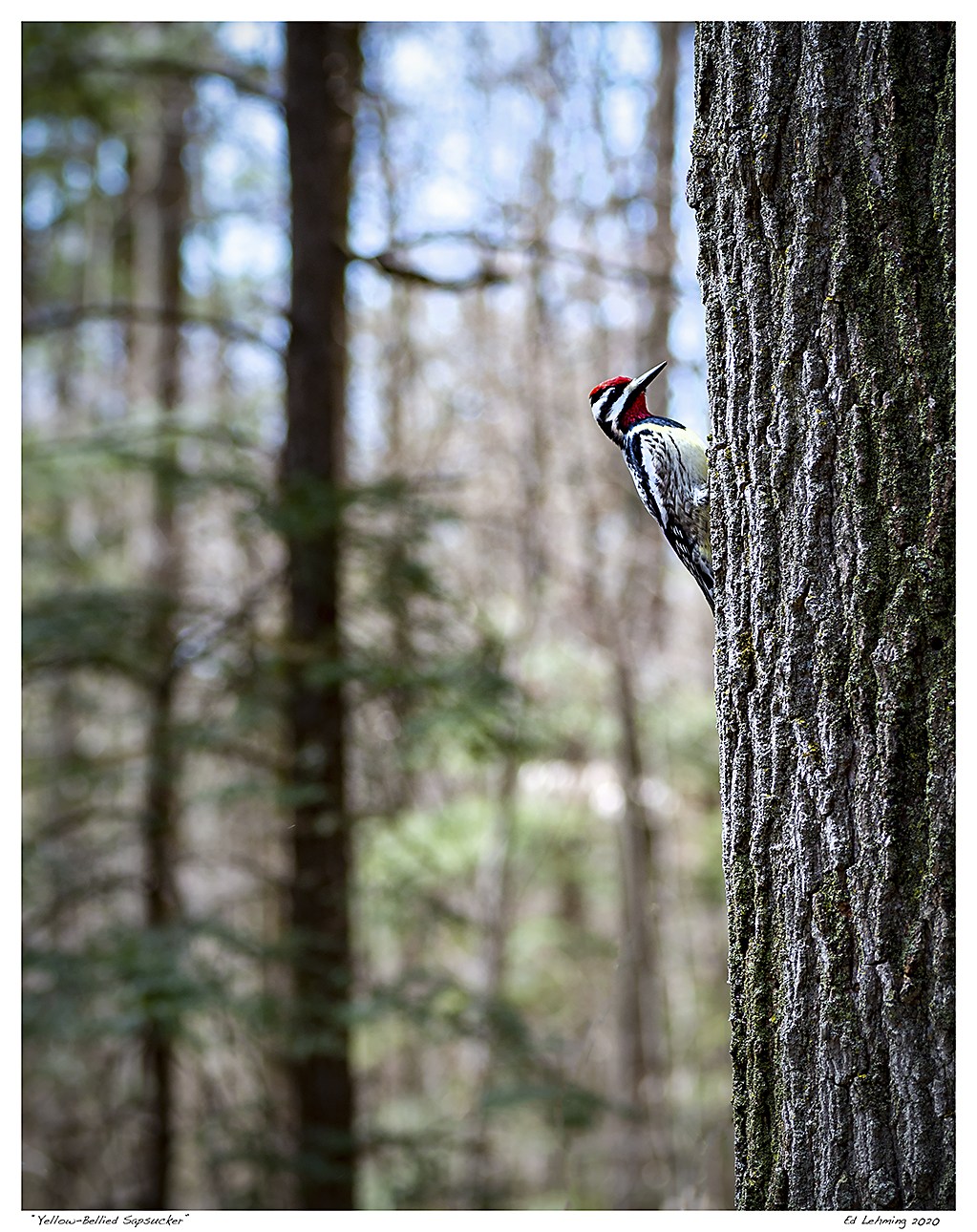
“After years of honing my skills as a photographer, the phrase “Timing is Everything” still holds true.” – Ed Lehming
Over the years I have deliberately practiced preparedness. I’ve gotten familiar with my cameras and lenses. I know what each can and can’t do effectively and I have learned through many failures how to shoot in different lighting conditions, and in all sorts of weather. Why? Because unpreparedness is how once ina lifetime phots are lost.
While the photo I chose for today is not a once in a lifetime shot, it’s still very pleasing and I would not have been able to make it had I not been prepared and aware of my setup’s limitations.
I’m not generally a wildlife photographer and I don’t spend hours in wait for some of the fantastic shots made by my fellow photographers who specialize in this genre of photography have produced. I’m more of an opportunist; I like to capture the experiences that I have while out hiking or traveling. This also means I have to be ready for anything that presents itself, in this case, a beautiful woodpecker.
I had just about concluded my 6.5 km hike through Uxbridge Ontario’s, North Walker Woods, documenting the early spring blooms. I paused along the trail, satisfied with my collection of photos, took a drink of water from my water bottle, and slid my camera back into my pack, ready to hike out to the trailhead. The moment I took a step forward I heard the sound of a woodpecker calling close by. As I turned around, I saw this Yellow-Bellied Sap Sucker in a tree mere meters from me and only a few meters up the trunk, a rare occurrence. I moved slowly to get my camera out of my bag. Since I was out to shoot wildflowers, the lens was my 90mm macro lens. The nice thing with this lens is that at 90mm it does offer me some level of zoom and has an extraordinarily quick focus. Not the ideal lens for this situation, but it made the shot possible. After a few quick setting changes, I was ready to shoot.
This all took about 15 seconds and serves as an example of understanding your gear and how to react when an opportunity presents itself. In the end, I was able to get about five good shots before the woodpecker noticed me and took off. Do I wish I had my 70-200mm with me? Sure, I could have had an even better shot, but you have to work with what you have and I’m pleased with the outcome.
Nikon D800
Tamron SP AF 90mm f/2.8 Di Macro 1:1 (272ENII)@90mm
1/160 sec, f/6.3, ISO 200
For more images like this, please visit my website (images are available for purchase)
http://www.edlehming.com

“The intricate details in nature are a thing to behold. The closer you look, the more wonderful those details become.” – Ed Lehming
For me, trout lilies mean spring is in full swing. The ground and air have warmed enough that these wonderful little flowers open up; one or two scattered randomly at first and then a profusion of yellow splashes seemingly everywhere.
The more I observe them the more subtle differences in appearance that I notice. In some, even close together, the petals are pure yellow, some have some brown markings, while others, like the one pictured here have quite a bit of brown. There is also a variation to the colouring of the stamen. In this example, the stamen is quite orange while others are yellow. There is such wonderful variation in a single species.
They are also fun to photograph as they require me to get down quite low to the ground to capture the details effectively. Shots from straight above are quite boring. The need to get down low also means that my fellow hikers often walk past me wondering why I am laying down. I now also have the added risk of acquiring ticks while doing this, something I have not had to concern myself with in the past.
Nikon D800
Tamron SP AF 90mm f/2.8 Di Macro 1:1 (272ENII)@90mm
1/320 sec, f/9.0, ISO 200
For more images like this, please visit my website (images are available for purchase)
http://www.edlehming.com

“Small and delicate does not infer weakness, there is tremendous resolve to flourish in even the most tender of things.” – Ed Lehming
I’m always intrigued by scenes like this, delicate flowers or leaves that have found a hole in a leaf and then pry the hole hider as they grow. There seems to be no stopping them.
In this case, a Bloodroot blossom is opened up after pushing its way through a maple leaf. It seemed to be a natural frame for the shot and the blossom is nearly perfectly formed, despite its captivity.
Nikon D800
Tamron SP AF 90mm f/2.8 Di Macro 1:1 (272ENII)@90mm
1/250 sec, f/9.0, ISO 800
For more images like this, please visit my website (images are available for purchase)
http://www.edlehming.com
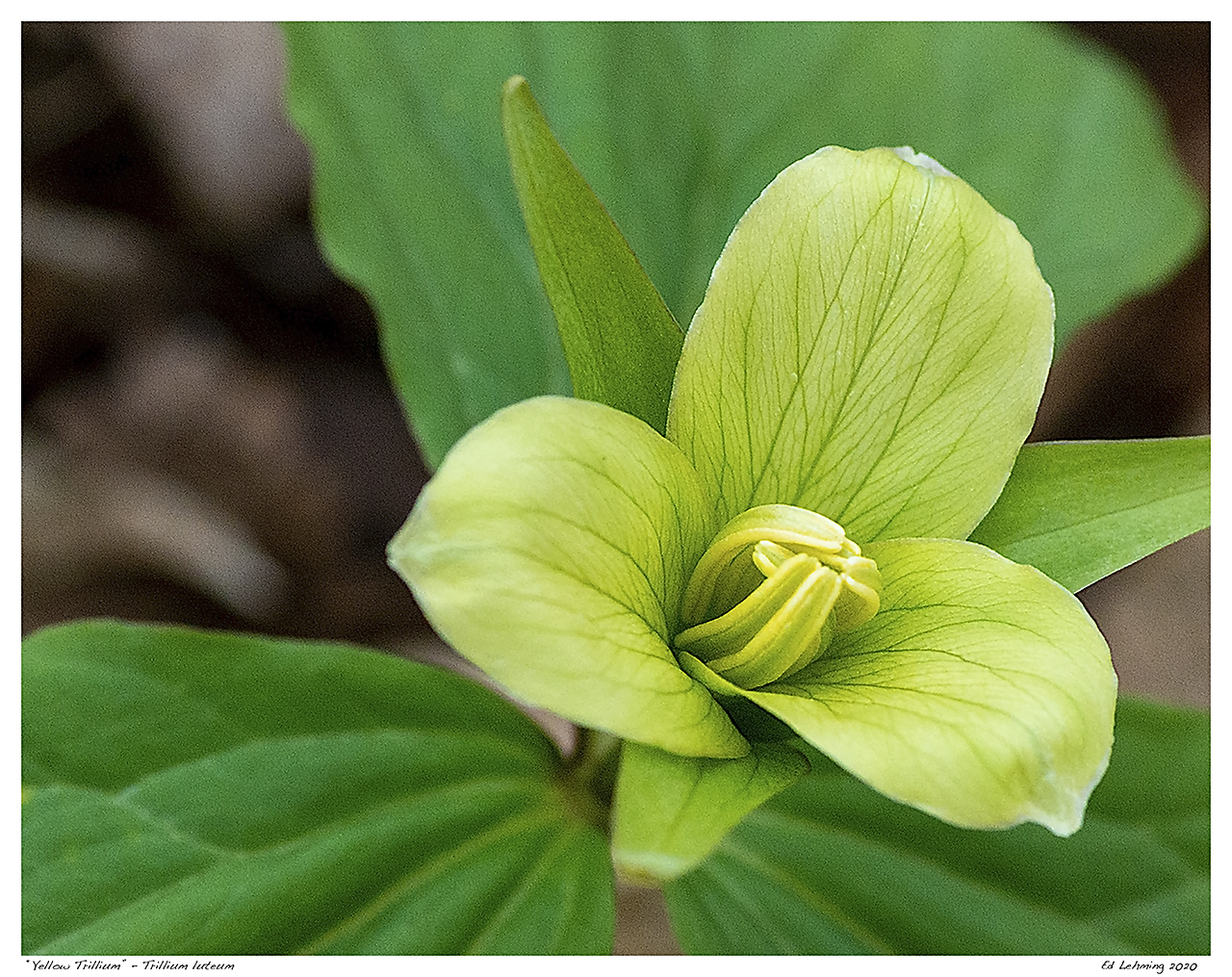
“Even after years exploring the local forests, some new wonder presents itself to me.” – Ed Lehming
On my latest foray into the forest, I was hoping to capture a few more wildflowers, understanding that it’s a slow start to the spring bloom. I did see far more Bloodroot blossoms and the trilliums are advancing daily. Pretty much what I was expecting.
But, there are always surprises. Yesterday I was surprised by something new; a beautiful yellow trillium, fully opened. I’ve been along this stretch of trail for many years but have never noticed this. As I looked around, I found a second blossom. I’m not sure how I could have missed these. Perhaps it’s just by chance that I happened to be here at exactly the right time? In any case, I was so pleased to spot them and make a few images to remember them by.
I was also very lucky that the photos were even possible, as I was only carrying my light courier bag and hadn’t brought a spare battery. As it turned out, this was the last image I made before the battery died. Lesson learned, always bring at least some spare gear or miss out on chances like this.
Nikon D800
Tamron SP AF 90mm f/2.8 Di Macro 1:1 (272ENII)@90mm
1/250 sec, f/9.0, ISO 800
For more images like this, please visit my website (images are available for purchase)
http://www.edlehming.com

“Pink whispers softly of love” – Ed Lehming
I realize that I have shifted my photographs from abstracts and forest paths but I’m finding that most of us are in desperate need of some brightness and what better way than flowers?
With all the anxiety and bad news we are surrounded with, I’m hoping that by sharing some of my own blossoms that I can bring some joy to others.
Today’s selection is a close up of some pink Chrysanthemums that were dropped off by neighbours around easter. They are still blooming nicely and bringing a splash of colour to our window.
Nikon D800
Tamron SP AF 90mm f/2.8 Di Macro 1:1 (272ENII)@90mm
1/50 sec, f/20.0, ISO 200
For more images like this, please visit my website (images are available for purchase)
http://www.edlehming.com

“In nature, all things come in their prescribed time. Nature delays deliberately, without explanation. In time, we see the reasons and they seem obvious.” – Ed Lehming
I think my perspective this spring is highly influenced by the current global COVID-19 pandemic. I live in Ontario, Canada and our provincial flower is the trillium, so I’m seeing a great analogy to the province ‘opening up’ the economy.
There are lots of trilliums along the trails right now, but they are mostly tightly bundled in their leaves, waiting for the conditions to be right to safely open as well. We can learn a lot from nature. Rather than rush into things, some caution is required or there is a risk of permanent damage. For trilliums, it’s frost damage, for our society, it’s many more months of lockdown or outright quarantine and unnecessary illness or deaths.
Nikon D800
Tamron SP AF 90mm f/2.8 Di Macro 1:1 (272ENII)@90mm
1/20 sec, f/20.0, ISO 400
For more images like this, please visit my website (images are available for purchase)
http://www.edlehming.com


 Ed Lehming Photography
Recent Comments