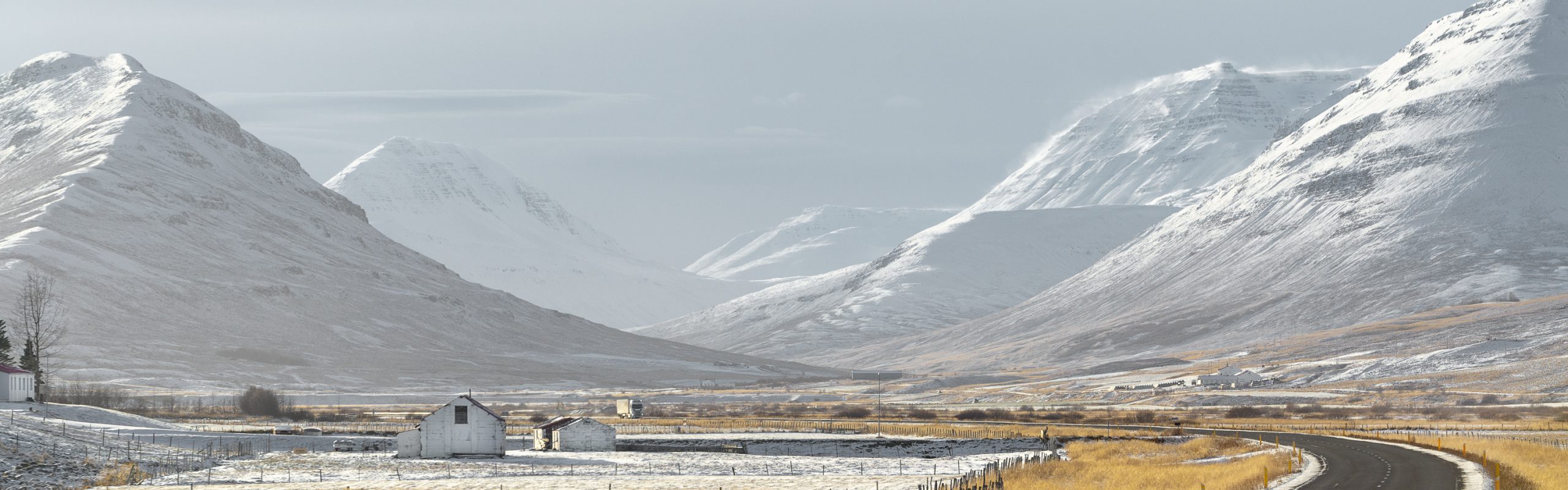

“Outside, there was that predawn kind of clarity, where the momentum of living has not quite captured the day. The air was not filled with conversation or thought bubbles or laughter or sidelong glances. Everyone was sleeping, all of their ideas and hopes and hidden agendas entangled in the dream world, leaving this world clear and crisp and cold as a bottle of milk in the fridge. ”
― Reif Larsen
As this wonderful mild September winds down, I’m reminded of the good time spent north of my home at our camper on Bancroft’s Marble Lake. Though I’m not a ‘morning’ person, there have been several occasions when I have ventured down to the dock to watch the sun rise, gradually burning off the mist that hangs over the water, dancing in the shifting air currents.
In mid to late September, the landscape participates in this dance as well. The cooler nights cause mist to form within the trees and hillsides and the whole world seems blanketed in fog. As I stood on the dock looking across the lake, the thinning fog began to reveal bright colours showing through layers of green. There was a magic to these muted colours that I really enjoyed. And so, here they are. It’s a bit more subdued than most of my recent images, but also has a real sense of calm and anticipation all in one image.
Nikon D800
Tamron SP 70-200mm f/2.8 Di VC USD @ 200 mm
1/80 sec, f/4.5, ISO 100
For more images like this, please visit my Facebook page:
https://www.facebook.com/EdLehming
or my website (images are available for purchase)
http://www.edlehming.com

“The difference between darkness and brightness is how you thrive on those moments and how you use such circumstances with goodwill in your spirit.”
― Angelica Hopes
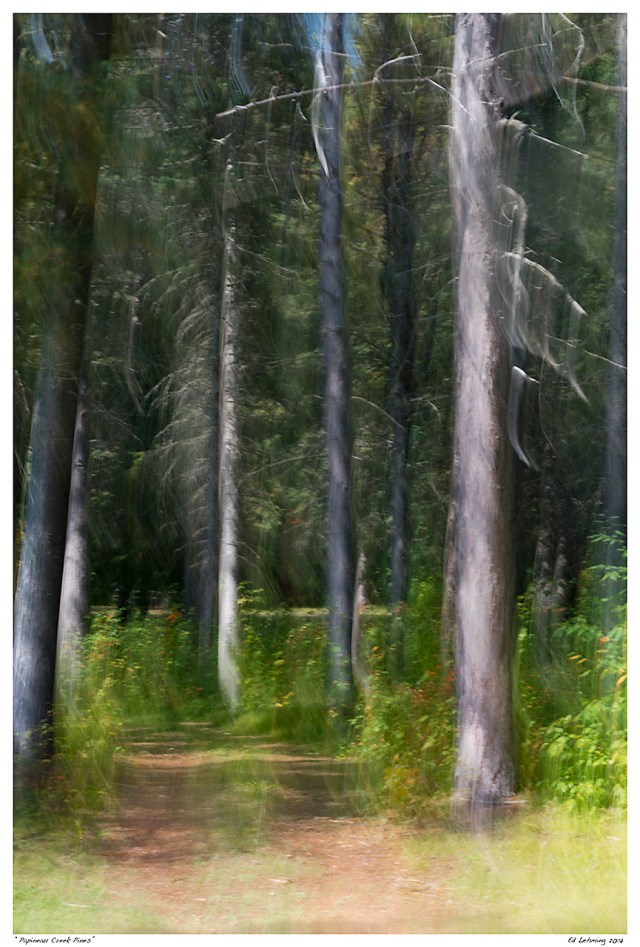
Here we are nearing the end of September, and the end of summer. I was surprised to see just how much colour change is already occurring not too far north of my home. As my family and I drove through the North hastings region of Ontario this past weekend, I especially noticed than some of the maples had already turned bright red. Sadly, I’m not sure what species of maple this is but it sure stood out.
I simply had to make an abstract of it. As with many of these, the finer details don’t get noticed till captured in a photo. I was subtly aware of the colour appearing in the undergrowth, but it really showed up in the photo. There was also a dead tree, bleached white by the sun, which really popped, especially in the photo.
This image is part of a small series I have posted over the past few days, all made within a few hundred meters of each other on Papineau Creek.
Nikon D800
Tamron SP AF 90mm f/2.8 Di Macro 1:1 (272ENII)@90mm
1/4 sec, f/29.0, ISO 100
For more images like this, please visit my Facebook page:
https://www.facebook.com/EdLehming
or my website (images are available for purchase)
http://www.edlehming.com
“Ah, September! You are the doorway to the season that awakens my soul… but I must confess that I love you only because you are a prelude to my beloved October.”
― Peggy Toney Horton
In a quiet, unmarked park, along the banks of Papineau Creek, stands a beautiful grove of red pines and balsam firs. Pathways wind between them, enticing me to take just a few more exploratory steps to see what lies beyond.
It’s a hot day, very hot for September, but I know October and cooler weather is inevitable. This is my first time really exploring this little gem of a park. It’s crisscrossed with paths and roadways, making it extremely accessible and quite open. So, as I explored, I made a few more photos. Many just snapshots and memories of a day spent with family and a few more deliberate ‘artsy’ images in my favourite abstract style.
I’m reviewing them slowly, enjoying what each image offers me, still not sure if I have a series or not. We’ll see what the next few days offer up.
Nikon D800
Tamron SP AF 90mm f/2.8 Di Macro 1:1 (272ENII)@90mm
1/4 sec, f/32.0, ISO 100
For more images like this, please visit my Facebook page:
https://www.facebook.com/EdLehming
or my website (images are available for purchase)
http://www.edlehming.com

“Fall has always been my favorite season. The time when everything bursts with its last beauty, as if nature had been saving up all year for the grand finale.”
― Lauren DeStefano
I’m considering starting another series based on this past weekend, enjoying the Bancroft Area Studio tour and the natural beauty of the North Hasting Highlands area, which we drove through as part of the tour.
This has been a very strange year indeed. As we drove from studio to studio, I noticed many of the leaves had already begun to change colour. For those who follow my blog regularly, you will know that we have had an excessively wet summer, and a bit cooler than usual. Well, that all changed a few weeks ago and we are now experiencing a dry spell and temperatures more appropriate for July. So, it’s really strange to have it feel like mid-summer yet see fall colours starting. The trend is supposed to continue for at least another week.
The image above was made at one of my favorite rest stops in the area. A small, unmarked park along the shores of Papineau Creek. I stopped here for lunch with my family and decided to make a few images before cooling off in the creek.
Adding the element of water had a nice effect on the image, but it’s the only one like it, the rest are images of the forest. Like I said, I may make a short series of them and wanted to start out with this one as I consider the other images.
Nikon D800
Tamron SP AF 90mm f/2.8 Di Macro 1:1 (272ENII)@90mm
1/4 sec, f/20.0, ISO 100
For more images like this, please visit my Facebook page:
https://www.facebook.com/EdLehming
or my website (images are available for purchase)
http://www.edlehming.com
“I think it is far more important to save one square mile of wilderness, anywhere, by any means, than to produce another book on the subject.”
― Edward Abbey
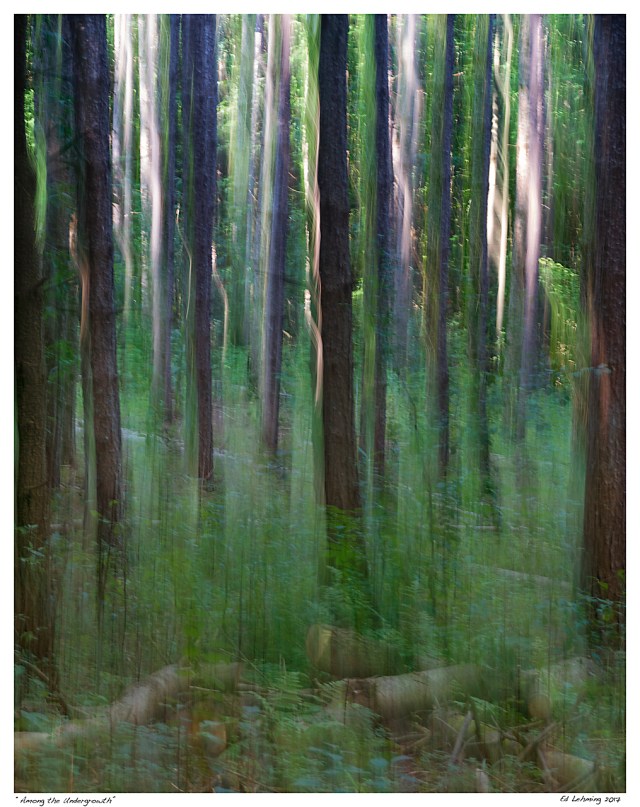
In this image, the pines emerge from a thickening undergrowth. You can also see evidence of deliberate ‘thinning’ of this managed forest. Larger trees are selectively removed, the forest managers careful to remove the branches, lest they become fuel for fires. The trunks cut into manageable pieces, are left to return to the earth, a slow, natural, but controlled cycle.
I chose to make this image because it shows the prevalence of the low underbrush, primarily sedges, bracken ferns, and a few maple, beech, and birch saplings, starting to take hold, as pine canopy thins. The sunlights is quite noticeable in the background, further evidencing this thinning. There is lots of room for growth here and I can only imagine what it will look like in a few short years, as the hardwoods take root “Among the Pines”, eventually becoming the dominant species till the pines become the minority in this evolving forest.
It has been interesting to me, working on this series to take the time to observe the many patterns in a very familiar forest. It’s not till I paused and really considered the elements in each composition that I became more and more aware of the stages and changes this area is going through, some accelerated and others a bit slower, each as it is required to be, an essential part of the life of the living breathing forest.
Nikon D800
Tamron SP AF 90mm f/2.8 Di Macro 1:1 (272ENII)@90mm
1/4 sec, f/18.0, ISO 100
For more images like this, please visit my Facebook page:
https://www.facebook.com/EdLehming
or my website (images are available for purchase)
http://www.edlehming.com
“The forest stretched on seemingly forever with the most monotonous predictability, each tree just like the next – trunk, branches, leaves; trunk, branches, leaves. Of course a tree would have taken a different view of the matter. We all tend to see the way others are alike and how we differ, and it’s probably just as well we do, since that prevents a great deal of confusion. But perhaps we should remind ourselves from time to time that ours is a very partial view, and that the world is full of a great deal more variety than we ever manage to take in.”
― Thomas M. Disch
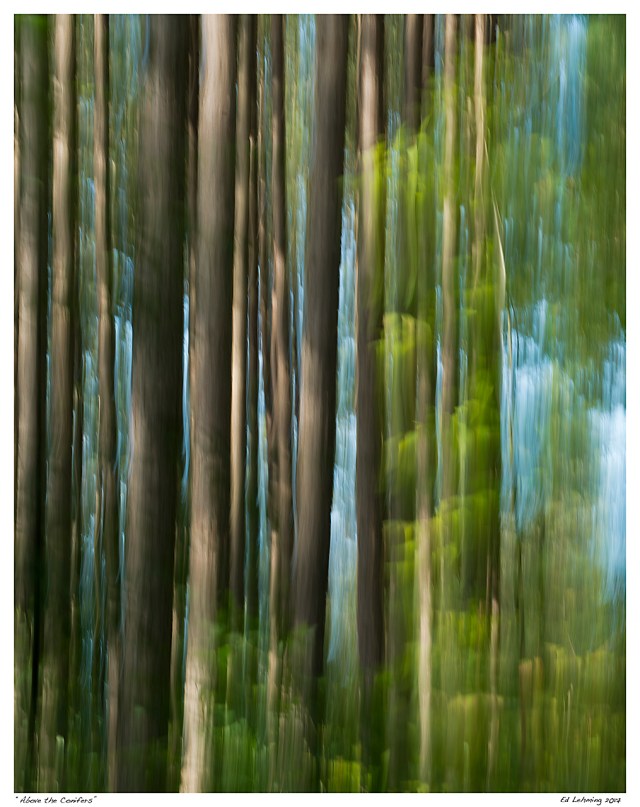
This image features the trunks of the pine trees higher up, just below the canopy. It yields a much brighter image, as elements of the sky and some high maples reflect the day’s bright sunlight among the rows of darker pines. There’s also an interesting weave of the smaller trees in the background. Among the seeming monotony of planted pines, wonderful patterns emerge and it’s no longer the same monotonous forest.
I enjoyed creating this fairly quick series on my hike this past weekend. I had not intended on a long hike, more focussed on making several connected images for my “Among the Pines” series. But, that Sunday was gorgeous for mid September and I ended up travelling some eight kilometers and exploring areas I had as yet not visited. The expansive trails of the Oak Ridges Trail System offer me so much variety. Even though I have been hiking them extensively for the past several years, there is always something new, some side trail that leads to an unexpected stream or meadow.
I’m blessed to live in an area with such diversity and with so may well maintained trails, literally on my doorstep. That’s why so many of my images feature these forests, I doubt I will ever get tired of them and the hours of solitude they provide me, so I can recharge after a busy day or workweek.
Nikon D800
Tamron SP AF 90mm f/2.8 Di Macro 1:1 (272ENII)@90mm
1/4 sec, f/20.0, ISO 100
For more images like this, please visit my Facebook page:
https://www.facebook.com/EdLehming
or my website (images are available for purchase)
http://www.edlehming.com

“Nothing is static; things always change. The best you can do is change along with them and work with what you have.”
― Cate Tiernan
I really struggled with the title on this one, but the sweeping, slightly giggled movement of the camera reminded me of a dance. The greens and browns blend together in a waltz of light. The movement is a bit more rigid than I prefer, yet created an interesting effect.
That’s the wonder of these abstractions, every image is different, significantly so. in many cases. I set out with a vision of what I am trying to communicate with the image and often if simply fails. This image nicely captured and separated the individual tones within the forest, showing the bright points of light within the darker areas. My eyes pick up on this when I see the composition initially, and it is usually what prompts me to stop for an image. The technique sounds so simple in concept but there are so many variables that make or break the final shot. Many times I have walked away disappointed that I could not effectively capture the essence of what I see, but there are less and less disappointments the more I shoot.
Here, the pines thin out as I enter the edge of a meadow, deep within the forest. These open areas often surprise me and I wonder how they came to be, in the midst of a thick forest. Fora shot like this, they let in lots of light, which makes for nice contrast, but is a challenge to balance without blowing the image out.
Nikon D800
Tamron SP AF 90mm f/2.8 Di Macro 1:1 (272ENII)@90mm
1/4 sec, f/32.0, ISO 100
For more images like this, please visit my Facebook page:
https://www.facebook.com/EdLehming
or my website (images are available for purchase)
http://www.edlehming.com

“Nature is a haunted house–but Art–is a house that tries to be haunted.”
― Emily Dickinson
Every now and then the gently winding path leads along or within patches of dark pine forest. These mighty trees rise from the ground and weave their branches into a tight canopy, blocking out most of the light. The space below is an eternal twilight filled with dead branches and a thick carpet of pine needles. Despite this, small green shoots struggle for a patch of sunlight, sheltered from the elements in this dark environment.
Along the edge of these groves of pines, bright sunshine warms the ground and plants flourish, creeping as close to the pines as possible, seeking shelter from the wind yet far enough away to catch the sunshine, like a person walking close to buildings to avoid the rain.
The contrast between the dark pines and the bright path is what inspired this image, the characteristics of the light visibly different once you slide back to the pines, where a golden light predominates.
As the quote above so eloquently puts it: Nature ‘is’ and art attempts to communicate the elements which makes it what it is. Through my abstract photos, I attempt to bring some of those elements of life into the image through deliberate movement.
Nikon D800
Tamron SP AF 90mm f/2.8 Di Macro 1:1 (272ENII)@90mm
1/4 sec, f/18.0, ISO 100
For more images like this, please visit my Facebook page:
https://www.facebook.com/EdLehming
or my website (images are available for purchase)
http://www.edlehming.com
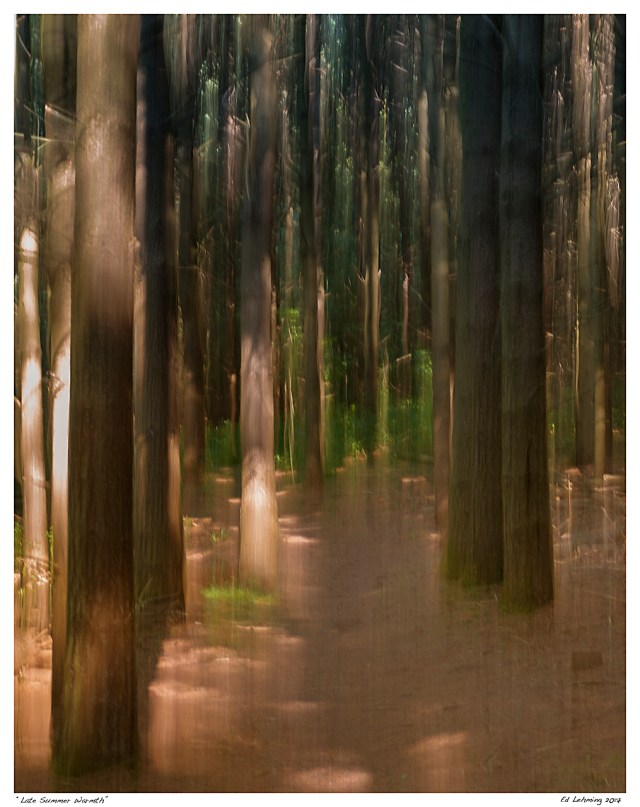
“The tremendous pines towering above the dark marshy soil resembled a gathering of severe mute brothers from a forbidden ancient order worshiping forgotten gods no one had ever heard of outside of the world of secret occult visions.”
― Simona Panova
As I went for a long hike last Sunday, looking for inspiration for my next photo series, I found myself in a large expanse of cultivated red pines. These trees would have been planted in the mid sixties to reclaim farmland as conservation areas were created.
The conservation areas were created not only for recreation but as a strategy to control floodwater flow after hurricane Hazel flooded destroyed areas outside and within the city of Toronto. Given current events in Houston and Florida, I take comfort that people had the foresight to create a flood control measures. By planting forests, ground erosion is greatly reduced and the forests also cool the air, not to mention all the other elements like wildlife habitat and so on.
I’ve stood among these pines before, and made a few images, but decided that late summer would be a nice time to start a series of pine forest images titled “Among the Pines”. My first few shots featured a lot of golden brown, like the one above, but as I proceeded to hike and photograph, a surprising amount of green plays into the images as well. Since this is a planted forest, it is also managed, and so, the forest is ‘thinned’ out every few years, to encourage growth in the trees and allow light to shine between the trees, which brings on growth of ground cover and an array of colours and textures.
There are a lot of maple and beech saplings growing between the pines, which is a natural progression. It turns out, you can’t plant a maple forest. You have to plant pines first and the maples grow between them. Once you clear out the pines, after several years, the maples are established and take over. Something I did not know before.
So, here it is, image number one of the “Among the Pines” series. I hope you enjoy it.
Nikon D800
Tamron SP AF 90mm f/2.8 Di Macro 1:1 (272ENII)@90mm
1/4 sec, f/14.0, ISO 400
For more images like this, please visit my Facebook page:
https://www.facebook.com/EdLehming
or my website (images are available for purchase)
http://www.edlehming.com

“Do you know how there are moments when the world moves so slowly you can feel your bones shifting, your mind tumbling? When you think that no matter what happens to you for the rest of your life, you will remember every last detail of that one minute forever?”
― Jodi Picoult
While on an extended hike yesterday, making photos for my next series, I entered a large meadow, filled with bright yellow Goldenrod. The plants were in peak condition, having just started blooming a few days ago. The entire field in which I stood, from treeline to treeline, was alight with gold. As I stood looking across the expanse of flowers, my ears became aware of an incredible buzzing sound. Upon looking closer, I noticed thousands of honeybees at work, extracting nectar and collecting pollen. I was literally engulfed in a sea of flowers and bees. Wow!
For a few moments, I stood there, eyes closed, the sun shining warmly on my face, savouring the moment, thrilling in the warmth and listening to the thrum of the bees. Everything else melted into the background as my senses drank in the sounds of life. I was blessed to be part of this moment, also thinking how awesome it was to see a significant population of honeybees, which have been on the decline for the past few years.
After pausing to enjoy this experience, I set out to make a few images to remember it by. It did not take long, as every flower has at least two bees on it. That is how many there were. As I said in previous posts, I used to have a fear of bees. What I have experienced lately is that honeybees are very gentle and could care less about me as I lean in close for a photo. I also noticed that as I pushed though the bee laden goldenrod, they simply flew into the air and landed back on the plants after I had passed. They bounced off my arms and chest as I waded through the flowers, simply another participant in the life of the meadow. By the way, for those not familiar with goldenrod, it grows on tall stalks and the flowers are at face level to me. I’m six foot one. So, the bees are right in front of me as well.
So, here it is, a “Golden Moment” to remind me of my time with the bees and the joy of that moment, in the flowers.
Nikon D800
Tamron SP AF 90mm f/2.8 Di Macro 1:1 (272ENII)@90mm
1/640 sec, f/13.0, ISO 400
For more images like this, please visit my Facebook page:
https://www.facebook.com/EdLehming
or my website (images are available for purchase)
http://www.edlehming.com
“The very life of any creature is a quick-fading spark in fathomless darkness.”
― Anthony Doerr
As I have completed my “Into Green Veil” Series, I am pausing to consider my next project, which will also be a short series of some sort. As I pause, I have the opportunity to go back over the past month’s photos and consider some of them to share.
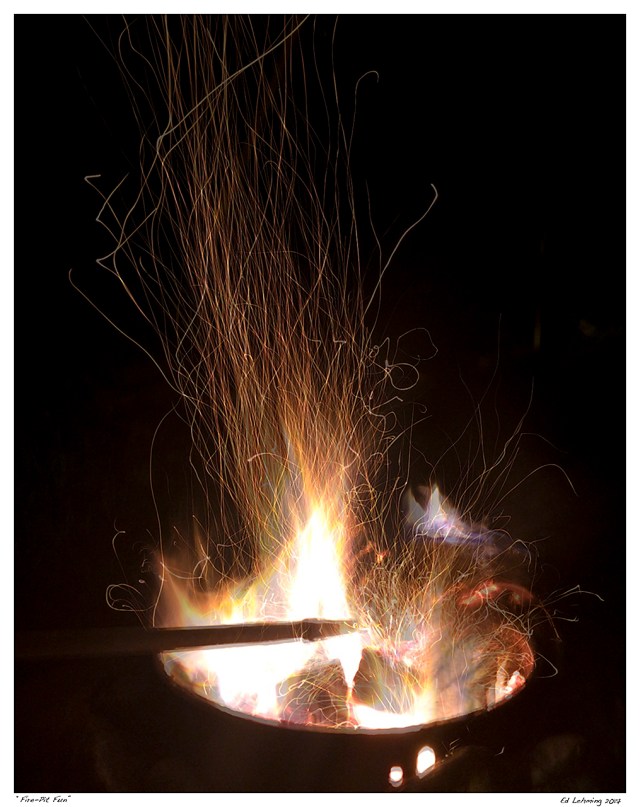
The above image is a bit of playing with long exposure and the fire-pit at my camper. It is truly amazing what a different view, such as long exposure, can do. In this case, I did a one second exposure to reveal the intricate play of the sparks within the fire. Just a bit of fun, worth sharing here.
iPhone 7 back camera @ 4.0mm
1sec; f/1.8; ISO 250
“All of us have had the experience of a sudden joy that came when nothing in the world had forewarned us of its coming – a joy so thrilling that if it was born of misery we remembered even the misery with tenderness”
– Antoine de Saint-Exupéry
As I have worked on this latest series of images, it has become clear to me that I must be ‘in’ the forest, a participant in its life. To merely stand along the edges and gaze in, does not satisfy the need to immerse myself under the enchantment of its Green Veil. I need to be engulfed, to fully experience it.
By being in the forest, there is a ‘feel’, an energy, which is difficult to convey to someone who has not felt this life force personally. As I step onto the trails, even briefly, there is a rush of joy which is inexplicable. To be surrounded by such vibrancy is a blessing which I wish everyone could feel at some point. It’s a connectedness, a ‘oneness’ that is experienced within the woods.
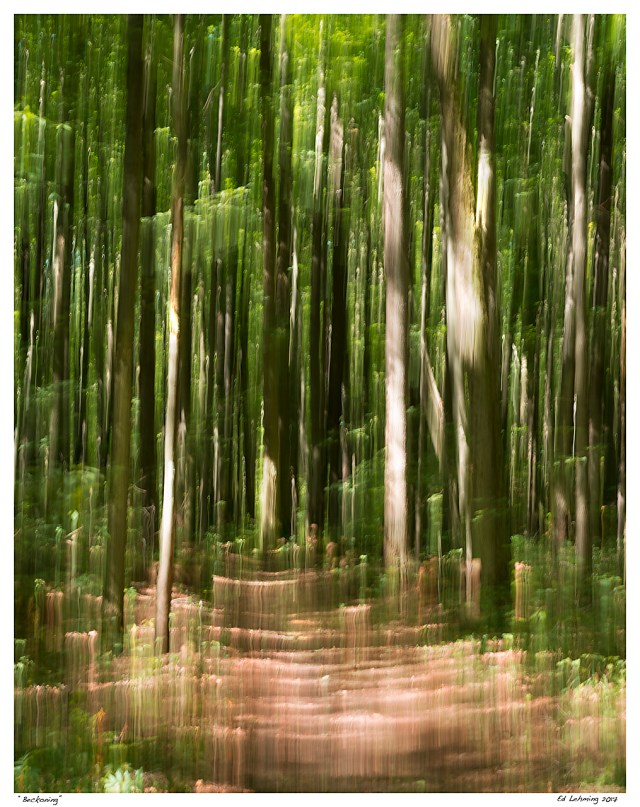
So, as I close this series off, I chose this image. The image which beckons me to step in, or conversely, beckons me to return, as I look back on it on parting. In either case, it’s an invitation that I am glad for and which I will eagerly accept, the next time the forest beckons me.
Nikon D800
Tamron SP AF 90mm f/2.8 Di Macro 1:1 (272ENII)@90mm
1/4 sec, f/16.0, ISO 200
For more images like this, please visit my Facebook page:
https://www.facebook.com/EdLehming
or my website (images are available for purchase)
http://www.edlehming.com

“I tried to discover, in the rumor of forests and waves, words that other men could not hear, and I pricked up my ears to listen to the revelation of their harmony.”
― Gustave Flaubert
Around a bend in the path, I found myself faced with a planted pine forest. A large ‘grove’ if you will. The trunks were thin and straight, with no foliage except at the very top. Among this tall pines, a few hearty maples have began to grow, their bright leaves appearing in waves across the image, each branch creating a luminous layer against the dark backdrop of the pines.
Enhancing the effect of the maples is the pine’s slow ascent up a small hillside as if trying to reach higher than the maples. It was quite a sight, the play between the trees and their unique characteristics.
Eventually the cultivated pines will be harvested for pulp or logs and the maples will remain, taking over the hillside and, no doubt, completing with pine seedlings, which are plentiful. Victory will go to the species best suited to grow here.
This was a shot I was uncertain of. The bright maple leaves dominate the scene and attempts to underexpose the image took away too much of the magical glow they displayed. After a bit of agonizing, I decide to proceed with it as is, since it is so close to what I experienced in the pine grove, inside the green veil of the summer forest.
Nikon D800
Tamron SP AF 90mm f/2.8 Di Macro 1:1 (272ENII)@90mm
1/4 sec, f/25.0, ISO 200
For more images like this, please visit my Facebook page:
https://www.facebook.com/EdLehming
or my website (images are available for purchase)
http://www.edlehming.com
“When you rise in the morning, give thanks for the light, for your life, for your strength. Give thanks for your food and for the joy of living. If you see no reason to give thanks, the fault lies in yourself. “
– Tecumseh
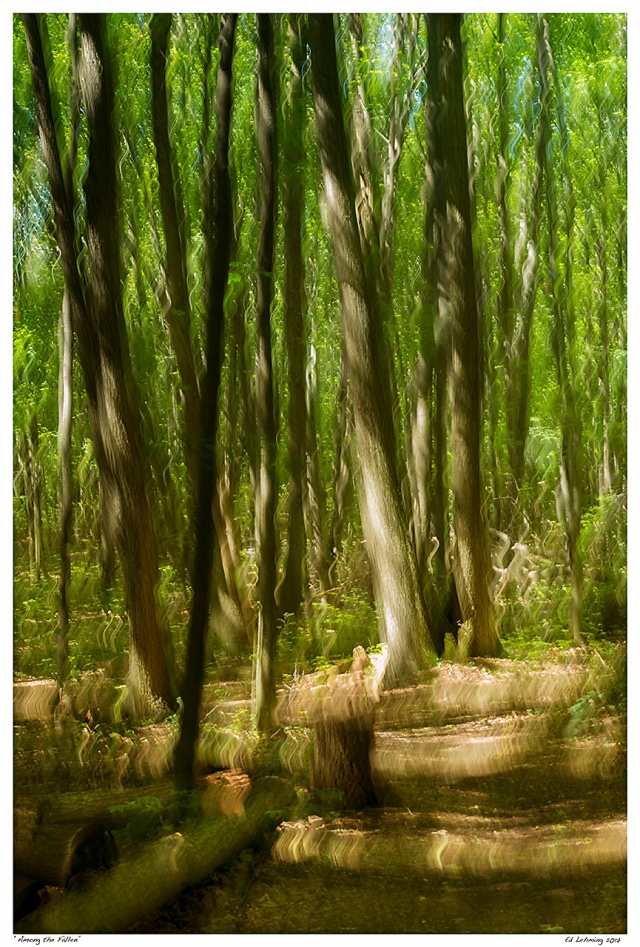
The inevitability of trees, and all life on earth, is that they eventually fall, through age, disease, or human intervention. The latter is the case in this image. In areas of a managed forest, individual or groups of trees need to be thinned to make room for the healthy growth of others.
What struck me in this composition is the variability of the light, from the dark trunks to the left, to bright, golden sunshine, and shimmering green in the canopy of leaves above. And, it really was odd to see this cluster of fallen trees just laying there. Generally, most are removed and a few left to rot down, but this was a fairly large pile of logs, left where they fell. But, they were just logs, not entire trees, the crowns having been removed, leaving just bare logs.
Throughout the image, my camera movement has captured fine points of light, dancing within the green vel which surrounds me.
Nikon D800
Tamron SP AF 90mm f/2.8 Di Macro 1:1 (272ENII)@90mm
1/4 sec, f/32.0, ISO 200
For more images like this, please visit my Facebook page:
https://www.facebook.com/EdLehming
or my website (images are available for purchase)
http://www.edlehming.com

“Life moves very fast. It rushes from Heaven to Hell in a matter of seconds.”
― Paulo Coelho
This past weekend, I took a little side drive to High Falls, which is really a former chute, turned to a waterfall by the installation of a dam nearly one hundred years ago. The dam closes off the end of Baptiste Lake, just north of the town of Bancroft, Ontario.
Because of the dam, the lake itself is a lot larger than it was originally, by about fifteen feet. As I stood along the side of the falls, I tried to picture this area before the dam was built. It must have been quite a sight, watching the massive flow of water surging through this narrow chute.
The dam was built to regulate the flow of the water from Baptiste Lake into the York River, which begins here and flows through the town of Bancroft several miles below. Spring floodwaters used to cause a lot of damage to the town. Even with the dam, the York River catchment basin is big enough to cause flooding in the town in the spring, as snow and ice melt. It must have been crazy before the dam was built.
I made several long exposures of various section of the falls, till a sudden cloudburst ended my day and I had to scramble back to the car, satisfied with only a few images. Of the five images I made, this one resonated with me the most. It shows the water spreading beyond the narrow rift and flowing over the surrounding rocks. The water was a bit higher than usual, in part because of our excessively rainy summer.
There is something about water that calms me, even rushing water. As I edited the image, I found myself zooming in on sections, taking in the complex movement and textures of the water as it rushes over teh rocks and downward to the rapids below.
Nikon D800
Tamron SP AF 90mm f/2.8 Di Macro 1:1 (272ENII)@90mm
1/4 sec, f/32.0, ISO 200
For more images like this, please visit my Facebook page:
https://www.facebook.com/EdLehming
or my website (images are available for purchase)
http://www.edlehming.com

“I’ve always believed there are moments in our lives which can be defined as a transition between the before and after, between the cause and the effect.”
― Benjamin X. Wretlind
Along the trail, the trees thin in places, a transition from forest to glade. More light enters along this transition zone, creating an ideal environment for new growth. Composting leaves and thin ground cover allow the sun’s light to warm the ground and germinate seeds which lie buried, waiting for conditions like this. A cycle begins, ends, continues.
It’s a transition zone. A place of change from one thing to another. I take note of these places, careful to observe them on future visits. The forest is a living and ever-changing place. The changes are often slow and subtle, like the light the weaves among the branches, often missed by the human eye which is constantly adjusting to balance the light, but captured by the camera, a moment, rather than a transition.
That’s the element I’m trying to capture in this “Into the Green Veil Series”, it’s that transitory light, which must be seen over a longer period of time rather than the split second of a typical camera shutter snap.
Nikon D800
Tamron SP AF 90mm f/2.8 Di Macro 1:1 (272ENII)@90mm
1/4 sec, f/18.0, ISO 100
For more images like this, please visit my Facebook page:
https://www.facebook.com/EdLehming
or my website (images are available for purchase)
http://www.edlehming.com
 “A forest is not a wilderness, but a community of souls who speak to one another on the wind.”
– Anthony T. Hincks
Nature creates unexpected patterns, those things that are noticeably different than others. Here, a group of three large trees grows together, sharing the same patch of ground. Their neighbours, are spread fairly evenly, each with its patch of ground, its own source of sparse sunlight and nutrients. Yet, these three grew together, sharing everything, so different that it drew my attention right away.
Beyond them, a lengthened patch of sunlight reveals a path untrodden, beckoning exploration. The light is everywhere, despite the ever present veil of green. Above, bright flashes of blue dance in the sky and into the canopy high above.
Nikon D800
Tamron SP AF 90mm f/2.8 Di Macro 1:1 (272ENII)@90mm
1/4 sec, f/10.0, ISO 100
For more images like this, please visit my Facebook page:
https://www.facebook.com/EdLehming
or my website (images are available for purchase)
http://www.edlehming.com
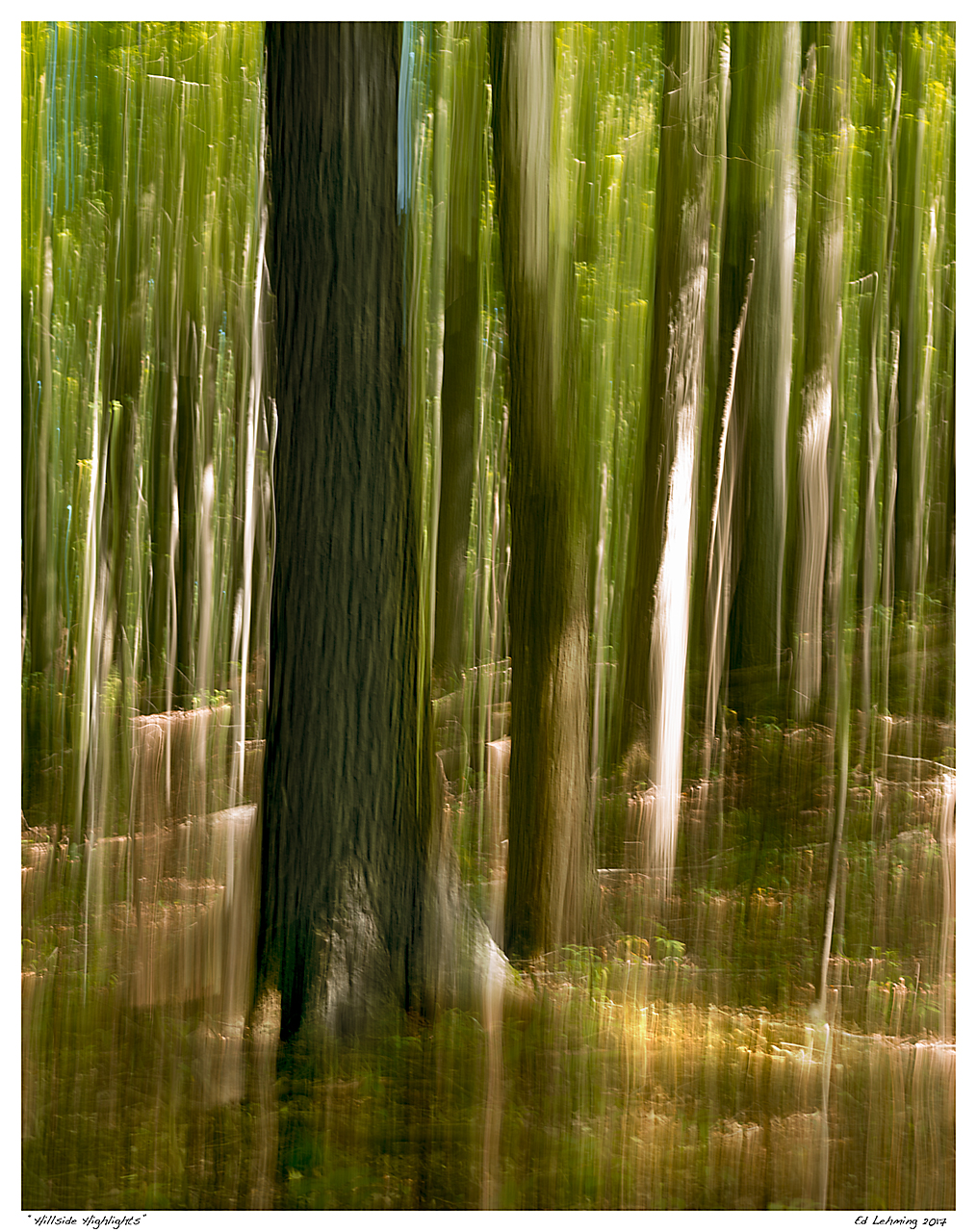
“The voice of beauty speaks softly; it creeps only into the most fully awakened souls”
― Friedrich Nietzsche
Bright rays of sun reflects off the tree lined hillside within the Durham Forest. Patches of light shine in golds and silvers, lighting up patches of leaf littered ground and pockets of bright green undergrowth.
I found some areas of the forest strangely devoid of undergrowth this year, which struck me as odd during this very wet summer. It looked like the snow had just melted yet it’s early September. This lack of undergrowth was somewhat disturbing but may simply be part of nature’s patter which I am just becoming aware of.
As I’ve said before, taking the time making, and later viewing these images, is allowing me to more fully appreciate the surroundings in which I make them. I spend considerable time looking for locations which offer good light and composition. I don’t just take random shots and hope for the best. For example, this image is the result of about eight attempts to get the light and camera movement right, as I work on capturing the energy I am seeing in the scene.
The resulting image contains all the elements which I originally saw: the gently sloping hillside, the trees, lined up as if marching up the hill, pright patches of light filtering the forest canopy, and a thin sliver of bright blue sky to set it all off, all within the green veil of light that fills the whole scene.
Nikon D800
Tamron SP AF 90mm f/2.8 Di Macro 1:1 (272ENII)@90mm
1/4 sec, f/8.0, ISO 100
For more images like this, please visit my Facebook page:
https://www.facebook.com/EdLehming
or my website (images are available for purchase)
http://www.edlehming.com
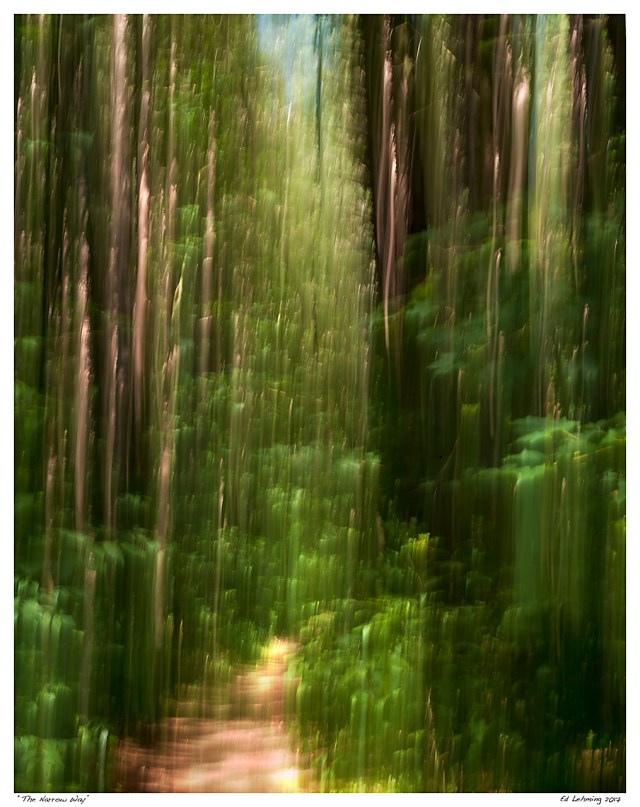
“There are no dead ends in life’s journey; there are no crossroads, no forks in the road. People who chose not to see reality, see the world as a tangled maze of intersections, forks in the road, and dead ends. These are illusions of people who follow the well trampled wide path woven out by others. This is not their true path. Life’s true sojourn reveals a long winding narrow path that only you can choose. Few have the courage to walk it.”
― RJ Blizzard
As the journey Into the Green Veil continues, the path I walk narrows in points, bounded on both side by tall maples and oaks, undergrowth crowding the trail edges, reaching into the golden patches of sunlight in the constricted open area of the path.
High above, there is a thinning of the canopy and pale blue competes for attention with the green canopy. This scene is so common on the trails of the Oak Ridges Moraine, an area conveniently located just north and east of my home.
The particular region I’m documenting in this series is know as the East Duffins Creek Headwaters area and has a wonderful network of well maintained trails running through mixed woodlands. This section of trail runs through rolling hills dominated by sugar maple, red oak, and beach trees. The growth is thick and healthy and being among these tall trees is one of my favourite experiences. Simple snapshots of the forest become quickly mundane and I’ve found that my photo abstractions, by adding an element of movement, bring a life and energy that a typical photo lacks. It allows me to appreciate the rich, dynamic, and ever changing light so much more, especially as I notice just how variable those patches of light can be. I hope, through this series, to convey that energy to others.
I’m also following a unique path of my own with this series. Capturing images in an unconventional style that I started pursuing a few years back. The images are always different, unexpected, and exciting. A chance for me to share my outdoors experiences in a challenging way. The journey continues. There are no dead ends. A few steep hills and sharp bends, but no dead ends.
Nikon D800
Tamron SP AF 90mm f/2.8 Di Macro 1:1 (272ENII)@90mm
1/4 sec, f/25.0, ISO 100
For more images like this, please visit my Facebook page:
https://www.facebook.com/EdLehming
or my website (images are available for purchase)
http://www.edlehming.com

“You are the light in a dark place. You are the water to my drought. You are everything I never knew existed and everything I wanted all at the same time.”
― Shelly Crane
The next image in my “Into the Green Veil” series is of a large maple tree which stood along the trail, roots spreading deeply into the forest floor. Further into the forest, slightly smaller maples catch golden rays of light.
The single large tree captured my attention primarily because it was the largest tree in this stretch of forest and secondly how the light reflected from its bark. It’s always about the light and its effects on the surrounding environment. There are also lovely golden patches of light dappled across the ground and up the slight rise behind the tree, yet the ‘green veil’ is omnipresent, though subdued by the golds and yellows.
Strangely enough, the light on the ‘guardian’ has more of a silver tone to it than the surrounding light, perhaps affected by the maple’s gray bark, though some golden tones are mixed in, as the light fades towards the left.
Nikon D800
Tamron SP AF 90mm f/2.8 Di Macro 1:1 (272ENII)@90mm
1/4 sec, f/10.0, ISO 100
For more images like this, please visit my Facebook page:
https://www.facebook.com/EdLehming
or my website (images are available for purchase)
http://www.edlehming.com
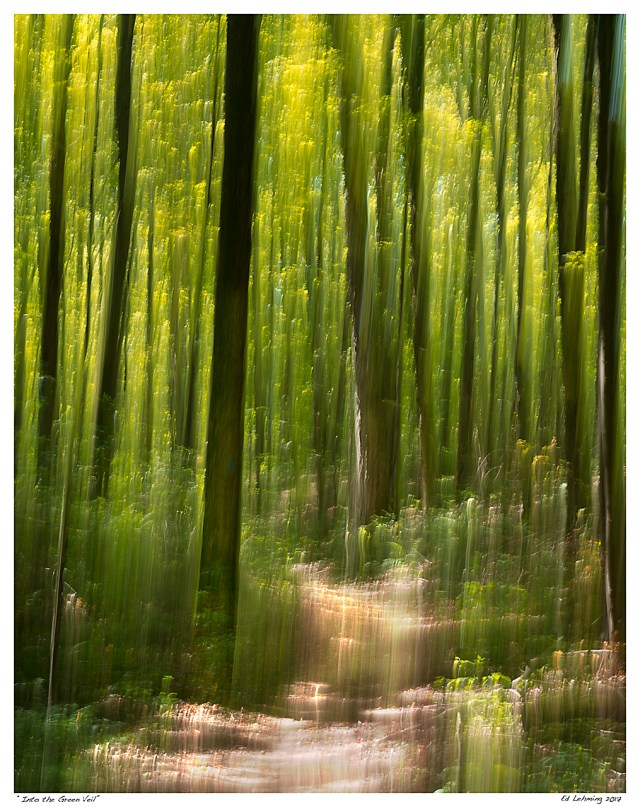
“The Green Veil shimmers richly around me,
in tones of deepest emerald and muted olive;
a dominating threshold between earth and sky.
Yet, through this veil,
gold light pierces and shimmers,
lighting the path and bright undergrowth,
in a dance of life and light.”
– Ed Lehming
I’ve been wanting to create a new series of images for some time, but the greens of summer, while lovely and filled with life, do not generally lend themselves to the photo abstractions I love so much.
Yesterday I felt inspired to get out for an early lunchtime walk and took my camera with me, as I often do, hoping for some inspiration. It did not take long, but a chance venture off my regular route brought me into an area of the forest with the most beautiful late summer light I have experienced this year. The forest surrounding me felt magical and filled me with joy. I had to do something with this moment, as it just felt right.
I made several images, reviewing each in my camera’s viewfinder. My abstraction technique is unpredictable and every single shot is slightly different, due to changes in the light and my movement. I was quite pleased with the resulting photos and believed I had enough material to create a new series of photos. The problem was, since it was a late summer forest, everything had a green cast to it. The human eye filters this out and we see a forest, but the camera is not so forgiving.
This green cast was bothering me and I was looking at ways to minimize it, without affecting the colours of the forest. Finally, I just gave up and processed and image, posting it on my blog yesterday for feedback, still having no idea what I would title this series. My last series: God Light, was quite easy to name, since it focussed on the wonderful patches of light that are created in forests. Those same patches exist in the summer too, as evidenced in the image above. But, what to call this summer series.
One of the followers of my blog David – It’s Complicated, wrote back with comments on the image and that they “like the color and effect of the green “veil”. Then it came to me, the “Green Veil” is dominant in all the images, and when I see it as a crucial element to the photo, I’m no longer inclined to remove it, but rather enhance its effect on the photos.
So, here’s the start of the “Into the Green Veil” series, the first image, above, is of the path leading into this forest glade. The title is also a bit of a play on words, as I was walking into a ‘vale’ as well.
Nikon D800
Tamron SP AF 90mm f/2.8 Di Macro 1:1 (272ENII)@90mm
1/4 sec, f/13.0, ISO 100
For more images like this, please visit my Facebook page:
https://www.facebook.com/EdLehming
or my website (images are available for purchase)
http://www.edlehming.com
“Sometimes all you need in your life is anything strange because strange things can revive your soul just like a cold water freshening your pale face with every splash!”
― Mehmet Murat Ildan
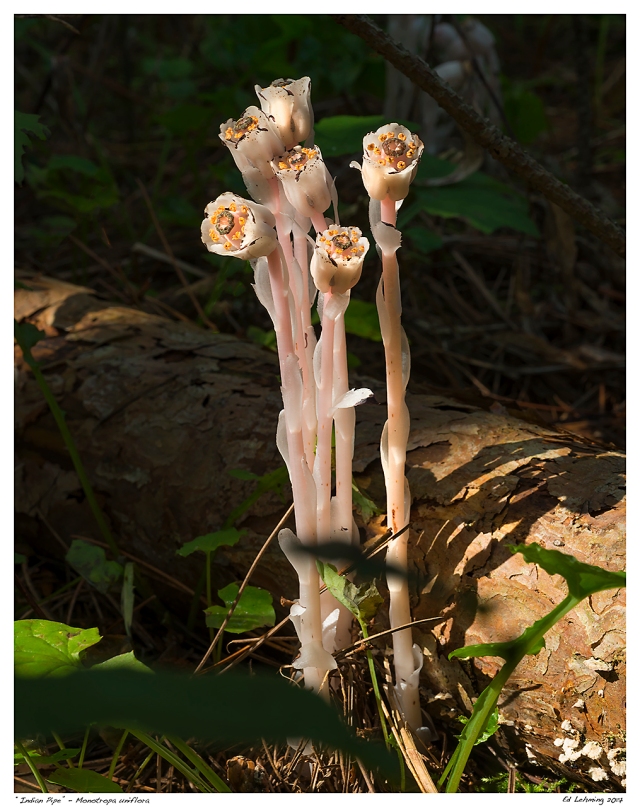
I thought I had missed them. A week ago, as I was hiking a local conservation area, I came across a patch of Indian Pipes, a very strange plant and a bit of a rarity around here. Alas, they were past their prime and already turning black. Not photo worthy.
Earlier today, as I made a brief foray into a local forest, I was surprised to find numerous clusters of Indian Pipe still in great condition. I was even more surprised to find them in bloom. Honestly, I did not know they bloomed, as I have never seen them at this stage and in such fine condition. I made several images in the highly variable light of the pine forest and this was the best of the series. Generally, the heads of the Indian Pipe are nodding, thus the name: Monotropa, from Greek monos, meaning “one” and tropos, meaning “turn”. I was also surprised by the pink colouration, as these plants lack chlorophyll, which is what gives plants their green colour. These odd plants get their nutrients through a mycorrhizal relationship with a fungus, which in turn gets its nutrients for local trees. It’s this complex relationship that has led to the Indian Pipes lack of chlorophyll, they don’t need it.
As I said, there were many clusters of this usually rare plant to be found, likely brought on by the warm, wet summer we have had. Usually, I have to look hard to find even a single plant, at the right time of year. Fortunately, I had my macro lense and tripod with me, so I was able to collect a nice sharp image, with good depth of field.
Nikon D800
Tamron SP AF 90mm f/2.8 Di Macro 1:1 (272ENII)@90mm
1/6 sec, f/22.0, ISO 100
For more images like this, please visit my Facebook page:
https://www.facebook.com/EdLehming
or my website (images are available for purchase)
http://www.edlehming.com

“Among the tales of sorrow and of ruin that came down to us from the darkness of those days there are yet some in which amid weeping there is joy and under the shadow of death light that endures.
― J.R.R. Tolkien
Over the past few days, I’ve been deliberately spending my lunches in the local forests, reconnecting with the wood and getting back to my love of photo-abstractions. Summer posses a unique challenge as bright greens dominate. Every now and then, a composition presents itself, as the light shifts continually, and an image emerges from the depths.
In the same theme as my 2016 Autumn series titled “God Light“, these patches of sunlight, moving and shifting throughout the branches have a deep spiritual effect on me. It’s almost like I’m supposed to focus on that particular place for some meaning. Sitting with the images pulls me into the scene, realizing there is more at play than just the patch of light, there is a larger effect on the surrounding trees, as this light further reflects on the larger space.
In this image, not only is the ground lit up, but a singular sapling, seemingly devoid of foliage is also caught in the light, becoming the focal point of the image, till the eye drifts past it and picks up the textures of the larger maples framing it.
Nikon D800
Tamron SP AF 90mm f/2.8 Di Macro 1:1 (272ENII)@90mm
1/4 sec, f/8.0, ISO 100
For more images like this, please visit my Facebook page:
https://www.facebook.com/EdLehming
or my website (images are available for purchase)
http://www.edlehming.com
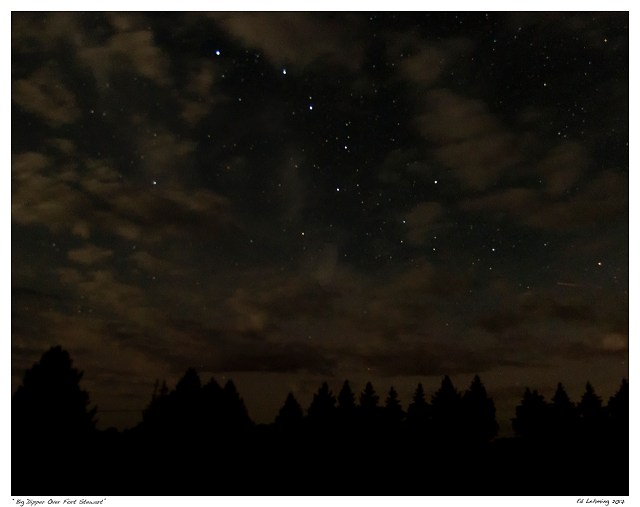
“The Big Dipper wheels on its bowl. In years hence it will have stopped looking like a saucepan and will resemble a sugar scoop as the earth continues to wobble and the dipper’s seven stars speed in different directions.”
― Ann Zwinger
This past weekend, I spent a few evenings with my son, who wanted to try his hand at night photography. So, I made a few shots of my own. Night photography is not my area of expertise and I spent quite a bit of time simply ‘experimenting’. I’ve also never used my D800, so was checking to see just how different the sensor was compared with my D300, with which I had become quite comfortable a few years ago.
Conditions were not ideal, despite travelling to a “dark zone”, just east of our camper. Dark Zones are areas identified for their lack of light pollution and should be ideal places for astrophotography. I’ve included a map site if you are interested. On the evening that we travelled to nearby Fort Stewart, the moon was in an advanced waxing crescent, just high enough to light up the low clouds and obscure the fainter stars. Then, of course, the sky clouded up a bit and we had to wait for a few breaks. Add to that the plentiful mosquitoes, brought on by our wet summer, and that was the recipe we had to work with.
In the end, I ended up with a few interesting images, including this one of the Big Dipper, just above a line of trees, with the moonlight reflecting off the clouds. I have yet to see my son’s images. I’m hoping he was successful in what he hoped to capture.
Nikon D800
Tamron 17-50 mm f/2.8 @ 17mm
15 sec, f/2.8 ISO 3200
For more images like this, please visit my Facebook page:
https://www.facebook.com/EdLehming
or my website (images available for purchase)
http://www.edlehming.com

“It is the dim haze of mystery that adds enchantment to pursuit.”
– Antoine Rivarol
I came across this mystery mushroom a few days ago, while hiking during our recent partial eclipse. I’m unsure of the species, but the red cap and ivory stem would indicate it to be a member of the Amanita family of mushrooms. The shape of the cap is not typical of this species though, so I’m stumped.
The image quality is not my best, as it was hastily made while trying to avoid the hoards of mosquitoes which were particularly active that day and were particularly voracious, despite my insect repellent, which is usually very effective. Despite the obstacles, at least I have an image I can review and figure out what this is called.
iPhone 7 back camera @ 4.0mm
1/15 sec; f/1.8; ISO 40
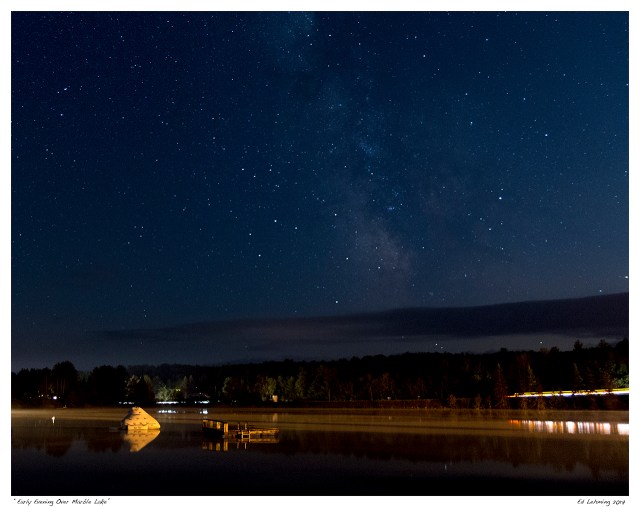
“I have loved the stars too fondly to be fearful of the night.”
― Sarah Williams
I spent Saturday evening with my son, on the dock at the camper near Bancroft, Ontario. Conditions were not ideal, as there was a fine have in the sky and the waxing crescent moon had just set, but we took the opportunity to make a few images despite these conditions.
The results, while not quite what I was after, are pleasing and capture the mood from the dock nicely, including traffic on Highway 62, which runs along the west end of the lake, creating the light streak to the lower right of the photo.
Nikon D800
Tamron 17-50 mm f/2.8 @ 17mm
20 sec, f/2.8 ISO 3200
For more images like this, please visit my Facebook page:
https://www.facebook.com/EdLehming
or my website (images available for purchase)
http://www.edlehming.com
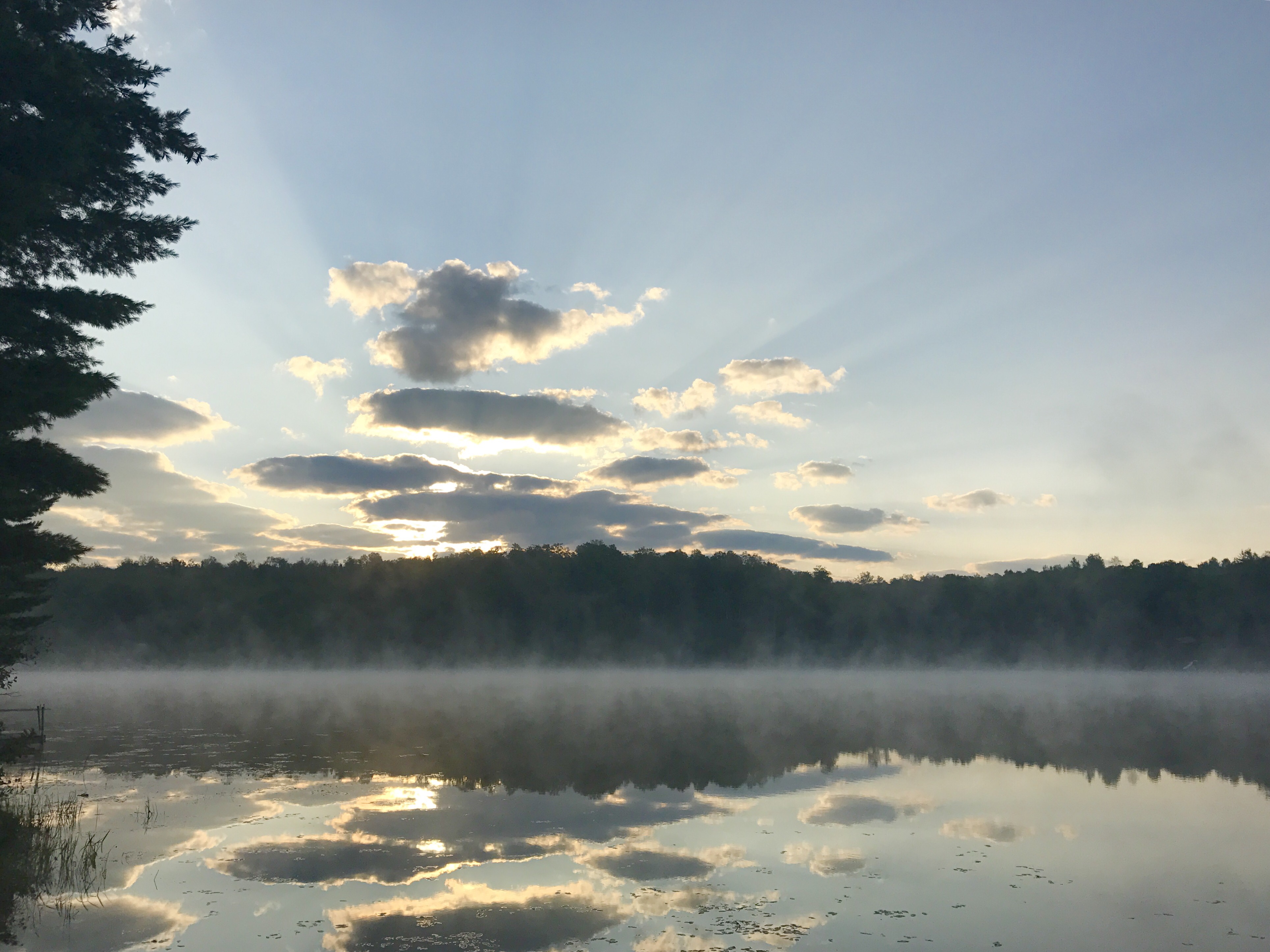 A beautiful, cool dawn on Bancroft’s Marble Lake. The mist swirls gently on the water’s surface, as the sun rises behind a low ridge. A pattern repeated throughout the summer, each time, slightly different.
In the distance, Blue Jays screech high in the trees and the world awakens as the sunlight reaches further every minute. A new day begins.
“Unfamiliar disturbs us; familiar comforts us! But for the wise man, unusual is more precious than the usual because it offers us a new way, a new vision, a new idea, a new world!”
― Mehmet Murat ildan
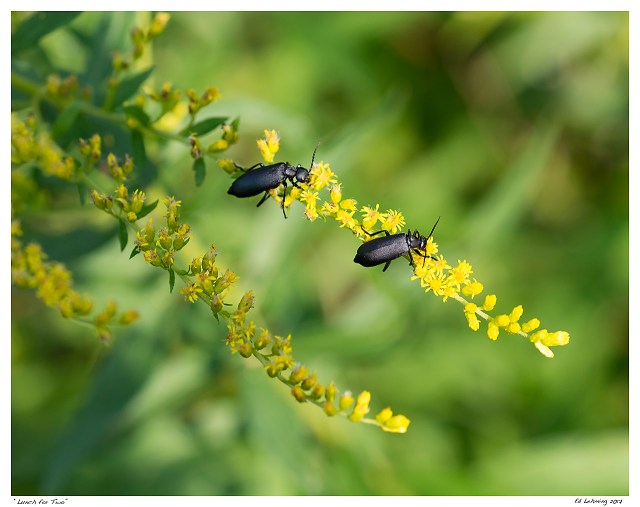
Quite often, I come across scenes that make me pause, because they are unusual or momentary. For me, those scenes are a break from the mundane, everyday scenes, and I relish them. Like this image of two Black Blister Beetles (Epicauta pennsylvanica), feasting on recently blooming Goldenrod. I also had to look the beetles up, since I was not sure what they were. To my surprise, most images of the beetles have them feeding on Goldenrod. So perhaps, this is not so unusual after all?
In my many hours hiking local trails I have not noticed these beetles, which on this particular day seemed to be infesting most of the Goldenrod along the trails. It may have been a unique event for this day, or I may simply have missed seeing it in the past.
What made this scene more interesting to me was that all the beetles; there where more than just these two, were all facing the same direction. It’s just the close proximity of these two that made me come up with the title. I did go back out the next day and the beetles were gone.
Nikon D800
Tamron SP AF 90mm f/2.8 Di Macro 1:1 (272ENII)@90mm
1/400 sec, f/10.0, ISO 400
For more images like this, please visit my Facebook page:
https://www.facebook.com/EdLehming
or my website (images are available for purchase)
http://www.edlehming.com

“Sometimes opportunities float right past your nose. Work hard, apply yourself, and be ready. When an opportunity comes you can grab it.”
― Julie Andrews Edwards
This was a fun scene to watch. There were initially two large bees, hastily gathering nectar from this bull thistle. As they busied themselves, a smaller bee approached closely, but when it saw the blossom full, darted off, yet kept coming back to check on the situation.
While I was snapping photos, one of the larger bees left, freeing up a large tract of real estate. As I continued to track the large bee, waiting for a good composition, the small bee darted in from the periphery, just as I hit the shutter release, yielding the action shot above.
The image makes me smile because I am so keenly aware that the small bee was so anxious to get its share of nectar and was probably relieved that one of its larger competitors had departed. Also, the slight blur of the smaller bee’s body gives a sense of speed and urgency to the image. The larger bee was so busy, it never even noticed the new arrival.
Nikon D800
Tamron SP AF 90mm f/2.8 Di Macro 1:1 (272ENII)@90mm
1/320 sec, f/9.0, ISO 400
For more images like this, please visit my Facebook page:
https://www.facebook.com/EdLehming
or my website (images are available for purchase)
http://www.edlehming.com

“You are imperfect, permanently and inevitably flawed. And you are beautiful.”
― Amy Bloom
I’ve been saving a quote for some time, waiting for the right image. Well, the image presented itself a few days ago. As I’ve said in a few posts, butterflies seem to be scarce this year, Monarchs even more so. I think this whole season I’ve only seen a handful.
This one was simply too wonderful to resist, despite it’s damaged wings? What, what, damaged? Have a closer look. What at first appeared to be a ‘perfect’ specimen, on further inspection shows some late summer wear and tear, though not extensive, the damage is irreparable. Does this make the butterfly any less beautiful? Not to me, as I watched it perched so wonderfully, posing, as if just for my benefit.
It was beautiful in its imperfection, and I’m glad for that. The damage makes me wonder how it came about. With all our rain and wind over the past few weeks, I’m surprised to see butterflies at all, let alone mostly intact. I can’t imagine how they survive. Yet, this one did, offering me a nice long view.
Nikon D800
Tamron SP AF 90mm f/2.8 Di Macro 1:1 (272ENII)@90mm
1/200 sec, f/7.0 ISO 100
For more images like this, please visit my Facebook page:
https://www.facebook.com/EdLehming
or my website (images are available for purchase)
http://www.edlehming.com


Recent Comments