“There is a pleasure in the pathless woods,
There is a rapture on the lonely shore,
There is society, where none intrudes,
By the deep sea, and music in its roar:
I love not man the less, but Nature more”
―
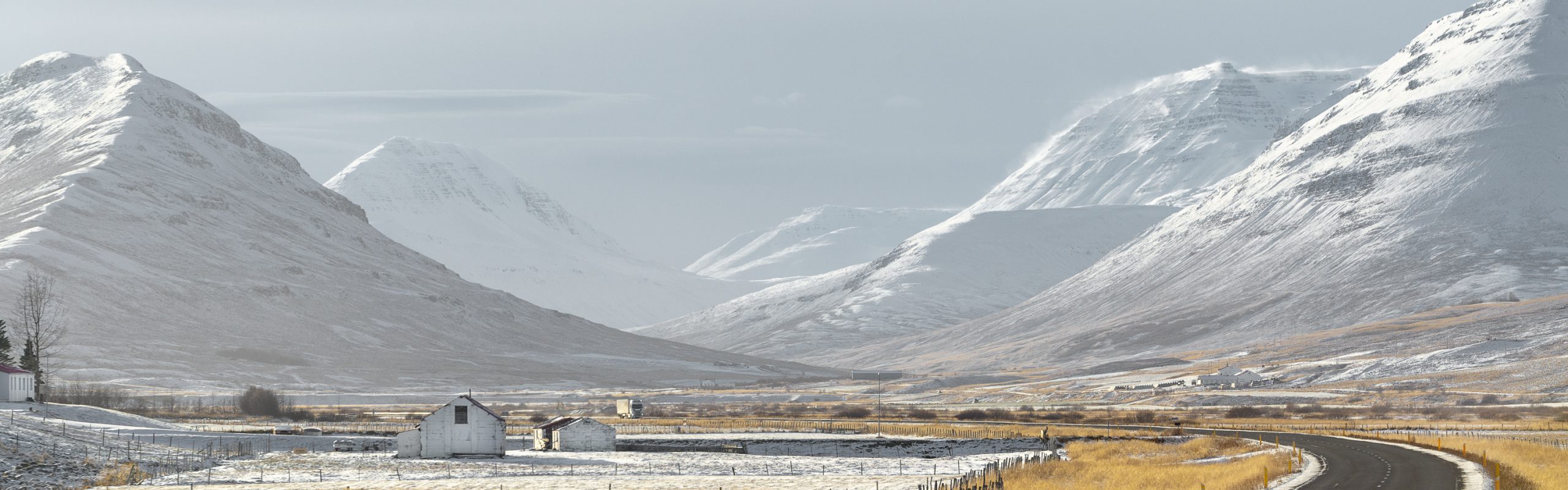
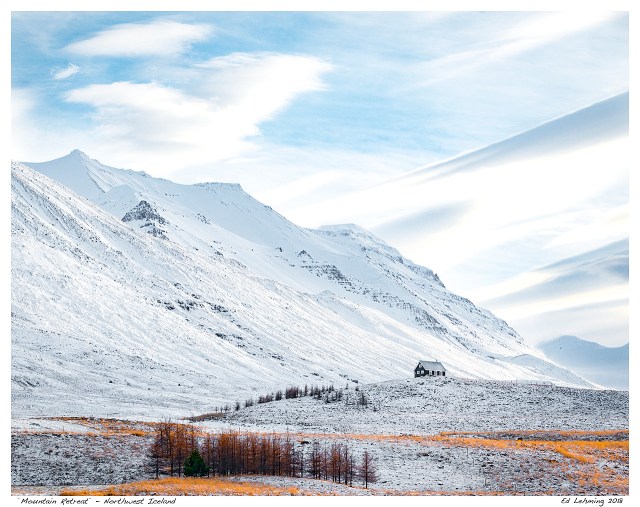
This was a common scene along many stretches of Iceland’s Ring Road; beautiful cabins on the mountainsides. I’m a bit envious. I’d love to stop at one of these retreats for a few days, surrounded by mountains and waterfalls. I know I’d spend my time reading and writing, inspired by the wonders of nature. Some, like this one, have small groves of trees planted around or near them, probably as a wind screen or source of firewood. The ever-present yellow grasses and mosses bring a splash of welcome colour to the wind-whipped landscape. Though the scene is primarily rock and snow, there is a peaceful and humbling majesty to it.
There were a few times, as we hiked some of the lower mountain trails when I would simply stand still, listening to the sounds of water flowing down the hillsides, the wind howling far above, and sometimes, just silence, peaceful, blessed silence.
My trip to Iceland last month was a balm to my soul; a much-needed pause in a busy and increasingly stressful world. For me to spend ten solid days with my son, with no real schedule, no firm plans, and to simply ‘be’ in this wonderful place has restored me.
To have the ability to capture some of what I experienced in photos is a blessing I am so thankful for. I can sit and review these moments and memories, each one stirring my soul and reminding me that there are still places of peace and wonder in this busy world.
In a way, the photos have become my cabin on the hill, a place that I can visit when I need to pause for a bit and restore myself. Though it’s not quite the same as the actual cabin, it brings be closer to that place.
Nikon D800
Tamron SP 70-200mm f/2.8 Di VC USD @ 116mm
1/250 sec, f/8.0 ISO 200
For more images like this, please visit my website (images are available for purchase)
http://www.edlehming.com

“Kleifarvatn” – South-East Iceland
“The very land oozed sulphurous steam, as if some ancient beast trapped below was exhaling through the cracks in the earth, yet the morning light filled the air with a quiet peace”
– Ed Lehming
Day 10, our final day in this wonderful land of contrasts: Fire and Ice, vast black plains and towering mountains. The land of endless waterfalls and barren lava fields.
On this final day, our loop ended where Highway 42 met Highway 427 along the south coast of Iceland, where our journey began on a dark morning at the end of October. We covered some 2,700 km of highways, side roads, and potholed dirt tracks.
The most amazing thing I discovered on this trip with my son is the incredible and indescribable diversity of this country. Every single vista, from majestic seaside mountains to the endless black and tortured lava fields is that there are surprises when you take the time to look closely.
I made far too many photos of the mountains we passed, but I fell in love with the Icelandic mountains, in their many forms, from tiered pyramids to flattened cones and every variation between. Some were pure black, made of ages of fine cinder and ash, while others were deep brown, covered in eons of moss. like ancient temples.
The deeper and more carefully you looked, the more wonderful they became, revealing details not noticed at first.
That is why I chose this as the final photo in this overview of our trip. When first composing the photo, I saw a lovely mountain lake with steaming volcanic vents in the distance. But, like the rest of the land, closer inspection reveals herds of grazing Icelandic horses and a farmhouse among the vents. The stark landscape opens up to be more than you first expect or see and the light, which shift sby the minute, always reveals more wonder.
The lake, in this photo, is called Kleifarvatn and is situated within one of Iceland’s many ‘rift’ valleys, areas of active geothermal activity. We drove around the lake, only a short drive from Reykjavik, on our way to the Krýsuvík Geothermal Area, a region of belching and bubbling mud pots, thermal vents, and hot springs as well as brightly coloured rocks, crusted with minerals. or final ‘photographic” destination before dropping off the rental car and heading to the airport.
Much of the trip was really about the journey and not the destination. As we drove to some of the more popular sites we were constantly amazed at the beautiful landscape between, despite low cloud and a constant dusting of snow at higher altitudes.
There are so many more places that we visited that a simple day by day review does not suffice. I will continue sharing some of the highlights of this trip over the next few weeks, retracing our journey around Iceland’s Ring-Road.
Nikon D800
Tamron SP 70-200mm f/2.8 Di VC USD @ 145mm
1/400 sec, f/10.0 ISO 200
For more images like this, please visit my website (images are available for purchase)
http://www.edlehming.com
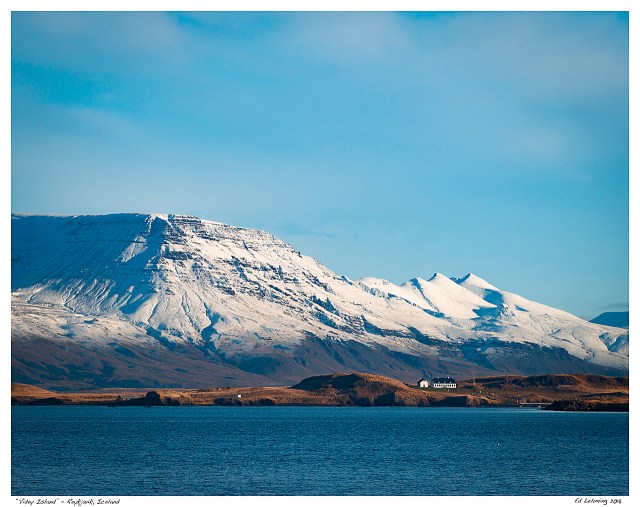
“Videy Island” – Reykjavik, Iceland
“You may say I’m a dreamer, but I’m not the only one. I hope someday you’ll join us. And the world will live as one.”
―
This was our final full day in the glorious land known as Iceland and we spent the day touring the city on foot, starting at the harbour front. I could not help but be entranced by the raw beauty of this place, even when surrounded by a bustling and busy European City.
Looking across the bay, my eyes were drawn to the vast mountain plateau and distant volcanic peaks that dominate the horizon. In front of this snowy majesty sits a small, uninhabited island known as Videy Island . You’ll notice a single large building. This is Videy House, now a restaurant and historical centre.
Something that I did not notice, when I was composing the photo, is the small white structure, just left of centre. It turns out that this is the Imagine Peace Tower and is an outdoor artwork conceived by Yoko Ono, in memory of her late husband, John Lennon.
It’s a tower of light designed to communicate to the world that peace and love is what connects us. It is lit every night from October 9th (John’s birthday) until December 8th (the anniversary of his death). It’s also lit on the Winter Solstice and New Years Day.
Sadly, while we were there, I was still under the weather and did not have the opportunity to see it lit up.
Nikon D800
Nikkor 70-300mm f/4.5-5.6 G I AF-S VR Zoom @ 170mm
1/400 sec, f/11.0, ISO 400
For more images like this, please visit my website (images are available for purchase)
http://www.edlehming.com
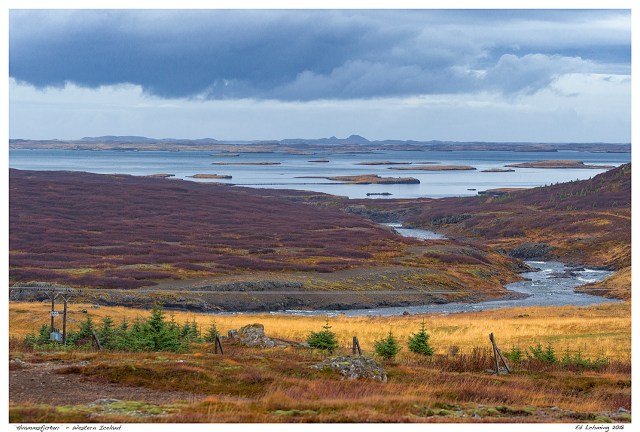
“Hvammsfjörður” – Western Iceland
“Those who live by the sea can hardly form a single thought of which the sea would not be part.”
―
There was a slight delay in my posts over the past few days. You see, for the last 2 days of my ten day Iceland trip, I was sick with some sort of gastro-intestinal infection. I have no idea where it came from. It felt like flu, but we really have had minimal contact with people, other than shopkeepers and our guesthouse hosts. In nay case, I was quite ill and fell behind on my posts.
On day eight we headed back inland and I have yet to process those photos. We left Borgarnes toward Reyjavik and decided to avoid the tunnel that connects the Akrenes peninsula with the mainland.
We had heard from on of our guesthouse hosts that there was still a whaling station active at the end of Hvalfjörður, Icelandic for the Whaling Fjord. It added a bit to our drive but was a wonderful side trip. Whaling season has ended, but the vast processing plant was interesting to see.
From the fjord, we headed inland, across high mountain plateaus toward Geysir, the location of the geyser that others took their name from. As expected, the place was packed with tourists ad a full sized restaurant and visitor centre had been built. It really was a fascinating site to visit, despite the crowds. Basically, anywhere within a 2 hour drive from Reykjavik is filled with tourists on day trips.
The original Geysir is now just a smouldering blue pool and an adjacent geyser, Strokkur, which erupts about every 4 minutes. The rest of the area is filled with bubbling hot springs and steam vents. It does reek of sulphur, which was not a great thing for my unsettled stomach. Once I get photos of Strokkur processed, I’ll revisit this location with its own post.
Nikon D800
Tamron SP 70-200mm f/2.8 Di VC USD @ 90 mm
1/80sec, f/4.5 ISO 200
For more images like this, please visit my website (images are available for purchase)
http://www.edlehming.com
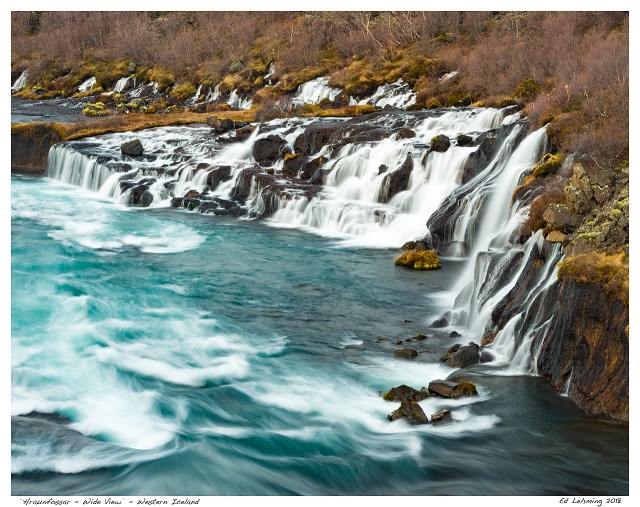 “Hraunfossar – Wide View” – Western Iceland
“In Iceland, water is everywhere. It surrounds the land itself. Water courses from high mountaintops, bursts from the ground, itself, and flows in endless ribbons over the ancient stone, cleansing the blackened and tortured landscape. The water rarely stands still, as if it’s the lifeblood of the land itself.”
– Ed Lehming
Today, as we headed toward the town of Borgarnes, on Iceland’s western coast, we pulled out a map and plotted a route that took us from the coast, inland to the high mountains, lava fields, and glaciers of south-eastern Iceland.
Along this route we picked a few points of interest, including Hraunfossar, a low and wide waterfall along the Hvítá river. The fall is unusual in that they burst forth from underground along the Hallmundarhraun, which is a massive lava plain that dominates this region. It’s strange to see this amount of water coming from the side of a hill, just below the vegetation. In fact, you hardly notice it at first.
I spent quite some time here, enjoying the scene before me and making many long exposure images of different parts of the waterfall.
Just above Hraunfossar is Barnafoss, a violent cascade created by the massive volumes of water from the glacial Hvítá river. Barnafoss, which translates into “the children’s waterfall” is named after a local tale that on a Christmas Eve many years ago two children in the Hraunsás household who were supposed to stay home while the parents went to church for Christmas Mass. When the parents returned from mass, they discovered that the children had disappeared (possibly because the children got bored and decided to go out). They then followed the children’s tracks to this waterfall at the stone natural bridge where the tracks disappeared. The mother concluded that the children must have fallen into the river and drowned. Thus, the name.
From here we traveled yet further inland, having mapped a course back to Borgarnes along a highway that looked like many of the unpaved roads we have travelled on this trip, only out find it had been re-designated as an “F” road, one of Iceland’s inland mountain roads, thus our rental car was forbidden to travel it.
Rather than simply turn back, we re-navigated to another gravel road that followed a less mountainous path along the opposite shore of the Hvítá river. In doing this loop, we did cross the Hvítá on a high plain and looked upstream to the glaciers that birthed it, making the detour interesting.
And so, we headed towards tonight’s destination: Borgarnes, a coastal town along the western cost to plan out our final few adventures in this astoundingly beautiful country.
Nikon D800
Nikkor 70-300mm f/4.5-5.6 G I AF-S VR Zoom @ 70mm
1/.0 sec, f/32.0, ISO 200
For more images like this, please visit my website (images are available for purchase)
http://www.edlehming.com

“October Afternoon at Kirkjufellfoss” – Iceland
“People are very busy; they are so busy that when they walk in the crowds they see no one, no one but themselves; they hear no voice, no voice but their own voice!”
―
Today was a day of long travels, over broken dirt roads, navigating a quicker route to our destination, the only real ‘destination’ we have had on this trip, apart from lodgings.
So far, we have ‘winged it’, simply driven between one overnight stop to the next, taking in the wonders along the way, enjoying the surprising gifts of beauty this country has to offer, and always expecting the unexpected.
Yes, we have a maps and guidebooks to help us find landmarks along the way, but till today, we did not set out with the intention of visiting a particular site. This has removed any pressure or expectation and has put us in places we had not expected to end up. It’s put us in places we see photos of, but really had no idea where they were, all the while avoiding the summer crowds during this off-season. Mind you, white outs and near impassible roads have helped with that too. Despite unforeseen weather and driving challenges, it has been and continues to be a completely amazing and soul-restoring trip.
Back today. We set out from our lodgings in Svinvaten, in North-East Iceland towards the town of Grundarfjörður, the home of Kirkjufellfoss and the crazy pyramid looking mountain that seems to be on everybody’s Instagram feed. To get there in reasonable time meant taking a few ‘shortcuts’.
Iceland’s road system includes a series of remote wilderness roads, knows as “F” roads, that take the traveller, with an appropriate vehicle into Iceland’s more remote locations. These roads are now closed for the season and our rental contract forbade using these roads. However, we found a few routes that parallel the F roads and cut directly cross-country to cut significant distances that result in sticking to the coast-hugging main highways. The roads we travelled were gravel, pot-holed tracks through open county, bounded by mountains and across vast plains of nothingness. It was beautiful, but slightly un-nerving.
In the end we reached our destination, only to find it filled with crowds (yes, even this time of year) of people with the accursed selfie sticks, posing in precarious locations around the falls.
My main reason for attending this location was to see for myself what the falls looked like and how some of these beautiful images I see are made. Having been there myself now, any shots without people are the result of patience or post-processing. People were everywhere, each in their own world, oblivious to others. Some balancing and posing for extended periods, and making it next to impossible to get a good shot.
I really don’t like crowds, primarily because of this mentality, which seems so pervasive with the inception of Instagram; everybody trying to outdo the other for that ‘wow’ shot.
As for me, I set up in a few locations, waited between ‘waves’ of visitors and snapped a few shots, hoping for something worthwhile. I was pleased with the image above. I could not imaging going back to this place in the summer, despite its beauty and surreal appearance.
Nikon D300
TAMRON SP AF 17-50mm F2.8 XR Di II LD Aspherical IF A16NII @ 32 mm
1/4 sec, F/29, ISO 200
For more images like this, please visit my website (images are available for purchase)
http://www.edlehming.com
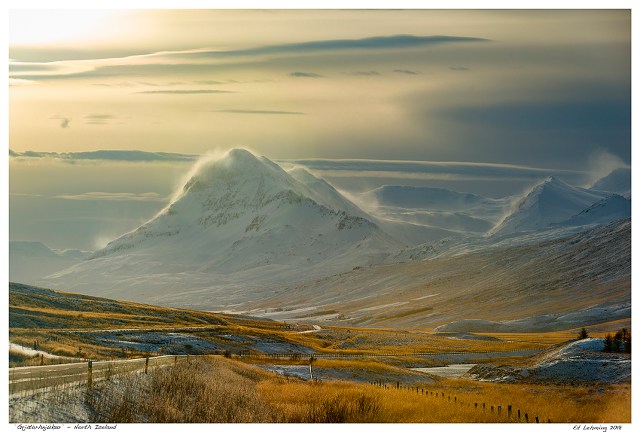
“Heiðarfall” – North Iceland
“Though we travel the world over to find the beautiful, we must carry it with us, or we find it not.”
―
On a day that started out dull, and blanketed in low cloud and with little promise of sights to photograph, we set out on the still icy road which would lead us to a stop at Goðafoss, a much photographed waterfall just off the main highway, a lovely lunch in the city of Akureyri, and finally, our overnight stay at a guesthouse in Svinvatn, a small interior lake.
As we approached Goðafoss, the sky began to brighten, but a layer of cloud still blocked the sun, but made for good conditions to photograph the waterfall, post to follow at a later date.
With the highlight of our day completed, we headed out of Akureyri, the second largest city in Iceland, following a long valley through the mountain range that rises on the western edge of the Eyjafjörður fjord.
With the sky just slightly overcast, the drive through the valley was lovely, and yielded a few ‘decent’ photos. I the distance, we could see a mountain peak, a bit hazy in the distance, lit up by the sun. We kept watching, as the peak began to come into sharper view, snow whipping from its snow covered summit.
We pulled over along the road to make a few photos of this interesting vista before us. Then, suddenly, magic happened. As I stood ready to make a photo, the clouds overhead changed the light, ever so slightly and bathed the valley before me in a wonderful golden hue and the world before me was like a scene from a dream, then it was gone again. But, I was able to capture that one brief moment as a photo I will treasure for a long time. The long valley, with the snowy mountain. A miracle of light and timing.
So, a ho hum day, became a day of sheer joy. That seems to be the nature of Iceland, you always have to be prepared for something new and wonderful, despite icy roads and gray skies.
What an incredible change from yesterday’s icy drive.
Nikon D800
Tamron SP 70-200mm f/2.8 Di VC USD @ 145 mm
1/320 sec, f/9.0 ISO 200
For more images like this, please visit my website (images are available for purchase)
http://www.edlehming.com
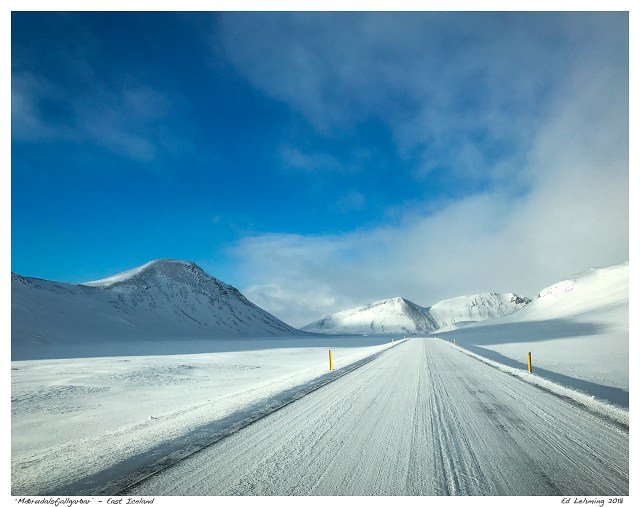
“Möðrudalsfjallgarðar” – East Iceland
“When hell freezes over the Earth shall be covered in snow.”
―
The theme of this day is snow, never-ending snow, floating snow, drifting snow, skin biting snow. You see, today we headed into the north of Iceland. As we awoke in the town of Egilsstaðir, light snow had already fallen overnight and dusted the world in white. The forecast showed the snow would be ending by mid-morning.
That was my first mistake, there is no such thing as a long-term forecast in Iceland, and a large arctic storm west of Norway was pushing cold air and moisture towards Iceland. Roads that started snow-dusted soon turned to ice and, as we ventured ever higher into the mountains which divide East and North Iceland, we ran into a continuous series of storms which created white-out conditions.
I should note that our rental vehicle was a 4×4 with studded tires. I wondered, “Why the studs?”, when we picked it up that rainy morning a few days ago. Now I know. There are no salters here and we only saw two snow ploughs on our 170 km drive, despite the horrible conditions.
This was to be our shortest drive on the ring road trek, but ended up taking much longer due to the ‘white knuckle” road conditions.
Despite this, we still had a great time and made many beautiful photos along the way, including Dettifoss and Snelfoss, two massive waterfalls that flow through an enormous fissure running through a wasteland of volcanic rock. That 24 km drive down the Dettifoss road was more of the same: icy roads and constant snow drifts. If roads at home were like this, I would not venture out.
As we neared the end of the day, having survived the roads, thus far, we headed for the Krafla Geothermal Plant, at the base of Krafla, a 818m high volcanic dome, with plans to drive to the viewing area at the top and take in the beautiful emerald-green pool that fills the cone. When we arrived, we found the access road closed, due to poor conditions. We sat in the car till yet another squall passed over and decided to hike the 2.5 km road to the top. Half way there we had reached the lead edge of the peak and were greeted with +100 km/h winds and stinging snow. In the distance, another squall loomed close by. Since there was no shelter at this height, we decided it was safer to head back down, rather than proceed.
I can’t say I have ever experienced nature in such a raw form.
Our final destination for the day was the Grjótagjá Cave, a series of caves containing hot springs, too hot for human use, filling the caves with warm steam. It is also quite amazing to realize the caves were caused by the collapse of the land within the valley, creating visible cracks that define the edge of the volcanic formation below.
I ended my day with a fantastic lamb and mushroom pizza and a lovely Icelandic Porter at a local restaurant. I seem to be ending each day with food?
iPhone 7 back camera @ 4.0mm
1/4167 sec; f/1.8; ISO 20
For more images like this, please visit my website (images are available for purchase)
http://www.edlehming.com
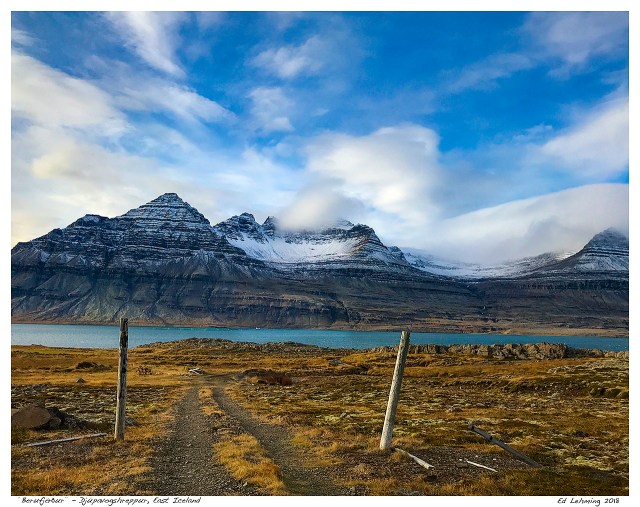
“Berufjörður” – Djúpavogshreppur, East Iceland
“Welcome to driving Iceland, where every turn in the road opens up a brand new and astounding vista. Just when you think you have found the most beautiful sight in the world, another competes with it in an endless play of wonders.”
– Ed Lehming
Today’s theme is mountains, fjords, and glacial streams. First, the mountains are really a continuation of yesterdays mountains, though in line with my quote, the mountains today, as we departed Höfn, had a slightly different character than the glacial mountains we travelled through yesterday. Today’s mountains were ancient and terraced, made deep in under the oceans and heaved up by tectonic forces. They remind me of the Rocky Mountains of North America, with their angular peaks and banded appearance.
Between these rows of mountains, deep fjords cut into the coast of East Iceland, stretching for many kilometers inland and forcing roads to cling tenaciously to the edges of the mountains.
The fjords certainly added to our travel, but what a sight to see; enormous mountains to one side and fingers of the Atlantic Ocean reaching far into the valleys between. It was astounding to look back across and see the fine thread that represented the road we had just traveled, along the edge of the water.
Within the valleys of the snow-covered mountains, nearly every crack and crevasse flowed with clear, ice-cold, melt water. I can imagine this place in late spring. The hills must be completely awash with water.
I could not resist filling my water bottle at the base of a 1,085 meter high mountain. It was an amazing experience to drink this ice-cold elixir while looking high up to the peak that created it, the cool mountain breezes blowing on my face and refreshing my very soul. This, is glacier water, not the stuff marketed with pictures of mountains! This is the real deal.
We neared our day with a 6 km. drive though a tunnel carved below Kollufell Mountain, shortening our drive by some 35 km. Before settling in our room in Egilsstaðir, we decided to take drive around the long lake that if formed within the Lagarfljót River, Lagarfljót Lake.
At the south end of the lake is a trailhead that leads to Hengifoss, a VERY steep, 2.5 km hike up the side of one of the river valley’s bounding mountains. We made it to just past the 1 km mark, beaten by high winds, cold, and exhaustion, being the end of the day. At this point in the ascent, we were greeted by Litlanesfoss, a smaller falls below Hengifoss. I took the time to make a few photos and began our decent.
At the end of the day, a nice bowl of Icelandic lamb stew in Egilsstaðir made up for the cold and the memory of the experience with stay with me for a long time.
iPhone 7 back camera @ 4.0mm
1/2179 sec; f/1.8; ISO 20
For more images like this, please visit my website (images are available for purchase)
http://www.edlehming.com

“Sveitarfélagið Hornafjörður – Glacial Pool” – East Iceland
“ If one looks at the glacier for long enough, words cease to have any meaning on God’s earth.”
―
Today was a day of volcanoes, mountains, and ice (and rough roads), as I continue my journey around Iceland’s Ring Road.
We entered the south-east of Iceland, having departed from Vik this morning, travelling along Highway 1. Shortly after Vik, the landscape changed dramatically into a jagged landscape of tortured rock and cinder. Just north of us, loomed the massive ice fields which cover the now dormant Katla volcano. There is a real problem when a volcano erupts under a glacier; it has nowhere to go but out, through the base of the glacier, creating catastrophic flooding and ash falls. The most recent eruption of Katla, was in 1918, but the area to the south-east of the volcano looks like it erupted a few days ago, with twisted shards of black stone and ash as far as the eye can see.
As we continued east, the landscape changed again, into a surreal world of mounds of rounded stone covered in thick green moss. This continued for quite some time until we entered yet another vast field of black sand and gravel, the runoff of the Vatnajökull glacier fields. The black sand is crisscrossed by an endless network of glacial rivers.
Beyond this black plain rise the sheer cliffs, mountains, and glaciers which dominated my day. The best of all is pictured above. At the base of one of the many Svínafellsjökull glacial ‘tongues’ below Hvannadalshnúkur, the highest glaciated mountain in Iceland. We hiked along the edge of the glacier but were most fascinated by the small glacial pool at the base, filled with icebergs of many sizes, some a spectacular blue. Some smaller pieces lay by the shore, crystal clear and beckoning me to have a taste, which I did. Oh, so cool and fresh! I’ve now eaten a piece of glacier.
We spend quite a bit of time on the shores of this pond, away from the crowds who did not seem to be able to find the trail that led us here, making photos and enjoying the vast glacier which stood before us.
iPhone 7 back camera @ 4.0mm
1/556 sec; f/1.8; ISO 20
For more images like this, please visit my website (images are available for purchase)
http://www.edlehming.com

It is said, “There is no bad weather in Iceland, only bad clothing”
– unknown
“Rangárþing Eystra” – South Iceland
The saying above rang true on day one of my trip to Iceland with my son. I agonized about taking the right cloths for this land of ever-changing conditions, trying not to pack too much, but being aware that too little could also pose a problem.
We landed at 6:05am to surprisingly mild temperatures and no rain, though the forecast had called for it. By 7:30 am we had picked up our rental 4×4 an were on the road towards Vik, our first stop on our ten day Ring Road excursion.
By 9:30 the sky was just brightening as we drove through a tortured and raw landscape of jagged volcanic debris, a slight tang of sulphur in the air, noting the columns of steam rising from the earth’s depths, reminders that volcanism is still a very real part of what makes Iceland what it is, a land of fire and ice.
For me, “raw” best describes what I am seeing. It’s layers upon layers of glaciers, lava fields, geysers, and pale yellow mosses that tenaciously cling to the exposed rock.
As we continued our journey towards Vik, the landscape calmed a bit, changing from lava fields to high, snow-covered mountains, water falls, and twisting, sinuous rivers, winding their way through black sands to the sea. Between these mountains, farms fill valleys, defying nature yet dwarfed by the enormity of the landscape the are part of. One such valley is pictured above, as icy waters escape their mountain homes, on black paths to mingle with sea water in the north Atlantic Ocean.
The other factor at play is, of course, the weather. This image was made around 12:30 and a system pushed straight up the mid-Atlantic by the Gulf Stream continues to darken the skies, eventually ending with sheets of rain and temperatures just above freezing. By the time we got to Vik around 3:00pm it was cold and miserable and we called it quits for the day. More tomorrow.
iPhone 7 back camera @ 4.0mm
1/556 sec; f/1.8; ISO 20
For more images like this, please visit my website (images are available for purchase)
http://www.edlehming.com
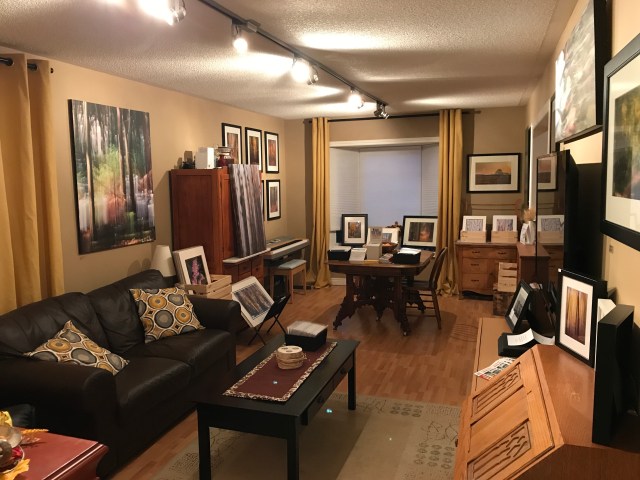
I’m all set up for my second studio tour. Looking forward to meeting new people and talking about my art. And hopefully, sell a few pieces too.
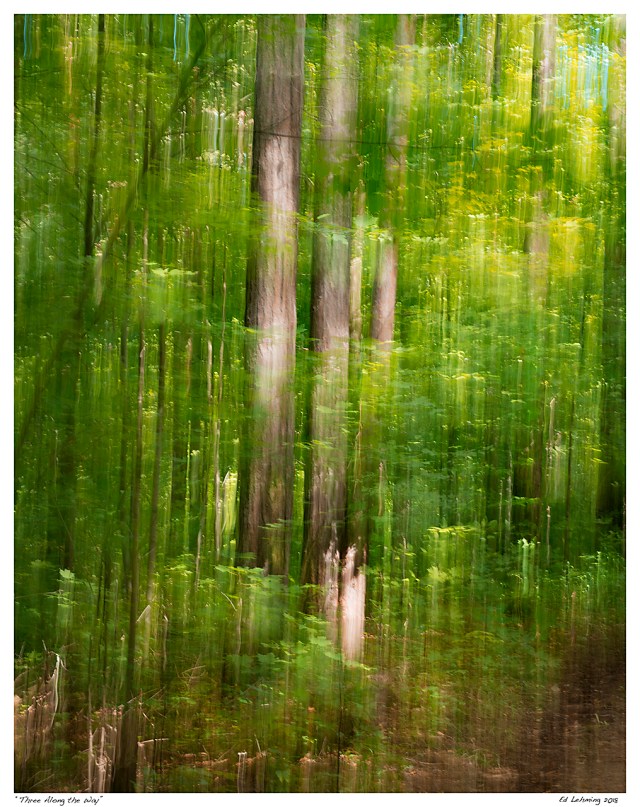
“The tree which moves some to tears of joy is in the eyes of others only a green thing that stands in the way. Some see nature all ridicule and deformity… and some scarce see nature at all. But to the eyes of the man of imagination, nature is imagination itself.”
―
As I walk the local trails, I’m often quite aware that, at some point, the trailblazers and foresters had to make choices about what trees remained and what trees needed to be felled. As the trails meander to and fro, it’s clear that conscious decisions were made to avoid having to cut certain trees.
I suppose, being a cluster of three, tightly grouped, makes you less vulnerable to the chainsaw, however well intentioned. There are many such clusters along the trails and the path always gently flexes around them. For me, each of the trees I pass tell a bit of the story about the formation of this trail system, so many years ago. As the story emerges, I am ever grateful to those who had the foresight to set these lands apart for our future enjoyment, one tree at a time.
Nikon D800
Tamron SP AF 90mm f/2.8 Di Macro 1:1 (272ENII)@90mmm
1/4 sec, f/22.0 ISO 400

“You expected to be sad in the fall. Part of you died each year when the leaves fell from the trees and their branches were bare against the wind and the cold, wintery light. But you knew there would always be the spring, as you knew the river would flow again after it was frozen”
– Ernest Hemingway
The theme of my posts, of late, has been leftover or left behind photos. All this because I’m preparing for a local Studio Tour and using my blog posts in my photo catalogue, because people like to hear some of the story and process behind the photos. That’s the reason I started blogging in the first place.
So, here I am reviewing one of my more popular photos from 2014, one I have as yet, not written about.
This “lone tree” stands in a farm field near Glasgow, Ontario, A few short moments drive from my house. I have made innumerable photos of this tree, in all seasons, yet this particular image remains my most popular. There is a warm glow from the clouds as the sun begins to set and the empty furrows lead the eye to this single tree. It’s quite a deliberate shot and all the elements combine to make it appealing to a wider audience.
Interestingly, though it was made in late November of 2012, it does not feel sad or cold. It simply feels at peace, as another season draws to a close and we look forward to the comfort of a warm heart as winter slowly approaches.
Nikon D300
Nikkor 70-300mm f/4.5-5.6 G I AF-S VR Zoom @ 80mm
1/160 sec, f/6.3, ISO 200

“I’m so glad I live in a world where there are Octobers.”
―
As I prepare for my 2018 Studio Tour, it gives me time to reflect on present photos, as well as those from previous years and I am astounded about how many have been printed, yet I have not taken the time to comment on them.
This image is one of those photos that for one reason or another was set aside. Interestingly, as I was preparing images for the Studio Tour, this one was chosen by three different individuals to be included.
The photo was made last autumn, a week after last year’s Tour. It was interesting, because the Tour weekend falls on the weekend after Canadian Thanksgiving, usually a peak period for autumn colours and I was slightly bemoaning the fact that I was missing out on this.
The day was cool, and windy, but the leaves were still hanging on quite well, despite this. Much of the predominant green and yellow was starting to fade and oranges, golds and bronzes were taking hold. It was the start of my “Golden Paths” series and has become one of my more powerful series of autumn images.
Here, I’m hiking past a familiar cluster of birch trees, with their yellow leaves just starting to wither and backfilled with the golden bronzes of the many beech trees. It really represents that ‘shift’ in colours so prominent at that particular time of year.
Nikon D800
Tamron SP AF 90mm f/2.8 Di Macro 1:1 (272ENII)@90mmm
1/4 sec, f/32.0 ISO 100
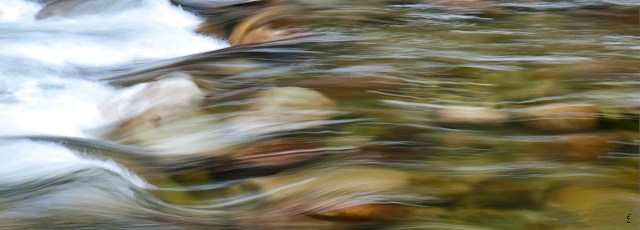
“Oh, these vast, calm, measureless mountain days, inciting at once to work and rest! Days in whose light everything seems equally divine, opening a thousand windows to show us God. Nevermore, however weary, should one faint by the way who gains the blessings of one mountain day; whatever his fate, long life, short life, stormy or calm, he is rich forever.”
―
I simply had to quote John Muir for this image that I made several years ago, as I began to experiment with long exposures to communicate the ‘feel’ of a place. The image itself is of the Merced River in California’s Yosemite national Park. It’s become a sacred place for me, one I have made several pilgrimages back to over the years.
This is a simple composition, made at the “Happy Isles” portion of the river, as its icy waters flood over centuries old river rock. There is colour and life; light and motion here. It’s a place I could sit for hours, simply enjoying the freshness and listen to the waters rush over the stones.
The photograph, has sat on my computer, perhaps waiting till I was ready to present it. I believe it’s time, so I have printed it as a 48″ canvas print for my upcoming Studio Tour.
Nikon D300
Nikkor 70-300mm f/4.5-5.6 G I AF-S VR Zoom @ 70mm
1/4 sec, f/32.0, ISO 200
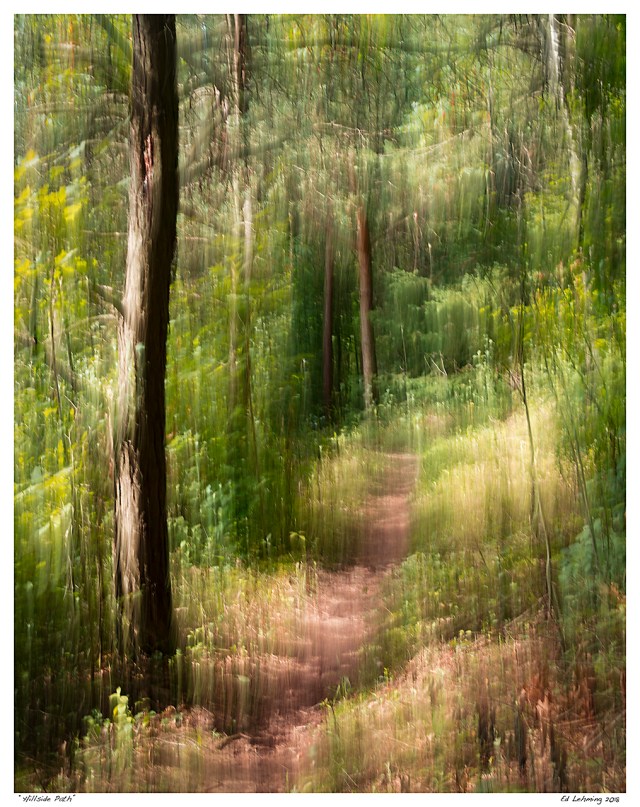
“It isn’t enough to pick a path—you must go down it. By doing so, you see things you couldn’t possibly see when you started out; you may not like what you see, some of it may be confusing, but at least you will have, as we like to say, “explored the neighborhood.” The key point here is that even if you decide you’re in the wrong place, there is still time to head toward the right place.”
―
This image came together almost immediately. As I stood at the edge of a steep gully, looking across miles of forest for this high vantage point the path along the edge beckoned me forward. I had just changed lenses from my 90mm macro to my 70-200 mm telephoto so that I could shoot a bit wider than my 90mm allowed.
My first glance through my viewfinder yielded this scene. The slightly winding path and the placement of the trees made for a simple composition which nicely represented the scene before me. The slight movement simply accents it and the long exposure saturates the colours a bit more, and also brings life to the image.
This spot was about half way around a loop trail and tied in nicely with my theme of gradual transition from summer to autumn because of the presence of more yellows and oranges. Not quite autumn, but definitely hinting at it; a turn in the path and in the seasons.
Nikon D800
Tamron SP 70-200mm f/2.8 Di VC USD @ 70 mm
1/4 sec, f/18.0 ISO 200
For more images like this, please visit my website (images are available for purchase)
http://www.edlehming.com

“Once you have traveled, the voyage never ends, but is played out over and over again in the quietest chambers. The mind can never break off from the journey.”
―
This image, while slightly darker than some of my prior posts, represents so well my typical experiences on the trail; bright sunshine streams between the branches light above, the canopy has a slight yellow tinge, as the days shorten, there are wonderful shifts in the light, each tree reflecting a slightly different shade of brown gray, or silver; far in the distance, a bright meadow shows through a gap in the trees, my destination, or just a glade along the trail edge?
The path, soft and sandy, littered with leaves, has become my gentle way. I tread these trails in reverence for the beauty they lead me through and am grateful to those early conservationists who had the foresight to set this land apart, so that I and many more could enjoy the wonder of the forest trails .
Nikon D800
Tamron SP 70-200mm f/2.8 Di VC USD @ 70mm
1/4 sec, f/9.0 ISO 200
For more images like this, please visit my website (images are available for purchase)
http://www.edlehming.com
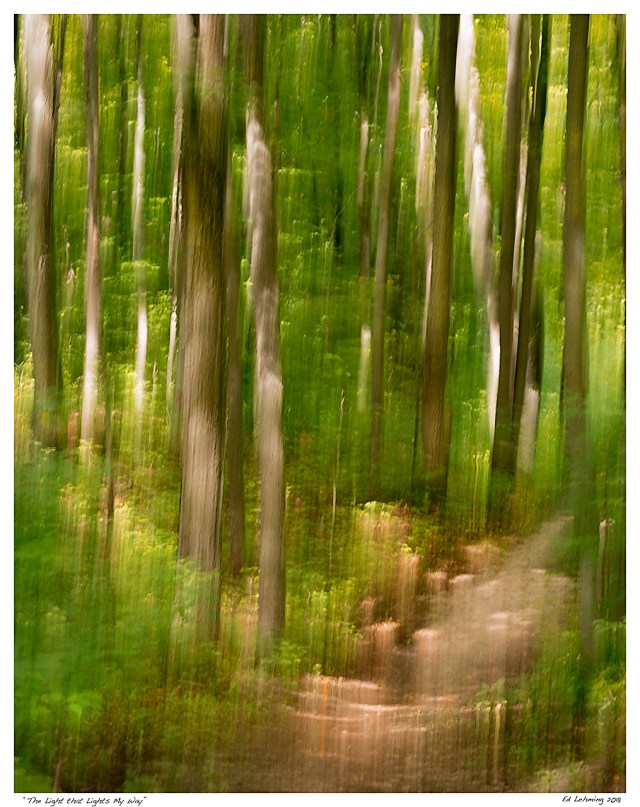
“It is good to have an end to journey toward; but it is the journey that matters, in the end.”
―
Scenes like this are one of the reasons I hike. I’ve referred to these dappled pools of light as “God-Light”, to quote C.S. Lewis. These small patches of golden light, like pools of energy seem to appear on all but the most overcast days. They are but one of the many effects in the forest which have a profound impact on me. In the forest, I feel in tune with my surroundings, the busyness of the workweek fades to a dull memory and my world come alive.
There is more to the light around me, while it lights my way, it warms my spirit and brings out the child in me. I find myself transfixed by the wonderful diversity of the forest paths, and grinning at simple things like a butterfly trying to land in the wind. Many of these scenes go undocumented, too brief to be captured as a photo, but remain with me as beautiful memories of my walks through the woods.
Nikon D800
Tamron SP AF 90mm f/2.8 Di Macro 1:1 (272ENII)@90mmm
1/4 sec, f/10.0 ISO 100
For more images like this, please visit my website (images are available for purchase)
http://www.edlehming.com
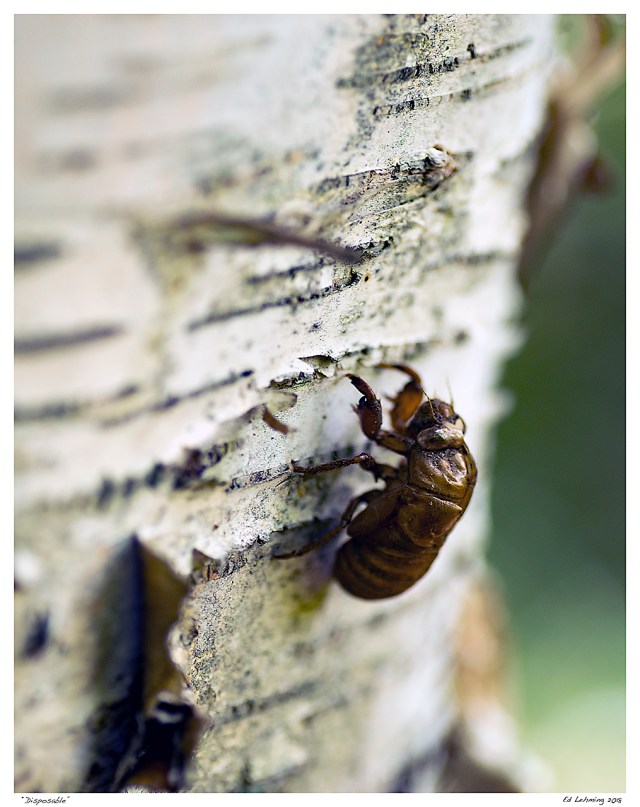
“Nothing ever really goes away–it just changes into something else. Something beautiful.”
―
I was debating the title for this image of a spent cicada pupa. I recall seeing thousands of them in the pine forests just outside Atlanta, Georgia a few years ago. We arrived for an event and the campground we were staying at seemed overrun with emerging cicadas. Every tree was covered in these little alien carapaces.
To find one close to home was a surprise, though cicadas are also plentiful here, I have, up till now, not seen evidence that they also emerged here. I guess I figured they came from somewhere else.
The shell, as I said, has a strange alien look to it, barely resembling the adult cicada with its large and shimmering wings, that provide a constant background buzz on hot summer days.
One of the advantages of shooting a 90mm macro lens as a prime lately is that I can quickly switch from forest abstracts to highly detailed macro images.
Nikon D800
Tamron SP AF 90mm f/2.8 Di Macro 1:1 (272ENII)@90mmm
1/100 sec, f/4.5 ISO 400
For more images like this, please visit my website (images are available for purchase)
http://www.edlehming.com
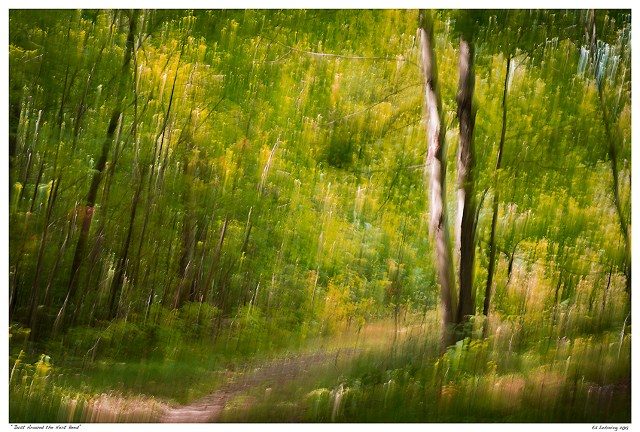
“Never forget that anticipation is an important part of life. Work’s important, family’s important, but without excitement, you have nothing. You’re cheating yourself if you refuse to enjoy what’s coming.”
―
Part of the enjoyment I get from hiking is the anticipation, the ‘unknown’ about what’s around the next bend. Though I’ve hiked these trails for years now, there is always something new to discover. On days where I feel uninspired, all I have to do is get on the trail, look around that next band, and I’m almost always treated with something unexpected, some play of the light, or a new plant that I had not noticed.
In this image, along the theme is anticipation, along with the broader theme of this series of photos, there is the knowledge that autumn is also just around the bend, as evidenced by the colour shift from deep green to hints of yellow and even a few coppery-orange leaves to be found along the trail. The changes will soon accelerate and “In the Blink”, it will be autumn. Given our weather this summer, I’m anticipating some beautiful colours.
For those who look at my camera settings (below), you will have noticed that I have been adjusting the ISO and aperture as lighting conditions vary throughout this hike. I keep my shutter speed consistent at 1/4 sec, as this is the speed I feel produces the best results with my process.
Nikon D800
Tamron SP AF 90mm f/2.8 Di Macro 1:1 (272ENII)@90mmm
1/4 sec, f/11.0 ISO 100
For more images like this, please visit my website (images are available for purchase)
http://www.edlehming.com
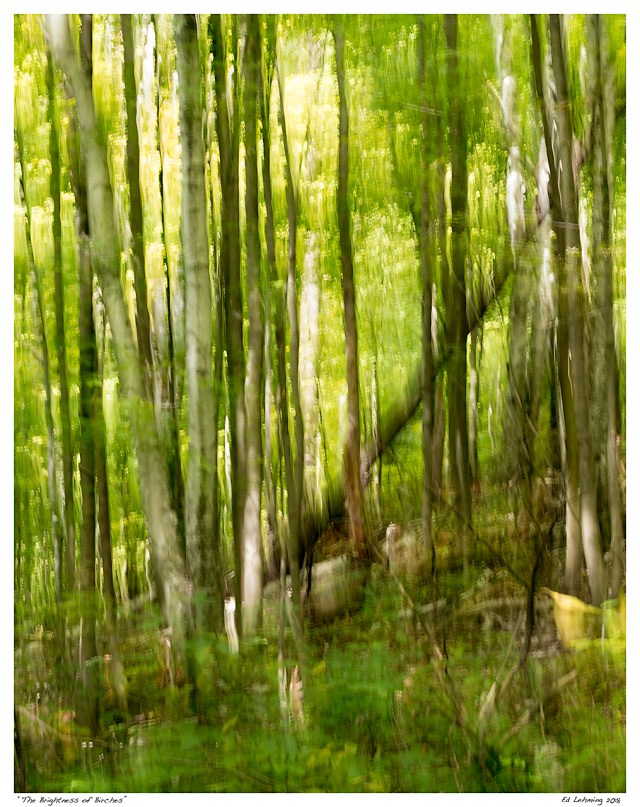
“In this hour, I do not believe that any darkness will endure.”
―
As my journey through the September forests continued the forest and light varied significantly, this is the nature of forests in this area. This constant change offers many opportunities for photos, or simply to stand still for a few moments, enjoying the light playing through the leaves.
In small patches, birch trees brighten up the forest with their brilliant white bark. Tis makes them a bit of a challenge to photograph, as I have to balance their brightness with the darker forest behind. Here, the bright pale green leaves in the background made that balancing a lot simpler and yielded a rather nice image of the trees which conveys very well the ‘feel’ of this scene, not so many days ago.
As a said, this is part of a series of photos and I have begun to print them and hang them. So far, they seem to flow rather nicely in preparation for my 2018 Studio Tour.
Nikon D800
Tamron SP AF 90mm f/2.8 Di Macro 1:1 (272ENII)@90mmm
1/4 sec, f/18.0 ISO 400
For more images like this, please visit my website (images are available for purchase)
http://www.edlehming.com

“As the years pass, I am coming more and more to understand that it is the common, everyday blessings of our common everyday lives for which we should be particularly grateful. They are the things that fill our lives with comfort and our hearts with gladness — just the pure air to breathe and the strength to breath it; just warmth and shelter and home folks; just plain food that gives us strength; the bright sunshine on a cold day; and a cool breeze when the day is warm.”
―
Beyond the transition from field to forest but within the transition from summer to fall, the forest shines with warm morning sunshine, finding its way through the canopy high above. It’s one of those simple blessings that the quote above mentions.
I stood, transfixed, for a moment, marvelling at just how bright the forest was at this time of day. Some of that brightness is caused by the gradual yellowing of the undergrowth. The greens are not as deep and light seems to reflect more, which for me, is a nice change for the deep dark greens of midsummer. WHile nice to walk through, it does not make for photos that appeal to me.
This particular scene was chosen for its diversity of shades, layers, and textures and introduces some bright browns to the composition. I’m always looking for contrasts and textures when I create these abstracts and the forest offers be a lot of choices. Though I always have a vision of what I want the photo to look like, I’m often surprised at what the variance in light and movement produces. That is one of the joys of this photographic style that I have refined to become my own.
Nikon D800
Tamron SP AF 90mm f/2.8 Di Macro 1:1 (272ENII)@90mmm
1/4 sec, f/32.0 ISO 100
For more images like this, please visit my website (images are available for purchase)
http://www.edlehming.com

“We know that in September, we will wander through the warm winds of summer’s wreckage. We will welcome summer’s ghost.”
―
It struck me, as I considered this image, that the day I made it started out cool and calm, and gradually became quite warm breezy. Sometimes, we miss those gradual changes, even in the span of a few hours, let alone days. That gradual change also aligns to the theme of this series “In the Blink”, those changes that happen so gradually that we almost miss them, until some event reminds of what was.
The day I made this photo, as I mentioned in a previous post, I hiked some 24 km throughout the wonderful conservation areas so close to my home. These forests, meadows, farms and wetlands cover a vast area and I am deeply indebted to those who had the foresight to preserve them as natural spaces, many years ago.
Were t not for these spaces, I’m not sure what I would to find peace and solace after a busy workweek. I would not have a place close by to enjoy the diverse flora and fauna, a place to simply walk for hours, each turn a new wonder. Foremost, I would not have these wonderful scenes to photograph and share. In may cases, these refuges disappear forever, also in the blink of an eye, though, as with the changing of seasons, it’s a gradual thing, barely noticed, till one day, they are gone, ghosts of what was.
Nikon D800
Tamron SP AF 90mm f/2.8 Di Macro 1:1 (272ENII)@90mmm
1/4 sec, f/32.0 ISO 100
For more images like this, please visit my website (images are available for purchase)
http://www.edlehming.com
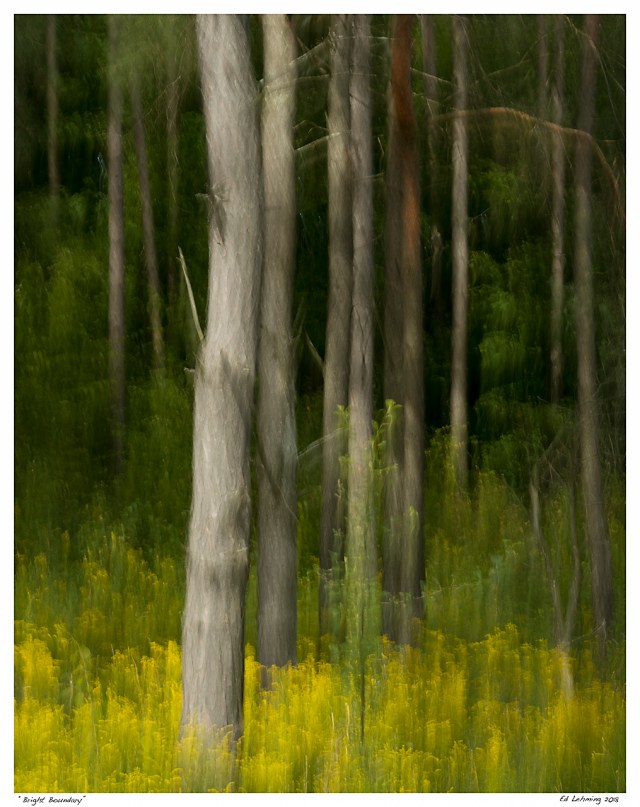
“Ah, September! You are the doorway to the season that awakens my soul… but I must confess that I love you only because you are a prelude to my beloved October.”
―
I like this image for its allusion to transition. The image fades from bright yellow, to the brooding darkness of the pine forest behind it. For me, it symbolises the shift from bright, sunny days, to the cool of autumn and, eventually, winter.
I prefer the boundary times, spring and autumn, because there is an accelerated shift in the environment, and ever present change. Summer and winter seem more steady and stable, with only slight changes. Summer is a time of warmth, bright greens, flowers, and activities, and winter is a time of cold, gray skies, ice and rest. Whereas autumn seems like it is changing daily. Leaves change colour and eventually fall to the ground, the temperature varies from warm to cold, rarely the same for more than a few days in a row.
This ‘doorway’ between seasons is, like the photo, a threshold to be crossed, and I hope to remain between the two seasons as long as they allow me to.
Nikon D800
Tamron SP 70-200mm f/2.8 Di VC USD @ 112mm
1/4 sec, f/32.0 ISO 200
For more images like this, please visit my website (images are available for purchase)
http://www.edlehming.com
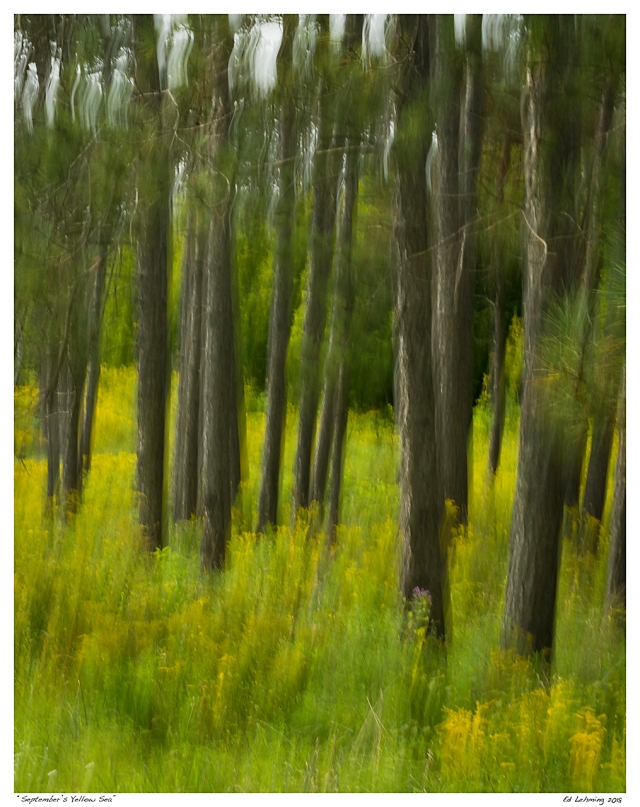
“That old September feeling, left over from school days, of summer passing, vacation nearly done, obligations gathering, books and football in the air … Another fall, another turned page: there was something of jubilee in that annual autumnal beginning, as if last year’s mistakes had been wiped clean by summer.”
―
This image makes me grin. The pine trees appear to be awash or dancing in a sea of yellow created by the profusion of Goldenrod, unsteady on their feet. I say awash, because the various angles of the trunks makes them seem to be swaying in water, further enhanced by the deliberate camera motion.
They seemed a bit out-of-place, not quite part of the forest, yet not part of the meadow either. It’s a very bright scene further enhanced by the soft morning sunlight. The Goldenrod fills this meadow with bright and pure yellow, a sure sign that summer is winding down.
Yet, yellow is just a temporary thing, the yellow will eventually fade to orange and rust, and then be gone for months, its warm brightness replaced by the harsh whites of winter. So, I’ll drink it in, while I can, letting the sun warm me for a few more weeks and looking forward to the cool gentleness and bright colours of autumn.
Nikon D800
Tamron SP 70-200mm f/2.8 Di VC USD @ 112mm
1/4 sec, f/32.0 ISO 280
For more images like this, please visit my website (images are available for purchase)
http://www.edlehming.com
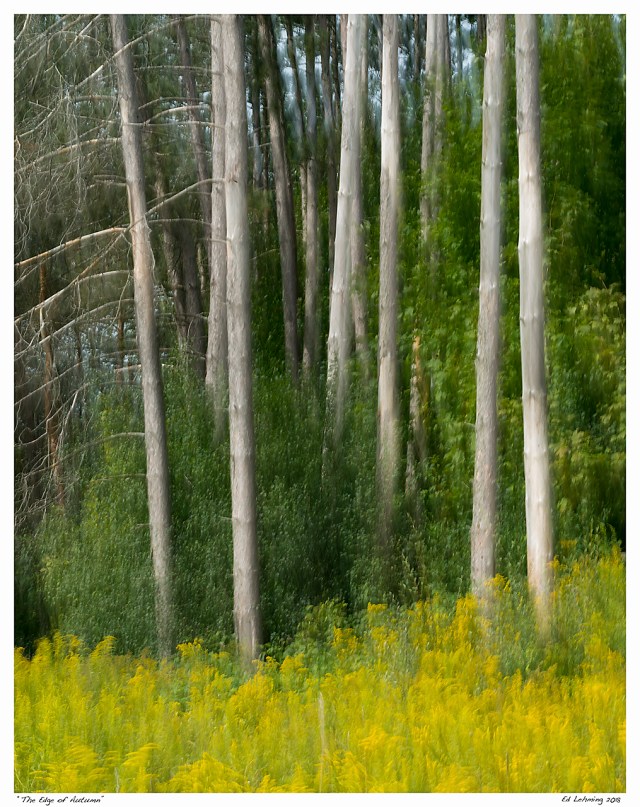
“There was no sudden, striking, and emotional transition. Like the warming of a room or the coming of daylight. When you first notice them they have already been going on for some time.”
―
I’m starting a new series of images documenting the transition from late summer to autumn. The series will be titled “In the Blink” and begins with this image of pine trees, stripped bare of much of their bark and bordered by a field of Goldenrod.
As the quote says, this change is not sudden, it’s gradual and you barely notice it until you are in it. That was so much the case as I went on an extended 24 km hike, on a glorious mid September day.
I’ve been noticing some very slight changes in foliage around my house, though at first glance, everything is still very lush and green. Yet, flecks of yellow and red are starting to show through and many trees have dry, brown leaf edges. The summer started out hot and dry and stressed many plants, which recovered fairly well over the past few hot, rainy, and humid weeks. Still, the effects of the drought stress manifest in some early colour changes. Of course, all the late summer plants, like goldenrod and asters are in full bloom.
There’s still a lot of green and summer is not quite done with us, though the evenings are cooling off, days are not as hot as recently, and the light in the forest is simply beautiful for photography, another gentle, largely unnoticed shift towards autumn, which has been going on, for some time.
Nikon D800
Tamron SP AF 90mm f/2.8 Di Macro 1:1 (272ENII)@90mmm
1/4 sec, f/32.0 ISO 100
For more images like this, please visit my website (images are available for purchase)
http://www.edlehming.com
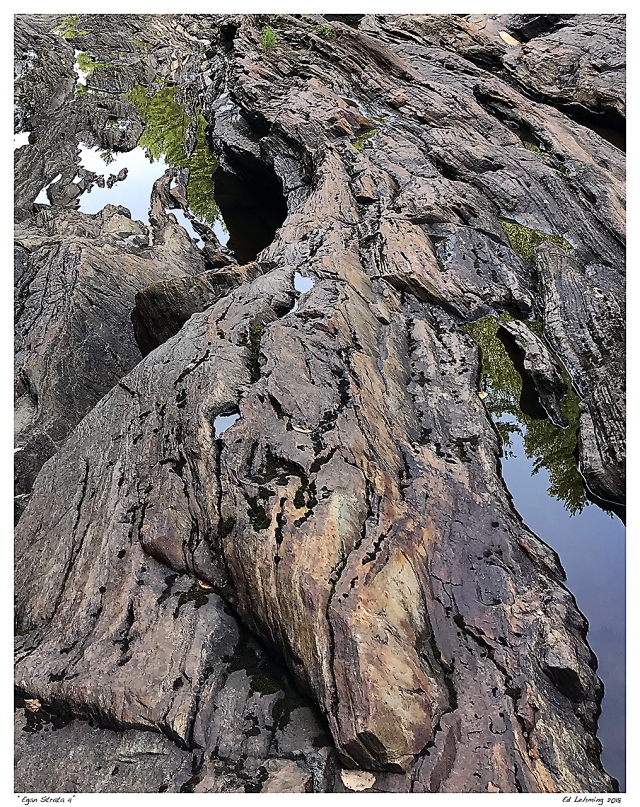
“A thought that stayed with me was that I had entered a private place in the earth. I had seen exposed nearly its oldest part. I had lost my sense of urgency, rekindled a sense of what people were, clambering to gain access to high waterfalls and a sense of our endless struggle as a species to understand time and to estimate the consequences of our acts.”
―
My final image, this one even more “map-like” than the previous posts. Were it not for the reflection of trees in the pooled water and the stray leaf in the foreground, it could be mistaken for an aerial photo of a mountain range.
I really like the flow, colour, and form of the rocks in this image. It feels like I have pulled up from the closer views and details to a broader vantage point.
Of the four images, I can’t pick a favourite. Each has its own unique character and feel. I’m looking forward to printing them and showing them as a collection.

“I went into geology because I like being outdoors, and because everybody in geology seemed, well, they all seemed like free spirits or renegades or something. You know, climbing mountains and hiking deserts and stuff.”
―
This is photo number three in the series. The image has much more water than the other images and shows much more structure than the prior images, yet all the elements of the image are similar.
The pooled water reminded me of a three dimensional topographic map of the area, with lakes filling the deep valleys between the ancient rocks of the Canadian Shield. I would have prefered an image looking straight down to further enhance this effect, but I could not get a satisfactory composition.
You’ll also note that some of the rocks are still wet and that the water has already begun to evaporate after a heavy overnight rainfall.
iPhone 7 back camera @ 4.0mm
1/210 sec; f/1.8; ISO 20
For more images like this, please visit my website (images are available for purchase)
http://www.edlehming.com
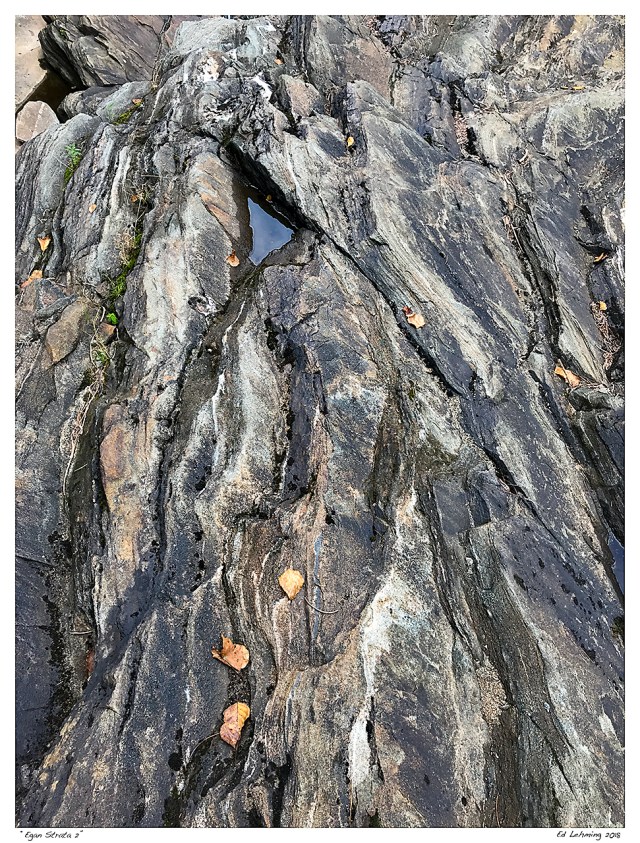
“Everything dreams. The play of form, of being, is the dreaming of substance. Rocks have their dreams, and the earth changes….”
―
Image two of this series of photos of the wonderful rock formations at Egan Chute. I found it interesting, despite my education in geology, that the form and flow of the rock really resonated with me, not for the first time, but very strongly. Enough to make this series of images.
I find myself enjoying these images and really appreciating the detail, the small clumps of moss, fallen leaves, and the layering of the rock itself. All things I observed when making the image, but diluted by the vastness of the stone itself and the constant roar of rushing water at my side. The little triangular pool of water is the focus of the image, so temporary within the seeming permanence of the rock, yet it’s the water which wears the rock down, trapped with no escape, except through evaporation in the hot summer sun.
iPhone 7 back camera @ 4.0mm
1/250 sec; f/1.8; ISO 20
For more images like this, please visit my website (images are available for purchase)
http://www.edlehming.com


 Ed Lehming Photography
Recent Comments