 “The greatest loss lies in our inability to accept loss.”
―
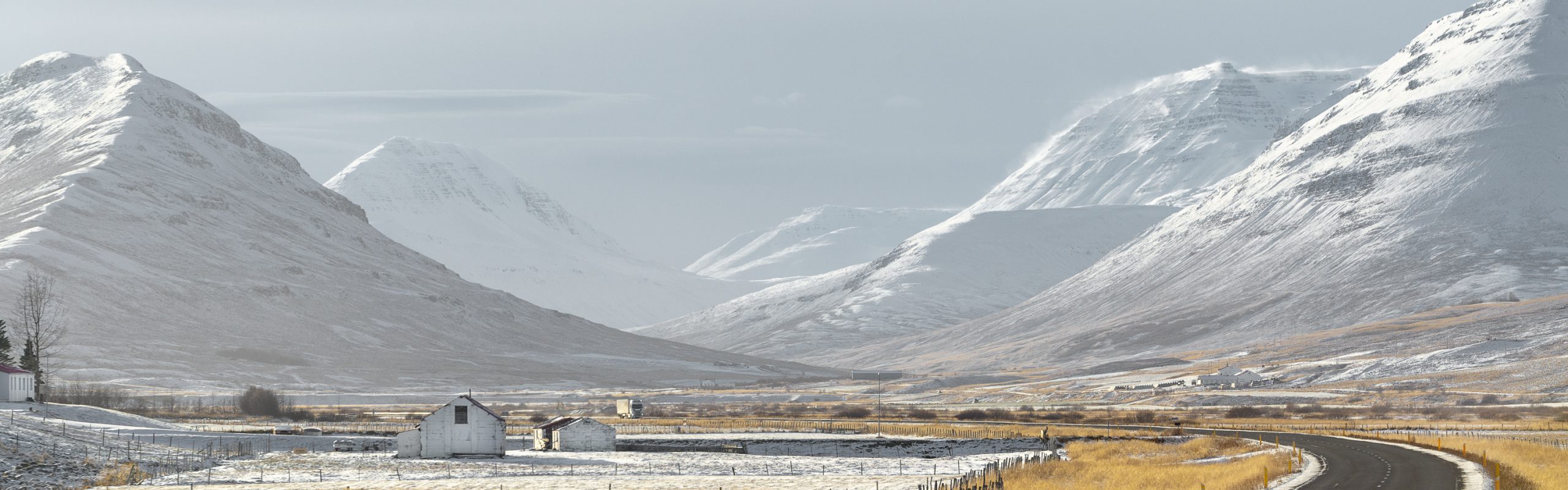
I have a strange fascination with abandoned buildings, always wondering how they became abandoned and the stories they must have to tell when they were somebody’s home.
Along the Ring Road we travelled through Iceland, there are many of these empty shells, some quite ancient, many perched along a lonely mountainside, lost in the vast, empty landscape which is present in much of Iceland. It struck me as emptiness in emptiness.
Take this house, for example. It’s on the shores of the Heiðará river, just past Heiðarfall mountain that dominates yesterday’s image. It sits on a field of the ever present yellow grasses and mosses, along the river, next the main Icelandic highway, with a tall mountain for a backyard. If you look closely, you can see that there must have been patches of garden at one point, given the drainage ditch and rectangular area of grass to the right of the house. The house itself does not look too old and the roof is in good repair, at least from this vantage point. Yet, it’s clearly abandoned.
Who lived here? A solitary sheep farmer or a family? There is easy access to water as well as the road, not to mention that the city of Akureyri, is only a short drive away. I’d love to know the story, but I fear it is lost in time and the wide and wild spaces of Iceland.
Nikon D800
Tamron SP 70-200mm f/2.8 Di VC USD @ 70mm
1/100 sec, f/5.0 ISO 200
For more images like this, please visit my website (images are available for purchase)
http://www.edlehming.com
“When you don’t cover up the world with words and labels, a sense of the miraculous returns to your life that was lost a long time ago when humanity, instead of using thought, became possessed by thought.”
―
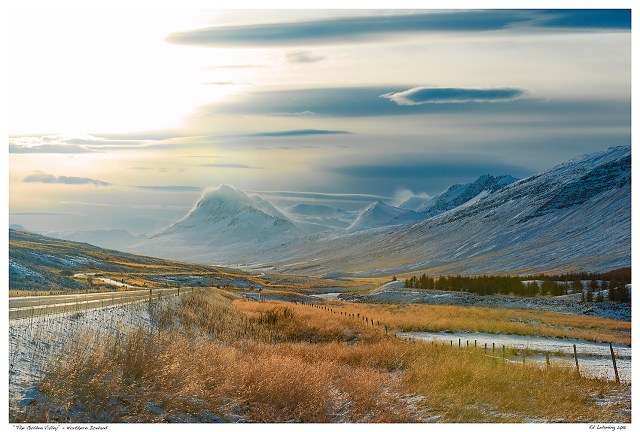
As I continue to review my photos from Iceland, inevitably I come across a collection of photos I have dubbed “The Golden Valley”. I posted one of them a few weeks ago. That particular image was a closer view of the mountain in the distance, Heiðarfall, and as I said then, we thought we had seen the highlight of our day at Goðafoss, earlier in the day. This image is a bit of a wider shot, showing more of the valley that contained the wonder that had us transfixed for a few brief moments on day five of our ten-day Iceland trip.
We continued on our journey, stopping for lunch in Akureyri, Iceland’s second largest city and headed westward through a long valley, not expecting to see much more, other than the high mountains which dominate the region surrounding Akureyri. This valley follows a moderate river known as Heiðará, which can be seen at the centre of my photo.
This drive was more beautiful than expected and we travelled deeper into the highlands, following the river valley between steep hillsides and mountains. Along the way, we stopped and made some photos of the various mountains, but our attention was fixed on this single peak in the distance, framed by the surrounding slopes, the sun hanging just to the left of it, casting soft shadows and lighting up the snow blowing from its peak.
As we got closer, I was hoping that the road would continue to take us nearer and not turn off to some adjacent valley. We were not disappointed and as we approached, we noticed the slight shifting slightly to a warm glow, which made the valley seem to glow in soft sunlight. We stopped the car along the road and watched this effect take hold, making several images each of this stunning spectacle of light. The whole valley seemed to shine in tones of gold, patches of sunlight catching the grasses and seeming to shimmer through the fine mist caused by blowing snow. The whole world around us was alight in a surreal brilliance. It was like a scene you imaging in a fantasy novel, we were just missing dragons and unicorns. And then just as it had begun, it ended, still lovely but lacking the stunning effect we had just witnessed, for a few glorious moments.
Every photographer’s dream is to capture a moment like this, accurately, so that others can experience it as well. I’m happy that my many years, out on the trails, making photos, and many times failing, had prepared me for this moment and enabled me to create an image that fully and accurately communicates what I witnessed. As I sat at my computer, reviewing and editing this photo, I found myself filled with the same raw emotion I felt when I made the photo. I hope that you, my reader, enjoy it too.
Nikon D800
Tamron SP 70-200mm f/2.8 Di VC USD @ 70mm
1/250 sec, f/9.0 ISO 200
For more images like this, please visit my website (images are available for purchase)
http://www.edlehming.com
“Nature was pure, and still is.”
―
On day five of our ten-day Iceland trip, we drove through what felt like a rather long stretch of nothing much, as we departed the plains and low hills of Mývatn and headed towards Akureyri, Iceland’s’ second largest city. On our map we noted the location of Goðafoss and decided this was to be an extended stop on our journey.
As I found typical of Iceland, things are often not what you expect. The map showed Goðafoss close to the highway, but we expected a short side trip to get closer. As we rounded a bend, a large river appeared in front of us and there it was,Goðafoss, right next to the highway, a distant spray of green and white in the distance, some six kilometers ahead of us, yet is was clearly recognizable.
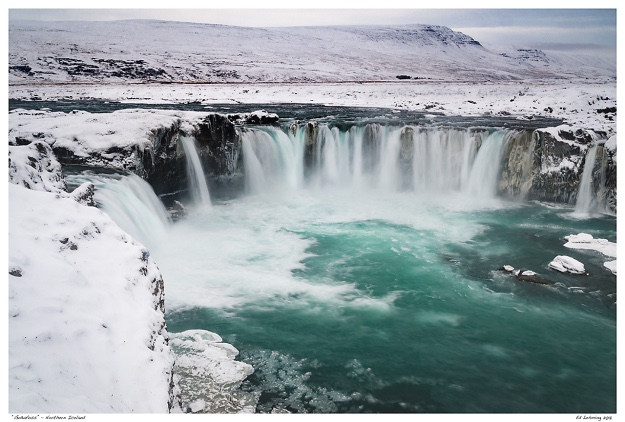
Goðafoss is not as big as I expected, with a vertical drop of about 12 meters and a width of 30 meters. Though not exactly as imagined, it’s a beautiful wide and complex waterfall, especially at this time of year, when the waters run cold and pure, no longer carrying the spring sediments which make the water cloudy and gray. This purity showcases the gorgeous green tones of the water, as it falls and as it pools beneath the falls. Goðafoss is the Skjálfandafljót river which flows north from central Iceland’s highlands.
As with many of the waterfalls we experienced, it was quite easy to gain close access to the waterfalls from well-marked access points. On our arrival, we set up our cameras close to the base of the eastern side of the falls, visible in my image just left of the bottom center. This area is a small shelf of rock, covered in snow, at this time of year.
There were several other people there taking pictures and just enjoying the sight, for the most part, very respectful of others enjoyment of this beautiful place, including photographers, like me, setting up tripods to make long exposures. My son and I spend quite a bit of time shooting from different angles and at different speeds trying to capture the feel of this fall.
I have several decent images, but none really resonate with me, so we headed up to the top, where there is a large viewing platform, with good visibility of the falls. Once more, there were quite a few people taking pictures; some avid photographers with tripods and filters, as well as the casual tourists and the ever-present ‘selfie seekers’, posing in various positions along the railings.
This platform yielded the best photos, though I was unprepared for the brightness of the freshly fallen snow and did not have a good neutral density filter with me to compensate for this. Generally, I can accomplish good light balance through ISO, aperture, and exposure settings, but I maxed them all out trying to get a long exposure. The image above is the best of my attempts, and despite the challenging light, I think it turned out alright, showcasing the bright snow and deep emerald waters. What it can’t show is just how cold this water is. The only evidence being the thin ice-floes accumulating in the foreground, just off my initial vantage point.
Nikon D300
TAMRON SP AF 17-50mm F2.8 XR Di II LD Aspherical IF A16NII @ 22 mm
1/6 sec, F/29, ISO 125
For more images like this, please visit my website (images are available for purchase)
http://www.edlehming.com

“I took my love, I took it down
Climbed a mountain and I turned around
And I saw my reflection in the snow covered hills
‘Til the landslide brought me down”
– Fleetwood Mac
As those who follow my blog regularly will know, I try to avoid people in my photos. My primary focus is to share places and things and try to convey some of the ‘feeling’ of those places and things. In this case, I am making an exception, because the ‘feel’ of this place, high on the slopes of Krafla volcano, is conveyed most effectively by my son, Greg, walking back down from a high ridge, trying to stay warm, as 100 km winds drive snow across the road around him.
I chose the lyrics of one of my favourite Fleetwood Mac songs, because we both joked about the line “Climbed a mountain and I turned around” as we warmed up in the car. Which begs the question, “Why did we climb in these conditions?”
We had left the waterfalls: Selfoss and Dettifoss about an hour earlier and wanted to check out the green water-filled caldera of a large volcano named Krafla. Like Dettifoss, this meant a bit of a detour along a snow-covered road, but it was not as bad as the Dettifoss road. The road itself leads to a large geothermal generating station and continues up to the top of Krafla.
As we approached the Krafla access road, we noticed that barricades had been placed across the road along with signage stating that the road was closed. At this time, another squall had come across and so, we waited till it cleared and decided to hike the 3 kilometers to the Krafla crater.
As we set off, the sky was still a bit snow filled and it was windy, but tolerable. and remained so, till we got to the crest of the ridge at the top of the road. At this point, the wind, now not blocked by the ridge, showed us its true nature, making it quite a bit less hospitable. We looked up the road, the Krafla parking lot about one kilometer distance, but barely visible. To the north of us, yet another menacing black cloud approached, meaning more wind and white out conditions. The road ahead offered no places of shelter and followed the ridge, which would have left us completely exposed when the next storm hit. So, we made the decision to abandon our quest and head back down to the car.
Within a few minutes, and sooner than expected, the fury of the next squall was on us, temperatures dropped, snow filled our sight, and winds picked up to hurricane force, whipping the snow at our backs.
I’m glad we decided to play it safe, because I can’t imagine what it would have been like on that exposed ridge and we had no idea how long this squall lasted.
It wasn’t a landslide that brought us down, but we had experienced something new: just one aspect of the raw and untamed nature of Iceland.
Nikon D800
Tamron SP 70-200mm f/2.8 Di VC USD @ 70 mm
1/250 sec, f/8.0, ISO 800
For more images like this, please visit my website (images are available for purchase)
http://www.edlehming.com
“Unlike the majority of people, he did not hate or fear the wilderness; as harsh as the empty lands were, they possessed a grace and a beauty that no artifice could compete with and that he found restorative.”
―
It’s really hard to describe this place. The photo was made about an hour after the one I posted yesterday. That’s how fast conditions change in Iceland. For about thirty minutes, we enjoyed relatively clear skies, though snow squalls loomed on the horizon.
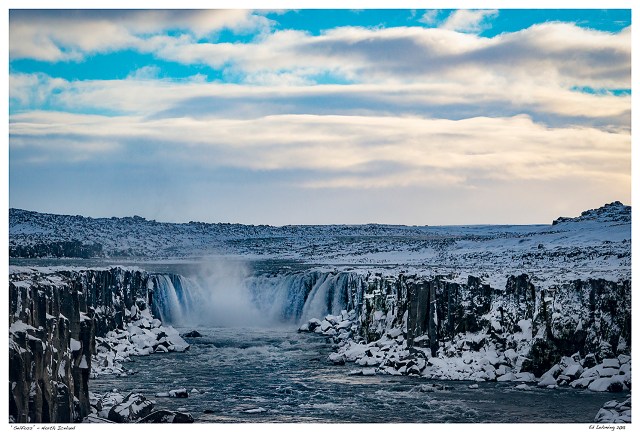
This is Selfoss, a broad, but relatively low waterfall in Northern Iceland. The landscape around this waterfall, and the higher, Dettifoss below it is unbelievable. From beyond Selfoss, the steep ravine you can see here gets even steeper with an almost tortured look, like the earth was torn apart, leaving a gaping maw of high, jagged cliffs of black basalt.
There is nothing smooth or soft here. The entire landscape is dark and sharp and barren, with a few mosses and sparse grasses clinging tenuously between the blasted rock. There must have been a great upheaval here, in the vast volcanic plains of Mývatnsöræfi, in Iceland northern region.
The other thing that does not show in the photo is the biting and relentless winds that whipped at us as we made photos of the waterfalls, stepping through deep snowdrifts and winding between the sharp rocks that line the edges of the gorge. Don’t get me wrong, this is a well-travelled tourist site, with a large parking lot and well-marked trails, but at times the drifts made it tough to walk and they covered jagged rock beneath them.
We spent about an hour photographing both Dettifoss and Selfoss. Then, looking to the sky and seeing another squall approaching , we made our way back to the car, which is about a half kilometer walk. Before we got to the car, the squall hit and made it difficult to see more than a few meters ahead of us. By the time we got back to the car, the full savagery of the storm was on us and we could barely see the length of the parking lot, so we decided to wait it out. As we sat in the car, we saw a tourist bus pull in and had to wonder how that bus had navigated the horrible, drift covered road that led us to the waterfalls, 26 kilometers off the Ring Road! Not to mention, people would have paid good money for the tour to the waterfalls, been transported through along dubious roads, only to arrive in blizzard-like condition.
The storm eventually eased and we left the parking lot with three other cars, knowing that the road we had travelled to get here would be in even worse condition on the way out. Fortunately, the trip was made safely and our journey continued.
Nikon D800
Tamron SP 70-200mm f/2.8 Di VC USD @ 160 mm
1/500 sec, f/13.0, ISO 800
For more images like this, please visit my website (images are available for purchase)
http://www.edlehming.com

“How glorious a greeting the sun gives the mountains!”
―
The name Austari – Skógarmannafjöll literally means East Skogar Mountains. I’m still trying to understand the multiple iterations of Icelandic names. These ‘mountains’ are a part of the area referred to by geographers as part of the Table Mountains of Northern Iceland. The whole region is characterized by vast, flat lava fields and these mountains stand alone in this flatness. For perspective, I used the full zoom on my 200m lense, as the mountains are about 10 km from the road.
What originally got my attention, as we drove through this bleak, snowy landscape, was the sun shining through the snow clouds, making at appear as if these dormant volcanoes were steaming. That, and the brilliant sunlight breaking through and catching them on their south flank, while the north fight off the dark of yet another heavy snow squall.
From my roadside vantage point, this contrast of elements: bright and dark, flat and tall, made for a nice composition which captured the character of this region, known, generally, as Mývatnsöræfi, or the ‘wilderness’ of Mývatn, which is such an appropriate name for this harsh landscape.
I have to admit that I had to edit out a powerline which bisected my view of the mountains for kilometers. I tried to get closer and get a shot under the wires, but the terrain was quit rugged and the wind was incredible and relentless. I finally resigned myself that a ‘clean’ shot was not possible and that I would have to edit the out. This was not a common occurrence as Iceland is being very deliberate in not spoiling their natural beauty with things like power lines. Work is underway to bury power lines for just this purpose
I’m glad for my decision to make the photo regardless of the obstruction, because the opportunity to make this image soon disappeared behind yet another squall, a constant theme for us as we ventured through this region in late October, 2018.
Nikon D800
Tamron SP 70-200mm f/2.8 Di VC USD @ 200 mm
1/640 sec, f/13.0, ISO 800
For more images like this, please visit my website (images are available for purchase)
http://www.edlehming.com

“I like geography best, he said, because your mountains & rivers know the secret. Pay no attention to boundaries.”
―
Believe it or not, this is a colour photo. The light is heavily filtered by the snow filled clouds that created a significant driving challenge as I was travelling through the highland which separate North and East Iceland.
The mountains are part of a long, actively volcanic, ridge that runs from the glaciers of Vatnajökull in the south to Iceland’s most north-eastern point, Kòpasker.
As we departed the town of Egilsstaðir in the east and followed the Hvannà river valley towards the interior, the light dusting of snow we had experienced in Egilsstaðir began to grow heavier and north winds whipped the snow across the barren and seemingly lifeless landscape. On the northern horizon, dark and menacing clouds threatened white-out conditions and the roads soon turned to pure ice.
Fortunately, our rental vehicle was a 4×4 with studded tires, which made the drive a bit safer for us, but the threat of heavy squalls and high winds remained, exaggerated by the altitude and wide open plateaus which we had entered. As snow blew around us, the occasional mountain peak would reveal itself from the maelstrom and then vanish again behind a veil of white fury. I’m fortunate to have grown up in Canadian winters, knowing how to drive these conditions, but still gripping the steering wheel tightly as we ploughed through ever deepening drifts across the road.
We drove this 100km stretch, stopping between squalls for photos, without incident, eventually dropping in elevation through the ridge of mountains that serves as the border between east and north Iceland. It’s that ridge that is pictured above, the steep volcanic cone of Geldingafell rising in the distance, offering us one final view before being obscured by snow once more. This brief, roadside moment lasted, as many things in our Icelandic journey, for mere seconds before disappearing from sight.
The colours, as you can see here, are so heavily muted by the snow that you would think this to be a toned black and white photo. It’s quite the effect and a bit unsettling when you are in it for an extended period. And, as you can see from my camera settings, it was quite dark, with the exception of the muted sun reflecting from the icy road.
At the time, I had no idea exactly where we were, only that we had passed safely through the mountains and onto the broad northern plains of Mývatnsöræfi and further adventures, in this geothermally active region, so different from any terrain we had experienced so far.
Nikon D800
Tamron SP 70-200mm f/2.8 Di VC USD @ 70 mm
1/250 sec, f/18.0, ISO 800
For more images like this, please visit my website (images are available for purchase)
http://www.edlehming.com
“Thousands of tired, nerve-shaken, over-civilized people are beginning to find out that going to the mountains is going home; that wildness is a necessity”
―
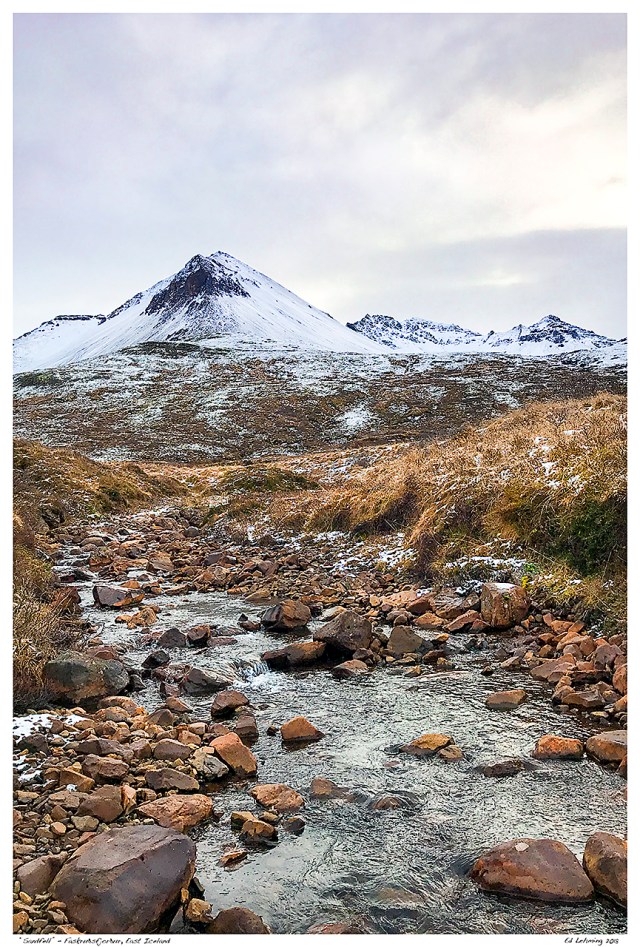
I have found myself looking back through the photos I made along a trail leading to Sandfell, a moderately high coastal mountain, on the Fáskrúðsfjörður fjord in Eastern Iceland. I shared a bit about this in yesterday’s post.
This place summed up a lot of what I experienced in Iceland. Here, I’m standing on the shores of a small glacial stream and looking up the slopes of Sandfell itself. It’s like the innumerable mountain streams that seem present everywhere in Iceland. The creek, one of many flowing down from the mountain, follows a stone filled gully, bounded with long grass and mosses. The mountain itself is not very high, at just over 700 meters and would not normally be snow-covered. The snow is the result of a series of late October snowfalls. It has remained frozen above 600 meters and the creek, where I am standing is a transition zone between freezing and melting.
The scene is also representative of the many colours and textures of Iceland; the endless moss and grasses and the stark black stone of ancient volcanoes, covered in light snow at this time of year. Its rugged yet peaceful, a natural and untamed beauty so rare in the world these days. I completely understand why thousands upon thousands of visitors come here every year. My hope is that, despite all the tourists, it can remain unspoiled.
iPhone 7 back camera @ 4.0mm
1/1150sec; f/1.8; ISO 20
For more images like this, please visit my website (images are available for purchase)
http://www.edlehming.com

“The path to our destination is not always a straight one. We go down the wrong road, we get lost, we turn back. Maybe it doesn’t matter which road we embark on. Maybe what matters is that we embark.”
―
During our journey along Iceland’s Ring Road, we took many occasions to satisfy our curiosity by hiking off the road when the opportunity presented itself. One of these opportunities was this gravel road, which leads up into the mountains that line the west shore of Fáskrúðsfjörður fjord.
The main reason we chose this trail was easy access from the main highway, meaning we could pull off the road safely and park our vehicle by driving part way up the road, till it became too rough to continue. Once parked, we donned our backpacks, filled with camera gear, and headed up the road, which soon narrowed to a rugged trail .Our goal: get to the snow line at the base of the mountains which you see in the distance. The highest peak, Sandfell, is 743 meters high. We were actually hoping to get part way up its slopes.
As our hike continued, the road banked sharply to the left, following a deep ravine toward the base of Sanfell. Something that is not often mentioned in the standard tourist literature is just how rugged Iceland’s terrain can be. Most scenes look quite smooth and simple to traverse, but in reality, the rugged landscape is filled with unseen obstacles, sharp rocks, ice-cold streams, and deep fissures The ravine I mentioned is just one such obstacle. A small glacial creek flows through it, but the banks are steep, jagged lava, and it takes time to find safe passage into the ravine and back up.
After crossing the ravine we were faced with a man-made obstacle, namely, a wide field of deep grass, to be used as feed for sheep or cattle. We only got a few meters into this dense, ankle grabbing grass, till we realized that crossing the field towards our goal would be absolutely exhausting. So, we turned back and forded the ravine once more. As I said, we had hoped to climb part way up Sandfell, but there was just too much terrain between us and the mountain
The other interesting thing we came across on this hike, was a ‘rustic; cabin at the end of the trail. 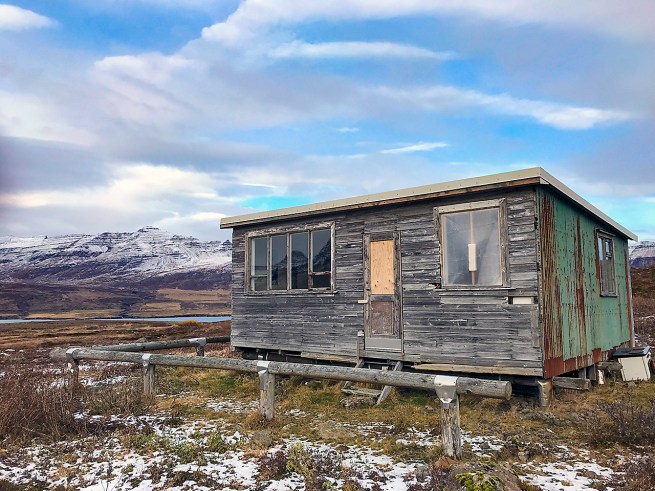 The owner had built it at the edge of the mountains and I can only imagine the lovely view in springtime and summer. The mountains fill the view through one window and the other side looks down across the long fjord.
So, we stood, at the base slopes of these majestic mountains, simply enjoying the view and taking a break from driving.
iPhone 7 back camera @ 4.0mm
1/2200 sec; f/1.8; ISO 20
For more images like this, please visit my website (images are available for purchase)
http://www.edlehming.com

“The best part of the journey is the surprise and wonder along the way.”
― Ken Poirot
One thing I never got tired of in Iceland was the waterfall and there was never a shortage of waterfalls. For those following this series of posts in my Iceland Journal Series, this will come as not surprise. In fact, it got to the point where I was bypassing some waterfalls as ‘insignificant’ since I knew there was not time to enjoy them all.
Back home, I could spend hours exploring a waterfall, photographing it at different angles and exposures, trying to capture the ‘essence’ of that particular waterfall. Each has its own unique characteristics that set it apart from others.
This particular waterfall, somewhere along the eastern coast of Iceland really fascinated me. It captures the character of the East Fjords so well. The water steps and zigzags down the steep slopes as it flows through the ravine of its own making. Or, was this deep ravine already here, the result of some geological upheaval and the water just found a convenient path? Would have loved to explore it more thoroughly, but, like many of the roadside waterfalls, it’s on private property and numerous fences make it difficult to get close.
So, I just stood in the grassy field near its base and enjoyed watching the progression of the water, leaping and dancing from rock to rock; sometimes taking small careful steps while, at other points, plunging great distances into cool pools below. I never get tired of watching water move and there is such an abundance here, I could not see it all, even in a lifetime.
Nikon D800
Tamron SP 70-200mm f/2.8 Di VC USD @ 95 mm
1/100 sec, f/5.0, ISO 400
For more images like this, please visit my website (images are available for purchase)
http://www.edlehming.com

“A horse loves freedom, and the weariest old work horse will roll on the ground or break into a lumbering gallop when he is turned loose into the open.”
―
Today’s image is a bit of a break from mountains, waterfalls and fjords, though I saw plenty along the way to this location, near the town of Egilsstaðir in Eastern Iceland. Unlike my previous photos, which featured primarily the coastal region, this image was made inland on a long lake named Lagarfljót.
My son and I had spent the day travelling and photographing the East fjords and our evening stops was Egilsstaðir. We had made good time and got to this are a bit ahead of schedule, so decided to travel around the lake. The long valley which contains Lagarfljót surprised us, since it is filled with trees; something we had not expected in Iceland, especially not in abundance, as was the case here. The trees are an Icelandic Birch, which is quite stunted and dense, more of a tall bush really.
Further along the shore, we came across a small herd of Icelandic horses, close enough to the road that we could get some good photos. Like the birches, the Icelandic horses have adapted to their environment and are quite short and furry, making them better suited to the rough terrain and cool, wet weather. By short, I mean they are about the size of ponies, standing at only 13 to 14 hands or 132 to 142 centimeters high . They are also an old breed, having been imported to the island in the 9th and 10th century. They are also the only breed of horse in Iceland, since the import of horse is forbidden. They also have very few diseases.
They come in all colours but I chose this gray one to photograph, primarily because I liked the colours and texture of her mane. She posed for me quite calmly, allowing me to get a shot with the lake in the background.
We saw many of these horses, throughout the county but few were close enough to photograph well. So I am glad to have had this opportunity.
Nikon D800
Tamron SP 70-200mm f/2.8 Di VC USD @ 165 mm
1/160 sec, f/4.0, ISO 400
For more images like this, please visit my website (images are available for purchase)
http://www.edlehming.com

“Well, first of all,” said the BFG, “human beans is not really believing in giants, is they? Human beans is not thinking we exist.”
―
You’d think, to look on this, that giants did exist, and had built a broad staircase to the heavens.
It’s quite a sight when you first see it, the broad and high steps of the steep hills along the East Fjords. For me, it was something I had not seen before. And, as most of my experiences, travelling through Iceland this fall, completely unexpected. They had the appearance of being somewhat unnatural, as if the mountains had been carved into these terraces.
I’m still curious as to the exact process that creates this effect. Yes, they have clearly been eroded over time to this form, but I don’t fully understand the geological process that causes this. It’s quite prevalent in Iceland, but I have, as yet, to find an article that explains it.
In any case, it makes the landscape quite stunning by creating layers upon layers of colour and texture, further enhanced, at higher altitudes by a light snowfall, as the layers continue into the sharp horn of Nóntindur, high above the Berufjörður fjord below it.
Nikon D800
Tamron SP 70-200mm f/2.8 Di VC USD @ 75 mm
1/320 sec, f/10.0, ISO 400
For more images like this, please visit my website (images are available for purchase)
http://www.edlehming.com

“It’s not the endings that will haunt you
But the space where they should lie,
The things that simply faded
Without one final wave goodbye.”
―
The long journey comes to an end, silently and slowly, in water.
Nothing is quick for a glacier, including its ending. The ice slowly flows down the mountains, slowly melting, cracking, and disintegrating. The last vestiges float about in a muddy pond, eventually fading not the water, at the feet of their majestic source..
In the image, you can clearly see the progression down the mountain, including the widening fissures at the face of the glacier. I made the photo from the edge of the pool, looking back up the glacier and waiting for the clouds to clear so that I could see the high peak of Hrútsfallstindar towering behind the glacier at 1,570 meters.
My son and I walked the edge of the pond, amazed at this natural spectacle and watching all shapes and sizes if ice floating around in front of us, or stuck to the muddy bottom and gradually melting away. What really surprised me was the variation, not just of shape and size but the colours and textures of the icebergs. Some were simply dull gray masses, others were made up of layers in every vibrant shade of blue imaginable, and some were absolutely crystal clear.
Behind us was a high mound of rock and gravel, the terminal moraine, made during the last advance of the glacier, as it pushed and piled the rock into a hill in front of it, creating a dam that is responsible for the glacial pool.
It was such a lovely place that we spent over an hour exploring the shoreline and photographing the icebergs and surroundings. It was an experience that I had not expected to ever have and one I will not soon forget.
Nikon D800
Tamron SP 70-200mm f/2.8 Di VC USD @ 75 mm
1/320 sec, f/10.0, ISO 400
For more images like this, please visit my website (images are available for purchase)
http://www.edlehming.com
“Ice, deep, blue and tortured ice;
The vault of time, and memory, long past.”
– Ed Lehming
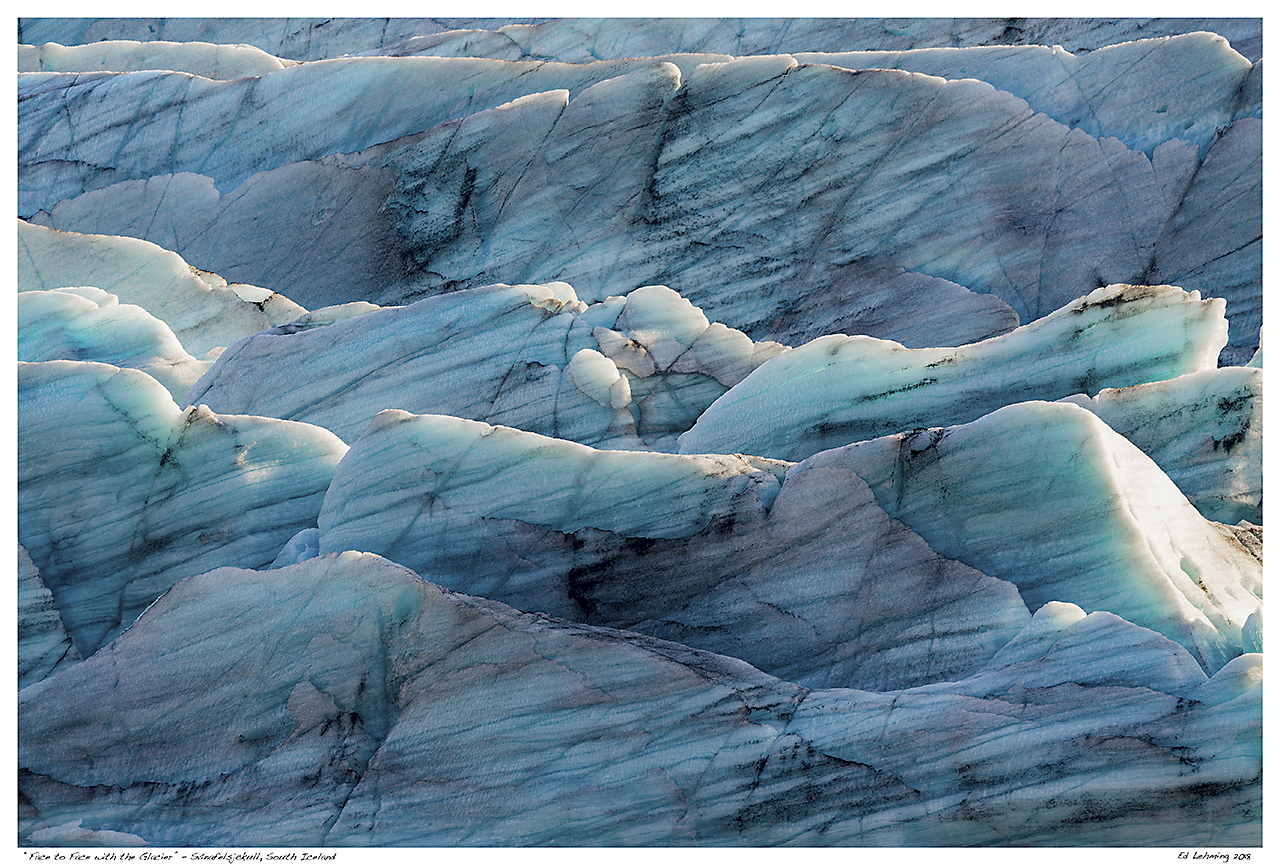
Words can barely describe the feeling of standing side by side with a glacier. Ice, formed tens of thousand of years ago. Ice, that has travelled for kilometers from high mountain peaks to slowly melt into oblivion, in a muddy glacial pool.
The photo hardly does it justice; layers of ice and dust, reminders of Iceland’s recent and distant volcanic past, laid out before me to ponder, close enough to touch. There are too many shades of blue to name, and light plays from and through the ancient mass before me.
Glaciers cover almost ten percent of Iceland’s surface, all melting at an accelerated pace in recent years. And now, I stand and witness their slow decay in the sound of dripping water and splashes far below the lead face.
I’m so glad I made this journey, at this time. I fear much of this wonder will soon be gone; though it’s hard to imagine that this much ice will someday by be nothing more than a muddy brown pond and a memory of what once was.
This, is Svínafelsjökull, close up and personal, this is Iceland’s past and future, a visual history of the land of Fire and Ice.
Nikon D800
Tamron SP 70-200mm f/2.8 Di VC USD @ 200mm
1/160 sec, f/6.3, ISO 200
For more images like this, please visit my website (images are available for purchase)
http://www.edlehming.com

Ice, massive ancient glacial ice, sagging and flowing under its own weight;
A great white beast, carving and devouring the mountains which contain it,
creeping forward, unstoppable;
It’s only foe, sunlight and warmth.
I stand humbled by its patient and persistent force.
– Ed Lehming
Svínafelsjökull glacier, or rather, the “glacier of Svínafels”, since jökull is Icelandic for glacier is actually one of the smaller glacial outflows associated with Hvannadalshnúkur, mentioned in a prior post.
I saw this glacier ahead of us as we continued to travel east along Iceland’s Ring Road. The sheer size of this incredible mass of snow and ice, piled high between the rugged peaks is humbling. The photo hardly does justice to the scale. At the far right foreground, a few vehicles sit parked along the road in front of a terminal moraine of this glacier. Basically, a pile of rock created by the front of the glacier plowing up the ground in front of it. The moraine itself is over 50 meters high and hides the lead edge of the glacier and the glacial pond formed by the meltwater trapped behind the moraine. More on that in a future post.
As we drove, ever closer, I hoped the road would bring me closer to this magnificent sight. I was not disappointed, the road came to within two kilometers of the glacier itself and we had opportunity to get even closer via a horribly potholed dirt road that led us to paths along side of the glacier and around the pond below.
As I said, the experience of walking along precipitous trails next to this massive and ancient ice is humbling, as we gazed across the deep crevasses of the slowly melting glacier and witnessing, close up, the unbelievable colours and patterns of the ice within meters of us. Then, looking upwards and seeing ice on ice, wedged between unyielding rock, piled ever higher and disappearing into the clouds above us.
Nikon D800
Tamron SP 70-200mm f/2.8 Di VC USD @ 172mm
1/320 sec, f/9.0, ISO 200
For more images like this, please visit my website (images are available for purchase)
http://www.edlehming.com
“It’s when rock breaks its silence that it crumbles to dust.”
―
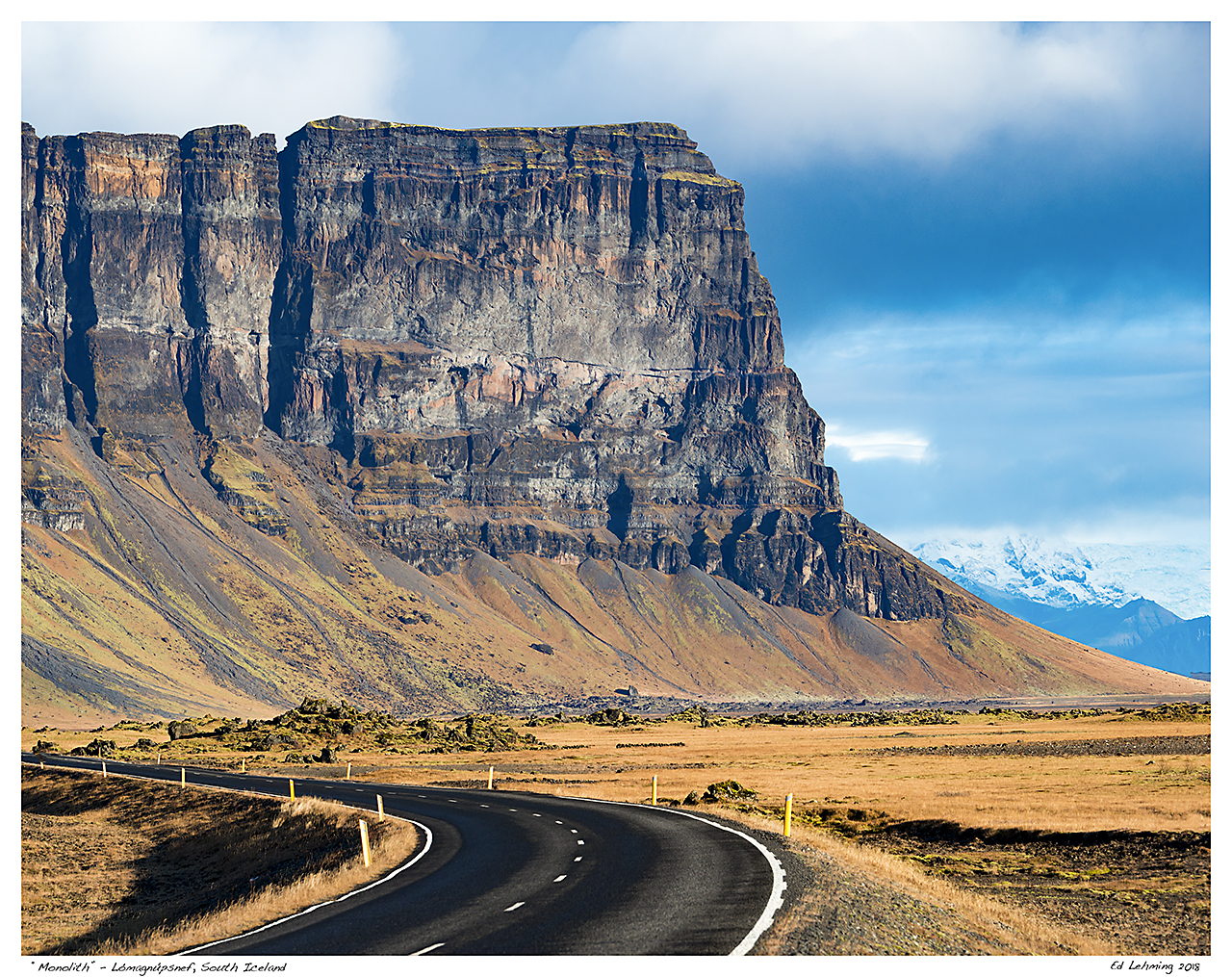
Today’s image is a closer look at the massive, dark cliff visible in yesterday’s post. This cliff, Lómagnúpsnef (nef is Icelandic for nose), dominated the horizon for a long time, ever brightening with more details emerging from the shadows as we got closer to it. There are many more details that I’m aware of, now that I’m not behind the wheel or standing along the road with my camera.
This large outcropping, which also acts as an unmovable boundary to the Skeiðarárjokull glacier, which is hidden behind the cliff’s talus slope in this image, reveals its wonderful colours and textures. The colour comes from the varied layers of basalt, which is the dark volcanic rock, and rhyolite, a pink-orange coloured volcanic rock. The difference in colour being the result of different mineral chemistry. Each layer would have been formed at a different period in time, deep underground.
The colour does not stop at the cliff itself; it continues down the slopes in tones or pink, orange and faint streaks of green.
The varied colours of this land really surprised me, since it is technically classified as tundra. I was not expecting all these bright colours, especially in the subdued late October sun, often blocked by layers of cloud.
Nikon D800
Tamron SP 70-200mm f/2.8 Di VC USD @ 130mm
1/250 sec, f/8.0, ISO 200
For more images like this, please visit my website (images are available for purchase)
http://www.edlehming.com

“The Road goes ever on and on
Down from the door where it began.
Now far ahead the Road has gone,
And I must follow, if I can,
Pursuing it with eager feet,
Until it joins some larger way
Where many paths and errands meet.
And whither then? I cannot say”
―
This single photo can sum up my Icelandic journey. By the way, I was not driving when I made this photo, I stopped and stepped onto the sparsely travelled road. The landscape, in its varied layers, over the visible distance, changes from rugged lava fields, the Eldhraun, covered in ancient moss, to rugged plateaus and the ever present yellow grasses flanked by steep talus slopes, filled with waterfalls and the dark high cliffs of Lómagnúpsnef, the bounding landmark to the western edge of the massive Skeiðarársandur, yet another glacial washout plain, this one, some 56 km wide and filled with a tangled network of creeks and rivers winding their way through black sand and golden grass to the sea. Their source: the vast glacier field known as Vatnatjökull, visible in the far distance.
As the road makes another turn, a huge boulder dominates the scene and yet another waterfall, Gulufoss, I believe, falls from the rim of the plateau. I can picture this plateau in late spring, spewing water through every crack and crevice.
Actually, only one of the glaciers that make up Vatnatjökull is visible in this image, Skeiðarárjokull, the source of the washout, can be seen stretching out in a bright white plain before the distant mountains and glaciers of Hvannadalshnúkur, Iceland’s highest peak, a 2,119 meter high volcano, also covered in ice, the summit obscured by clouds.
As the day progressed and we drew nearer to Hvannadalshnúkur, I found myself hiking through mossy lava fields to get a closer look at a small waterfall, driving a small potholed dirt road that rattled my teeth to get a closer view of Svínafelsjökull, one of several outflow glaciers coming from Hvannadalshnúkur. Here, I could almost touch the fractured glacier as it flowed between the mountains, melting into a muddy pool, filled with glacial icebergs of varying size and colour. We then spend time along the pond, enjoying the icebergs in their variety. I even had the chance to pick up a small, crystal clear fragment and taste it. A magnificent and unexpected experience. It was oh, so pure and pleasant. The taste of a glacier!
My journey, as I reflect on these images and memories did not end when I flew home, rather, it continues, as I begin to understand the incredible forces and dynamics that shape this country.
Nikon D800
Tamron SP 70-200mm f/2.8 Di VC USD @ 200mm
1/160 sec, f/6.3, ISO 200
For more images like this, please visit my website (images are available for purchase)
http://www.edlehming.com
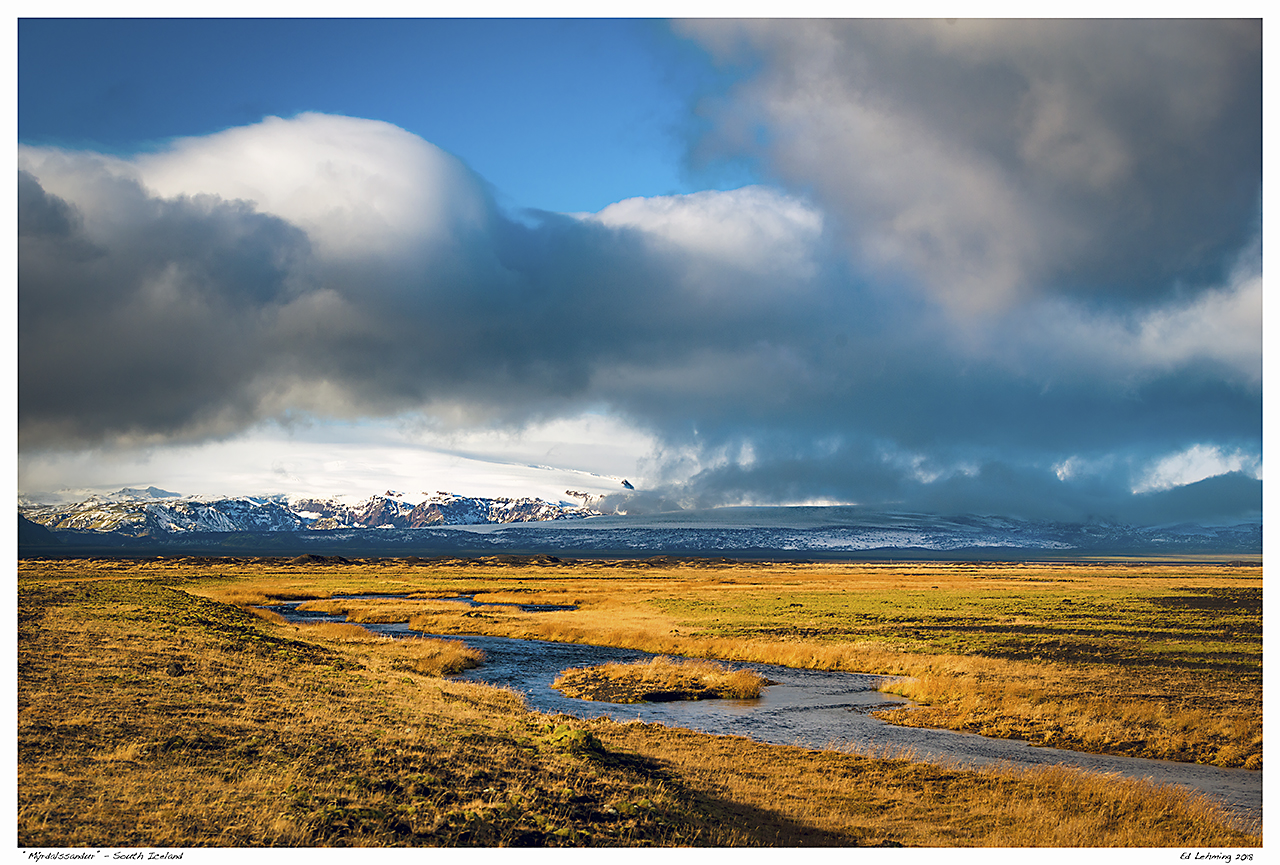
“There was an ocean above us, held in by a thin sac that might rupture and let down a flood at any second.”
―
Mýrdalssandur is a massive outwash plain just east of the town of Vik, on Iceland’s south coast. The Ring Road enters this area after a short run along the mountains near Vik. I have never seen anything like this and at first had no idea what I was witnessing. As far as the eye can see, the landscape has been washed flat, yellow grasses and moss cling tenuously to the black sand, gravel, and lava boulders that make up this vast area for some 25 kilometers. There are warning signs along the road that dust storms of fine black sand, resembling smoke, can be created, if the conditions are right. I was concerned, as we entered the region, as the winds whipped up to over 80 km/h, but the recent rains and coastal fog held the dust down.
Threading their way through this barren landscape are glacial streams of varying size, faint reminders of the torrents of water, or jökulhlaup (glacial outwashes), that created this area.
This region was most recently sculpted by an enormous jökulhlaup, the result of a subglacial eruption of the nearby volcano, Katla.
In 1918, Katla erupted underneath the enormous glacier, Mýrdalsjökull (seen in the background, just beneath the clouds), melting the glacier below the surface and forming a massive sub-glacial lake. The volcano continued to erupt under the ice and increasing pressure caused it to burst out the side of the glacier, creating a violent flood, of water, ice and volcanic debris. The water volume at the peak of the jökulhlaup was estimated to be around 200,000 – 300,000 m³/s, making it, for a brief time, the largest river in the world, based on the volume of water. The jökulhlaup absolutely devastated the area, wiping out homes and farms and leaving this mainly barren plain as evidence of its power.
The region is largely unsettled, primarily due to the risks of future eruptions of Katla, which remains active below the ice, and the frequent jökulhlaups. Because of this and the alien look of the landscape, it was used for the opening scene of the Star Wars, Rogue One movie.
Nikon D800
Tamron SP 70-200mm f/2.8 Di VC USD @ 70mm
1/250 sec, f/8.0, ISO 200
For more images like this, please visit my website (images are available for purchase)
http://www.edlehming.com

“The places where water comes together with other water. Those places stand out in my mind like holy places.”
―
Water upon water, water flowing everywhere, from the high and cold places, that is Iceland.
And this, is one of the most known waterfalls for a few reasons. Skógafoss is one of the largest waterfalls in Iceland, at 60 meters in height and 25 meters wide. It’s also just a short drive from Reykjavik and one of the first significant waterfalls you see for the Ring Road, Highway 1. It’s also very easily accessible. In fact, you can walk right up to it. You’ll get soaked by the mist in seconds, but you can walk right up to it, as many people did on this rainy October day.
The waterfall itself is on the River Skóga, this the name Skóga / foss (Skóga / waterfall). It’s actually one of many waterfalls on the Skóga river, but the others are much smaller and further up the river from Skógafoss.
As I mentioned, many people walk right up to it; people with cellphones, point and shoot cameras, and the hardcore photographers with their tripods and water resistant coverings, all wanting to take some memory of the beautiful place home with them.
You’d think this would be dangerous, but despite the height of the waterfall, the actual volume flowing over it is not as great as you’d think. I would not recommend showering under it, but you can get very close, and very wet!
As I said, we visited on a rainy day, so were already in our rain gear as we approached. It did make for stunning photos either, as I was trying to get an angle that did not have people in it and the fine mist and rain provided me with a soft white background rather than a few clouds and blue sky. I also did not want to commit to bringing a tripod and setting up like many others, so shot this handheld at 1/8 of a second, which is the best I can do at shooting hand held. Thank goodness for the Vibration reduction in modern lenses.
I thoroughly enjoyed being there and taking in this wonderful sight, despite the spray of water and the cool temperatures. It looks much more pleasant in the summer, though I expect it would be packed with people.
Nikon D800
Tamron SP 70-200mm f/2.8 Di VC USD @ 78mm
1/8 sec, f/13.0, ISO 200
For more images like this, please visit my website (images are available for purchase)
http://www.edlehming.com
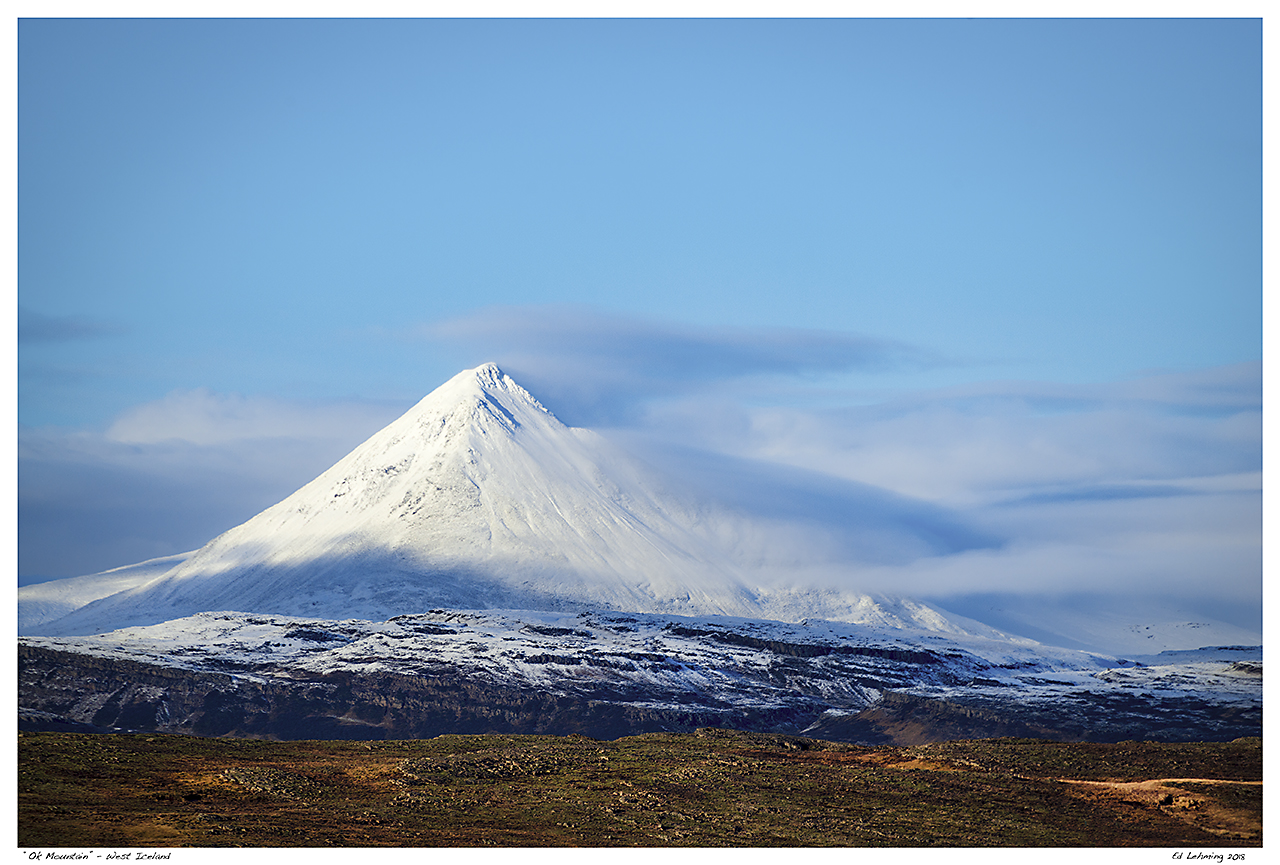
We pass through the present with our eyes blindfolded. We are permitted merely to sense and guess at what we are actually experiencing. Only later when the cloth is untied can we glance at the past and find out what we have experienced and what meaning it has.”
―
I chose the attached quote for several reasons. First, and foremost, I’m referring to the ever changeable nature of Iceland’s landscapes. Many times, only small glimpses revealed themselves, hinting at something grander, yet unseen. Other times, a scene would reveal itself for just a brief period and then be obscured by clouds once more. Secondly, much of what I experienced is just starting to sink in now. I’m discovering names of places, mountains, glaciers, and waterfalls that, even though we had a good travel book with us, did not ‘fit’ together into a continuous story.
We experienced mini vistas, in isolation from each other. Recalling these ‘moments’ and the photos associated with them, fills in the experience some time after the experience itself. Understanding how these places and natural systems work together has given me a whole new appreciation for the wonder that is natural Iceland.
I’ve reviewing images that I believed that I made in one place only to find it was in a slightly different location altogether and that the surroundings are more significant than I had realized while there.
The images and associated stories, now expanded, provide a deeper meaning to the experience and I find myself getting a bit emotional about them. Putting myself back in that particular time and space and discovering them over again, with a fuller understanding and appreciation.
The volcanic mountain, or stratovolcano, pictured her is Ok. Yes, that’s its name. Even though we had driven in very close proximity to it and saw it on our map, we never actually saw the volcano till we were driving away and it briefly revealed itself though the clouds, behind us. Really? How do you not see a mountain? In Iceland, it’s quite easy and I wonder how many other wonders the clouds hid from our view?
In a way, my journey through this beautiful country continues, as my understanding and appreciation expands.
Nikon D800
Nikkor 70-300mm f/4.5-5.6 G I AF-S VR Zoom @ 300 mm
1/250 sec, f/8.0 ISO 200
For more images like this, please visit my website (images are available for purchase)
http://www.edlehming.com
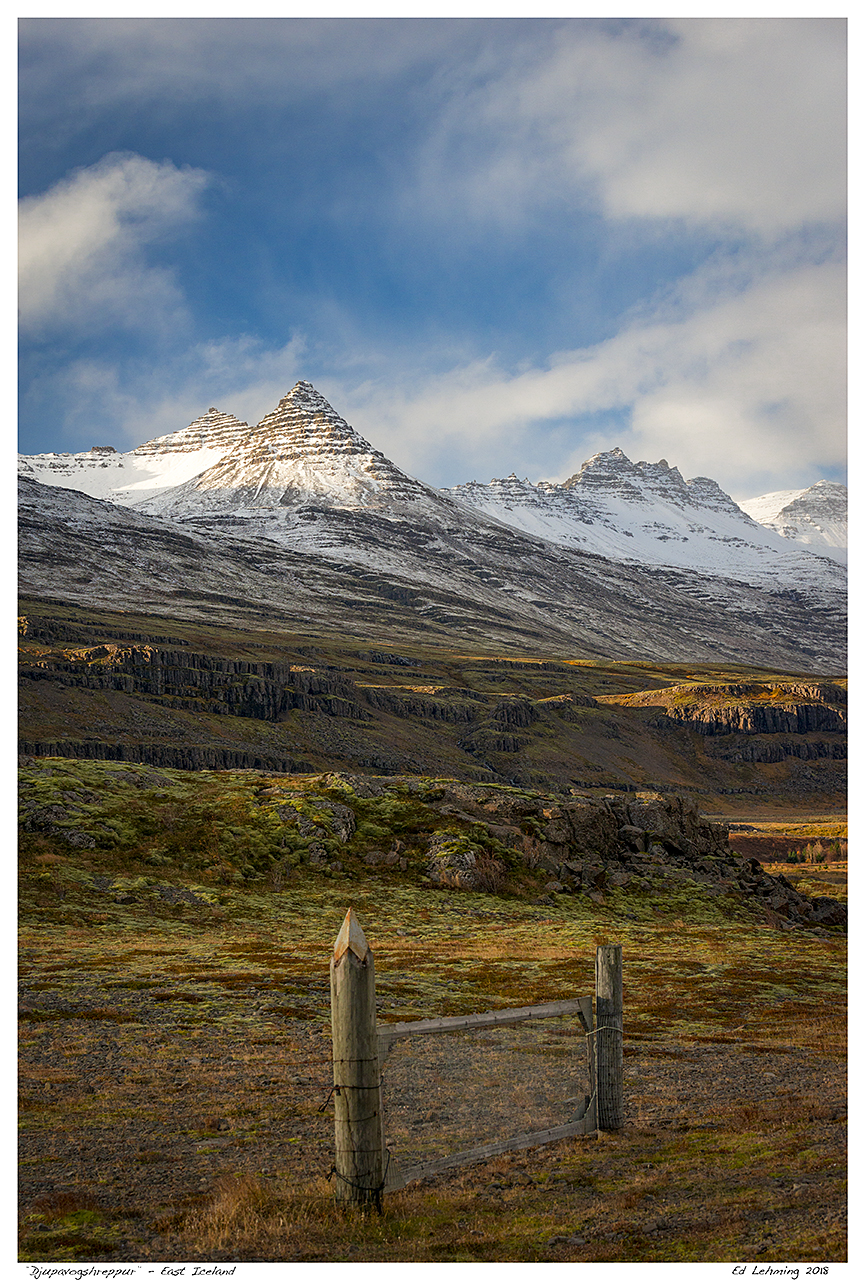
“Those who contemplate the beauty of the earth find reserves of strength that will endure as long as life lasts. There is something infinitely healing in the repeated refrains of nature — the assurance that dawn comes after night, and spring after winter.”
―
I couldn’t help but match my favourite Rachel Carson quote with this image. The scene above left me breathless as I beheld it for the first time. I was captivated be the shape of the high mountains which bound this relatively short Eastern Icelandic fjord, Hamarsjörður, and the stunning play of light on both the peaks and the flanking foothills. When I return to Iceland, next time, I plan to spend more time travelling these spectacular fjords.
In the foreground is Nontindur, a stunning 935 meter high pyramid-like peak. I was enthralled by these mountains the first time I saw them, the recent high level snowfalls accenting the horizontal tiers that make the peaks in this region so unique.
The light that morning, as we followed the Ring Road along the southern coast eastward from the town of Höfn, was absolutely gorgeous and makes the ever-present yellow grasses glow with a soft golden warmth that we experienced so many times on our journey. I was concerned that travelling to Iceland at this time of year might make for some fairly dull images, but was so pleased when I revisited these locations in Google Street View to find that the light and colours that I experienced were by far better than that of summer, at least in the Google images.
As I composed the shot, from the side of the road, all the elements came together once more to produce this post card-like image that so wonderfully conveys the feelings I experienced while standing there, taking in the beauty.
In this case, as in several other shots I have been sharing, I deliberately put an object in the foreground to help establish scale. In this case, the freshly installed and sharpened fence post nicely echoes the shape of the mountains behind it and seems to be pointing to the peak itself.
Once more, I’m including the Street View link so you can also take in the surroundings that make up this shot. This is the exact spot I pulled off. You can even see the gate and fence post in the foreground 🙂
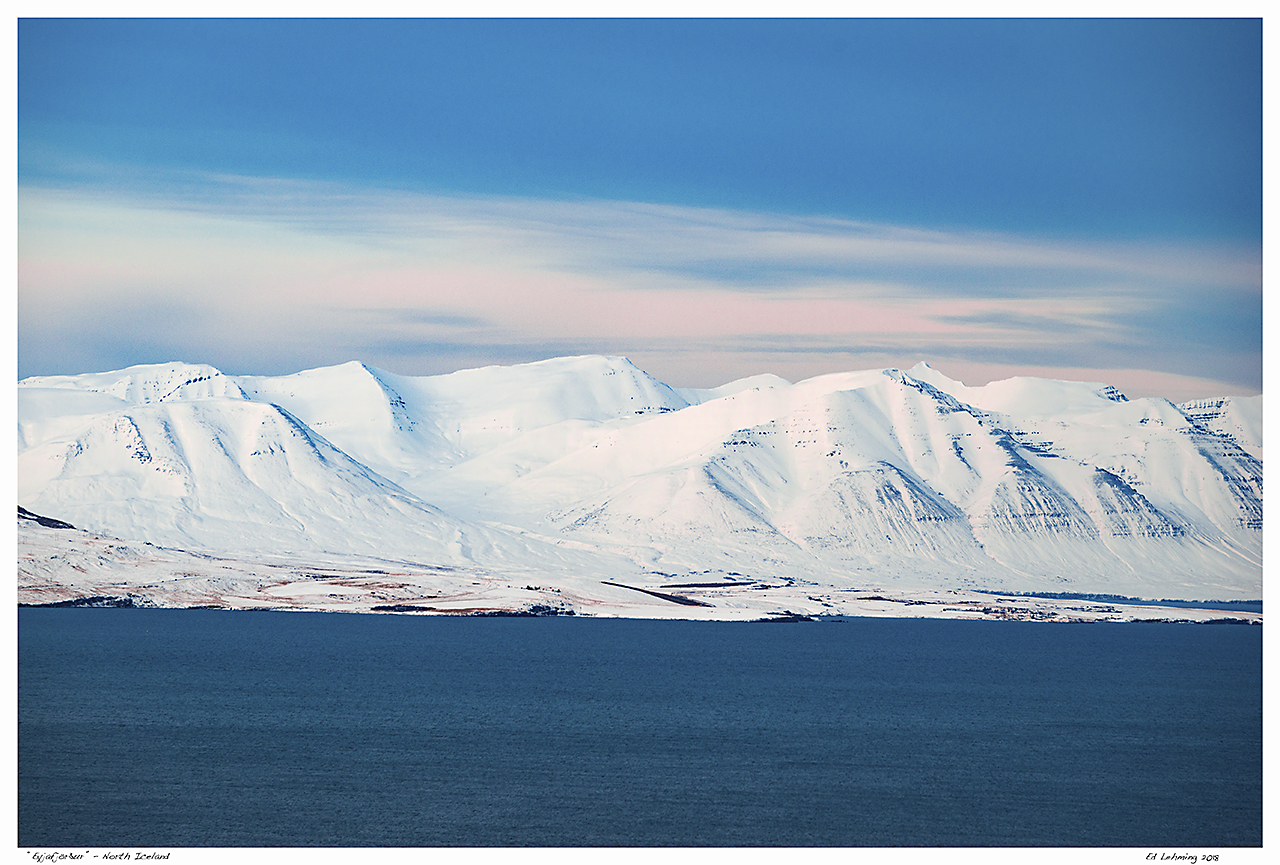
“Mountains, according to the angle of view, the season, the time of day, the beholder’s frame of mind, or any one thing, can effectively change their appearance. Thus, it is essential to recognize that we can never know more than one side, one small aspect of a mountain.”
―
More mountains, their scale lost against the massive northern Icelandic fjord, Eyjafjörður. The highest peak, at the center, Kerahnjúkur, rising to 1,097 meters.
This was our view as we continued our round trip of Iceland, descending from high passes to enter the region around Akureyri, Iceland’s second largest city, which sits at the innermost end of this 60 km long fjord, the longest in Iceland.
I was mesmerized at the stark whiteness of the mountains against the slate blue water of the fjord, coupled with the wonderful pinks in the distant clouds; layers upon layers of colour and texture. The entire region beyond these mountains, the Tröllaskagi peninsula, is defined by high, rugged, and glacier topped peaks and long, deep valleys.
The image was made at the end of October and yet, the entire landscape is like a scene from the arctic circle, which, while close, is till some 60 kilometers distant from this point. In fact, while Iceland is close to the Arctic Circle, none of the mainland is actually in the arctic, only a few northern islands can make that claim.
Once more, I’m adding the Street View link, so you can get a sense of scale. The image above is the mountains to the distant right on the Street View image:
Nikon D800
Tamron SP 70-200mm f/2.8 Di VC USD @ 200mm
1/200 sec, f/7.1 ISO 200
For more images like this, please visit my website (images are available for purchase)
http://www.edlehming.com
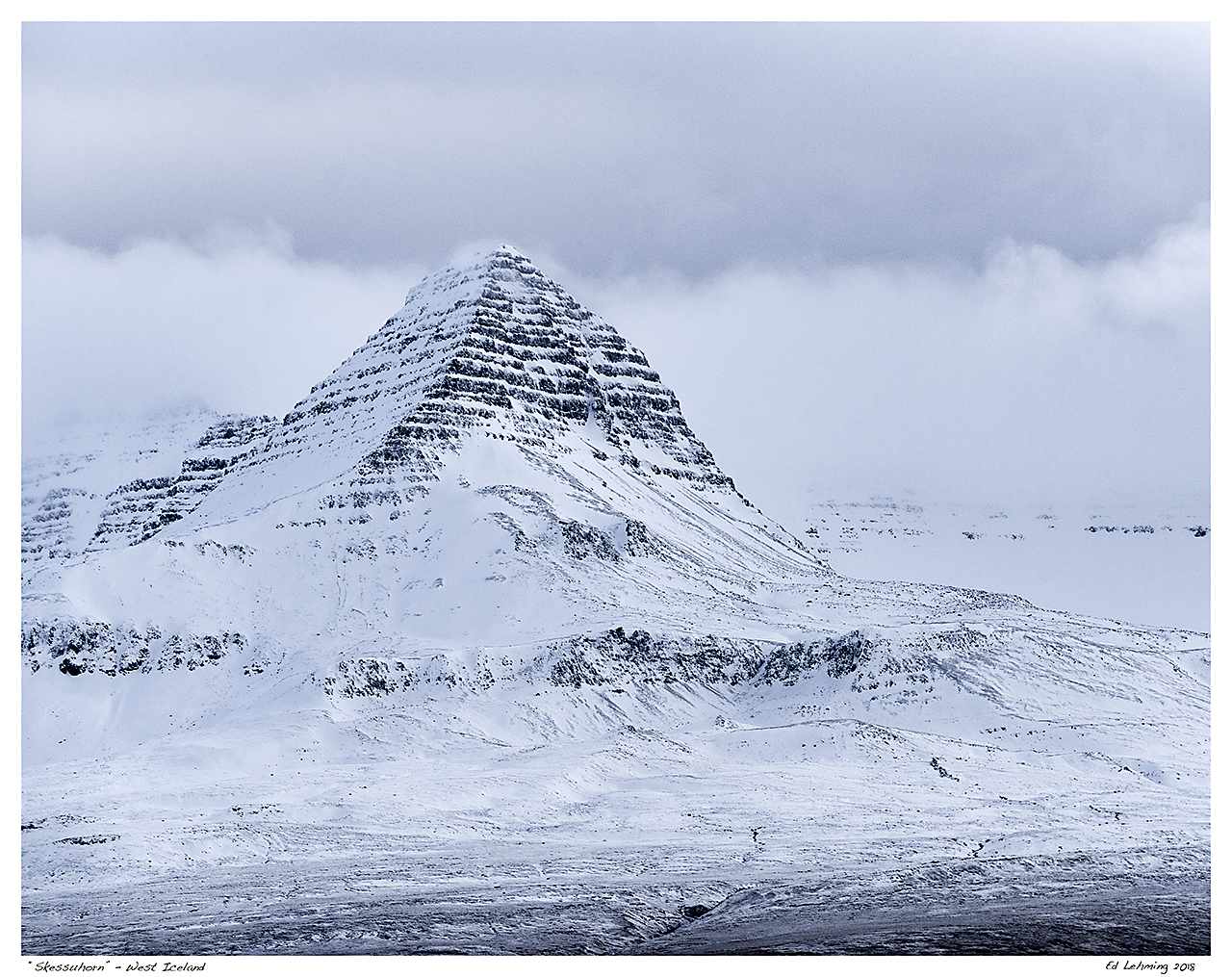
“We are now in the mountains and they are in us, kindling enthusiasm, making every nerve quiver, filling every pore and cell of us.”
―
It feels a bit odd using a John Muir quote here, because they know the mountains he is referring to, namely the Sierra Nevada of California and Yosemite National Park. Yet, his words ring true in these mountains as well. On this day, my son and I headed south, towards the coastal town of Borgarnes, in Western Iceland.
As we drove south from the Westfjords, a large group of mountains greeted us on the far horizon. These mountains are centered around Skarðsheiði, a 1,054 m peak. In the foreground, and just peeking through a large bank of low cloud was Skessuhorn, a steep mountain with its wonderful terraced slopes. I just kept looking at it, hoping the road would bring me nearer and that the cloud cover would not increase.
In fact, the cloud bank clung to the mountains all day and only Skessuhorn has clearly visible to us. So, when you look at this image, be aware that, in typical Iceland fashion, much of what is before is not currently visible, only being revealed for short periods and then gone again.
For me, it’s these fantastic horizontal terraces that give many Icelandic mountains such a unique appearance, as opposed to North America’s Rocky Mountains, which, while still layered, are angled. These mountains look like pyramids, with layers carefully planned out and neatly stacked. It all has to do with the unique geology of Iceland, which straddles two continental plates, creating volcanoes and areas of tectonic upheaval that sculpt the rock in such marvelous ways. By the way, this is a colour photo, but the colour is lost, in snow and rock and cloud.
Here’s the summer time Street View link. I think it looks much nicer in November:
Nikon D800
Tamron SP 70-200mm f/2.8 Di VC USD @ 180mm
1/200 sec, f/7.1 ISO 200
For more images like this, please visit my website (images are available for purchase)
http://www.edlehming.com
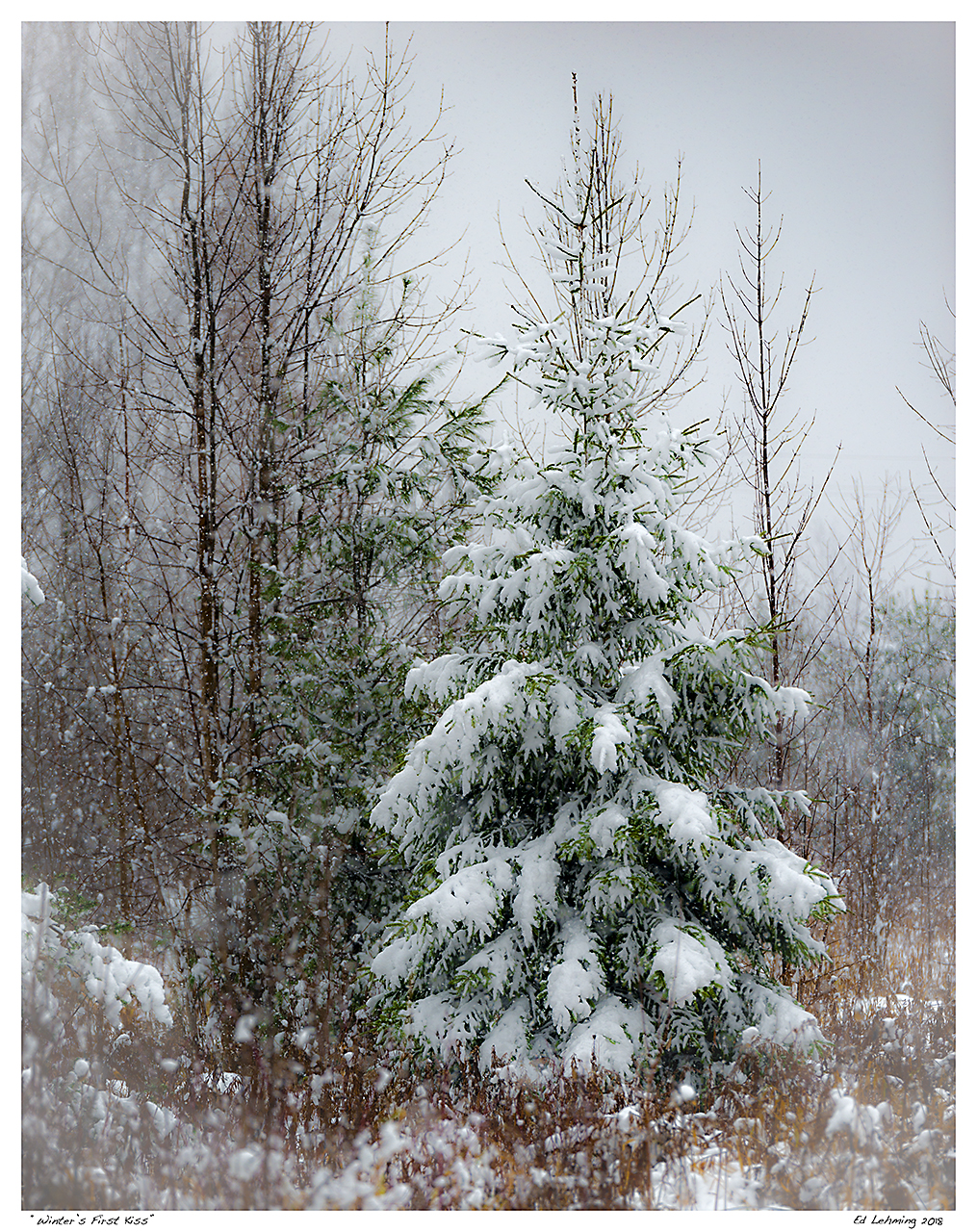
“Snow flurries began to fall and they swirled around people’s legs like house cats. It was magical, this snow globe world.”
―
Here’s yet another image, made during a recent snow squall, a squall which abruptly shoved us closer to winter.
The large flakes quickly stuck to branches weighing them down and obscuring all traces of autumn with their bright purity.
I got out around noon to try to capture some of this wonder and was pleased that the ‘feel’ of the snow squall translated well through my images despite the flat light and the thick and continuous snowfall.
Nikon D800
Tamron SP 70-200mm f/2.8 Di VC USD @ 140mm
1/800 sec, f/2.8, ISO 160
For more images like this, please visit my website (images are available for purchase)
http://www.edlehming.com
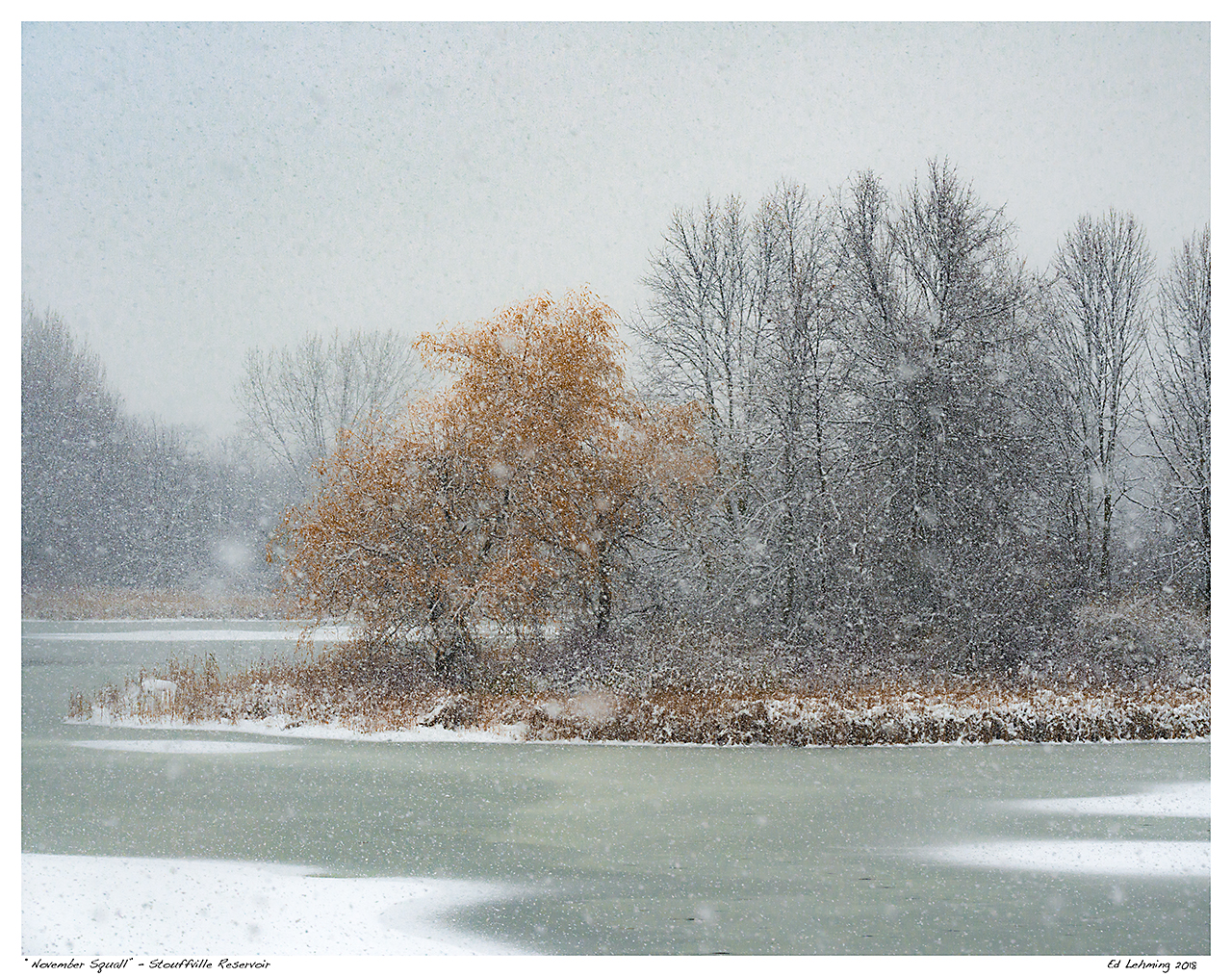
“In November, the earth is growing quiet. It is making its bed, a winter bed for flowers and small creatures. The bed is white and silent, and much life can hide beneath its blankets.”
―
I wanted to post another photo of the beautiful wintery scenes created by last Friday’s snow squalls. Though a bit early for my liking, heavy snows turned the world into a wonderland in mere minutes.
The world now lays buried under this thick blanket of snow, only hints of autumn’s brightness remain, in stubborn yellow leaves, shining brightly between the large snowflakes.
Beyond that, colours are soft and subdued, the world is quiet, as if taking a deep breath before it’s winter repose.
Nikon D800
Tamron SP 70-200mm f/2.8 Di VC USD @ 95mm
1/200 sec, f/8.0, ISO 400
For more images like this, please visit my website (images are available for purchase)
http://www.edlehming.com

“Look with open eyes and you will see the beauty of the waterfall.”
―
In this post, I decided to return to Hraunfossar, as fascinating series of waterfalls in Western Iceland.
What makes these falls so amazing, is that at first glance, they look like typical waterfalls, pouring down from some glacial stream. But, on further inspection, you realize that there is no stream involved here, at least not in the typical sense.
You see, Hraunerfosser, or Lava Falls, in Icelandic, comes from underground rivers, flowing through the Hallmundarhraun lava tunnels from a significant distance. The glaciers which feed these waterfalls are many kilometers away, but can been seen on the distant horizon.
I particularly enjoyed this location, since it’s just far away from Reykjavik to decrease the number of tourists, thought there was a single bus here when we arrived, but the crowds were quite spread out. This allowed me the time to really enjoy this natural beauty without contending with the accursed selfie-sticks and people posing precariously on the rocks to get that perfect Instagram worthy shot.
The location does have some very well laid out and spacious viewing areas. Again, minimizing the tenancy for people to climb barriers for a ‘personalized’ view. It also provided some nice places to set up my tripod to make a series of long exposure images and to visually explore this beautiful place without people bumping into me or walking in front of my camera.
By “exploring visually”, I mean being able to take the time to really appreciate the fine details that make this waterfall so lovely. For example, the fine ribbons, jsu left of centre on the shot above, yielded this detail, as the ribbons flowed gently over the rock surfaces:

The detail of the water, the texture of the rock, and the vibrant colours of the wet mosses made for a beautiful photo, which for me, really captures the essence of this waterfall, or rather series of waterfalls, which just blend together into a complex and curtain of flowing water.
Of all the massive and humble falls I saw, I think I was most captivated by this one.
Nikon D800
Nikkor 70-300mm f/4.5-5.6 G I AF-S VR Zoom @ 92mm
1.0 sec, f/32.0, ISO 200
For more images like this, please visit my website (images are available for purchase)
http://www.edlehming.com

“In November, the trees are standing all sticks and bones. Without their leaves, how lovely they are, spreading their arms like dancers. They know it is time to be still.”
―
Today I decide to make a short departure from my Iceland Journal, though that will continue for some time, as I continue to process the images and memories.
While I revel in those times, not so long ago, nature reminded me that there is beauty here in the present as well. An early November squall brought us a winter wonderland in mid-November.
Some trees are still hanging on to their leaves and it is not quite time to say farewell to yellow and orange for the season. Through the heavy snowfall, bright leaves still shine, bringing colour to the otherwise monotone landscape. Those too will soon be gone. I’m sure the weight of the snow and the cold nights will accelerate their departure as the world falls into the quiet gray sleep of winter, once more.
I did not have to go far afield for this image, it was made just steps from my home, at a local conservation area which always has some new wonder to offer me. Today was no exception.
Nikon D800
Tamron SP 70-200mm f/2.8 Di VC USD @ 122mm
1/200 sec, f/8.0, ISO 400
For more images like this, please visit my website (images are available for purchase)
http://www.edlehming.com

“The stars looked down at me from infinite space. We are tiny, they said, but you are insignificant.”
―
On the first day of my Iceland trip, something that came to my attention, almost immediately, was the incredible contrast in scale between the land itself and man-made things, particularly houses, which seem so insignificant against the mass of rock and ice that surrounds them.
Here, a farm which has guest cottages, presumably for hikers venturing into the highlands, seems overwhelmed by its grand surroundings. In the background the rock rises ever higher, disappearing into the clouds.
The icecap , far above, covers Eyjafjallajökull, the volcano, which erupted back in 2010, stalling air traffic through most of Europe. Remember that one? The name that nobody could pronounce? It simply became, “That volcano in Iceland.” By the way, I’ve been getting ever better at pronouncing Icelandic places, including this, simply through researching the places I visited and repeating the names, over and over.
Well, that volcano is in this farm’s backyard, and I often found myself wondering what that would be like, having one of nature’s most powerful and dangerous creations so close.
The coastal plain that this farm faces is a vast, flat lava field, created by previous eruptions, and endless streams of meltwater flows through streams lined with black volcanic rock. The farm, occupies a very small place in time and geography. It was only one of many along the way.
Once more, I’m adding the Google Street View link for perspective:
Nikon D800
Tamron SP 70-200mm f/2.8 Di VC USD @ 92mm
1/125 sec, f/5.6, ISO 200
For more images like this, please visit my website (images are available for purchase)
http://www.edlehming.com
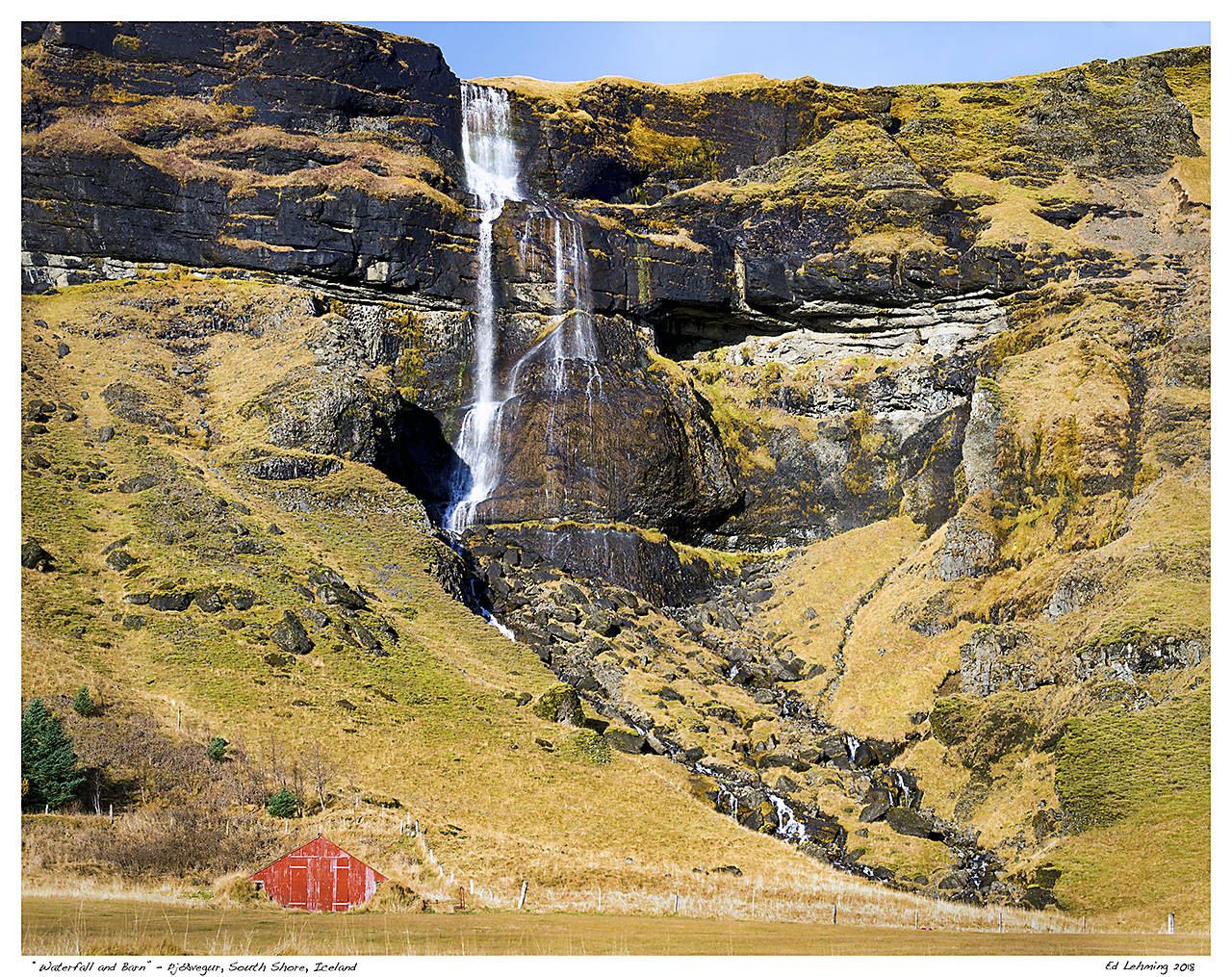
“Waterfall and Barn” – Þjóðvegur, South Shore, Iceland
“The icy waters flow and drop in silver streams from high cliff tops; they nourish the land and flow among the ancient bedrock and volcanic debris; sculpting, cleansing, and nourishing this rugged landscape with their cool purity and gentle persistence”
– Ed Lehming
It seemed like this stretch of highway between Vik and Höfn was lined with some form of waterfall for much of the early part of the drive. This high and ancient plateau oozed water from every crack and crevice, creating waterfalls in so many forms it is hard to describe them all.
There were slow meandering ribbons of water that followed the slope of the land and high thundering falls that plunged through the void to thunder upon on rocks far below, and some flowed in wide ribbons across exposed rock, like a vast white curtain in the wind.
The source of all this water, kilometers from our sight, is the ancient ice fields and glaciers of Vatnajökull, covering some 14,000 square kilometers of Iceland’s interior in snow and ice.
With the number of waterfalls and the flow of the water, I can only imagine what spring and early summer must be like, as even in late October, it was simply magnificent to behold.
I read somewhere that Iceland has over 10,000 waterfalls. From my experiences during my ten-day trip, I think that number falls far short from reality. There are waterfalls everywhere. In fact, it was tough, being a ‘flatlander’ not to stop every few minutes along the highway to make yet another photo.
It should also be noted, for those new to Iceland, that many of these smaller waterfalls, while clearly visible from the highway are on private property and can only be viewed from a distance.
Along this coast, one side of the highway is the high plateau, while the other side is an endless lava field that stretches for kilometers south before meeting the shore of the North Atlantic.
I’ve embedded the Google Maps view for your reference:
https://www.google.ca/maps/@63.8506677,-17.9003383,3a,75y,342.02h,97.82t/data=!3m6!1e1!3m4!1sKddaHD6706lpCl-pw1tqHw!2e0!7i13312!8i6656
Nikon D800
Tamron SP 70-200mm f/2.8 Di VC USD @ 70mm
1/200 sec, f/7.1, ISO 200
For more images like this, please visit my website (images are available for purchase)
http://www.edlehming.com

“Sunlight will always follow in a clouds wake.”
―
One of the aspects of Iceland that I enjoyed most was that nothing lasts very long. It does not rain all day, nor snow all day, sunshine comes and goes, and the clouds above shift and morph by the minute.
Oh, the clouds and light of Iceland, they are simply unbelievable. Clouds come in layers, each layer with a mind of its own, passing and sliding between one another. One moment you are looking at a dark bank of low clouds on the horizon and minutes later, they slide back like a magical curtain revealing a mountain hidden among them.
The volcanic cone pictured here is Strútur, and ancient volcano in the highlands of western Iceland. As we ventured further inland, seeking the many wonderful waterfalls, one of the roads we had planned to drive turned out to be a “F” Road, one of Iceland’s many interior mountains roads, generally only accessible with rugged four-wheel drive vehicles and largely closed in winter months. This road was marked as a side road on our map, but as we ventured onto it the signage indicated that is was, in fact” an “F” Road, meaning our rental insurance was null and void if we travelled that road.
This slight setback caused us to turn back and take another road to our destination. That decision put us on a road that briefly headed deeper into Iceland’s backcountry and facing a think bank of clouds reaching across the distant horizon of low, rolling hills and lava fields.
As we progressed along this road, the clouds pulled back and revealed this wonderful sight. Strútur, is a large volcanic cone and is 937 meters high. You can see where the cone collapsed and the lava flowed outwards to where I made the photo.
Soon after I made the photo, the clouds rolled back in and obscured the mountain once more.
Once again, Iceland provided me with a brief and wonderful vista and then took it back again, all within mere minutes.
Nikon D800
Tamron SP 70-200mm f/2.8 Di VC USD @ 116mm
1/320 sec, f/9.0 ISO 200
For more images like this, please visit my website (images are available for purchase)
http://www.edlehming.com


 Ed Lehming Photography
Recent Comments