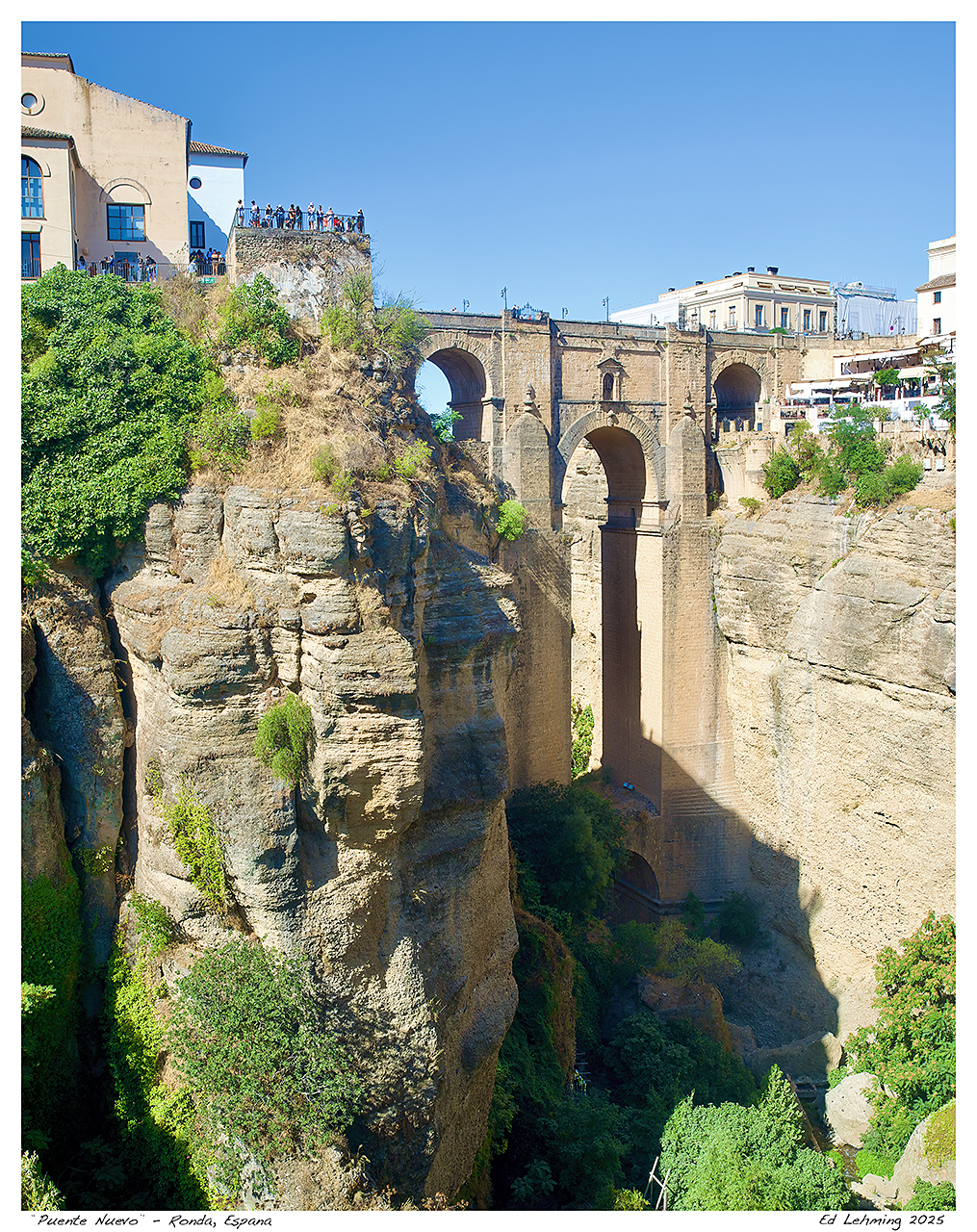
“Puente Nuevo” – Ronda, Espana
“Where stone meets sky, the world remembers how to stand tall.” – Ed Lehming
Moving on from Lisbon to Malaga, Spain. One of my most anticipated day trips was to get to Ronda and the beautiful bridge that seems to be on so many Spanish tourist sites and brochures. A short bus ride from Malaga brought us into the town of Ronda. I guess I was surprised when we pulled up that I had not seen the bridge or the gorge that it straddles while approaching the town. I had this vision that I’d see it in the distance.
The reality is that the road approach does not offer even a brief preview; in fact, it’s a bit of a walk from the bus terminal to get to the bridge itself. However, the walk is worth it, as it brings you past the Alameda de Tajo, a beautiful, treed urban park that leads to a viewpoint overlooking the gorge. The gorge itself is called El Tajo. The path through the park and along the steep gorge leads shortly to Ronda’s famous bullfighting ring. Ronda is famous for it’s bullfighting history. The ring is not the oldest in Spain, but it is unique in that it is constructed primarily of stone. Another feature is that the entire seating area is covered, which is a great benefit in the hot Iberian sun. There is also a spectacular statue of a bull in front of the structure.
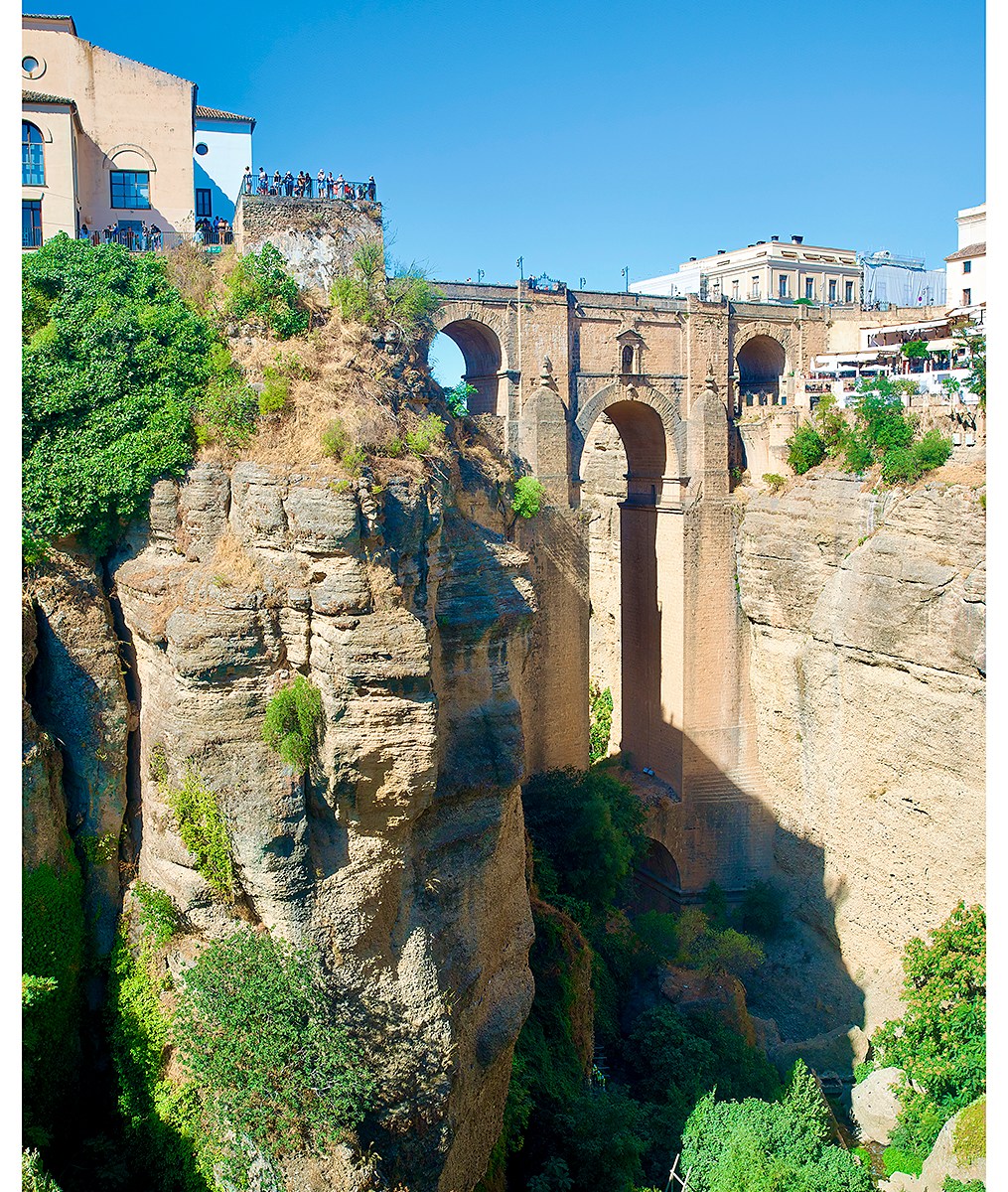
Continuing past the bullring, you eventually come to the bridge itself. You know you have arrived because the density of tourists increases significantly. At street level, it appears like any other bridge, but the gorge it spans is spectacular and divides the town of Ronda in half, so the need for a bridge is understandable. This is not the first bridge; it’s the Puente Nueva, or the “New Bridge.” There was a previous bridge, built in 1735, but it was apparently constructed too quickly and poorly, collapsing in 1741 and killing 50 people. The construction of this version of the bridge started in 1759 and took 34 years to complete.
You’ll notice a small window at the center of the bridge, which leads to a chamber that has been used for various purposes, including a prison. During the Spanish Civil War in 1936–1939, the use as a prison and torture chamber continued, and apparently prisoners were often thrown out of the small window into the gorge 120 meters below. It now contains a museum.
There are various viewing platforms (visible in this photo), most quite crowded, and I found that the best view was offered by the Jardines de Cuenca, a bit lower in the gorge, which is where this photo was made. This vantage point can be accessed by various fairly well-marked paths and is worth the hike into the gorge.
You’ll also notice in my camera data below, that I switched to my Nikon D800 for this. Though my iPhone provided some really good images, I once again wanted more control over the aperture to control the depth of field, something that the camera does not do well, in my opinion. My wide-angle lens also has a circular polarizer, so I can eliminate unwanted glare.
Nikon D800
Tamron SP 24-70 mm f/2.8 Di VC USD @ 24 mm
1/200 sec, f/7.1, ISO 400


Stunning. I’d love to peer over the edge, very carefully, of course. 🙂
Imagine the construction of this bridge! Wow!
What a mess it must have been down below the “Throw ’em out the window” room.
Wow, just saw this on today’s stage of La Vuelta!!