“It is very important that we have the capacity to love many different things or people at the same time. Our love should radiate like the sun, warming everything it touches.”
― Peggy Toney Horton
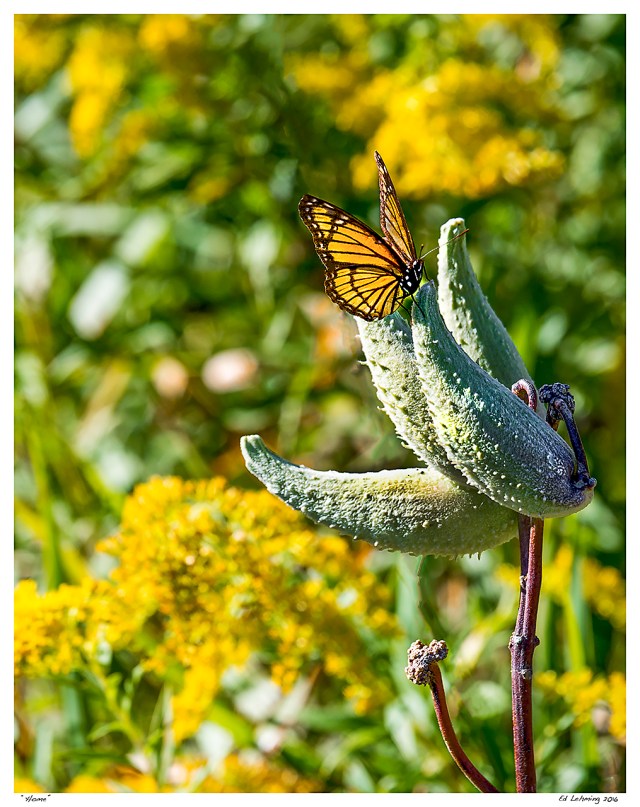
The sun is less intense, nights are cool, and mornings full of mist and promise. The fields are filled with late summer wildflowers: goldenrod, purple asters, fleabane, and the shells of mid-summer blossoms, now gone to seed. And, the butterflies, oh, the butterflies abound. Yellow sulphurs and cabbage butterflies dart around nervously, and the monarchs perch upon their milkweed.
As is evident with this singular monarch butterfly, they certainly have an affinity for milkweed, it’s where they chose to lay their eggs and seems to be their nectar of choice, till the blossoms fade and seed-pods form, then they seem to favour goldenrod, at least in this area, and the goldenrod is plentiful and healthy this time of year.
Despite all the bright colours competing with her, this monarch still stands out as she perches atop her pedestal, her home, surveying the world around her. It was interesting that she remained still and let me approach, quite closely, without alarming her. She just sat there, basking in the sun and fanning her wings; drinking in the final warmth of the day.
I took multiple shots as she fanned her wings, trying to capture that exact moment when the late afternoon sun illuminated her wings from behind. All the elements came together, provided the effect I wanted to convey, and made the image look almost three dimensional.
Nikon D800
Tamron SP 70-200mm f/2.8 Di VC USD @ 200 mm
1/200 sec, f/7.1, ISO 200
For more images like this, please visit my Facebook page:
https://www.facebook.com/EdLehming
or my website (some images available for purchase)
http://www.edlehming.com
This week’s submission to Norm 2.0‘s Thursday Doors.
Thursday Doors is a weekly feature allowing door lovers to come together to admire and share their favourite door photos from around the world.
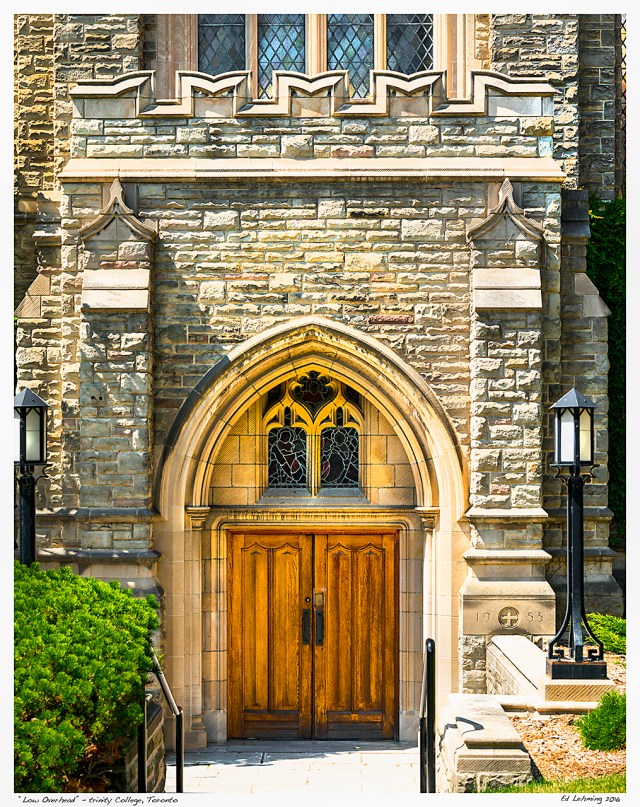
Yet another return to the University of Toronto and its doors. Today, I have chosen a peculiar doorway to Trinity College. Though it’s difficult to show the scale on the photo, the doorway is quite short, only about five feet tall. I’m not sure what the significance is, perhaps it forces you to bow on entering?
This portion of the building is a more recent addition, as indicated by the cornerstone, though it still had the same wonderful architecture as the main building it was added to.
Once again, this day offered me superb natural light which shone from the stones, illumination the wonderful oak doors.
Nikon D800
Tamron SP 70-200mm f/2.8 Di VC USD @ 70 mm
1/160 sec, f/6.3, ISO 200
For more images like this, please visit my Facebook page:
https://www.facebook.com/EdLehming
or my website (some images available for purchase)
http://www.edlehming.com
“You notice, by the way, that we never have a meeting with an alien. It’s always an encounter.”
― Jack McDevitt
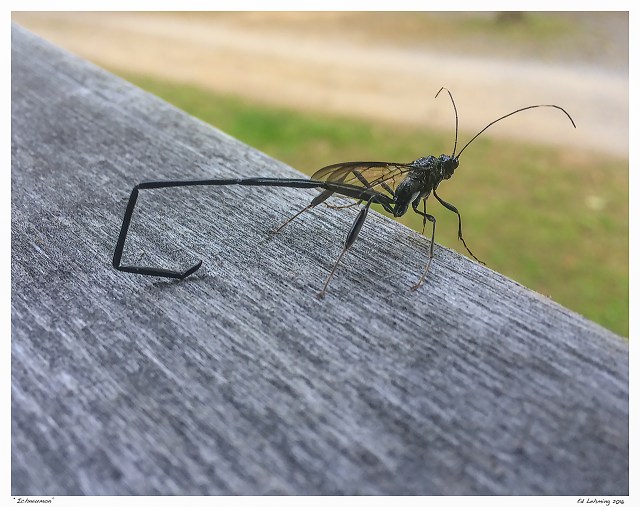
Also known as a Scorpion Wasp due to their appearance, or more correctly, American Pelecinid Wasp. These alien looking creatures look like they may have come from a child’s nightmare, but the long tail, which resembles a scorpion’s stinger as actually used by the wasp to deposit its egg on grubs underground.
So, from a human standpoint it’s no real threat. But to a grub, it’s a horror story. You see, the long stinger allows the wasp to deposit eggs on grubs while they are still underground, by poking through the dirt and inserting the eggs onto the living grub. As the single egg hatches, the wasp’s own grub begins to eat the host from inside.
The wasp itself is a nectar feeder, usually flying low and can often be seen on bushes and low growing plants. It’s primary benefit is the control of beetle populations by using their grubs as hosts.
iPhone 5s back camera 4.15mm f/2.2
1/30 sec; f/2.2; ISO 50
For more images like this, please visit my Facebook page:
https://www.facebook.com/EdLehming
or my website (some images available for purchase)
http://www.edlehming.com
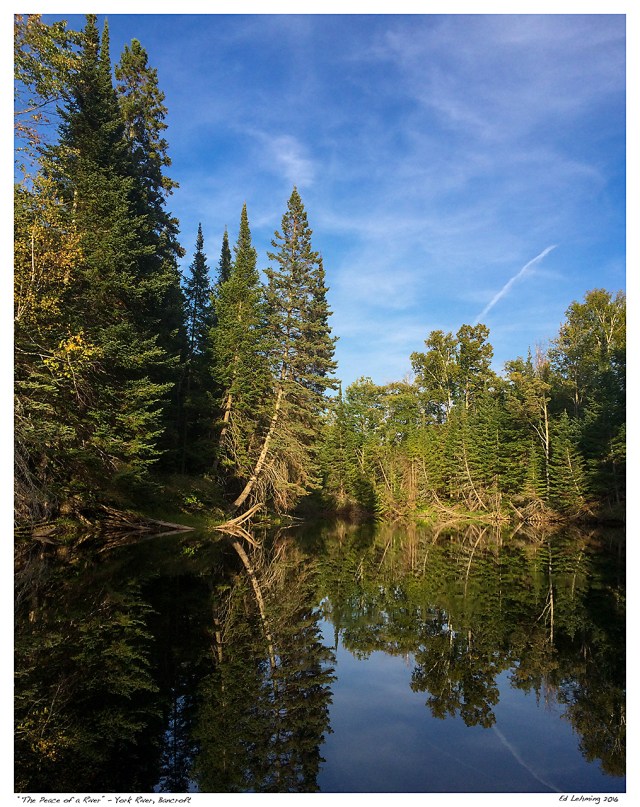
“When peace like a river, attendeth my way,
When sorrows like sea billows roll;
Whatever my lot, Thou hast taught me to say
It is well, it is well, with my soul.”
– Horatio Spafford
It’s difficult to put into words the multiple feelings I experience when paddling. My canoe is one of my ‘sacred places’. Like being behind a camera, I am in the moment, and experience only this. Through this photo, I’m sharing a very small piece of the experience of being on the river.
I can sense the water flowing beneath me, feel the gentle breeze on my skin, and the sun warms me. The paddle propels me forward, yet connects me with the water with every stroke. I feel the gentle resistance, watch the water swirl around the wood, and hear the gurgle and drip of water behind me as the stroke completes. I see the woods, mirrored on the calm water, hear insects buzzing, and see the currents below the surface moving across the river’s bottom. It’s all movement, sound, and light, yet there is no turmoil.
Just looking at the photo draws me back to that moment, sitting still, drinking it all in and marvelling at the beauty I am blessed with in this land I call home.
The photo was made last weekend, while paddling the York River, near Bancroft. We made a seven and a half hour day of it, paddling upstream, against a gentle flow till we reached our destination and then let the river’s current carry us back to our starting point. I can’t think of a better way to spend a day, than on the water with friends and family, experiencing this beauty together and then sitting around a campfire, recounting our shared moments.
iPhone 5s back camera 4.15mm f/2.2
1/1000 sec; f/2.2; ISO 32
For more images like this, please visit my Facebook page:
https://www.facebook.com/EdLehming
or my website (some images available for purchase)
http://www.edlehming.com

For many who recount the shocking events of September 11th 2001, they will tell you the day started out like any other day, but at Canada AM, that wasn’t the case. When I first started full time at AM, the hosts were Valerie Pringle and Dan Matheson. I worked with them, and loved every minute […]
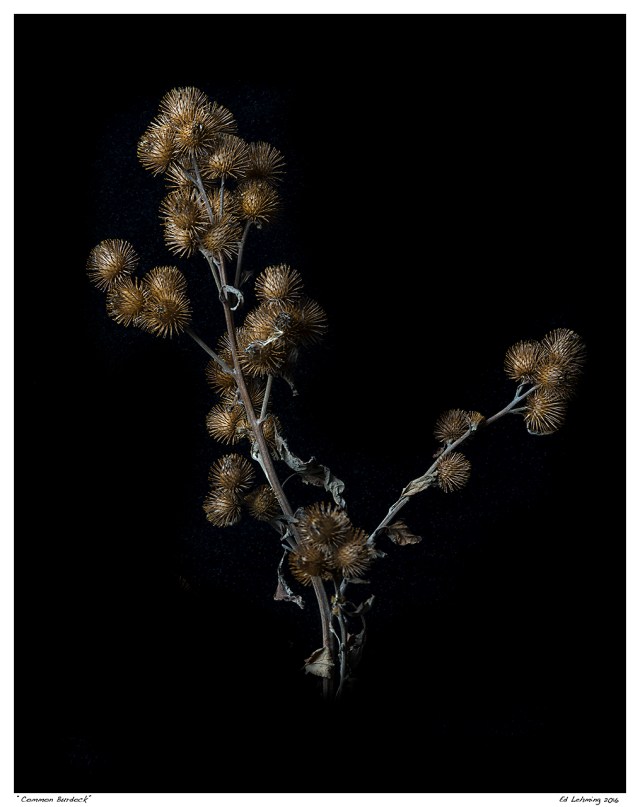
“Do not allow any negativity or ugliness in your surroundings, or anybody at all, destroy your confidence or affect your growth as a blooming flower. It is very normal for one ugly weed to not want to stand alone.”
― Suzy Kassem
The bane of all dog owners and hikers. These ‘stick to everything’ seeds of the common burdock are really quite an ingenious way to transport seeds long distances. For those unfamiliar with ‘burrs’, the spiky balls are tipped with a hook, which easily catches on anything rubbing against the plant. The hooks cling with amazing force and are very difficult to remove. When long haired dogs run through a patch of these, the result for the dog owner is usually hours of manually picking the burrs from the animal’s fur.
The hooks work very well, and I believe are the inspiration for Velcro. This makes long distance seed dispersal possible since they do not easily dislodge, but rather, break off over time.
It’s interesting, especially when reflection on the quote I chose, that I had always seen burdock as a bit of an ‘ugly’ plant, though the blossoms in midsummer are quite pretty. Yet in the fall, they are brittle brown bushes. I found isolating the plant against the black background and using the right light brought out beauty, in even this plant. Something to consider, in many contexts.
Nikon D800
Tamron SP 70-200mm f/2.8 Di VC USD @ 200mm
4.0 sec, f/22.0, ISO 200
High Resolution image on 500px:
For more images like this, please visit my Facebook page:
https://www.facebook.com/EdLehming
or my website (some images available for purchase)
http://www.edlehming.com

“There comes a time in your life, when you walk away from all the drama and people who create it. You surround yourself with people who make you laugh. Forget the bad and focus on the good. Love the people who treat you right, pray for the ones who do not. Life is too short to be anything but happy. Falling down is a part of life, getting back up is living.”
― José N. Harris
Ah, the butterfly bush, which takes over large areas as an invasive species, yet barely survives my garden. I am amazed at it’s frailty and resilience. In what should be ideal conditions it fails, yet prospers in places where it should surely wilt. I liken it to the quote above, which has become a mantra for me over the past few years.
I’ve planted this beautiful flowering bush in a few ‘ideal’ locations, hoping to shelter it from winter’s ravages. I have lost more times than I have won. yet, this plant, recovered from my mother-in-law’s garden when she downsized seems to survive year after year. I always leave a few stems un-pruned, so that I know where the plant is the next year.
All through the spring, the brown twigs sit dormant, seemingly dead and dried up. Then, suddenly, green buds appear and it leafs out, and gradually blooms. It’s been three years now and it keeps coming back, yet still only producing three slender stalks.
This year has been a bonus. I thought it was done blooming a few weeks ago, due to the drought we are experiencing this year. Yet, after a few short rainfalls, new flower clusters emerge, attracting butterflies and hummingbirds to our yard. It reminds me, that sometimes, you have to wait for the beauty, firm in the knowledge that it will come, at the right time. Not my time, but the right time.
Nikon D800
Tamron SP 70-200mm f/2.8 Di VC USD @ 200mm with 20mm macro extender
1.6 sec, f/14.0, ISO 200
High Resolution image on 500px:
For more images like this, please visit my Facebook page:
https://www.facebook.com/EdLehming
or my website (some images available for purchase)
http://www.edlehming.com
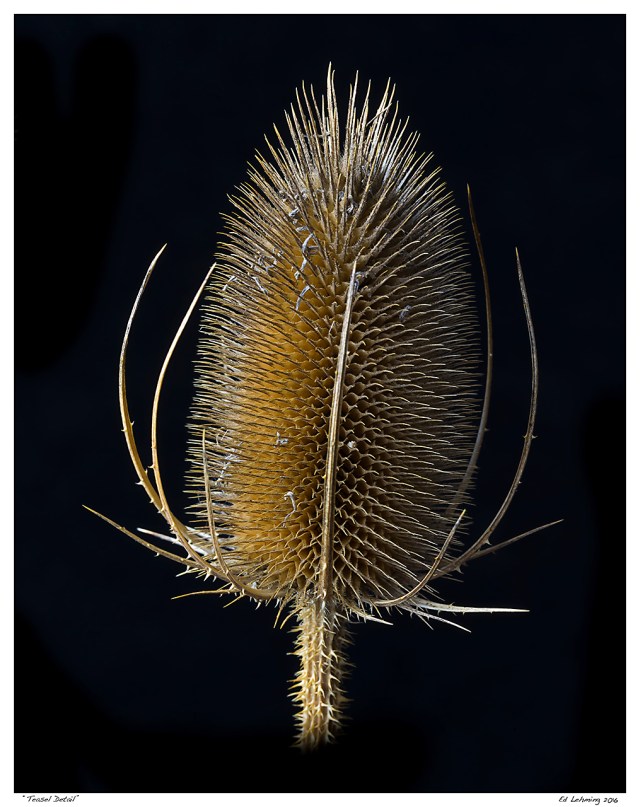
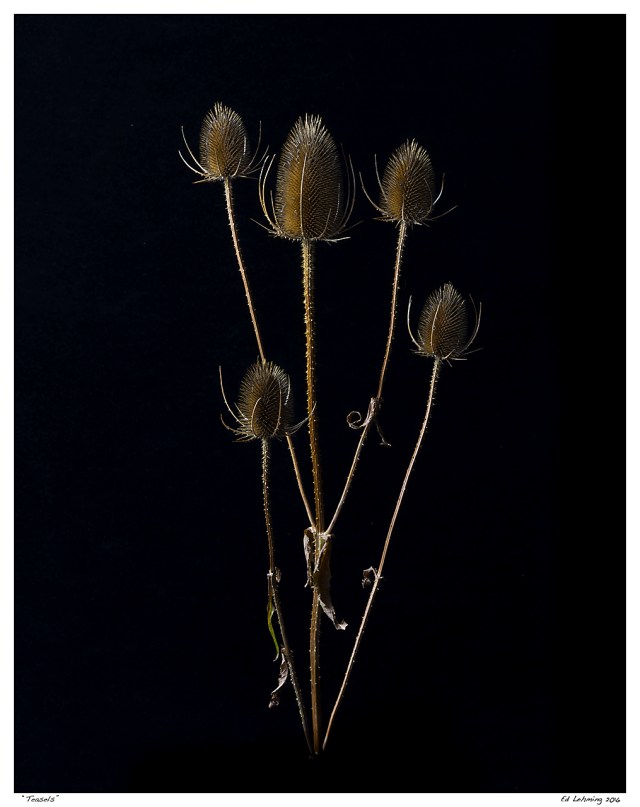
“When someone comes around at that dreary moment, when all hope was lost, and thorns emerged. And that fellow, walks on that thorn just to cross to your side, to bear the pains for your sake, to bleed, to self-destroy himself, just to protect you. He places you above his priorities, and doesn’t give a damn whatsoever taunt he receives, his foremost desire is to make sure you are save, feel loved and cared for, and that’s the true definition of love.”
― Michael Bassey Johnson
Definitely a thorny plant, tough to handle, even to make a photograph, but incredibly beautiful when you look at the structured details.
For many years I had only seen the dried and prickly seed heads of this plant until a few summers ago, when, at the right time, I found a cluster in bloom, wrapped in a partial blanket of pale purple flowers. The flowers themselves don’t cover the entire head, but grow up it in a narrow band. A most curious sight.
As fall approaches and more plants begin to go to seed, I see myself making more photos of this, mixed with several of the wonderful fall blooms. Yet, I keep surprising myself at how much beauty there is in the mundane, even the brown prickly stuff 🙂
Nikon D800
Tamron SP 70-200mm f/2.8 Di VC USD @ 92 mm
4 sec, f/25.0, ISO 200
High Resolution image on 500px:
For more images like this, please visit my Facebook page:
https://www.facebook.com/EdLehming
or my website (some images available for purchase)
http://www.edlehming.com
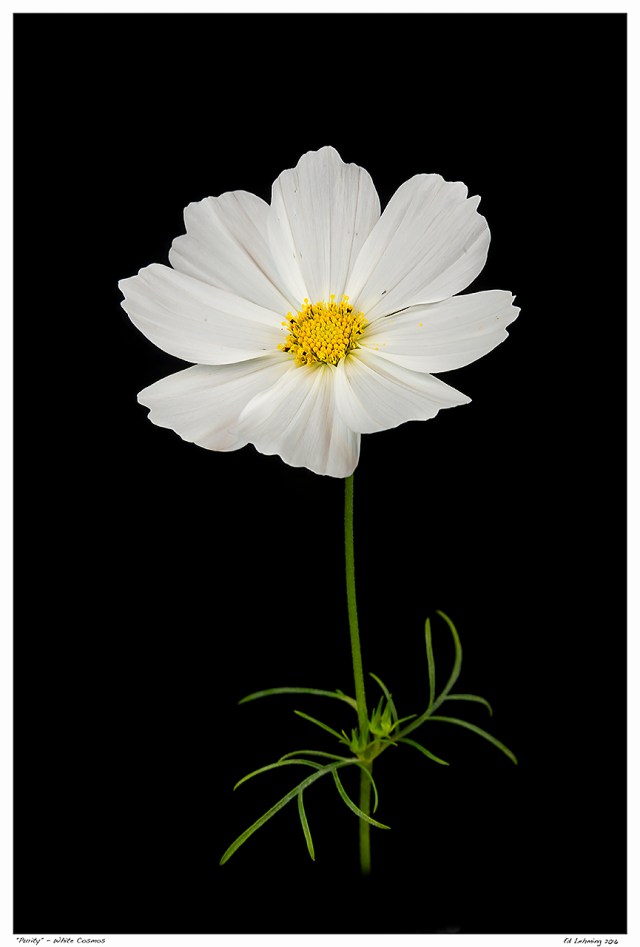 “The light of love, the purity of grace,
The mind, the Music breathing from her face,
The heart whose softness harmonised the whole —
And, oh! that eye was in itself a Soul!”
― George Gordon Byron
At this time of the season, when plants begin to wilt from the exertions of the summer, the cosmos still perseveres, brightening my gardens with their snow white purity and diaphanous petals.
I see the cosmos as such a pure and delightful plant. It’s so delicate, you’d think the petals would break or fold to the touch, yet they don’t. They weather the heat, the storm, and the wind, retaining their beauty and I’m glad to see a survivor.
Nikon D800
Tamron SP 70-200mm f/2.8 Di VC USD @ 200mm with 20mm macro extender
2.0 sec, f/18.0, ISO 200
High Resolution image on 500px:
For more images like this, please visit my Facebook page:
https://www.facebook.com/EdLehming
or my website (some images available for purchase)
http://www.edlehming.com
 This week’s submission to Norm 2.0‘s Thursday Doors.
Thursday Doors is a weekly feature allowing door lovers to come together to admire and share their favourite door photos from around the world.
This week, a return to the University of Toronto and it numerous spectacular doors. Today, I have chosen the main doorway to Knox College, another building on the U of T grounds, proudly facing the central campus grounds as they have for over one hundred years.
I’d like to return her to photograph the interior. The website link above shows a brief glimpse into this architectural wonder.
Nikon D800
Tamron SP 70-200mm f/2.8 Di VC USD @ 70 mm
1/100 sec, f/5.0, ISO 200
For more images like this, please visit my Facebook page:
https://www.facebook.com/EdLehming
or my website (some images available for purchase)
http://www.edlehming.com
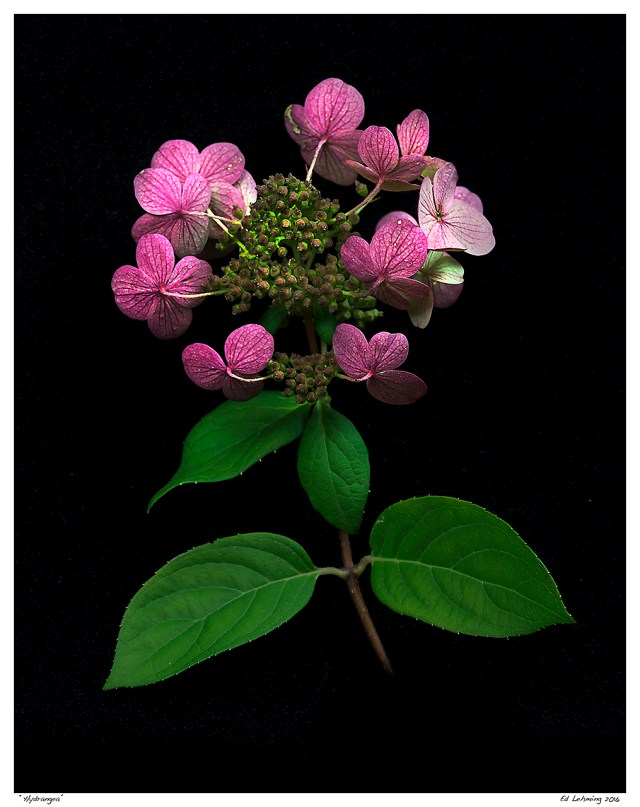
“I’ll admit that my garden now grows hope in lavish profusion, leaving little room for anything else. I suppose it has squeezed out more practical plants like caution and common sense. Still, though, hope does not flourish in every garden, and I feel thankful it has taken root in mine.”
― Sharon Kay Penman
A photo of my neighbour’s hydrangea this time. You see, the hydrangeas we have are white Annabelles and only bloom white. Our neighbours however, have a different variety which blooms pink, due to the alkalinity of the soil. Unless the soil has been amended, hydrangeas in Ontario bloom pink, yet the same variety will bloom blue in regions with acidic soil .
I have seen people try to cheat and buy blue hydrangeas for their gardens, which gradually turn pink, as the soil acidity changes.
I actually like the pink colour. In the case of this hydrangea, you are seeing the back of the blossom. Even though it’s a front on view, the flowers flip over, revealing the beautiful pink colour, while the inside of the blossoms are a creamy white. I’m not sure of the variety of this hydrangea, once more, I lean on the knowledge of those more savvy in the naming of specific plants, but they may be a variety of lacecap.
Another desirable trait of this particular species is that it seems quite drought resistant and despite the intensely hot days and the lack of rain this summer, it seems to have flourished, while my Annabelles have smaller than normal blossoms, many sunburned from many hot, dry days.
Nikon D800
Tamron SP 70-200mm f/2.8 Di VC USD @ 200mm with 20mm macro extender
2 sec, f/16.0, ISO 200
High Resolution image on 500px:
For more images like this, please visit my Facebook page:
https://www.facebook.com/EdLehming
or my website (some images available for purchase)
http://www.edlehming.com

“Whoever drinks beer, he is quick to sleep; whoever sleeps long, does not sin; whoever does not sin, enters Heaven! Thus, let us drink beer!”
― Martin Luther
A change of pace, sort of, from garden plants and flowers, yet this is a flower. The flower of the hop plant. A chief ingredient in beer and a very interesting green flower.
I had heard of hop plants and seen photos of them, thinking them native to Europe and Asia, but not till recently did I see a live specimen. Now, they seem to be quite common, once I knew what to look for, then they seem to be everywhere and I wonder how I missed them for so long.
Hop is an interesting plant, with natural antibacterial properties, which is why it was first used in beer making, as a preservative. I’d like to try growing one in my garden but apparently, they grow very quickly and I’d be afraid of overwhelming my yard.
Nikon D800
Tamron SP 70-200mm f/2.8 Di VC USD @ 200mm with 20mm macro extender
1.6 sec, f/20.0, ISO 200
High Resolution image on 500px:
For more images like this, please visit my Facebook page:
https://www.facebook.com/EdLehming
or my website (some images available for purchase)
http://www.edlehming.com
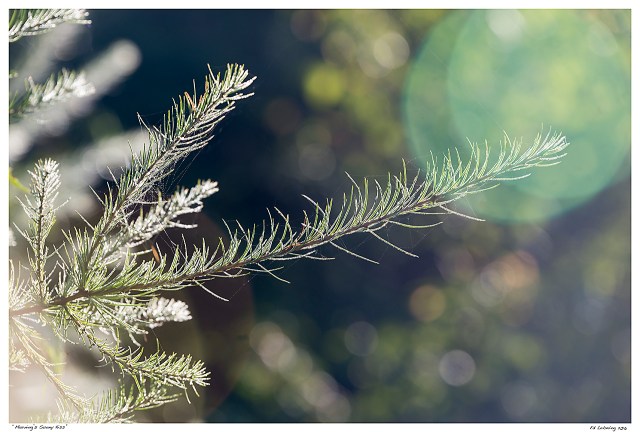
“Morning is an important time of day, because how you spend your morning can often tell you what kind of day you are going to have.”
― Lemony Snicket
Dawn broke forth bright and very cool this past weekend. That’s the nature of September around here. Glorious, warm days spent basking in the last few weeks of summer, hoping for a mild and extended fall.
It’s been a hot and dry summer here in southern Ontario, a bit too dry for plants, which are showing signs of heat stress. But, I hate to say goodbye to such a wonderful summer, spent hiking, canoeing, and gardening. Yet, the gradual change of seasons brings pleasant surprises, like the soft sunshine, creating tiny jewels in the tamarack branches, greeting me as I rounded a corner during my morning walk, bringing a smile to my face.
Nikon D800
Tamron SP 70-200mm f/2.8 Di VC USD @ 200 mm
1/160 sec, f/6.3, ISO 200
For more images like this, please visit my Facebook page:
https://www.facebook.com/EdLehming
or my website (some images available for purchase)
http://www.edlehming.com

“Every man has his secret sorrows which the world knows not; and often times we call a man cold when he is only sad.”
― Henry Wadsworth Longfellow
Two views of the same flower, a week apart.
Sometimes, I keep the flowers I photograph a bit too long but it was interesting for me to compare the two images.
It also reminded me how gradually things can change without you really noticing them.
I was debating the title of the top image, as sorrow may sound too depressing, but that is the emotion that comes over me in waves the past few days.
You see, my youngest two children, now young adults have recently moved from home in the span of a few days. One to go into college residence, not too far from home, but away, nonetheless. The other, is in third year university, and has chosen to live closer to school to save the long commute he has endured the last two years.
So, while I am happy for their growth and proud of all my children, I still experience moments of sorrow. You see, I still look back at the bright, young flower and all the happy times spent with them as children. I recall bringing each of them home for the first time. And, while they are certainly not the wilted, desiccated flower at the top, I feel I looked away a moment too long and missed the gradual transition. Yet, this reminds me that, like a garden, after a winter of transition, fresh blossoms emerge to replace last year’s beauty.
The cycle continues and ‘sorrow’ becomes a transient thing. I’m looking forward the the gardens my children have planted and continue to nurture.
Nikon D800
Tamron SP 70-200mm f/2.8 Di VC USD @ 155 mm
15 sec, f/22.0, ISO 200
High Resolution image on 500px:
For more images like this, please visit my Facebook page:
https://www.facebook.com/EdLehming
or my website (some images available for purchase)
http://www.edlehming.com
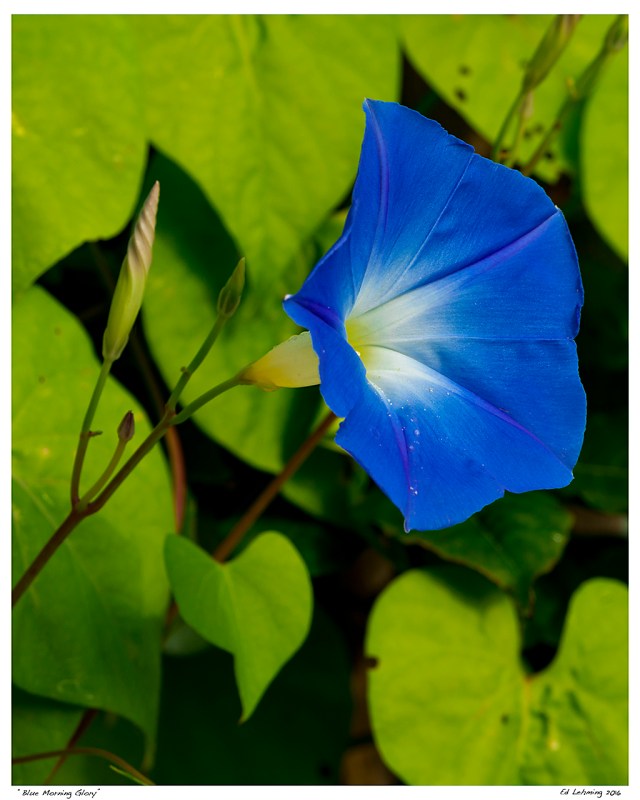
“Morning is wonderful. Its only drawback is that it comes at such an inconvenient time of day.”
― Glen Cook
Such a stunning blue, it seems almost unnatural. I wished I had my portable background with me that day, but the opportunity presented itself and the light was nice. I may have to go back for a reshoot, provided the plant is still blooming. It’s in a friend’s garden and a bit of a distance away.
Morning Glories are such wonderful plants to just observe. Watching the large blossom unfurl from the tight ‘screw’ of a bud is quite the experience. With the heat we have had this summer, the blossoms fade quite quickly.
Nikon D800
Tamron SP 70-200mm f/2.8 Di VC USD @ 160 mm
1/80 sec, f/10.0, ISO 200
For more images like this, please visit my Facebook page:
https://www.facebook.com/EdLehming
or my website (some images available for purchase)
http://www.edlehming.com
“Coming out of your comfort zone is tough in the beginning, chaotic in the middle, and awesome in the end…because in the end, it shows you a whole new world !!
Make an attempt..”
― Manoj Arora
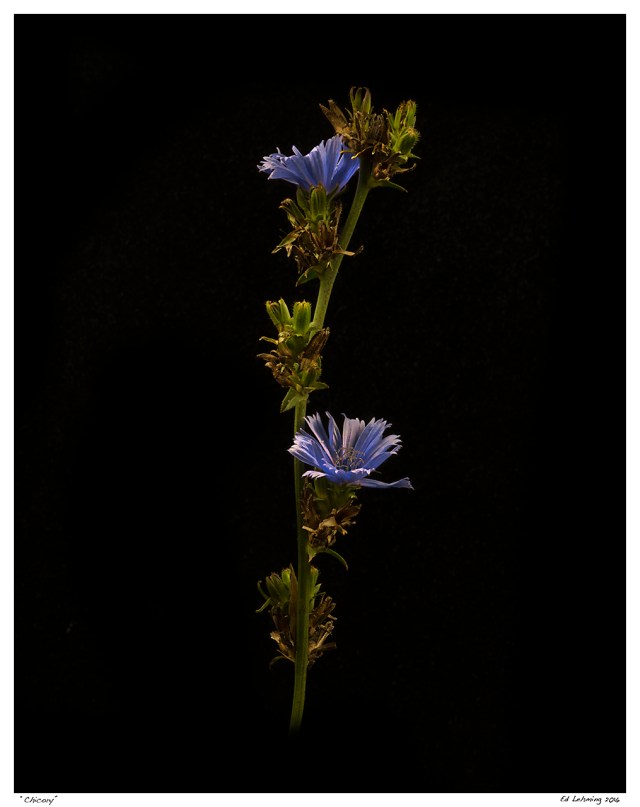
This was, in fact, the first wildflower I photographed, five years ago, when I got my first DSLR. Not this actual plant, but a chicory blossom. It was also the beginning of my journey into serious photography, which like the quote above, has not always been easy, but I’m sure glad I stuck with it.
Chicory has always had a natural attraction for me. The plant itself is rugged and seems to grow in the worst soils, in dry clay and along stony roadsides. It resists the heat of mid August and brightens my walks. There is also something about the colour blue in nature. Aside from the sky, blue is not a common colour, so it stands out for me as something unique. The blossoms, despite the tough stalk they grow on, are quite delicate.
This summer’s drought has been tough on even the hardy chicory and good specimens have been tough to find but this one will have to suffice, for now.
Nikon D800
Tamron SP 70-200mm f/2.8 Di VC USD @ 160 mm
1/5 sec, f/22.0, ISO 200
High Resolution image on 500px:
For more images like this, please visit my Facebook page:
https://www.facebook.com/EdLehming
or my website (some images available for purchase)
http://www.edlehming.com

“Everything made by human hands looks terrible under magnification–crude, rough, and asymmetrical. But in nature every bit of life is lovely. And the more magnification we use, the more details are brought out, perfectly formed, like endless sets of boxes within boxes.”
― Roman Vishniac
I dug this from my archive of macro experiments from earlier this year. The clematis looks, to me, like some creature from a sci-fi movie or some deep sea creature.
Macro photography is something relatively new to me and I enjoy seeing details that my eye would miss. Very much like my experiences when I go on hikes. I tend to see things which I photograph and then have friends ask me where the photo was made, only to discover it was just down the road from them and that they had passed that place many times without noticing it. I just love seeing the beauty in the mundane and have posted many times on that topic.
As I said above, this is one of my early attempts and I used an old 50mm prime lens with manual extensions tubes, not really knowing what I was doing, but I was happy with the results. Not happy enough to post it at the time, but flipping through old images, this one stood out.
I’ve used the quote above before, but it rings so true to me. With macro photography, when photographing nature, it seems that the closer you get, the more complex and beautiful the subject becomes. These are definitely things that most people never take notice of, including me, till now. Nature is truly magnificent!
Nikon D800
Schneider-Kreuznach Exida-Xenon 50mm f/1.9 @ 50mm (14mm extension tube)
1/320 sec, f/1.9, ISO 5600
For more images like this, please visit my Facebook page:
https://www.facebook.com/EdLehming
or my website (some images available for purchase)
http://www.edlehming.com

This week’s submission to Norm 2.0‘s Thursday Doors.
Thursday Doors is a weekly feature allowing door lovers to come together to admire and share their favourite door photos from around the world.
As the name tag indicates, this is the door to the Provost’s Lodge at Trinity College, part of the University of Toronto. It’s part of a full day photo shoot I did at the U of T a few weeks ago. The light that morning was wonderful and soft, reflecting off the ground and nicely filling the shadows for me.
Nikon D800
Tamron SP 70-200mm f/2.8 Di VC USD @ 70 mm
1/60 sec, f/4.0, ISO 200
For more images like this, please visit my Facebook page:
https://www.facebook.com/EdLehming
or my website (some images available for purchase)
http://www.edlehming.com
 “…lace is formed from the absence of substance; it is imagined in the spaces between the threads. Lace is a thing like hope. It lived, it survived, and it was desired for what it was not. If faith, as the nuns said, was the substance of things hoped for, then lace was the outline – the suggestion – of things not seen.”
― Iris Anthony
How appropriate is the name of this common wildflower, with it’s beautiful. complex flowers. You’d expect to see them pressed flat as doilies, under fine teacups.
I’ve observed them and photographed them on many occasions, but it was not till I used this black background technique that I noticed the complexity of the small flowerettes that make up the larger bloom that we see. As with many of my recent photos, I’ll never see them the same way again.
Nikon D800
Tamron SP 70-200mm f/2.8 Di VC USD @ 200 mm
1/4 sec, f/25.0, ISO 200
High Resolution image on 500px:
For more images like this, please visit my Facebook page:
https://www.facebook.com/EdLehming
or my website (some images available for purchase)
http://www.edlehming.com

“My temple is the swamp… When I would recreate myself, I seek the darkest wood, the thickest and most impenetrable and to the citizen, most dismal, swamp. I enter a swamp as a sacred place, a sanctum sanctorum… I seemed to have reached a new world, so wild a place…far away from human society. What’s the need of visiting far-off mountains and bogs, if a half-hour’s walk will carry me into such wildness and novelty.”
― Henry David Thoreau
This beautiful, delicate wildflower is considered an ‘invasive species‘ in my native Ontario, and most of North America. It was, just like many other species, imported as an ornamental plant. But, with no natural predators and it’s extraordinary number of seeds, it escaped its domestic bonds and soon began to take over Ontario’s wetlands, choking out native species like cattail.
The image above if of a single stalk and loosestrife grows in tall clumps, colouring the wetlands bright magenta.
Nikon D800
Tamron SP 70-200mm f/2.8 Di VC USD @ 160 mm
1/8 sec, f/22.0, ISO 200
High Resolution image on 500px:
For more images like this, please visit my Facebook page:
https://www.facebook.com/EdLehming
or my website (some images available for purchase)
http://www.edlehming.com

Never in my wildest imaginings did I see this coming, especially when I first started and had those “no views” days that were so discouraging.
Thank you to all who have chosen to follow my blog, especially to those who have commented on my photos and writing and encouraged me. This is a huge honour.
Ed
“In this delicate and unpredictable life, the future is unwritten. Do not take someone for granted today, for once tomorrow dawns upon the indigo night the only remaining trace will be tracks in the sand…”
― Virginia Alison
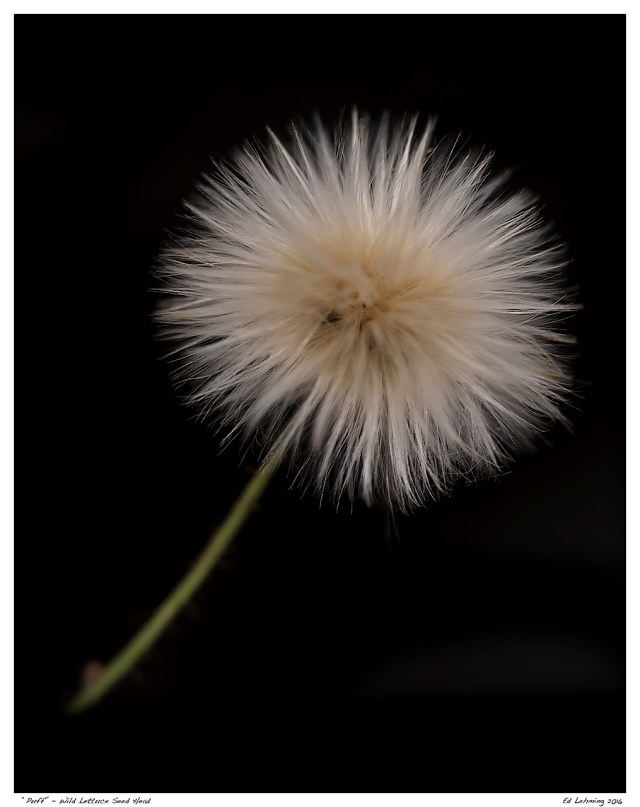
I’ve recently spend time capturing wildflowers and their domestic cousins in a series of photos with black backgrounds, including many which I’ve made using a portable background which allows me to make these photos in the wild. This technique, employed outdoors, can prove challenging, since it involves narrower aperture settings and longer exposures, without the use of a flash.
Indoor, studio work, is much more predictable and that is the route I chose for this delicate specimen. It would have been next to impossible to capture the fine details of the tufts without well controlled conditions. The seed head is the outcome of a blossom I had forgotten about, in a vase, which had gone to seed, leaving this wonderful puffy ball.
It’s a macro shot, so depth of field was a bit challenging, but a learning experience for me, nonetheless.
Nikon D800
Tamron SP 70-200mm f/2.8 Di VC USD @ 200 mm (w manual tube extenders)
1/40 sec, f/2.8, ISO 200
High Resolution image on 500px:
For more images like this, please visit my Facebook page:
https://www.facebook.com/EdLehming
or my website (some images available for purchase)
http://www.edlehming.com

The Lyric Theatre, New York
Here is this week’s 52 Week Photo Challenge: Week 3 – Black and White. This is another new challenge that is starting up from The Girl That Dreams Awake. If you don’t know her, you should check out her blog.
I made this photo back in February during a visit to New York City using my iPhone.
Posted originally back in March
iPhone 5s
Back Camera @ 4.2mm
1/30 sec, f/2.2, ISO 80
For more images like this, please visit my Facebook page:
https://www.facebook.com/EdLehming
or my website (some images available for purchase)
http://www.edlehming.com

“A weed is but an unloved flower.”
― Ella Wheeler Wilcox
This common north american wildflower has had me scratching my head over the past few years. In our area, it’s a prolific ‘weed’ that grows everywhere. A few years back, while visiting family in British Columbia, I notice people had them planted in their gardens and several seed companies offer them in their catalogues. They are beautiful, but I had not imagined them deliberately putting them in my garden.
There is also a misconception that this plant is the source of many allergic reactions. I’ve looked that up and discovered that the goldenrod pollen is too big and sticky to be inhaled deeply enough to cause an allergic reaction. It’s the companion plant, ragweed, which grows at the same time that’s the true culprit.
Nikon D800
Tamron SP 70-200mm f/2.8 Di VC USD @ 200 mm
1/5 sec, f/11.0, ISO 200
High Resolution image on 500px:
For more images like this, please visit my Facebook page:
https://www.facebook.com/EdLehming
or my website (some images available for purchase)
http://www.edlehming.com
“He told her the flowers in her painting contained exactly the purple substance of the flowers on the desk in front of her […] Let us open the window and see if your painting can entice the butterflies.”
― Sarah Hall
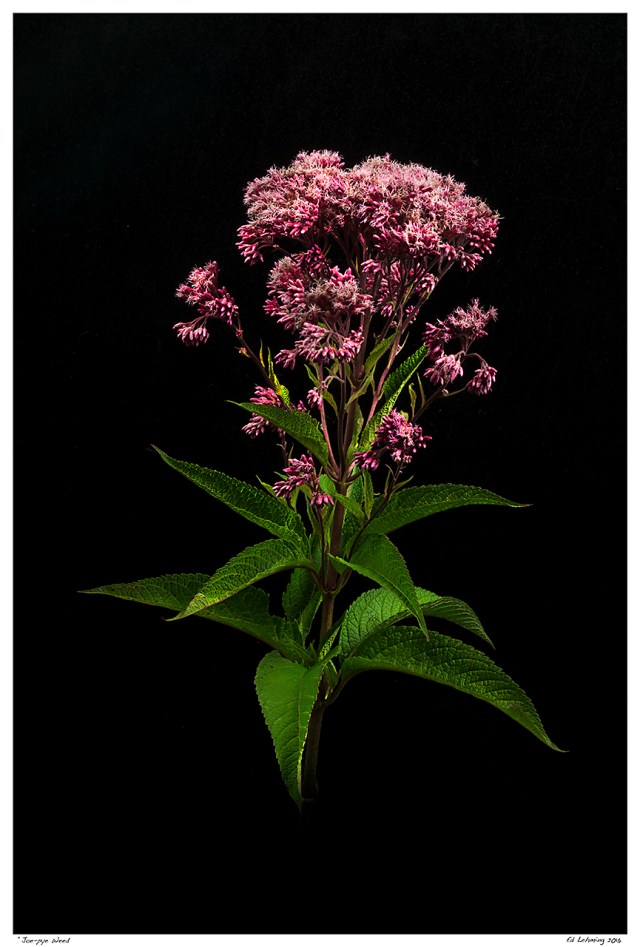
Back out on the trails and enjoying the late summer heat. This oddly named plant, native to North America is named on a derivation of an aboriginal name Jopi, who was a native healer. Somewhere in time , the name stuck and became Joe-Pye.
This is a beautiful, tall, showy plant that can be found in wetlands and begins to bloom in late June. At this time of year, it’s still going strong and adds a nice plash of colour to the landscape as other plants are going to seed. Despite our drought-like conditions this summer, the local Joe-Pye is looking strong and healthy. Perhaps that is where one of its other names “Queen of the Meadow” comes from, as it’s also a very tall plant, related to sunflowers.
This particular specimen was found along the roadside, outside the hamlet of Claremont. I noticed a rather health customer of the plants just off the road and down a short path and decided this one was going to be the one I’d photograph, since it was very healthy and unblemished.
Nikon D800
Tamron SP 70-200mm f/2.8 Di VC USD @ 70 mm
1/8 sec, f/22.0, ISO 200
High Resolution image on 500px:
For more images like this, please visit my Facebook page:
https://www.facebook.com/EdLehming
or my website (some images available for purchase)
http://www.edlehming.com
“Life is a series of natural and spontaneous changes. Don’t resist them; that only creates sorrow. Let reality be reality. Let things flow naturally forward in whatever way they like.”
― Lao Tzu
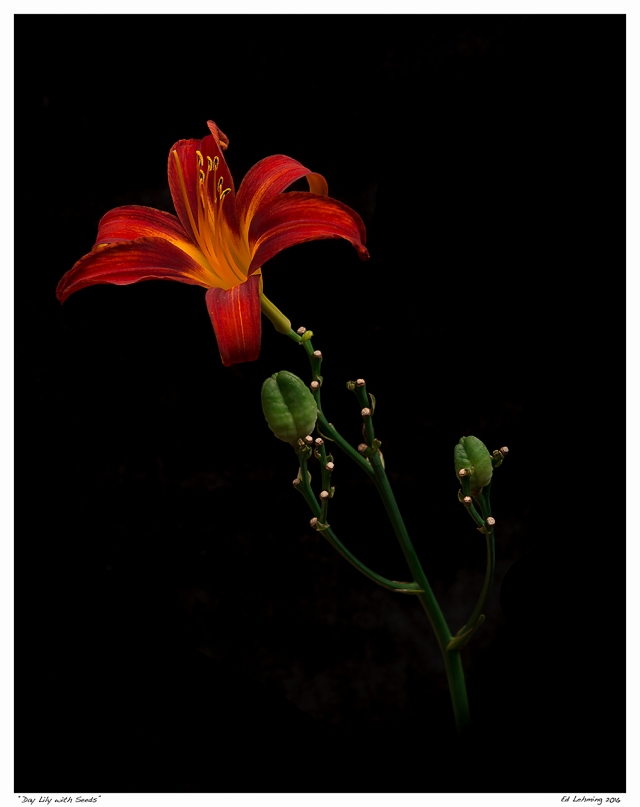
As the summer continues, the plants begin to mature and change form. Some wither and dry up, others go to seed, while some continue to flourish till the air cools. This day lily was pretty much the start of my journey down the road of fine art floral photography and has opened a whole new creative world for me.
I thought it had stopped blooming about a week ago, but to my surprise, it had one blossom left to share. It’s quite mature and this image shows two seed pods beginning to develop as well as the ‘stubs’ where blossoms used to be.
Nikon D800
Tamron SP 70-200mm f/2.8 Di VC USD @ 200 mm
1/4 sec, f/14.0, ISO 200
High Resolution image on 500px:
For more images like this, please visit my Facebook page:
https://www.facebook.com/EdLehming
or my website (some images available for purchase)
http://www.edlehming.com
“Wildflower; pick up your pretty little head,
It will get easier, your dreams are not dead.”
― Nikki Rowe
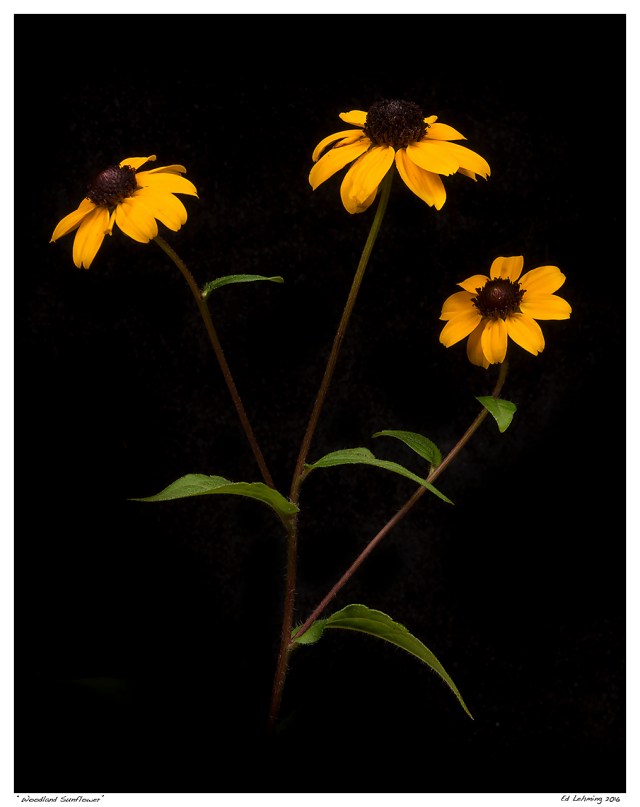
I hope I have these named correctly. I’m hoping my wildflower followers will correct me as required.
It’s late summer and there is a noticeable shift in the plant life. The delicate pinks and purples are going to seed and yellows and orange are starting to make their showing. I’ll miss the abundance of wildflowers and the bright green healthy leaves, which are now showing insect damage and stress from our recent drought. This is the time of year when plants begin to look ‘tired’. But, change is inevitable and the bright colours of fall will soon dominate.
Nikon D800
Tamron SP 70-200mm f/2.8 Di VC USD @ 200 mm
1/4 sec, f/22.0, ISO 200
High Resolution image on 500px:
For more images like this, please visit my Facebook page:
https://www.facebook.com/EdLehming
or my website (some images available for purchase)
http://www.edlehming.com
This week’s submission to Norm 2.0‘s Thursday Doors.
Thursday Doors is a weekly feature allowing door lovers to come together to admire and share their favourite door photos from around the world.
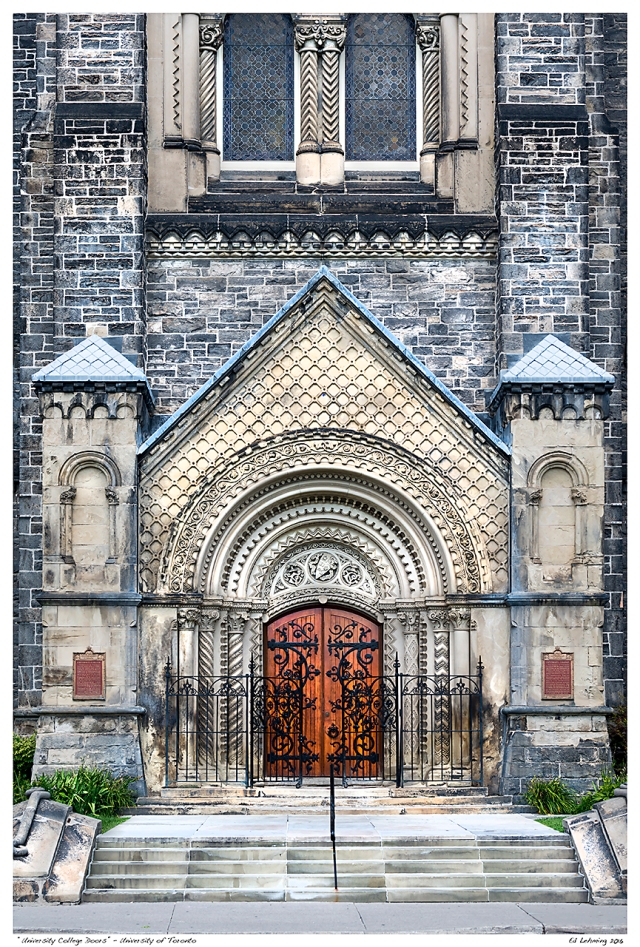
Yet another of many images made during my tour of the University of Toronto campus a few weeks ago
The door above belongs to the University of Toronto’s “University College Building”. This building sites in the centre of the main campus. The plaque below can be seen on either side of the door in the image above above, the lefthand one in French and righthand one in English, Canada’s official languages.
The door is almost lost in the elaborate facade, with its intricate stone work and concentric arches. I also included the details of part of the main tower to add scale to this image. It truly is a beautiful door, and one of many in the downtown Toronto campus. More to follow.
Nikon D800
Tamron SP 70-200mm f/2.8 Di VC USD @ 70 mm
1/125 sec, f/5.6, ISO 200
For more images like this, please visit my Facebook page:
https://www.facebook.com/EdLehming
or my website (some images available for purchase)
http://www.edlehming.com
“I have always been caught by the pull of the unremarkable, by the easily missed, infinitely nourishing beauty of the mundane.”
― Tana French
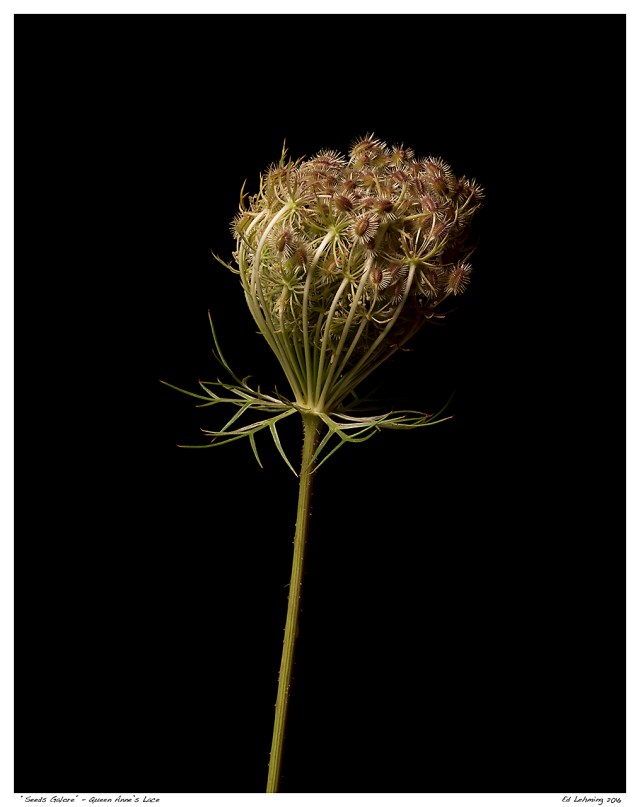
A theme that keeps coming back to me is how much detail and beauty there is in mundane things. Generally, when Queen Anne’s Lace finishes blooming, I hardly notice them, until winter when the basket-like heads get coated in little snow ‘hats’.
It was not till I was composing this mage, that I noticed just how intricate the seeds of this common wildflower really are. The seeds look like multi-legged insects attacking the plant. Simply fascinating to look at and not lost in the background with this black background. So, have a look yourself, next time you are strolling along a path, you’ll never see it the same way again.
Nikon D800
Tamron SP 70-200mm f/2.8 Di VC USD @ 200 mm
1/10 sec, f/10.0, ISO 200
High Resolution image on 500px:
For more images like this, please visit my Facebook page:
https://www.facebook.com/EdLehming
or my website (some images available for purchase)
http://www.edlehming.com
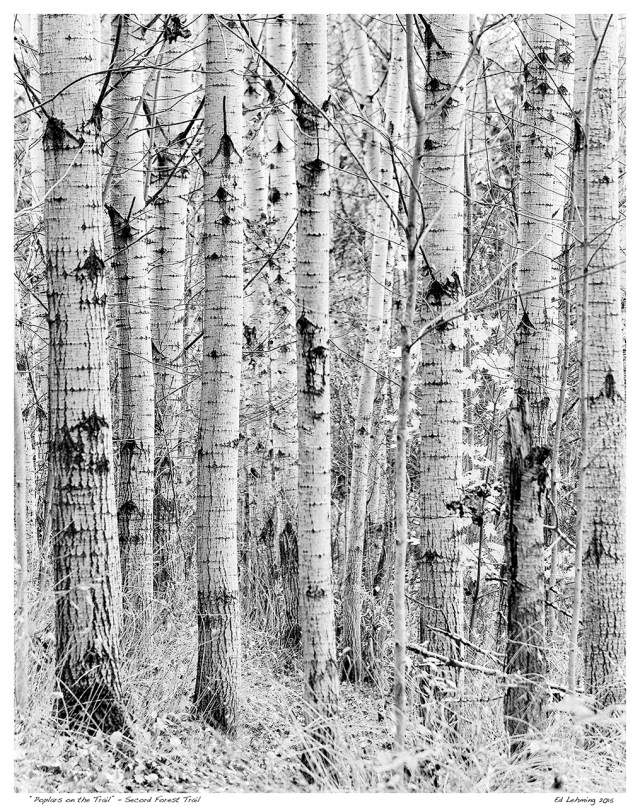
The story behind this image was posted back in December 2015.
Nikon D300
Tamron 70-200 mm f/2.8 @ 70 mm
1/100 sec, f/5.0 -0.33, ISO 250
For more images like this, please visit my Facebook page:
https://www.facebook.com/EdLehming
or my website
http://www.edlehming.com


 Ed Lehming Photography
Recent Comments