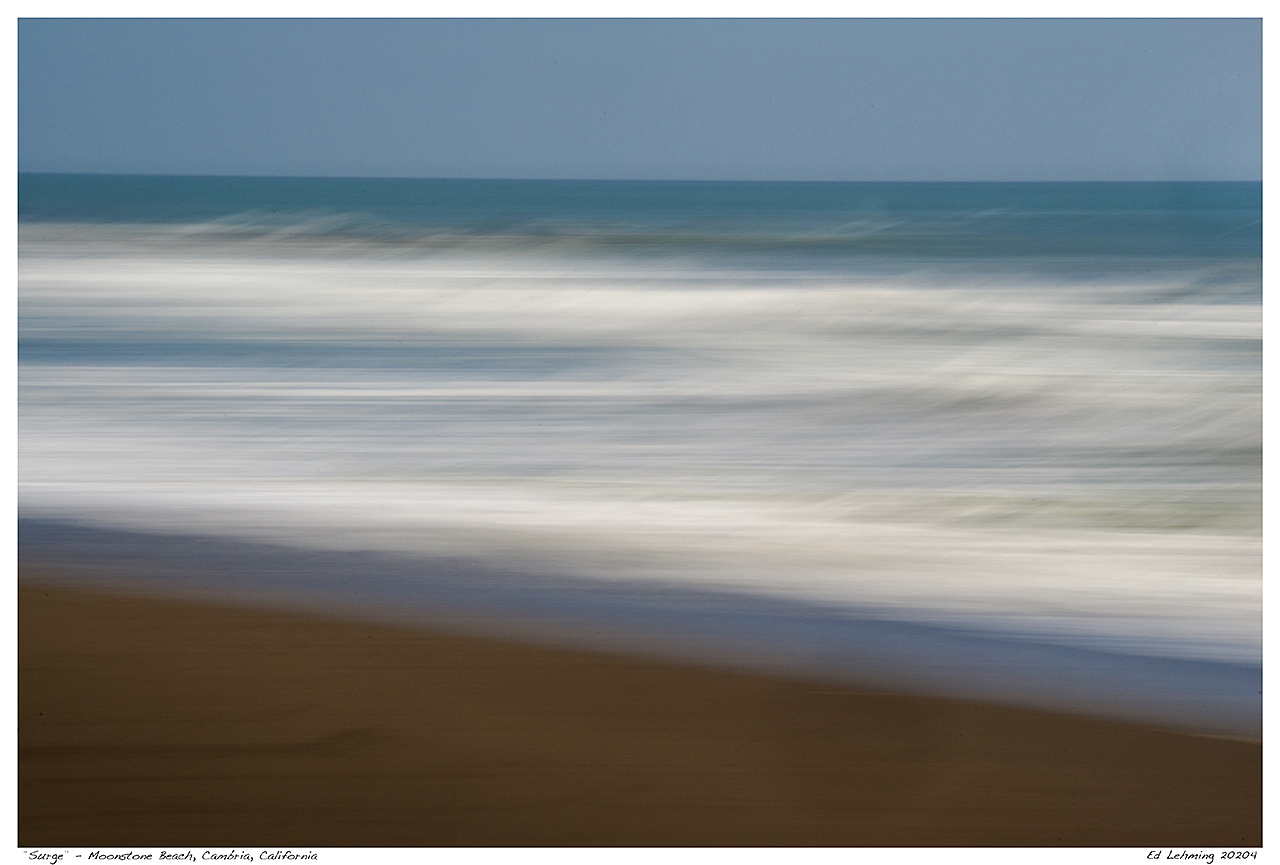
“Surge” – Moonstone Beach, Cambria, California
“Motion within motion. It is amazing what a difference a slightly different perspective makes. By looking at things differently, new wonders emerge.” – Ed Lehming
I almost named this image “Motion within Motion”, but what struck me first, and how I generally name my images, is the impression I first get from the image, and that impression was “surge”.
It was not till I spent a bit more time with the image, something I tend to do a lot; simple self-indulgence in a memory captured as an image, that I saw the impact of moving my camera horizontally as the waves crashed to shore. There was a compounding of the motion that transformed it into something more.
The technique I used is called Intentional Camera Movement (ICM); something I have tended to do a lot of in forest scenes with strong vertical lines, and only occasionally, horizontally, to get something a bit more “artsy”. I always have my camera set to 1/4 exposure for this, as that I where I find I get my best images and it’s the speed I can comfortably tilt my camera up and down constantly and relatively straight. My next decision, is the aperture and ISO. Forgive me non-photographers for getting a bit technical here. ISO is the sensor sensitivity to light and aperture is how narrow the camera aperture is. The narrower the aperture, the less light gets to the sensor and the more in-focus the overall image is (depth of field).
Now that I’ve covered that aside, a crucial factor is that I can correctly expose the image. At a 1/4 sec shutter speed, a LOT of light enters the camera, a big problem on sunny days where I can’t compensate for the exposure through ISO and aperture settings. At some point, there is no way of lowering my exposure enough through camera settings to prevent a blown-out image and I have to resort to a neutral density (ND) filter, which is a filter of varying shades of grey that acts like sun glasses for my camera
At one point, I carried a series of ND filters in my kit, till I discovered a Circular Variable Density ND filter that I could darken and brighten just by twisting it (one filter rather than 3 or 4). On the day I made this image, I had it with me in my camera bag and simply began to experiment with different levels of filtering. I did that by adjusting the filter darker and darker and reviewing my images on my camera display. Once I have what I want, I begin to shoot another series of images to get the motion right. In the end, this image took about 20 attempts to get everything to fall in place and produce the image I was after, that and a touch of post-editing. This was not a point and shoot day where I could take out my iPhone and get the shot in one go. Which is a limitation I noted on my previous post, yesterday. This was technical moment to get the image I envisioned. One final point on this technique is that you never get the same thing twice and each image is a surprise.
There you have it, a far more technical post than I had intended, but I think it was important to describe the process so that you know what you are looking at and how I got it..
Nikon D800
Tamron SP 70-200mm f/2.8 Di VC USD @ 200mm
1/4 sec, f/25, ISO 400
K&F Concept Variable ND8-2000 @ 1200


 Ed Lehming Photography
I like the result, but I’ve never tried this technique. When I see it from someone else, I always think I should.
It’s a lot of trial and error, then it becomes muscle memory. It’s just instinctual for me now. The variable ND has been a game changer for me. I got it primarily for waterfalls, but it helps with ICM on bright days.
I so appreciate the technical explanation. I enjoy playing with ICM and look forward to adding shutter speed and ND to the equation. Thank you
I love the “silky” ethereal quality of this image, so soft and fluid. A very painterly feel.